Throughout the spring and summer of 1831, government officials in the German city-state and North Sea port of Hamburg were closely monitoring the spread of cholera westwards across Europe. Between May and July, Hamburg authorities received news that cholera, the bacteriological disease endemic to the Bengal delta of the Indian subcontinent, had broken out in cities along the Baltic Sea, the Red Sea and the White Sea coasts. In response, they ordered into quarantine all arriving ships that had departed from those ports before they could unload their cargoes in Hamburg.Footnote 1 Likewise, after cholera had reached the inland population centres of Warsaw, Berlin and Vienna between June and September, Hamburg placed restrictions on the entrance into the city of goods and people travelling from these cities. In June, Hamburg's medical doctors began to meet weekly to discuss cholera and its treatment. At the end of July, before any cases of cholera had been reported in Hamburg, the city council ordered the creation of two cholera hospitals. Each could accommodate two hundred patients and both were made ready within ten weeks.Footnote 2
As Hamburg braced itself for the arrival of cholera, on 10 September 1831, Amalie Sieveking, a thirty-seven-year-old upper-class woman, whose late father had been a merchant and senator of Hamburg, issued an appeal in one of the city's newspapers.Footnote 3 With the anticipated appearance of cholera in mind, Sieveking addressed her ‘beloved brothers and sisters in the Lord’ and invited them to join her in volunteering to nurse the ‘members of the poorer classes of our father city’. Sieveking continued:
We now live in a world that lies in a pitiful condition, a veritable showplace of sufferings and sorrows. We are living in so-called Christendom, but we are surrounded by those to whom ‘Christianity’ is just an empty word, those who have not experienced the sanctifying and quickening power of the gospel in their own hearts. Dare we boast that we have had such an experience of the gospel? If we have, regardless of whether we are men or women, must we then not all consider ourselves to be missionaries in a certain sense? Have we thus not become those who are commanded to proclaim the glorious goodness of Christ, who has called us to into his wonderful light, so that through our witness other souls may not drift away, but rather, be returned to him who is their faithful shepherd? Perhaps a few of the lost may be called to Christ through the witness of our words, but the greater witness of a life that is delighted in God and active in works of love is a sacred duty that is incumbent upon all Christians together.Footnote 4
Despite her plea, no one joined Sieveking at the new cholera hospital that Hamburg city officials had set up in the Ericus Bastion, one of the city's old fortifications near the harbour district.Footnote 5 However, the following May, in the middle of a second cholera outbreak in Hamburg, twelve women did support Sieveking in founding the Weiblicher Verein für Armen- und Krankenpflege (Women's Association for the Care of the Poor and the Sick). Over the next twenty-seven years, Hamburg endured fourteen further outbreaks of cholera, which altogether claimed the lives of nearly eight thousand city residents and infected tens of thousands of others. Every year, the members of the Women's Association re-elected Sieveking to serve as their president, until her death in April 1859.
Notwithstanding her significance to the histories of social work, Protestantism and women's empowerment in Germany, Amalie Sieveking remains an understudied figure. There is no modern scholarly biography of her in German and little has been written about her work in English. She has, however, been the subject of five studies published between 1985 and 2013 by Rainer Postel, Theodor Kuessner, Jutta Schmidt, Inge Grolle and Inge Mager.Footnote 6 These have analysed different aspects of her life and work, including the influence of the historic pietist tradition and the early nineteenth-century Awakening (Erweckung) movement on the development of her theological views, her opposition to the theological rationalism of the Protestant religious Enlightenment, and her vision for her association's ministry. To complement these previous studies, after first examining Hamburg's decades of public health struggles against cholera, which prompted the work of the Women's Association and formed its social context, this article concentrates on Sieveking's leadership of her association and the administrative procedures she developed to foster the health of those whom it served in various practical ways. It concludes by considering the legacy of her example in stimulating other women to become publicly active in Christian work.
This research is based on the annual reports of the Women's Association and examines how the public health crisis that cholera created in Hamburg during the middle decades of the nineteenth century catalysed a group of Protestant women in the city to take unprecedented public action in the pursuit of their religious and humanitarian goals. The scholarship on Protestant social reform initiatives in nineteenth-century Germany has long emphasized the transformative influence of the revolutionary movements of 1848 on church leaders’ attentiveness to the struggles of the urban poor. However, it is demonstrated here that the recurring outbreaks of cholera in Hamburg in the 1830s prompted a small group of Protestant women to address the needs of vulnerable urban residents in their city. These women pioneered a new organizational form of women's public Christian service that spread widely within German-speaking Europe and to Protestant communities in other countries.
The ways in which Amalie Sieveking sought to respond to the immediate physical danger of cholera were inextricably related to her conception of the Christian life of faith, her concerns for the spiritual condition of Hamburg (especially the welfare of its most vulnerable residents), and her conviction that both the gospel and the contemporary needs of the kingdom of God made it necessary for Protestant women to take up a more active role in German society. While cholera gave the initial impetus to her work, Sieveking soon developed a holistic conception of health that was more than the mere absence of sickness. In addition to arranging nursing and medical care for those who were ill, the Women's Association attempted to promote the comprehensive well-being of those whom they assisted by supporting their access to a healthy diet, employment with regular wages, adequate housing and opportunities to cultivate their spiritual life.
Sieveking was not alone in undertaking this new type of religious voluntary work. During the early decades of the nineteenth century, Protestants in large cities and small towns throughout German-speaking Europe founded numerous religiously motivated associations and societies to pursue various evangelistic and social reform goals. These included societies to support the distribution of Bibles and booklets on religious topics to lower-income people, as well as societies that had formed out of concern for the spiritual life and physical well-being of vulnerable people in German society, whose circumstances were believed to have estranged them from Christian faith.Footnote 7 German Protestant voluntary societies were formed to care for (among others) orphans, men and women who had been recently released from prison, and women who were leaving prostitution. Indeed, according to Ernst Huth, a German pastor in Mecklenburg-Schwerin, in 1845 there were ‘1,457 Protestant associations for Christian purposes in Germany and German-speaking Switzerland’, while the prominent Hamburg Christian social reformer Johann Hinrich Wichern believed that Huth had considerably undercounted and that there were more than six thousand such associations in German-speaking Europe.Footnote 8 That Protestants founded so many new voluntary associations to pursue their various religious goals, instead of attempting to accomplish them through already existing churches, marks a major development within German Protestantism. Hamburg was a locus of this activity: Protestants (most of whom were Lutherans) founded twenty-five new religious voluntary societies in the city between 1814 and 1844.Footnote 9 To put this in context, in 1842 there were just forty-four clergy ministering to the 161,238 parishioners of the seventeen Lutheran parishes in Hamburg and its surrounding suburbs. Hamburg at this time was overwhelmingly Lutheran, with 94 per cent of its inhabitants belonging to a Lutheran parish. The remaining 6 per cent of the city's residents (10,416 people) belonged either to one of six other Christian churches (Church of England, English Reformed, French Reformed, German Reformed, Mennonite and Roman Catholic) or to the city's Jewish community.Footnote 10
In an attempt to conceptualize all of these new endeavours, the Göttingen University professor of theology Friedrich Lücke introduced a new term into the German Protestant lexicon in a November 1842 lecture to the Göttingen Missionary Society: ‘the inward mission’ or ‘home mission’ of the Protestant church (die innere Mission der Evangelischen Kirche).Footnote 11 By this expression Lücke emphasized that, parallel to the ‘outward mission’ or ‘foreign mission’ (äußere Mission) of the church ‘to send the gospel outwards, and spread Christian truth and Christian life among non-Christians’, there was an equally imperative need to do the same in German society.Footnote 12 Lücke called for a corresponding ‘inward mission’ to the many in Germany who, by virtue of being born in a historically Christian country, were considered church members, but for whom, according to him, personal Christian faith did not characterize their lives. More recently, historians Michael Häusler and Ulrike Gleixner have identified the considerable proliferation of Protestant voluntary societies at this time as part of the ‘bourgeois transformation of church life’ (die Verbürgerlichung des kirchlichen Lebens), by which economically ascendant members of the middle class were beginning to transform the public religious landscape of German-speaking Europe.Footnote 13
Amongst this plethora of new, extra-ecclesiastical German Protestant organizations, the Women's Association for the Care of the Poor and the Sick in Hamburg was nonetheless unique. Following the precedent of the German women's patriotic associations which had been formed during the Napoleonic wars under the aegis of Princess Marianne of Prussia in March 1813 to raise money, collect materials that were needed by the army, and nurse sick and wounded soldiers, Sieveking's association was the first religious voluntary society in Germany to be founded by a woman and to have an exclusively female membership.Footnote 14 For the first time in post-Reformation Germany, upper- and middle-class urban women had organized themselves into a religious voluntary society that was independent of any church, for the purpose of carrying out a public Christian ministry.Footnote 15 While in Roman Catholic areas and territories of Germany women's religious orders had long looked after the physical and spiritual needs of the poor in their local community, and had directly inspired Sieveking, her Protestant association did not require its members to make the degree of commitment that taking vows in a religious order entailed.Footnote 16 It permitted married women with children and other family responsibilities to participate fully in the association's work. As such, its activities, which included visiting the homes of those in need, providing jobs to unemployed men and women, and operating residential housing for low-income families, proved historically significant within the history of German Protestantism.
Another important context of Sieveking's decision to establish a religious voluntary association to practise Christian charity was the question of whose Christian duty it was to care for the sick and other vulnerable members of Hamburg society. While in other Protestant states in Germany, kings or dukes acted as the supreme bishop (summus episcopus) of the church in their lands, in Hamburg it was the city-state's Council (referred to as the Senate after 1814) that held the highest ecclesiastical authority; as a condition of holding public office, members had to promise to uphold the Lutheran Formula of Concord.Footnote 17 As part of Enlightenment-era ecclesiastical reforms (discussed below) that were adopted in 1788 with strong support from the city's Lutheran clergy, the Council decided to transfer responsibility for providing for the poor (and also the associated funds) away from the five main parish churches of Hamburg and invest them instead in a newly created General Foundation for Poor Relief (allgemeine Armenanstalt).Footnote 18
Eighteenth-century Hamburgers did not regard this development as an act of aggressive secularization, but as one of social progress animated by Christian social concern for the poor. In December 1791, Joachim Christoph Bracke, pastor of the Hauptkirche Sankt Nikolai, one of the principal parish churches in Hamburg, emphasized this in comments he addressed to officers of the General Foundation during a sermon:
Your foundation for the poor is the greatest, most comprehensive, and in the opinion of experts, the most consummate work in our German fatherland up until now. Over four thousand poor families find through your arrangement and supervision housing, work, sustenance, care, and the children of these poor receive education and help for their further advancement. May this monument of Christian patriotism, which you have established and built, remain the ornament of our city!Footnote 19
The historian Hans Otte has argued that the establishment of the General Foundation reflected a belief among Hamburg's patricians that the city's clergy lacked the expertise to administer on their own poor relief for a city of 130,000 inhabitants. After the enactment of these reforms in Hamburg, according to Otte, ‘the church no longer had a function of its own in caring for the poor’.Footnote 20 These reforms shifted to civil authorities responsibilities for poor relief that had long been the purview of Hamburg's church officials. By founding her voluntary society, Sieveking asserted that, in addition to the church and the state, individual Christians, too, including women, were also responsible to God for caring for the most vulnerable members of society. Sieveking came to this conclusion through her reading of Isaiah 58: 6–12 and Matthew 25:31–46: these admonitions to feed the hungry, clothe the naked, shelter the poor and care for the sick, she argued, gave a biblical mandate to her association's activities.Footnote 21
The First Cholera Outbreak in Hamburg
After all the city's preparatory efforts, the first case of cholera in Hamburg was detected in early October 1831, only a few days after the new hospitals were furnished and made ready to receive patients. On 6 October, the medical examiner of Hamburg reported the first cholera fatality to the police, a sixty-seven-year-old man who, decades earlier, had been a sailor.Footnote 22 Prior to his death, the man had been living underground, twenty-four steps below street-level, in badly overcrowded conditions near the waterfront. He was one of forty-one men, women and children living together in living quarters that had been converted from a former dance hall, public house and bowling alley. The second person to die from cholera in the city was a twenty-eight-year-old woman, who had lived at the same location as the first victim for the past fifteen years. According to the medical examiner, both had lived lives of considerable hardship. The man had been a beggar for thirty-one years, the woman had worked as a prostitute since the age of eighteen, and both suffered from alcohol addiction.Footnote 23
While the deprivations of the first two victims’ housing conditions were severe, they were not atypical in Hamburg at that time, when the city was home to a reported 145,363 residents.Footnote 24 In November 1831, Johann Carl Georg Fricke, a physician, member of the city's board of health and founder of a medical school in Hamburg, authored a report on the cholera outbreak in which he discussed the city's housing stock.Footnote 25 According to Fricke,
Hamburg has a large number of small, gloomy, damp alleyways, passages and courtyards in which numerous people dwell. Very many of them are only able to see the sun when they leave their homes. Very many of them, in fact, a numerous class of poor but hardworking, citizens, who are employed in the trades, live along larger alleys, but in low, gloomy and damp cellars …Footnote 26
Fricke explained that the nearby Elbe river flooded these cellar apartments several times each year for six to eight hours at a time. Residents were forced to shovel out the sediment deposited by the flood waters before they could reoccupy their homes. Fricke estimated that between 30,000 and 40,000 working class inhabitants of Hamburg, plus an additional 6,000 to 7,000 people in poverty, lived in such inadequate housing. Three or four generations residing together in one apartment was not uncommon. The dearth of quality housing in Hamburg and the accompanying social problems persisted for decades as the city-state's population increased at a higher annual rate than any of the other thirty-four states that belonged to the German Confederation, rising by 53 per cent between 1831 and 1858, when it reached 222,379.Footnote 27
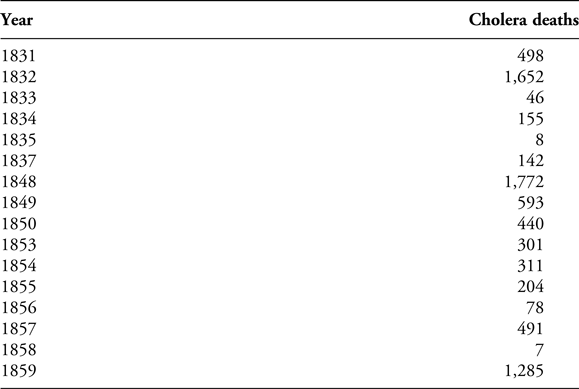
During the 1831 cholera epidemic in Hamburg, those who lived close to the harbour, the river and the canals, and those who worked as manual labourers, tradesmen and seamen, were especially, but not exclusively, affected by the disease.Footnote 28 While an estimated 10,000 people experienced some symptoms of cholera infection, Hamburg officials noted 937 particularly severe cases, of which approximately two-thirds were men and boys. Of these more severely ill cholera patients, 439 recovered and 498 died.Footnote 29 Following two months of declining numbers of new cases in December 1831 and January 1832, on 1 February 1832, 119 days after the first reported case in the city, government officials pronounced Hamburg free of cholera. The city's Lutheran, Reformed, Catholic, Mennonite and Anglican churches were asked to give thanks to God for preserving the city through the plague during their services on Sunday, 12 February 1832.Footnote 30
However, the officials’ assessment that the city was free of the disease proved to be premature. Cholera reappeared just two months later. Between 1 April and 22 December 1832, Hamburg endured a much worse outbreak than it had suffered in 1831. Over these thirty-eight weeks, there were 3,349 severe cases of cholera (2.3 per cent of Hamburg's population) resulting in 1,652 deaths (1.1 per cent of Hamburg's population).Footnote 31 Further outbreaks occurred in fourteen out of the next twenty-seven years, from 1833 to 1859, which cumulatively claimed the lives of 5,833 further residents of Hamburg.Footnote 32
Cholera Deaths in Hamburg, 1831–59

Source: Wolter, Das Auftreten der Cholera, 254–6, 273–8, 282–95.
Hamburg's decades of public health struggles against cholera, its urban misery resulting from overcrowding and inadequate housing, to say nothing of the consequences of the great fire of May 1842, which, according to contemporary reports, killed 51 and left 19,995 men, women and children (approximately 11 per cent of the city's population) homeless, formed the social setting in which Amalie Sieveking founded and led her association.Footnote 33
The Activities of the Women's Association for the Care of the Poor and the Sick
From 13 October to 6 December 1831, Amalie Sieveking lived at the cholera hospital and nursed its male and female patients. During the preceding eighteen years, she had worked in girls’ education, having decided not to marry. Her interest in girls’ welfare had been shaped in part by her experience of losing her own mother at age five and her father at age fifteen. The trade embargo against Britain that Napoleon had introduced in November 1806 ruined her father's business and, as a result, following his death, she and her two brothers were all separated from each other.Footnote 34 After a period spent privately tutoring girls who came from a similar social milieu, in 1815 she co-founded a charity school that provided free education to girls from working class backgrounds.Footnote 35 In 1823 Sieveking published, anonymously, a collection of reflections on texts from the Old and New Testaments.Footnote 36 After receiving encouragement to write more on the Bible from Claus Harms, a prominent Lutheran pastor in nearby Kiel, and Johannes Geibel, an influential Reformed pastor in neighbouring Lübeck, she published a second volume of essays in 1827, again anonymously.Footnote 37
While the doctors in the hospital and the members of Hamburg's General-Gesundheits-Commission (General Health Commission) had initially been dismissive of Sieveking's abilities and sceptical of her commitment, during her eight weeks of voluntary work in autumn 1831 she was able to gain their respect, to the extent that upon her departure five of them presented her with their written thanks for her service.Footnote 38 As she wrote in a letter dated 16 March 1832 to her former governess, Wilhelmine Hösch, it was during her time in the hospital that she refined her plans for founding ‘a women's association for the care of the poor and the sick’. Its purpose would be ‘frequently and regularly to visit the poor sick in their own homes, to provide closer oversight of them than it is possible for the officials of the poor relief service to do, to show concern for their order and cleanliness, and for whatever else, by which they may be helped spiritually and physically’.Footnote 39 Sieveking further confided to Hösch that she had shared a draft of her plans for her envisaged association with two of the doctors from the hospital, Friedrich Siemssen and Joachim Friedrich Siemers, who had encouraged her and promised her their future support.Footnote 40
On 23 May 1832, twelve other women, six married and six unmarried, met with Sieveking in the home of Anna Brunnemann, with whom she had lived after the death of her parents.Footnote 41 This gathering marked the first meeting of the Women's Association for the Care of the Sick and the Poor. Sieveking opened with prayer:
Lord, our Saviour, we thank you, that you have guided us together, and united us in a work, that, we hope, will glorify your name! … Kindle within us the fervour of your love, and make us ready to be instruments of blessing. Yes, allow your kingdom to be advanced by the undertaking for which we have now come together!Footnote 42
Sieveking next spoke about some of the obstacles she anticipated that they would face: the distress they might feel from seeing the miserable conditions in which some people in Hamburg lived, the mockery of those who thought the women foolish or vainglorious for what they were trying to do, and the frustration of being rebuffed or disrespected by the people whom they were trying to help. Sieveking also stressed that the members of the association ought to be humble and respectful in their interactions with those who had already for many years been providing services to the poor, Hamburg's relief officers (Armenpfleger) and the physicians who worked closely with them (Armenärzte).
Under the Enlightenment-era reforms introduced in Hamburg in 1788, whose proponents had included Amalie Sieveking's uncle, Georg Heinrich Sieveking, the administration of all the city's poor relief services had been reorganized under the General Foundation for Poor Relief (allgemeine Armenanstalt). Supervising these efforts was a board (Großes Armen-Collegium) that consisted of church treasurers, state officials and prominent citizens, of whom seventeen functioned as an executive council (Kleines Armen-Collegium).Footnote 43 This council oversaw the poor relief efforts in five districts (Haupt-Armenbezirke). The two superintendents (Armenvorsteher) of each district sat on the executive council, along with five members of the city council, and two lay church officers (Oberalte). Each of the five districts was further subdivided into twelve quarters (Armen-Quartiere) and each quarter was served by three relief officers (Armenpfleger). The boundaries of the quarters were drawn so that each encompassed an area with roughly fifty needy families.Footnote 44 Additionally, the five districts were each served by at least one physician and one surgeon to whom the relief officers could refer poor residents for medical care.Footnote 45 Clergy (Pfarrer) were permitted to serve neither on the board nor on the council of the General Foundation for Poor Relief; nor might they function as relief officers.Footnote 46 By 1832, the number of relief officers per city quarter had been reduced from three to two, even as a sixth district with eight new city quarters had been added. That year there were twenty-one superintendents, 136 relief officers, twelve physicians, seven surgeons, and thirty-three apothecaries providing care for the poor of Hamburg.Footnote 47
Sieveking's association was in no way intended to supplant the work of the General Foundation for Poor Relief in Hamburg. Sieveking recognized that the latter provided financial and practical assistance on a far greater scale than her association ever could. For example, in 1832, when the average weekly wage of a factory worker was approximately eight Hamburg marks a week, the General Foundation received an income of 299,133 Hamburg marks (215,500 in state funding, plus 83,633 from private donations) and, drawing upon its capital reserves, disbursed 336,872 Hamburg marks in various services to the poor.Footnote 48 Sieveking's was a far smaller operation: the annual reports show that between 1833 and 1858 the average annual income of her association was 12,600 Hamburg marks, and the most income it received in any one year was 30,593 Hamburg marks. Rather, Sieveking saw the task of her association as supplementing the aid that the civil authorities were able to provide by focusing on individuals who had been overlooked by the poor relief system but would benefit from personal attention.Footnote 49 Moreover, Sieveking regarded her association's activities as a public, collective expression of its members’ Christian faith, one which she likened to the ministrations of the deaconesses in the ancient churches.Footnote 50 As she wrote in the association's first annual report, by befriending people who were sick, who were living in difficult circumstances or who were on their deathbeds, they sought to reconcile to God those whose bitterness and despair had estranged them.Footnote 51
Sieveking relied on written recommendations from the city's poor relief officers, district physicians and other individuals whose judgement she trusted when identifying whose who would benefit from a visit.Footnote 52 If a poor person applied directly for assistance, Sieveking would first speak with them. Once convinced that the association could help, she coordinated with the relevant district physician and requested information about the person's living situation and their family's circumstances, provided on a form. Questions included: what support the family was already receiving from the General Foundation, what illnesses the members of the house suffered from, what kind of diet the physician recommended to help them with their illness, and whether they ‘belonged to the class of the honourable poor’, by which Sieveking meant that they did not abuse alcohol, ‘make a living from begging’ or live out of wedlock.Footnote 53 The Women's Association helped both those who were already receiving support from the General Foundation and those who were not. In 1840, the association amended its statutes to limit the eligibility for new cases of assistance to those in which a formerly ‘[wage-]earning member of the family is seriously ill’.Footnote 54
Once the association had accepted a family for assistance, Sieveking was generally the first member of the society to visit them in their home. Thereafter, according to their level of need, a rota of between three to six women from the association took turns visiting the family twice weekly, weekly or twice monthly. There were two reasons for this policy. Sieveking believed that the association could better evaluate how best to address the family's needs by having multiple perspectives on their situation. Additionally, she hoped that each member of the society would become more adept at assessing how to help the poor by visiting multiple families. Sieveking hoped that through receiving these visits, the family would be encouraged that there were people who cared about their welfare and who were working to help them obtain food, other necessities that they lacked and employment. In becoming a member of the association, the women visitors also promised to foster the Christian faith of those whom they visited, by engaging them in spiritual discussion and encouraging them to read the Bible and edifying Christian books, attend church worship services and find enjoyment in taking holy communion.Footnote 55
After each visit, the members of the association were required to write a report, again using a form designed by Sieveking. These reports, submitted to and collated by her, served as the basis for discussions at the association's weekly meetings. These were held on Wednesday afternoons in a room in the Hamburg government administration building (Stadthaus) that had been procured for them by senator Martin Hieronymus Hudtwalcker, who sat on the executive council of the General Foundation for Poor Relief.Footnote 56 Using the money that it received from its donors, and gifts in kind from butchers, bakers, grocers and other benevolent people, the association distributed the necessities of life to those whom they visited. For example, according to its accounts for 1835, the association administered weekly donations of meat and bread, provided vouchers for peat fuel for home heating, and paid for other foodstuffs, clothing, clean bedding for the families of tuberculosis patients, medicines, transportation to the doctor and children's school fees. Inspired by the society, other women in Hamburg also began to invite the families whom the society visited for weekly meals in their homes. Additionally, each member received two Hamburg schillings per family visit, per week, that she could use at her discretion to purchase items for the family.Footnote 57 Sieveking determined that any greater expenditure of the association's funds had to be discussed as a group. All the association's annual reports record such expenditure and disbursements of food and other needed items.
Most of the association's funds were devoted to creating opportunities for employment. In its second annual report, Sieveking argued forcefully that the saying ‘one only has to want to work, in order to find work in Hamburg’ was simply not true.Footnote 58 Sieveking had seen first-hand evidence during her visits that some people were unemployed not because of any character fault, but because they were overburdened by their caring duties for sick or disabled family members. Others experienced financial difficulties when their wares did not sell at the expected time or for the desired price, while still others simply had genuine difficulties finding suitable employment. Like many from her class background, Sieveking believed that the poor could improve their living conditions by adopting ‘the virtues of middle-class life: industriousness, good housekeeping, order, cleanliness, faithfulness and integrity’.Footnote 59 However, Sieveking also had compassion for the apparent absence of these qualities in those whom the association visited, and she believed that they could be nurtured by providing employment opportunities.
In accordance with this conviction, from 1833 to 1858, between 49 per cent and 74 per cent of the association's annual expenditure was dedicated to paying the wages of poor men and women employed to undertake a variety of types of work. For example, the association hired some of its clients to do the laundry of other families who were too sick to do it themselves; they paid others to nurse sick people or to clean their homes while they convalesced. Among those the association engaged were carpenters, metalworkers, potters, shoemakers and tailors, who were supported to ply their trades for the benefit of others for whom the association was caring. The association also employed people to process and spin silk, flax and wool, to knit garments or to make feather beds or cushions and seagrass mattresses.Footnote 60 Some of these products were intended for commercial sale, but most, particularly shoes, were produced for the families whom the association visited. Sieveking believed that not only having work, but having the security of regular guaranteed wages formed an integral part of a person's health and well-being.Footnote 61
In 1837, the Women's Association received a large donation of 10,300 Hamburg marks, from an anonymous man whom Sieveking described as ‘a ninety-year-old foreign Christian philanthropist’.Footnote 62 This enabled the association to expand the scope of its activities and to provide accommodation to families in need of housing. Using these funds, and land donated by the government, the association built a complex of nine simple flats of three and four rooms each; the first families were welcomed on 15 November 1840, paying below market-rate rents of between 30 and 36 Hamburg marks per year. Known as the Amalie Home (Amalienstift), the building was equipped with shared facilities for cooking, laundry and storage, and a common room in which residents could gather for morning and evening readings from the Bible and Johann Arndt's devotional work, True Christianity.Footnote 63 On the first floor were two larger and two smaller rooms, out of which two physicians in partnership with the association, Otto Moraht and Adalbert Rambach, operated a children's hospital.Footnote 64 Starting with this building, the association acquired other proprieties, and by 1901 it was operating five homes that provided accommodation for a total of 105 families.Footnote 65
Conclusion
From one perspective, the achievements of the Women's Association were modest. According to the statistics included in the twenty-six annual reports that Sieveking wrote before her death in April 1859, the members and income of the association grew from 20 women and 1,322 Hamburg marks in 1833, to 61 and 7,827 in 1843, to 80 and 12,852 in 1853. Altogether, between May 1832 and May 1858, a total of 193 different women joined the association and visited a total of 1,192 impoverished families in Hamburg. During the nearly three decades that Sieveking led the organization, it addressed the physical needs of several thousand vulnerable people in Hamburg and attempted to encourage them in the Christian life of faith. This was a small proportion of the needy poor in Hamburg in these years. However, the association's broader historical significance lies in the fact that it demonstrated for the first time that Protestant women could organize and operate an effective public ministry in German society.
On 25 October 1841 Sieveking discussed her inseparable concerns for the welfare of the poor, the evangelization of Germany and the social agency of women, when, at the invitation of Georg Treviranus, the pastor of a Reformed congregation in Bremen, she spoke to three hundred men and women gathered in a public hall. After recounting how Jesus's exhortation in Matthew 25 that Christians should care for the vulnerable members of society had motivated her to establish her association, Sieveking elaborated on what she hoped her association would do for women in German society, particularly those who came from the burgeoning middle class:
I had two things in mind with the idea that I was seeking to bring to life. I certainly hoped it would be a blessing to the poor and those in need, however, my attention was not directed towards that alone. At least as important to me was the blessing that I hoped it would bring to those of my fellow sisters who would join me in such words of love. The higher interests of my sex lay close to my heart …Footnote 66
Sieveking lamented the attitudes that disrespected and disregarded widows and older women who did not have husbands or children as being unable to make a useful contribution to society. At the same time, she criticized the amount of time that young unmarried women were encouraged to dedicate to the ‘fineries and vanities’ of embroidery, dressmaking and dances. Empathizing with these young women from middle- and upper-class backgrounds, Sieveking considered it unavoidable that ‘feelings of emptiness so often take hold of them, the vague yearning, the longing to get out of their circumstances’.Footnote 67 In response to these and other limitations that society had placed on women, it had been her goal to create alternative opportunities for women to exercise leadership and undertake meaningful responsibilities in public life through Christian service: ‘How to unite all this dormant strength in common work for the Kingdom of God, that was the task I set myself, the solution to which I began to deliberate, as soon as I left the cholera hospital.’Footnote 68
Sieveking's association met with a positive reception across northern and western Europe largely due to the wide readership of her detailed, published annual reports. In addition to financial information on the association's income and expenditures, these included lengthy essays on practical, social, political and theological topics related to their work. Among the readers of Sieveking's reports were Queen Caroline Amalie of Denmark and Queen Elisabeth of Prussia, who corresponded with her and later received her when she visited Copenhagen in 1843 and Berlin in 1849.Footnote 69 However, her initiative inspired many other women, and also some men. By 1842, other women's religious voluntary societies modelled on Sieveking's had been formed in twenty-six cities and towns across Europe, including Bern, Bonn, Bremen, Danzig, Frankfurt-am-Main, Hannover, London, Paris, Potsdam, Rotterdam, Stuttgart, Tallinn and Zürich.Footnote 70 Sieveking's pioneering work in Hamburg also encouraged the growth of the modern German Protestant deaconess movement, established in October 1836 when Theodor and Friederike (née Münster) Fliedner opened a hospital and deaconess-training institute (Diakonissen Bildungs-Anstalt) in Kaiserswerth. After Friederike Fliedner died in childbirth, Theodor Fliedner married Caroline Bertheau, a former pupil of Sieveking's. By 1878, deaconess institutes founded on the model of Kaiserswerth had been established in another twenty-seven cities in the German empire and twenty cities in Britain, Europe and the United States. In aggregate, these institutes had trained 3,908 deaconesses, who worked in 1,095 locations, including asylums, hospices, hospitals, orphanages, prisons and schools.Footnote 71 However, unlike Sieveking's association, the institutes that followed the model of Kaiserswerth did not permit married women to serve as deaconesses.
Sieveking continued to be an influential figure among German Protestant women long after her death in 1859. Emma Poel, to whom Sieveking had entrusted her personal papers, published a biography in 1860, which was quickly translated into English, Danish, Dutch and French. Among those in the twentieth century to be inspired by Sieveking was Eva Hoffman-Aleith. After receiving her doctorate in church history from the University of Berlin in 1937, Hoffmann-Aleith later functioned as the emergency pastor of a Confessing Church congregation in Brandenburg during the Second World War. Hoffmann-Aleith introduced her own biography of Sieveking in 1940 by noting:
Anyone who immerses themselves in the writings of Amalie Sieveking, becomes gripped by the words of this woman of great character. Here one finds, the rare integration of person and work, Protestant faith and conscientious deeds. What she has to say to German girls and German women about true womanhood, which unites in a harmonious whole, empathy, clarity of understanding and resoluteness of character, remains of everlasting importance.Footnote 72
Arguably the greatest testimony to Sieveking's legacy is that in 2021, the association she founded over 189 years ago continues to assist vulnerable people in Hamburg.Footnote 73
While Sieveking has long been admired for her Christian social conscience, the sources examined in this article illustrate how her association's achievements rested not only on her ability to articulate a compelling theological vision for their work, but also on her skills as organizer and administrator. In addition to building rapport with those on whose behalf she organised aid for over twenty-five years, Sieveking's public ministry required her to be able continually to inspire other women to join her, to evaluate many applications for assistance, to assess numerous reports of her members’ visits to clients, to oversee and coordinate the different committees of her association, to make decisions about the association's finances, to manage relationships with government officials and those who contributed funds and needed items to her association, and to prepare yearly reports on the association's activities to give account to donors and publicize the work to a wide readership in Hamburg and beyond. In all these ways, Sieveking worked to rouse the ‘dormant strength’ of Christian women and create new possibilities for their participation in German society.