Non-technical Summary
This paper describes new dinosaur specimens from the Newark Canyon Formation of Nevada, USA. These include the first records of ceratopsians (horned dinosaurs) and tyrannosauroid theropods (tyrant dinosaurs). These are rare dinosaur groups in North America at this time (Early Cretaceous), and their presence indicates that they were probably much more widespread than is currently realized.
Introduction
The western United States has been one of the richest sources for dinosaur fossils for more than a century, but in fact most of these materials come from the foreland basins of the US Western Interior. The complex Mesozoic outcrops of the Pacific Coast and within the Basin and Range province have less surface exposure, have been less well explored, and consequently have yielded many fewer specimens. This has resulted in poorer knowledge of the terrestrial Mesozoic paleontology of these regions, limited the variety of paleocommunities represented in our samples, and restricted our ability to understand the paleogeographic ranges of taxa.
The US state of Nevada is emblematic of this imbalance. Although it is slightly larger than Colorado (286,380 km2 vs. 269,601 km2) and less vegetated, terrestrial Mesozoic sediments account for much less of its geologic outcrop, and it has produced fewer than 4% as many dinosaurs (20 vs. 556 occurrences in the Paleobiology Database, www.paleodb.org). Presently only three strata in Nevada are known to produce Mesozoic dinosaur fossils: the Newark Canyon Formation (Aptian), Willow Tank Formation (Cenomanian), and Baseline Sandstone (Cenomanian). Although historically poorly prospected for fossils, recent work (Bonde et al., Reference Bonde, Varricchio, Jackson, Loope, Shirk, Duebendorfer and Smith2008, Reference Bonde, Varricchio, Bryant, Jackson, Bonde and Milner2011, Reference Bonde, Hilton, Jackson, Druschke, Pennell and Garside2015, Reference Bonde, Hall, Krumenacker and Varricchio2022) has greatly improved our knowledge of terrestrial vertebrates from these strata.
The most productive so far has been the Willow Tank Formation, which has revealed a diverse dinosaurian fauna that includes iguanodontians, thyreophorans, titanosauriform sauropods, dromaeosaurid and tyrannosauroid theropods, and eggs allied with caenagnathids (Bonde et al., Reference Bonde, Varricchio, Jackson, Loope, Shirk, Duebendorfer and Smith2008, Reference Bonde, Varricchio, Bryant, Jackson, Bonde and Milner2011). Recently, the first named dinosaur taxon from Nevada, the neornithischian Nevadadromeus schmitti Bonde et al., Reference Bonde, Hall, Krumenacker and Varricchio2022, was described from these beds (Bonde et al., Reference Bonde, Hall, Krumenacker and Varricchio2022). Comparatively little work has been done in the Baseline Sandstone, concerning which the only published report is of possible sauropod footprints (Bonde et al., Reference Bonde, Varricchio, Bryant, Jackson, Bonde and Milner2011). Lastly, recent fieldwork has begun to reveal the faunal composition of the Newark Canyon Formation as well. Thus far, dinosaurs include basal euornithopods and iguanodontians, as well as indeterminate sauropods, thyreophorans, and theropods of varying sizes (Bonde et al., Reference Bonde, Hilton, Jackson, Druschke, Pennell and Garside2015). The presence of elongatoolithid eggshell suggests the presence of oviraptorosaurs (Bonde et al., Reference Bonde, Hilton, Jackson, Druschke, Pennell and Garside2015).
These new discoveries add to the only previous report of dinosaurs from the Newark Canyon Formation, published nearly fifty years ago (Smith et al., Reference Smith, Ketner and Mabey1976) and based on discoveries made by J. Smith during United States Geological Survey (USGS) work in 1961. Those authors recorded the presence of an ankylosaur (based on several teeth, a rib fragment, and a partial vertebra) and a possible coelurid theropod (based on a tooth), relying on taxonomic identifications made by G.E. Lewis (Smithsonian Institution) and B. Brown (American Museum of Natural History).
Nothing further has been written about these fossils, which were housed in the USGS fossil collection in Denver for many decades. However, in 2021 the entire USGS fossil collection was transferred to the Smithsonian’s National Museum of Natural History, providing an opportunity to re-examine these materials, which are associated with several undescribed specimens and unpublished archival information. In this paper I describe these materials, offer refined locality data and taxonomic identifications, and integrate these data into the known Newark Canyon dinosaur fauna.
Associated archival data
The fossil collections are associated with original notes and cataloguing information from the USGS. Because these are the only records providing direct contextual data for the fossils, they are described below by locality and illustrated in Figures 1–3.
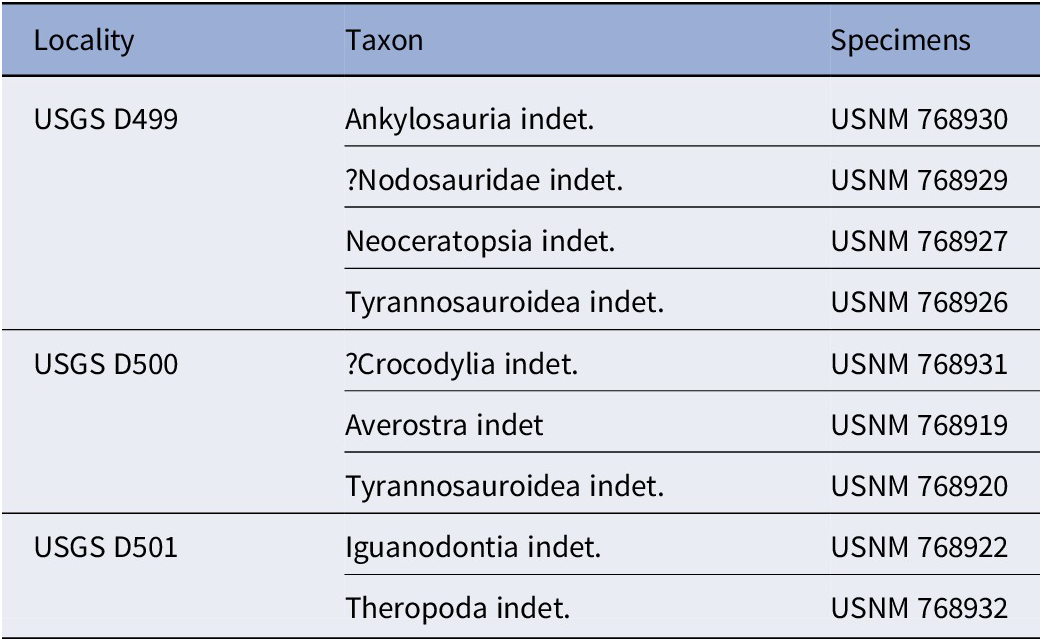
Faunal compositions of individual USGS localities within the Newark Canyon Formation as described in this paper

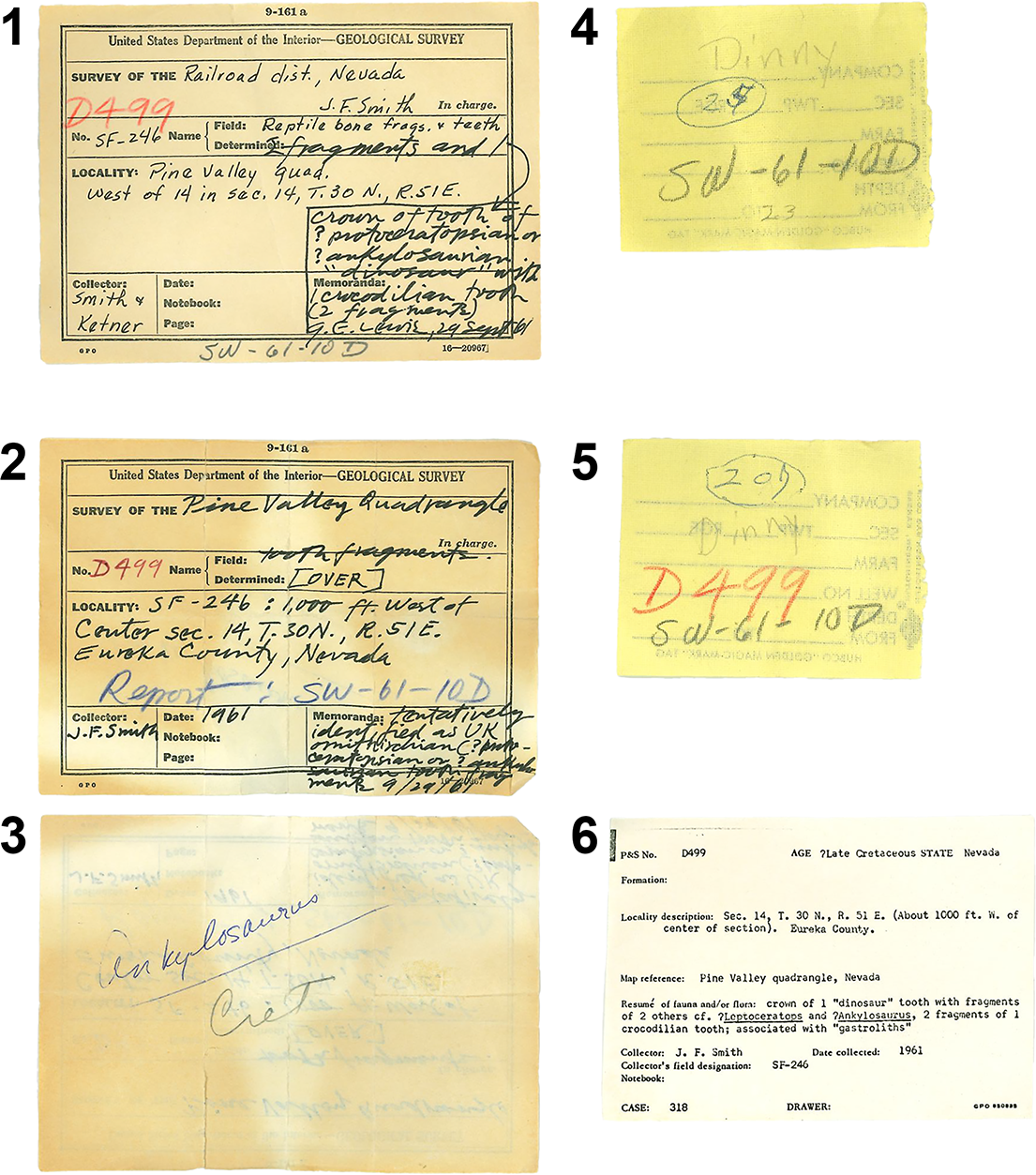
Archival materials associated with collection from USGS locality D499: (1–3) collection labels; (4, 5) sample-bag labels; (6) catalog label.

USGS Locality D499
Two USGS collection labels bear consistent but slightly varying information. There is also a computer-printed catalog label and two yellow field sample-bag labels (Hubco, Hutchinson Bag Corp., Hutchinson, Kansas) (Fig. 1).
The first collection label (Fig. 1.1) appears to be the oldest of the two noting “Survey of the Railroad dist., Nevada J.F. Smith in charge,” with the locality as SF-246, “Pine Valley quad., west of 14 in sec. 14, T.30N., R.51E.” The field identification was “Reptile bones frags. & teeth,” and the material was collected by “Smith & Ketner.” Further information was added to the identifications, in different handwriting: “2 fragments and 1 crown of tooth of ?protoceratopsian or ?ankylosaurian ‘dinosaur’ with 1 crocodilian tooth (2 fragments) G.E. Lewis, 29 Sept 61.”
The second collection label (Fig. 1.2) is written in a similar hand to the latter information on the first label. Here the collection is listed as coming from the “Survey of the Pine Valley Quadrangle,” at “1000 ft. West of Center sec. 14, T.30N., R.51E. Eureka County, Nevada.” The collector is listed solely as J. F. Smith. and the identification notes indicate “tooth fragments. tentatively identified as UK [= Upper Cretaceous] ornithischian (?protoceratopsian or ?ankylosaurian tooth fragments 9/29/61.” The back (Fig. 1.3) has “Ankylosaurus” and “Cret” added in different writing from the front.
Both labels have locality number “D499” added in red ink, and are assigned to Report SW-61-10D.
Each of the two sample-bag labels (Fig. 1.4, 1.5) bears the word “Dinny” and “SW-61-10D” One is also marked “25” and “23,” whereas the other reads “207” and “D499.”
Finally, the printed catalog label (Fig. 1.6) largely repeats information from the handwritten collection labels, but assigns a “?Late Cretaceous” age to the collection. The collector is again identified as J.F. Smith. Specimens are identified as “crown of 1 ‘dinosaur’ tooth with fragments of 2 others cf. ?Leptoceratops and ?Ankylosaurus, 2 fragments of 1 crocodilian tooth; associated with ‘gastroliths’.”
USGS Locality D500
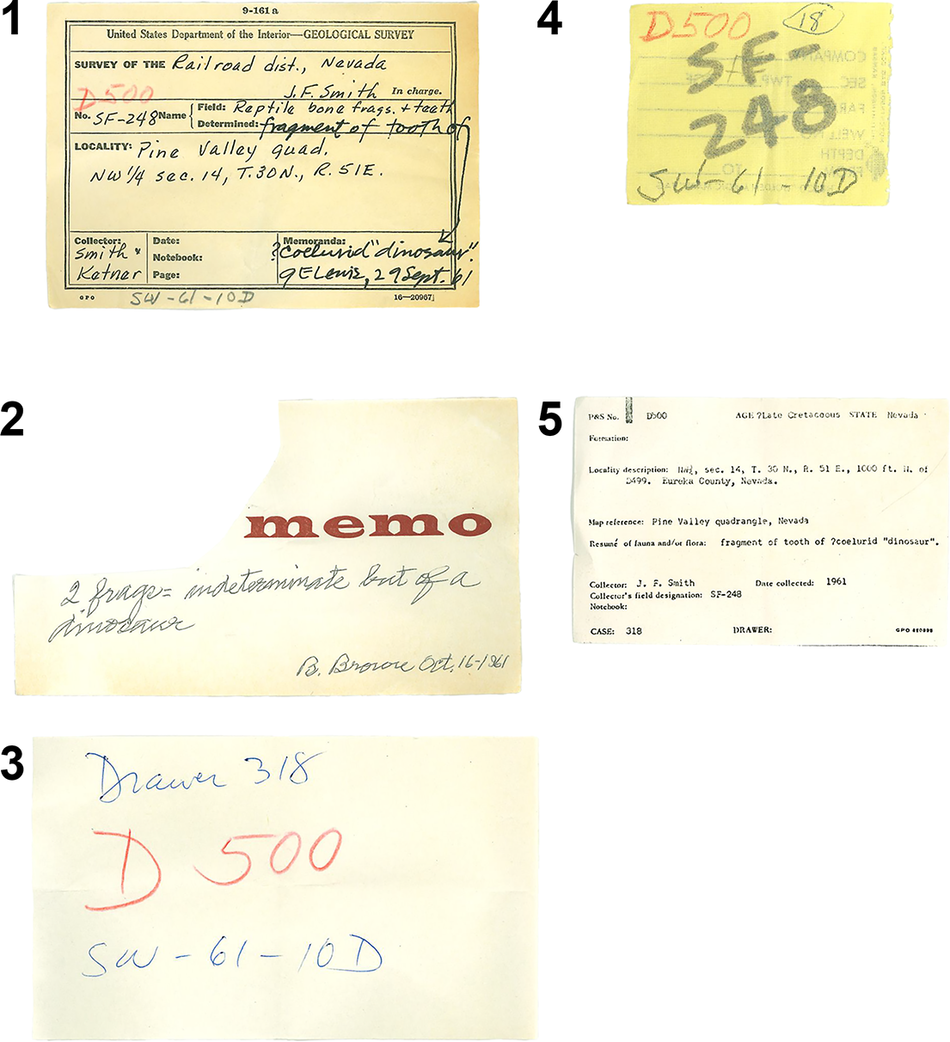
This collection is accompanied by one USGS collection label, one computer-printed catalog label, one sample-bag label, and two notes (Fig. 2).
Archival materials associated with collection from USGS locality D500: (1) collection label; (2, 3) associated notes; (4) sample-bag label; (5) catalog label.

The collection label (Fig. 2.1) is written in the same hand, and presumably at the same time, as the first collection label from USGS Locality D499. It indicates the same “Reptile bones frags. & teeth,” from the same survey and collectors, but is from locality SF-248, “Pine Valley quad. NW ¼, sec. 14, T.30N., R.51E.” The same secondary handwriting adds the following identification notes: “fragment of tooth of ?coelurid ‘dinosaur.’ G E Lewis, 29 Sept. 61.” “D500” and “SW-61-10D” were added later.
The first note (Fig. 2.2) is on a “memo” sheet with the top left corner cut away. On it, Barnum Brown noted, “2 frags = indeterminate but of a dinosaur. B. Brown Oct. 16-1961.”
The second note (Fig. 2.3) reads “Drawer 318” [the material’s location in the Denver USGS collection], “D500,” and “SW-61-10D.”
The sample-bag label (Fig. 2.4) reads “D500,” SF-248,” “SW-61-10D,” and “18.”
Finally, the catalog printed label (Fig. 2.5) repeats most information from the handwritten label but adds “1000 ft. N of D499. Eureka County, Nevada” to the location description. It indicates only J.F. Smith as the collector.
USGS Locality D501
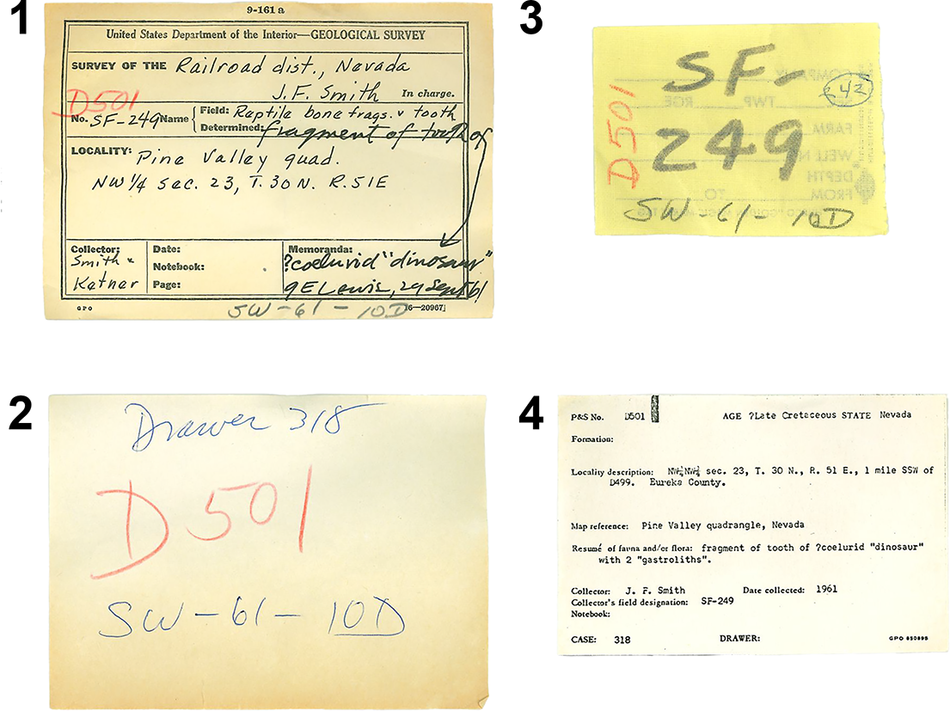
The specimens from this locality are accompanied by one USGS catalog label, one computer-printed catalog label, one sample-bag label, and one note (Fig. 3).
Archival materials associated with collection from USGS locality D501: (1) collection label; (2) associated note; (3) sample-bag label; (4) catalog label.

The collections label (Fig. 3.1) is similar to those from the other two collections, with consistent information about the survey, collectors, and field identification. Here the locality number is SF-249, located in “Pine Valley quad. NW ¼, sec. 23, T.30N., R.51E.” The same secondary handwriting adds, “fragment of tooth of ?coelurid ‘dinosaur’ G E Lewis, 29 Sept 61.” “D501” and “SW-61-10D” were added later.
The note (Fig. 3.2) reads “Drawer 318,” “D501,” and “SW-61-10D.”
The sample-bag label (Fig. 3.3) reads “D501,” SF-249,” “SW-61-10D,” and “42.”
Finally, the printed label (Fig. 3.4) again repeats most information from the catalog label. It adds “?Late Cretaceous” and identifies only J.F. Smith as the collector. The location includes “1 mile SSW of D499. Eureka County,” and the identification reads “fragment of tooth of ?coelurid ‘dinosaur’ with 2 ‘gastroliths.’”
In summary, these associated archival papers indicate that the materials were all collected by J.F. Smith in 1961 during the USGS survey of the Pine Valley Quadrangle, work that eventually formed part of USGS Report SW-61-10D and was published in Smith et al. (Reference Smith, Ketner and Mabey1976). Interestingly, the notes indicate the possible presence of a ceratopsian among the remains, a fact not noted in that publication. The geologic and geographic data extracted from these documents are included in the following section.
Geologic and geographic setting
The sediments of the Newark Canyon Formation represent fluvial (basal) and lacustrine (upper) deposits that were laid down in a piggy-back basin in the hinterland of the Sevier thrust belt, specifically within the central Nevada thrust belt (Vandervoort and Schmitt, Reference Vandervoort and Schmitt1990; Druschke et al., Reference Druschke, Hanson, Wells, Gehrels and Stockli2011; Di Fiori et al., Reference Di Fiori, Long, Fetrow, Snell, Bonde and Vervoort2020). As such, their vertebrate fossils offer a window onto a poorly understood paleogeographic region of North America. Radiometric dating at several levels within the formation indicates that the lower member is latest Aptian at the oldest, with deposition of the upper member continuing into at least the early Cenomanian (Di Fiori et al., Reference Di Fiori, Long, Fetrow, Snell, Bonde and Vervoort2020).
Regardless, the Newark Canyon Formation is roughly coeval to several vertebrate-bearing strata elsewhere in North America, most located farther east. These include the Cloverly Formation (Montana, Wyoming), Antlers Formation (Oklahoma, Texas), Lakota Formation (South Dakota), Ruby Ranch Member of the Cedar Mountain Formation (Utah), Shellenberger Canyon Formation (Arizona), and Arundel Clay (Maryland). Only a few dinosaur-bearing localities are known from farther west in North America—in the Budden Canyon Formation of California (a euornithopod limb; Hilton et al., Reference Hilton, DeCourten and Embree1995, Reference Hilton, DeCourten, Murphy, Rodda and Embree1997) and the Hudspeth Formation of Oregon (ornithopod bones; Retallack et al., Reference Retallack, Theodor, Davis, Hopkins and Barrett2018, Reference Retallack, Carr and Broz2023)—and all have produced only fragmentary remains.
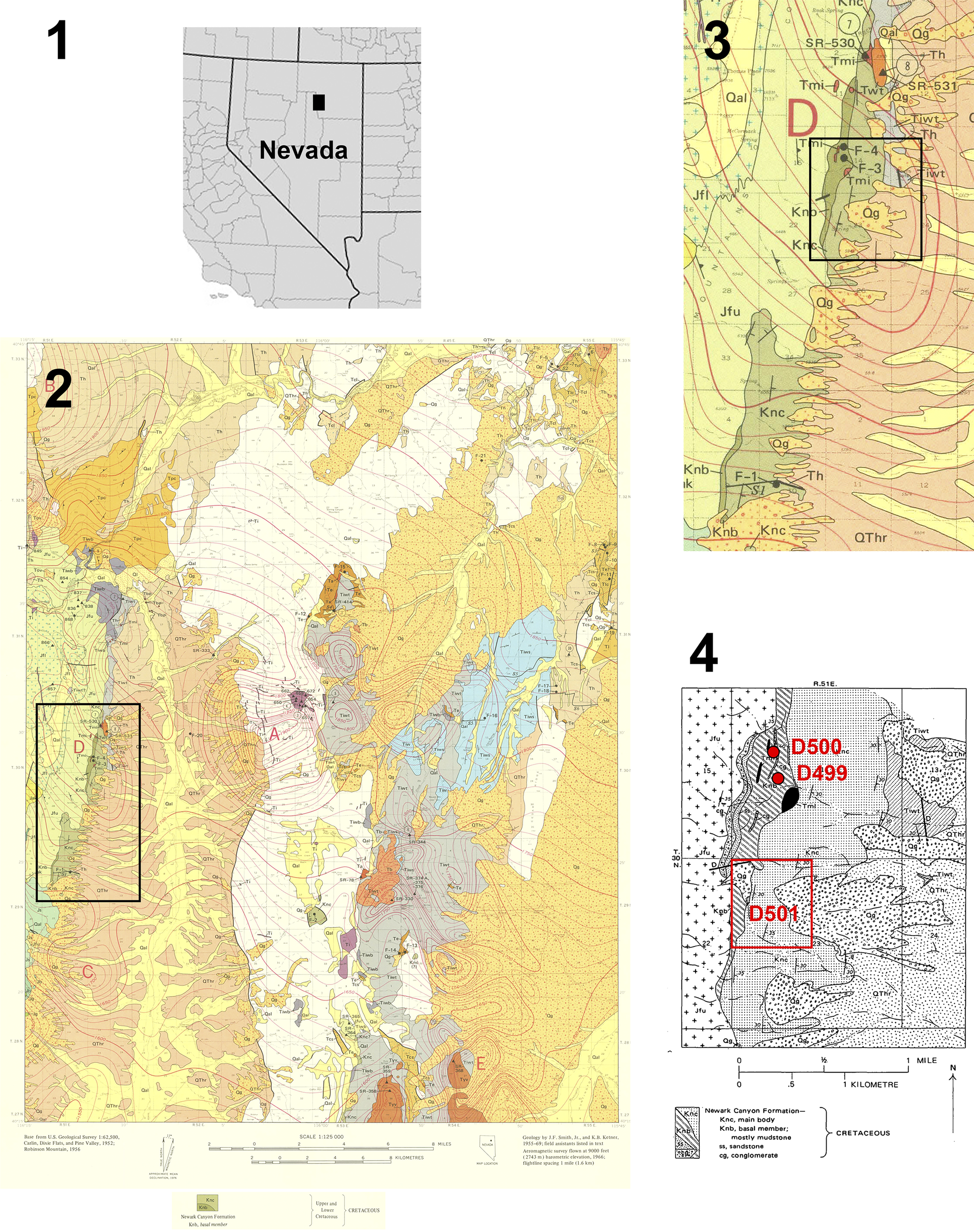
The present materials were collected from three localities in the Carlin-Piñon Range area of Eureka County, Nevada (Fig. 4.1). In this area, the Newark Canyon Formation crops out along a narrow, south-southwest to north-northeast band for about 12 kilometers on the eastern flank of the Cortez Mountains (Smith et al., Reference Smith, Ketner and Mabey1976, pl. 1; Fig. 4.2). Two localities were pinpointed geographically and stratigraphically in Smith et al. (Reference Smith, Ketner and Mabey1976): USGS D499 (= SF-246, map point F-3) and USGS D500 (= SF-248, map point F-4) were mapped as pertaining to the basal member of the Newark Canyon Formation (Knb in Smith et al., Reference Smith, Ketner and Mabey1976, fig. 2; Fig. 4.3, 4.4). The third locality, USGS D501 (= SF-249), was collected at the same time but not mentioned in Smith et al. (Reference Smith, Ketner and Mabey1976); both its geographic and stratigraphic descriptions are less precise and based solely on the information in the archival documents.
Geographic and geologic context: (1) map of Nevada, USA, with black box indicating location of map shown in (2), modified from GISGeography.com; (2) geologic map of Carlin-Piñon Range area, Elko and Eureka counties, Nevada, with black box indicating location of map shown in (3), modified from Smith et al. (Reference Smith, Ketner and Mabey1976, pl. 1); (3) close-up map of Newark Canyon (Knb, Knc) exposures from previous map, with black box indicating location of map shown in (4), localities D499 (F-3) and D500 (F-4) are marked with black dots; (4) close-up map of northern exposures of Newark Canyon Formation (Knb, Knc), modified from Smith et al. (Reference Smith, Ketner and Mabey1976, fig. 2); red dots mark localities D499 and D500, and locality D501 occurs within the red box.

It is important to mention that the Newark Canyon Formation in the study area was not specifically described or mapped in Di Fiori et al. (Reference Di Fiori, Long, Fetrow, Snell, Bonde and Vervoort2020), therefore the refined stratigraphic regime presented in that paper cannot be directly correlated to the older geologic data available for the present collections. However, although it is not possible to ascertain which member of the formation might have yielded the present collections, the fact that at least two localities (D499, D500) were described as coming from the “basal member” by Smith et al. (Reference Smith, Ketner and Mabey1976) suggests that they are likely latest Aptian to Albian in age.
Materials and methods
The specimens described in this paper were initially studied using a Zeiss Stemi SV 6 binocular microscope. Subsequently, photographic images were taken with a Nikon SMZ18 stereomicroscope fitted with a DS-Fi3 camera and stacked using Nikon Imaging Software, NIS-Elements with Extended Depth of Focus Module. USNM 768919, 768920, 768922, 768927, and 768929 were scanned in a GE Phoenix v|tome|x M dual tube 180/240kV μCT at the USNM. Scans were performed at 80 kVp and 260 μA, with a voxel size of 25 μm3, with volumes rendered for imaging using 3D Slicer (Fedorov et al., Reference Fedorov, Beichel, Kalpathy-Cramer, Finet and Fillion-Robin2012).
Most of the anatomical terminology in this paper follows Hendrickx et al. (Reference Hendrickx, Mateus and Araújo2015, which builds on earlier papers that are not cited individually here). However, most specimens represent isolated lateral teeth that cannot be assigned to either the dentary or maxilla, such that several important anatomical directions (and therefore terms) remain uncertain. In these cases, the teeth are arbitrarily described as if derived from the dentary, with potentially ambiguous dependent directional terminology put in quotation marks. (e.g., “labial”). Anatomical directions for teeth whose left- or right-side origin is unknown are treated similarly.
Repositories and institutional abbreviations
The specimens were originally held in the collections of the United States Geological Survey (USGS), Denver, Colorado, USA, but are now housed at the Smithsonian Institution’s National Museum of Natural History (formerly United States National Museum, USNM), Washington, DC, USA.
Results
The materials mostly comprise broken, non-diagnostic bone fragments, some of which likely represent dinosaurian (or perhaps large crocodylian) remains based on their size. A substantial number of tooth fragments are also present, but most are sufficiently incomplete to preclude further identification. However, 11 specimens (including nine teeth) are taxonomically identifiable and described in more detail below.
Ankylosaurians
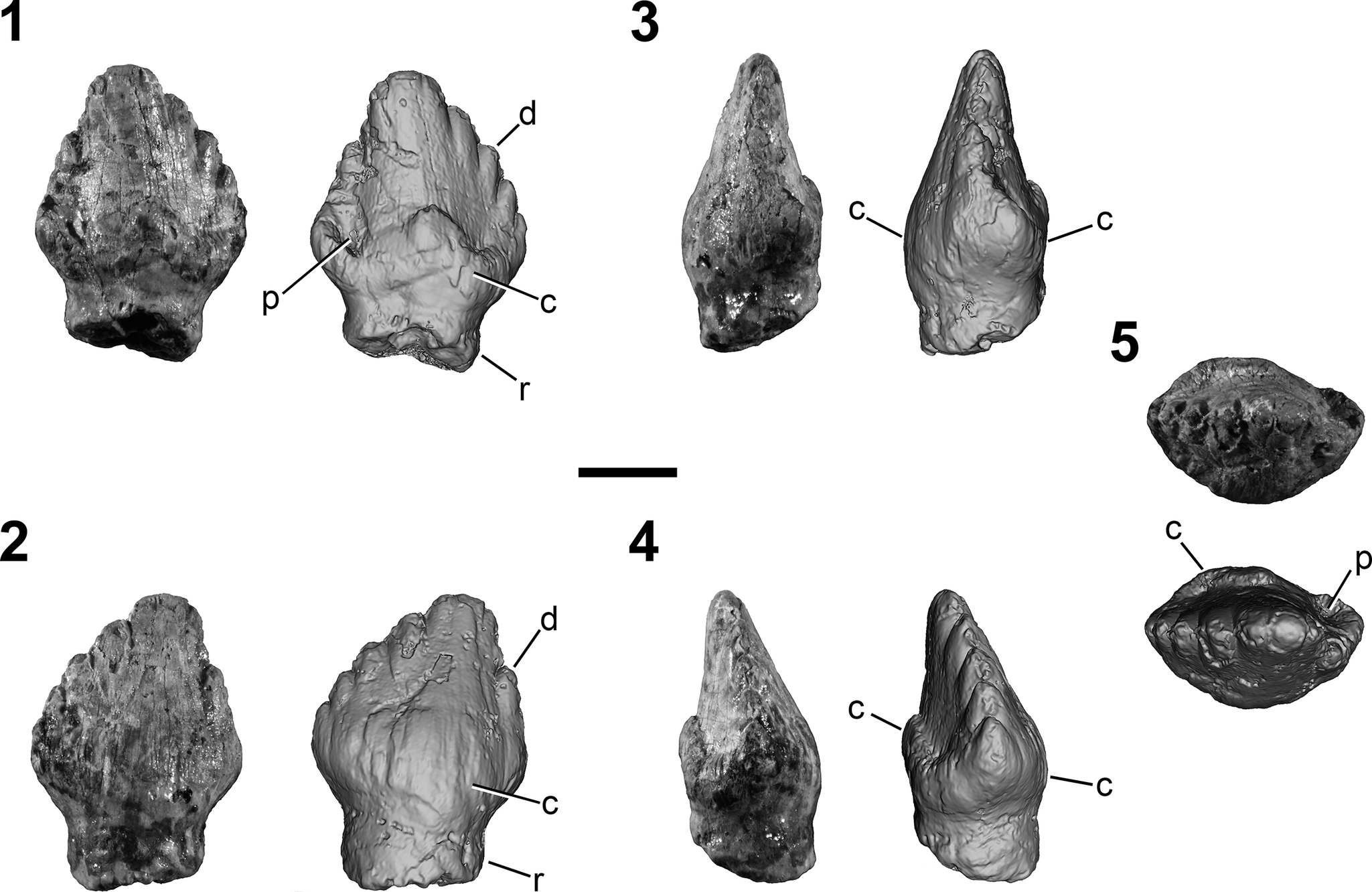
USNM 768929 (USGS locality D499) is a relatively well-preserved lateral tooth (Fig. 5). In labiolingual view (Fig. 5.1, 5.2) the crown has a rounded triangular profile with a blunt apex that is offset posteriorly (distally). The widest part of the crown embraces the basal cingula, below which it tapers to the relatively straight-sided root; there is a slight basal constriction. Nine denticles traverse the occlusal edge, varying irregularly in size. The tooth is either unworn or very lightly worn; individual denticles expose their dentine cores, but it is unclear whether this is due to usage wear or post-mortem breakage. There is no distinct wear facet.
Ankylosaur (?nodosaurid) lateral tooth (USNM 768929) from USGS locality D499: (1) “labial” view; (2) “lingual” view; (3) anterior view; (4) posterior view; (5) apical view. Photographs are on the left (1–4) or top (5) of each set, with digital CT renders on the right (1–4) or bottom (5); c = cingulum; d = denticle; p = pocket; r = root. Scale bar = 5 mm.

The “lingual” side of the crown (Fig. 5.1) exhibits an inflated, W-shaped basal cingulum, which has a rougher surface texture compared to the main face of the crown. The cingulum is contiguous with the basal part of the apical ridge on its posterior edge, where the latter turns “lingually” and then anteriorly to form a tight hairpin curve that encloses a small pocket. The denticles are indistinct along this portion, which narrows to a thin ridge. The “labial” side (Fig. 5.2) is inflated basally but does not exhibit a cingulum that is as discretely set off from the remainder of the crown. Instead, the crown narrows more evenly from base to apex. These distinctions are clear in anterior and posterior views (Fig. 5.3, 5.4).
In apical view (Fig. 5.5), the irregular size and shape of the denticles are readily apparent. Each is separated from its neighbor by a narrow fissure that extends onto both faces of the crown but terminates well before reaching the cingulum. Where worn, the individual denticles are round or slightly anteroposteriorly oval in cross-section. The “labial” pocket set off by the posterior end of the apical ridge is also clear in this view.
This tooth resembles the teeth of ankylosaurs in all pertinent details (e.g., Coombs, Reference Coombs, Carpenter and Currie1990). The asymmetrical crown and lack of striations extending from the denticles to the cingulum place this tooth outside of Parankylosauria (Soto-Acuña et al., Reference Soto-Acuña, Vargas, Kaluza, Leppe and Botelho2021), whereas the low number of denticles (< 13) and rounded (rather than pointed) crown profile exclude it from Ankylosauridae (Arbour and Currie, Reference Arbour and Currie2016). It is likely that it pertains to Nodosauridae or another non-ankylosaurid group within Ankylosauria.
USNM 768930 (USGS locality D499; not figured) is a fragment from a slightly larger lateral tooth that preserves a worn apical ridge but is broken above the cingulum. Although the denticles have been worn away, the apex is similar in shape and proportions to USNM 768929 and other lateral teeth of ankylosaurians.
Ornithopod
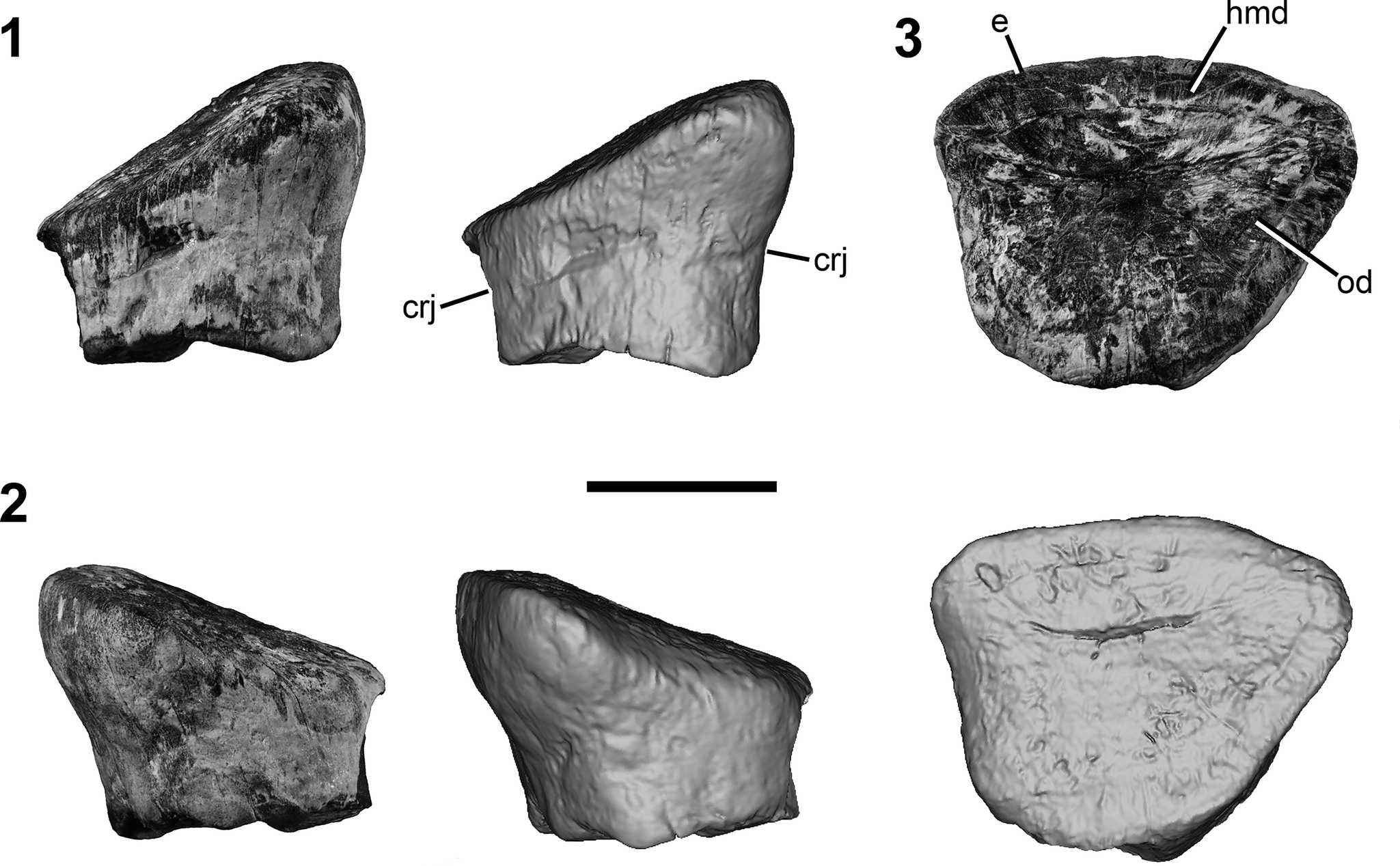
USNM 768922 (USGS locality D501) is a complete tooth crown and partial root pertaining to the lateral dentition (Fig. 6). The tooth is heavily worn with a flat occlusal surface that is oriented approximately 40° oblique to the crown-root junction in anteroposterior view (Fig. 6.1, 6.2), as is the case in many non-hadrosaurid ornithopods (Ősi et al., Reference Ősi, Barrett, Evans, Nagy, Szenti, Kukovecz, Magyar, Segesdi, Gere and Jó2022). Based on wear patterns in other ornithischian teeth (e.g., Ősi et al., Reference Ősi, Barrett, Evans, Nagy, Szenti, Kukovecz, Magyar, Segesdi, Gere and Jó2022), the lower side of the tooth would be labial if derived from the dentary, and lingual if derived from the maxilla.
Ornithopod (iguanodontian) lateral tooth (USNM 768922) from USGS locality D501: (1) “anterior” view; (2) “posterior” view; (3) occlusal view. Photographs are on the left (1, 2) or top (3) of each set, with digital CT renders on the right (1, 2) or bottom (3); crj = crown-root junction; e = enamel; hmd = hard mantle dentine; od = orthodentine. Scale bar = 5 mm.

In occlusal view (Fig. 6.3), the surface is D-shaped, with the straightest edge along the highest part of the crown. The edges of the surface are complete but rounded, and do not present sharp delineations with the unworn portions of the crown. A thick band of hard mantle dentine with incremental lines surrounds the central orthodentine for the entire circumference of the tooth (Erickson et al., Reference Erickson, Krick, Hamilton, Bourne, Norell, Lilleodden and Sawyer2012; Virág and Ősi, Reference Virág and Ősi2017). Enamel appears to be present at least along the higher edge of the tooth, but weathering makes it difficult to determine its full extent. In basal view, the pulp cavity is placed asymmetrically so that the central orthodentine is thicker on the lower (i.e., non-cutting) side of the crown, consistent with the condition observed in non-hadrosaurid ornithopods (Ősi et al., Reference Ősi, Barrett, Evans, Nagy, Szenti, Kukovecz, Magyar, Segesdi, Gere and Jó2022).
The overall robustness of this tooth, along with its wear angle and asymmetrical crown dentine, suggest that it derives from a non-hadrosaurid iguanodontian ornithopod. The tooth bears general similarities to the worn lateral teeth of ornithopods such as Camptosaurus and Tenontosaurus, but in its worn condition, USNM 768922 cannot be assigned to a particular species.
Ceratopsian
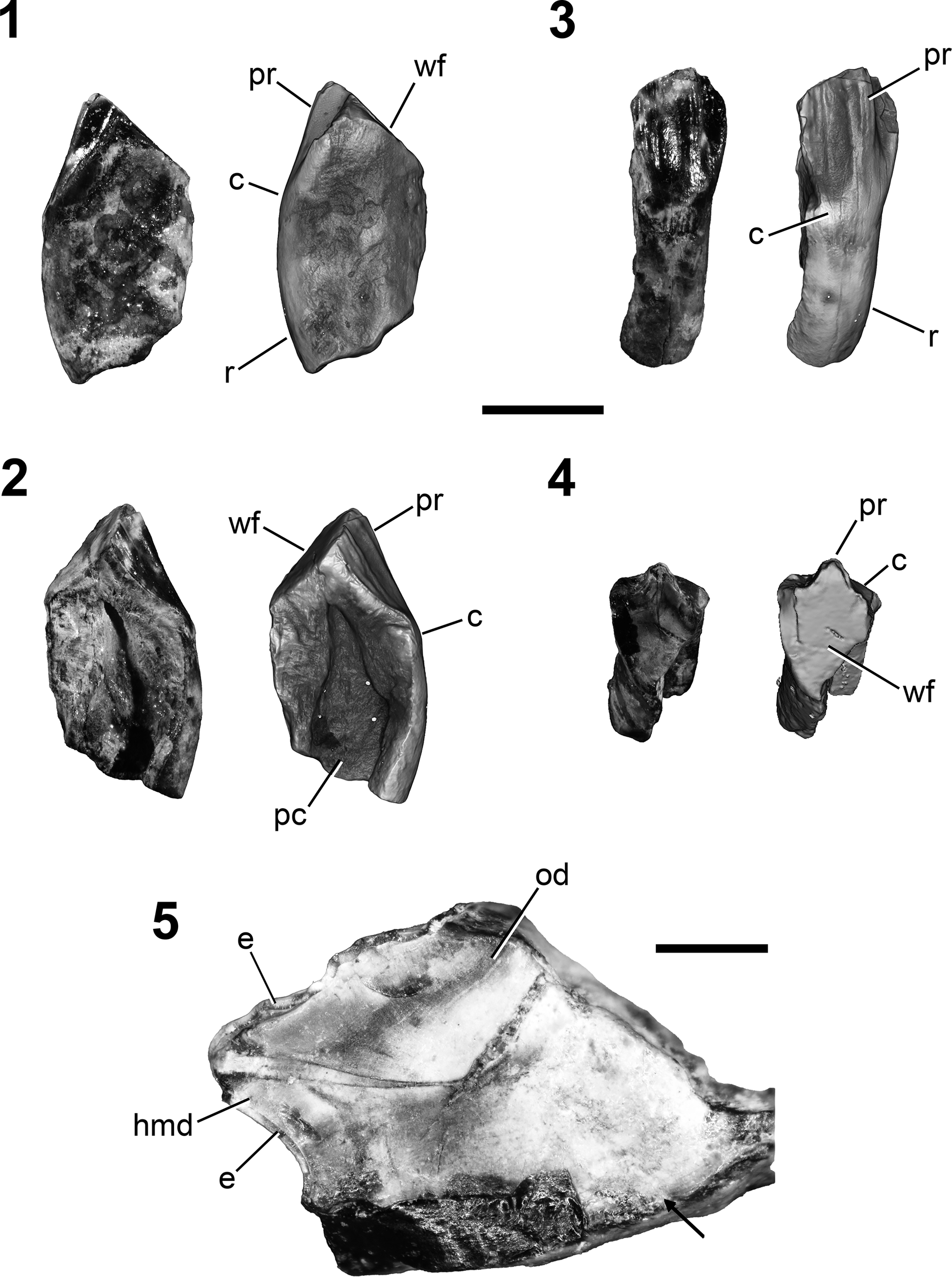
A partial lateral tooth, USNM 768927 (USGS locality D499; Fig. 7), is most likely that identified as “?protoceratopsian” and “?Leptoceratops” by G.E. Lewis. The tooth is fractured along one edge but is otherwise nearly complete from apex to base and exhibits a strong, flat wear facet.
Ceratopsian lateral tooth (USNM 768927) from USGS locality D499: (1) anterior view; (2) posterior view; (3) “lingual” view; (4) “labial”/occlusal view; (5) close-up of “labial”/occlusal view, with “lingual” to the left; arrow marks complete edge lacking evidence of enamel and hard mantle dentine. Photographs are on the left, with digital CT renders on the right (1–4); c = cingulum; e = enamel; hmd = hard mantle dentine; od = orthodentine; pc = pulp cavity; pr = primary ridge; r = root; wf = wear facet. Scale bars = 5 mm (1–4) and 1 mm (5).

In anterior view both the crown and root surfaces are smooth (Fig. 7.1). The cingulum is only faintly visible in this view, where it merges with the rising anterior edge of the crown. The posterior edge of the tooth has been broken away, exposing the pulp cavity, which tapers apically (Fig. 7.2). The unworn “labial” crown surface and “lingual” wear facet meet at an acute angle (~35°) at the apex. These surfaces diverge toward the level of the cingulum, which is apparent along the “lingual” edge. Below this point, the root then narrows labiolingually. Although the tooth cannot be precisely oriented, given the length of root preserved and its position, it is unlikely that the wear facet was vertically oriented in life.
In “labial” view (Fig. 7.3), the unworn crown surface bears a strong primary vertical ridge that is not centrally placed, but rather occurs closer to the complete anterior edge than the broken posterior edge. This primary ridge marks the highest point of the crown apex and continues basally to merge with the cingulum. It bears three finer longitudinal striations that do not run for its entire length. The ridge delineates two discrete portions of the crown surface. The smaller portion is essentially a pocket between the main ridge and the anterior border of the crown. The larger portion, which is incomplete, bears several fine longitudinal ridges of varying length, all of which terminate before reaching the cingulum. Overall, the crown has a rounded apical profile except for where the main ridge extends slightly above the remainder of the tooth edge. The cingulum is an apicobasally broad, swollen band that traverses the crown base anteroposteriorly but nearly disappears before reaching the anterior edge.
In “lingual” view, the entire crown surface is worn into a single flat facet that effectively documents the cross-sectional geometry of the crown (Fig. 7.4). The upper (“labial”) margin is dominated by the primary ridge, which is triangular and occupies about one-third of this edge. Along this margin, a thin layer of enamel can be seen to cover the “labial” surface of the tooth, external to a thicker layer of hard mantle dentine (Erickson et al., Reference Erickson, Sidebottom, Kay, Turner, Ip, Norell, Sawyer and Krick2015), neither of which appears to be present on the opposite side (Fig. 7.5). The anterior edge is curved toward the lower side of the tooth. The remainder of this surface is missing.
The presence of a primary ridge that is offset rather than centrally placed on the crown surface, secondary ridges that do not reach the cingulum, and enamel only on the labial side of the tooth suggest referral to Ceratopsia (Chinnery et al., Reference Chinnery, Lipka, Kirkland, Parrish, Brett-Surman, Lucas, Kirkland and Estep1998). Within Ceratopsia, the tooth exhibits a mixture of primitive and derived features, indicating placement within Neoceratopsia but outside Ceratopsidae, including an oblique but not vertical wear facet, a rounded crown profile, a single cylindrical root that is significantly wider labiolingually than long anteroposteriorly, and a primary ridge that merges with the cingulum (You and Dodson, Reference You and Dodson2003; Lindgren et al., Reference Lindgren, Currie, Siverson, Rees, Cederström and Lindgren2007). Like basal neoceratopsians, the primary ridge is less prominent and flanked by shallower indentations than in more derived forms such as Leptoceratops and Protoceratops (Tanoue et al., Reference Tanoue, Grandstaff, You and Dodson2009).
Theropods
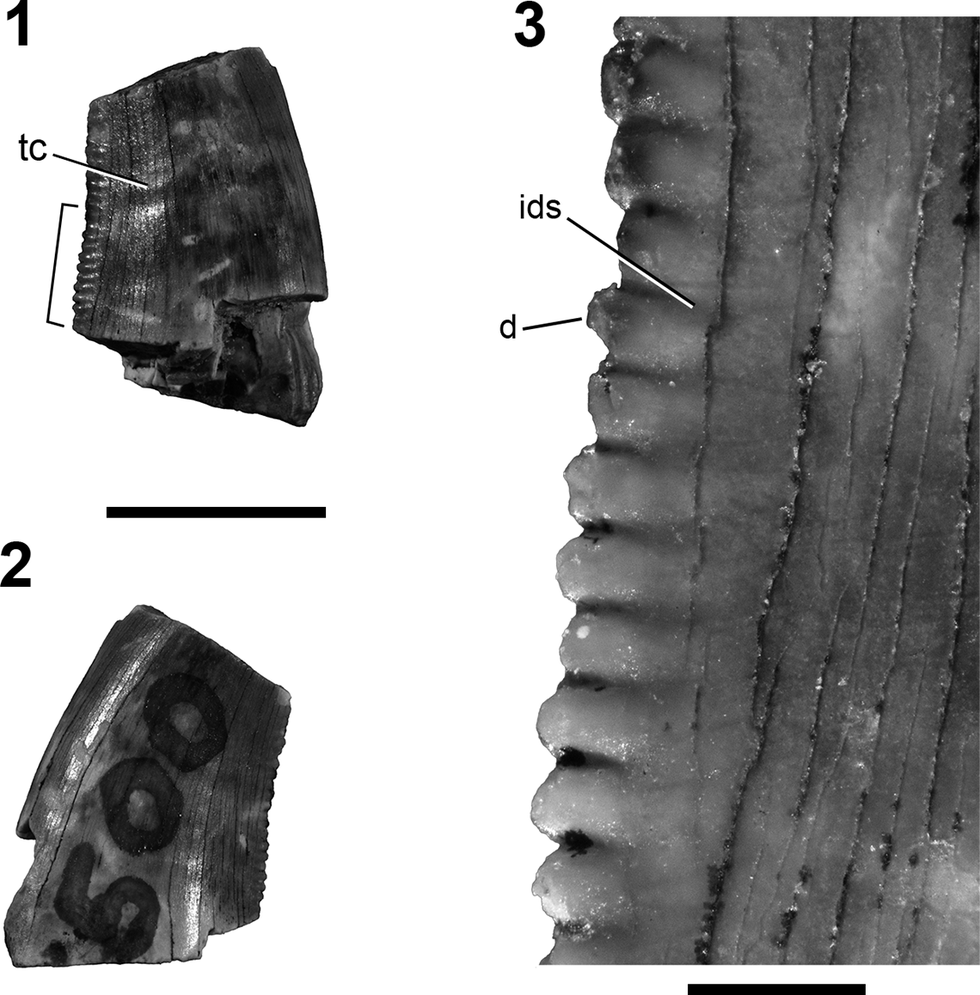
USNM 768919 (USGS locality D500) consists of the main part of a recurved lateral tooth, missing approximately the upper one-third (including the apex) as well as the base (Fig. 8). The tooth surface is smooth, lacking any fine wrinkling or other small-scale texturing of the enamel. It does exhibit faint transverse crenulations (= undulations or “wrinkles”), as are common in many averostran and tetanuran teeth (Brusatte et al., Reference Brusatte, Benson, Carr, Williamson and Sereno2007; Hendrickx et al., Reference Hendrickx, Mateus, Araújo and Choiniere2019), which are more pronounced on the distal half of the surface. Portions of 22 fine serrations (denticles) are present along the distal carina, but the mesial carina is smooth. The few intact serrations are slightly asymmetrical, with a low, rounded denticle apex (Fig. 8.3). Each serration is separated from the next by a distinct groove that is continuous with a much shallower interdenticular sulcus (Hendrickx et al., Reference Hendrickx, Mateus, Araújo and Choiniere2019) extending onto the tooth surface. In basal view, the tooth has an elliptical cross-section. Based on the presence of transverse crenulations, I assign this tooth to Averostra indet.
Theropod lateral tooth (USNM 768919) from USGS locality D500: (1) “lingual” view; (2) “labial” view; (3) close-up of serrations from region bracketed in (1); d = denticle; ids = interdenticular sulcus; tc = transverse crenulation. Scale bars = 5 mm (1, 2) and 1 mm (3).

A second specimen, USNM 768932 (locality D501; not figured), is more fragmentary, representing the basal half of another lateral tooth. As with USNM 768919, the mesial carina is smooth but the distal carina bears serrations, which unfortunately are heavily damaged. The basal cross-section is elliptical. Notes with the materials from this locality indicate that this specimen was identified as a “? coelurid” tooth by G.E. Lewis and is therefore probably the “? coelurid” tooth referred to in Smith et al. (Reference Smith, Ketner and Mabey1976, p. B13). None of the described features allow this tooth to a specific theropod clade, and at present I consider it as Theropoda indet.
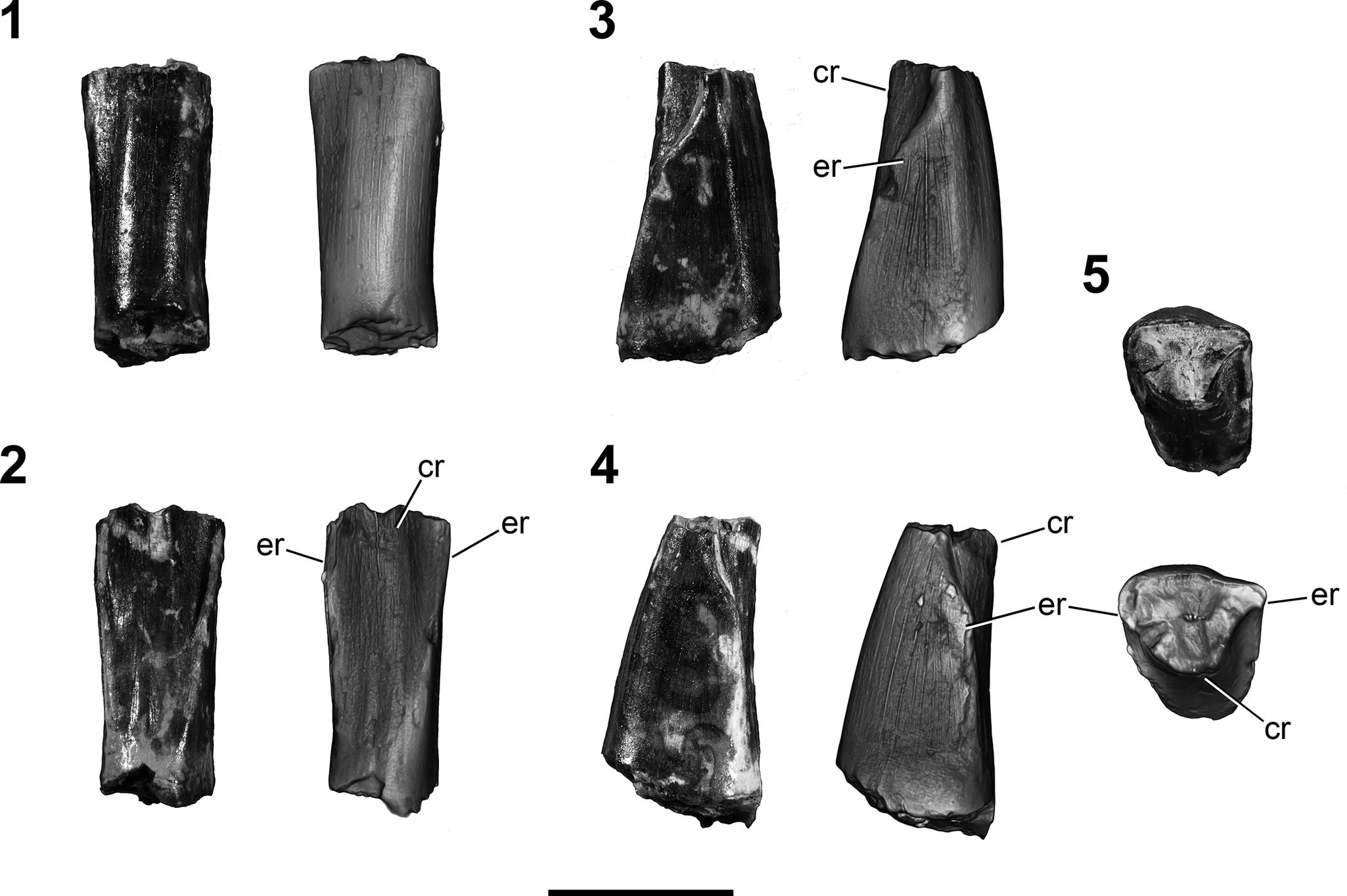
USNM 768920 (USGS locality D500) is a well-preserved premaxillary tooth, lacking the apex and part of the base on the lingual side (Fig. 9). The tooth is incisiform overall, with straight, nearly parallel mediolateral sides and curved labial and lingual faces. It lacks serrations.
Theropod (tyrannosauroid) premaxillary tooth (USNM 768920) from USGS locality D500: (1) lingual/mesial view; (2) labial view; (3) “right” view; (4) “left” view; (5) occlusal view. Photographs are on the left (1–4) and top (5), with digital CT renders on the right (1–4) and bottom (5); cr = central ridge; er = external ridge. Scale bar = 5 mm.

The labial face is smooth and strongly convex (Fig. 9.1). Its broad mediolateral arch flattens apically. The lingual face has a more complex morphology (Fig. 9.2). Each outer edge bears a distinct external ridge that runs the full height of the tooth. Most of the face is dominated by the prominent, wide central ridge, which bifurcates and shallows basally. The face is concave on either side of the central ridge(s), very strongly so on the “right” side. The lingual face broadens slightly overall from basal to apical.
Each side of the tooth bears a flat, unadorned surface between the broadly rounded labial side and the sharply delimited lingual edge (Fig. 9.3, 9.4). Both sides taper apically. Toward the top of the preserved portion, the mesial edge curves lingually, exposing the central ridge(s). The tooth has a D-shaped cross-section at its base, which transitions to a more complex shape apically. At the broken apex (Fig. 9.5), the cross-section is flat lingually, convex on the “left” side, and convexo-concave on the “right.” Based on its basal cross-section, incisiform shape, and strong central ridge, this tooth is assigned to Tyrannosauroidea.
USNM 768926 (USGS locality D499; not figured) is a second, smaller premaxillary tooth that, although more poorly preserved, generally resembles USNM 768920. Based on its D-shaped basal cross-section, I assign it to Tyrannosauroidea.
Other dinosaurian materials
Based on the opinion of Barnum Brown (as relayed to G.E. Lewis), Smith et al. (Reference Smith, Ketner and Mabey1976) reported an ankylosaurid rib fragment and vertebral centrum end from USGS locality D499. These materials are in the present collection. The rib fragment (USNM 768924) has an L-shaped cross-section, indicating it comes from the proximal section of a dorsal rib. It is not hollow, suggesting it does not pertain to a theropod, but it also lacks the T-shape typical of the proximal cross-sections of thyreophoran ribs. Although it is probably dinosaurian, the fragment is otherwise taxonomically unassignable. The vertebra (USNM 768925) is also solid internally, and the preserved articular surface is concave and slightly taller than wide. Otherwise, the bone is heavily worn and exhibits no other salient morphological features. It is probably dinosaurian but likely cannot be identified further.
Lastly, two rounded and polished pebbles are included with the collection from USGS locality D501, identified as “gastroliths” on one of the associated archival labels (Fig. 4.4). Although “gastroliths” are also mentioned on labels associated with USGS locality D499 (Fig. 2.6), I found no similar specimens among those materials. Regardless, in the absence of more detailed contextual information that might exclude a wholly geological and/or sedimentological origin for these specimens, they cannot be reliably interpreted as gastroliths.
?Crocodylians
Smith et al. (Reference Smith, Ketner and Mabey1976) also noted the presence of two crocodylian tooth fragments, again identified by G.E. Lewis, which are mentioned on the archival labels associated with USGS locality D499 as pertaining to a single tooth (Fig. 2.1, 2.2, 2.6). Although there are several tooth fragments among the materials from this locality, I could not find any that fit this description or that resemble crocodylian teeth especially. I was able to locate one specimen from a different locality (USNM 768931, USGS locality D500) that might represent an abraded longitudinal slice of a robust, conical crocodylian tooth. Other tooth fragments from this and other localities are too incomplete to identify.
Discussion
Dinosaurian fauna of the Newark Canyon Formation
The present report provides several updates to the known dinosaur fauna of the Newark Canyon Formation that help to augment our knowledge of this poorly sampled stratum (Table 1).
Based on the materials described herein, it is safe to eliminate coelurids (however questionably defined that group might be) from the faunal list, because the tooth likely thought to represent this taxon cannot be assigned more specifically than Averostra indet.
The tooth previously referred to Ankylosauridae (Smith et al., Reference Smith, Ketner and Mabey1976) can be placed into a finer taxonomic context, because it bears several features characteristic of nodosaurids. Both euornithopod teeth and iguanodontid vertebrae have been reported (Bonde et al., Reference Bonde, Hilton, Jackson, Druschke, Pennell and Garside2015), to which may now be added a likely iguanodontian tooth that is very similar to heavily worn examples from Camptosaurus and Tenontosaurus.
Two groups
neoceratopsians and tyrannosauroids—are reported here for the first time. Both groups are known from a relatively small number of other Early Cretaceous localities in North America, and the significance of their discovery here is discussed in more detail below.
In general, the overall fauna of the Newark Canyon Formation remains poorly sampled, therefore the relative abundances of taxa cannot be ascertained, nor it is possible to be confident that particular taxonomic groups (e.g., sauropods) are indeed absent. The taxa thus far described are similar to those known from approximately contemporaneous settings in the US Western Interior (e.g., Cloverly and Cedar Mountain formations) but are too fragmentary for their potential phylogenetic affinities to be investigated.
North American ceratopsians in the middle Cretaceous
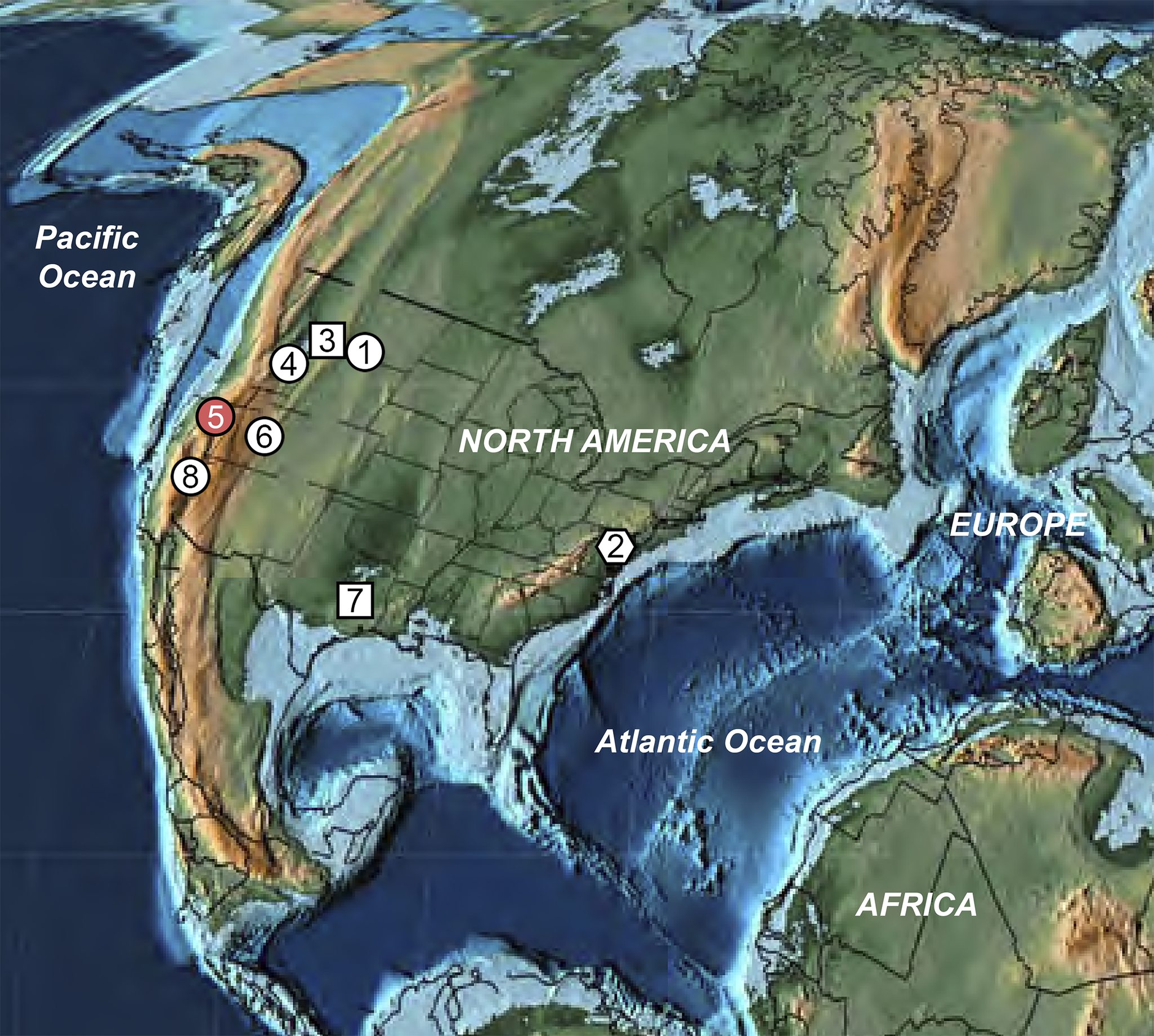
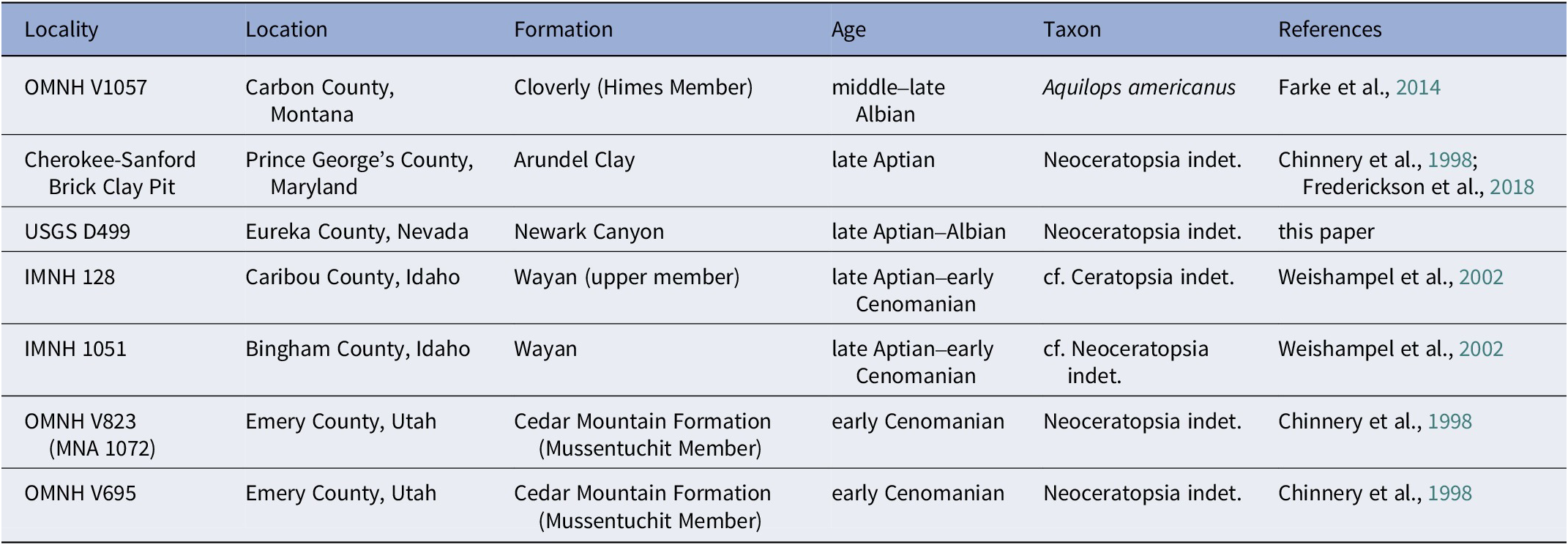
Ceratopsian remains are unknown from the Jurassic of North America and are extremely rare in the late Early and early Late Cretaceous (Fig. 10; Table 2). The most complete example is Aquilops americanus Farke et al., Reference Farke, Maxwell, Cifelli and Wedel2014, based on a nearly complete skull from the Cloverly Formation (Montana, USA; Farke et al., Reference Farke, Maxwell, Cifelli and Wedel2014). A skull roof fragment and series of caudal vertebrae from the Wayan Formation (Idaho, USA) have been tentatively assigned to Ceratopsia and/or Neoceratopsia (Weishampel et al., Reference Weishampel, Meers, Akersten, McCrady, Akersten, Thompson, Meldrum, Rapp and McDonald2002). Aside from this, the only other records comprise three teeth from the Arundel Clay (Maryland, USA; Chinnery et al., Reference Chinnery, Lipka, Kirkland, Parrish, Brett-Surman, Lucas, Kirkland and Estep1998; Frederickson et al., Reference Frederickson, Lipka and Cifelli2018) and two teeth from the Mussentuchit Member of the Cedar Mountain Formation (Utah, USA; Chinnery et al., Reference Chinnery, Lipka, Kirkland, Parrish, Brett-Surman, Lucas, Kirkland and Estep1998).
Ceratopsian and tyrannosauroid distributions in the late Early and early Late Cretaceous (Aptian through Cenomanian) of North America, with the location of the materials described in this paper highlighted in red. Symbols: hexagons = ceratopsians; squares = tyrannosauroids; circles = both; 1 = Cloverly Formation; 2 = Arundel Clay; 3 = Blackleaf Formation; 4 = Wayan Formation; 5 = Newark Canyon Formation; 6 = Mussentuchit Member, Cedar Mountain Formation; 7 = Lewisville Formation; 8 = Willow Tank Formation. Early Albian base map from Scotese (Reference Scotese2014).

Middle Cretaceous (Aptian–Cenomanian) occurrences of ceratopsians in North America

Abbreviations: IMNH, Idaho Museum of Natural History, Pocatello, ID, USA; MNA, Museum of Northern Arizona, Flagstaff, AZ, USA; OMNH, Sam Noble Oklahoma Museum of Natural History, Norman, OK, USA.
In this context, the discovery of USNM 768927 is significant, highlighting the Newark Canyon Formation as only the fifth ceratopsian-bearing stratum in North America during this time interval. Although most of these ceratopsian remains (including USNM 768927) are too incomplete to provide significant biogeographic or evolutionary data, the widespread distribution of the group in North America at the end of the Early Cretaceous suggests that ceratopsians may have arrived on the continent considerably earlier. Their relatively small body sizes may have contributed to their apparent scarcity.
North American tyrannosauroids in the middle Cretaceous
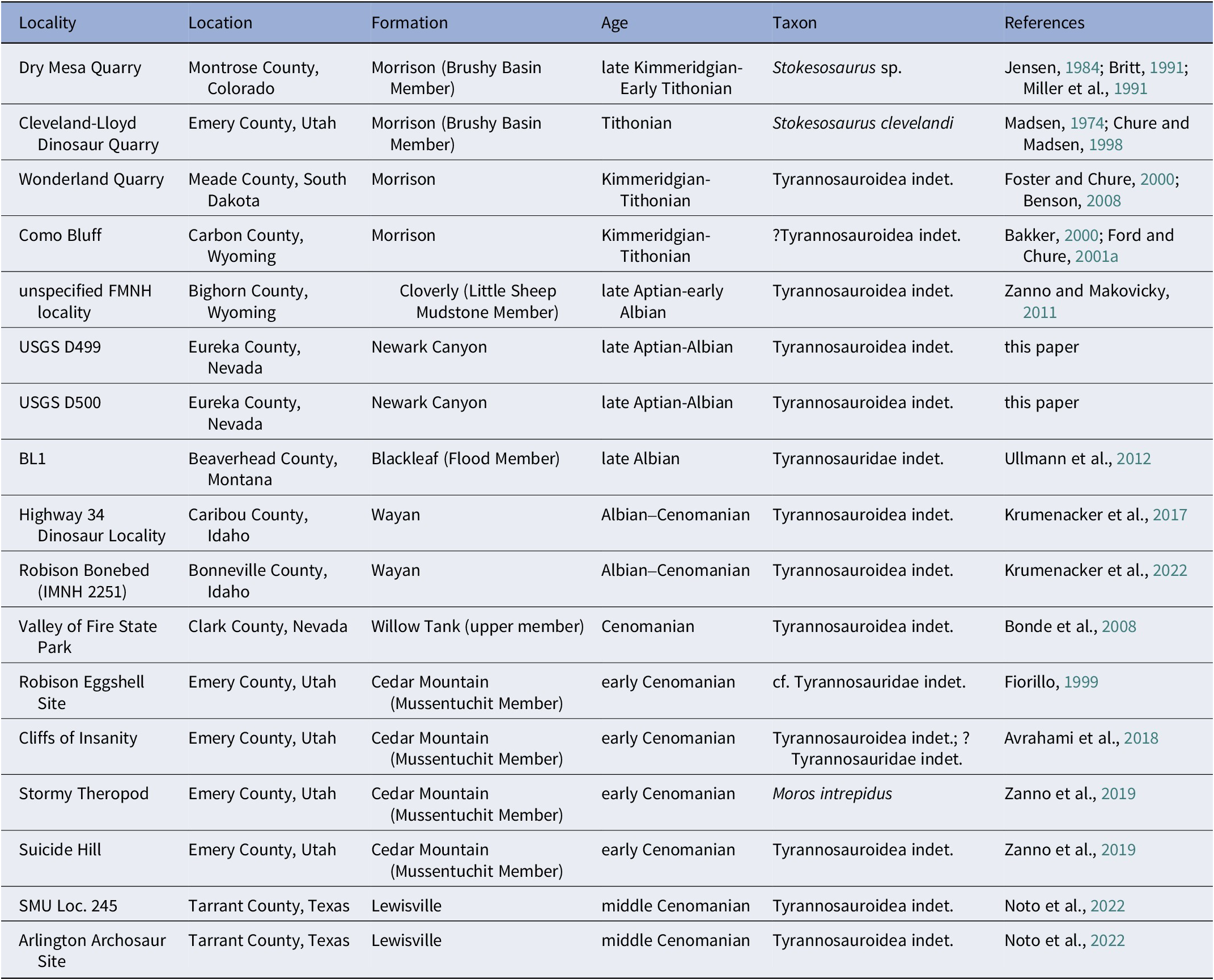
Tyrannosauroids are rare components of Late Jurassic and Early Cretaceous (in fact, all pre-Campanian) dinosaur faunas in North America, being represented primarily by isolated teeth from a small number of localities (Fig. 10; Table 3). The presence of a tyrannosauroid in the Newark Canyon Formation is significant in providing additional evidence of the widespread, if rare, nature of this group in pre-Late Cretaceous North America.
Late Jurassic through middle Cretaceous (Aptian–Cenomanian) occurrences of tyrannosauroids in North America

Abbreviations: FMNH, Field Museum, Chicago, IL, USA; SMU, Southern Methodist University, Dallas, TX, USA; IMNH, Idaho Museum of Natural History, Pocatello, ID, USA; MNA, Museum of Northern Arizona, Flagstaff, AZ, USA; OMNH, Sam Noble Oklahoma Museum of Natural History, Norman, OK, USA.
The oldest North American tyrannosauroids are Late Jurassic, known only from the Morrison Formation of the USA. Stokesosaurus clevelandi Madsen, Reference Madsen1974, from the Cleveland–Lloyd Quarry in Utah, is the sole named taxon with undisputed membership in the clade. (Tanycolagreus topwilsoni Carpenter, Miles, and Cloward, Reference Carpenter, Miles, Cloward and Carpenter2005, has also been referred to Tyrannosauroidea [Senter, Reference Senter2007], but less securely so [Rauhut et al., Reference Rauhut, Milner and Moore-Fay2010]). Three additional specimens from Dry Mesa Quarry, Colorado, have been assigned to Stokesosaurus sp. (Miller et al., Reference Miller, Baer, Stadtman, Britt and Averett1991), and a tyrannosauroid ilium is known from the Wonderland Quarry, South Dakota (Benson, Reference Benson2008; originally referred to Stokesosaurus by Foster and Chure, Reference Foster and Chure2000). In addition, a small number of isolated teeth may pertain to tyrannosauroids (Ford and Chure, Reference Ford and Chure2001a, but see Bakker, Reference Bakker2000).
Tyrannosauroids are even more poorly represented in the Early Cretaceous. A few isolated “?deinodont” teeth were reported from the Antlers Formation (at Butler Farm and Greenwood Canyon, Texas, USA; Thurmond, Reference Thurmond and Perkins1974), but these need to be re-examined before assuming they pertain to tyrannosauroids in the modern taxonomic sense. Elsewhere, tyrannosauroids have been documented from the Cloverly Formation (teeth; Zanno and Makovicky, Reference Zanno and Makovicky2011), Wayan Formation (teeth and a partial femur; Krumenacker et al., Reference Krumenacker, Simon, Scofield and Varricchio2017, Reference Krumenacker, Zanno and Sues2022), and the Flood Member of the Blackleaf Formation (teeth; Montana, USA; late Albian; Ullmann et al., Reference Ullmann, Varricchio and Knell2012).
In the early Late Cretaceous, tyrannosauroids are similarly uncommon, and aside from the partial skeleton of Moros intrepidus Zanno et al., Reference Zanno, Tucker, Canoville, Avrahami, Gates and Makovicky2019 (Mussentuchit Member of the Cedar Mountain Formation; Zanno et al., Reference Zanno, Tucker, Canoville, Avrahami, Gates and Makovicky2019), are nearly entirely represented by isolated teeth. These derive from the upper member of the Willow Tank Formation (Bonde et al., Reference Bonde, Varricchio, Jackson, Loope, Shirk, Duebendorfer and Smith2008), the Lewisville Formation (Texas, USA; Noto et al., Reference Noto, D’Amore, Drumheller and Adams2022), and the Mussentuchit Member of the Cedar Mountain Formation (Fiorillo, Reference Fiorillo and Gillette1999; Avrahami et al., Reference Avrahami, Gates, Heckert, Makovicky and Zanno2018).
These occurrences document the persistent presence of tyrannosauroids in North America starting no later than Kimmeridgian time. All materials indicate animals of modest body size in comparison to their gigantic latest Cretaceous relatives, although no specimens aside from Moros allow for assessment of ontogenetic age.
The affinities of these tyrannosauroid taxa remain open to question. Aside from Stokesosaurus and Moros, none is sufficiently complete to be placed in a precise phylogenetic context. Although the Cloverly Formation tooth was proposed to represent a sister-taxon to the Asian form Xiongguanlong baimoensis Li et al., Reference Li, Norell, Gao, Smith and Makovicky2009, this affinity was based on a single shared character, the absence of serrations on the premaxillary teeth (Zanno and Makovicky, Reference Zanno and Makovicky2011).
The interpretation of unserrated premaxillary teeth has been problematic for decades. It has a phylogenetically homoplastic distribution and can even vary within a taxon, as it is known to do in Tyrannosaurus rex Osborn, Reference Osborn1905. Unserrated tyrannosauroid premaxillary teeth are known from many Upper Cretaceous strata, including the El Gallo Formation (Mexico; Ford and Chure, Reference Ford and Chure2001b), Udurchukan Formation (Russia; Van Itterbeek et al., Reference Van Itterbeeck, Bolotsky, Bultynck and Godefroit2005), Iren Dabasu Formation (China; Currie et al., Reference Currie, Rigby, Sloan, Carpenter and Currie1990); the Judith River (Leidy, Reference Leidy1868), Ferris, Hell Creek, and Lance (Carpenter, Reference Carpenter1982; Lillegraven and Eberle, Reference Lillegraven and Eberle1999) formations of the USA, and the Foremost (Peng et al., Reference Peng, Russell and Brinkman2001), Dinosaur Park (Ryan et al., Reference Ryan, Russell, Eberth and Currie2001) and Oldman (Peng et al., Reference Peng, Russell and Brinkman2001) formations of Canada. The existence of unserrated tyrannosauroid premaxillary teeth in the latter two formations strongly suggests that they occur as variations in the well-known taxa Gorgosaurus, Albertosaurus, and/or Daspletosaurus; the alternative is that they derive from an as-yet-undiscovered form (in terms of skeletal materials) in these otherwise well-studied strata. Many middle Cretaceous tyrannosauroid teeth in North America are also unserrated, indicating that the feature is widespread in both space and time. Without a better ability to understand its true phylogenetic distribution, I do not consider it to offer useful information about the affinities of isolated teeth within Tyrannosauroidea.
Historically, tyrannosauroid remains have been rare in pre-Upper Cretaceous deposits of North America. However, their widespread nature suggests that these small- to medium-sized predators were components of many (perhaps most) North American terrestrial faunas since at least the Late Jurassic. Like the neoceratopsians of this time, their apparent rarity may be partly influenced by their relatively small body sizes.
Conclusions
Study of previously collected materials from the Newark Canyon Formation (Lower Cretaceous) of Nevada, USA, has revealed the presence of neoceratopsian and tyrannosauroid theropod dinosaurs in this stratum for the first time. These data add to a growing body of evidence that these dinosaur groups, although generally moderate in body size, were present in many (and possibly most) North American terrestrial faunas through the Early Cretaceous. Although still poorly understood overall, the fauna of the Newark Canyon Formation provides an important window onto a poorly sampled paleogeographic region during a period of major faunal transition in North America.
Acknowledgments
I am grateful to A. Millhouse and J. Nakano for their work to incorporate the USGS fossil vertebrates into the USNM collections, and their specific help in cataloguing the materials described in this paper. A. Telfer provided guidance on using the Nikon SMZ18 stereomicroscope and associated software, and A. Behlke and J. Hill performed the μCT scanning. This paper was improved thanks to reviews from J. Bonde and L. Krumenacker.
Competing interests
The author declares that he has no competing interests.