

Introduction
The term “dementia” originates from the Latin demens (“out of one's mind”), but the conceptual understanding of dementia has changed considerably over the past three centuries from that of a mental handicap (Willis, Reference Willis and Pordage1684) to an illness of the brain, primarily affecting older people. Alzheimer's discovery of a neurological basis for dementia has led to a predominantly medical model being utilized in its assessment, formulation and treatment. The medical model of dementia states that dementia is (a) pathological and individual, (b) organic in etiology (caused by progressive deterioration of those parts of the brain that control cognitive and behavioral functioning), and (c) treated and managed according to medical authority (Lyman, Reference Lyman1989). The development of the medical model of dementia has countered the longstanding assumption that mental decline is an inevitable consequence of old age. But the biomedicalization of dementia has also been criticized on the basis that it leads to the person with dementia being viewed as a disease entity and a source of burden rather than an individual responsive to stress (Lyman, Reference Lyman1989).
It is well established that many people with dementia experience disability over and above that arising purely from neurological impairment and this has sometimes been being described as “excess disability” (Brody et al., Reference Brody, Kleban, Lawton and Silverman1971). Of particular interest is the frequent lack of correlation between the clinical presentation of dementia in the living person and the extent of neuropathology at post mortem. For example, some older people presenting as having no impairment in neuropsychological tests and on clinical examination have shown to have a high degree of Alzheimer's pathology at post mortem (Snowdon, Reference Snowdon2003).
This evidence beyond the neuropathology has encouraged the development of non-medical and psychosocial perspectives of dementia. Referencing all such models is beyond the scope of this paper, but several models, stemming from a range of perspectives, will now be summarized in chronological order.
Butler and Lewis (Reference Butler and Lewis1982) stated that “the experience of being cut off from normal stimuli and the opportunity for perceptions which occur experimentally or accidentally in various ways, such as in loss of hearing or eyesight, by being marooned, by solitary confinement . . . may lead to disorganized thinking, depression, panic, delusions, and hallucinations.” The “Progressively Lowered Stress Threshold model” (PLST; Hall and Buckwalter, Reference Hall and Buckwalter1987) argues that the environment must be adjusted in order to care for people with dementia and their deteriorating cognitive and functional abilities. As the illness progresses, the stress threshold is lowered during the course of the day, depending on various factors including “overwhelming and conflicting stimuli” and “physical stressors”. The model's categorization of stress factors has been used in the planning and evaluation of care (Finnema et al., Reference Finnema, Droes, Ribbe and Tilberg2000).
The Adaptation-Coping model (Dröes, Reference Dröes1991) is a useful framework for understanding behavioral problems in dementia. It argues that people constantly strive for equilibrium. When confronted with dementia and the subsequent disruption in balance, people will try to cope with these changes and “regain balance”. The model provides examples of cognitive, emotional and social adaptive tasks. For example, learning to cope with invalidity caused by dementia and developing adequate relationships with staff are seen as cognitive tasks. The degree to which these adaptive tasks are stressful depends on the cognitive appraisal of the situation or the changes that the person is going through, either consciously or unconsciously. The model integrates personal, illness-related, material environmental and socio-environmental factors. It presents adjustment as a process which develops through an internal (i.e. through the person) and external (person-environment) cycle.
Sabat and Harre (Reference Sabat and Harre1992) offered a social constructionist approach to dementia, which views Alzheimer's disease (AD) as a loss of the “self”. They described people having a “private self”, which remains relatively intact in dementia, and a “public self”, which becomes disintegrated through negative social interactions. For example, once someone with AD has been positioned as helpless and confused, it is rare for him/her to be seen as anything other than this.
Kitwood (Reference Kitwood1993) broke new ground with a more coherent model to take account of the interaction between psychosocial and neurological factors in the development and course of dementia in old age. He stressed the importance of psychosocial factors which “deprive a neurologically impaired individual of his or her personhood”. Kitwood suggested that “subtle processes occur, which enable people to keep dementia sufferers at a psychological distance and to avoid engaging them in their full capacity as persons”. Kitwood argued that the maintenance of self-esteem was crucial to learning, efficacy and good social relationships, and that when self-esteem was damaged by a “malignant social psychology”, the individual falls into a cycle of discouragement and failure. The “malignant social psychology” occurs when others treat the sufferer in a detrimental way, and for the individual with dementia this can be due to a number of social processes (Kitwood, Reference Kitwood1990). For instance, “treachery” occurs when some form of deception is used to get the person with dementia to comply with someone else's wishes, and “outpacing” is when a carer continues conversation or activities too quickly for the person with dementia to follow what is going on. Kitwood's more comprehensive “dialectical model of dementia” (Kitwood, Reference Kitwood1993) described dementia as the interrelationship between neurological damage and psychological factors. He presented a simple equation whereby dementia (D) = P + B + H + NI + SP (where P = personality, B = biography, H = physical health, NI = neurological impairment and SP = social psychology). Kitwood's ideas have made a significant impact on the way that dementia has been viewed in recent years, with his subsequent work being based on a “new culture of dementia care” and the importance of “personhood” (Kitwood, Reference Kitwood, Meisen and Jones1997).
Bender and Cheston (Reference Bender and Cheston1997) proposed a three-stage model of the subjective experiences of dementia, involving (a) the feelings engendered by dementia, (b) the process of decline, and (c) the person's emotional reaction, which is dependent on the extent of their cognitive impairment and their social context. Haberg (Reference Haberg, Meisen and Jones1997) advocated a psychodynamic approach to dementia. This approach stated that different variables (self image, personality, experiences, ego functions and defense mechanisms) together influence the functioning of the person with dementia. It assumes that the person with dementia adjusts to changes through an adaptive psychodynamic process, based primarily on earlier experiences and personal factors such as personality and ego functions. Haberg viewed the degree of cognitive deterioration as being based on three dimensions: cognitive power, ego functions and social relationships.
Cohen-Mansfield (Reference Cohen-Mansfield2000) provided a useful summary of the evidence, at the time, for the “heterogeneity” observed in people with dementia. Her paper identified three key sources from which this is derived in the observable areas of cognition, behavior, functional status and affect. The three key sources were initial predisposing factors, lifelong events and the current condition, each source comprising three general domains (genetic/ biological/medical, psychosocial, and environmental).
Davis (Reference Davis2004) wrote an article challenging the biomedicalization of dementia by drawing on sociological and philosophical constructions of the illness. For example, he raised issues around the loss of power and the “problematization of dementia” whereby dementia is constructed as a problem from a social, economic and political perspective.
Downs et al. (Reference Downs, Clare, Anderson, Woods and Clare2008) highlighted the need for dementia to be viewed as a biopsychosocial condition and went on to look at the implications for practice and research. They note that Engel (Reference Engel1977) pioneered the idea of a biopsychosocial (as opposed to a medical) model of illness and this has now been accepted within the World Health Organization's understanding of disease (World Health Organization, 2002). In contrast to the limits of current models of dementia, there has been great progress in our theoretical understanding of normal aging. For instance, instead of framing aging as solely a period of decline and disability, Baltes and Baltes (Reference Baltes, Baltes, Baltes and Baltes1990) presented a more developmental model linking psychological and social functioning with adaptation, optimization and compensation. Nygren et al. (Reference Nygren, Aléx, Jonsén, Gustafson, Norberg and Lundman2005) describe the characteristics of resilience, sense of coherence, purpose in life and self-transcendence as aspects of inner strength, which are crucial for retaining health and handling adversity in aging. These inner strengths might be open to enhancement and they may be particularly important to help counterbalance the negative views of the aging process within the health care systems. This indicates that psychosocial models of dementia need to incorporate positive aspects of personhood such as adaptability and aspects of inner strength.
The existing models and research described offer a great deal to our understanding of the dementia process. However, there is a need for a model which incorporates all the relevant factors so that it can be used as a tool for understanding cases. Existing models may have some limitations, for example even Kitwood's more detailed model (1993) does not consider the impact of the physical environment and mental stimulation. The aims of this paper are twofold:
(1) to reconceptualize and update the biopsychosocial model of dementia, amalgamating key features from past models and research; and
(2) to propose a pragmatic, diagrammatic model which can help clinicians formulate cases more clearly and tailor interventions to meet their needs. The use of this model will be illustrated with a case example.
Overview of the model
This model disaggregates psychosocial and biological processes, with the aim of understanding the inter-relationship between the two. It suggests that in both domains there are fixed factors (aspects which relate to history or risk factors and therefore not amenable to change), and tractable factors (aspects which may be amenable to change). Tractable factors could also be viewed as either risk or protective factors, depending on the extent to which they exist in the individual and the relative impact they may have on the level of dementia. This would include factors which can be influenced through biological (e.g. medical) and psychosocial interventions. In this way the model aims to encourage people to think of dementia as something which is malleable and where change, adaptation and improvement is possible. The model also proposes that the tractable factors will be influenced by both fixed factors and interventions. This implies that certain aspects of dementia are beyond the control of the individual and their environment, whereas others can be influenced and potentially improved.
In the model (Figure 1) the trajectory of dementia is presented as a process, beginning with aging, early organic change and MCI (mild cognitive impairment), and moving towards diagnosis, dependency, institutionalization, end of life care, and death. Both the fixed and the tractable factors will influence the point at which the symptoms of dementia begin, the speed and nature of the deterioration, and the appropriateness and effectiveness of interventions. The model includes two dotted lines which may fall at the same or at different points along the dementia spectrum. One line indicates where the person is currently functioning, while the dotted line indicates where they may potentially function with optimal interventions and support. The distance between the lines is the “excess disability”.
The biopsychosocial model.

Psychosocial fixed factors
There is evidence that both a person's former education and IQ may be linked to dementia. For example, research has identified links between low education and dementia, irrespective of other factors such as gender and occupation (De Ronchi et al., Reference De Ronchi, Fratiglioni, Rucci, Paternicò, Graziani and Dalmonte1998). Katzman (Reference Katzman1993) proposed that education increases synaptic density, leading to the delay of symptoms in AD by around five years. Cognitive Reserve Theory (Stern, Reference Stern2002) assumes that when synapses are depleted beyond a critical point, the initial symptoms of dementia will appear. Active models of reserve suggest that the brain actively attempts to compensate for brain damage by using alternative brain structures or networks, and that some people are more efficient at compensating for brain damage, particularly those with higher pre-morbid intelligence. The theory also proposes that higher functioning individuals have a higher level of “brain reserve”, such that dementia is often only apparent later in the illness.
Dramatic deterioration in people with dementia can be reported following major life events, such as bereavement or a move into care. Life events have been found to increase the risk of admission into hospital for people with dementia (Orrell and Bebbington, Reference Orrell and Bebbington1998). Links have been made between pre-morbid personality traits and behavioral and psychological symptoms of dementia (BPSD). For example, Low et al. (Reference Low, Brodaty and Draper2002) found that higher neuroticism was predictive of delusions and overall behavioral disturbance. However, their sample was small and the results were inconsistent with previous research findings, highlighting the complexity of these potential associations in these relationships.
Biological fixed factors
Age is the most obvious biological risk factor, with the risk of dementia doubling every five years from the age of 65 onwards. Genetic factors play an important role, particularly in early onset AD (Blennow et al., Reference Blennow, De Leon and Zetterberg2006). Certain physical health conditions are linked to (VaD) dementia, including heart disease and high blood pressure (Gorelick, Reference Gorelick2004). Sensory deficits can also impact on level of cognitive functioning and can contribute to delirium. Impairments in sensory modalities are common in old age but for people with dementia, these effects are likely to be exaggerated, due to problems in attending to or interpreting sensory input. For example, visual impairment may be compromised both by being disorientated in a new environment and by trying to make sense of where you are in a poorly lit room.
Psychosocial tractable factors
The rationale and theory of “use it or lose it” suggests that mental stimulation may reduce apparent deterioration in dementia. Research into “Reality Orientation” as far back as the 1960s showed that re-teaching orientation information could result in cognitive benefits for people with dementia (Folsom, Reference Folsom1966). A more recent drive towards “gold standard research” has produced randomized controlled clinical trials which demonstrate more systematically a link between engaging in mental activity and improvements in memory and cognition (Breuil et al., Reference Breuil1994; Spector et al., Reference Spector2003).
Although their occurrence is often beyond the control of the individual, the experience and reaction to life events may be influenced by factors such as social support and carer support. Life events may lead to depression, which causes further deterioration in people with dementia, or it may be harder for people to adapt to new situations with reduced mental and emotional resources.
There is a high co-morbidity between depression and dementia, with approximately 20% of clinical samples of people with dementia suffering from depression (Ballard et al., Reference Ballard, Bannister, Solis, Oyebode and Wilcock1996). Clinical depression may present as “pseudodementia”, in which a person's memory appears to be affected whereas in fact they are inattentive to their surroundings and unable to retain new information due to low mood. Many people become depressed about their deficits and the resulting changes in their life. Low mood may lead to further withdrawal, exacerbating symptoms further. Anxiety has also been shown to have a high prevalence in dementia, with rates of around 30% (Ballard et al., Reference Ballard, Bannister, Solis, Oyebode and Wilcock1996).
Personal psychology factors have been less prominent in models of dementia, but their importance may have been underestimated. People's individual coping strategies and adaptive mechanisms tend to be indicative of their personality and life experiences. Bahro et al. (Reference Bahro, Silber and Sunderland1995) described various coping strategies in case studies of people with dementia, including denial, externalization (attributing problems to others), somatization (attributing problems to physical change) and self-blame. These coping mechanisms may vary in their effectiveness, with ineffective strategies leading to further problems. For example, externalization may lead to interpersonal difficulties, which may be hard to resolve because of communication problems. The work by Nygren et al. (Reference Nygren, Aléx, Jonsén, Gustafson, Norberg and Lundman2005) on positive psychology in relation to mental health found a strong correlation between sense of coherence and depression in older people.
The social environment may have a considerable impact on a person with dementia. People living alone, and those without any social ties, are at higher risk of developing dementia (Fratiglioni et al., 2004). Kitwood (Reference Kitwood, Meisen and Jones1997) described how “malignant social psychology” may have a direct influence on the expression of dementia but he also identified aspects of positive social psychology and coined the concept of “positive person work”, which includes skills of recognition, negotiation and collaboration. Netten (Reference Netten1991) classified care homes into three types of regime: positive (opportunities for residents to do or decide things for themselves), mixed (opportunities for freedom and choice in some areas) and restrictive (residents denied opportunities to decide things for themselves). She found a significant relationship between regime type and apathy, social disturbance and orientation. Zimmerman et al. (Reference Zimmerman2005) evaluated quality of life (QoL) for 421 people across care settings, and found that change in QoL was associated with facilities which used a specialist worker approach, trained more staff in dementia and encouraged activity participation. Further, poor quality care environments often provide poor sensory stimulation, such as inadequate lighting and loud background noise which can make selecting both auditory and visual information extremely difficult.
Biological tractable factors
Many physical and psychiatric factors may be amenable to intervention. Urinary infections for example may cause additional confusion and can often be cured by antibiotics. Pain, as a result of physical illness, may impact on a person's mood or reduce their motivation to take part in activities. Many people are prescribed anti-psychotic medication to control “behavioral symptoms” of dementia, when in reality the side-effects may lead to increased confusion and impairment (Lawlor, Reference Lawlor2004). Physical health problems and falls may limit a person's ability to attend day care or other activities, for example, leading to reduced stimulation and further decline. Physical health has been linked with dementia, with Laurin et al. (Reference Laurin, Verreault, Lindsay, MacPherson and Rockwood2001) finding that compared to no exercise, physical activity was associated with lower risk of cognitive impairment, dementia and specifically AD. They did acknowledge that physical activity may not play a definitively protective role, but may be associated with good physical health, which itself may be linked to reduced cognitive impairment.
Although sensory deficits (e.g. visual impairment) are described as fixed, the degree to which the person is impaired by them may be considered tractable. This is because the sensory impairment experienced may be influenced by psychosocial interventions such as multi-sensory stimulation, or biological interventions such as reading glasses.
Psychosocial interventions
There is a range of psychosocial interventions available designed to impact on different areas of an individual's life (Woods and Clare, Reference Woods, Clare, Woods and Clare2008). Cognitive interventions such as Cognitive Rehabilitation (Clare et al., Reference Clare, Woods, Moniz-Cook, Orrell and Spector2003) and Cognitive Stimulation Therapy (CST; Spector et al., Reference Spector2003) both aim to provide mental stimulation with the intention of improving or maintaining either general cognitive functioning (CST) or specific cognitive abilities (Cognitive Rehabilitation). Behavioral interventions may target the environment or consider social psychology through changing the way in which others respond to the person's behavior. Group-based interventions such as CST and Reminiscence Therapy, in addition to being mentally stimulating, often incorporate multi-sensory stimulation, with the aim of providing an enhanced learning environment and improving well-being. There is also a focus on improving mood, quality of life and social psychology, by encouraging group facilitators to adopt a person-centered approach (Brooker, Reference Brooker2004). Social support and carer support may influence factors such as experience of life events, mood and social psychology.
Biological interventions
Current biological interventions include a range of pharmacological interventions such as cholinesterase inhibitors for AD, aspirin for VaD, and other drugs for BPSD (e.g. antidepressants for depression). Medication may impact on cognitive function or mood, which can have knock-on effects in other areas such as reaction to life events. Sensory aids can improve sensory functioning, for example people with dementia often have glasses with the incorrect prescription. Physical exercise can improve physical health, as well as impacting on cognitive functioning and well-being (Laurin et al., Reference Laurin, Verreault, Lindsay, MacPherson and Rockwood2001).
Discussion
Working example
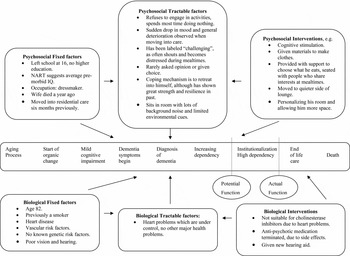
To illustrate how this model may be used to formulate cases of individuals with dementia, the following fictional example is provided. The relevance of all the factors presented in Figure 1 are considered in relation to a specific case, and the boxes completed accordingly (Figure 2).
Working example: Cyril.

Cyril is an 82-year-old man, formerly a dressmaker, who has recently moved into residential care following the death of his wife. He suffers from moderate vascular dementia. Cyril found it very hard to settle in to the care home, with a sharp deterioration in both his cognitive abilities and mood following admission. Most noticeably to staff, he frequently became distressed at mealtimes, shouting at other residents and once throwing his plate across the room. In response, he was put on an antipsychotic drug to “control his temper and calm him down”.
Cyril's full details can be seen in Figure 2, enabling his staff team to think beyond his “behavior” and make sense of how various factors might contribute to his presentation. A detailed exploration is beyond the scope of this summary, but some of the questions raised by the completion of Figure 2 include:
• How much is Cyril being stimulated, and how might he become engaged? What is the best way to approach him and what activities might be interesting and relevant to him?
• How was his move into care managed and was he given any support in this transition? For example, was he given help finding his way around, was he introduced to other residents? How may he be supported now?
• Why might mealtimes be particularly difficult for him? For example, do the staff know what he likes to eat? Who is he sitting with?
• How might his need to be alone at times be viewed positively?
• How might his problems with vision and hearing be contributing to his problems?
• What are the effects of the anti-psychotic medication he is given?
Through careful consideration of all the tractable factors, staff would be able to think more creatively about formal and informal interventions to improve Cyril's well-being, functioning and mood. It turned out that Cyril was never consulted about what he wanted to eat, due to difficulties communicating (as he has poor vision and hearing), and hence was often given food he disliked. He also sat with people with whom he had nothing in common and who had alienated him from their group. Providing him with support to choose what he eats and seating him with people who share his interests at mealtimes has made a huge impact. In addition to the emotional impact of moving to residential care, Cyril had become very disorientated as environmental cues and support were limited. Staff have since invested more time in labeling his room, showing him around, and introducing him to others. They also realize that as he is a person who likes his own space, he had been labeled a loner and that this had limited his access to what was going on in the home. Attention to what he is being offered and how has made a huge difference. For instance, he has been given material and encouraged to sew with another resident who was also once a dressmaker. He has been invited to a CST group, which encourages mental stimulation, multisensory stimulation and a positive social psychology between staff and residents. His antipsychotic medication was deemed unnecessary and has been terminated. All these changes have had a positive impact on his mood and overall functioning.
Conclusion
It important to consider some of the strengths of the medical model of dementia, especially its prediction of stages of disease progression and inevitable deterioration, which can be used to rationalize certain treatment strategies. For example, institutionalization may be considered appropriate in “later stages”. Furthermore, disease “stages” provide structure in people's understanding of what is happening, and, by making the disease course more predictable, it makes it easier for them to make plans for the future. Although there is a move to incorporate a stronger biopsychosocial perspective, particularly when thinking about how to work with individuals, the medical model still has an important place and offers a common language among many professionals. However, the biopsychosocial model we describe provides a theoretical framework and a more ambitious approach to dementia as it takes into account positive as well as negative factors.
There are limitations to this model. In some situations, the breakdown into fixed factors seems to be an artificial divide and there may be some overlap, for example in sensory deficits and sensory impairments. Further, physical exercise is listed as a biological intervention, although some might view it as psychosocial due to the more generalized changes in well-being that it may bring about (Laurin et al., Reference Laurin, Verreault, Lindsay, MacPherson and Rockwood2001). The model makes the assumption that people with dementia are aging, and although this is normally the case, it would not fit so well for younger people with dementia. This model has not been tested empirically. Future research might look at whether a range of clinicians might reliably use the model to reach similar conclusions and recommendations about cases. This might depend on the nature of the service, with services ranging from multi-disciplinary community mental health teams to psychiatry-led services. Subsequently, a variation in the degree to which a more medical or biopsychosocial approach is adopted will naturally exist.
We hope that the model may become a useful tool for researchers and clinicians to help understand mechanisms of change in relation to psychosocial interventions, as well as fixed and tractable factors in the person's life history. This may enable them to identify ways to improve the person's quality of life and reduce excess disability. It may at times produce more questions than answers, but hopefully will lead to lively debate. All too often, the behavior and actions of a person are solely attributed to the illness, and this model helps to work against this assumption by taking a more individual and biopsychosocial perspective.
Conflict of interest
None.
Description of authors' roles
A. Spector reviewed the literature and was the lead author of the paper. M. Orrell provided intellectual contribution to the paper and commented on drafts.