1. A Word about Terminology
In this paper, I am concerned with underdetermination arguments that appeal to the role of background assumptions and auxiliary hypotheses in science. As such, there are forms of underdetermination that don't concern me here. To put it in a general form, however, we can say that underdetermination obtains when scientists are unable to responsibly decide between rival theories. Following a common characterization of underdetermination, say formally that underdetermination obtains for a set of rival theories, a standard for what would count as responsible theory choice, and a set of circumstances in which the standard allows no responsible choice among the rival theories.Footnote 1
2. How Auxiliary Theories Make Inference Less than Certain
The familiar Duhemian argument for underdetermination begins with the observation that experiments in modern science often require appeal to auxiliary assumptions for their probative force. For the sake of concreteness, consider the claim that the Earth is flat and the counter-claim that the Earth is round—less colloquially, that the Earth is an oblate spheroid. Call these claims
 $T_{F}$ and
 $T_{R}$ respectively. There have been many adherents of
 $T_{R}$, of course, and many attempts to demonstrate its superiority over
 $T_{F}$. Copernicus provides a typical argument:
This [spherical] form of the sea is also discerned by sailors, seeing that land is visible from the top of the mast, even when it cannot be seen from the deck of the ship. And conversely if a light is held on the top of the mast, it appears to those on the shore to gradually descend as the ship moves away from land, until at last it disappears like the setting sun. (De Revolutionibus Bk. I ch. 2, author's translation)
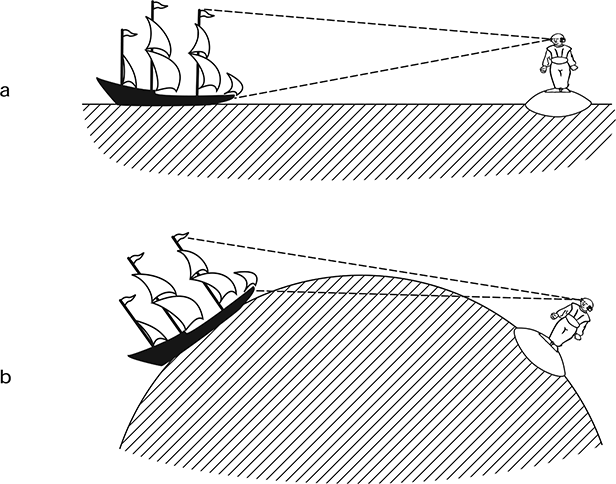
The idea is simple enough. If the sea were flat, then an observer who could see a ship clearly should be able to see both the hull and the mast, as in Figure 1a.
(a) If the Earth were flat, then an observer on the shore would see both the mast and prow of the ship if he could see either. (b) Since the Earth is round, the observer sees the mast even when the hull is hidden behind the curve of the Earth.

Contrariwise, since the sea is curved, an observer may see the mast even at a distance at which the hull is not visible, as in Figure 1b. The latter of these is observed, and the observation decides between these two depictions. The catch is this: The test implicitly assumes that light travels in a straight line—but of course the rectilinear propagation of light is independent of
 $T_{F}$ and
 $T_{R}$.
Without the implicit assumption, the observation may not favor
 $T_{R}$. Suppose
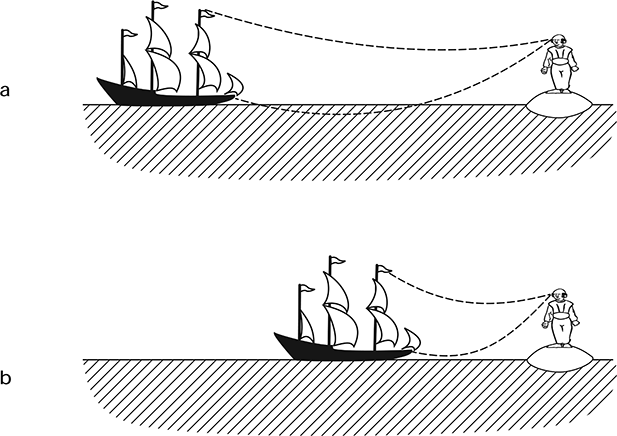
 $T_{F}$ is true—the Earth is flat—but that light sags slightly between the object and the observer, curving down toward the surface of the Earth. At a distance, the light from the hull of the ship may sag down into the water while the light from the mast reaches the observer. Thus, the observer sees the mast even as the hull has passed from view. This situation, depicted in Figure 2, would yield the relevant observation.Footnote 2
(a) Light beams sag between the ship and the observer, so the prow of the ship is occulted by water even as the mast is visible. (b) As the ship approaches, the observer can see both the prow and the mast.

Call the assumption that light travels in a straight line
 $T_{L}$, and call the observation of the mast of the ship when the hull is out of sight O. Although O is offered as evidence of
 $T_{R}$ over against
 $T_{F}$, the best it can do is show that if light travels in a straight line then the Earth is round. One may conclude that this conditional is true, but not that
 $T_{R}$ is true or that
 $T_{L}$ is false.
Cases like this are used to underwrite what is sometimes called the Duhem-Quine (or DQ) Thesis: Theories are not tested in isolation.Footnote 3 As Quine puts it, theories “face the tribunal of sense experience not individually but as a corporate body” (Reference Quine1953, 41). The point may be stated as a lesson about underdetermination. The experiment was aimed to decide between
 $T_{R}$ and
 $T_{F}$. This theory choice is underdetermined for a standard of judgement that denies you the assumption
 $T_{L}$; such a meager standard allows you only to conclude only
 $T_{L}\rightarrow T_{R}$. Worse still—since there is a great deal more to optics than the rectilinear propagation of light—the inference involves still other auxiliary assumptions
 $T_{M}$,
 $T_{N}$, and so on. If the DQ Thesis is correct, then the observation allows you only to conclude the rather uninteresting conditional
 $(T_{L}\,\& \,T_{M}\,\& \,T_{N}\,\& \,\cdots) \rightarrow T_{R}$.
If we treat theory choice as a deductive inference from the evidence, O only yields
 $T_{R}$ given an indefinite number of other assumptions. We might have arrived at this conclusion directly. Let L be the set
 $T_{L},\,T_{M},\,T_{N},\,\ldots $. By hypothesis,
 $(O\,\& \,L) \rightarrow T_{R}$, and there is no
 $M\subset L$ such that
 $(O\,\& \,M) \rightarrow T_{R}$. We observe O. These assumptions validly entail
 $L\rightarrow T_{R}$ but leave
 $T_{R}$ indeterminate. Suspiciously, the conclusion follows without any consideration of the content of L, O, and
 $T_{R}$ and without any reflection on methodology or confirmation.
The crux of the matter is whether standards of responsible judgement should lead you to assume L or treat it as being as much in question as
 $T_{R}$. One might argue that the right standards should promise us certainty.
 $T_{L}$ is open to revision, so conclusions drawn on the basis of it are a fortiori fallible. But no certain knowledge is to be had. Whether we may rely on auxiliary hypotheses to decide between rival theories depends on their actual content and on our epistemic situation. Little more can be said in the abstract. The Duhemian argument seems to fail.
2.1. Finding Duhem in the Duhemian Argument
Although Quine is often cited as having established the force of underdetermination in ‘Two Dogmas of Empiricism’, he writes there that the “doctrine was well argued by Duhem” and offers it without much positive argument (Reference Quine1953, 41, note 17). Admittedly, Duhem does seem to draw a strong conclusion. He writes “that comparison is established necessarily between the whole of theory and the whole of experimental facts” (Reference Duhem1954, 208).Footnote 4 It is important to note, however, that this passage is a quick summary of his position, offered after it had been developed with greater care in prior sections. Moreover, Duhem did not see his holism as entailing any pernicious underdetermination. It does mean that theory choice cannot be a matter of deductive or logical certainty, but it leaves room for fallible theory choice. Duhem explains that “what impels the physicist to act thus is not logical necessity. It would be awkward and ill inspired for him to do otherwise, but it would not be doing something logically absurd” (Reference Duhem1954, 211).
We should, of course, acknowledge that scientific theory choice is not a matter of deduction. It lacks even the plausible pretense of certainty. Duhemian concerns show us that, given a decontextualized standard of judgement, underdetermination is rampant. If there are standards of good sense that allow querists in a context to decide between theories, as Duhem thought, then the underdetermination disappears when we consider choices relative to those standards. Duhem is, I concede, not always as clear on this point as he could be, and commentators have often recapitulated the ambiguity.Footnote 5
Duhem thinks that “good sense” should save the physicist from awkwardness and ill inspiration, but also that
these reasons of good sense do not impose themselves with the same implacable rigor that the prescriptions of logic do. There is something vague and uncertain about them; they do not reveal themselves at the same time with the same degree of clarity to all minds. Hence the possibility of lengthy quarrels between the adherents of an old system and the partisans of a new doctrine, each camp claiming to have good sense on its side, each finding the reasons of the adversary inadequate. (Reference Duhem1954, 217)
This reveals possibilities for underdetermination. On the cusp of controversies, the evidence will be insufficient to settle matters between rival camps—not because many scientists are undecided between rival views, but because good sense is vague enough to permit disagreement. Yet, new evidence is collected, old evidence is reconsidered, and each doctrine is run through its paces. In time, the question may be settled. There is not some instant in time before which the old theory is the reasonable choice and after which the contender is triumphant, but agreement may be secured by an array of new evidence along with the inconstant nudgings of good sense.Footnote 6 Note, however, that this agreement may come about even though the theories in question still rely on auxiliaries, and reasonable disagreement may occur even when the interlocutors agree on the relevant auxiliaries. There is a kind of underdetermination that, as Duhem might say, follows from the vagueness of good sense, but it is neither ubiquitous nor established by scientists’ reliance on background theory.
3. How Auxiliary Theories Make Empirical Equivalence Impossible
In the last decade or so, the prevalence of background assumptions has underwritten arguments against underdetermination—principally in discussions following Laudan and Leplin (Reference Laudan and Leplin1991).Footnote 7 Scientists utilize a host of auxiliary assumptions and collateral information in performing experiments, as is readily seen by considering examples like the one in the previous section. Suppose, then, that two theories L and
 $L^{\prime }$ make no predictions that would allow us to differentiate between them. This empirical equivalence might be taken to warrant a conclusion that the choice between L and
 $L^{\prime }$ is underdetermined. What would the scope of this underdetermination be? It would include our present circumstance, but we may imagine circumstances it would not include. Suppose we learned that
 $(L\rightarrow O) $ and
 $(L^{\prime }\rightarrow \neg O) $ for some observable phenomenon O. The theories would not then be empirically equivalent, and we could responsibly decide between them.
Of course, suitable revision of the rival theories would repeat the underdetermination at the level of theory cum background theory. We would be able to decide between L and
 $L^{\prime }$, but the choice between
 $L\,\& \,(L\rightarrow O) \,\& \,(L^{\prime }\rightarrow \neg O) $ and
 $L^{\prime }\,\& \,(L\rightarrow \neg O) \,\& \,(L^{\prime }\rightarrow O) $ would remain underdetermined. Yet why do we believe
 $(L\rightarrow O) $ and
 $(L^{\prime }\rightarrow \neg O) $? Surely not merely because they would defuse the underdetermination between L and
 $L^{\prime }$! Say that we believe them because they are entailed (with some assumptions about initial conditions) by a well-tested and widely-believed background theory X. We may attempt to cook up some alternate
 $X^{\prime }$ that would enjoy the same empirical support as X but entail
 $(L\rightarrow \neg O) \,\& \,(L^{\prime }\rightarrow O) $, but there is no guarantee that this will be possible. The theory X may have systematic connections to other parts of science, such that any
 $X^{\prime }$ sufficiently different to work here would introduce a panoply of anomalies.
Earman objects to Laudan and Leplin's argument in this way: Either the X appealed to is a contestable hypothesis like L and
 $L^{\prime }$ or it is not. If the former, then the rivals under consideration are no longer L and
 $L^{\prime }$—the rivals are instead
 $(L\,\& \,X) $ and
 $(L^{\prime }\,\& \,X) $. “The result is sidestepped … but that is changing the subject since what counts as the hypothesis has been changed.” If the latter, then X is presumed. This would amount to dogmatism, since auxiliaries like X “must go beyond the empirical evidence … and thus their epistemic status will be just as open to question as that of the [hypotheses]” (Reference Earman1993, 35).
I don't think that there is a sharp point to either horn of this dilemma. First: Even if Earman were right that this changes the subject, that doesn't make it legerdemain. It is perfectly legitimate to substitute a determinable theory choice for an underdetermined one, a tractable problem for an insoluble one.Footnote 8 Second: The problem is soluble, because X does not stand in the same need of justification as L or
 $L^{\prime }$. The auxiliary goes beyond the evidence and so too is open to question—it is not in principle shielded from scrutiny.Footnote 9 What's methodologically crucial is that a community or an individual scientist may hold an accepted background theory fixed for the purpose of some investigation. As Norton (Reference Norton2003) argues, we can't understand inductive inference if we don't recognize the role of material assumptions.
4. The Move to Total Science
At this point, many philosophers are tempted to ask about the choice not between theories but between packages of Total Science. A Total Science is the collected body of all scientific knowledge at a time. Some authors call this a ‘total theory,’ but this is at best misleading. As I argue below, a Total Science is not a scientific theory in any ordinary sense.
Adding a theory T to a given Total Science
 $\mathstrut{\cal S} $ produces a new, different Total Science. Thinking of theories as sets of propositions, one might think of a Total Science as the union of all the theories known to science and think of the combination as
 $\mathstrut{\cal S} \cup T$. Thinking of theories instead as sets of models, one might think of a Total Science as the intersection of known theories and think of the combination as
 $\mathstrut{\cal S} \cap T$. In order to remain neutral between these and more exotic possibilities, let
 $(\mathstrut{\cal S} \oplus X) $ stand for the resultant Total Science when theory or observation X is added to Total Science
 $\mathstrut{\cal S} $.Footnote 10
Let the initial state of Science prior to any knowledge of L,
 $L^{\prime }$, or X be given by
 $\mathstrut{\cal S} $. The choice between
 $(\mathstrut{\cal S} \oplus L) $ and
 $(\mathstrut{\cal S} \oplus L^{\prime }) $ is, by assumption, underdetermined. This underdetermination cannot be resolved by appealing to X. Appeal to X is a non sequitur, since X is not part of the Total Science
 $\mathstrut{\cal S} $. If we learned X from some experiment, then we would transition to a different total science. That choice would be between
 $((\mathstrut{\cal S} \oplus X) \oplus L) $ and
 $((\mathstrut{\cal S} \oplus X) \oplus L^{\prime }) $. It would not be underdetermined, true, but that is a different choice between different Total Sciences. Perhaps the choice of one from
 $\{ (\mathstrut{\cal S} \oplus L),\,(\mathstrut{\cal S} \oplus L^{\prime }),\,((\mathstrut{\cal S} \oplus X) \oplus L),$
 $((\mathstrut{\cal S} \oplus X) $
 $\oplus \: L^{\prime }) \} $is not underdetermined, but that too is beside the point. On this approach, strong conclusions are drawn from underdetermination that obtains between empirically equivalent Total Sciences.
Several authors appeal to Total Science in this way. Quine said, “The unit of empirical significance is the whole of science” (Reference Quine1953, 42). Hoefer and Rosenberg, mindful of Quine, write that “the thesis of underdetermination of theory by evidence is about empirically adequate total science” and conclude rightly “that Laudan and Leplin's arguments for the defeasibility of empirical equivalence have no application in the context of systems of the world”—that is, in the context of Total Sciences (Reference Hoefer and Rosenberg1994, 594, 598). Kukla deploys the notion of Total Science and concludes: “The prima facie case has been stated. The burden of proof is on [defenders of the Laudan and Leplin argument] to show why the total sciences version of the underdetermination argument fails” (Reference Kukla1998, 66).
This can be seen as a reformulation of the Duhemian argument, one that cannot be answered merely by an appeal to fallibilism. Even allowing that it is legitimate to appeal to background theories, empirically equivalent Total Sciences cannot be distinguished by some empirical test because all of the available background theories are already included in each Total Science. At the outset, I said that underdetermination concerned the choice among rival theories. If we substitute Total Sciences for theories, it's hard to make sense of choices—underdetermined or otherwise.
In the remainder of the paper, I offer several argument to undercut the move from theories to Total Sciences.
We could never in any meaningful sense choose between Total Sciences. Querists never face choices between Total Sciences. In actual enquiry, there is some matter in question and other matters presumed. It is possible, of course, that a querist should call some assumption into question. Nevertheless, there is no moment when everything is up for grabs. This means that underdetermination about Total Sciences could have no practical upshot whatsoever. More than that, underdetermination between Total Sciences could not have any part in a methodology we could actually employ. A real method must tell us where to go from here. The underdetermination of Total Science for the abstract querist is at too far a remove from enquiry and methodology to hold lessons for concrete querists like us.
Although our present science is often treated implicitly as a Total Science, it seems likely that actual science doesn't constitute a well-defined Total Science. It is fair to ask what Total Science would look like. Kukla writes that “a total science is nothing more or less than the conjunction of any ‘partial’ theory and all the auxiliary theories that we deem to be permissible. It does not matter which partial theory we begin with—the end result will be the same” (Reference Kukla1996, 143, emphasis added). Yet there is no guarantee that this conjunction either exists or is well-defined. Philosophers’ examples usually take the the form of comparing the usual Total Science with a slight revision of the same; as with the well-worn example of flat space versus curved space with appropriate corrections, we are given single theories as stand-ins for Total Sciences. We are invited to think that a Total Science is something we understand well enough. Since there is a body of scientific knowledge, then its makes sense to think of it collected at a time—right?
Whom would we ask and where would we look if we wished to know the state of Total Science? Perhaps Total Science includes only matters about which all scientists agree. Complete consensus is a rare thing, though, so this would count only the tiniest subset of what might plausibly be billed as scientific knowledge. This may miss the point, since underdetermination of can be taken as a lesson about the situation of an individual querist.Footnote 11 Even so, it is hard to know how the beliefs of a single scientist could be seen as a Total Science. The scientist may have some sense of which beliefs she believes qua scientist and which ones she believes qua citizen or consumer, but this will not be a sharp division. Moreover, what she believes qua scientist may be inconsistent; she believes the theory of relativity, but also quantum mechanics. It is impossible, I suggest, to sum up her beliefs as a Total Science—if she does not believe even one Total Science, why should it matter if she could not decide between several?
Total Sciences could not be compared to evidence, so they could neither be determined nor underdetermined by data. Underdetermination of Total Science is often said to obtain between empirically adequate and equivalent Total Sciences. We can think of these wholly adequate Total Sciences as sciences of the end times, sciences which have answered all empirical questions as adequately as questions can be answered. Thinking in these terms makes it irrelevant that present actual science doesn't constitute a Total Science,Footnote 12 but it exacerbates the disconnect between underdetermination and methodology. Hoefer and Rosenberg concede that “we can never be in a position to know a purportedly empirically adequate total theory is in fact a total theory or empirically adequate. But this epistemological truism does not undercut the conceptual point that two empirically adequate total theories would be nondefeasibly underdetermined by the evidence” (Reference Hoefer and Rosenberg1994, 595).Footnote 13 This conceptual point that some Total Sciences may be “nondefeasibly underdetermined” loses its force if no Total Sciences could ever be defeasibly determined.
The appeal to Total Science precludes the invocation of background theories by packaging the background theories in the rival Total Sciences. Yet since observations, data, and the outcome of our experiments are also part of our Total Science, rival Total Sciences could never be compared against the evidence—there is no evidence outside of the Total Sciences against which they could be compared! Underdetermination of Total Sciences entered our discussion as a radical form of the underdetermination of theory by data, but it seems reasonable to think that only things that can be compared to data can be underdetermined by data.
For there to be a well-defined Total Science, science must be unified in an implausibly strong sense. Kukla suggests that the move to Total Science is sufficient to shift the burden of proof. Yet there is no clear reason why the move should be presumptively legitimate. For the last two decades at least, a growing number of philosophers have argued for a “picture of science as radically fractured and disunified” (Dupré Reference Dupré, Galison and Stump1996, 101).Footnote 14 Perhaps, as Hacking writes, “[t]he unity of science is rooted in an overarching metaphysical thought that expresses not a thesis but a sentiment” (Reference Hacking1996, 44). It is only when we are in the grip of that sentiment that Total Science seems a plausible enough thing to constitute even a prima facie case.
Collecting the various sciences into one Total Science would require not just unity, but unity of a rather extreme kind. The view that science is utterly fractured and disunified is not the only alternative to such monolithic unity. It may be that special sciences are integrated, in the sense that they mesh together where their domains overlap (Farber Reference Farber2000), but that they are not so unified that they can be collected altogether as a Total Science.
Underdetermination seems to suppose that there are two or more maximally good Total Sciences, but there is no guarantee that epistemic virtue provides that kind of ordering relation. Even the unity of science would not necessarily entail the existence of a final, fully adequate Total Science. As Paul Churchland suggests: “Just as there is no largest positive integer, it may be that there is no best theory. It may be that, for any theory whatsoever, there is always an even better theory, and so ad infinitum” (Reference Churchland, Churchland and Hooker1985, 46). If possible states of science stand in an ordering relation such that there is no supremum, then there would be no final sciences—a fortiori not the two or more required for underdetermination.
5. Conclusion
The role of background theories in science ameliorates more than it aggravates problems of underdetermination. Duhemian considerations only amount to pernicious underdetermination if we demand that scientific theory choice be timeless and noncontextual. When we acknowledge that ampliative inference is fallible and contextual, the bugbear is beaten back. Underdetermination slinks away defeated and will not rally even when the banner of Total Sciences is raised.