INTRODUCTION
Soybean, Glycine max (L.) Merr., is an autogamous plant; however, it presents traits for pollinator insect attraction found in allogamous plant species (Juliano Reference Juliano1976; Erickson & Garment Reference Erickson and Garment1979; Arroyo Reference Arroyo, Polhill and Raven1981; Erickson Reference Erickson, Jones and Little1983; Delaplane & Mayer Reference Delaplane, Mayer, Delaplane and Mayer2000; Horner et al. Reference Horner, Healy, Cervantes-Martinez and Palmer2003). Bradner (Reference Bradner1969) stated that all of the breeding components existed for hybrid seed production in soybean, except that a suitable vector for pollen transfer from the male parent to the female parent had not been found. Bee pollinators may be the best means by which pollen can be transferred between parents. There are more than 3500 species of bees in North America (Smith-Heavenrich Reference Smith-Heavenrich1998). Only a small number of these species are social, living together in manageable colonies and most species are solitary. Both solitary and social species are important in crop pollination, but the social species are more easily managed. The honey bee, Apis mellifera (L.), represents the most highly-developed example of social organization in bees. Its complex division of labour is made possible through the development of communication, and ongoing food inter-exchange and stimulation provided through body contact (Stephen et al. Reference Stephen, Bohart and Torchio1969). In contrast, solitary bees live alone or exist in groups or colonies in which each female builds and provisions her nest without assistance from other bees (Stephen et al. Reference Stephen, Bohart and Torchio1969).
Compared to honey bees, some wild bees have proved to be more efficient pollinators of certain crops because of unique and desirable behaviours. For example, Southeastern blueberry bees, Hapropoda laboriosa (F.), buzz-pollinate blossoms by shaking pollen from the flower with high-frequency muscle vibrations. For blueberry, this greatly improves pollination efficiency (Cane & Payne Reference Cane and Payne1988). One solitary bee used for commercial crop pollination is the alfalfa leafcutting bee, Megachile rotundata (F.), which is extensively employed for the production of alfalfa seed (Pedersen et al. Reference Pedersen, Bohart, Marble, Klostermeyer and Hanson1972). The efficiency of honey bees and alfalfa leafcutting bees as pollinators in soybean has been described with contrasting results. Roumet & Magnier (Reference Roumet and Magnier1993) evaluated the aptitude of alfalfa leafcutting bees to pollinate ms2ms2 soybean male-sterile plants in caged plots. They reported that alfalfa leafcutting bees were effective in producing high quantities of hybrid seed. Soybean ms2ms2 male-sterile, female-fertile plants are mutants that lack the ability to produce viable pollen; the male sterility is controlled by a single recessive allele and it is due to an abortion of tetrads. Callose dissolution and initiation of microspore walls do not occur, sterile anthers are found to be completely empty at maturity and they are morphologically distinct from fertile anthers (Graybosch et al. Reference Graybosch, Bernard, Creemens and Palmer1984). Koelling et al. (Reference Koelling, Kenworthy and Caron1981) did not observe significant differences in seed production on ms2ms2 male-sterile soybean plants using either honey bees or leafcutting bees as pollinators. Both bee species were equally effective as pollinator vectors to produce seed on male-sterile soybean plants. Zhao et al. (Reference Zhao, Sun, Ma and Huang1999) found that both species (honey bees and alfalfa leafcutting bees) increased seed-set on ms2ms2 soybean male-sterile plants evaluated in caged plots.
Lewers et al. (Reference Lewers, St. Martin, Hedges, Widrlechner and Palmer1996) used three planting patterns to evaluate outcrossing in ms6ms6 soybean plants under open-field conditions, with honey bees as pollinator. Soybean ms6ms6 plants are male-sterile, female-fertile mutants unable to produce normal pollen. The male sterility is controlled by a single recessive allele. Male-sterile plants (ms6ms6) have smaller flowers (compared to normal type), reduced, shrunken anthers, degenerating microspore tissue imprisoned in locules and a lack of normal pollen in the anthers. A pleiotropic effect of the ms6 allele on flower size and a close linkage of the ms6 allele with the w1 locus (flower colour) are unique traits for this male-sterile, female-fertile mutant (Skorupska & Palmer Reference Skorupska and Palmer1989; Palmer & Lewers Reference Palmer and Lewers1998). Environmental conditions were observed to strongly influence the honey bee efficiency as pollinator and seed-set varied considerably from year to year. For example, the lowest seed-set (1·7 seeds/male-sterile plant) occurred in 1993, whereas the highest seed-set (41·8 seeds/male-sterile plant) occurred in 1994 (Lewers et al. Reference Lewers, St. Martin, Hedges, Widrlechner and Palmer1996). Another male-sterile soybean line evaluated for seed-set is male-sterile ms1ms1, which presents defects in cytokinesis following telophase; the four-nucleate microspores develop a pollen-like wall and become engorged with lipid and starch reserves (Brim & Young Reference Brim and Young1971; Albertsen & Palmer Reference Albertsen and Palmer1979).
Pollinator behaviour and efficiency under caged conditions may have little or no relevance to pollinator behaviour and efficiency under open-field conditions. Evaluation for economical hybrid soybean seed production requires research to be conducted under field conditions. The objective of the present study was to evaluate seed-set on male-sterile, female-fertile soybean lines by using alfalfa leafcutting bees and honey bees as pollinators under field conditions for three growing seasons at two locations.
MATERIALS AND METHODS
Plant materials
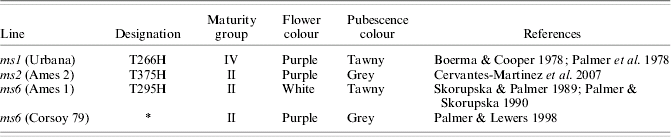
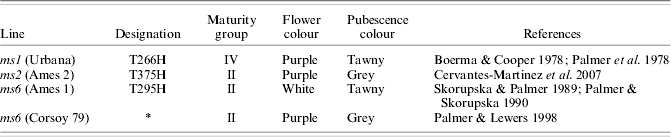
Four soybean lines obtained from the USDA Soybean Genetic Type Collection (USDA-ARS, Urbana, Illinois, USA) were evaluated. The Soybean Genetic Type Collection comprises strains with qualitative genetics traits. These strains are assigned T numbers, where an H suffix indicates that the allele is carried in the heterozygote (Table 1). Two lines segregating for male sterility at the ms1 and ms2 loci and two others segregating for the ms6 locus were evaluated for hybrid seed-set (Table 1). The lines are of maturity groups (MGs) II and IV. MG refers to the responsiveness of different cultivars to photoperiod, which affects the time to flowering and maturity. Cultivars are usually placed in one of 13 groups. MG 000 is the designation for the earliest cultivars. The latest MG is X (Whigham & Minor Reference Whigham, Minor and Norman1978). Three lines had purple flowers and one had white flowers. Two lines displayed grey pubescence, and two had tawny pubescence (Table 1). These lines were selected based on high seed-set or low seed-set observed in previous experiments (Ortiz-Perez et al. Reference Ortiz-Perez, Horner, Hanlin and Palmer2006). The cultivar ‘Apex’ was used as the pollen donor for all male-sterile lines. ‘Apex’ is a MG III soybean with white flower colour and tawny pubescence.
Male-sterile, female-fertile soybean lines evaluated for seed-set at Ames, IA in 2003 and 2005, and at Wooster, OH in 2003, 2004 and 2005
* Near-isogenic line segregating at the ms6 locus (from T295).
Field experiments
A randomized complete block design (RCBD) with four replications per male-sterile line was used. The lines were grown at the Bruner farm near Ames, Iowa, USA in summers 2003 and 2005 and at the Ohio Agricultural Research and Development Center (OARDC) farm near Wooster, Ohio, USA during summers 2003, 2004, and 2005. Each year, the lines were grown in four-row plots, 3 m long, with 0·76 m between rows and 0·60 m between plots. The two centre rows were the female rows and the two outside rows were the male parent, ‘Apex’. Seeds were planted at 46 seeds/m2. Each experiment was surrounded by eight rows of ‘Apex’. At the Ames location (Clarion–Nicollet loam soil type), at flowering stage R1 (Fehr et al. Reference Fehr, Caviness, Burmood and Pennington1971; i.e. the reproductive stage in soybean plants in which one flower can be observed at any node), alfalfa leafcutting bee domiciles were placed in alley-ways surrounding the plots. The domiciles contained alfalfa leafcutting bee pupae. The bees emerged as adults 2 days later. Hobbs (Reference Hobbs1967) stated that alfalfa fields could be thoroughly pollinated in 3 weeks with about 96 000 leafcutting bees/ha. For new seedlings, 50 000 leafcutting bees/ha were recommended and for established stands, 100 000 leafcutting bees/ha were required for good pollination (Baird & Bitner Reference Baird and Bitner1991). Although there is no established density for alfalfa leafcutting bees to pollinate soybean, a conservative number was chosen based on the total land area used in the experiment. Thus, five domiciles were placed at the north end of the plots, facing south. Altogether, around 3000 alfalfa leafcutting bees were released, where the sex ratio was 2:1 males to females (Peterson et al. Reference Peterson, Baird and Bitner1992). For the control entries, the experimental design and replications was the same as described for the plots with alfalfa leafcutting bees and honey bees. The control entries consisted of the same male-sterile lines without alfalfa leafcutting bee domiciles or honey bee hives placed at flowering time. To ensure that the seed-set observed was the result of true insect pollination, at the beginning of flowering R1 (Fehr et al. Reference Fehr, Caviness, Burmood and Pennington1971), the male-sterile plants were sprayed with insecticide. The active ingredient was composed of the synthetic pyrethroid lambda-cyhalothrin and dimethylcyclopropanecarboxylate, applied at a rate of 200 ml/ha, with 10-day intervals between applications. This was continued until the flowering period R2 (Fehr et al. Reference Fehr, Caviness, Burmood and Pennington1971) ended. R2 is the reproductive stage in soybean plants where flowers at the node immediately below the uppermost node with a completely unrolled leaf can be observed. At flowering R2 (Fehr et al. Reference Fehr, Caviness, Burmood and Pennington1971), the male-sterile plants were identified by the absence of pollen production and were labelled. Male-fertile siblings were cut out. After removing male-fertile sibling plants, final stands averaged 7–10 male-sterile plants/m. Flowering extended for 33–39 days, depending upon the year. Once flowering ended, the domiciles were removed. At maturity R8 (Fehr et al. Reference Fehr, Caviness, Burmood and Pennington1971), i.e. the reproductive stage in soybean plants where 0·95 of the pods are brown (called harvest maturity), the numbers of pods and seeds per male-sterile plant were recorded.
For the honey bee experiment at Ames, plant materials and procedures for the male-sterile plants were the same as for the alfalfa leafcutting bee experiment. The density of honey bees used to pollinate soybean varies from 7 to 12 hives/ha (Manning Reference Manning1998). According to this information, four single-storey honey bee hives were established in the honey bee experiment, each single-storey containing around 6000 bees. Two hives were placed at the north end of the plots and two hives were placed in the centre alleys of the plots, all entrances facing to the south. The same number of hives was used for both seasons. Irrigation was applied for both seasons before flowering at stage V4 (Fehr et al. Reference Fehr, Caviness, Burmood and Pennington1971), which occurs when N number of nodes on the main stem (beginning with the unifoliate node) can be observed and at maturity when appropriate.
At Wooster (Wooster silt loam and Ravenna silt loam soil), alfalfa leafcutting bee boards were placed in alley-ways surrounding the plots at flowering stage R2 (Fehr et al. Reference Fehr, Caviness, Burmood and Pennington1971). The boards contained around 10 000 bee pupae, which were preincubated at 22°C for 3 days, after which they were incubated at 30°C for 4 days. The experimental design and number of replications were the same as at Ames. The control entries were treated the same way as the procedure described for Ames. Male-sterile plants were identified by absence of pollen production and were labelled. Male-fertile siblings were cut out. At maturity R8 (Fehr et al. Reference Fehr, Caviness, Burmood and Pennington1971), the number of pods and seeds per male-sterile plant also were recorded. The alfalfa leafcutting bee boards were removed at harvest.
For the honey bee experiment, plant materials and procedures for the male-sterile plants were the same as described previously for Ames. Unlike at the Ames location, one honey beehive containing around 50 000 workers was placed in the middle of the plots. Irrigation was applied before flowering at stage V4 (Fehr et al. Reference Fehr, Caviness, Burmood and Pennington1971) only in 2005.
The studies were conducted under open-field conditions and the experimental plots were at the same farm but separated from each other by a distance of 510 m between the alfalfa leafcutting bee plots and the honey bee plots. The separation was necessary to minimize any confounding effects regarding any mixing or overlapping of the two bee species foraging in the same field. Leafcutting bees are efficient; 150 of these bees can do the work of 3000 honey bees (Smith-Heavenrich Reference Smith-Heavenrich1998); thus, the ratio of alfalfa leafcutting bees to honey bees was smaller at both locations.
Maximum and minimum air temperature, rainfall and relative humidity throughout the growing seasons were obtained from the Iowa Environmental Mesonet (IEM) for the Ames experiments, and from the OARDC for the Wooster experiments.
Statistical analysis
Data were subjected to Analysis of Variance with PROC GLM of SAS (SAS 2003). A RCBD was used, where the linear model was:

where μ=the general mean; Y i=the effect of the ith year; L j=the effect of the jth location; YLij=the interaction effect between the ith year and the jth location; B k=the effect of the kth pollinator species, YBik=interaction effect between the ith year and the kth pollinator species, LBjk=interaction effect between the jth location and the kth pollinator species; YLBijk=interaction effect of the ith year, the jth location, and the kth pollinator species; S l=the effect of the lth male-sterile line; YSil=the interaction effect between the ith year and the lth male-sterile line; LSjl=the interaction effect between the jth location and the lth male-sterile line; YLSijl=the interaction effect between the ith year, the jth location, and the lth male-sterile line.
A factorial design was conducted where replications, locations and years were treated as random factors. Male-sterile lines and pollinator species were treated as fixed factors. The mean number of seeds per male-sterile plant across lines was compared across years and locations. The fixed effects of male-sterile lines and pollinator species were tested by using the expected means squares as error terms from their interaction effects with years and locations. Effects were considered significant in all statistical calculations when P<0·05.
RESULTS
Due to the differences in the years of data collection at the two locations (Ames in 2003 and 2005; Wooster in 2003, 2004 and 2005), the data were analysed separately for each location. At Ames, the combined analysis of variance for seed-set across years indicated significant differences for the effects of male-sterile lines and the interaction effect of year×male-sterile line. The effects of years and pollinator species and the interaction effect of year×pollinator species were not significant (data not shown). At Wooster, the effects of years and male-sterile lines and the interaction effect of year×pollinator species were significant. The effect of pollinator species was not significant for any year or location.
Ames
Environmental effects and seed-set
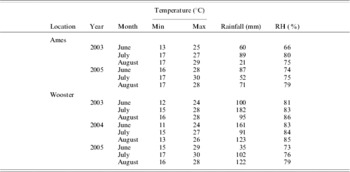
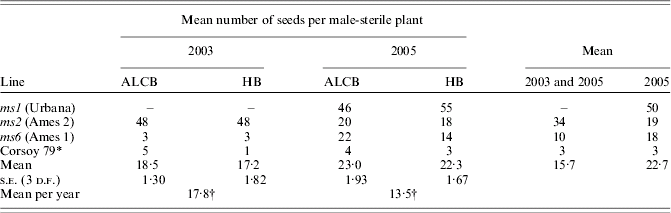
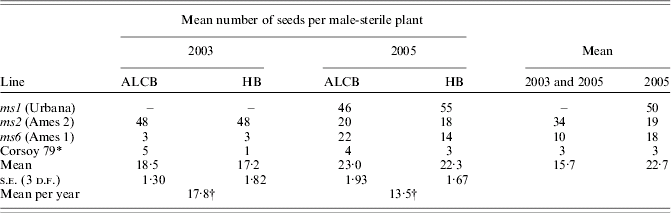
Total rainfall and relative humidity were slightly higher at flowering time (July) in 2003 than in 2005 (Table 2). The maximum average air temperature was slightly higher during June and July 2005. Nonetheless, significant departure from the normal values for these variables was not observed. The grand mean across the lines evaluated within each year across pollinator species was 18 seeds per male-sterile line for 2003; for 2005 it was 13 seeds per male-sterile line (Table 3).
Monthly means of minimum (Min) and maximum (Max) air temperature, rainfall and relative humidity (RH) from 1 June to 31 August at Ames, IA in 2003 and 2005 and at Wooster, OH in 2003, 2004 and 2005

Mean number of seeds per male-sterile soybean plant by using alfalfa leafcutting bees (ALCB) and honey bees (HB) as pollinators at Ames, IA in 2003 and 2005
* Near-isogenic line segregating at the ms6 locus (from T295).
† Average mean across the lines evaluated within each year across pollinator species.
A wide range of values was observed for seed-set among the male-sterile lines. Although the control male-sterile plants were sprayed with insecticide to avoid the presence of pollinators, a few seeds were observed in the male-sterile entries (data not presented). The few seeds were assumed to be the result of cross-pollination. Averaged over years, the effect of male-sterile line on seed-set was significant. In 2005, the ms1 (Urbana) male-sterile line had the highest mean value (50 seeds per male-sterile plant) followed by ms2 (Ames 2) with 19 seeds per male-sterile plant, and ms6 (Ames 1) with 18. The lowest mean for seed-set (3 seeds per male-sterile plant) was observed in the line Corsoy 79 segregating for male sterility at the ms6 locus (Table 3). For the latter, the mean value for seed-set had minimal variation across years (Table 3). The line ms6 (Ames 1) presented one of the lowest means for 2003, but its mean value for seed-set in 2005 was much higher (nearly six-fold over 2003) (Table 3). On the contrary, ms2 (Ames 2) had higher seed-set (48 seeds per male-sterile plant) across pollinators in 2003 compared with 19 seeds per male-sterile plant across pollinators in 2005. This variation contributed to the significant interaction effect of year×male-sterile line.
Pollinator species
During flowering time when the plants were scored for male fertility and male sterility, bee activity on soybean flowers was observed for both pollinator species. These observations were made on a daily basis for at least 3 weeks. In the case of the alfalfa leafcutting bees, it was difficult to observe pollen transfer because the pollen load is carried on the abdomen. Alfalfa leafcutting bees were observed foraging actively in the north end of the plots at the beginning of the flowering season and plants started to flower first in that area. In the honey bee plots, foraging activity was also observed in the north end of the plots. The honey bees were able to maintain the colony and produced an excess of honey (from 2 to 3 frames).
The direct effect of pollinator species and the interaction effect of pollinator species×year were not significant. The ranking for seed-set among the evaluated lines was the same regardless of pollinator species (Table 3). Averaged across years and male-sterile lines, the mean number of seeds per male-sterile line for the plots pollinated by alfalfa leafcutting bees was 21 and was 20 for the plots pollinated by honey bees.
Wooster
Environmental effects and seed-set
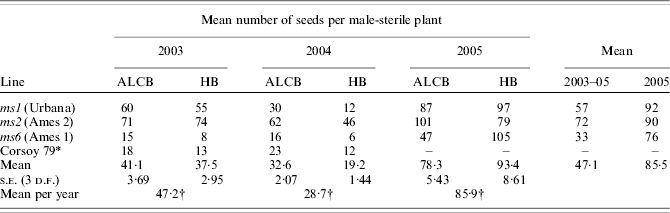
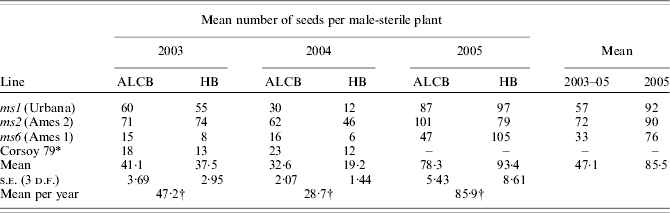
In 2003 and 2004, maximum air temperature and relative humidity were very similar. In 2004, rainfall was almost half of that observed at flowering time (July) in 2003 (Table 2). The 2005 season was slightly warmer and dryer, and total rainfall was less during the growing season when compared with 2003 and 2004 (Table 2). However, unlike 2003 and 2004, the plots for both experiments were irrigated in 2005 before flowering, at stage V4 (Fehr et al. Reference Fehr, Caviness, Burmood and Pennington1971). Notably, a large increase in seed-set was observed in 2005. The mean seed-set for 2005 across lines was 86 seeds per male-sterile line, followed by 47 and 29 seeds per male-sterile line in 2003 and 2004, respectively (Table 4). The results observed in the control entries were comparable to Ames, where cross-pollinated seed-set was very low and mainly vestigial pods where observed.
Mean number of seeds per male-sterile soybean plant by using ALCB and HB as pollinators at Wooster OH in 2003, 2004 and 2005
* Near-isogenic line segregating at the ms6 locus (from T295).
† Average mean across the lines evaluated within each year across pollinator species.
The main effect of male-sterile lines on seed-set was significant. Averaged over all 3 years and pollinator species, the male-sterile line ms2 (Ames 2) presented the highest mean value followed by ms1 (Urbana); the lowest mean was observed in the line ms6 (Ames 1) (Table 4). The effect of year was significant, thus separate analyses of variance were conducted for each year. A significant interaction effect of year×male-sterile line was observed, but the ranking of the lines was not affected in 2003 and 2004 where the mean seed-set for each year was similar. For 2005, the year with the highest seed-set for all lines, significant differences between ms1 (Urbana), ms2 (Ames 2) and ms6 (Ames 1) were not observed. This was in contrast to 2003 and 2004 when seed-set on ms6 (Ames 1) produced significantly lower seed-set, suggesting a strong year effect.
Pollinator species
Foraging alfalfa leafcutting bees and honey bees were not recorded on a regular basis. However, honey bees or alfalfa leafcutting bees were seen actively foraging in the soybean plots. As observed at Ames, the soybean plots were blooming at a time when little else was flowering in the surrounding area. It was assumed that the pollinator species mostly foraged in the soybean plots. The bee populations of either species did not decrease; the honey bees were able to maintain the colony, but did not store surplus honey.
The effect of pollinator species was not significant for any of the 3 years. The mean across years for number of seeds per male-sterile line for the plots with alfalfa leafcutting bees was 51 and for the plots with honey bees, the mean number of seed per male-sterile line was 50. The plots with alfalfa leafcutting bees presented a higher mean than the plots with honey bees in 2004 only (Table 4). This accounted for the significant interaction effect of pollinator species×year, although the ranking for seed-set among the evaluated lines was the same regardless of pollinator species.
DISCUSSION
Environments and seed-set
The overall seed-set on male-sterile plants was higher at Wooster than at Ames. Environmental conditions characterized by warm temperatures (within the range for normal soybean plant development) were observed at both locations. However, Wooster had more rainfall during the growing seasons than did Ames. The experimental plots at Ames were irrigated both seasons; thus, it is unlikely that such difference in performance was due to water stress. The plots at Wooster were irrigated only early in the 2005 growing season. Sweeney et al. (Reference Sweeney, Long and Kirkham2003) reported that yield increases in early maturity irrigated soybean were only 20% compared with non-irrigated plots and would probably be less when environmental conditions were favourable. In the present study, the highest seed-set for the study was observed in 2005, the only season the Wooster location was irrigated.
Seed-set on the male-sterile plants is dependent upon cross-pollination, thus environmental factors that affect pollinator activity are important. Significant seed-set was not observed in the control entries (male-sterile lines in absence of pollinators and insecticide sprays applied). The plant–pollinator interaction is very complex and it is influenced by both biotic factors (i.e. floral structure, timing of anthesis and quantity and quality of floral rewards) (Erickson Reference Erickson1975; Corbet Reference Corbet1990) and abiotic factors (i.e. temperature, wind and solar radiation) (Corbet Reference Corbet1990). Robacker et al. (Reference Robacker, Flottum, Sammataro and Erickson1983) stated that environmental conditions which promoted greater flower production, larger flower size, more intensely coloured flowers and higher nectar secretion favoured greater attractiveness to pollinators. In the present study, the higher seed-set observed at Wooster could certainly be influenced by fixed environmental conditions such as soil type, fertility, etc. In soybean, it has been reported that nectar secretion increases with increased air and daytime soil temperature and soil nitrogen and decreases with increasing soil phosphorus levels (Robacker et al. Reference Robacker, Flottum, Sammataro and Erickson1983). Differences among locations in those conditions could affect the performance of the pollinator species through the differences in the amount and quality of the reward (nectar and pollen) obtained. Similarly, a meta-analysis of published research on relationships between plant rewards and bee visitation by Widrlechner & Senechal (Reference Widrlechner and Senechal1992) indicated that intraspecific differences in floral display and rewards often were positively correlated to observed levels of bee activity.
In the present study, the mean seed-set observed across male-sterile lines, years and locations was higher than that previously observed (Ortiz-Perez et al. Reference Ortiz-Perez, Horner, Hanlin and Palmer2006). In the studies conducted by Ortiz-Perez et al. Reference Ortiz-Perez, Horner, Hanlin and Palmer2006, soybean lines segregating for male sterility at 10 different loci were evaluated by using alfalfa leafcutting bees as pollinator at Ames. One difference in the study by Ortiz-Perez et al. (Reference Ortiz-Perez, Horner, Hanlin and Palmer2006) was that male-fertile sibling plants were not cut out, so plant density was higher. In the present study, removing the fertile sibling plants resulted in a wider spacing between male-sterile plants, which could contribute to higher out-crossed seed-set per plant. Roumet & Magnier (Reference Roumet and Magnier1993) reported that widely spaced male-sterile soybean plants segregating for the ms2 locus presented flowers on lateral inflorescences later in the season compared to the central inflorescence flowers. In this way, an extended flowering period (cross-pollination) and consequently higher seed-set was obtained. In their study, Ortiz-Perez et al. (Reference Ortiz-Perez, Horner, Hanlin and Palmer2006) used as male parents the fertile siblings of their male-sterile lines, which could cause an unfavourable effect. In the present study, a commercial unrelated line (Apex) was used as male parent. The levels of seed-set in studies reported in the literature and in the present study indicate that insect transfer of pollen may not be the limiting factor in producing economical levels of hybrid soybean seed.
The seed-set observed in the line ms1 (Urbana) across years and locations was similar to that reported by Graybosch & Palmer (Reference Graybosch and Palmer1988), who used alfalfa leafcutting bees and honey bees as pollinators. The rankings for seed-set observed in the present study for ms2 (Ames 2) and ms6 (Ames 1) are also in agreement with previous research (Ortiz-Perez et al. Reference Ortiz-Perez, Horner, Hanlin and Palmer2006), where lines carrying ms2 (Ames 2) and ms6 (Ames 1) produced the highest and lowest seed-set, respectively, although the overall seed-set for both lines in their study was lower than that reported in the present study.
Pollinator species
Comparisons of the performance of alfalfa leafcutting bees and honey bees as pollination vectors have been conducted at least since the mid-1970s. The successful use of alfalfa leafcutting bees and honey bees as pollinators in soybean male-sterile plants has been reported (Koelling et al. Reference Koelling, Kenworthy and Caron1981; Graybosch & Palmer Reference Graybosch and Palmer1988; Roumet & Magnier Reference Roumet and Magnier1993; Zhao et al. Reference Zhao, Sun, Ma and Huang1999). However, these studies were conducted with caged plots. Abrams et al. (Reference Abrams, Edwards and Harris1978) studied the effects of honey bees and alfalfa leafcutting bees on three soybean commercial cultivators in Indiana. Alfalfa leafcutting bees experienced almost 60% reduction in their population, and visitation to soybean flowers was observed to be minimal. With honey bees the colony experienced at least a two-fold increase in population, but the out crossing rate was very small, and no significant increases in seed yield were recorded.
In the present study, no significant differences were found between the two pollinator species based on seed-set in either year or location under open-field conditions. Environmental factors and health conditions for both alfalfa leafcutting bees and the honey bees were favourable, which should have given both pollinator species relatively equal opportunities to forage. The years when the experiments were conducted did not present extreme high or low temperatures that could affect the foraging behaviour of either species. No parasitism or disease was detected on the bees and water supply was appropriate. The population of both pollinator species at Wooster was higher than those at Ames, which could have had an effect on the higher seed-set produced at Wooster. However, putting an excess number of bee colonies in soybean plots apparently does not have a discernable effect in increasing the pollination rate and seed-set (J. Tew, personal communication, 2006).
Alternatively, the presence of additional pollinators (other wild bee species) at Wooster may also have played some role, but there is no data to evaluate this possibility. Pollinator-specific preference patterns for male-sterile lines were not observed; i.e. the male-sterile lines that produced the highest seed-set in the alfalfa leafcutting plots were the same as those that produced the highest seed-set in the honey bee plots. The cultivar ‘Apex’ was used as the pollen donor for all male-sterile lines at both locations, which provided pollen and nectar, while for the male-sterile lines, nectar was the only source of food for pollinators.
There seems to be a basis for preferential foraging by honey bees in relation to soybean nectar carbohydrate composition (Severson Reference Severson1983; Erickson Reference Erickson1984) and concentration (Sheppard et al. Reference Sheppard, Jaycox and Parise1979). A basis for preferential foraging in soybean by alfalfa leafcutting bees in relation to floral rewards has not been reported. However, the results of the present study indicate that soybean lines offered floral rewards that equally attracted (as evidenced by higher seed-set) or discouraged (as evidenced by lower seed-set) both pollinators. However, neither nectar composition nor quantity were measured in the present experiments, because the main objective first was to establish any differential efficiency among pollinators as monitored through seed-set.
Seed-set on four male-sterile, female-fertile soybean lines was evaluated at two locations and 3 years by using two insect pollinator insect species. Significant differences for seed-set among male-sterile lines were observed. Differences in seed-set between the two locations were also evident. Both locations presented similar temperature patterns for normal soybean plant development. However, differences in environmental conditions, such as soil type and fertility, which can affect plant development along with pollinator performance, could have caused differences in seed-set among locations. In the present study, honey bees performed similarly to alfalfa leafcutting bees; neither the effect of pollinator species nor the interaction effect of pollinator species×location were significant for any year. Relative costs and local conditions need to be addressed to support the choice of either pollinator species as a pollination vector to produce hybrid soybean seed.
We thank Drs Kenneth Moore and Mark Widrlechner (ISU, USDA-ARS) for their suggestions and assistance. The assistance and technical support by Sharon McClurg is much appreciated. We also thank Dairyland Seed Co., Inc. and Verde Seed Co., Inc. for partial support of this project. Thanks are due to Dr R. L. Nelson, the Curator of the Soybean Genetic Type Collection.