I. INTRODUCTION
The Canadian Jesuit Bernard Lonergan (1904–1984) is a major figure in Catholic philosophical theology. He has been described as the greatest Catholic theologian since St. Thomas Aquinas, and Time magazine in 1970 billed him as “the finest philosophic thinker of the 20th century” on the basis of his great theological works Insight: A Study of Human Understanding and Method in Theology. Footnote 1 Lonergan was unusual among theologians in having expertise in mathematics and an up-to-date knowledge of economics. He was not only knowledgeable about economics but spent considerable time in the 1940s developing his own dynamic multisectoral macroeconomic model, which he continued to refine in the 1970s and taught to students at Harvard, Boston College, and various Catholic institutions. This economic research, which was not published in his lifetime, has only recently become widely available in two volumes of his Collected Works (Lonergan Reference Lonergan and McShane1998, Reference Lonergan, Lawrence, Byrne and Hefling1999a). It raises historical questions about the relationship of his economic modeling to Adam Smith, Karl Marx, John Maynard Keynes, Friedrich Hayek, and Joseph Schumpeter, whose works he read in the 1940s, and to Michal Kalecki and the post-Keynesians, whose work he saw as close to his own when he returned to economics in the 1970s.Footnote 2 Many Lonergan scholars believe there is continuing value in his economic model, but his work has not been properly contextualized in the history of economics. Neither have the claims of Lonergan scholars about the novelty and continuing value of his model been seriously tested by economists: for instance, the suggestion of Patrick Brown that we make a new beginning in economic theory working on the basis of Lonergan’s macrodynamic model; or the claims of Philip McShane in his introduction to the manuscript entitled For a New Political Economy that Lonergan offers an entirely different economics that has the potential to deal with many of our pressing real world economic problems.Footnote 3 Lonergan’s foray into economics also raises interesting questions about the relationship between economic and theological research. For instance, Jane Collier wrote that Lonergan shows “doing theology requires openness to other disciplines” and Lonergan’s later writings offer a “‘metamethod’ which structures the parameters of all disciplinary endeavour.”Footnote 4
This paper begins by locating Lonergan’s economic research within his overall intellectual project, considering why he devoted so much time to economics. The early twentieth-century contexts in Catholic social teaching and economic problems of the 1930s are important for understanding his economic research. Some differences of approach compared with contemporary mainstream economics are noted. I then describe Lonergan’s core economic model, which is not straightforward as there are several versions and the terminology and mathematical notation are idiosyncratic. Lonergan’s economic work will be brought into dialogue with contemporary macroeconomic modeling, especially post-Keynesian work on expectations and endogenous money, and Lonergan’s novelty and continuing contribution to economic research will be assessed.
II. HISTORY AND THE FREE ECONOMY AS FOUNDATIONS FOR LONERGAN’S ECONOMIC RESEARCH
Lonergan’s interest in economics grew from his broader concern with history and social theory in Catholic theology. He worked to develop an alternative account of history to those of Georg Hegel and Karl Marx, though he was equally unsatisfied with liberal accounts of history. Like Marx, he saw that economics was necessary for such a history, and wrote that “any reflection on modern history and its consequent crisis in the West reveals unmistakably the necessity of a Summa Sociologica” to complement Thomas Aquinas’s Summa Theologica (Lonergan Reference Lonergan1991, p. 156). Lonergan’s economic research was a contribution to the economic component of such a Summa, and ultimately to Catholic social action.
In Lonergan’s view, economics without a proper theological framework is problematic, as is theological engagement with the modern world, which ignores economics. His desire to build a formal economic model grew from dissatisfaction with Catholic social teaching of his time, which lacked a proper understanding of economics, as he wrote that “common sense is unequal to the task of thinking on the level of history” (Lonergan Reference Lonergan, Crowe and Doran1992, p. 253). Catholic social teaching and action, in his view, needed to be informed by better economic theory. Economics also needs a larger philosophical or theological framework; for Lonergan, “the empirical science of economics … must be informed by a theological reflection to provide adequate interpretation of the whole economic and historical process” (Hoyt-O’Connor Reference Hoyt-O’Connor2009, p. 12).
Lonergan’s economics, like his theology, stressed the importance of human freedom. His argument that liberal capitalism and Marxism do not do justice to the transcendence of the human person is a critique of their faulty accounts of human freedom. He saw Marxism as another faulty solution that effectively eliminates freedom, seeking to force people to be good. In Lonergan’s view, providing a sustainable standard of living for all requires democracy, which he understands as participatory and nourished by education. This allows for the free exchange of ideas, provides greater incentives for innovation, and properly utilizes available information and intelligence. While Lonergan values human freedom, he also recognizes a proper role for the state in relation to the economy.
For Lonergan, an adequate economic theory contributes to democracy by helping individuals and governments understand how economies function, especially how business cycles actually work. He wants to educate citizens in a democratic society to make wise decisions appropriate to the situation of the economy, towards the common good. Not all seek the common good, but if citizens lack understanding of how economies work, then even those seeking the common good will not know how to choose wisely. Part of his concern was that a failure to understand the economic processes leaves society vulnerable to crises that open the way for undemocratic forces.
III. THE DEPRESSION AS STIMULUS FOR LONERGAN’S ECONOMIC RESEARCH
The specific stimulus for Lonergan’s economic modeling in the 1940s was the Great Depression. He could not accept that the social devastation he had observed was necessary.
At the same time the limitations of traditional Catholic social teaching on economic matters became evident to him. One of his philosophy teachers, Lewis Watt, put the question of the compatibility of some aspects of Catholic teaching and the survival of capitalism particularly clearly.Footnote 5 Employers seeking to provide a living wage sufficient to support a family could end up out of business and their workers unemployed with no wage at all. This dilemma led Lonergan to wonder whether a problem with Catholic social teaching was that the moral precepts being offered were not grounded in a proper understanding of economics, which meant that church statements on economic questions remained inconsequential or unhelpful.Footnote 6
Lonergan began to immerse himself in economic literature, as his theological teaching and research in Rome and Montreal in the 1930s allowed. We know from notes that are preserved among his papers at Regis College in Toronto that he read the English classical economists: Karl Marx’s Capital; John Maynard Keynes’s General Theory of Employment, Interest and Money; Lionel Robbins’s Essay on the Nature and Significance of Economic Science; Frank Knight’s Risk, Uncertainty, and Profit; Erik Lindahl’s Studies in the Theory of Money and Capital; and Friedrich Hayek’s Monetary Theory and the Trade Cycle, among others. Perhaps the most significant economist for the development of his own thought was Joseph Schumpeter, whose Theory of Economic Development and Business Cycles he read and annotated profusely. Reading these works in the light of the approach to history he had worked out in the previous decade convinced him that the key task of economics was to explain the booms, slumps, and crashes of the business cycle. From this understanding of the dynamics of a capitalist economy, he hoped more satisfactory moral precepts would emerge.
This conviction led to two manuscripts on economics. The first was written around 1942, subsequently misplaced only to be rediscovered after Lonergan’s death in 1986 by his friend Eric Kierans, and was published in 1998 as For a New Political Economy, volume 21 of the Collected Works of Bernard Lonergan. The second manuscript, his 1944 Essay on Circulation Analysis, which presented a detailed model of the economic process, was available only in various Lonergan archives around the world until published in 1999 as Macroeconomic Dynamics: An Essay on Circulation Analysis, volume 15 of the Collected Works of Bernard Lonergan. Soon after the Essay on Circulation Analysis was completed, Lonergan sought feedback on the manuscript through friends from economists, only to find a mixture of disinterest in and puzzlement at what he was trying to do.Footnote 7 This led him to shelve economic modeling and turn fully to his theological and philosophical work, culminating in the publication of Insight in 1957 and Method in Theology in 1971.
In the 1970s, however, stirred to action by reading Johann Baptist Metz and Gustavo Gutiérrez, and still dissatisfied with economic knowledge among Catholic theologians, Lonergan returned to his 1944 manuscript and reworked it as the text for annual seminars he taught on economics at Boston College from 1978 until 1983. The published version, Macroeconomic Dynamics: An Essay on Circulation Analysis in volume 15 of the Collected Works of Bernard Lonergan, reflects the reworking of the original manuscript during those years. Lonergan began to see strong parallels to his own project in the writings of Polish economist Michal Kalecki and the post-Keynesian economists. Lonergan’s main sources at this time were Kalecki’s Selected Essays on the Dynamics of the Capitalist Economy and Alfred Eichner’s edited volume A Guide to Post-Keynesian Economics. Lonergan also regularly referred to Schumpeter’s History of Economic Analysis and Robert J. Gordon’s Macroeconomics, the first textbook to introduce rational expectations theory to undergraduates. This suggested possible bridges between his own work and that of professional economists, in contrast to the situation when he developed his ideas several decades previously.
IV. LONERGAN’S CRITICISMS OF PREVAILING ECONOMICS
Lonergan criticized the state of economics in both of the periods in which he engaged the discipline. In the 1940s manuscripts, his criticism was fairly restrained, with his energy directed to constructing an alternative macroeconomic model. When he returned to economics in the 1970s, he offered more strident criticisms of mainstream economics. His criticisms included the following.
First, he rejects the emphasis of mainstream economics on a particular type of choice theory and the associated call for microfoundations of macroeconomic models. Instead he is concerned to discern the natural rhythms of the economic process, which is part of the larger rhythm of history.
Second, Lonergan offers a different understanding of rationality from that of contemporary economics, in which the dominant view of rationality is consistency of decisions in satisfying arbitrarily determined preferences. For Lonergan, to act rationally as an economic agent is to recognize the intrinsic intelligibility of economic processes and to conform oneself to that intelligibility.
Third, for Lonergan, the economic process has an end or telos, but teleological discussion has not been part of mainstream professional economics for many years.Footnote 8 What is this telos? Lonergan speaks of economic activity as “an ordered and variable process towards a standard of living” and of the productive process as “terminating in a standard of living” (Lonergan Reference Lonergan and McShane1998, pp. 205, 232), which is a realization of the potentialities of nature. The production process is formally defined as “the totality of activities bridging the gap between the potentialities of nature … [including] human nature, and the actuality of a standard of living” (Lonergan Reference Lonergan, Lawrence, Byrne and Hefling1999a, p. 19). While the standard of living is the immediate goal of the productive process, it cannot be the ultimate good. Lonergan’s account of the human good is a nuanced one, with the economy serving what he calls the “good of order” that mediates between individual economic action and the attainment of the higher-order goods, such as cultural goods and interpersonal relations.Footnote 9 The economy contributes to but cannot deliver these higher-order goods on its own. Such an approach is entirely congruent with the Catholic natural law tradition in which correct understanding of the telos/end/purpose of actions is the basis for moral evaluation of those actions.
Fourth, he rejects the prediction and the control of human behavior as reasons for economic analysis, whether for the sake of private profit or for formulating government policy. “The only solution that [modern economics] can ever offer to economic problems,” Lonergan observes, “is by supplying a brain trust to an incipient bureaucracy, by supplying technicians for a totalitarian state” (Lonergan Reference Lonergan and McShane1998, p. 5). Similar comments may be found in the epilogue to Insight where Lonergan laments, for instance, the “relentless modern drift to social engineering and totalitarian controls” (Lonergan Reference Lonergan, Crowe and Doran1992, p. 767). An authentic view of economics recognizes that people are intelligent and free beings, made in the image of God. The proper way to address them is to appeal to their intelligence to act in ways that further the ends of the economy of which they are part. This involves a commitment to the common good, not just their own individual good, and involves restraint or sacrifice. As he puts it, the role of economics is to “effectively augment the enlightenment of enlightened self-interest” (Lonergan Reference Lonergan, Lawrence, Byrne and Hefling1999a, p. 6).
Fifth, Lonergan introduces categories absent from contemporary economics, namely sin and evil. He claims we cannot account for human dynamisms, individual or social, without recognizing what he calls the “surd of sin” (Lonergan Reference Lonergan, Crowe and Doran1992, pp. 689–690, 716). To Lonergan, human sin and unintelligibility of economic processes are intimately connected.
V. THE LONERGAN MANUSCRIPTS
The editors of the economics volumes of Lonergan’s Collected Works had a difficult task because of many changes to the text of the Essay on Circulation Analysis over the period from 1944 to 1982, the existence of significant alternative texts, and many fragments and notes found among his papers. The editors of volume 15 decided to attempt to reconstruct Lonergan’s intended final version of the Essay on Circulation Analysis and then provide alternative versions of parts of the Essay. There are, for instance, five versions of the economic diagram we will consider below, discussed by the editors in an appendix. In volume 15 the Essay on Circulation Analysis occupies approximately ninety pages and the supplements around eighty pages. The editor of volume 21 believes the 1942 text For a New Political Economy is the most important Lonergan text, but succeeds less well in presenting a coherent set of texts from the fragments found among Lonergan’s papers. The arrangement and editorial discussion of For a New Political Economy often seems dominated by the editors’ own polemical agendas in relation to mainstream economics. In volume 21 the main 1942 text is approximately 100 pages and the fragments a further 200 pages. I take the Essay on Circulation Analysis to be the most important economic text, because this is the text Lonergan constantly revised and the text Lonergan used in teaching macroeconomics at Boston College in his later years, though I sometimes make use of the other economic texts.
Aside from establishing the text, reading Lonergan is time-consuming and frustrating for a contemporary economist, even one generously disposed towards his work. The writing is much less polished than his published theological work. There seems to be an excessive concern with definitions and terminology, and the terminology Lonergan eventually settles on is difficult to relate to standard economic categories.
His core model is presented through a mixture of verbal exposition, mathematical expressions, and a summary diagram, which is considered below. On many occasions the mathematics seems to be incomplete or unclear. Sometimes ideas well known to economists seem to be expressed overly elaborately: for example, Lonergan’s treatment of index numbers (Lonergan Reference Lonergan, Lawrence, Byrne and Hefling1999a, pp. 73–74). Sometimes there were multiple unreconcilable versions of the mathematics.
VI. LONERGAN’S ANALYSIS OF THE PRODUCTIVE PROCESS
Lonergan’s core model is of flows of goods and services and money in a closed economy. It is a production-based model, with explicit consideration of intermediate activities and stages of the production of goods and services. It is dynamic theory from the beginning, expressed in terms of flows and changes in rates of flow through the economic cycle. Lonergan is keen to stress the novelty of beginning with the production process as “a dynamic entity” (Lonergan Reference Lonergan, Lawrence, Byrne and Hefling1999a, p. 21). The novelty and importance of a dynamic perspective is discussed in relation to the classical economists and to Schumpeter’s views on the need for a fundamentally dynamic approach, as opposed to what Lonergan sees as a wrong turn to static analysis by the marginalist economists of the 1870s. Dynamic analysis, for Lonergan (Reference Lonergan, Lawrence, Byrne and Hefling1999a, p. 86), is an analysis where variables do not have the same time subscript, and his variables typically depend on earlier conditions as well as expectations about the future.
He states that flows of money and goods and services are correlated, though imperfectly (Lonergan Reference Lonergan, Lawrence, Byrne and Hefling1999a, p. 39) and their relationship is one of the unresolved questions of economics (Lonergan Reference Lonergan, Lawrence, Byrne and Hefling1999a, pp. 52, 54). This view also runs through his discussion of the “quintessence” of money (Lonergan Reference Lonergan, Lawrence, Byrne and Hefling1999a, p. 48). Most of Lonergan’s discussion of flows over the business cycle makes no distinction between flows of goods and services and their monetary correlatives, but discussions of monetary disturbances and other discrepancies and lags are consistent with his view that they are not perfectly correlated—for instance, his discussion of how a monetary expansion can trigger an increased flow of goods, and his discussion of accelerations of goods flows calling forth the monetary flows that facilitate them. There is considerable though somewhat obscure discussion of possibilities of changes in “the rate of transactions” and “turnover frequency” (Lonergan Reference Lonergan, Lawrence, Byrne and Hefling1999a, p. 60), which may accommodate tensions of money and goods flows without the need for injections of additional money into the system. In one of the fragments there is a discussion of money held for non-transaction purposes, which is “dynamically quiescent” (Lonergan Reference Lonergan and McShane1998, p. 254). He offers no model of the banking system or the credit creation process, though there is some discussion in a chapter on monetary flows (Lonergan Reference Lonergan and McShane1998, pp. 251–252).
Central to Lonergan’s analysis of the productive process is the distinction between what he identifies as the basic circuit (flows of goods and services that constitute the standard of living: for instance, food) and the surplus circuit (those goods and services used to produce the basic goods and services: for instance, a harvesting machine). For Lonergan, this is an explanatory and functional distinction, based on the actual use of goods and services. Functional, not proprietary, relationships are his focus when distinguishing basic and surplus flows. It seems to correspond to economists’ distinction between consumption and capital goods, though Lonergan seems reluctant to use this terminology.
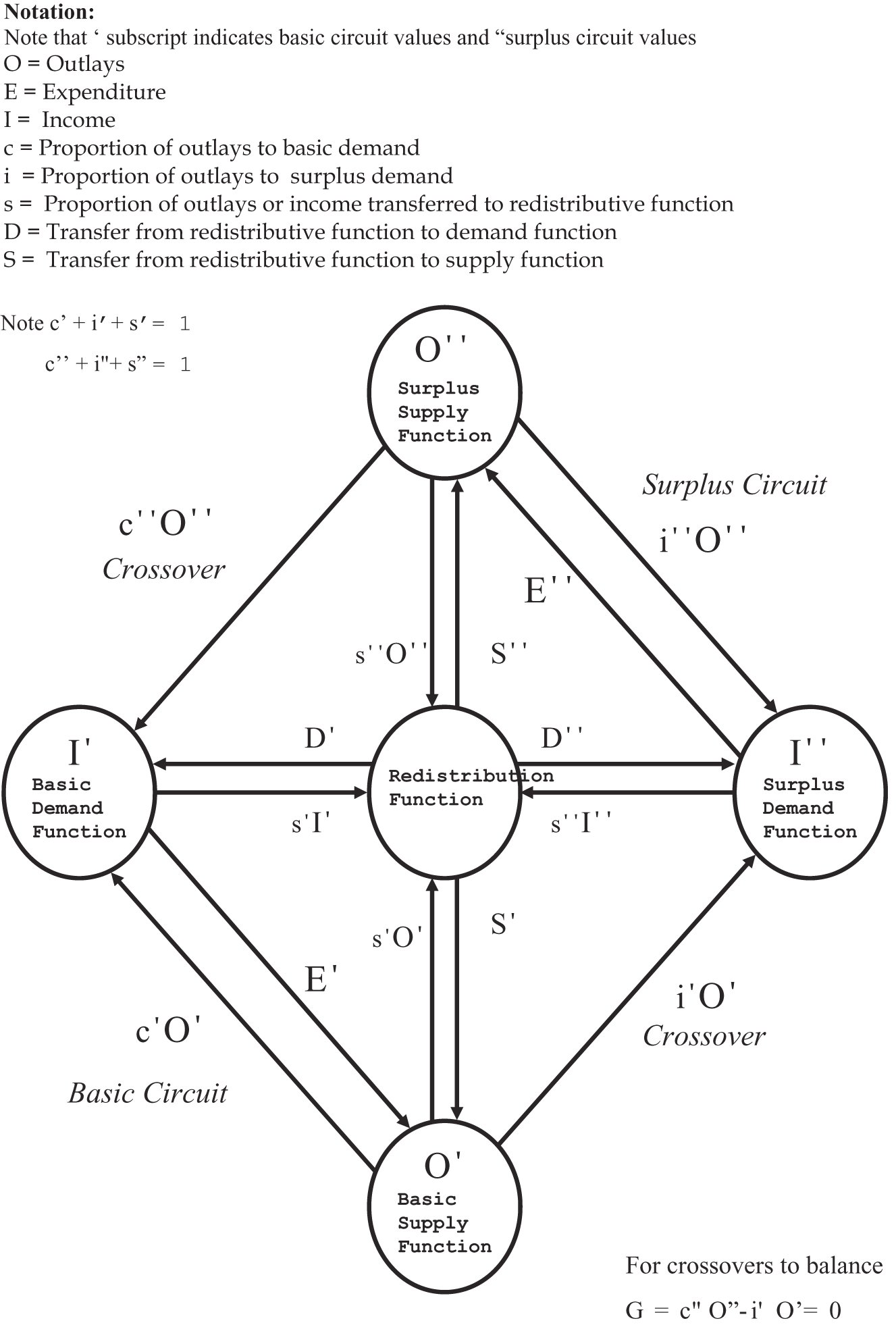
To illustrate the flows Lonergan turns to his “baseball diagram” (Lonergan Reference Lonergan, Lawrence, Byrne and Hefling1999a, p. 55), reproduced as Figure 1. As Lonergan (Reference Lonergan, Lawrence, Byrne and Hefling1999a, pp. 45–54) explains, the basic circuit involves expenditure E’ from the basic demand function I’ to the basic supply function O’, responding to outlays c’O’ from the basic supply function to the basic demand function.
Lonergan’s Economic Diagram

Similarly, the surplus circuit involves expenditure E” from the surplus demand function I” to the surplus supply function O”, responding to outlays i”O” from the basic supply function to the basic demand function.
These basic and surplus circuits are distinct but linked through additional flows that Lonergan calls “crossovers.” The crossover c”O” feeds the basic circuit from the surplus circuit. The crossover i’O’ feeds the surplus circuit from the basic circuit. If these crossovers are not in equilibrium, one circuit will drain the other, leading eventually to a collapse of both circuits. For example, if c”O” < i’O then the basic circuit is drained.
The functional nodes of the diagram (labeled I’, I”, O’, and O”) from which the flows emanate are reservoirs that seem to be able to be temporarily built up and depleted, though the stock/flow relations are not clearly specified by Lonergan. His emphasis on functional rather than proprietary relations resists identification of the nodes with the wealth of particular individuals, such as representative capital owners and workers in a more conventional analysis.
Superimposed on these basic and surplus circuits is the somewhat mysterious redistribution function. The flows to and from the other functional nodes to the redistribution function are distinguished by Lonergan as non-operative flows (contrasted with the operative flows in the basic and surplus circuits). At one point he writes that the redistribution function involves “transactions that do no more than transfer ownership” (Lonergan Reference Lonergan, Lawrence, Byrne and Hefling1999a, p. 54), but many of his examples do more than this.Footnote 10 The redistribution function encompasses borrowing and lending, government expenditure and taxation, and international trade and the balance of payments. For instance, the basic demand function may send funds s’I’ to the redistributive function, which may comprise what a mainstream economist would call “savings,” as well as taxation and imports.Footnote 11 The return flow D’ to basic demand (which may be greater or less) could comprise government welfare payments or export demand for basic goods.
VII. LONERGAN’S ANALYSIS OF THE PURE CYCLE
The point of setting up this diagram of flows is to consider economic fluctuations, and Lonergan first describes a pure cycle, which is an idealized cycle with which the actual cycles we observe will be compared. For Lonergan, the productive process has a “wave or cycle” that is “inherent” (Lonergan Reference Lonergan, Lawrence, Byrne and Hefling1999a, p. 35) in the economic process, though his cycle language is slightly misleading—the pure cycle is actually a smooth expansion.
Lonergan elaborates many different ways the system of flows can be disturbed.Footnote 12 One is a temporary or short-term acceleration of the basic circuit: for instance, triggered by monetary stimulus, a reduction of inventories or fuller utilization of existing capital (Lonergan Reference Lonergan, Lawrence, Byrne and Hefling1999a, p. 32).
However, the disturbance of flows Lonergan is most interested in is what he calls a “long-term acceleration” in the surplus circuit. Such an acceleration is usually triggered by innovation (which Lonergan understands in a very broad sense to include organizational as well as technological change) in the surplus circuit. Innovation in the surplus circuit, he believes, has a greater potential than innovation in the basic circuit to expand the rate of flows, and eventually the standard of living,
A crucial variable in the system is pure surplus income, which is the return to surplus circuit entrepreneurs over and above maintenance. Pure surplus income is contrasted by Lonergan with normal profit, and so it would appear to correspond to economists’ concept of above-normal profit, but the comparison is complicated by Lonergan’s view that pure surplus income is a social dividend necessary for innovation.Footnote 13
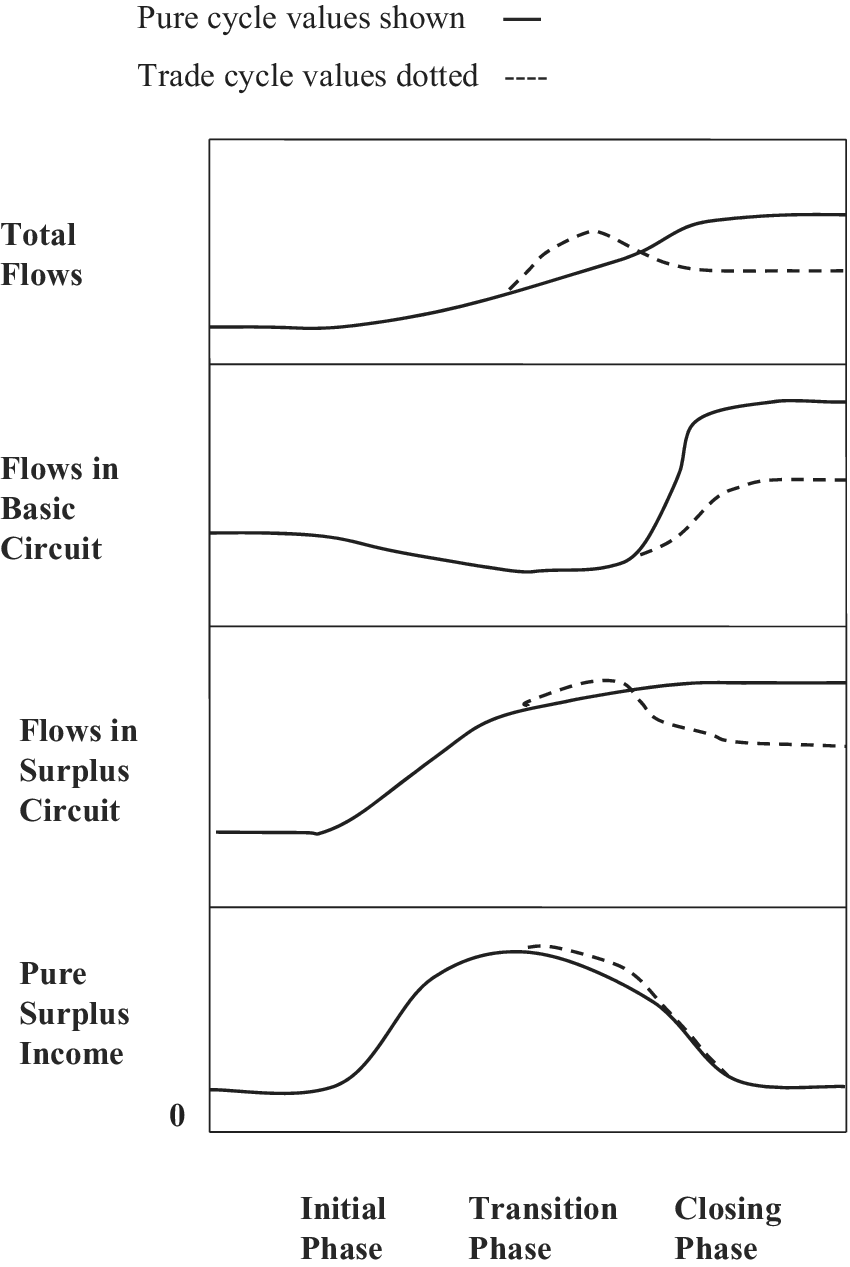
Consider a long-term acceleration in the surplus circuit with the aid of Figure 2. As the surplus circuit expands, pure surplus income increases with it. This discussion of pure surplus income calls for an account of pricing and pricing and distribution, which Lonergan (Reference Lonergan, Lawrence, Byrne and Hefling1999a, pp. 72–74) attempts to provide in the discussion of price spreads in imperfectly competitive markets. As this initial expansion phase draws to a close, the rate of increase of the surplus circuit flows declines and pure surplus income begins to decline.
Illustration of Long-Term Acceleration in Surplus Circuit

In the idealized pure cycle, entrepreneurs recognize the natural dynamics at work and moderate their behavior, accommodating themselves to the fall in pure surplus income, and the expanded surplus circuit feeds the basic circuit through the relevant crossover. Thus the innovation that originates in the surplus circuit leads to an augmentation of the standard of living, and this is achieved in a smooth and ordered manner.
Pure surplus income eventually returns to zero, and the rate of flows in both the surplus and basic circuits stabilize at new higher levels than before the innovation. The economic system has reached a new stage with a higher standard of living
VIII. LONERGAN’S ANALYSIS OF THE TRADE CYCLE
In contrast to this idealized pure cycle is the actual trade cycle that we observe.Footnote 14 The trade cycle is a distorted version of the pure cycle where entrepreneurs fail to recognize the natural dynamics at work and consequently fail to moderate their behaviour as pure surplus income declines after the initial expansion. Contributing to their failure is the difficulty entrepreneurs face in distinguishing among the different components of the returns they receive—in particular, in identifying the pure surplus income component of their returns.
Lonergan’s analysis of the pure cycle indicated that entrepreneurs need to adjust their expectations of profit levels downward as pure surplus income declines rather than seek to maintain profitability through layoffs, aggressive behavior toward competitors, etc. Such actions arising from mistaken expectations are in the end self-defeating and exacerbate the natural tapering off of profits, generating the commonly observed boom-and-bust trade cycle.
Lonergan describes this situation as a failure to distinguish the social dividend from other components of profit, writing about the failure: “The reason is not the reason on which the simple minded moralists insist. They blame greed. But the prime cause is ignorance … when people do not understand what is happening and why they cannot be expected to act intelligently … frantic self preservation takes over” (Lonergan Reference Lonergan, Lawrence, Byrne and Hefling1999a, p. 80).
By contrast, the intelligent adjustment of expectations of profit levels can prevent a downturn, which would otherwise lower the standard of living for all. Intelligent adjustment would achieve the idealized pure cycle described by Lonergan rather than the actual trade cycles he observed in capitalist economies. In this way correct understanding of the pure cycle is the basis for the sound decision making necessary for stable expansion of the economic system.
In terms of Figure 2 the dotted trade cycle values of the key variables begin to diverge from their pure cycle values at the end of the initial phase. Entrepreneurs succeed for a while in delaying the fall in pure surplus income, but the natural forces eventually overpower them and pure surplus income returns to zero just as it did in the pure cycle. Their temporary success also boosts surplus circuit flows for a while but then they decline to a rate below what they would have been under a pure cycle—reflecting the self-defeating character of the actions to maintain profits in the face of their natural decline. In the basic circuit the misguided actions of the entrepreneurs postpone and weaken the closing phase where the surplus circuit feeds the basic circuit, so that innovation yields a smaller increase in the standard of living than under the pure cycle. The trade cycle involves a rise and contraction in total flows, in contrast to the smooth expansion of Lonergan’s pure cycle.
Lonergan then discusses the ineffectiveness of palliatives such as credit creation, welfare spending, and foreign trade policies in overcoming the problems of the trade cycle (Lonergan Reference Lonergan, Lawrence, Byrne and Hefling1999a, pp. 82–85). They are ineffective because they do not address the fundamental problem of mistaken expectations.
It was Lonergan’s hope to develop simple economic and moral maxims for different phases of the cycle that could be widely understood, and that could guide economic decision making to serve the common good. An example might be for firms “to look to the common good” when adjusting prices and output during a downturn.
IX. CONTEXTUAL ASSESSMENT OF LONERGAN’S ECONOMICS
It needs to be remembered that though Lonergan had a degree in mathematics, he was entirely self-taught in economics, and lacked opportunities to refine and correct his work in dialogue with economist colleagues. His ambitious effort to build a macrodynamic model that synthesizes Hayek on money and cycles, Keynes on effective demand, Schumpeter on innovation, plus some original elements, must be judged a substantial achievement in relation to the state of economic theory of cycles and growth in the 1940s.
It is an even greater achievement in relation to Roman Catholic economic thought in the 1940s (surveyed by Teixeira and Almodovar Reference Teixeira, Almodovar, Durlaf and Blume2008). Early twentieth-century Catholic economists were inspired by the Papal social encyclicals beginning with Rerum Novarum, but their progress was limited by a reluctance to engage with professional economics. Anthony Waterman (Reference Waterman2004) argues this was due to the continental European location of most of the Catholic economists and the deep suspicion of Anglo-American liberal social philosophy associated with much academic economics. The lack of training in mathematics of most Catholic priests and theologians undoubtedly contributed. Standard Catholic works such as Heinrich Pesch ([1923] Reference Pesch and Ederer2003), and Catholic university college textbooks such as Valère Fallon (Reference Fallon, McNulty and Goss1933) described the institutions of the economy, along with practical wisdom informed by the Papal encyclicals, but offered little of substance in relation to the contemporary issues such as mass unemployment, the seeming inability of many firms in capitalist economies to pay a living wage and remain profitable, and instabilities stemming from the business cycle.
There is nothing remotely comparable to his macrodynamic model in the early twentieth-century Catholic literature, aside from the linear programming models Maurice Potron S.J. (1872–1942) developed to determine conditions for capitalist firms to be viable and for a living wage to be paid to workers. Potron’s economic research had been receiving attention from economists after the valuable translation and contextualization work of Christian Bidard and Guido Erreygers (see the texts in Potron, Bidard, and Erreygers Reference Potron, Bidard and Erreygers2010; commentary in Bidard, Erreygers, and Parys Reference Bidard, Erreygers and Parys2009; and commentary in Bidard and Erreygers Reference Bidard and Erreygers2016). Maurice Potron was part of a wealthy devout Catholic family, who studied engineering, then joined the Jesuits and spent most of his adult life teaching mathematics in Catholic institutions. Stimulated, like Lonergan, by the Papal social encyclicals beginning with Rerum Novarum in 1892, he developed a sophisticated linear programming model of the economy, with dynamic and pricing extensions, solved using the Perron–Frobenius theorem. Papers were published in mathematics and Catholic theological journals in 1911–12, and he returned to economics after WWI with further publications and attempts to promote his model to a wider audience. Potron read almost no economics, and like Lonergan he had little contact with professional economists. Lonergan appears not to have known of Potron’s work in economics despite their both being Jesuits. Lonergan and Potron were concerned with similar questions, especially the capacity of a capitalist economy to pay the living wage enjoined by Catholic social teaching, but Lonergan went much further than Potron in developing a full macrodynamic model that addressed this and other contemporary issues.
While Lonergan’s achievement must be recognized, there are problems with his model as identified in the previous sections. His analysis is largely classificatory and descriptive, and weak on behavioral relations. Savings and investment are treated inconsistently and rather less than clearly. The precise relationship between money and real activity is also unclear, and the redistribution function particularly obscure.
Lonergan’s economics has also suffered from being oversold by some of his followers.Footnote 15 For instance, the claim (most notably by Philip McShane in his editorial introduction to Lonergan Reference Lonergan and McShane1998, For a New Political Economy, p. xxv) that Lonergan offers a uniquely dynamic economic analysis is demonstrably false—Schumpeter and many other contemporaries had developed dynamic models, as had the classical economists many years before. Another tendency among followers is to claim that Lonergan’s work alone offers a way out of the confusions of the economics profession (for example, the claim by McShane on p. xxx of his introduction that “Lonergan’s fundamental achievement in economics is his discernment of the structure of division of labor that would meet these needs for precision and so lift effete scholarship, disoriented science, and ineffective journalism, into a humanly efficient steering of the global enterprise”). Lonergan himself was well aware of these predecessors and was more modest in his claims for his achievement. This overselling of Lonergan’s economic model and the sensitivity of Lonergan’s followers to any criticism of his economics has not helped contextualization and assessment of his work by economists. Neither has the fact that few contemporary economists are familiar with or well disposed towards the work of theologians.
X. IS THERE CONTINUING VALUE IN LONERGAN’S ECONOMICS?
A test of whether Lonergan’s research has a contribution to make to contemporary economics would be the chances of acceptance in a highly ranked contemporary economics journal of a selective and generous interpretation of his model, suitably translated into contemporary mathematical style. This could be a contemporary mainstream journal or a heterodox journal. Our own attempt to mathematize Lonergan’s model has been abandoned. Several of us involved in the research project on Lonergan’s economics, along with John Ormerod, the mathematician employed with grant funding, spent considerable time with the texts and made some progress towards translating Lonergan’s mathematics (Ormerod Reference Ormerod2010), but it eluded translation into a coherent system of differential equations. The “technical restatement” (Lonergan Reference Lonergan, Lawrence, Byrne and Hefling1999a, pp. 36–38) presented particular interpretative difficulties despite the promising title.
I am doubtful that the model is translatable into something that is publishable in a contemporary economic theory journal. I am also doubtful whether further investments of time by economists in developing Lonergan’s core model are be likely to be fruitful.
The feature of Lonergan’s model that is highlighted by devotees as a contribution is its dynamic nature. He may have been at the frontier of dynamic economics in the 1940s, but there are now many dynamic models in the post-Keynesian and Kaleckian literatures (as discussed by King Reference King2002; White Reference White2004; Kriesler and Nevile Reference Kriesler and Nevile2012; and many others). However, there may be some benefit is pursuing his ideas on particular topics. If Lonergan has anything to add to contemporary theoretical discussion, I believe it is in the following areas.
-
• Expectations and coordination
Lonergan sees expectations formed cooperatively with a view to common good—developing natural law ideas about rationality. Specifically, in the pure cycle firms moderate their profits as they anticipate the expansion phase of the business cycle coming to an end, even though in usual economic theories of expectation formation it is not in the interests of individual firms to do so (Lonergan Reference Lonergan, Lawrence, Byrne and Hefling1999a, pp. 80–82).
Lonergan sees firms’ actions being moderated by their managers’ reasoning about the benefits of cooperative action in pursuit of the common good, and building this reasoning into their expectations. Such reasoning in expectation formation is sharply at odds with contemporary rational expectations models where the individualism and egoism of the underlying models extend to the process of expectations formation (as Lonergan himself recognized in the 1970s—see, for instance, the comments in Lonergan Reference Lonergan, Lawrence, Byrne and Hefling1999b, the essay set for the macroeconomics course he taught at Boston College in this period). It is also at odds with more recent models where expectations are formed using statistical inference (Menzies and Zizzo Reference Menzies and Zizzo2009) or maximizing individual utility (Brunnermeier and Parker Reference Brunnermeier and Parker2005). Since the adjustment of expectations and profits leads to a better outcome for all than supposedly “rational expectations,” we might label the view of expectations formation in Lonergan’s model “supra-rational expectations.” It emerges, as has been noted, from a different view of human nature and rationality from that of contemporary mainstream economics. Human beings in his Thomistic natural law framework have purposes beyond themselves and reason accordingly. What Lonergan is suggesting is a form of decentralized moral intelligence where coordination in the interests of the common good is the key.
It is likely that the affinities with the more complicated views of expectations formation important for Keynes’s theory of investment and income determination, and in Kalecki’s mark-up pricing theory, explain why Lonergan was particularly attracted to the post-Keynesians when he resumed his economic research in the 1970s. As Sheila Dow (Reference Dow1996, ch. 7) and John King (Reference King2015, pp. 123–124) suggest, expectations formation is an area of post-Keynesian economics in need of further development. Lonergan’s theory of coordination of expectations based on a higher rationality may have something to contribute here.
-
• Endogenous money
Lonergan’s account of accelerations of the productive process includes discussion of how the money supply expands to facilitate the expansion of the productive process (Lonergan Reference Lonergan, Lawrence, Byrne and Hefling1999a, pp. 48–53). Changes in expectations can also induce monetary changes that drive economic accelerations (Lonergan Reference Lonergan, Lawrence, Byrne and Hefling1999a, p. 70). This is a theory of the endogeneity of money originating in the 1940s, and what is distinctive about Lonergan’s version is the connection—admittedly vague—between monetary expansion and changes in expectations. He also builds his theory of endogenous money into a model of cycles and growth. Theories of endogenous money would later be developed by post-Keynesian economists such as Nicholas Kaldor and Basil Moore.Footnote 16 There may be benefit in further exploring Lonergan’s ideas about the connection between expectation formation and monetary expansions.
Whether or not Lonergan’s model offers anything novel to contemporary economic theorists, or worth developing by contemporary post-Keynesians, his work also has contemporary importance as a bridge between the post-Keynesian literature and Catholic economic thought. Perhaps there is a Lonerganian strand of post-Keynesian economics to be developed alongside the other post-Keynesian schools identified by John King (Reference King2002, Reference King2015) and by Geoff Harcourt and Peter Kriesler (Reference Harcourt and Kriesler2013) in their surveys of post-Keynesian economics. Such a Lonerganian strand has the potential to expand the reach of post-Keynesian economics even if its theoretical novelty is limited.
This synergy and potential for expanding the reach of post-Keynesian economics is highlighted by a recent essay by Luigi Pasinetti on economic theory and Catholic social teaching.Footnote 17 Pasinetti notes the gap between the Catholic encyclicals and contemporary economic theory:
The social doctrine of the Church states rather precise and detailed principles in relation to current economic and social problems. But there is no trace of it in the literature of economics…. In essence it would seem that the social doctrine of the Church and economic theory move in parallel but separate ways. Sometimes it even seems that they try not to meet, so as not to give each other nuisance. (Pasinetti Reference Pasinetti2010, p. 3)
As the essay proceeds Pasinetti’s criticisms of mainstream economics emerge and he assembles parallels between Catholic social teaching and post-Keynesian economics. The parallels are especially poignant because of the similarity between Pasinetti’s structural economic dynamics (Pasinetti Reference Pasinetti1981, Reference Pasinetti1993) and Lonergan’s models, a closer similarity perhaps than the one Lonergan observed in the 1970s between his own models and those of Michal Kalecki. Moreover, the similarities even extend to Pasinetti’s focusing on two practical questions of inequality and the possibility of capitalist firms paying a living wage that were important stimuli for Lonergan’s economic research in the 1940s. There is no evidence that Lonergan read Pasinetti or was aware of his work, and his declining health in the late 1970s meant he had little opportunity to become aware of it. Pasinetti also seems unaware of Lonergan’s economic research. Do particular sorts of economic modeling comport better with Catholic theology? We have an eminent Catholic theologian and an eminent economic theorist who have independently come to similar conclusions about parallels between Catholic social teaching and post-Keynesian economics.
XI. CONCLUSIONS
A largely negative finding about the coherence and contemporary value of Lonergan’s economic model does not mean that investigating Lonergan’s economics has been a waste of time. Just as with econometric work, a failure to reject a null hypothesis provides useful information and guides future research. Here the null hypothesis is provided by the almost zero impact of Lonergan’s economic research on professional economists, in spite of the claims about his macrodynamic model by Lonergan devotees. It was a null hypothesis worth investigating because of Lonergan’s standing as a major theologian and the importance he placed on economic research. As suggested in the previous section, my negative finding about the coherence and value of his model, though, does not rule out his ideas on expectations and the endogeneity of money yielding fruit.
Aside from the question of the contemporary value of Lonergan’s economic research, it remains of some historical interest. His macrodynamic model deserves a modest place in accounts of theory of cycles, growth, and macroeconomics in the early twentieth century. One could speculate on what influence Lonergan’s model might have had if his friends had succeeded in their attempts in the 1940s to bring it to the attention of professional economists. There is no doubt this would have sharpened Lonergan’s economic thinking.
The natural law framework by which Lonergan approaches economics has value as an alternative to the combination of positivism and utilitarianism that dominates the contemporary economics profession, as discussed earlier in this paper and previously by Neil Ormerod, Paul Oslington, and Robin Koning (Reference Ormerod, Oslington and Koning2012).
Another aspect that could be explored further is how Lonergan’s endeavors illustrate the difficulties of cross-disciplinary work, and the reception of such work in different disciplinary communities. Contrast the adulatory reception of his economics in Lonergan circles with his invisibility within the community of professional economists even after his economic writings became widely available in the early 2000s through the publication of the Collected Works.
The way Lonergan relates economics to theology is significant. His respect for the autonomy of economics is exemplary for theologians tempted to jump to theological pronouncement before undertaking or at least reviewing detailed empirical and theoretical research on relevant economic matters. Catholic theology certainly motivated and guided Lonergan’s economic research, but no economic proposition is argued for on the basis of theology; instead, economic questions are resolved by examining theoretical and empirical economic arguments. Lonergan’s economic research and its reception are a helpful case study of relations between religion and economics, and his view has much to recommend it. Despite the recent upsurge of interest among historians of economics in the connections between religious and economic thought, we still have a long way to go in understanding how religious thought has shaped economics and how economics has in turn has shaped religious thought.
APPENDIX 1: BRIEF BIOGRAPHICAL OUTLINE
1904. Born Buckingham in Quebec.
1918–22. Student at Loyola College, Montréal.
1922–26. Entered Society of Jesus in Guelph, Ontario. Novitiate and study of classics.
1926–30. Heythrop College, University of London. BA in Languages, Mathematics, Philosophy.
1930–33. Montreal. Papal Encyclical QA issued in 1931, developing Rerum Novarum issued in 1891.
1933–37. Gregorian University in Rome. Final two years were doctoral studies.
1934. Essay on Fundamental Sociology.
1933–35. Panton Anakephalaiosis.
1937–38. Analytic Concept of History.
1936. Ordination.
1937–38. Tertianship, Amiens, France.
1938–40. Gregorian University in Rome for STD.
Thesis published as “Grace and Freedom” in Theological Studies.
1940–46. Teaching at Loyola College, Montréal, and Thomas More Institute, Montreal.
Eric O’Connor mathematician colleague.
1940s. Reading Pesch, Robbins Essay, Knight Risk Uncertainty Profit, Schumpeter Theory of Economic Development and Business Cycles, Hayek Money Trade Cycle, Roos Dynamic Ec.
1942. “For a New Political Economy” found by Eric Kierans in 1986. Published in CW 1998.
1944. “Essay on Circulation Analysis” published in CW 1999.
1940s. Letters attempting to interest economists in “Essay on Circulation Analysis” are fruitless.
1947–53. Teaching at Jesuit Seminary Regis College in Toronto.
1953–64. Teaching at Gregorian University Rome. Vatican II begins.
1956. Halifax lectures on Insight. Influence of Philip McShane begins.
1957. Insight published.
1965–75. Teaching at Regis College, Toronto. Surgery. Influence of Robert Doran.
1968. McShane correspondence. Lonergan provoked by reading Metz and Liberation theology.
1971. Method in Theology published. Rev. ed. 1973.
1971–72. Stillman Professor at Harvard.
1974. “Moral Theology and Human Sciences” at International Theological Commission.
1975–1983. Teaching at Boston College.
1970s. Reading Kalecki Selected Essays on the Dynamics of the Capitalist Economy, Schumpeter History of Economic Analysis, EJ back issues, HOPE, Joan Robinson, Jane Jacobs, Eichner Guide to Post-Keynesian Economics, Robert Gordon Macroeconomics, Adolph Lowe Economic Knowledge.
1975. “Healing and Creating History” lecture at Thomas More Institute, Montreal.
1979–83. Taught course “Macroeconomics and the Dialectic of History” at Boston College.
Continues revising his 1944 manuscript in conjunction with his teaching.
1984. Died at Jesuit infirmary in Canada.
APPENDIX 2: LONERGAN’S PERSONAL LIBRARY
Held at Regis College, Toronto. The list below is selective, concentrating on economic works. Many books he read on economics would have been in libraries rather than his own collection, especially in earlier years. This is confirmed by the notebooks from the early years preserved at Regis College.