Introduction
Lambs are born with limited stores of energy and are poorly insulated, particularly while wet, in the first few hours after birth (Alexander, Reference Alexander1962). Newborn lambs use their energy stores of glycogen and brown adipose tissue, but these reserves of energy are limited and need to be replaced as soon as possible with other forms of energy, through consumption of colostrum. The consumption of colostrum also provides the lamb with immunoglobulins and water and, more importantly, plays a major role in lamb survival, since the sucking of colostrum aids the development of a strong ewe–lamb bond soon after birth (Nowak and Poindron, Reference Nowak and Poindron2006).
The amount of colostrum a lamb requires depends, largely, on how much fuel it requires for heat production (Mellor and Murray, Reference Mellor and Murray1985), and any factor that increases its rate of heat production (e.g., cold exposure) will increase its requirements for colostrum. The heat produced by a 3.5 kg fasted lamb under mild conditions (8°C and no wind) is 0.19 MJ/h, which equates to about 30 ml of colostrum (McCance and Alexander, Reference McCance and Alexander1959). On this basis, a newborn lamb requires between 180 and 290 ml of colostrum per kg of body weight during the first 18 h after birth (Mellor and Cockburn, Reference Mellor and Cockburn1986; Mellor and Murray, Reference Mellor and Murray1986; Mellor, Reference Mellor1988), with an immediate requirement at birth of 50 ml per kg of body weight (Robinson et al., Reference Robinson, Rooke and McEvoy2002) to avoid hypothermia.
Thus, lambs require a good supply of colostrum from the moment they are born, and well-fed ewes generally produce sufficient colostrum prior to parturition to meet the requirements of the newborn lamb for energy (Banchero et al., Reference Banchero, Quintans, Martin, Lindsay and Milton2003). However, in extensive grazing systems, the pasture is often of poor quality and the ewes are nutritionally stressed in late pregnancy. Under these conditions, many lambs die of starvation as they do not receive adequate colostrum, but supplementing these ewes with grains during late gestation should increase the amount of colostrum available for the lamb at birth (Murphy et al., Reference Murphy, McNeill, Fisher and Lindsay1996; Banchero et al., Reference Banchero, Quintans, Milton and Lindsay2002, Reference Banchero, Quintans, Martin, Lindsay and Milton2004a, Reference Banchero, Quintans, Martin, Milton and Lindsay2004b and Reference Banchero, Quintans, Vazquez, Gigena, La Manna, Lindsay and Milton2007). The extra colostrum produced by the ewes in these studies should have improved the likelihood of their lambs surviving, but lamb survival was not measured. Hall et al., (Reference Hall, Holst and Shutt1992) reported an increase in colostrum production from single but not twin-bearing ewes supplemented with a concentrate containing by-pass protein that would increase the supply of protein for digestion to amino acids in the small intestine. Lotus uliginosus, a high protein legume containing tannins, could also provide additional protein for digestion to amino acids in the small intestine of ewes bearing single lambs. L. uliginosus grown amongst native pastures could be a cheaper alternative to feeding cereal grains to lift the nutrition of single-bearing ewes before lambing. In this study, we tested the hypothesis that improving nutrition of single bearing ewes during the last week of pregnancy by supplementation with commercial lick, maize or by grazing L. uliginosus, would increase production of colostrum and therefore enhance lamb survival, compared to ewes grazing only average native pastures.
Material and methods
The experiment was conducted in accordance with the directives of the Experimental Unit ‘Palo a Pique’ of INIA Treinta y Tres in Uruguay, with regard to the use of animals for experimentation.
Experimental treatments
The experiment was conducted at the Experimental Unit ‘Palo a Pique’ of INIA Treinta y Tres, Uruguay (35°S), in September 2004, using 261 mature Corriedale ewes bearing single fetuses at scanning on day 90 of pregnancy, and weighing 48 ± 5.2 kg with a mean body condition score of 2.6 ± 0.23 on a scale of 0 to 5 (Russell et al., Reference Russell, Doney and Gunn1969). The ewes were selected from a flock of 400 that had been synchronised using a single injection of 160 μg of Delprostenate (Glandinex™; Universal Lab Ltd, Montevideo, Uruguay) and mated with Corriedale rams (10 ewes per ram) during the second estrus after synchronisation. The ewes grazed native pastures (75 g crude protein (CP) and 7.1 MJ metabolizable energy (ME) per kg of dry matter (DM)) from mating until day 130, when the ewes were allocated randomly, according to weight and body condition score, to one of two groups. One group of ewes continued to graze native pastures and the other group grazed an improved pasture of about 50% L. uliginosus (181 g CP and 9.1 MJ ME/kg DM). The average mass of herbage available for the L. uliginosus and native pasture was 3815 and 2534 kg DM/ha, respectively, and the ewes were offered about 12 kg of pasture DM/100 kg of live weight daily. Five days later (14 days before the expected start of lambing) the ewes were allocated to four feeding treatments as follows:
• native pasture alone (Native pasture, Control n = 66);
• native pasture plus a commercial lick consisting of mainly maize grain and soybean meal along with some liquid molasses, urea and oleina oil (83.2% DM, 242 g CP and 14.0 MJ ME/kg DM; Native pasture with lick, n = 66);
• L. uliginosus pasture alone (L. uliginosus, n = 66);
• L. uliginosus plus a supplement of whole maize (88% DM, 96 g CP and 13.6 MJ ME/kg DM; L. uliginosus with maize, n = 63).
The lick and the whole maize were introduced gradually at rates of 0.2, 0.2, 0.3, 0.3, 0.4, 0.4, 0.5 and 0.5 kg/head per day from day 135 to 142 of gestation. Thereafter, the full amount of 0.6 kg/day was offered until the ewes lambed (mean length of gestation was 149 days).
Colostrum production, viscosity and concentration of components and immunoglobulin G (IgG)
The weight, viscosity and concentration of components and IgG in the colostrum that had accumulated at lambing were measured in 40 ewes (10 per treatment) during daylight hours. These ewes were observed continuously and as soon as an ewe lambed, it was given an intramuscular injection of 5 IU of oxytocin (Hipofamina™; Lab Dispert, Montevideo, Uruguay) and one teat was completely hand milked. The other teat was left unmilked and was available for the lamb. The colostrum was weighed, and its viscosity was classified according to appearance and consistency using the 8-point score of McCance and Alexander (Reference McCance and Alexander1959), where 0 is no expressible secretion, 1 is a clear, serous, straw-colored liquid, grading through to 7 which is an opaque, white liquid similar to normal milk. A 20 ml sample of colostrum from each ewe had a preservative added (50 μl of 10% potassium dichromate) and was then stored at 4°C until analyzed for fat, lactose and protein using a Milkoscan 133 (Foss Electric, Hilleroed, Denmark), and the concentration of IgG was measured by radial immunodiffusion (McGuire et al., Reference McGuire, Regnier and Kellom1983) with a sheep IgG VET-RID® kit (Bethyl Laboratories Inc., Montgomery, TX, USA).
The remaining 221 ewes that were not milked were used to determine the survival of their lambs up to 20 days of age. The ewes lambed unassisted, unless the birth process took more than 2 h (Dwyer et al., Reference Dwyer, Lawrence, Brown and Simm1996).
Lamb birth weight, identification and blood sampling
The lambs born to the ewes that were milked had a sample of jugular blood taken at birth. The concentration of glucose was measured immediately after collection, using a single drop of whole blood, by means of a Medisense2® blood glucose meter (Medisense Inc., MA, USA) and sensor electrodes. All lambs were identified with a numbered ear tag 1 day after birth; they were weighed and had their sex, date and time of birth and identification number of the dam recorded.
Lamb survival
Since all ewes were pregnant with a single fetus, the expected number of lambs to be born was 261. Lamb survival was calculated as the number of lambs alive at tailing – 20 days after birth – expressed as a percentage of the total number born. Dead lambs were classified as either: (i) born dead (stillbirth/stillborn) or (ii) born alive and died within 20 days.
Statistical analysis
Least Squares Analysis of Variance was used to analyze the effect of treatment on volume and quality of colostrum, concentration of colostrum IgG, concentration of glucose in blood and lamb birth weight using the procedure PROC GLM of SAS software (Statistical Analysis Systems Institute (SAS), 2003). The model applied for these variables included treatment as fixed effect. The means were compared by orthogonal contrast. The viscosity of the colostrum was analyzed as discrete data using the SAS GenMod procedure. Regression analysis was used to establish correlations between colostrum production and viscosity, and colostrum production and concentration of IgG. Lamb survival was assumed to have a binomial distribution and was applied a logit link function using the procedure PROC GENMOD of SAS software. Treatment and lamb sex were included as fixed effects in the model. The sex of the lamb was included in the model to adjust difference between treatments, since distribution of sexes was not balanced between treatments. Effects were deemed to be significant when the level of probability was 0.05 or less. All results are presented as means ± standard errors.
Results
Ewes fed Native pasture with lick ate the entire lick supplement, whereas ewes fed L. uliginosus with maize ate only 47% of the cereal grain offered to them.
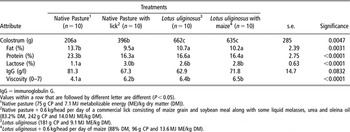
At lambing, ewes supplemented with the lick or maize or that grazed L. uliginosus produced two to three times the quantity of colostrum produced by the ewes grazing only Native pasture (P < 0.05, Table 1). The colostrum produced by the ewes grazing native pasture alone was more viscous (P < 0.05, Table 1) than the colostrum produced by the ewes on the other three treatments. The viscosity of the colostrum was negatively correlated with the amount of colostrum accumulated at parturition (n = 40, r = −0.54, P < 0.05); thus, the more viscous the colostrum, the less produced.
Weight, components and mean viscosity score (0 to 7) of colostrum accumulated at lambing by single-bearing Corriedale ewes, grazing native pastures or Lotus uliginosus with or without a supplement prior to lambing

IgG = immunoglobulin G.
Values within a row that are followed by different letter are different (P < 0.05).
1Native pasture (75 g CP and 7.1 MJ metabolizable energy (ME)/kg dry matter (DM)).
2Native pasture + 0.6 kg/head per day of a commercial lick consisting of maize grain and soybean meal along with some liquid molasses, urea and oleina oil (83.2% DM, 242 g CP and 14.0 MJ ME/kg DM).
3Lotus uliginosus (181 g CP and 9.1 MJ ME/kg DM).
4Lotus uliginosus + 0.6 kg/head per day of maize (88% DM, 96 g CP and 13.6 MJ ME/kg DM).
Supplementation of ewes by licks, maize or by grazing on L. uliginosus before lambing affected all the main constituents of colostrum at parturition. The percentage of fat and protein was lower in these ewes, but the lactose percentage was higher than in the ewes that grazed native pasture alone (P < 0.05; Table 1). The IgG concentration in the colostrum of the ewes grazing only native pasture was slightly, but not significantly, higher than the ewes fed the other treatments (Table 1; P = 0.08). Overall, the concentration of IgG was negatively correlated with colostrum production (n = 38, r = −0.41, P < 0.05).
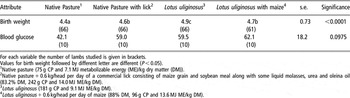
At birth, male lambs were heavier than females (4.74 v. 4.53 kg; P < 0.05). Lambs born to ewes that grazed L. uliginosus alone were heavier than those born to ewes grazing native pasture, whether supplemented or not (Table 2; P < 0.05).
Birth weight and the concentration of glucose in the blood of lambs born from single-bearing Corriedale ewes grazing native pastures or Lotus uliginosus with or without a supplement prior to lambing

For each variable the number of lambs studied is given in brackets.
Values for birth weight followed by different letter are different (P < 0.05).
1Native pasture (75 g CP and 7.1 MJ metabolizable energy (ME)/kg dry matter (DM)).
2Native pasture + 0.6 kg/head per day of a commercial lick consisting of maize grain and soybean meal along with some liquid molasses, urea and oleina oil (83.2% DM, 242 g CP and 14.0 MJ ME/kg DM).
3Lotus uliginosus (181 g CP and 9.1 MJ ME/kg DM).
4Lotus uliginosus + 0.6 kg/head per day of maize (88% DM, 96 g CP and 13.6 MJ ME/kg DM).
The mean concentrations of glucose did not differ significantly amongst the lambs born to ewes that received improved nutrition, either through supplementation or by grazing L. uliginosus (Table 2; P = 0.098). However, lambs born to the ewes grazing native pasture alone had lower concentrations of glucose in their blood than lambs from the supplemented treatments (42.1 ± 5.9 v. 60.20 ± 3.4 ng/ml; P = 0.012).
Two lambs from the L. uliginosus with maize treatment were excluded from the analysis of lamb survival since they had congenital malformation (one diplopagus and one with artrogriposis).
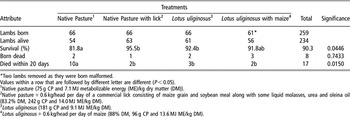
Overall lamb survival was 90.3%. More lambs born to ewes fed native pasture plus lick survived compared to lambs from the ewes fed native pasture alone (95.5% v. 81.8%; P < 0.05, Table 3). The survival of lambs born to ewes that grazed L. uliginosus, with or without maize, was also higher than the survival of lambs from the ewes grazing native pasture alone (91.8% and 92.4% v. 81.8%; P = 0.08 and P < 0.05, respectively). Of the 25 lambs that died within 20 days of birth, 8 were born dead and the remainder died during the following days. There was no difference between treatments for the numbers of lambs born dead, but more lambs died within 20 days of birth in the native pasture alone treatment than in the other three treatments (Table 3, P < 0.05).
Number of lambs born, born dead and died within 20 days in each treatment

*Two lambs removed as they were born malformed.
Values within a row that are followed by different letter are different (P < 0.05).
1Native pasture (75 g CP and 7.1 MJ metabolizable energy (ME)/kg dry matter (DM)).
2Native pasture + 0.6 kg/head per day of a commercial lick consisting of maize grain and soybean meal along with some liquid molasses, urea and oleina oil (83.2% DM, 242 g CP and 14.0 MJ ME/kg DM).
3Lotus uliginosus (181 g CP and 9.1 MJ ME/kg DM).
4Lotus uliginosus + 0.6 kg/head per day of maize (88% DM, 96 g CP and 13.6 MJ ME/kg DM).
Discussion
Our hypothesis that supplementation of ewes during the last days of pregnancy to increase production of colostrum would enhance lamb survival, was supported in this experiment. Lambs born alive to ewes that were supplemented with the lick or maize or that grazed L. uliginosus in late pregnancy survived better to 20 days after birth than lambs born to ewes that grazed only native pasture. These ewes also produced more colostrum, and this colostrum was less viscous than that of ewes grazing native pasture alone. The form of the supplementation per se appeared to be less important for survival than the fact that it induced the ewes to produce more colostrum. Indeed, when ewes were grazing L. uliginosus, additional supplementation with maize did not increase further their production of colostrum or the birth weight of their lambs and, consequently, had no benefit for survival of their lambs up to 20 days. This result confirms the work of Banchero et al. (Reference Banchero, Quintans, Martin, Lindsay and Milton2004a and Reference Banchero, Quintans, Martin, Milton and Lindsay2004b) which showed that feeding ewes with a high-energy supplement during the last week of pregnancy enhances the production of colostrum of adequate quality, and extends this work to show that such feeding can boost survival.
This study also shows that, for single-bearing ewes, grazing a high-quality improved pasture like L. uliginosus in late pregnancy can substitute for supplementation with maize or barley to increase the quantity and quality of colostrum produced. Maize and barley were shown by Banchero et al. (Reference Banchero, Quintans, Martin, Lindsay and Milton2004a, Reference Banchero, Quintans, Martin, Milton and Lindsay2004b and Reference Banchero, Quintans, Vazquez, Gigena, La Manna, Lindsay and Milton2007) to enhance production of colostrum in twin-bearing ewes when fed for a short period pre partum. But, adding maize to the diet of ewes grazing L. uliginosus in this experiment did not further improve the production of colostrum. In fact, 3 weeks grazing on this pasture was sufficient to improve lamb survival concurrent with an increase in colostrum production and, equally importantly, to lift the plasma glucose levels of the lambs. This opens the opportunity to consider strategies for feeding pasture-fed ewes in late pregnancy to improve survival of their lambs by altering the type of pasture alone, without the need to supplement with grain or concentrates.
However, such strategies must take into account that the experiment described here was with single-bearing bearing ewes only. Single-bearing ewes are more likely to produce adequate colostrum when maintained on pasture than twin-bearing ewes (McNeill et al., Reference McNeill, Murphy and Lindsay1998) because they have greater rumen capacity in late pregnancy to accommodate and digest forage (Weston, Reference Weston1988). Nevertheless, Banchero et al. (Reference Banchero, Quintans, Martin, Lindsay and Milton2004a, Reference Banchero, Quintans, Martin, Milton and Lindsay2004b and Reference Banchero, Quintans, Vazquez, Gigena, La Manna, Lindsay and Milton2007) showed that twin-bearing ewes produced more colostrum than single-bearing ewes when supplemented with cereal grains. They highlighted the fact that twin-bearing ewes benefited in two ways from such supplementation. First, their two lambs have a greater demand for colostrum than a single lamb and secondly, they responded better to supplementation with concentrates. Clearly, the response in twin-bearing ewes to L. uliginosus or similarly high-quality pasture needs to be studied in a range of conditions before we can recommend replacing concentrates as a means of generally improving survival of lambs, especially twins.
The greater response in the production of colostrum for ewes grazing L. uliginosus over those supplemented with the concentrate lick was probably not due to an inherent superiority of the legume, but to a longer period of feeding. Access to L. uliginosus was for 20 days compared with only 7 days of effective supplementation with the lick. Lambs born to ewes with access to L. uliginosus, irrespective of whether they were supplemented during the last 7 days of pregnancy, weighed more at birth than lambs born to both groups of ewes with access to native pastures. On the other hand, 7 days of supplementation was not enough to change the birth weight of the lamb which is consistent with earlier studies (Murphy et al., Reference Murphy, McNeill, Fisher and Lindsay1996; Banchero et al., Reference Banchero, Quintans, Martin, Lindsay and Milton2004a, Reference Banchero, Quintans, Martin, Milton and Lindsay2004b and Reference Banchero, Quintans, Vazquez, Gigena, La Manna, Lindsay and Milton2007). Thus, the enhanced survival was not simply an effect of birth weight alone, because the concentration of lactose in the colostrum and the level of glucose in the blood of the lambs were similar to those of ewes fed native pasture plus the lick, and around 40% higher than that of lambs born to ewes grazing only native pasture, reflecting that the lambs were being fed better. Glucose is an immediate source of energy for the lamb before it can reach the teat and suck colostrum (Pattinson et al., Reference Pattinson, Davies and Winter1995); so lambs with higher levels of blood glucose are likely to be more active and stronger at birth and better able to develop an early and strong bond with their mother. Nowak and Lindsay (Reference Nowak and Lindsay1992) showed that the earlier this bond was established, the higher the chances of lamb survival.
In conclusion, high-energy supplements fed to ewes during the last week of pregnancy can boost survival of lambs by enhancing the quantity of colostrum available to them in their first hours of life. It is now clear that these supplements need not be exclusively grain or concentrates, as ewes that grazed intensively on L. uliginosus also responded positively in both colostrum and survival. This opens the opportunity to consider strategies for feeding ewes in late pregnancy to improve survival of their lambs by altering the type of pasture alone, without the need to supplement with grain or concentrates.
Acknowledgements
We thank Gabriel Garcia, Andres Vazquez and Richard Beltran for their technical help.