

It is well established that adults have significant difficulty perceiving many nonnative phonetic contrasts (e.g., Flege, Bohn, & Jang, Reference Flege, Bohn and Jang1997; Tsukada et al., Reference Tsukada, Birdsong, Bialystok, Mack, Sung and Flege2005; Werker, Gilbert, Humphrey, & Tees, Reference Werker, Gilbert, Humphrey and Tees1981). Nonetheless, perceptual learning of some nonnative contrasts can be achieved in adulthood given intensive exposure to a second language (e.g., Levy, Reference Levy2009). Many studies have shown that laboratory training procedures can induce modest gains in perceptual ability for nonnative contrasts involving vowels (Kingston, Reference Kingston2003; Lambacher, Martens, Kakehi, & Marasinghe, Reference Lambacher, Martens, Kakehi and Marasinghe2005; Nishi & Kewley-Port, Reference Nishi and Kewley-Port2007), fricatives (Jamieson & Morosan, Reference Jamieson and Morosan1989; Morosan & Jamieson, Reference Morosan and Jamieson1989), stops (Pruitt, Jenkins, & Strange, Reference Pruitt, Jenkins and Strange2006), and liquids (Bradlow, Pisoni, Akahane-Yamada, & Tohkura, Reference Bradlow, Pisoni, Akahane-Yamada and Tohkura1997; Iverson, Hazan, & Bannister, Reference Iverson, Hazan and Bannister2005; Lively, Pisoni, Yamada, Tohkura, & Yamada, Reference Lively, Pisoni, Yamada, Tohkura and Yamada1994; McClelland, Fiez, & McCandliss, Reference McClelland, Fiez and McCandliss2002). These studies have practical significance in the realm of accent reduction and speech therapy (Rvachew & Jamieson, Reference Rvachew, Jamieson and Strange1995). They also have implications for theories of speech development, statistical learning mechanisms, and the neurophysiology of phonological processing (Callan, Jones, Callan, & Akahane-Yamada, Reference Callan, Jones, Callan and Akahane-Yamada2004; Guenther & Gjaja, Reference Guenther and Gjaja1996; Kuhl et al., Reference Kuhl, Conboy, Coffey-Corina, Padden, Rivera-Gaxiola and Nelson2008; McMurray, Aslin, & Toscano, Reference McMurray, Aslin and Toscano2009; Salminen, Tiitinen, & May, Reference Salminen, Tiitinen and May2009; Zhang et al., Reference Zhang, Kuhl, Imada, Iverson, Pruitt and Stevens2009).
The extent to which cross-linguistic intervention studies are informative for clinical or theoretical applications is dependent upon careful attention to the methods employed. Particular attention has been paid to the nature of the stimuli to be presented to research participants during speech perception training. There is now a consensus that highly variable natural speech input provides the best foundation for learning in second language speech perception interventions (Bradlow, Pisoni, Akahane-Yamada, & Tohkura, Reference Bradlow, Pisoni, Akahane-Yamada and Tohkura1999; Lively, Logan, & Pisoni, Reference Lively, Logan and Pisoni1993; Nishi & Kewley-Port, Reference Nishi and Kewley-Port2007; Zhang et al., Reference Zhang, Kuhl, Imada, Iverson, Pruitt and Stevens2009).
Past research has established that multitalker input is more effective than single talker input, especially when the desired outcome is generalization of learning to new phonetic contexts, lexical items, and talkers. For example, Lively et al. (Reference Lively, Logan and Pisoni1993) trained Japanese adults to identify words containing /ɹ/ and /l/ in singleton and cluster contexts in word initial and intervocalic position as spoken by multiple talkers. Generalization was achieved for new words spoken by an unfamiliar talker and novel words spoken by a familiar talker. In contrast, other Japanese learners failed to generalize to a new talker when trained with the same words spoken by a single talker.
The highly variable natural speech input used in most cross-linguistic intervention studies does not permit one to isolate the specific sources of variability that contribute to speech perception learning or the multiple roles that such variability may play in the learning process. Specifically, the input will be characterized by relatively systematic variation in the primary and secondary cues that are associated with the contrast being taught. Other forms of acoustic–phonetic information in the training words, such as phonetic context or suprasegmental elements, may influence the expression of the primary and secondary cues even if not varying with the contrasting phone categories in a systematic fashion. Finally, social–indexical markers carried in the acoustic waveform are highly variable within and across phonetic categories in the training input. The relative importance of each type of variability to successful learning in these studies is unknown. Furthermore, it is not known if the efficiency of these training paradigms might be improved by more systematic manipulation of these separate sources of variability.
Studies of early language learning have examined the impact of the frequency distribution of primary cues to a phonetic contrast on perceptual performance. Maye, Weiss, and Aslin (Reference Maye, Weiss and Aslin2008) presented unimodal or bimodal distributions of stimuli representing a Hindi voice onset time (VOT) continuum to English-learning infants and found that the former condition suppressed perception of the contrast while the latter enhanced perception of the contrast. Furthermore, the facilitation effect that was observed after brief laboratory exposure to a bimodal distribution of prevoiced and short-lag tokens as spoken by a single talker was generalized from one phonetic context to another. None of these studies have examined the ideal distribution of cues within a bimodal set to enhance infant learning however. Studies exploring the effect of different distributions on adult categorization and learning have found that exposure to distributions that are more tightly distributed around prototypes increases the sharpness of categorization functions (Clayards, Tanenhaus, Aslin, & Jacobs, Reference Clayards, Tanenhaus, Aslin and Jacobs2008) and improves learning (Zhao, Reference Zhao2009). It is not known whether infant learning is best supported by input that emphasizes the prototypical members of the categories to be learned or by input that marks the location of the boundary between the categories of interest. Furthermore, it is not clear whether optimal input for infant learning will be the best input for second language adult learning: first, adults, unlike infants, may need to overcome learned inattention to the criterion cue; second, the learning process in infancy involves unsupervised learning in response to passive exposure to speech input, whereas adult learning is enhanced by explicit identification of the category membership of each exemplar in the training input, usually via feedback about the accuracy of the learner's categorization responses.
Multiple talkers as a source of variability in the training input has received more direct experimental attention in second language learning as noted above (Lively et al., Reference Lively, Logan and Pisoni1993). The importance of this source of variability to generalization of learning has been taken as support for exemplar-based models of speech perception development. According to these models each individual token that is presented during training, including phonetic and indexical information, is stored in memory, creating a multidimensional parametric acoustic space from which phonetic units can be abstracted. A selective attention mechanism weights specific stimulus dimensions in accordance with their relevance to the contrastive phonetic units. During word recognition, new items are compared to the stored items in relation to these weighted dimensions. Research from the perspective of exemplar models has established that indexical information impacts on-line processing of speech (Mullenix, Pisoni, & Martin, Reference Mullenix, Pisoni and Martin1989). Furthermore, indexical information is stored in long-term memory, and these stored representations impact future processing of speech (Goldinger, Pisoni, & Logan, Reference Goldinger, Pisoni and Logan1991; Nygaard, Sommers, & Pisoni, Reference Nygaard, Sommers and Pisoni1994). The specific role of indexical information in perceptual learning requires further investigation.
Some studies have involved a fading technique in which the criterion cue to the phonetic context is systematically manipulated and the participants are taught to identify the most exaggerated category exemplars first. Training gradually progresses toward pairs of stimuli that are close to the boundary between the two categories being learned. Jamieson and Morosan (Reference Jamieson and Morosan1989) demonstrated that adults can learn a nonnative fricative contrast when exposed to single talker stimuli of this nature. Iverson et al. (Reference Iverson, Hazan and Bannister2005) implemented this procedure with multitalker stimuli and found that the results were not superior to highly variable natural recordings. No single talker conditions were included in this study however.
No second language learning studies have isolated the effect of talker variability from phonetic variability via orthogonal manipulations of these parameters. However, a recent pair of studies of infant word learning accomplished this goal. Rost and McMurray (Reference Rost and McMurray2009) taught 14-month-old infants' to associate the novel words /buk/ and /puk/ to novel objects using the switch task. Infants failed to learn the association when the auditory stimuli consisted of a single token of each word spoken by a single talker. Infants were successful at this word-learning task when habituated and tested with multiple tokens of the words recorded from multiple talkers however. In a follow-up study, Rost and McMurray (in press) varied phonetic and indexical information independently in separate experiments. When multiple cues to voicing category were varied but speaker was held constant, infants failed to learn the words. In the final experiment, the infants were presented with the same highly variable set of tokens recorded from multiple talkers that had successfully induced learning in Rost and McMurray (Reference Rost and McMurray2009) except that VOT and burst cues were digitally constrained to be similar across tokens within each voicing category. The infants succeeded in learning the words under these stimulus conditions. Overall, this series of experiments demonstrated that noncontrastive variability within the training stimuli was more supportive of minimal-pair word learning for these infants than variability in the contrastive acoustic–phonetic cues. It is possible that noncontrastive variability helps infants to encode and store exemplars from which phonological knowledge emerges. Alternatively, this kind of variability may serve to highlight contrastive cues to phonetic categories in the input.
Perceptual learning of native language phonetic categories in first language acquisition is an important component of speech production development. Perceptual categories serve as acoustically defined targets for production, and over time, perceptual and articulatory categories become tightly linked (Callan, Kent, Guenther, & Vorperian, Reference Callan, Kent, Guenther and Vorperian2000; Perkell et al., Reference Perkell, Guenther, Lane, Matthies, Stockmann and Tiede2004). Flege, MacKay, and Meador (Reference Flege, MacKay and Meador1999) found a correlation between second language vowel perception and production proficiency in advanced first language Italian learners of English, even after controlling for age of acquisition and amount of first language use. Perceptual training with multitalker input, provided to children with speech sound disorders, has resulted in significant improvements in speech production accuracy (Rvachew & Jamieson, Reference Rvachew, Jamieson and Strange1995; Rvachew & Brosseau-Lapré, Reference Rvachew, Brosseau-Lapre, Williams and McCauley2010). One goal of perceptual training with second language learners is to provide acoustic targets for speech production that might serve to reduce foreign accent when speaking in the second language. Evidence of changes in speech production accuracy as a result of speech production training would be a powerful indicator of the efficacy of a perceptual training procedure.
Bradlow et al. (Reference Bradlow, Pisoni, Akahane-Yamada and Tohkura1997) reported changes in production of [ɹ] by native speakers of Japanese following perceptual training with highly variable natural speech input. The participants received 45 sessions of training in the identification of words containing [ɹ] and [l] phonemes over a 3- to 4-week period. English listeners identified the participant's posttraining word productions as being significantly “better” than their pretraining productions, indicating that the perceptual training had generalized to speech production even though no speech production training was provided. Improvements in perception exceeded the improvement observed for production performance on average but there was considerable between-subjects variability and the degree of improvement in the two domains was not correlated within individual participants. Two profiles accounted for this unexpected finding. In some cases, participants who made no change in perceptual performance changed their production by manipulating nonstandard cues to [ɹ] identity that were unhelpful to their perceptual performance but increased the intelligibility of their speech to the English listeners. In other cases, participants who made similar gains in perceptual accuracy by learning to focus on the appropriate acoustic–phonetic cues generalized this learning to speech production at different rates. Overall, however, the study demonstrated that the success of the perceptual training program in focusing the listener's attention on the relevant cues played a role in the adequacy of their speech production learning.
The purpose of the current research was to examine adult learning of a second language vowel contrast under six different stimulus conditions in which the contrastive and noncontrastive dimensions were varied orthogonally to each other. Specifically, adult speakers of English were presented with single syllable words containing the French vowels /ə/ or /ø/ for identification in a two-alternative forced-choice task. English has no front rounded canonical vowels. For adult monolingual English speakers the contrast between French rounded closed mid vowel /ø/ and the midcentral vowel /ə/ should result in single category assimilation to the English /ə/ (schwa).
Natural recordings of words were resynthesized to create continua in which the contrastive cues to vowel identity were varied in equal steps from the unrounded schwa to the rounded closed midvowel. The distribution of contrastive cues was varied across training conditions as follows: in the prototype condition, participants heard a single token representing the prototypical exemplar of each vowel category from each continuum; in the far condition, participants heard multiple tokens of each vowel category that maximized differences between the categories; and in the close condition, participants heard multiple tokens of each vowel category that were placed close to the category boundary so as to minimize differences between the categories. Two versions of each of these training conditions were created, one involving tokens from a single talker and another involving tokens recorded from multiple talkers. A seventh condition, involving identification of gender appropriate grammatical elements, served as a control condition. Pre- and posttraining measures of vowel perception and production were obtained from each participant.
METHOD
Stimulus materials
Natural speech stimuli. Four minimal pair single words contrasting the vowels /ə/–/ø/ were selected: de/deux, je/jeu, ne/noeud, and que/queue. Six native speakers of Quebec French (three women, three men) recorded the eight words in a sound booth using a microphone (AKG C 420 III PP MicroMic). Talkers were asked to repeat three instances of each word presented one at a time in random order on a computer screen located inside the sound booth. The speech signals were digitized at 44,100 Hz using Pro Tools (v. 7.1, Digidesign). The words were then downsampled to 22,050 Hz after low-pass filtering (cutoff frequency of 11,000 Hz) and recorded as wave files. Finally, the files were digitally edited to normalize the amplitude across tokens. Quality ratings of the words were obtained from eight native speakers of Quebec French to select the best exemplars of each minimal pair produced by each of the six talkers. The first five formant frequencies of all vowels produced by the talkers were extracted manually using Praat (Boersma & Weeninck, Reference Boersma and Weenink2007) by selecting a 30-ms window between the first and second third of the vowel.
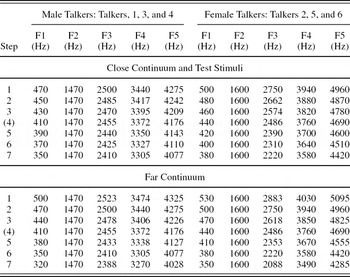
Synthesized speech. Two seven-step continua were synthesized from the natural speech of the six native speakers of Quebec French. The close continuum was developed such that the first step of the continuum consisted of the same formant values as the naturally produced vowel /ə/ and the last step of the continuum consisted of the same formant values as the naturally produced vowel /ø/. The five remaining steps of the continuum were digitalized using the Synth Klatt Parameter Editor (Synth; AVAAZ Innovations, Inc., 1993–2004) by decreasing the values of formants 1, 3, 4, and 5 in equal steps as shown in Table 1. In the far continuum, Steps 2 and 5 consisted of the formant values of the naturally produced vowels; the remaining steps, 1 and 3 and 4 and 6, were equally spaced around these stimuli with respect to second and fifth formants as shown in Table 1. Using TFR (AVAAZ Innovations, Inc., 1999), the consonants produced by the native French speakers were isolated from the vowel and pasted to each step of the continua in order to obtain the eight target words.
Synthesized Klatt parameters for the testing and training stimuli by talker gender, condition, and step of the continuum

Note: Common respective parameters for the male and female tokens included durations of 275 and 290 ms and F0 values of 130 and 200 Hz. Vowel parameters were constant across words and speakers within a gender group. Step 4 was not used during training.
Participants
Seventy adult English speakers who reported normal hearing participated in the study. There was a total 18 males and 52 females, with an average age of 26 years (range = 16–52 years, median = 24 years). All participants had limited knowledge of French as measured by a language questionnaire consisting of the following items: place of birth, other cities of residence for at least 6 months; language(s) spoken at home, language(s) spoken with friends; elementary school language(s); secondary school language(s); college and/or university language(s). Participants were asked to indicate the percentage of each language used if applicable. Most participants were born and raised in Canada or the United States; 8 participants were born and raised in other English-speaking countries (South Africa, New Zealand, Australia) or immigrated to Canada at a young age and were subsequently raised in English (Singapore, Kuwait, Germany, Budapest). Fifty-seven participants only spoke English at home; the remaining 13 participants spoke mostly English at home (at least 80% of the time), as well as Mandarin, Cantonese, Urdu, Punjabi, Vietnamese, Kadhi, Hungarian, or Icelandic. Fifty-nine participants spoke only English outside of the home; 11 spoke English at least 90% of the time and French 5% or 10% of the time. All participants attended elementary and high school in English; 14 of them received French as a second language instruction in elementary school and 15 of them in high school. All participants attended college and/or university in English.
In order to verify that the test and training stimuli were perceptible to native speakers of French a comparison group of 10 adult francophones (aged 23–35 years) was also recruited. These participants were born and raised in Québec, grew up in monolingual French-speaking homes, attended elementary and high school in French, and preferred French as their normal language of communication although they learned English as young adults and attended college or university in English.
Procedure
Participants completed a pretraining assessment, two training sessions, and a posttraining assessment. The total duration of the experiment was 2.5. hr over 2 days. All participants completed the same pre- and posttraining procedures. Participants were randomly assigned to one of seven training conditions: control, single voice prototype (SVP), multiple voice prototype (MVP), single voice close (SVC), multiple voice close (MVC), single voice far (SVF), or multiple voice far (MVF); there were 10 participants per group.
Pre- and posttraining procedures. The participants' ability to produce and perceive the vowel contrast was assessed during the pretraining session (first 45 min on Day 1) and during the posttraining session (second 45 min on Day 2). As an introduction to the production testing procedure, participants first heard a French native speaker produce each of four minimal pairs while being shown the printed version of each word. Subsequently the printed words were presented without the auditory stimulus. While wearing a head-mounted microphone (AKG C 420 III PP MicroMic) each participant read three instances of each of the eight words presented randomly on a computer screen. Their productions were recorded into Pro Tools (V. 7.1, Digidesign).
ECOS (Avaaz Innovations Inc.) was used to set up the perceptual component of the pretraining measure, which consisted of a two-alternative forced-choice word identification task. The perceptual task took place in a quiet room and participants listened to the minimal pairs through headphones (Senheiser HD 496). Participants were presented with two blocks of 105 trials each of three minimal pairs: que/queue produced by Talker 1, de/deux produced by Talker 2, and ne/noeud produced by Talker 2. The length of time required to complete the word identification task was approximately 30 min including a short break between the blocks of stimuli. Participants heard one word at a time, and were required to select one of the two printed words. The next trial was presented 2000 ms following their previous response. Participants did not receive feedback on their performance during the test. In comparison to a group of 10 native-speakers of French, all participants achieved less than 80% accurate perception on Stimuli 1, 2, 3, 5, 6, and 7. Production was judged to be less than 50% accurate on a pretraining measure by the first author, a native speaker of French.
Training sessions. ECOS (Avaaz Innovations Inc.) was used to set up all training sessions that took place in the same quiet room. Each training session lasted approximately 30 min (last half-hour on Day 1 and first half hour on Day 2). Participants in the experimental groups were presented with a block of 240 trials of the minimal pair de/deux as well as with a block of 240 trials of the minimal pair je/jeu following a short break during each training session. Participants listened to the stimuli through headphones (Sennheiser HD 496). Participants in the prototype conditions listened to the stimuli at Steps 2 and 5 of each of these continua. Participants in the far conditions listened to stimuli at steps farthest from the category boundary, whereas participants in the close conditions listened to the stimuli at steps closer to the category boundary, as described in Table 1. Participants in the multiple voice conditions heard the two minimal pairs from Talkers 1 and 3 to 6, whereas participants in the single voice condition heard the two minimal pairs produced by Talker 1 only. All participants received visual feedback regarding their performance accuracy on each trial during the training sessions. The next trial was presented 2000 ms following the visual feedback.
Participants in the control condition completed a grammatical gender identification task that was also set up with ECOS (Avaaz Innovations Inc.). Participants in the control grammatical judgment task were presented with two blocks of 240 printed French words on the computer screen. They were asked to select which of two determiners written on the screen, one masculine and one feminine, was appropriate for the target word (e.g., “un” for singular masculine noun or “une” for singular feminine noun). The following trial was presented once they had received feedback on their performance.
RESULTS
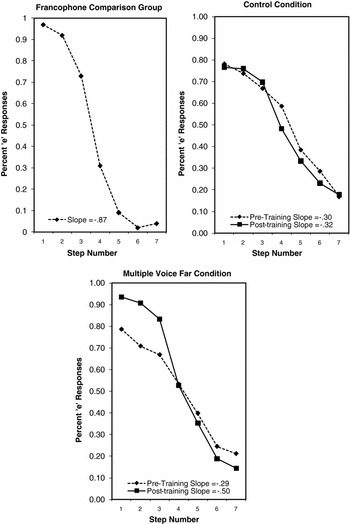
The impact of the speech perception training procedure on speech perception outcomes was evaluated by examining the slopes of the identification functions. Slopes were calculated separately for each continuum and by aggregating responses across all three test continua. Figure 1 shows selected group identification functions in order to illustrate the relationship between the slope of these functions and perceptual ability, especially change in perception performance over time. The left hand function shows the aggregate identification function for the 10 francophone participants in the comparison group, who obtained slopes ranging from −0.70 to −3.21, yielding an aggregate slope of −0.87. The middle functions were obtained from the control group before and after training in the grammatical gender identification task. Although more “e” responses were obtained for Stimuli 1, 2, and 3 than for Stimuli 5, 6, and 7 the shallow slope of −0.30 that is virtually unchanged after training indicates poor perception of the contrast and no perceptual learning. The right-hand function, obtained from the participants in the multivoice far condition, represents a shallow slope prior to perception training but a significant improvement to −0.50 after training, reflecting more consistent “e” responding for Stimuli 1, 2, and 3. Note that the slopes shown in Figure 1 are for the aggregated group identification functions and therefore do not correspond exactly to the slopes reported in Table 2, which are averaged across slopes derived from individual functions.
Selected identification functions showing the percentage of “e” responses and the associated slopes for (left) the francophone comparison group, (middle) the control group (pre- and posttraining), and (right) the multiple voice far condition (pre- and posttraining).

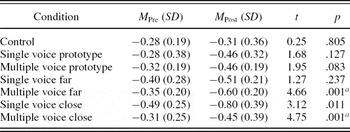
Mean slope (SD) by assessment time (pre- or posttraining) and condition with results of paired t tests

a After applying the Bonferroni correction, these values are statistically significant (i.e., <.007).
The effectiveness of the intervention was assessed using a repeated-measures analysis of variance (ANOVA) followed up by paired t tests to examine changes between pretraining and posttraining performance for each condition and by using analysis of covariance (ANCOVA) to compare across all conditions at the posttraining assessment point.
The impact of the speech perception training procedure on the participants' ability to produce the /ə/–/ø/ vowel contrast was also examined. Between group differences in D(a) for vowel centroids were assessed with ANOVAs for vowels produced before and after training in order to describe productive changes in the separation of the vowel categories. Furthermore, listener judgments as to the accuracy of the nonnative rounded vowel productions were submitted to a repeated-measures analysis.
Perception results by condition
Table 2 contains the mean slopes, aggregated across continua, for the pretraining and posttraining assessment, for each experimental condition. A 2 × 7 repeated-measures ANOVA with time (pre- vs. posttraining) as the within-subjects variable and condition (control, SVP, MVP, SVF, MVF, SVC, MVC) as the between-subjects variable revealed a significant effect of time, F (1, 63) = 50.70, p < .001, η2 = 0.45, and a significant time by condition interaction, F (6, 63) = 2.48, p = .032, η2 = 0.19; the effect of condition was not significant, F (1, 6) = 2.13, p = .06, η2 = 0.17.
Given the significant interaction, change over time was assessed for each condition separately using paired t tests. Table 2 shows the results of the paired t tests, assessing the effectiveness of the intervention in each condition. The mean slopes of the identification functions in the control condition were weakly negative both prior to and after the intervention with no significant change. A more strongly negative slope was obtained posttraining compared to pretraining in the SVP condition, but the change is not statistically significant. Multiple voices appeared to enhance the effectiveness of training with prototypical vowel input, but the change in slope was not statistically significant in the MVP condition. No change in perception of the vowel contrast was observed in the SVF condition. Training subjects to identify a range of stimuli produced by multiple talkers and placed far from the boundary resulted in a significant improvement in identification performance for subjects in the MVF condition. Subjects in the SVC condition had the best pretraining performance but achieved an even steeper slope in the mean identification function after training. This change in slope was not statistically significant after applying the Bonferroni correction however. Finally, the MVC condition resulted in a significantly steeper slope posttraining when compared to the pretraining identification function.
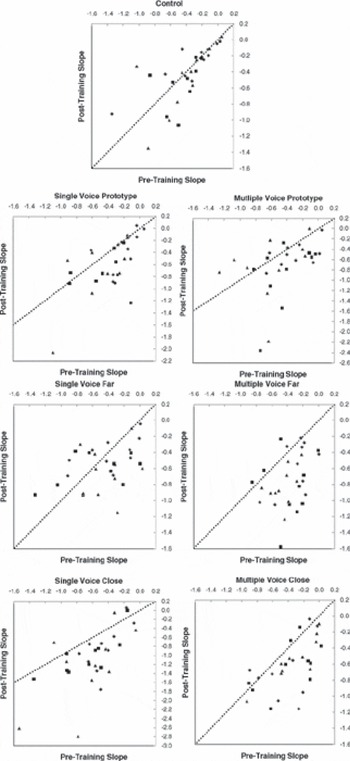
To further illustrate the pattern of results presented in Table 2, Figure 2 plots the pretraining slopes against the posttraining slopes by condition and continuum. Each point represents the pre- and posttraining slope for one participant when responding to one of the three test continua. The diagonal line in each figure represents identical slopes pre- and posttraining. Points below and to the right of the line correspond to participants with steeper (more negative) slopes after training and points above and to the left of the line correspond to participants with shallower (less negative) slopes after training. To sum up, pretraining slopes in all conditions were slightly negative but shallow indicating weak ability to sort the exemplars into rounded and unrounded vowel categories prior to training. On average, posttraining slopes shifted to slightly more negative values posttraining in all conditions. However, changes in slope after two training sessions were statistically significant in only two of the seven conditions, specifically MVF and MVC, suggesting that perceptual learning was enhanced by variability in the phonetic and indexical characteristics of the training stimuli.
Pretraining slopes plotted against posttraining slopes for each condition. Points are plotted separately by participant and test continuum. Diamonds indicate Continuum 1 (trained talker, new word pair), squares indicate Continuum 2 (new talker, trained word pair), and triangles indicate Continuum 3 (new talker, new word pair). The diagonal line indicates no change in slope from the pre- to posttraining perception test.

Perception results by continuum
The next analysis was directed at comparing outcomes across groups after controlling for pretraining differences in vowel identification ability. A one-way ANCOVA was conducted for the slopes derived from the identification responses for each continuum. Posttraining slopes were the dependent variable, pretraining slopes were the covariate, and training condition was the random between groups factor. Planned comparisons involved using the least significant difference method to compare each experimental training condition to the control condition.
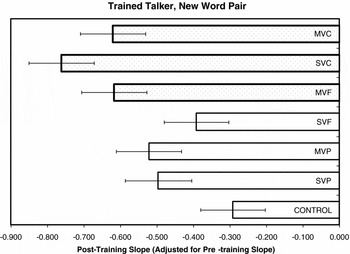
Continuum 1: Trained talker, new word pair. The first continuum assessed the subjects' generalization of learning of the /ə/ versus /ø/ contrast to a new word using stimuli recorded from a talker that was presented during training (que/queue produced by Talker 1). Overall, the ANCOVA revealed a significant training effect after controlling for pretraining vowel identification performance, F (1, 6) = 3.07, p = .011, η2p = 0.23. As shown in Figure 3, the training conditions MVF, SVC, and MVC resulted in significantly steeper posttraining slopes relative to the control condition.
Mean slopes of the posttraining identification functions after controlling for pretraining perceptual performance on Continuum 1 (trained talker, new word pair). Standard error bars are shown. Hatched bars indicate conditions that yielded significantly greater posttraining slopes in comparison to the control condition. SVP, single voice prototype; MVP, multiple voice prototype; SVF, single voice far; MVF, multiple voice far; SVC, single voice close; MVC, multiple voice close.

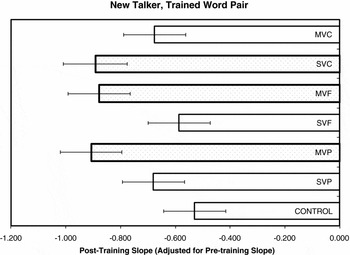
Continuum 2: New talker, trained word pair. The second continuum assessed transfer of learning to a new talker when the subjects identified words that had been presented during training (de/deux produced by Talker 2). As shown in Figure 4, the greatest differences in posttraining slope were observed in the SVC, MVF, and MVP conditions relative to the control condition. However, the trend toward a main effect of training condition was not statistically significant, F (1, 6) = 1.91, p = .093.
Mean slopes of the posttraining identification functions after controlling for pretraining perceptual performance on Continuum 2 (new talker, trained word pair). Standard error bars are shown. Hatched bars indicate conditions that yielded significantly greater posttraining slopes in comparison to the control condition. SVP, single voice prototype; MVP, multiple voice prototype; SVF, single voice far; MVF, multiple voice far; SVC, single voice close; MVC, multiple voice close.

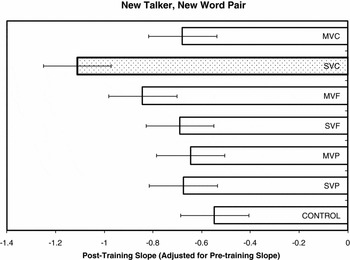
Continuum 3: New talker, new word pair. The third continuum assessed generalization of the training effect to a new talker and a new word pair (ne/noeud produced by Talker 2). The results for Continuum 3 are illustrated in Figure 5 and suggest a steeper posttraining slope, after controlling for pretraining slope, in the SVC condition relative to the control; however, a significant main effect of condition was not observed for this continuum, F (1, 6) = 1.70, p = .135.
Mean slopes of the posttraining identification functions after controlling for pretraining perceptual performance on Continuum 3 (new talker, new word pair). Standard error bars are shown. Hatched bars indicate conditions that yielded significantly greater posttraining slopes in comparison to the control condition. SVP, single voice prototype; MVP, multiple voice prototype; SVF, single voice far; MVF, multiple voice far; SVC, single voice close; MVC, multiple voice close.

A final analysis involved conducting a 3 × 2 factorial analysis of variance after excluding the control group slopes from the data set and aggregating responses across all three continua. The factors were vowel distribution (prototype, far, close) and talker variability (single talker, multitalker). There was no main effect of vowel distribution, F (1, 2) = 0.29, p = .774. Neither was there a significant main effect of talker variability, F (1, 1) = 0.24, p = .675. A marginally significant interaction of vowel distribution and talker variability was observed however, F (1, 2) = 3.30, p = .045, η2p = 0.11. These results confirm the overall impression conveyed by Figures 3 through 5: training with multiple talkers was most effective when subjects were presented with a range of vowel stimuli that were far from the category boundary (estimated marginal means = −0.61 vs. −0.47 in the MVF and MVC conditions, respectively); however, the single talker condition was more effective when subjects were trained with vowel stimuli that were close to the category boundary (estimated marginal means = −0.72 vs. −0.49 in the SVC and SVF conditions, respectively). Neither prototype condition was effective in improving perceptual knowledge of the /ə/–/ø/ contrast (estimated marginal means = −0.51 vs. −0.49 in the SVP and MVP conditions, respectively).
Production results by condition
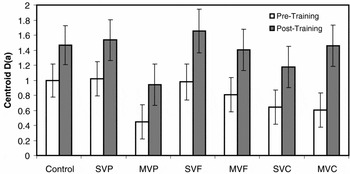
Acoustic analyses. Whereas English vowels can be differentiated using continua describing only the first two formants (F1 and F2), reliable classification of front rounded vowels requires that higher formants such as F3 and F4 be considered (Ménard, Schwartz, & Boë, Reference Ménard, Schwartz and Boë2002; Traunmüller & Öhrström, Reference Traunmüller and Öhrström2007). Because of the inherent problems associated with attempting to resolve upper vowel formants for female speakers, the vowels were categorized on the basis of spectral moments analysis. After confirming that the first spectral moment, or centroid, was sufficient to reliably distinguish productions of /ə/ and /ø/ by French native speakers the centroid produced by the 70 participants were therefore calculated in Praat (v. 5.05; Boersma & Weeninck, Amsterdam) using a Matlab script (v. 7.4; Mathworks, Natick, MA) similar to the procedure described by Shiller, Sato, Gracco, and Baum (Reference Shiller, Sato, Gracco and Baum2009). For each participant, the degree of separation (or overlap as the case may be) in the distribution of /ə/ and /ø/ productions was determined by calculating D(a) scores, averaging across all words within a vowel category. A 2 (Time) × 7 (Condition) repeated-measures of analysis was conducted to examine change in D(a) scores for the vowel centroids as a function of training condition from the pretraining to the posttraining assessment. A main effect of time was observed, F (1, 1) = 30.00, p < .001, η2p = 0.35. As shown in Figure 6, all groups increased the difference in centroid between the two vowels from the pretraining to the posttraining assessment. There was no main effect of training condition however, F (1, 6) = 1.14, p = .35. Nor was there a significant interaction between assessment time and training condition, F (1, 6) = 0.22, p = .97.
Mean D(a) scores for vowel centroids by condition from the pretraining and posttraining assessments. SVP, single voice prototype; MVP, multiple voice prototype; SVF, single voice far; MVF, multiple voice far; SVC, single voice close; MVC, multiple voice close.

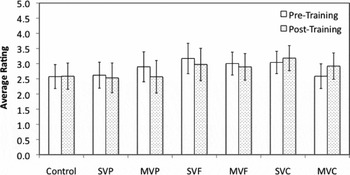
Listener judgments. Listener ratings of the accuracy of the /ø/ vowel produced in words by the subjects before and after speech perception training were obtained from two native speakers of French who were naive to the purposes of the experiment. They rated each production on a 5-point scale from 1 (not at all like /ø/) to 5 (exactly like /ø/). The raters were in high agreement (R 2 = .68) and pre- and postscores were very similar (R 2 = .53). Productions were rated 2.8 on average, indicating moderate ability to produce the target vowel, and there was no difference between the pre- and posttraining average ratings, as shown in Figure 7. There was a numerical increase in the average ratings for the SVC (pre = 3.04, post = 3.18) and MVC (pre = 2.59, post = 2.92) training groups and a numerical decrease for the MVP training group (pre = 2.90, post = 2.57). These ratings were submitted to a 2 (Time) × 7 (Condition) repeated-measures of analysis. This analysis revealed no effect of time or condition and no interaction of assessment time and training condition.
Mean listener judgments of pre- and posttraining rounded vowel production attempts in which native speakers of French rated each vowel on a scale from 1 (not at all like /ø/) to 5 (exactly like /ø/).

The results of the production assessment lead to the conclusion that the testing procedure itself encouraged subjects to attempt to differentiate the vowels, possibly stimulated by the difference in spelling that was apparent in the text stimuli provided as production prompts during the production task and as response alternatives during the perceptual identification tasks. However, no specific effect of the speech perception training procedure on production accuracy was observed. Control subjects changed their productions as well as subjects in all experimental training conditions. Furthermore, francophone listeners reported that the subjects' vowels did not sound accurate and that no changes in production accuracy were perceptible to these native speakers from the pretraining to the posttraining assessment.
DISCUSSION
In this study English-speaking adults received approximately 1 hr of training in the perception of a French vowel contrast. Orthogonal manipulations of phonetic and indexical variability resulted in six experimental training conditions that were contrasted with a control condition. Perceptual outcomes were assessed by testing subjects' identification of various continua representing minimal pair words contrasting /ə/ and /ø/ in untrained words spoken by a familiar talker, trained words spoken by an unfamiliar talker and untrained words spoken by an unfamiliar talker. When assessing pre- to posttraining changes in the slope of the identification functions, statistically significant training effects were observed in only two conditions: MVF and MVC. These results confirm previous findings of enhanced adult learning of second language phonetic contrasts under conditions of stimulus variability (e.g., Bradlow et al., Reference Bradlow, Pisoni, Akahane-Yamada and Tohkura1997; Lively et al., Reference Lively, Logan and Pisoni1993). Outcomes were superior when the subjects were trained with multitalker stimuli that varied the criterion acoustic cue to the vowel contrast.
The results further suggest that multitalker training was more effective in the multitalker far condition than the multitalker close condition. In other words, the subjects were most likely to learn to perceive the vowel categories when presented with a range of exemplars that were distributed around the center of the phonetic categories. The procedure was less effective when multitalker training stimuli emphasized the location of the boundary between the phonetic categories being taught. This finding appears to be consistent with the conclusions drawn from computational modeling using the mixture of Gaussians approach. McMurray et al. (Reference McMurray, Aslin and Toscano2009) explained that this approach leads to independent learning of each category from the frequency distribution of cues in the exemplar space, with the important parameters being the location of the mean or prototype as well as the width and height of the frequency distribution associated with a given category. In short, the results of the simulation suggested that category learning involves learning the characteristics of individual categories rather than the location of the boundary between categories.
In contrast, examination of posttraining identification functions in relation to control group outcomes revealed a significant training effect in SVC, a condition that forced subjects to attend to the category boundary point. In fact, this group showed the steepest posttraining identification function slope overall. This result may reflect a true training effect given that the outcome measure, slope of the identification function, is highly sensitive to changes in identification performance at the category boundary. Learning to identify exemplars that are close to the category boundary is a difficult task. Perhaps multitalker input rendered this task too difficult to learn, especially with the brief period of training provided in this study. Caution is required in the interpretation of this finding however. Unfortunately, despite random assignment, there were small between-group differences in pretraining perception performance such that the subjects in the single voice close group out-performed all other groups. Thus, it is possible that the outcomes observed for this group reflect an interaction between pretraining perceptual knowledge and the training procedure rather than the relative effectiveness of the SVC training condition alone.
Efforts to teach perception of lexical tone to English-speaking adults have revealed interactions between training conditions and pretraining subject characteristics. Wong and Perrachione (Reference Wong and Perrachione2007) found a large degree of between-subject variability in the learning of lexical tone contrasts that was partially explained by the subjects' nonlinguistic pitch perception ability prior to training. Furthermore, subjects with poor pitch perception benefited the most from single-talker training, whereas subjects with better pitch perception benefited the most from multitalker training. These findings do not relate directly to our results in which subjects with relatively good pretraining vowel perception appeared to benefit from the single talker close stimulus condition. However, these studies highlight the need to carefully consider interactions among subject characteristics, task difficulty, the specific nature of the training stimuli, and optimum sequencing of training conditions.
Training with the protoypical exemplar of the vowel categories from each continuum was not effective in single talker or multitalker conditions. This is not consistent with the findings reported for infants by Rost and McMurray (in press). They found that infant learning of a VOT contrast was enhanced by multitalker input even when within category acoustic–phonetic cues were restricted to prototypical values. Direct comparison of findings from infants to adults is problematic although some researchers have suggested similarities in the learning process. Some studies have observed shifts in lateralization and focalization of neural responses to speech input that accompany training induced shifts from auditory to phonetic processing of nonnative speech contrasts; furthermore, the topography of these shifts in neural responses appear to be similar to those that occur in early speech perception development (Tremblay, Kraus, McGee, Ponton, & Otis, Reference Tremblay, Kraus, McGee, Ponton and Otis2001; Tremblay, Nina, Carrell, & McGee, Reference Tremblay, Nina, Carrell and McGee1997; Zhang et al., Reference Zhang, Kuhl, Imada, Iverson, Pruitt and Stevens2009). The nature of the learning process that leads to these shifts in neural responses may not be comparable however: infant learning of speech contrasts involves a process of implicit learning from passive exposure to the relevant speech input whether induced in the laboratory or in natural learning environments; implicit unsupervised learning contrasts sharply with cross-linguistic training studies in which adults receive corrective feedback when learning to identify speech stimuli according to multiple nonnative phonetic categories. Behavioral and neurophysiological studies of visual category learning have shown that implicit and explicit category learning relies on dissociable learning mechanisms underpinned by fundamentally distinct neural systems (Casale & Ashby, Reference Casale and Ashby2008; Zeithamova, Maddox, & Schnyer, Reference Zeithamova, Maddox and Schnyer2008). Further research is required to determine whether these two forms of learning benefit differentially from distinct types of input.
Another difference between the infant and adult learning contexts is that the adult often must shift attention away from an inappropriate cue and overcome learned inattention to the criterion phonetic cue when learning a new speech contrast, a challenge not faced by the infant learner. Although adults do seem to be able to shift attention toward a new cue with training (Francis, Baldwin, & Nusbaum, Reference Francis, Baldwin and Nusbaum2000), this is a notoriously difficult problem for second language learners. This problem is highlighted by discontinuities between adult performance in perception versus production tasks involving nonnative contrasts. Bradlow et al. (Reference Bradlow, Pisoni, Akahane-Yamada and Tohkura1997) describe apparent improvements in the production of American English /ɹ/ by Japanese subjects after minimally successful perception training. These subjects, however, were manipulating secondary cues in production such as segment duration; attention to these same cues during perception testing led to highly unreliable perceptual performance with a contrast that is signaled by spectral cues. Similarly, in the present study, production outcomes suggested that all groups of subjects, including the control group, were prompted to manipulate overall vowel centroid as one acoustic parameter associated with lip rounding. Lowering the centroid of /ø/ relative to /ə/ did not result in a perceptually correct /ø/ in the judgment of native francophones because this change by itself did not signal the correct place of articulation. The vowel /ø/ is characterized by the location of F2′ in relation to F1, with F2′ being a composition of F2, F3, and F4 (Ménard et al., Reference Ménard, Schwartz and Boë2002). Although attention to overall centroid allows for some degree of accuracy in the categorization of these vowels as shown in the pretraining identification functions, the achievement of sharply defined category boundaries requires attention to the more specific acoustic–phonetic cue. It is quite probable that the type of stimuli required to draw the learner's attention to the appropriate criterion cue is the same in the case of both infant first language and adult second language learning; the learning conditions that promote inhibition of attention to an inappropriate cue have not been clarified.
Limitations and future directions
In this study we sought to compare the relative effectiveness of six different stimulus conditions, in comparison to a control condition, when teaching English-speaking adults to perceive a French vowel contrast. First, the primary limitation of the study is the very brief period of training, providing the research participants with an hour of supervised learning experience with the nonnative vowel contrast over a 2-day period. In contrast, other studies of second language phonetic learning have involved more intense training, typically 10 to 15 hr of training (e.g., Lively et al., Reference Lively, Pisoni, Yamada, Tohkura and Yamada1994; Nishi & Kewley-Port, Reference Nishi and Kewley-Port2007; Zhang et al., Reference Zhang, Kuhl, Imada, Iverson, Pruitt and Stevens2009). Therefore, the limited generalization observed may reflect the brevity of the training program rather than the stimulus conditions per se. Second, the digital processing of the stimuli to ensure control over the primary acoustic cue to category membership reduced the distinctiveness of talker characteristics within gender groups so that the variability in the multiple talker conditions was not as great as it would be with fully natural stimuli. Third and finally, the large number of training conditions ensured small group sizes despite a large number of subjects overall and thus power to detect between group differences was reduced. Despite these limitations, the results confirmed the importance of variable stimuli for perceptual learning while suggesting that the exact form of stimulus variability that is provided may interact with other variables such as subject characteristics and the use of implicit versus explicit learning paradigms. The outcome of this study suggests hypotheses that can be tested in future studies that will concentrate resources on training conditions most likely to yield efficient results. In particular, studies of individual differences in learning have suggested that training with multiple voices may be most effective for learners with some ability to discriminate the critical perceptual dimension (Wong & Perrachione, Reference Wong and Perrachione2007). This suggests that preceding multitalker training with some single talker training may be more effective than multitalker training alone.
ACKNOWLEDGMENTS
This research was funded by a Natural Sciences and Engineering Research Council of Canada Discovery Grant (to S.R.); a Fonds de Recherche en Santé du Québec studentship (to F.B.-L.); a Centre for Research in Language, Mind, and Brain postdoctoral fellowship (to M.C.); and CIHR Health Professional Student Awards (to D.D. and S.R.). We are grateful for the assistance provided by Marie Desmarteau, Tamara Stein, and Sarah Roy.