Bringing Regional Elections into The Study of Party System Nationalization in india
for more than a decade, party system scholars have taken a strong interest in providing comparative measurements for party system nationalization (Bochsler 2010a; Caramani Reference Caramani2004; Chhibber and Kollman Reference Chhibber and Kollman2004; Golosov Reference Golosov2014; Jones and Mainwaring Reference Jones and Mainwaring2003). Party system nationalization expresses the degree to which a party system is territorially integrated. Social scientists use party nationalization scores to compare and contrast different party systems or to sketch the evolution of a particular party system over time. More ambitiously, they use party nationalization to explain territorial differences in campaign strategies or to understand why authority migrates from the centre to the constituent units of a nation or vice versa.
Notwithstanding the merits of party system nationalization for social scientific inquiry, party and electoral scholars are not united over how to operationalize the concept.Footnote 1 However, the leading studies on party system nationalization (Bochsler 2010a; Caramani Reference Caramani2004; Chhibber and Kollman Reference Chhibber and Kollman2004; Golosov Reference Golosov2014; Jones and Mainwaring Reference Jones and Mainwaring2003) all measure party system nationalization on the basis of variations in national or general election outcomes alone. Yet, with the rise of regional authority (Hooghe et al. Reference Hooghe, Marks and Schakel2010) across a range of OECD countries since 1950, there is a strong case to incorporate sub-national (regional) election results into the conceptual understanding and analysis of party system nationalization. Indeed, measurements of nationalization that are based purely on national election results exemplify ‘methodological nationalism’ because they give ‘a nation-state outlook on society, law, justice and history’ (Beck Reference Beck2002: 52). Broadening our understanding of nationalization to include electoral performance in regional elections enables us to answer questions which the ‘traditional’ nationalization studies cannot explore. For instance, what underpins a rise in denationalization? Does denationalization primarily result from a growing discrepancy in voting behaviour across the states of a multilevel state in national elections or also in regional elections? Is denationalization triggered primarily by voters switching votes between national and regional elections (dual voting) or simply by wider inter-regional variations in voting patterns for national and regional elections? We develop alternative measures of nationalization which enable us to explore these questions in full in relation to party system nationalization in India. Indeed, recent work by Schakel (Reference Schakel2013a, Reference Schakel2013b) has started to incorporate regional election results into the conceptualization of party system nationalization in Europe. Yet we believe that there is a strong need to extend such analyses to other parts of the world with relatively well-institutionalized party systems and regional governments. India makes an important case study of this kind for a variety of reasons.
Firstly, with an electorate of more than 800 million voters and with (as of 2014) 29 states and two union territories with directly elected assemblies, India is demographically the largest democracy in the world. Furthermore, since 1952 and until the general elections of April–May 2014, India held 16 general elections and 351 regional (state) elections, providing an extremely rich data set of election results which enable us to track patterns of party system nationalization over time. Voters in India also hold the state and not the central government accountable for a range of important policy issues (Chhibber et al. Reference Chhibber, Shastri and Sisson2004: 339–52). For instance, when asked in a pan-India survey which level of government was responsible for providing a set of public goods, the share of citizens holding the state (and not the central or local governments) responsible varied between 67 and 74 per cent for medical and education facilities, electricity, crime and ration supply; and between 50 and 60 per cent for drinking water, pollution and roads (Chhibber et al. Reference Chhibber, Shastri and Sisson2004: 350). These findings are in line with other studies which see the MLA (Member of the state Legislative Assembly) as a more important interlocutor for gaining access to public goods than a national MP (Brass Reference Brass1994). They also tie in with findings that have attributed a larger role to the states since the 1990s due to the liberalization of the Indian economy (Sinha 2004) and the dependence of central governments on the support of regional parties in the era of national coalition and/or minority government (1989–2014; Arora and Kailash Reference Arora and Kailash2012).
Secondly, we add to the literature on the Indian party system, by giving equal attention to electoral dynamics in general and state elections since 1952. Until a few years ago, most studies of the Indian party system focused primarily on national election results (Palshikar and Suri Reference Palshikar and Suri2014; Shastri et al. 2009; Yadav Reference Yadav1999; Yadav and Palshikar Reference Yadav and Palshikar2009a), state election results (Yadav and Palshikar Reference Yadav and Palshikar2006), or both within a particular state (e.g. Harriss and Wyatt Reference Harriss and Wyatt2013; Kumar Reference Kumar2013). Fewer analyses have provided a more systematic link between state and national elections; Arora (Reference Arora2000), Yadav and Palshikar (Reference Yadav and Palshikar2008, Reference Yadav and Palshikar2009a), and more recently Palshikar et al. (Reference Palshikar, Suri and Yadav2014); Arora and Kailash (Reference Arora and Kailash2012) and Kailash (Reference Kailash2014b) are exceptions. For instance, tracking state and national election contests in the period since 2004, Yadav and Palshikar (Reference Yadav and Palshikar2009a) note a discrepancy between the ‘legislative dominance’ of the centre and the ‘political dominance’ of the state arena. They argue that national electoral outcomes ‘derive from’ ‘principal’ electoral contests at the state level and critically engage with the ‘European notion’ of second-order elections in the Indian context. Yet, most of these studies focus primarily on developments in the ‘post-Congress polity’ (1989–present) whereas we propose to track party system nationalization since the first elections in 1952.
Thirdly, our article follows shortly after what many have perceived as historic general elections in April–May 2014. In this context it has been assumed that the outcome of the 2014 general elections produced a significant nationalization of the Indian party system due to the return of a single party majority after 25 years of coalition or minority government (mostly even minority coalition government; see Sridharan Reference Sridharan2012). Yet, as we will argue, the true relevance of the 2014 elections for Indian democracy cannot be fully understood without situating this election in a wider context: longitudinally by comparing its results with previous general elections, but also vertically, by comparing the 2014 and preceding general elections with previous state elections. Conceived as such, we will argue that the 2014 general election provides more evidence of continuity than change in the Indian multilevel party system.
In what follows we first provide an alternative way of conceptualizing ‘nationalization’ based on four different sets of measurements. Subsequently we apply these measurements to all general and state elections that took place in India between 1952 and 2014 (we take the 2014 general elections as our endpoint). We relate our findings to prevailing conceptions on the ‘nationalization’ and ‘federalization’ of the Indian party system and engage with the Indian party system literature to explain shifts in our measurements over time. In the next section we contextualize the significance of the 2014 general election result by placing it in a longitudinal and multilevel perspective and by bringing in party nationalization scores to examine the extent to which this election has made the Bharatiya Janata Party (BJP – Indian People’s Party) the most important national party. Next, we produce nationalization measures on the basis of seat not vote share given that India’s first-past-the-post system often produces major anomalies between vote and seat share. The conclusion summarizes our main findings and provides avenues for future research.
Rethinking Party System Nationalization: Beyond ‘Methodological Nationalism’
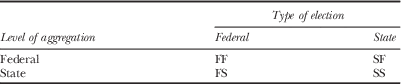
In order to conceptualize and measure long-term trends towards (de)nationalization, we conceive the Indian party system as a multilevel electoral system which consists of two tiers of government – state and federal, and which hold two types of elections – state and federal (Schakel Reference Schakel2013b). This means that we can (dis)aggregate party vote share according to level of aggregation and/or type of election. In Table 1 we display four different party vote share types, the first letter denotes the type of election, the second indicates the level of aggregation.
Types of Vote Share in a Multilevel Electoral System

Regional election scholars generally measure congruence between the federal and state vote by a dissimilarity index which subtracts vote share won in state elections from that won in federal elections, takes absolute values and sums them over the number of parties and divides the sum by two because one party’s gain is another party’s loss. An often overlooked aspect of the dissimilarity index is that one can vary the type of vote share which is put into the formula (Schakel Reference Schakel2013b). The following formula allows us to vary the type of election and the level of aggregation in the dissimilarity index:
 $$Dissimilarity\,index\;{\equals}{1 \over 2}\mathop{\sum}\limits_i^n \!{\,\mid\,\!\!X_{{ijk}} {\minus}X_{{ijk}} \!\mid\,} $$
Whereby X represents a vote share for party i in a particular type of election j (state or federal) and aggregated to level k (state or federal). The dissimilarity index varies from a minimum of 0 per cent – completely similar or full congruence – to 100 per cent – completely dissimilar or full incongruence (note that there is an inverse relationship between the dissimilarity index and the degree of congruence). We develop four measures of congruence on the basis of the dissimilarity index whereby one either varies the type of election (j) or the level of aggregation (k) or both (see Table 1). A detailed overview of how the various measures are operationalized can be found in the online appendix.
-
∙ Party system congruence (FF-SS): This measure evaluates the extent to which a particular state party system is different from the federal party system and it is the result of two sources of variation: the extent to which a state electorate is different from the federal electorate (level of aggregation) combined with the extent to which the state electorate switch their vote between state and federal elections (type of election). How a state electorate votes in a state election closest to a federal election is compared with how the federal electorate voted in that federal election. Because electorates and type of election are different, it logically is the measure for which we anticipate the highest dissimilarity. Arguably, it is also the measure which gives the most holistic expression of how nationalized or de-nationalized the multilevel party system is. To tease out both sources of variation (electorates and type of election) we also consider the following measures.
-
∙ Electorate congruence state elections (SF-SS): Electorate congruence seeks to measure to what extent a particular state electorate is different from the federal electorate. Put differently, the type of election is held constant (state elections), but the electorate (level of aggregation) is not; hence we compare and contrast the voting behaviour of the electorate of a specific state in state elections, with the voting behaviour of all state voters (including the electorate of the state concerned) across the polity in the same cycle of state elections. State (and federal) elections can be held at different dates and to match state elections to each other (and to federal elections) we found for each federal election the state election that was closest in time. In other words, if a federal election takes place every five years, then we compare the results of state elections that were held within 2.5 years (30 months) before and after that federal election. We compare individual state results with the aggregate of all state elections held within that cycle. The online appendix provides details on how state elections are clustered.
-
∙ Electorate congruence federal elections (FF-FS): This measure is the ‘federal election’ variant to the above, i.e. we compare and contrast the voting behaviour of the electorate of a specific state in federal elections with the behaviour of all voters in the polity (including the state electorate concerned) in the same federal election(s). In some sense, it is the measure which comes closest to Chhibber and Kollman’s (Reference Chhibber and Kollman2004) understanding of nationalization since it is purely based on how electors in a state vote differently from each other in the same type of election, i.e. the national or federal election.
-
∙ Election congruence (FS-SS): This measure evaluates the extent to which a state electorate votes differently in state and federal elections; hence the electorate (level of aggregation) is held constant but the type of election changes. As such it is an appropriate measure to express the extent to which voters switch their vote between federal and state elections (dual voting).
By using party system congruence as a proxy for party system nationalization, we acknowledge that the nationalization of a party system is a reflection of at least three distinctive phenomena: (1) the extent to which the electorates of all state and union territories vote similarly in the same general election; (2) the extent to which the electorates of a state or union territory vote similarly in the election of their particular state or union territory assembly compared with how the other states and union territories vote in their state or union territory assembly elections; (3) the extent to which the electorate of a particular state or union territory switch their vote between a federal and state assembly election. (2) and (3) bring in state election outcomes in the conceptualization of nationalization, thus providing a more holistic measurement of nationalization. Furthermore, by breaking down party system nationalization into its components (electorate congruence and election congruence) we can determine the most important contributory factor of nationalization. For instance, where election congruence is much higher than electorate congruence, voters in a particular state tend to vote mostly for the same party irrespective of the type of election they are voting in, but they vote differently compared with voters in other states or union territories. Our understanding of nationalization is different from the set of authors to whom we referred in the introduction. Electorate congruence for federal elections is the measure which comes closest to how party nationalization is understood by Chhibber, Kollman and others because it is based exclusively on territorial variations in voting behaviour in one type of election – that is, the national or federal election.
We also link party system nationalization to patterns of nationalization for individual parties within the party system. We felt it necessary to provide that information for India because the dominant narrative of the ‘regionalized party system’ since the 1990s has been very much tied up with the gradual decay of the Indian National Congress Party (INC or Congress Party) as the pre-eminent Indian party. To express state variations in party electoral support we have applied the Bochsler (2010b) party nationalization scores as they express the extent to which a party obtains a similar vote share across the various states. It ranges from 0 – completely regional; that is, a party only gains votes in one state – to 1 – completely nationalized; that is, a party gains identical vote share in all of the states. Therefore, the size of the party does not matter, only the state distribution of its vote share. As for congruence measures, party nationalization measures can weight for the size of the states (for example, in India larger states such as Uttar Pradesh are much more important in the nationalization index than small ones such as Mizoram) and for the number of states (not irrelevant in the Indian case given that the number of states has varied over time).
Denationalization in India: A Long-Term Perspective (1952–2014)
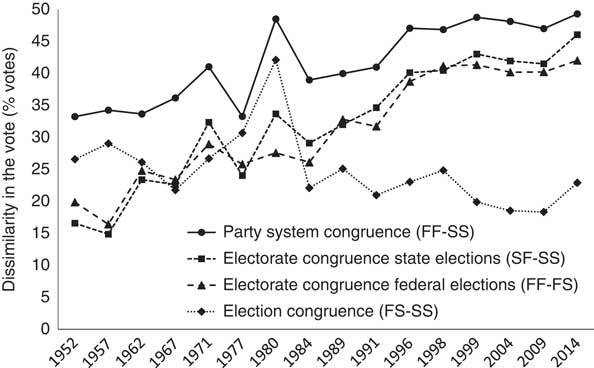
In what follows, we apply our different nationalization measures to the Indian multiparty system, thereby moving beyond an understanding of nationalization which relies purely on general election results. Figure 1 projects the evolution of our congruence measures since the first Indian general elections in 1952. Congruence measures are calculated on the basis of vote share and each state or union territory electorate is given a weightage in proportion to the size of its electorate in the overall electorate. We track the evolution of party system congruence first and subsequently turn to electorate and election congruence.
Congruence between Federal and State Election Vote Share from 1952 to 2014 Note: See the main text for an explanation of the measures.

Party System Congruence
In the graphic presentation of the party system congruence measure in Figure 1 we can see a gradual denationalization of the Indian party system, which accelerated during the 1990s. Since 1952 state electorates in federal and state elections have increasingly diverged. If we leave aside a temporary rise in party system congruence around the 1977 federal elections and a drop around the 1980 federal elections three years later, party system congruence has gradually come down since the first federal and state elections in 1952.Footnote 2 Although this decrease in nationalization complies with Chhibber and Kollman’s observations (2004: 199–209), the path of denationalization that we observe is more gradual. Both authors (2004: 166) link the denationalization of the Indian party system primarily to developments since 1991 as their ‘party aggregation score’ doubles from 2 to 4 between 1991 and 1998. Our data confirm a process of further party system denationalization in that period but not at such a fast pace. In fact, party system congruence decreased as much between 1971 and 1989 as in the period between 1989 and 2009. By bringing state election results into the conceptualization of nationalization, our measures account for the growing divergence across state electorates in state elections during the 1970s (see our separate measurements of electorate congruence for state elections); a phenomenon which Chhibber and Kollman cannot capture. The gradual denationalization of the Indian multilevel party system is easier to understand when it is unpacked into its component parts.
Party System Congruence Unpacked I: Shifting Trends in the Evolution of Electorate Congruence. Figure 1 clearly demonstrates that the drop in party system congruence is in line with a steady decline in electorate congruence (for state and central elections). The uncoupling of state and federal elections made that decline initially more pronounced for state than for general elections, but in time the electorate congruence for state and general elections dropped, with comparable values. How can the gradual rise in electorate congruence be explained? Our data point us to two important factors: (1) the rise of state or non-polity-wide parties, sometimes as breakaway factions of polity-wide parties, especially Congress; (2) the inability of new parties with polity-wide ambitions to retain a pan-Indian electoral following. Jointly, these factors produced distinctive (yet often concentrated) party systems at the level of the states but a highly fragmented party system at the centre (on this point, see also Sridharan Reference Sridharan2002, Reference Sridharan2010). As party systems have increasingly diverged from one state to the other (not necessarily in the number of parties but in which parties compete where), electorate congruence has gone down. We touch upon both of these factors in turn.
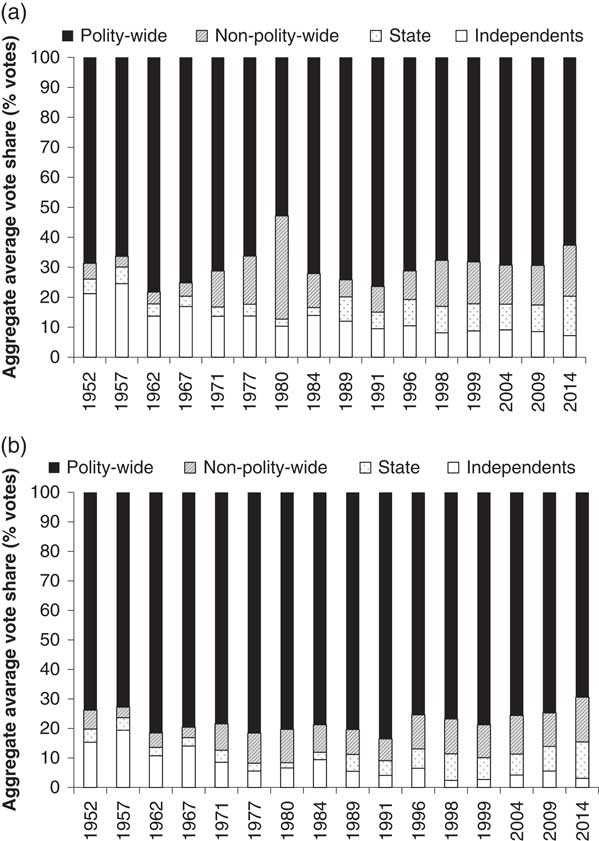
During the first federal elections, the Congress Party was dominant across a majority of the Indian states (with the exception of the south of India). This generated relatively homogeneous patterns of party competition across the states and territories. From 1962 onwards, state parties (parties which participate in elections in only one state) and non-polity-wide parties (parties which participate in more than two but less than half of the Indian states) started to make headway (see Figure 2).Footnote 3 Around 1962, the average vote (across states) for state parties was 4.1 per cent in state elections and 2.8 per cent in general elections. For non-polity-wide parties the figures were respectively 3.9 and 4.9 per cent. By 2014, the average vote share in state elections had shot up to 13.2 per cent for state parties and to 17.0 per cent for non-polity-wide parties (for the 2014 general election the figures stood respectively at 12.3 and 15.1 per cent). Our data show that the rise of state and non-polity-wide parties in this period is linked to the decreasing vote share for independent candidates (from 13.7 per cent of the vote in state elections around 1962 to 7.2 per cent of the vote in state elections around 2014, and from 10.7 per cent of the vote in the 1962 federal elections to 3.1 per cent in the 2014 federal elections; see also Mayer, Reference Mayer2013: 182–3, who links a drop in independent candidates to a rise in party candidates, mostly from state and non-polity-wide parties). Our data also show that polity-wide parties (parties which participate in more than half of the Indian states) find it increasingly difficult to hold on to a large pan-Indian vote base during this period. In state elections around 1962, they still captured 78.3 per cent of the vote, a percentage which dipped to below 62.6 per cent in state elections around 2014. In federal elections their vote share also dropped from 81.6 per cent (1962) to 69.5 per cent (2014).
Average Vote Share in (a) State and (b) Federal Elections Note: Polity-wide parties=parties participating in more than half of the regions; non-polity-wide parties=parties participating in more than one but less than half of the regions; state parties=parties participating in one state; independents=candidates with no party affiliation.

Why did state and non-polity-wide parties become more prominent over time? The extensive literature on politics in post-independent India highlights three important reasons.
Firstly, there has been a gradual rise of the state as a key unit for political mobilization within the Indian polity, to the detriment of the centre. This rise is linked to the reorganization of the states, initially along linguistic lines, and later also on the basis of tribe or territorially expressed socioeconomic grievances (Tillin 2013). Consequently, voters came to identify more with the state level (cf. Chhibber et al. Reference Chhibber, Shastri and Sisson2004; Yadav and Palshikar Reference Yadav and Palshikar2008, Reference Yadav and Palshikar2009a), resulting, for instance, in higher turnout rates for state elections than for general elections. The uncoupling of federal and state elections since 1971 added to the autonomy of state elections.
Secondly, the Congress Party has gradually declined and no single polity-wide party has been able to reclaim a core part of its social base, which in turn has been explained by three important factors: (1) the party’s dwindling appeal as the natural party of governance due to its fading association with India’s struggle for independence as time moved on; (2) the deepening of Indian democracy, or what Jaffrelot (Reference Jaffrelot2003) has referred to as a ‘Silent Revolution’ in Indian politics, linked with the mobilization of the backward castes in the populous Hindi belt of North India (Jaffrelot Reference Jaffrelot2003). As a result, the Congress Party could not accommodate lower caste or regional dissent within its own ranks; its local structures reflected ‘vertical’ caste hierarchies and did not offer direct representation to lower caste groups; (3) the party’s centralist organizational structure (Hasan Reference Hasan2012; Swenden and Toubeau Reference Swenden and Toubeau2013; Wilkinson Reference Wilkinson2015: 424–5), which left insufficient room for the accommodation of regional challengers. As party leader, Indira Gandhi suspended democratic party elections in 1971 and transformed the party from a multilevel democratic party into a dynastic pyramid (Kochanek Reference Kochanek1976) in which party functionaries first and foremost became answerable to the Gandhi dynasty and the select few of the central working committee (central party executive). After Indira Gandhi’s assassination, Congress retained a dynastic and highly centralized organizational template, even though in practice there was a limited degree of decentralization.
Equally important, however, is the inability of a single polity-wide party to reclaim the eroding social base of the Congress. For instance, the Janata Party united the anti-Congress opposition but quickly disintegrated into its component parts ahead of the 1980s elections after just one term in central government. The key successors to the Janata Party were the Lok Dal (split in Lok Dal A and Lok Dal B after the death of Charan Singh in 1988), the BJP and the Janata Party led by Chandrashekar (Brass Reference Brass1994: 85). Ten years after the Janata Party came to power at the centre, the Janata Dal dislodged Congress from central office. Yet, like the Janata Party before, the Janata Dal quickly disintegrated into various state splinters such as the Rashtriya Janata Dal and the Samati Party – later Janata Dal United – in Bihar, the Samajwadi Party in Uttar Pradesh, the Biju Janata Dal in Odisha and the Janata Dal (Secular) in Karnataka. Only the BJP has been able to buck this trend somewhat during the 1990s and more recently in its performance during the 2014 federal elections (see below).
Thirdly, the ascendance of the states and the emergence of a ‘post-Congress’ polity changed the dynamics of Indian party competition at the centre, especially after 1989, when no single party obtained an outright legislative majority. Hereafter parties with a state-based following realized that they could still be ‘federally competitive’ (that is, be a coalition partner at the centre or at least exert significant blackmail potential at that level; Kailash, Reference Kailash2014b: 190), without having to seek a polity-wide following. It is in this sense that Arora (Reference Arora2000), Arora and Kailash (Reference Arora and Kailash2012) and Kailash (2011, Reference Kailash2014a, Reference Kailash2014b) referred not only to the denationalization of the Indian party system but also to its federalization. Federalization forced single-state and non-polity-wide parties to take national elections seriously for the possibility it generated of entering federal alliances or coalitions, just as polity-wide parties (Congress and the BJP) took state and non-polity-wide parties seriously in their role as coalition-makers. Single-state parties gradually learned that they could share central power by forging pre-election seat-sharing arrangements or post-election coalition deals with polity-wide parties. The leaders of these state and non-polity-wide parties frequently coveted particular central ministerial posts such as the ministry of railways, power, telecommunications or rural development (e.g. Guha Thakurta and Raghuraman Reference Guha Thakurta and Raghuraman2007: 340). They used the centre’s access to discretionary grants to disburse resources in these areas in a way which disproportionally benefited their state or state constituents (Wilkinson, Reference Wilkinson2007, Reference Wilkinson2015: 438–9). In turn, with the prospect of participating in central government, voters had a stronger incentive to support state or non-polity-wide parties in general elections too. The rising support of regional parties in general and state elections provided an incentive for ambitious party leaders within dynastically led polity-wide parties such as Congress to break away and establish a new party to further their career prospects (Ziegfeld 2012). Recent examples of such breakaway parties are the Nationalist Congress Party, the Trinamool Congress Party or the Yuvajana, Shramika, Rythu (YSR) Congress Party.
Party System Congruence Unpacked II: Shifting Trends in the Evolution of Election Congruence. By breaking down party system congruence in electorate and election congruence, we can try to find out which of the two has the stronger impact on the denationalization of the Indian multilevel party system. Since 1984, the general drop in party system congruence is linked primarily to a rise in electorate congruence and less so to election congruence (a rise in dual voting). Hence state party systems diverge more from each other, but voters vote more similarly in state and national elections. This marks a clear departure from developments in the previous period, when election congruence was often lower than electorate congruence (see Figure 1).
As anticipated, the de-coupling of state and general elections in 1971 initially sparked a rise in dual voting.Footnote 4 Voters had clear incentives to perceive general elections through a different frame at that time in view of the personalization of electoral politics by Indira Gandhi and the implications of a vote in federal elections for state politics.Footnote 5 Yet, although shortly after resuming office in 1980 Indira Gandhi continued to intervene heavily in the politics of the states, especially of Punjab, her successor and son Rajiv Gandhi had become more tolerant of regional diversity (Bose Reference Bose2013). This may have boosted voters to frame federal elections through the lens of state politics and to vote for non-Congress (and often state parties) in state and federal elections. Put differently, as state party systems started to diverge more from each other, state electorates also displayed more uniform voting patterns in state and general elections. After this point, we observe a modest increase in dual voting between 1989 and 1998, but a sharper drop thereafter until 2009. As explained above, by 1998, the opportunity structure of the Indian multilevel electoral arena had transformed in such a way that voters no longer felt excluded when supporting a state or non-polity-wide party in federal elections too (instead of in state elections only), and this contributed to a relative drop in dual voting (or modest rise in election congruence) between 1998 and 2014.
The 2014 Election as a Possible Turning Point
At first sight, the 2014 general election result does not exemplify in any way a move to party system nationalization, as party system congruence reached an overall low. A closer look at Figure 1 reveals that all underlying dissimilarity indices in the run-up to the 2014 general elections are on the rise. Yet, despite the overall emphasis on continuity in the denationalizing trajectory of the multilevel party system, two elements could point to the 2014 general election result being a possible starting point of long-term change: (1) the rise of dual voting, reflecting a surge in BJP support across most of the Indian states compared with preceding state elections; and (2) the more even territorial spread of the BJP vote compared with Congress. We turn to each of these points below.
A Short-term Rise in Dual Voting?
A first ‘departure’ from recent trends in the 2014 general election concerns an increase in dual voting (which in the short term contributes to a ‘denationalization’ of the multilevel party system according to our operationalization). Given that election congruence drops more sharply than electorate congruence for federal elections, dual voting is now once more the strongest contributory factor to the overall drop in party system congruence. We attribute this to a strong federal anti-incumbency effect (and a strong anti-state incumbency effect in states controlled by Congress and non-polity-wide parties which are not ‘regionalist’ in character).Footnote 6 Another factor is the ‘presidentialization’ of the campaign by BJP prime ministerial candidate Narendra Modi (see Kailash Reference Kailash2014a; Palshikar and Suri Reference Palshikar and Suri2014; Shastri and Syal Reference Shastri and Syal2014: 77) and the capacity of Modi to attract a large number of ‘mobilizers’ capable of bringing out the BJP vote (Chhibber and Ostermann Reference Chhibber and Ostermann2014). For instance, in the CSDS/Lokniti 2014 general election survey, 27 per cent of BJP voters reported that they would have supported a different party if another leader had been the party’s prime ministerial candidate instead of Modi (Palshikar and Suri Reference Palshikar and Suri2014: 42). This short-term surge in dual voting could produce long-term nationalization if the BJP were to replicate its result in forthcoming state elections – that is, if voters were to support it in lieu of non-state-wide or regional parties. Although election results in Maharashtra, Haryana (October 2014) and Kashmir (Jammu at least) have reinforced the BJP surge, this pattern was not replicated in assembly elections in Delhi (February 2015) and Bihar (November 2015) and the same may be true for states in which the party traditionally has a weaker presence (see Kailash Reference Kailash2014a).
The BJP as the New Congress?
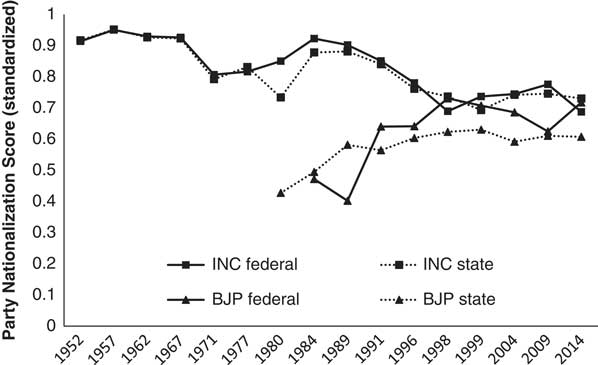
As highlighted above, the denationalization of the Indian multilevel party system is linked to the electoral decline of the Congress Party and the inability of an alternative polity-wide party to assume its place. After the 1980s, however, the BJP emerged as a new ‘national political force’ to be reckoned with, although its territorial spread of the vote was lower than that for the rival Congress Party. Figure 3 compares the nationalization (territorial spread) of the vote for both parties on the basis of Bochsler’s (Reference Bochsler2010b) party nationalization scores, standardized according to the number of regions so that the scores are comparable over time. It shows that the 2014 general election result is historic insofar as it produced only the second election result in which the BJP’s electoral support was spread more evenly than the Congress Party’s. This had happened only once before (in the 1998 general election).
Party Nationalization for the Congress Party (INC) and the BJP in Federal and State Elections, 1952–2014

At the same time, Figure 3 shows that the more even geographic spread of the BJP reflects a long-term trend. A decision to contest more seats in general and state elections since 1991 enabled the party to break out of its initial strongholds in Rajasthan, Madhya Pradesh, Gujarat and Maharashtra. Coupled with its ‘Mandir’ mobilization politics,Footnote 7 the BJP established (temporary) strongholds in Uttar Pradesh, Bihar and Himachal Pradesh, among others. Furthermore, the inability of the BJP to craft a majority on its own after the 1996 general election contributed to the party’s realization that it could not govern the centre without programmatic (toning down its Hindutva agenda, for instance) and strategic adjustments (for example, by forging seat-sharing or coalition alliances with a range of regional parties across India ahead of and following these elections). Hence, in the 1998 general elections, the BJP alliance consisted of 13 pre-election and 10 post-election allies (parties). Combined, the BJP strengthened its influence in south and east India, areas that had been largely outside its reach in the 1996 elections (Sridharan Reference Sridharan2010: 125). In 1999 (following early elections after the withdrawal of the AIADMK or All India Anna Dravidian Progress Federation from the coalition), the BJP entered the federal elections as a coalition (National Democratic Alliance) consisting of 20 pre-election allies and a common national platform. Congress suffered two further federal election defeats (1998, 1999) before it recognized the same predicament (Yadav and Palshikar Reference Yadav and Palshikar2009b). Although in time state parties have swapped costly pre-election seat-sharing arrangements for more lucrative post-coalition deals, it is striking that in the build-up to the 2014 general elections, 22 small or state-based parties entered seat-sharing arrangements with the BJP, against only 10 with Congress (Sridharan Reference Sridharan2014: 31). This not only accelerated the Congress Party’s electoral losses, but it also made Congress support more territorially concentrated – confined to those states where the party could still win (more or less) on its own.
The Nationalization of the Party System Based on Seat Share, Not Vote Share
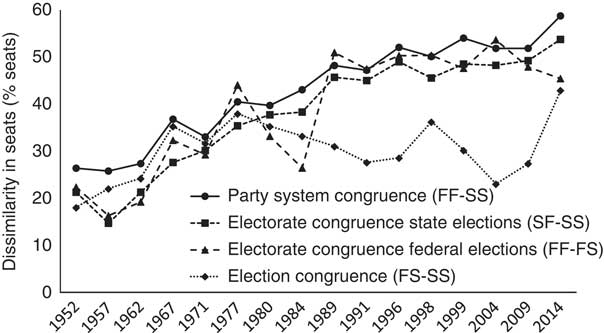
Our conceptualization of nationalization is based on vote share, not seat share. However, in India’s first-past-the-post electoral system there is a much closer connection between who governs and the seat share of parties. To account for this limitation, Figure 4 shows nationalization scores based on party seat shares.
Congruence between Federal and State Election Seat Share, 1952–2014 Note: See the main text for an explanation of the measures.

At first sight, the nationalization scores based on seat share do not undermine the overall trajectory of gradual denationalization of the Indian multilevel party system. Even when breaking down party system congruence into its constituent parts the previous analysis largely holds: party system congruence has gradually declined since the 1980s (until 2009), reflecting a much sharper drop in electorate congruence than in election congruence. Yet nationalization scores based on seat share mark out the so-called ‘transformative elections’ more clearly; party system congruence and all its component measures declined more sharply in 1967 when Congress lost significantly in seats in general and state elections, and particularly since 1980, reflecting the entrenchment of distinctive regional party coalitions or parties in state elections. Similarly, the 1989 federal election stands out because of a sharp drop in electorate congruence, consolidating the formation of regionally distinct party systems, even in a federal election!
Just as the seat share data make the ‘turning points’ in the development of the multilevel party system more visible, so Figure 4 accentuates the critical nature of the 2014 general election: the BJP benefited from an unprecedented vote–seat multiplier effect (the party added 1.67 per cent of the seats for every 1 per cent of the votes; Sridharan Reference Sridharan2014: 20), whereas Congress (and some of the state parties) encountered the opposite effect (Congress added only 0.4 per cent of seats for every 1 per cent of votes, illustrating a ‘negative vote–seat multiplier effect’ for the party). Since the rise of the BJP in state elections only gained momentum after the Gujarat state election in December 2012, election congruence based on seat share dropped sharply in the build-up to the 2014 general elections. Although in the short term this sharp spike in dual ‘seat representation’ contributed to a further decline in party system congruence or nationalization overall, on one measure at least we observe a tendency towards nationalization – that is, electorate congruence for federal elections (lowest dissimilarity score since 1989). Whether this signifies a trend towards more durable nationalization remains to be seen. Much will depend on the ability of the BJP to keep its heterogeneous social coalition alive in forthcoming state elections, but also on the capacity of Congress to reinvent itself. For the first time, support for the Congress Party dipped below 20 per cent at the national level. Evidence from state elections shows that the party lost its pivotal position in state party systems where its support dropped below that level (Palshikar Reference Palshikar2014). Although state parties held up reasonably well (Kailash Reference Kailash2014a), non-polity-wide parties such as the Bahujan Samaj Party (BSP), Samjwadi Party (SP), Janata Party (United) (JD(U)) and the Rashtriya Lok Dal (RLD) also performed poorly. More recent efforts to reunite the erstwhile members of the ‘Janata Parivar’ ahead of the 2015 Bihar state elections can be interpreted as an attempt to make a stronger electoral force against the BJP, especially in the wake of a much-enfeebled Congress.
Conclusion: The Denationalization of The Indian Party System and The 2014 General Election
This article has made the case for incorporating sub-national or ‘state’ electoral results into a conceptualization of the ‘nationalization’ of party systems in multilevel polities with directly elected sub-national assemblies. We demonstrated that existing party nationalization studies, apart from suggesting different ways of operationalizing ‘nationalization’, all excluded sub-national electoral results from their conceptualization of nationalization. By doing so, we argued that these studies unwittingly engaged in ‘methodological nationalism’. Instead, we have offered a different and more holistic understanding of nationalization which also builds on electoral behaviour in sub-national (or state) and not just national (or federal) elections.
This broader conceptualization of nationalization has found its way in recent studies on the European party systems, but we are the first authors to apply it to India, the world’s most populous democracy with strong and politically significant states (and union territories) and directly elected state assemblies. We applied our measurements to India’s 16 general elections and 351 state elections held between 1952 and 2014.
Although our findings are not too dissimilar from those that a previous nationalization study (based on general election results) by Chhibber and Kollman (Reference Chhibber and Kollman2004) had shown for India, bringing state election outcomes into the conceptualization of party system nationalization nonetheless generates a comparatively more gradual pattern of denationalization and weakens the relevance of the 1989 general election outcome as a critical juncture in denationalization after independence. Furthermore, unlike earlier studies, we can identify the key sources of denationalization more clearly: electorate congruence (the extent to which state electorates diverge from each other in state and/or federal elections) or election congruence (the extent of dual voting). Although we observe a gradual drop in congruence across each of the four measurements, we showed that this drop has been steeper for electorate congruence than for election congruence, confirming the continuous growing apart of the Indian state party systems. We have also shown that this process (at least in the past 30 years but not including the 2014 general election) has gone hand in hand with a decrease in dual voting as state electorates were increasingly keen to support the same (often state or non-polity-wide) parties in state and federal elections. In this sense, our findings corroborate the ‘federalization’ thesis propagated by Arora (Reference Arora2000) and Arora and Kailash (Reference Arora and Kailash2012).
Our longitudinal and multilevel approach to party system nationalization also enabled us to properly contextualize the outcome of the 2014 Indian general election which, in view of the BJP majority which it produced, has been perceived as ‘nationalizing’. In contrast, we show that, based on how people voted, the 2014 results continue a trend of denationalization. This result is the outcome of two phenomena: (1) despite the almost territorially uniform swing towards the BJP, compared with voting behaviour across state elections in the build-up to the 2009 federal elections and in that general election, state electorates voted more differently from each other in state elections prior to the 2014 general elections and in that general election; (2) the strong swing towards the BJP in the 2014 general election also pushed up dual voting, reducing election and party system congruence in the short run.
However, the 2014 general election results contain some seeds of potentially more durable party system change and party system nationalization. Whether such nationalization effectively materializes will depend very much on the BJP’s ability to hold on to the broad, but very heterogeneous coalition of voters underpinning its current national mandate and on the party’s capacity to replicate its success in vote and seat share in future state and federal elections. Yet, because our data suggest that the Indian state party systems have never diverged further from each other in terms of vote shares than in 2014, the consolidation of the BJP as the pre-eminent and nationalizing force in the Indian multilevel party system, though not impossible, will remain a very tall order.
Finally, although the key purpose of our article was to introduce a set of new measurements for studying the (de-)nationalization of the Indian multilevel party system, our analysis could form the basis of exploratory research in which the (de)nationalization of the Indian party system is linked to the denationalization or federalization of the state. By reconceptualizing nationalization, the causal direction which Chhibber and Kollman (Reference Chhibber and Kollman2004) propagate between shifts in authority migration within the state and the nationalization of the party system may have to be reconsidered. Nationalization measures for the party system as a whole could also be linked with the campaign or organizational strategies of individual parties within the party system or the dynamics of party competition more generally.
Acknowledgements
Our submission benefited from the comments of two anonymous referees, Ashutosh Varshney and both journal editors, Katharine Adeney and Paul Taggart. The usual disclaimers apply.
Arjan Schakel would like to thank the Hansewissenschaftskolleg Institute for Advanced Studies, Delmenhorst, Germany, where he was a fellow during the 2014–15 academic year, for its generous support during the writing of this article.
Wilfried Swenden would like to thank the Leverhulme Trust, grant no. IN-2013-043, ‘Continuity and Change in Indian Federalism’.
Supplementary material
To view supplementary material for this article, please visit http://dx.doi.org/10.1017/gov.2015.42