On 25 January 2009, the Bolivian people approved a new constitution that significantly enhances the rights of the country's indigenous people. After the election of Evo Morales as the country's first indigenous president in 2005, the enactment of the controversial new constitution marked another high point of ethnopolitical mobilization in Bolivia. Yet, despite considerable polarization in the run-up to the referendum, the ballot took place in a “peaceful climate amidst high participation.”Footnote 1
According to much of the academic literature, the Bolivian scenario of unrestrained ethnic politics in a poor and ethnically divided country should constitute a recipe for chaos and civil violence.Footnote 2 Indeed, ethnicity has been a defining feature of the majority of civil conflicts since World War II.Footnote 3 Especially when they take the form of secessionist or irredentist movements, the negative externalities of these conflicts go beyond individual states, unsettling the stability of the international system.Footnote 4 Admonitory examples of the relationship between ethnic mobilization and civil violence abound: from the violent dissolution of Yugoslavia to the twenty-six-year-long Tamil insurgency in Sri Lanka. This begs the question: why did some states, such as Bolivia, that have seen large-scale ethnic mobilization in the last decades, escape the perilous consequences of ethnic competition? Why did the Civil Rights Movement in the USA not degenerate into a violent struggle, as, for example, the Basque nationalist movement, despite the call by radical organizations for “an all-black nation state?”Footnote 5 Or, expressed in more general terms: why is ethnic mobilization more dangerous in some multiethnic countries than in others?
Focusing on the long-term legacies of European overseas colonialism, I argue that violent intergroup conflict is least likely under conditions of profound, historically determined stratification. In contrast, ethnic mobilization is more likely to trigger violent conflict the more segmented ethnic groups are. In the way I use the term here, ethnic stratification is related to what has been called “ranked ethnic systems” in the literature.Footnote 6 It implies two characteristics of ethnic groups’ relation to each other. First, they are positioned in a stable power hierarchy with one ethnic group historically dominating state power to the continuing exclusion of other groups. Second, ethnic groups have become embedded within the same socioeconomic and cultural institutions. This embedded condition is what I call ethnic groups’ social integration. It is the opposite of social segmentation, that is, when groups live within the same polity as separate subsocieties, featuring distinct, relatively independent social systems. Countries in which ethnic groups are both hierarchically organized and socially integrated are considered stratified systems.
Ethnic stratification produces what I call an “equilibrium of inequality” in which peaceful contention emerges as the most viable strategy for historically marginalized groups. This equilibrium of inequality is produced by four main causal mechanisms. First, high between-group inequality limits the material resources available to marginalized groups and, thus, their organizational strength. Second, social integration decreases ethnic groups’ distinctiveness and internal cohesion, which reduces the strength of collective mobilization. While this lack of organizational strength affects collective action in general, it becomes particularly consequential in the case of costly and high-risk forms of it, such as armed rebellion. Third, stable between-group hierarchies make coercion on the part of the ruling regime more effective. This prevents the emergence of viable military challenges, especially to central state power. Finally, high social integration decreases the opportunities for armed rebellion, even in the face of profound inequality, by increasing interdependence between groups. This fourth mechanism operates most strongly against secessionist attempts.
Hence, this argument deviates from grievances-based theories of ethnic conflict, which expect the conflict-fueling effect of ethnic mobilization to be strongest in those countries that exhibit the most profound intergroup inequalities.Footnote 7 According to these works, the more severe ethnic inequality is, the stronger the collective grievances on the part of the marginalized groups, and the more likely violent resistance. Some scholars also explicitly or implicitly assume that ethnic groups as such generally possess similar mobilization capacities and face similar opportunities to rebel.Footnote 8 Thus, these approaches usually treat the political opportunity structure and groups’ mobilization capacity, on the one hand, and ethnic inequality, on the other hand, as alternative explanations for civil conflict. Moreover, despite their groundbreaking insights, previous works on ethnic stratification and ranked ethnic systems did not offer any theoretical and empirical assessment of the origins of ranked ethnic systems nor of the relationship between different ethnic systems and the likelihood of violent conflict at the global level. In fact, Horowitz argued that ranked and unranked ethnic systems are equally prone to conflict, albeit of different forms.Footnote 9 In contrast, my study specifies the historical origins of distinct ethnic cleavage types in the majority of today's states and theorizes their consequences for ethnic groups’ organizational strength and their opportunities to rebel. Thus, it embeds the concept of ethnic systems in a broader theory of colonial state building, inequality, and political violence in the contemporary world.
European overseas colonialism has decisively shaped the type of ethnic cleavages that we observe today. The colonial settler states that became independent under the continuing rule of the European settlers (or their descendants) constitute archetypical cases of stratified ethnic systems. I distinguish these settler states from what I call the “decolonized states,” where independence resulted in self-rule by the formerly colonized people. The retreat of the colonizers—and, thus, the breakdown of the primary hierarchy—and the legacy of colonial policies of “divide and rule” have made the decolonized states paradigmatic examples of segmented multiethnic states. Therefore, the colonial settler states and the decolonized states constitute the two sets of cases where the empirical implications of my theoretical argument should be most evident.
Using new data on the linguistic and religious segmentation of ethnic groups, I test my arguments in a global quantitative study of all multiethnic states from 1946 to 2009. The empirical results confirm, first, that the extremely unequal colonial settler states experience less violent ethnic conflict than the decolonized states and other multiethnic countries. Second, beyond comparing postcolonial states, I find that ethnic conflict is generally more likely the more segmented and less hierarchically structured multiethnic states are. Third, in line with the theory, stable between-group hierarchies reduce the risk of governmental conflict, whereas segmentation affects only secessionist conflicts. Additional robustness tests indicate that the theorized equilibrium of inequality holds when examining the immediate postindependence period of the settler states and when controlling for the identity of colonial powers, democratic freedoms, natural resource production, as well as different measures of state strength. I also provide evidence for the exogeneity of my main independent variables by accounting for those factors that may have affected how colonialism ended.
Hence, beyond the far-reaching international consequences of ethnic (and, especially, secessionist) conflict, my study also highlights its historical international sources. Previous studies have already pointed out how international factors, such as geopolitical competition, colonialism, or military mobilization affected state formation,Footnote 10 the emergence of democratic political institutions,Footnote 11 and countries’ economic development.Footnote 12 The results of this study suggest that their present-day conflict proneness, too, greatly depends on the historical structure of ethnic group relations resulting from specific colonial legacies.
European Colonialism, State Formation, and Ethnic Stratification
European overseas colonialism is the instance of colonial expansion that has most directly molded the contemporary international state system, creating almost two thirds of all current multiethnic states.Footnote 13 I distinguish between two specific classes of European ex-colonies: the colonial settler states and the decolonized states, which constitute the two sets of cases where the empirical implications of my theoretical argument should be most evident. The colonial settler states are those states that became de jure or de facto independent under the continuing rule of the European settlers (or their descendants) over the indigenous population. Thus, codified as racial distinctions, the colonial hierarchies—composed of the white rulers, the subjugated aboriginal populations, and (in the case of the Americas) the imported African slaves and their descendants—were directly carried over to the postindependence period. This is true for both Latin American and English settler colonies. Although the English settler colonies have been characterized by more political equality among the European settlersFootnote 14 their institutions are based on the same inequality between the settlers and the racially defined others as in Latin America.
Moreover, the conquered groups in the colonial settler states have become incorporated into the political and economic institutions (legal order, organization of land ownership, political party system, etc.) set up by the European settlers. Through linguistic and religious assimilation they have also adopted the settlers’ cultural institutions to a certain degree. For instance, African Americans in the USA, Afro-Brazilians in Brazil, or indigenous people in El Salvador and Honduras all speak the language of the dominant group of their states. Likewise, in Guatemala and Ecuador, indigenous people have become incorporated into the religious institutions set up by their conquerors. As a result, ethnic groups in the colonial settler states are socially highly integrated. These states thus constitute archetypical cases of stratified or “ranked” ethnic systems, according to my definition.
In contrast, the decolonized states are countries that were ruled by a European power during the period of overseas colonialism but became independent under the self-rule of the formerly colonized people. These were generally resource colonies in Asia, Africa, and a few territories in the Caribbean and the Pacific. While their independence in the twentieth century was equivalent to decolonization, their ethnic cleavages were also profoundly shaped by European colonialism. To control the subjugated indigenous populations the colonial rulers turned to policies of “divide and rule,” consciously fostering linguistic, religious, and tribal distinctions between groups. Colonial administrative penetration—especially tax and labor policies, as well as educational institutions—strengthened these segmented ethnic identities over time.Footnote 15 As a consequence, independence and decolonization marked the transformation of racially ranked societies to congregations of “separate subsocieties,”Footnote 16 assembled within a common political territory.
For instance, Sunnis, Shiites, and Kurds in Iraq; Baluchis, Pashtuns, Punjabis, and Sindhis in Pakistan; the Muslim Fulani, Christian Beti, and Christian, but anglophone Bakweri groups in Cameroon; and the Buddhist Sinhalese and Hindu Tamils in Sri Lanka are all assembled within a common political territory shaped by European colonizers, but they remain divided into distinct, relatively independent social systems. Although colonial favoritism towards specific groups was quite common, with the retreat of the colonizers the primary hierarchy disappeared. Therefore, ethnic segmentation, rather than stratification, is the most common ethnic cleavage type in these states.Footnote 17
European colonial rule took very brutal forms in both types of European ex-colonies. Yet, while the intense, relatively short-term quest for natural resources also resulted in appalling regimes of colonial exploitation in Africa,Footnote 18 the external and internal colonization of the Americas occurred over a longer period of time. The genocidal impact of colonial conquest, labor exploitation, and imported diseases significantly decimated the indigenous people in the Americas to the degree that they now constitute (sometimes small) minorities in almost all states. Nevertheless, since at least the 1970s, a new wave of ethnic group mobilization has gained traction even in those colonial settler states with very small minority populations, such as Paraguay or El Salvador.Footnote 19 In many cases, such mobilization occurred under an umbrella political identity at the national level, for example, in the case of indigenous people in Argentina or African Americans in the USA. In other cases, it was propelled by distinct ethnic groups, such as the Garifuna in Honduras or the Miskito in Nicaragua.Footnote 20
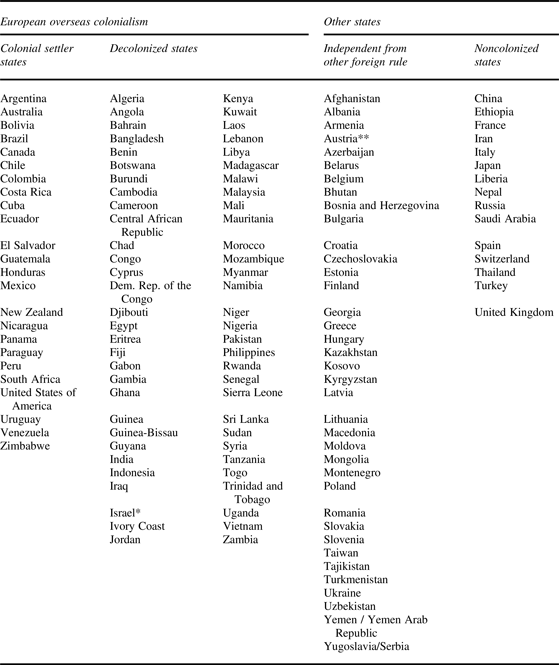
Finally, both the colonial settler states and the decolonized states can be distinguished from those countries in Europe and (less commonly) Asia that were never subject to European overseas colonialism. In most of these cases, state formation was promoted by a core ethnic group that is now recognized as the titular group of the respective state. Many of them emerged out of larger empires, such as the Ottoman Empire or the Soviet Union. Although some of them also contain significant numbers of settlers from these former occupying powers (such as the Russians in Latvia, Belarus, or Turkmenistan), the crucial difference to the colonial settler states is that the independence of these states was promoted by, and attained under the rule of, an “indigenous” state-building group. As Figure 2 shows, this type of state building has also led to stable ethnic hierarchies in some cases.Footnote 21 Yet, the core group at the center and the geographically concentrated linguistic and/or religious minorities often constitute relatively segmented subsocieties, quite similar to those in the decolonized states. In those cases where state building remained unfinished and the state was never able to firmly penetrate its whole territory, for example, in Afghanistan, ethnic groups are even more likely to constitute independently functioning subsocieties today. Table 1 shows the classification of all countries included in the study.Footnote 22
Classification of multiethnic states

Notes: The table includes all countries in which ethnicity has been politically relevant, according to the EPR-ETH data set used in this study. Countries excluded by this criterion are Burkina Faso, the Czech Republic, Denmark, the Dominican Republic, East Timor, Germany, Haiti, Ireland, Jamaica, Lesotho, the Netherlands, North Korea, Norway, Oman, Papua New Guinea, Portugal, Somalia, South Korea, Swaziland, Sweden, Tunisia, and the United Arab Emirates.
* Israel is also often treated as a settler state in the pertinent literature. See, for example, Elkins and Pedersen Reference Elkins and Pedersen2005. Yet, the Jewish settlement in Palestine was not connected to the colonial expansion of a European state. In contrast, the Jewish and Arab groups living in the territory of the present Israeli state became independent of Great Britain. Hence, I follow Hensel Reference Hensel2014 in considering Israel a former British colony (and therefore a decolonized state). However, the empirical results are very similar if Israel is included in the settler states category.
** Following Hensel Reference Hensel2014, the classification of Austria is based on its integration into Germany's “Third Reich.”
Ethnic Movements and Intergroup Violence
Following Tilly, “political mobilization” can be broadly defined as “the process by which a group goes from being a passive collection of individuals to an active participant in public life.”Footnote 23 Whether ethnopolitical mobilization triggers violent intergroup conflict greatly depends on the historically determined ethnic cleavage types that shape both the organizational strength of group mobilization and the “structure of political opportunities.”Footnote 24 In particular, I focus on two properties of cleavage types: the extent of between-group hierarchization and the degree of ethnic groups’ social integration. In the colonial settler states and other stratified ethnic systems, stable between-group hierarchies and a high degree of social integration produce an “equilibrium of inequality” in which the marginalized groups lack both the organizational strength and the opportunities for armed rebellion. As a consequence, while ethnicity is not necessarily less politicized in these states than in other countries, peaceful ethnopolitical contention emerges as the most viable strategy for the subordinated groups. In contrast, ethnic mobilization in the decolonized and other segmented states is more likely to trigger violent conflict.
Resource Mobilization, Group Identities, and Organizational Strength
Stable between-group hierarchies limit the organizational strength of historically marginalized groups’ mobilization and thus reduce the likelihood of violent insurgencies. Any social movement must control and mobilize a certain amount of resources (for example, money, facilities, and labor) to carry out collective action.Footnote 25 While this argument applies to collective action in general, it is especially true for violent challenges to the state, which are costlier in material terms and entail higher economic opportunity costs than other forms of contentious actions.Footnote 26 The costlier and riskier collective action is, the more difficult it is to organize and thus the more resources are needed.
Elite members of groups play a crucial role in mobilizing these resources.Footnote 27 Yet, because of the entrenched between-group hierarchies (which tend to extend to the economic realm), the elite of the historically marginalized groups in stratified ethnic systems is often too small and too weak to mobilize the necessary resources. At the same time, the material incentives of these leaders to be co-opted and sacrifice collective struggles in favor of (further) individual advancement are also particularly high. As a result, the material co-option of a handful of group leaders is often enough to undermine mobilization and thus prevent rebellion. If, in addition, average group members are poor, they will not be able to financially contribute to or supply the necessary labor for organizational processes.
In contrast, where between-group hierarchies are less stable, intra-ethnic stratification should be more pronounced. In other words, each ethnic group in these states usually has its own elite and poorer stratum, which facilitates the provision of the necessary resources for ethnic rebellion. For example, in decolonized Nigeria, each of the main ethnic groups had their own national leaders that were able to organize the non-elite group members into powerful political organizations, which subsequently served to mobilize individuals for violence.Footnote 28 As Esteban and Ray note, “such inequalities possess their own perverse synergy. Specifically, the rich within a group can supply the resources for conflict, while the poor supply conflict labor.”Footnote 29
The organizational strength of group mobilization is also a function of the degree of ethnic groups’ social integration. By the social integration or segmentation of ethnic groups, I refer to the extent to which groups are embedded within the same socioeconomic and cultural institutions. Institutions can be defined as established sets of norms, values, and modes of action and interaction that govern particular aspects of social life.Footnote 30 Specifically, social integration reduces the strength of collective mobilization by decreasing ethnic groups’ distinctiveness and internal cohesion. Distinct and cohesive collective identities make group boundaries more evident and thus operate against cross-cutting membership in political organizations. They also make individual assimilation more difficult.Footnote 31 The more integrated groups are, the less distinct and cohesive their group identities and, as a consequence, the easier it is for individuals to cross group boundaries and seek political or economic advancement as individuals. This individual “escape hatch” hampers the collective political organization of groups as a whole. In contrast, the more segmented groups are, the more distinct and cohesive their collective identities and, consequently, the greater their potential for political organization.
Again, while this mechanism affects ethnic mobilization in general, it becomes particularly consequential in the case of costly and high-risk collective action, such as armed revolt, because under such conditions individuals have even greater incentives to cross group boundaries (if provided with the opportunity).Footnote 32 In other words, the centrifugal forces that affect collective action are greater the riskier and costlier such collective action gets, requiring more organizational strength to keep individuals together and prevent them from defecting.
Coercion, Interdependence, and the Opportunities for Armed Rebellion
Next to the organizational strength of group mobilization, the political opportunity structure plays a crucial role in explaining ethnic group rebellion. Stable between-group hierarchies affect the political opportunity structure by making coercion on the part of the ruling regime more effective. Specifically, the unequal distribution of the political and socioeconomic instruments of power in the colonial settler states provides the dominant ethno-class with a wide array of coercive measures against challenging groups. These range from monitoring the subordinated group(s) and economic coercion (for example, the denial of access to resources, boycotting the labor of members of these groups for certain periods of time, etc.) to outright violent repression by the unilateral use of military force.Footnote 33 The dominant ethno-class can also dissuade the subordinated groups from challenging the status quo through the clientelistic distribution of resources and through policies of divide and rule.
Between-group hierarchies should be most consequential for armed revolts directed against the state center. State power is usually strongest at its center so coercion works most effectively against direct challenges to governmental power. In contrast, if marginalized ethnic groups inhabit territorial pockets where the political authority of the dominant group is comparatively weak, they might be able to avoid repression and challenge the state in their own territory. As a consequence, group hierarchization should have a stronger deterring effect on conflicts over government than on territorial (or secessionist) conflicts.
These arguments obviously apply to any type of multiethnic society. The more profound political and economic inequality between ethnic groups is, the more adverse the political opportunity structure facing the marginalized group(s). Yet, because of their distinct historical legacy, the ranked colonial settler states are particularly likely to feature such stable between-group hierarchies. Only in the case of an extremely unequal demographic balance, when the subordinated groups form an overwhelming majority—for instance, in Zimbabwe and South Africa—coercion becomes too costly (or even impossible) to sustain.
High social integration also narrows the political opportunity structure. The more integrated ethnic groups are, the higher their interdependence. In the colonial settler states and other highly stratified ethnic systems, individual members of the dominant and subordinated groups are often embedded in tightly knit, hierarchically structured relationships, taking on a patron-client, employer-worker, officer-soldier, or similar format. This social and economic interdependence decreases both the opportunities and incentives of the marginalized groups for sustained violence. For instance, the status of the small circle of elites of subordinated groups in the colonial settler states usually depends on their adhesion to the dominant culture and their access to the resources of the ruling group.Footnote 34 Hence, while they may try to peacefully mobilize members of their ethnic group to enhance their political leverage, these elites will have little interest in a violent escalation of political conflicts. Conversely, the dominant ethno-class usually depends on the labor supply (for example, for food production) by the subordinated groups. Thus, high degrees of social integration and the associated interdependence of ethnic groups should generally decrease the likelihood of violent intergroup conflict. By contrast, ethnic groups in highly segmented societies are more likely to constitute (and perceive themselves as) self-standing communities able to exist as separate entities.
Of course, geography is an important aspect of social integration. Because socioeconomic and cultural institutions are often adopted across groups as a result of spatial proximity, ethnic groups in segmented societies are also more likely to be geographically segmented.Footnote 35 Therefore, they usually possess the separate territorial bases that facilitate the coordination of insurgent actions, especially for secessionist movements.Footnote 36 This situation is common for ethnic groups in the decolonized states, which often inhabit distinct geographic zones, for instance, the Kurds in Iraq or the Diola in Senegal. It also applies to many titular nation states with sizeable ethnic minorities, as the examples of the Basque country and the Russian-speaking eastern part of the Ukraine show. In the case of strong collective grievances, ethnic groups in these states are more likely to seek secession than the highly integrated ethno-classes in the colonial settler states.
The comparison of the two classes of postcolonial states leads us to the first hypothesis of this study:
H1
Colonial settler states are less prone to violent ethnic conflict than decolonized states.
While the colonial settler states and the decolonized states are archetypical cases of ranked and segmented ethnic systems, respectively, my theoretical arguments about the effect of distinct cleavage types on the likelihood of violent conflict should be applicable to all multiethnic countries. Hence, from the foregoing explanations, three additional hypotheses can be deduced to test the general validity of my theory:
H2
Stable between-group hierarchies decrease the likelihood of violent ethnic conflict.
H3
High social segmentation increases the likelihood of violent ethnic conflict.
H4
High social segmentation increases the risk of territorial conflict, whereas stable group hierarchies decrease the likelihood of governmental conflict.
Alternative Explanations
Before turning to the empirical analyses, I address three potential objections to my arguments. First of all, the choice of peaceful, rather than violent, strategies may also depend on the degree of democratic freedom. In democratic systems where groups are more likely to trust the existing regime to address their grievances, peaceful strategies should be more likely. However, the examples of South Africa and the USA under Jim Crow show that even formally functioning democratic systems may systematically disregard demands from specific ethnic groups, whether they are expressed through conventional institutional channels or through peaceful protest activities.Footnote 37 In fact, as Gamson famously pointed out, while democratic regimes are designed to take into account and balance the interests of established polity members, they tend to systematically resist (and sometimes actively oppress) the interests of challenging groups.Footnote 38 It is not surprising then that according to previous research, the empirical relationship between democracy and civil conflict is shaky at best.Footnote 39 Nevertheless, countries’ level of democracy might certainly play a role and, therefore, will be controlled for in the following quantitative analyses.
Second, as discussed earlier, the racial minority population in some of the colonial settler states is very small. One could thus argue that these minorities are simply too small to rebel, and/or that violent rebellions of underprivileged groups occur under a different, non-ethnic banner. In this case, the colonial settler states would not be very different from any of the nation states in the Western hemisphere that became ethnically homogenized centuries agoFootnote 40 and are now characterized by a large demographic majority group that is also politically dominant. According to this argument, the theorized equilibrium of inequality is caused entirely by homogeneity, rather than ethnic stratification.
Third, and relatedly, such ethnic homogenization is likely to be associated with a high degree of state consolidation. Cultural homogenization was most likely to occur in states that were able to exert strong administrative power in their territories over a long period of time. Despite the political marginalization of the “surviving” ethnic minorities,Footnote 41 such old, consolidated states should be less conflict-prone than younger states.Footnote 42 From this view, the equilibrium of inequality and the differences between the colonial settler states and the decolonized states would simply be a function of state consolidation. Both of these two scenarios suggest that the colonial settler states are a subset of a more general class of consolidated, homogenous countries, implying a causal logic that is distinct from my own theoretical argument. I address these objections empirically by controlling for state consolidation and ethnic homogeneity in the regression models.
Data and Methodology
The empirical analysis includes all independent multiethnic countries of the world, covering the time period from 1946—or the country's year of independence—to 2009. It examines ethnic inequality and civil conflict in three types of multiethnic states: the colonial settler states, the decolonized states, and a residual category composed of noncolonized states and those that became independent from other types of foreign rule (see Table 1).
Dependent Variable: Ethnic Civil Conflict
This study focuses on ethnic violence in the form of civil conflict. The civil war data stem from the UCDP/PRIO Armed Conflicts data set where a conflict is defined as a contested incompatibility over government or territory between two parties of which at least one is the government of a state, resulting in at least twenty-five battle-related deaths per year.Footnote 43 In accordance with the ACD2EPR data set, civil conflicts were classified as ethnic if the corresponding rebel organizations both recruited fighters from a particular ethnic group and made public claims on behalf of the group.Footnote 44 Overall, the sample contains 262 civil conflict onsets (about 4% of all country years), of which 155 were classified as ethnic (2.4% of all country years).
However, in highly stratified societies, class and ethnicity tend to overlap so intergroup violence often takes on the form of a class conflict without explicit ethnic claims being advanced.Footnote 45 Because this could distort the comparison between the stratified colonial settler states and other multiethnic countries, additional analyses rely on a broader operational definition of ethnic conflict, which classifies civil conflicts as ethnic if the corresponding rebel organizations either recruited fighters from a particular ethnic group or made public claims on behalf of the group. This includes all instances of civil violence where rebel organizations relied heavily on specific ethnic groups without making explicit ethnic demands. Overall, there are 192 civil conflicts (2.9% of all country years) that conform to this broader definition of ethnic civil conflict.
Finally, H4 distinguishes between governmental and territorial conflicts. The UCDP/PRIO Armed Conflicts data set defines governmental conflicts as conflicts over regime type, replacement of the central government, or a change of its composition, whereas territorial conflicts are defined as conflicts over the status of a territory within a given state (i.e., secession or autonomy).Footnote 46 Of the 155 ethnic civil conflicts in the data set, following the strict definition, fifty qualify as governmental (0.8% of all country years), and 105 as territorial (1.6%).
Ethnic Groups and Ethnic Inequality
To measure the degree of ethnopolitical inequality, I rely on the Ethnic Power Relations (EPR-ETH) data set, version 2.0.Footnote 47 Constructed on the basis of an expert survey, EPR-ETH provides information about politically relevant ethnic groups, and their access to executive state power, in all countries of the world with a population, in 1990, of at least 500,000.Footnote 48 Ethnic groups are considered “politically relevant” if at least one political organization has claimed to represent their interests at the national level or if its members are subjected to state-led political discrimination.Footnote 49 Because of its focus on groups that exhibit a minimal level of political mobilization, the EPR data are very well-suited to test my theoretical argument about the distinct consequences of ethnic movements as a function of different ethnic cleavage types. Appendix 1 provides a list of all ethnic groups included in the EPR-ETH data set by country.
Ethnic groups’ access to state power is assessed based on the positions of the political leaders representing these groups, focusing explicitly on executive power and using a roughly ordinal scale composed of three main categories: (1) a group controls power alone (group status of monopoly or dominant); (2) shares power with other ethnic groups (either as senior or junior partner); or (3) is excluded from executive state power (group status of regional autonomy, powerless, or discriminated).Footnote 50
Previous studies using this data set have mostly focused on the last category, finding that excluded groups are more likely to rebel than included groups and countries with large excluded ethnic segments of the population are likely to experience civil conflict.Footnote 51 However, there are two crucial distinguishing features among regimes of ethnic exclusion. First, exclusion may be the consequence of one-group ethnic dominance—where all but one ethnic group are excluded from access to national-level executive power—or it may stem from an incomplete power-sharing regime, in which two or more groups share power but exclude some other groups. Second, ethnic exclusion may be more or less persistent over time.
Both of these characteristics are highly relevant for the concept of hierarchization that constitutes a central element of my theoretical argument. Hence, to gauge the degree of group hierarchization, the bivariate analyses use two complementary indicators. The first is a dummy variable for dominance that is based on the category of one-group rule. It takes the value of 1 when an ethnic group controlled power alone in a given country year, being coded as either “dominant” or “monopoly” in EPR-ETH, and 0 otherwise.Footnote 52 By itself this indicator is not enough to assess the stability of group hierarchies because different ethnic groups may be politically dominant at different points of time. Thus, a second dummy variable records the ethnic power shifts in a country. It is coded as 1 in country years, in which EPR-ETH codes a change in the coalition of the politically included ethnic groups (for example, when a new group became included or when there was a change of senior and junior partners), and as 0 otherwise.
The regression analyses rely on a count variable of the consecutive years of one-group dominance as a continuous measure of group hierarchization. Finally, when examining the casual mechanisms responsible for the different ethnic conflict rates, I also test the impact of ethnic exclusion per se, as analyzed in the studies I mentioned (i.e., independent of ethnic dominance). To this end, I include a continuous indicator of the relative size of all excluded groups as a fraction of the size of all politically relevant ethnic groups in the corresponding regression models.
Social Integration vs. Segmentation of Ethnic Groups
To empirically capture the idea of socioeconomic and cultural “embeddedness” of ethnic groups implied by my definition of integration and segmentation, I rely on group-based indicators of ethnic groups’ linguistic and religious overlap. These indicators stem from the new EPR-ED data set,Footnote 53 which identifies the precise “cultural content” of all ethnic groups included in the EPR-ETH data set by indicating the languages group members speak and the religions they practice. For each group, the three largest linguistic and religious fragments (in terms of their share of the total group population) are reported.
Both indicators of linguistic and religious segmentation were computed in the same way, by calculating group-level differences, which were subsequently aggregated to the country level. Appendix 2 describes the procedure in more detail and provides a real-world example. Put simply, the measures indicate from how many other groups in the country, on average, any ethnic group is linguistically (or religiously) distinct. Both indicators range from 0 (complete integration) to 1 (complete segmentation). For example, Uruguay and Rwanda are linguistically highly integrated states, in which all groups share one common language (Spanish and Kinyarwanda, respectively), whereas Belgium is an example of high linguistic segmentation. Importantly, the two indicators do not correlate with each other (r = 0.00; p = 0.84), justifying their treatment as two distinct expressions of ethnic groups’ social integration.
I refrain from drawing on the commonly used fractionalization indices because they refer to the likelihood of individuals to be from different ethnic groups. Moreover, although there are important divisions within ethnic groups, existing fractionalization data treat them as homogenous, mutually exclusive entities. As a result, these data sets are unable to measure the degree of cultural (for example, linguistic or religious) overlap between groups that indicates their social integration or segmentation.
Control Variables
The control variables attempt to capture those factors that could potentially have an impact on both ethnic inequality and ethnic civil violence, such as the level of democracy, economic development, state age, country-level ethnic homogeneity, and the prior occurrence of ethnic violence. Prior ethnic violence is captured by the number of previous ethnic conflicts in a given country. I use the Polity index Footnote 54 and a gdp per capita variable from the Penn World Table, version 7.0,Footnote 55 to assess the level of democracy and economic development. An additional robustness test employs a democracy indicator from the new V-Dem data set, version 6.1,Footnote 56 instead of the Polity index. State age is measured with a count variable of the number of years since independence, based on the independent-states data set by Gleditsch and Ward.Footnote 57 Country-level ethnic homogeneity is proxied by the size of the single largest ethnic group in a country as a fraction of the country's total population, according to the EPR-ETH data set. I also include a total country population variable, drawn from the Penn World Table, in all models.
In additional robustness tests, I examine the plausibility of a number of other potential alternative explanations. First, previous studies of colonial legacies’ long-term effects focused on the identity of the colonizersFootnote 58 whereas my own argument is centered on the (ethno-racial) identity of the promoters and beneficiaries of independence. To compare the explanatory weight of the two alternative approaches with respect to violent ethnic conflict, I include colonial power dummies, taken from Hensel.Footnote 59 Second, postcolonial violence may be more likely if independence was achieved through violent struggle. Therefore, an additional robustness model includes a violent independence dummy variable based on the same data source. Third, as an alternative to my measure of state consolidation, I test the effect of a state's extractive capacity, measured by the tax ratio (i.e., a state's tax revenue as a percentage of GDP). These data are taken from Thies.Footnote 60 Fourth, particular colonial legacies may be related to distinct economic profiles in terms of natural resource production—which, in turn, may have an effect on conflict likelihood. Hence, another robustness model controls for countries’ per capita oil and diamond production quantities (the two resource types that figure most prominently in conflict studies), based on data from Humphreys.Footnote 61
When testing the postulated causal factors responsible for the equilibrium of inequality (between-group hierarchy and social integration), I take into account the impact of ethnic groups’ settlement patterns, that is, the degree of their geographic overlap. For this purpose, I employ a count variable of the number of ethnic groups that live dispersed throughout the country's territory, taken from the GeoEPR-ETH data set.Footnote 62 The more groups that live dispersed throughout the country, the more geographic overlap should exist.
Finally, since my analysis examines the effect of distinct colonial legacies by comparing the colonial settler states with the decolonized states and other multiethnic countries, I assess potential concerns of endogeneity with regard to these state type indicators. This exogeneity test accounts for those factors that may have affected how colonialism ended: physical accessibility, historical disease environment, and historical resource attractiveness of countries, drawing on data on countries’ proximity to a coast,Footnote 63 logged settler mortality rates,Footnote 64 and soil fertility,Footnote 65 respectively. Appendix 3 provides summary statistics of the main independent variables.
Statistical Estimation
The study draws on bivariate analyses and logistic regression models of ethnic conflict onset to test the theoretical argument. In the logit models, the unit of analysis is the country year, and the data are formatted as a pooled panel with yearly time intervals. Because civil conflict onsets are very infrequent, I rely on logistic regressions for rare events data, as proposed by King and Zeng.Footnote 66 To account for temporal dependence within countries, the models contain a cubic polynomial of ethnic-peace years.Footnote 67 Because the different observations within a country are likely to be correlated, the result tables report country-clustered Huber-White standard errors.Footnote 68
Ethnic Conflict in Postcolonial States
Ethnic Stratification and the Equilibrium of Inequality
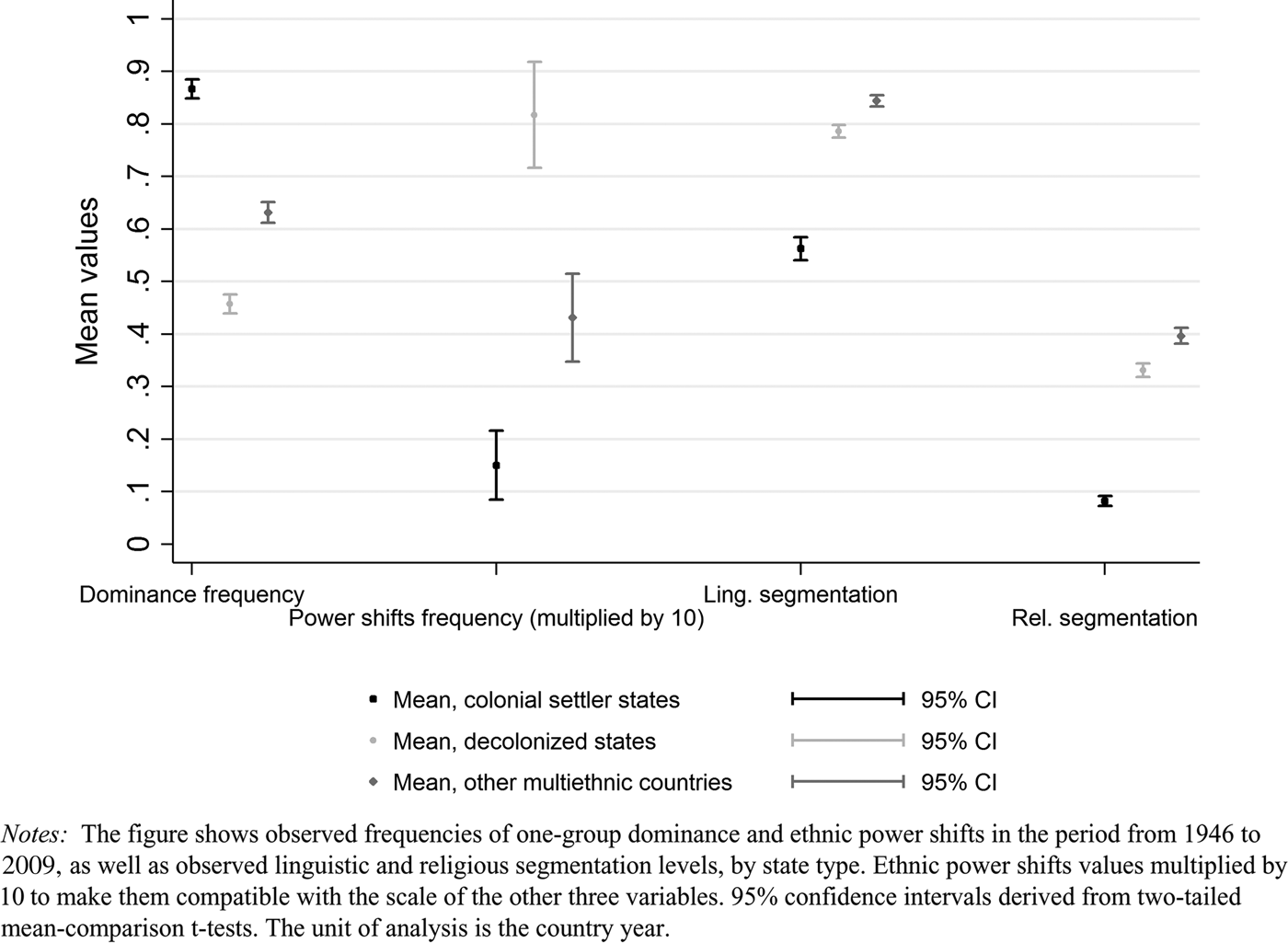
Figure 1 compares the colonial settler states, decolonized states, and other multiethnic countries in terms of both dimensions of ethnic stratification: the stability of group hierarchy and ethnic groups’ social segmentation. Stability of hierarchy is measured by the average frequencies of one-group dominance and ethnic power shifts observed in the data between 1946 and 2009;Footnote 69 social segmentation by the observed mean levels of linguistic and religious segmentation. The results show sharp differences between the three state types. Ethnic group relations are clearly most hierarchical in the colonial settler states. One-group dominance is the common situation in these states, while ethnic power shifts are very rare. In contrast, although they are not spared from the risk of ethnic dominance, the decolonized states feature much more fluid ethnic power structures as different ethnic groups become politically included and excluded over time. Specifically, the frequency of ethnic power shifts is much higher than in both the colonial settler states and other multiethnic countries.
The stability of group hierarchies and ethnic groups’ segmentation

The values of the countries that remained unaffected by European overseas colonialism lie exactly in between those of the European ex-colonies. While nation-state building has also resulted in ethnic inequalities in these states,Footnote 70 their group hierarchies are, on average, clearly less pronounced than in the colonial settler states. Overall, the two types of European ex-colonies constitute actual poles in terms of group hierarchization, testifying to the distinct long-term consequences of this particular instance of colonialism.
The decolonized states and the countries that remained unaffected by European overseas colonialism are much more similar in terms of ethnic groups’ segmentation. In fact, the “unaffected” category even displays somewhat higher average values of linguistic and religious segmentation. Both of these state types differ hugely from the colonial settler states, which exhibit by far the lowest segmentation values. In other words, ethnic groups in these states are not only very hierarchically organized, but also highly integrated in social terms. This provides strong evidence for the stratified nature of the colonial settler states.
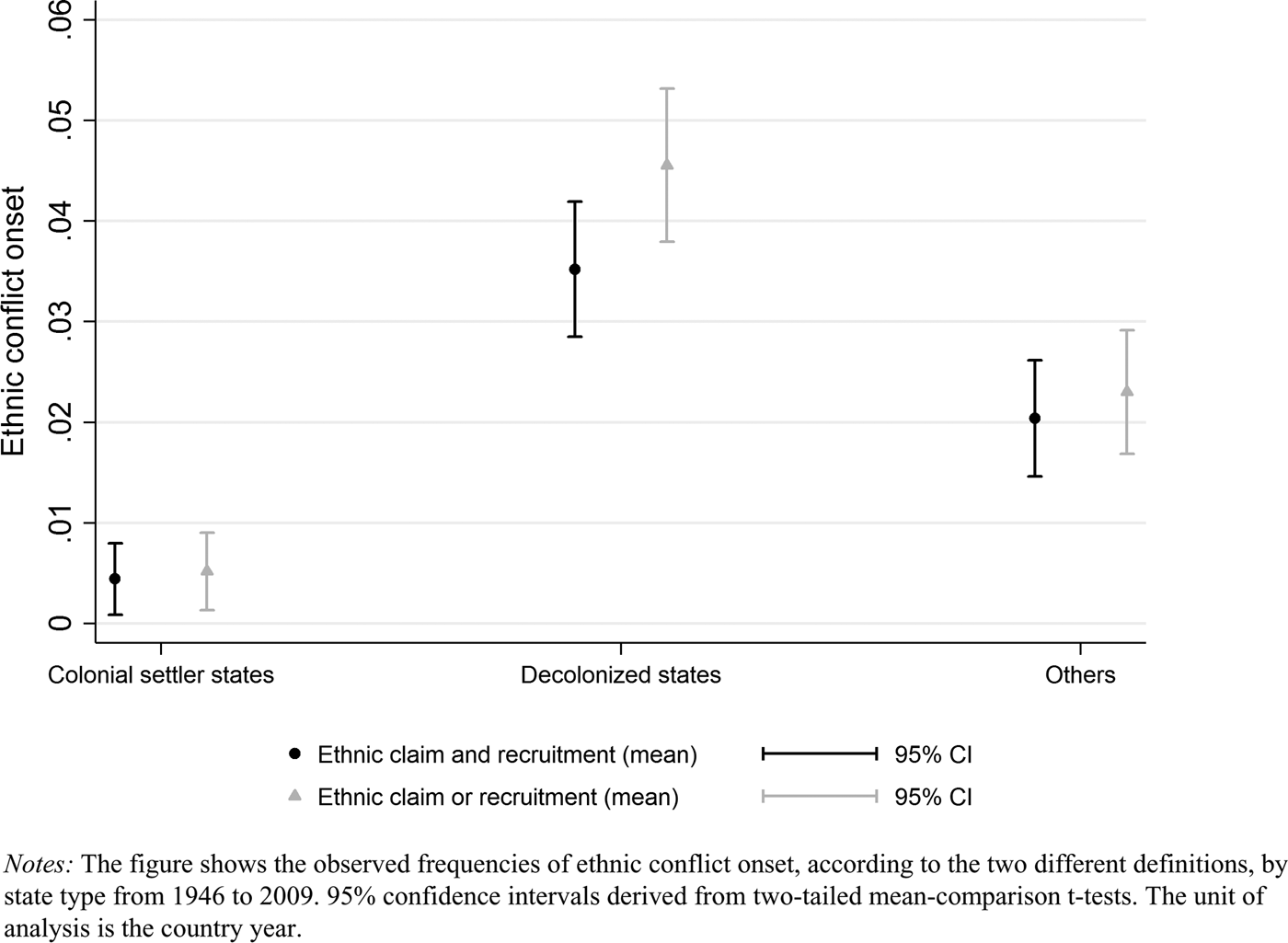
Figure 2 illustrates how these distinct cleavage types affect the likelihood of ethnic civil conflict. It shows the observed rates of ethnic conflict onset in the colonial settler states, the decolonized states, and other multiethnic countries between 1946 and 2009, according to the two different operational definitions I described (ethnic claim and recruitment vs. either claim or recruitment). Ethnic stratification in the settler states goes hand in hand with a significantly lower risk of violent ethnic conflict. The average frequency of ethnic conflict onset was about eight times lower in the colonial settler states than in the decolonized states, and over four times lower than in other multiethnic countries. The results do not change very much when employing the broader operational definition of ethnic conflict. In fact, the difference between the two classes of postcolonial states becomes even starker.
Rates of ethnic conflict onset by state type, 1946–2009

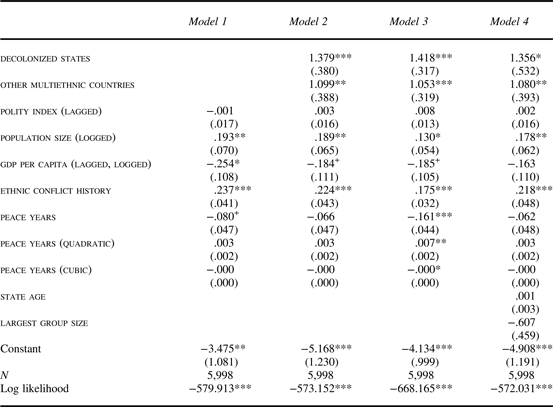
Modeling the risk of ethnic conflict onset in all multiethnic states between 1946 and 2009, the logit regression analyses in Table 2 provide further evidence for the theoretical argument by controlling for the influence of other relevant factors. I first show a reference model composed of the most commonly used explanatory variables in quantitative civil war research. I then introduce two dummy variables for the decolonized states and other multiethnic countries, with the colonial settler states as the baseline category. The results of Model 1 mirror the findings in the existing literature.Footnote 71 Low economic development, large populations, and the prior occurrence of ethnic violence all increase the risk of ethnic conflict. The results also confirm that a democratic state system by itself does not necessarily prevent the outbreak of intergroup violence. Introducing the two dummy variables, Model 2 reveals that the decolonized states and other multiethnic countries indeed have a significantly higher ethnic conflict risk, as expected, even when controlling for other factors such as economic development and the level of democracy. The gdp per capita variable actually loses a considerable part of its effect once we introduce the state type dummies. All other variables behave more or less the same as in the reference Model 1.
Cleavage type and ethnic conflict onset. Rare-events logistic regression results

Notes: Robust standard errors, with clustering on countries, in parentheses. Log-likelihood figures obtained from standard logistic regressions. *p < .05; **p < .01; ***p <.001; + p ≤ 0.1.
Model 3 again takes into account those instances of civil violence where rebel organizations relied heavily on specific ethnic groups without making explicit ethnic demands. Thus, the model replicates Model 2, using the alternative ethnic conflict onset variable, based on the broader operational definition of ethnic conflict, as dependent variable.Footnote 72 This leaves the results virtually unaffected. Even the residual category of other multiethnic countries still exhibits a clearly higher ethnic-conflict risk than the settler states. Model 4 adds the controls for state age and ethnic homogeneity. The empirical results do not support the alternative explanations discussed earlier. Neither of these control variables exerts a statistically significant effect on the dependent variable. In contrast, the state type dummy variables remain robustly related to a higher probability of ethnic conflict onset.
Thus, the consolidation of state and nation by itself cannot account for the enormous difference in ethnic conflict risk between the colonial settler states and the decolonized states (and other multiethnic countries). Indeed, many highly homogenous countries among decolonized and titular nation states—for example, the Philippines, Azerbaijan, and Georgia—have experienced protracted ethnic conflicts between the state and small minorities. Extremely small ethnic groups (sometimes constituting less than 1 percent of their country's population) have also been able to mount serious military challenges to such countries as Russia, India, Myanmar, or Bangladesh. Thus, group size by itself can certainly not account for the lack of armed mobilization by small minorities in the colonial settler states.
Appendix 4 presents seven additional robustness models.Footnote 73 Models A1 and A2 control for the identity of the colonizers by including dummy variables for the six most important colonial powers (measured by the number of observations in the data set of this study). Model A1 includes only the alternative colonial classifiers, whereas Model A2 tests them against my own state type dummy variables. Model A3 includes the violent independence dummy variable, and Model A4 uses the indicator of states’ taxing capacity as an alternative measure of state strength. Model A5 replaces the polity index with the V-Dem indicator of participatory democracy to test whether the results are robust to the use of alternative measures of democracy. This index measures the degree of active participation by citizens in all political processes, both electoral and nonelectoral, and is therefore well-suited to gauge the relationship between democratic freedom and the choice of violent or nonviolent contention.Footnote 74 Model A6 controls for countries’ natural resource profile proxied by their per capita oil and diamond production quantities. The two state type dummies remain completely robust in all models. In Model A1, the effect of the Spanish colony dummy is statistically significant but it is clearly weaker than the effects of the state type dummies and turns insignificant once they are included in Model A2. The other additional controls do not exert a statistically significant effect on the dependent variable. All remaining variables behave more or less the same as in Table 2.
Finally, Model A7 tackles potential concerns of endogeneity in my main independent variables. The analysis considered the colonial settler states and decolonized states (and other multiethnic countries) as state types that received a distinct treatment in terms of colonial heritage, entailing distinct ethnic cleavage types. However, these colonial legacies could themselves be the results of causally prior factors that were not only responsible for how colonialism ended but subsequently also influenced the likelihood of postindependence ethnic conflict. My empirical approach in Model A7 is based on the idea that how colonialism ended depended on the timing and intensity of European settlement.Footnote 75 Territories with an earlier and higher influx of European settlers were more likely to become independent under European rule, that is, as colonial settler states. In turn, this influx of settlers was likely to be influenced by the accessibility and attractiveness of the territories. Easily accessible territories that offered living conditions conducive to European settlers, as well as those that promised exploitable resources, were more likely to experience early and extensive European settlement. Hence, Model A7 tests whether the consideration of the physical accessibility (distance to coast), historical disease environment (logged settler mortality rates), and historical resource richness (soil fertility) of countries undermines the explanatory weight of my main treatment.Footnote 76
The results speak against the notion of endogeneity. While none of these additional control variables exerts a significant effect on ethnic conflict risk, the two state type dummy variables remain robustly related to the outcome variable. These results provide strong support for H1 and highlight the long-term consequences of the ethnic cleavage types produced by distinct outcomes of European overseas colonial rule.
Testing the Mechanisms: The Origins of the Equilibrium of Inequality
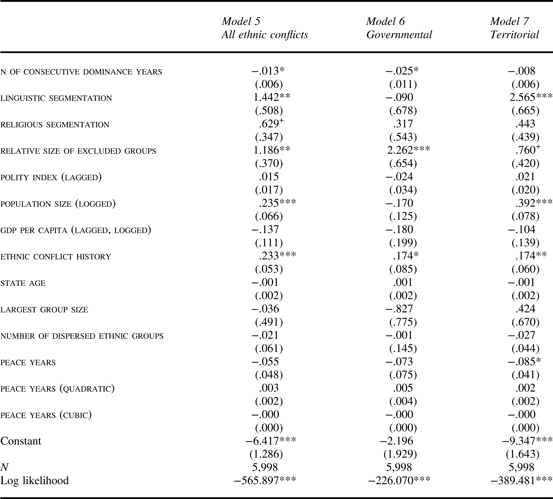
To get closer to the causal mechanisms driving these findings, I now focus on the two properties of ethnic cleavage types highlighted in the theoretical argument: between-group hierarchies and social integration. This also serves to test the main tenets of my theory for all multiethnic countries in general. Models 5 through 7 in Table 3 examine the explanatory power of these cleavage properties by including three additional variables: the count variable of the consecutive years of one-group dominance as a measure of group hierarchization, as well as the linguistic and religious segmentation indicators. Model 5 tests their effects on ethnic conflict onset in general, whereas Models 6 and 7, respectively, focus on governmental and territorial conflicts only. All models control for the degree of ethnic groups’ geographic overlap. They also include the continuous indicator of the relative size of all excluded groups to control for the impact of ethnic exclusion per se (independent of ethnic dominance), as analyzed in previous studies.Footnote 77
Between-group hierarchies, segmentation, and ethnic conflict onset. Rare-events logistic regression results

Notes: Robust standard errors, with clustering on countries, in parentheses. Log-likelihood figures obtained from standard logistic regressions. *p < .05; **p < .01; ***p < .001; + p ≤ 0.1.
In Model 5, the coefficients of all three cleavage variables point in the expected directions and are statistically significant. First, the results give strong support to the effect of social segmentation, referred to in H3, although in the case of religious segmentation the coefficient falls short of the standard 95 percent confidence level (p = 0.07). Generally, the more segmented ethnic groups are in either linguistic or religious terms, the more likely is ethnic conflict. Second, the results also highlight the importance of stable between-group hierarchies, as expressed in H2. The longer political dominance lasts—that is, the more stable group hierarchies are—the lower the risk of ethnic conflict. At the same time, the ethnic exclusion indicator has a significant positive effect on ethnic conflict risk. Hence, while ethnopolitical inequality generally increases the risk of ethnic conflict onset, stable group hierarchies—in the form of long-term ethnic dominance—make ethnic conflict less likely. This attests to the relevance of the distinction between different regimes of ethnic exclusion.
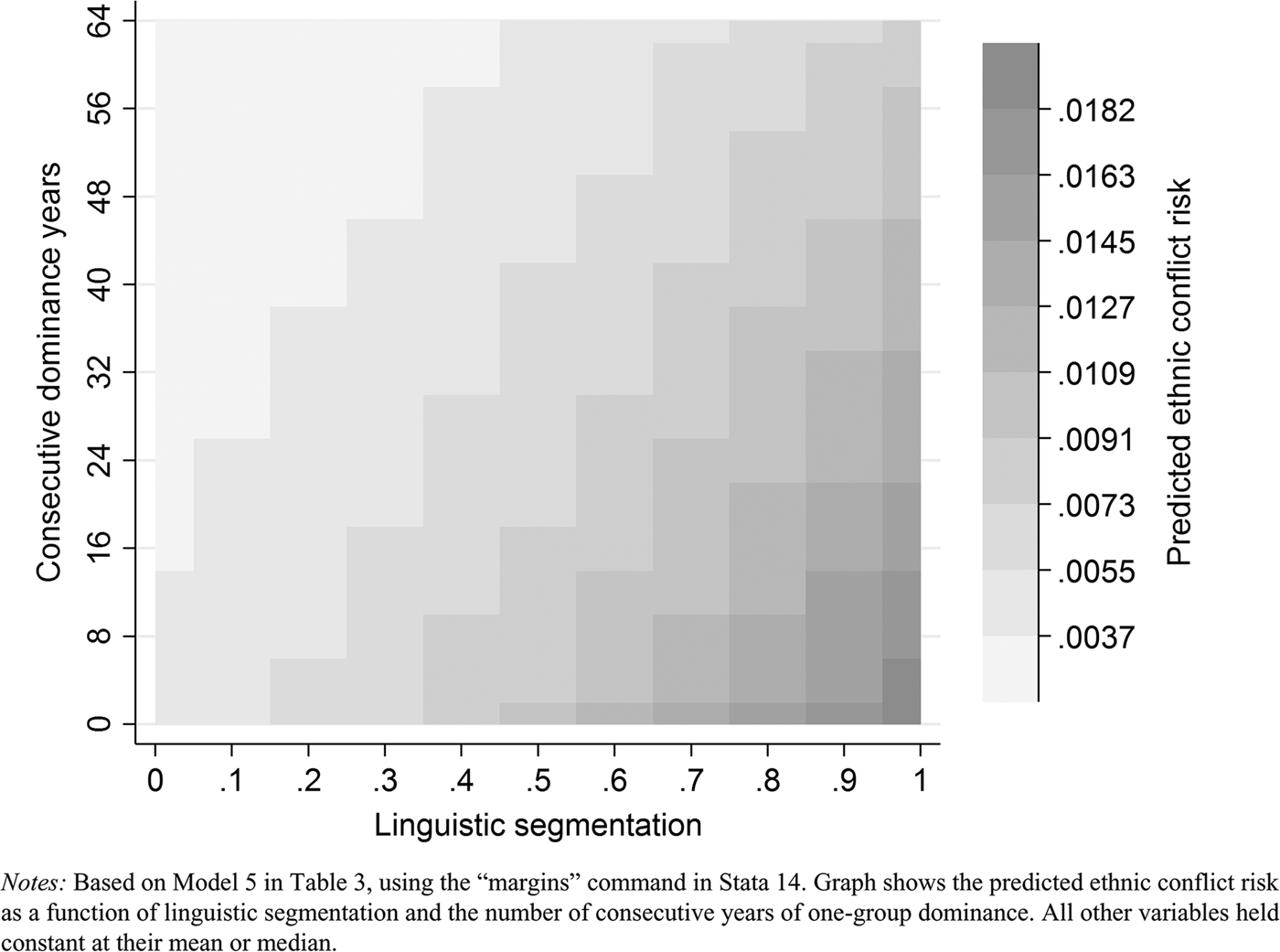
Figure 3 shows a contour plot of the risk of ethnic civil conflict as a function of both linguistic segmentation and the number of consecutive years of one-group dominance, based on Model 5. It confirms that conflict risk is greatest where group hierarchies are least stable and ethnic groups are most segmented. This is the area in the bottom right corner. The figure also suggests that between the two variables, linguistic segmentation has a stronger effect on ethnic conflict risk. At high levels of segmentation, the risk of civil conflict is still higher even if the group hierarchy is very pronounced (area in the upper right corner) than at low hierarchization values combined with low linguistic segmentation (bottom left corner). This is precisely why the few highly hierarchical decolonized states (such as Sudan) are still more likely to experience violent ethnic conflict than the equally hierarchical, but much more integrated colonial settler states. It also explains the higher conflict rates of noncolonized but segmented nation states, such as Turkey, Thailand, or the ex-Soviet province of Azerbaijan, compared to the settler states.
Ethnic conflict risk as a function of hierarchization and segmentation

Models A8 and A9 in Appendix 5 show that these results are robust to alternative measures of ethnic heterogeneity. Model A8 controls for the number of relevant ethnic groups in a country (according to EPR-ETH), while Model A9 includes the ethnic fractionalization and polarization indices from Alesina and colleagues.Footnote 78 None of these control variables alters the results in any significant way. Finally, Model A10 tests for a potential nonlinear effect of the years of one-group dominance by including a quadratic version of the variable. To interpret the coefficients and visualize the precise form of the effect of between-group hierarchies, Appendix 6 plots the predicted probabilities of ethnic conflict onset as a function of the number of dominance years, based on Model A10. It shows that there is only a relatively soft curve in the predicted probabilities. While the conflict risk slightly augments in the first years of ethnic dominance, it decreases steadily after about twenty years. This is very much in line with my theoretical argument in this study. The notion of stratification advanced here implies very stable group hierarchies (besides high social integration) that go beyond the more temporary ebbs and flows of ethnic inclusion and exclusion. The negative effect of ethnic dominance persistence therefore becomes really pronounced only after a large number of years, that is, when between-group hierarchies are indeed highly entrenched.
Models 6 and 7 in Table 3 lend support to H4, confirming the distinct effects of hierarchization and segmentation on governmental and territorial conflicts, respectively.Footnote 79 The size of the coefficient of the hierarchization variable almost doubles in the governmental-conflict Model 6 compared to Model 5, but becomes considerably weaker and statistically insignificant when it comes to territorial conflicts. In contrast, the effect of linguistic segmentation becomes much stronger and more significant in the territorial-conflict Model 7 compared to Model 5, whereas it is almost indistinguishable from 0 in Model 6. The effect of religious segmentation is consistently positive and somewhat more important for territorial than governmental conflicts, but remains statistically insignificant in these models. Overall, these findings lend strong credibility to my theory by showing that its main tenets are valid for multiethnic states in general.
A Look Back in History
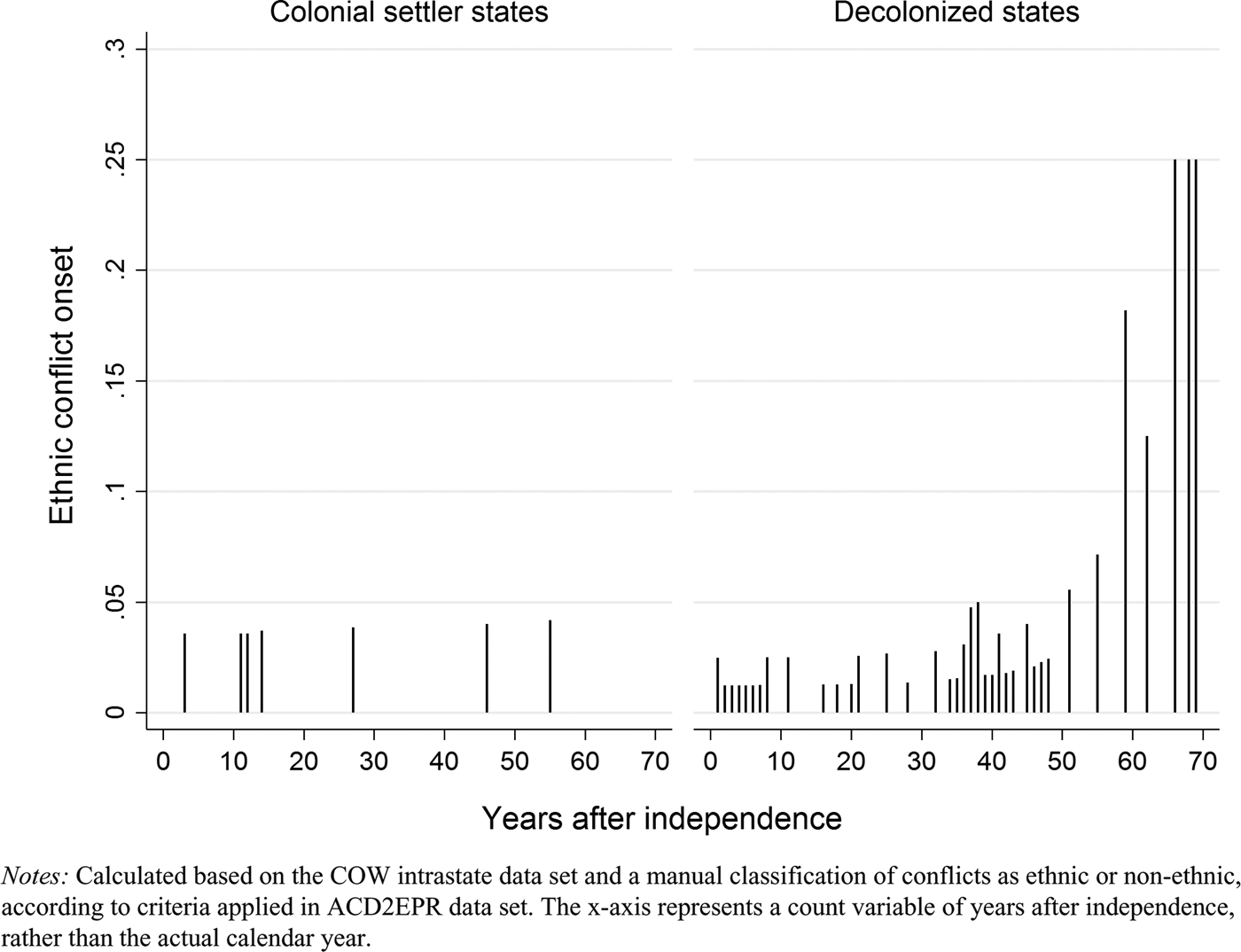
The comparison between colonial settler states and decolonized states could be flawed if most ethnic rebellions in the colonial settler states occurred soon after independence. In this case, the analysis—setting in 1946—would simply miss the relevant time period in the colonial settler states. To examine this possibility, I draw on the COW intrastate war data set,Footnote 80 the only conflict data set that reaches back into the nineteenth century, to compare the frequency of ethnic civil conflict in the first seventy years after independence of all European ex-colonies. Since the COW data do not distinguish between ethnic and non-ethnic conflicts, I manually classified all included conflict instances in this time period according to the same criteria of claim and recruitment applied in the post-World War II period.Footnote 81
Figure 4 shows the ethnic conflict rate (defined as the number of onsets divided by the number of country observations) in each of these first seventy years after independence in both categories of postcolonial states. The results clearly reveal that even immediately after independence, the colonial settler states experienced very few ethnic civil conflicts and much fewer than the decolonized states would experience after their independence a century later. There are only eight conflicts recorded in the COW data that can be coded as ethnically based (0.4% of all country years), compared to fifty-one in the decolonized states (1.4%; two-tailed t-test: p = 0.000).Footnote 82 Thus, the theorized equilibrium of inequality resulting from profound ethnic stratification has been a constant feature of the colonial settler states.
Rates of ethnic conflict onset in colonial settler states and decolonized states—historical comparison

Conclusion
My findings suggest that the present-day dynamics of ethnic politics continue to be profoundly shaped by the legacies of distinct colonial experiences. Indeed, one could argue that colonialism has never really ended in the settler states where the conquered groups continue to form the lower stratum of relatively integrated systems of ethno-classes. This internal colonialism is not only associated with high stratification but also with significantly lower levels of intergroup violence than in other multiethnic countries. In contrast, the later resource colonies that were liberated from colonial rule now grapple with societies divided into distinct ethnic segments whose boundaries and identities were very much institutionalized by European colonizers imbued with ethno-nationalist ideas and eager to divide the subjugated population. Although—or precisely because—ethnic hierarchies tend to be less pervasive in these states, ethnic group mobilization is more likely to turn violent than in the colonial settler states.
These findings deviate from the expectations inherent in many existing theories of ethnic conflict that civil violence should be most likely where intergroup inequalities are most profound.Footnote 83 Instead, they show that historically determined ethnic stratification may result in an equilibrium of inequality in which marginalized groups lack both the organizational strength and the opportunities for armed rebellion. Beyond the comparison of postcolonial states, this study's empirical results suggest that ethnic conflict is most likely where the ethnic cleavages created by the historical processes of state building run vertically between socially segmented groups. Therefore, while the colonial settler states are certainly not the only countries with durable regimes of ethnic dominance, the theorized equilibrium of inequality seems to be contingent on the degree to which oppressors and oppressed form “ascriptively defined components of a single society.”Footnote 84 It is most powerful in the colonial settler states because they constitute archetypical cases of such ranked ethnic systems.
However, this article has focused on a particular type of intergroup violence, namely civil war. Its findings do not necessarily apply equally to the relationship between ethnic mobilization and other forms of intergroup violence, such as communal violence. Also, particular strategies of violence, for example, terrorism, may exhibit distinct dynamics that escape the underlying premises of my theoretical argument. For instance, the organizational strength of group mobilization necessary to carry out terrorist attacks is likely to be lower than what is required for the formation of an armed group capable of fighting in a civil conflict (even a low-level conflict). Nevertheless, by using an operational definition of ethnic civil war with a relatively low threshold of battle deaths, the analysis also captured many of these low-scale instances of intergroup violence.
What are the broader implications of these results for the academic research on ethnic politics? First of all, whereas conflict researchers often follow Barth's encompassing approach to ethnicity, which draws no distinction between different ethnic markers,Footnote 85 I emphasize the lasting political impact of distinct ethnic cleavage types related to specific markers, such as race, language, and religion. Specifically, in contrast to the stratifying force of race, linguistic and religious segmentation of ethnic groups increases the risk of violent ethnic conflict. Previous studies that focused on specific ethnic markers also tended to regard religious divisions as particularly violence prone.Footnote 86 By contrast, this study's results suggest that linguistic segmentation might actually be more critical than religious segmentation, especially for separatist violence. This structural approach to explaining ethnic groups’ opportunities for secession also contributes to the literature on secessionist conflicts, which so far has mostly focused on groups’ grievances,Footnote 87 transborder ethnic kin relations,Footnote 88 institutional opportunities for mobilization,Footnote 89 and the strategic interaction between state governments and ethnic challengers.Footnote 90
Second, the results of this study also suggest that rather than treating ethnic inequality and the political opportunity structure as two alternative explanations for civil war, we should regard both of these factors (as well as groups’ mobilization capacity) as at least partly a function of distinct structures of ethnic group relations. By emphasizing the historical roots of these structures, the study joins a recent literature that has analyzed the lasting effects of specific colonial legacies.Footnote 91 But in contrast to these studies, which have usually examined the legacies of different colonial powers in terms of democratic political institutions and economic development, I argue that when it comes to ethno-political institutions and conflict, the crucial distinction lies in the ethno-racial identity of the promoters and beneficiaries of independence.
Finally, if we envision ethnic politics as playing out in a dyadic relationship between the government and its challengers,Footnote 92 my findings have implications for the understanding of either side. On the one hand, certain types of ethnic cleavages are more likely to feature what Tilly called “durable inequality”Footnote 93 than other cleavage types, which are associated with less pervasive intergroup inequality. At the same time, higher equality often carries with it an element of competition. In such a situation, ethnic movements may play a highly dangerous role by fueling ethnic violence. In contrast, the historical oppression built into stratified ethnic systems is usually challenged by more peaceful attempts of political emancipation. Hence, by highlighting the contrasting effects of ethnic movements as a consequence of distinct historical legacies, this study helps to systematize the wealth of empirical research on ethnic politics, and to move towards a comprehensive theory of inequality, mobilization, and violence in multiethnic states.
Supplementary Material
Supplementary material for this article is available at <https://doi.org/10.1017/S0020818317000479>.