1. Introduction
Shock waves generated by multiple time-delayed explosions are relevant to diverse physical systems, ranging from multi-pulse laser–matter interactions (Döppner et al. Reference Döppner, Fennel, Diederich, Tiggesbäumker and Meiwes-Broer2005; Ranjbar, Lin & Volkov Reference Ranjbar, Lin and Volkov2018; Komar et al. Reference Komar, Raspe, Kazak, Iwe, Meiwes-Broer and Tiggesbäumker2024; Tsymbalov et al. Reference Tsymbalov, Gorlova, Ivanov, Starodubtseva, Volkov, Tsygvintsev, Kochetkov, Korneev, Polonski and Savel’ev2025) and sequential supernova detonations (Soker Reference Soker2022) to engineering applications (Yao & Wang Reference Yao and Wang2016). In such scenarios, the finite delay between successive events controls the interaction of the resulting shock fronts. Their interaction and possible merging constitute a complex problem that lies beyond classical theoretical descriptions. The flow field structure is dominated by the propagation, interaction and various discontinuities associated with multiple shock waves (Ranjbar et al. Reference Ranjbar, Lin and Volkov2018). In multi-physics environments, these interactions also critically affect material and energy transport. For example, multiple shocks can drive debris motion in confined vessels of extreme ultraviolet sources (Meng et al. Reference Meng, C.B., J.Z., Wang, Q. and K.L.2024). In laser-ablation applications, material processing often relies on multiple pulses because the ablated mass per pulse is relatively small, and pulses are typically delivered at a finite repetition rate (Ranjbar et al. Reference Ranjbar, Lin and Volkov2018). The behaviour of multiple shock waves in frameworks involving rotation, magnetic fields or dusty media is especially pertinent to astrophysical settings (Nath Reference Nath2020, Reference Nath2022). Although the evolution of shocks from a single point source or finite sources is well studied, the dynamics governing a coupled system of multiple, time-delayed blast waves remains unresolved.
The theoretical foundation for the evolution of a blast wave from a single point source begins with the pioneering work of G.I. Taylor in the 1950s (Taylor Reference Taylor1950). Using dimensional analysis, Taylor developed a solution to describe the flow physics of a strong shock produced by the sudden release of a large amount of energy, thereby establishing the fundamental scaling laws for a point-blast wave. Systematic photographic studies of explosion fronts empirically confirmed the power-law dependence of the shock radius on time,
 $x \sim t^{2/5}$
. This self-similar solution, independently derived by Taylor (Reference Taylor1950) and Sedov (Reference Sedov1959), is now universally known as the classical Taylor–Sedov blast-wave model. The model has been validated across a vast range of scales, from nuclear explosions and supernova remnants (Ostriker & McKee Reference Ostriker and McKee1988; Cohen, Piran & Sari Reference Cohen, Piran and Sari1998; Liang & Keilty Reference Liang and Keilty2000) to laser-induced plasmas (Grun et al. Reference Grun, Stamper, Manka, Resnick, Burris, Crawford and Ripin1991; Kielkopf Reference Kielkopf1995; Edwards et al. Reference Edwards, MacKinnon, Zweiback, Shigemori, Ryutov, Rubenchik, Keilty, Liang, Remington and Ditmire2001; Edens et al. Reference Edens, Ditmire, Hansen, Edwards, Adams, Rambo, Ruggles, Smith and Porter2004; Gamaly et al. Reference Gamaly, Juodkazis, Nishimura, Misawa, Luther-Davies, Hallo, Nicolai and Tikhonchuk2006) and granular systems (Antal, Krapivsky & Redner Reference Antal, Krapivsky and Redner2008; Boudet, Cassagne & Kellay Reference Boudet, Cassagne and Kellay2009). As a cornerstone for describing shock dynamics, the Taylor–Sedov solution provides the essential framework for extending blast-wave theory to multi-source and time-delayed conditions.
The Taylor–Sedov model forms the cornerstone for describing strong-shock propagation from a single point-source explosion, whereas finite-source blast waves exhibit more intricate behaviour and provide a more realistic representation of many practical scenarios. To clarify the relationship between finite-source and point-source blast waves, their evolution is often divided into distinct temporal regimes. In the short-term regime, the decay of the spherical main shock is strongly affected by radial motion and the increasing surface area of the expanding front (Whitham Reference Whitham1958). In the long-term regime, however, the main shock from a finite spherical source asymptotically converges to the point-source solution once its radius greatly exceeds the initial blast size (Brode Reference Brode1955). As the shock propagates farther into the far field, its strength decays, eventually violating the strong-shock assumption underlying the Taylor–Sedov solution (Whitham Reference Whitham1950; Sakurai Reference Sakurai1953; Ling & Balachandar Reference Ling and Balachandar2018). A comprehensive review of finite-source blast sphere models is provided by Sachdev (Reference Sachdev2004).
When energy is released continuously over time, the propagation speed of the main shock is modified accordingly. If energy is injected at finite intervals, then the behaviour of the main shock becomes more complex. For a sequence of ideal point-source blasts, each subsequent explosion is essentially independent, as it is unaffected by near-field features of its predecessors. By contrast, finite-source blasts possess strong near-field characteristics. Each new blast is influenced by the flow field established by previous ones. This situation represents closely real-world conditions. Beyond the geometric influence of a finite source on a single shock, introducing finite time delays between successive blasts in a multi-source system gives rise to complex, coupled shock interactions. The intricate dynamics of shock propagation in such multi-blast scenarios therefore requires further investigation.
To investigate the interaction of shock waves generated by sequential explosions – such as cascading supernovae in astrophysical environments or pulsed laser blasts in laboratory experiments – we introduce the physical model that systematically describes this process. The model reveals that the resulting shock waves either merge into a single, stronger front or propagate independently, depending on whether the delay between events falls within a critical time interval. This finding establishes a predictive framework applicable to astrophysics, advanced materials processing, and any system governed by multiple time-delayed energy releases, thereby contributing a new principle to nonlinear blast-wave dynamics.
The paper is organised as follows. Section 2 examines the behaviour of the main shock under a finite time delay. Section 3 presents numerical simulations of two finite-source blast spheres with a time interval. Section 4 extends the analysis to systems with multiple sequential blasts. Section 5 describes the asymptotic behaviour of the merged shock in the strong-shock stage. Finally, § 6 provides concluding remarks.
2. Main shock behaviour under finite time interval
The configuration of two finite-source blast spheres with a time delay, as considered in this study, is illustrated in figure 1(a). The evolution of the two blasts is separated by a finite time interval
 $\Delta t$
. Key features of the system are the stable, outward-propagating main shock fronts and the associated gas contact interfaces, shown in figure 1(b). For each finite-source blast sphere, the region inside the contact interface constitutes a low-density core.
(a) Sketch of the first and second finite-source blast spheres with a time delay. (b) Schematic of the main shock and the gas contact interface for the two spheres; solid and dashed lines correspond to the first and second blasts, respectively. (c) Short-time structure of a single finite-source blast sphere, showing the distinct flow regions. Representative
 $x$
–
 $t$
diagrams of the compressible flow induced by a single finite-source blast sphere are shown for (d) the short-term regime and (e) the long-term regime.

During the early expansion phase of a single finite-source blast sphere, five distinct flow regions emerge, bounded by the main shock, the gas contact surface, a secondary shock and an expansion fan. This configuration constitutes a fundamental spherical Riemann problem. For reference, the resulting flow regions are labelled 0–4 in figure 1(c), with the corresponding physical quantities listed accordingly. The initial states of the source gas and the ambient medium are denoted by 4 and 0, respectively. The leading main shock wave propagates outwards (between regions 0 and 1), and the secondary shock (between regions 2 and 3) also forms. The gas contact interface (between regions 1 and 2) separates the expanded core gas from the ambient gas. The expansion fan is bounded by a leading head and a trailing tail. During this stage, the head of the expansion fan propagates inwards into the high-pressure source gas (region 4), while the other wave structures propagate outwards into the ambient medium (region 0).
The finite-source radius
 $R_s$
serves as the characteristic length scale governing the gas flow evolution and is used to normalise the dimensionless shock distance. Correspondingly, the characteristic time scale is defined as
 $\tau = R_s / c_4$
, where
 $c_4$
denotes the initial sound speed within the source gas. This time scale effectively delineates the short-term and long-term regimes of the blast sphere’s evolution. According to previous simulations (Ling & Balachandar Reference Ling and Balachandar2018), the main shock transitions to a self-similar solution between
 $1.5\tau$
and
 $2.5\tau$
. This interval corresponds to approximately twice the time required for the head of the expansion fan to travel from the interface to the origin. Crucially, the finite radius governs the near-field dynamics, including the motion of gas interfaces and the expansion of the heat source region. Therefore, treating the source as finite is indispensable for capturing the correct physics of sequential blast interactions.
The short-term evolution of a finite-source blast wave can be effectively visualised using an
 $x$
–
 $t$
diagram, as presented in figure 1(d). In this regime, shock dynamics are commonly analysed using Whitham’s shock–area relation (Whitham Reference Whitham1958, Reference Whitham1974), a fundamental tool for studying both diverging and converging shocks. Although widely applicable, this method shows limitations in both the acoustic and strong-shock regimes, as noted by Hayes (Reference Hayes1968), who subsequently developed an improved formulation for investigating asymptotic self-similar shock behaviour. The secondary shock is located between the contact discontinuity and the expansion fan. While absent in planar flows, a secondary shock inevitably develops in both cylindrical and spherical geometries. In the planar case, the main shock and the expansion region achieve instantaneous equilibrium, connected by a region of uniform pressure and velocity. In contrast, for cylindrical and spherical cases, the high-pressure gas expands through the rarefaction wave to pressures significantly lower than in an equivalent one-dimensional expansion. This over-expansion is caused by geometric divergence (the volumetric effect), which results in the pressure at the tail of the rarefaction wave dropping below the pressure behind the main shock. To reconcile this pressure mismatch, a compressive secondary shock forms at the tail of the expansion fan (Ling & Balachandar Reference Ling and Balachandar2018).
In the long-term evolution, finite-source effects dominate the near-field dynamics (see figure 1 e). Meanwhile, the far-field evolution of the primary shock becomes largely decoupled from near-field details, and the point-source model provides an increasingly accurate description (Brode Reference Brode1955). As the shock propagates outwards over extended times, post-shock disturbances become progressively less significant relative to the expanding shock surface. Consequently, the shock behaviour departs from predictions based solely on the shock–area relation, and transitions to its long-term asymptotic state. In this regime, the shock propagation converges to the point-source solution (Brode Reference Brode1955), following the scaling law
 \begin{align} x=S \left(\frac {E_{\textit{tot}}}{\rho _{0} } \right)^{\frac{1}{5} }t^{\frac{2}{5} }, \end{align}
where
 $E_{{tot}}$
is the total energy of the compressed gas,
 $\rho _0$
is the ambient density, and
 $S$
is a dimensionless constant that depends only on the specific-heat ratio of the ambient gas
 $\gamma _0$
(Taylor Reference Taylor1950). For a finite-source sphere,
 $E_{{tot}}$
can be written in terms of the initial pressure
 $p_4$
and specific-heat ratio
 $\gamma _4$
of the compressed gas, together with the radius of the spherical source
 $R_s$
, as
 \begin{align} E_{\textit{tot}}=\frac {4\pi R_{s}^{3}p_{4}}{3(\gamma _{4}-1)} . \end{align}
According to the criterion from Ling & Balachandar (Reference Ling and Balachandar2018), the strong-shock regime corresponds to dimensionless shock speeds with
 $\hat {u}=u/c_0\gt 2$
. In this regime, the Taylor–Sedov self-similar solution provides an accurate description of the shock propagation. In the weak-shock regime, the shock speed becomes
 $\hat {u}=u/c_0\lt 2$
, where the pressure jump is small and the shock decays more slowly than predicted by the strong-shock scaling. As the main shock propagates outwards and decays, the strong-shock assumption inherent to the Taylor–Sedov solution becomes progressively less valid. Consequently, the shock velocity decays more slowly than the classical scaling predicts. To account for moderately weak shocks, Sakurai (Reference Sakurai1953) extended the Taylor–Sedov formulation, though that modification remains accurate only for a limited range of shock Mach numbers. For substantially weaker spherical shocks, Whitham (Reference Whitham1950) derived an alternative description based on linear theory. Subsequently, Ling & Balachandar (Reference Ling and Balachandar2018) proposed a composite model that bridges the Taylor–Sedov strong-shock solution and weak-shock linear theory, providing a unified description of shock propagation across all regimes. Their model, constructed using weighting coefficients, successfully captures the transition between different shock strengths, and has been validated numerically.
The long-term evolution of secondary shock also differs from short-term, and wave reflection at the origin becomes important. While the density difference influences local sound speeds, the propagation direction of the secondary shock is primarily governed by the local pressure gradient. The full evolution of this secondary shock can be described in three phases. The secondary shock initially propagates outwards. This is driven by the radial expansion of the flow and the pressure gradient behind the main shock at early times. As the finite-source sphere continues to expand, the pressure within the core region drops significantly. A critical point is reached when the pressure in the core region falls below the pressure in the post main shock region. At this moment, the local pressure gradient that drives the secondary shock reverses. Consequently, the secondary shock begins to propagate inwards towards the origin. This reversal occurs before the secondary shock could reach the outward moving gas contact surface. The inward propagating secondary shock eventually reaches the origin, reflects, and propagates outwards again, ultimately passing through the gas contact in this stage, as shown in figure 1(e). The secondary shock is initially weak but intensifies as it converges towards the origin, where it reflects and propagates outwards. This reflected shock subsequently interacts with the contact discontinuity, resulting in a bifurcation that generates an outward-transmitted secondary shock and an inward-reflected tertiary shock. This interaction initiates a cycle of decaying reverberations; through these recursive wave interactions, the gas volume bounded by the contact discontinuity undergoes damped oscillations of expansion and compression, eventually asymptotically approaching a stationary state.
For two finite-source blast spheres initiated at the same location with a time delay and under identical finite-size initial conditions, the key control parameter is the time interval
 $\Delta t$
between the first and second blasts. To decouple near-field and far-field flow physics, and to allow the main shock of the first blast to enter the self-similar stage,
 $\Delta t$
is chosen to exceed
 $2\tau$
. At this stage, energy release from the finite source is essentially complete, and near-field flow properties exhibit negligible fluctuations.
The contact surface between the compressed gas and the ambient gas expands outwards, approaching a terminal radius
 $x_{gc\infty }$
with an oscillatory decay in velocity. This interface is subject to Rayleigh–Taylor (Mankbadi & Balachandar Reference Mankbadi and Balachandar2012; Zhao, Liu & Lu Reference Zhao, Liu and Lu2020) and Richtmyer–Meshkov (RM) instabilities (Zhou et al. Reference Zhou, Ding, Cheng and Luo2023), which can induce turbulence and mixing in the late-time evolution (Courtiaud et al. Reference Courtiaud, Lecysyn, Damamme and Poinsot2018; Meng et al. Reference Meng, Wu, Chong and Zhou2026). The RM instability is seeded at the gas contact interface by impulsive accelerations arising from both the reverberating secondary shock of the first blast and the subsequent passage of the second blast’s main shock. However, the amplification of this instability is governed by a finite characteristic time scale. For a spherical blast, the linear growth phase typically spans several characteristic time units (
 $\tau$
). Conversely, the transition to a fully developed, turbulent mixing layer requires a much longer duration – typically of the order of tens to hundreds of
 $\tau$
, particularly for the development of fine-scale mixing. In this study, the time delay
 $\Delta t$
is selected to ensure that the first blast enters the self-similar regime. Within this time frame, the interface likely reaches the early nonlinear stage of RM instability, but the duration is insufficient for a fully mixed layer to develop before the second blast initiates. Consequently, the merging dynamics are primarily governed by the global density jump across the interface rather than the microscopic details of the mixing layer.
Although the rate at which the contact surface converges toward
 $x_{gc\infty }$
is influenced by the initial sound speed ratio
 $c_4/c_0$
, the terminal radius itself is determined primarily by the initial pressure ratio
 $p_4/p_0$
and the initial blast sphere radius
 $R_s$
, scaling as
 $x_{gc\infty } \sim (p_4/p_0)^{1/3} R_s$
. A theoretical model based on bubble oscillation has been proposed to explain this scaling (Ling & Balachandar Reference Ling and Balachandar2018).
Assuming weak diffusional effects, the density inside the contact discontinuity,
 $\rho _{gc\infty }$
, can be obtained from mass conservation as
 \begin{align} R_{s}^{3}\rho _{4}= x_{gc\infty }^{3}\rho _{gc\infty } ,\quad \frac {\rho _{4}}{\rho _{gc\infty }} =\left(\frac {x _{gc\infty }}{R_{s}} \right)^{3}\sim \frac {p_{4}}{p_{0}} . \end{align}
The second finite-source blast sphere is initiated at the same location as the first, but as illustrated in figures 1(a,b), it expands within the near-field region defined by the terminal radius
 $x_{gc\infty }$
and the reduced density
 $\rho _{gc\infty }$
. According to the classical Taylor–Sedov solution, a shock propagates faster into a lower-density external medium. Consequently, the main shock of the second blast can rapidly traverse the preceding contact surface and eventually catch up with the shock wave of the first blast. This process makes the merging of the two shock fronts a critical phenomenon. When the main shocks from the two blasts merge, the Rankine–Hugoniot jump conditions must be re-established across the newly combined front, altering the global density and pressure distributions, and modifying the subsequent propagation speed of the wave.
When the time interval
 $\Delta t$
is sufficiently small and the main shock of the second blast propagates primarily through the low-density region (characterised by
 $x_{gc\infty }$
and
 $\rho _{gc\infty }$
), the Taylor–Sedov solution can be used to model the chase process of the two shocks. Denote by
 $t^{*}$
the time at which the second shock catches up with the first. The propagation distances
 $x$
and the corresponding times for the first and second shocks, respectively, obey the Taylor–Sedov scaling
 \begin{align} x=S\left(\frac {E_{\textit{tot}}}{\rho _{0}} \right)^{\frac{1}{5} }(t^{*}+\Delta t)^{\frac{2}{5} }=S\! \left(\frac {E_{\textit{tot}}}{\rho _{gc\infty }} \right)^{\frac{1}{5} }t^{*\frac{2}{5} }, \end{align}
dimensionless constant is the total energy of the initial finite-source blast sphere,
 $\rho _{0}$
is the ambient gas density, and
 $S$
is a dimensionless constant. Introducing the initial density ratio between the compressed gas and the ambient gas,
 $\rho _4/\rho _0$
, as well as the density ratio between the compressed gas and the low-density region behind the contact surface,
 $\rho _4/\rho _{gc\infty }$
, the time relation can be rewritten as
 \begin{align} \left(\frac {t^{*}+\Delta t}{t^{*}}\right)^{2} =\frac {\rho _{0}}{\rho _{gc\infty }} =\frac {\rho _{0}}{\rho _{4}}\frac {\rho _{4}}{\rho _{gc\infty }}\sim \frac {\rho _{0}}{\rho _{4}}\frac {p_{4}}{p_{0}}. \end{align}
The gas flow is assumed to follow the ideal-gas law
 $p=\rho RT$
. The sound speed ratio can therefore be expressed as
 $c_4/c_0=\sqrt {(p_4/p_0)/(\rho _4/\rho _0)}$
. The final merging time
 $t^{*}$
satisfies
 \begin{align} \frac {\Delta t }{t^{*}} \sim \frac {c_{4}}{c_{0}} -1. \end{align}
The sound speed ratio
 $c_4/c_0$
is therefore essential to shock merging, as it governs the propagation of information in the medium. A higher sound speed ratio facilitates the merging of the two main shocks. When the initial sound speed ratio approaches 1, the second blast shock requires a significantly longer time to overtake the preceding main shock. The time interval
 $\Delta t$
within which merging can occur is bounded by
 \begin{align} 2\frac {R_{s}}{c_{4}} =2\tau \leqslant \Delta {t} \leqslant 2\tau \frac {c_{4}}{c_{0}} =2 \frac {R_{s}}{c_{0}}. \end{align}
The characteristic length
 $R_s$
is fixed, while the characteristic times for information propagation differ between the near field and the far field due to their respective characteristic sound speeds. In the near field, the time
 $2R_s/c_4$
corresponds to the duration for an internal wave to complete a round trip over the distance
 $R_s$
(involving two reflections). In the far field, the ambient sound speed
 $c_0$
governs the propagation, giving a characteristic time
 $R_s/c_0$
. Notably, twice this value,
 $2R_s/c_0$
, represents the time required for a wave to travel distance
 $2R_s$
in the far field. The lower bound (
 $\Delta t\gt 2\tau$
) ensures that the first blast’s main shock has settled into self-similar state at the near field. The exact factor of 2 arises from the condition that the first blast’s near-field evolution is complete, after which the core region is established. The upper bound (
 $\Delta t\lt 2{R_{s}}/{c_{0}}=2\tau {c_{4}}/{c_{0}}$
) limits the propagation time of the first blast at the far field. We limit the propagation time of the first blast within twice the far-field time scale
 $R_s/c_0$
. Thus the initial sound speed ratio
 $c_4/c_0$
is a key parameter for regulating near-field and far-field time scales.
The primary factor governing shock merging is the reduced density of the medium into which the second blast expands. Specifically, the second blast wave propagates through a low-density region bounded by a contact discontinuity. Although this interface is subject to RM perturbations, the effective density experienced by the leading edge of the second shock remains significantly lower than the ambient medium. According to the Taylor–Sedov solution, the shock propagation velocity increases as the density of the external medium decreases. Thus the acceleration of the second shock remains qualitatively robust, regardless of whether it traverses a purely uniform low-density region or a mixed layer with a correspondingly low average density. This also indicates that the initial sound speed ratio,
 $c_4/c_0$
(which reflects this density contrast), is the dominant control parameter.
3. Simulation of the finite-source blast sphere with delayed time range
3.1. Parameters of the finite-source blast sphere
To verify the shock merging condition for two blast waves, we performed finite-source blast sphere simulations under varying sound speed ratios
 $c_4/c_0$
and time intervals
 $\Delta t$
. The simulation parameters were selected from previous studies (Brode Reference Brode1955; Ling & Balachandar Reference Ling and Balachandar2018). The initial pressure ratio was fixed at
 $p_4/p_0 = 121$
, while the initial sound speed ratio
 $c_4/c_0$
was set to
 $11$
,
 $3.3$
and
 $1$
for cases 1, 2 and 3, respectively. The ambient gas outside the blast source remained identical in all simulations, with density
 $\rho _0 = 1.222\ \mathrm{kg\ m^{-3}}$
and pressure
 $p_0 = 1.010 \times 10^{5}\ \mathrm{Pa}$
. The initial radius of the finite-source blast sphere was
 $R_s = 0.0254\ \mathrm{m}$
, and the specific heat ratio was
 $\gamma _0 = \gamma _4 = 1.4$
. In the scaling analysis governing the merging condition, the influence of the initial state is encapsulated by the single parameter
 $c_4/c_0$
. To validate this result, we performed a set of simulations, designated as case 4. In this test, the initial pressure ratio was set to
 $p_4/p_0=363$
(three times the value of 121 used above), while the initial sound speed ratio was held fixed at
 $c_4/c_0=11$
(identical to case 1). All other control parameters remained unchanged.
For scaling the blast-wave propagation, the sound speed inside the compressed gas sphere
 $c_4$
and the sphere radius
 $R_s$
were chosen as the reference velocity and length scales, respectively. The dimensionless shock propagation distance is therefore defined as
 $\hat {x} = x / R_s$
, and the corresponding dimensionless time as
 $\hat {t} = t c_4 / R_s$
.
Within the considered range of
 $\Delta t$
, merged main shocks are observed only for large initial sound speed ratios
 $c_4/c_0$
. For cases 1 and 4, the merging occurs in the interval
 $2\tau \leqslant \Delta t \leqslant 22\tau$
. For case 2, the merging occurs in
 $2\tau \leqslant \Delta t \leqslant 6.6\tau$
. Case 3 corresponds to the limit
 $c_4/c_0 = 1$
, in which no merging occurs under the given initial conditions. Thus a set of simulations has been conducted, covering time intervals both inside and outside the merging regime. For each case, different values of
 $\Delta t$
are labelled as a, b and c. All simulated cases are summarised in table 1.
Time interval of different finite-source blast spheres for the cases simulated.

3.2. Governing equations and numerical validation
The present model of the blast-wave dynamics is built upon the following key assumptions: (i) the initial gas flow is spherically symmetric, (ii) the fluid is inviscid, and (iii) both the compressed gas and the ambient medium obey the ideal-gas law. Gravitational and body forces are neglected. The flow is governed by the three-dimensional Euler equations for compressible flow,
 \begin{align} \frac {\partial U}{\partial t} +\frac {\partial F(U)}{\partial x} +\frac {\partial G(U)}{\partial y} +\frac {\partial H(U)}{\partial z}=0, \end{align}
where
 $U= (\rho ,\rho u,\rho v,\rho w,E) ^{\rm T}$
is a vector of the conserved variables, and
 $F, G, H$
are inviscid flux vectors
 \begin{align} F=\begin{pmatrix}\rho u \\ \rho u^{2}+p \\ \rho uv \\ \rho uw \\(E+p)u \end{pmatrix},\quad G=\begin{pmatrix}\rho v \\ \rho vu \\ \rho v^{2}+p \\ \rho vw \\(E+p)v \end{pmatrix},\quad H=\begin{pmatrix}\rho w \\ \rho wu \\ \rho wv \\ \rho w^{2}+p \\(E+p)w \end{pmatrix}, \end{align}
where
 $\rho$
is density,
 $\boldsymbol {u}=(u,v,w)^{\rm T}$
is velocity,
 $p$
is pressure, and
 $E$
is energy.
The numerical simulations employ a finite-volume framework on an unstructured mesh. Inviscid fluxes are computed using the Harten–Lax–van Leer–Contact approximate Riemann solver (Toro et al. Reference Toro, Spruce and Speares1994). Shock capturing is achieved through a third-order, central-targeted essentially non-oscillatory scheme (Ma et al. Reference Ma, Chong, Wang and Zhou2024). Time integration is performed with a third-order explicit Runge–Kutta method (Gottlieb & Shu Reference Gottlieb and Shu1996). Although the physical problem possesses spherical symmetry, the simulations were performed in a fully three-dimensional domain using an unstructured mesh. It is worth noting that the extracted shock dynamics are invariant with respect to the azimuthal and polar coordinates, confirming that the numerical solution preserves the isotropic nature of the flow. This approach establishes the numerical foundation for future investigations of more complex, asymmetric blast interactions in future work – including the explicit introduction of perturbations to study RM (Ding et al. Reference Ding, Li, Sun, Zhai and Luo2019, Reference Ding, Fan, Zhou and Luo2025; Zhang et al. Reference Zhang, Zhao, Zhou, Ding and Luo2025) and Rayleigh–Taylor (Li et al. Reference Li, Gao, Guo, Zhai and Luo2025; Liang & Luo Reference Liang and Luo2026) instabilities at the contact interfaces – which inherently require a three-dimensional treatment. The three-dimensional simulations enable direct seeding of gas contact perturbations, allowing the present method to capture the growth of instabilities and the development of mixing layers in the post-shock flow and gas contact surface. This capability positions our numerical platform for future studies of turbulence in multi-blast systems.
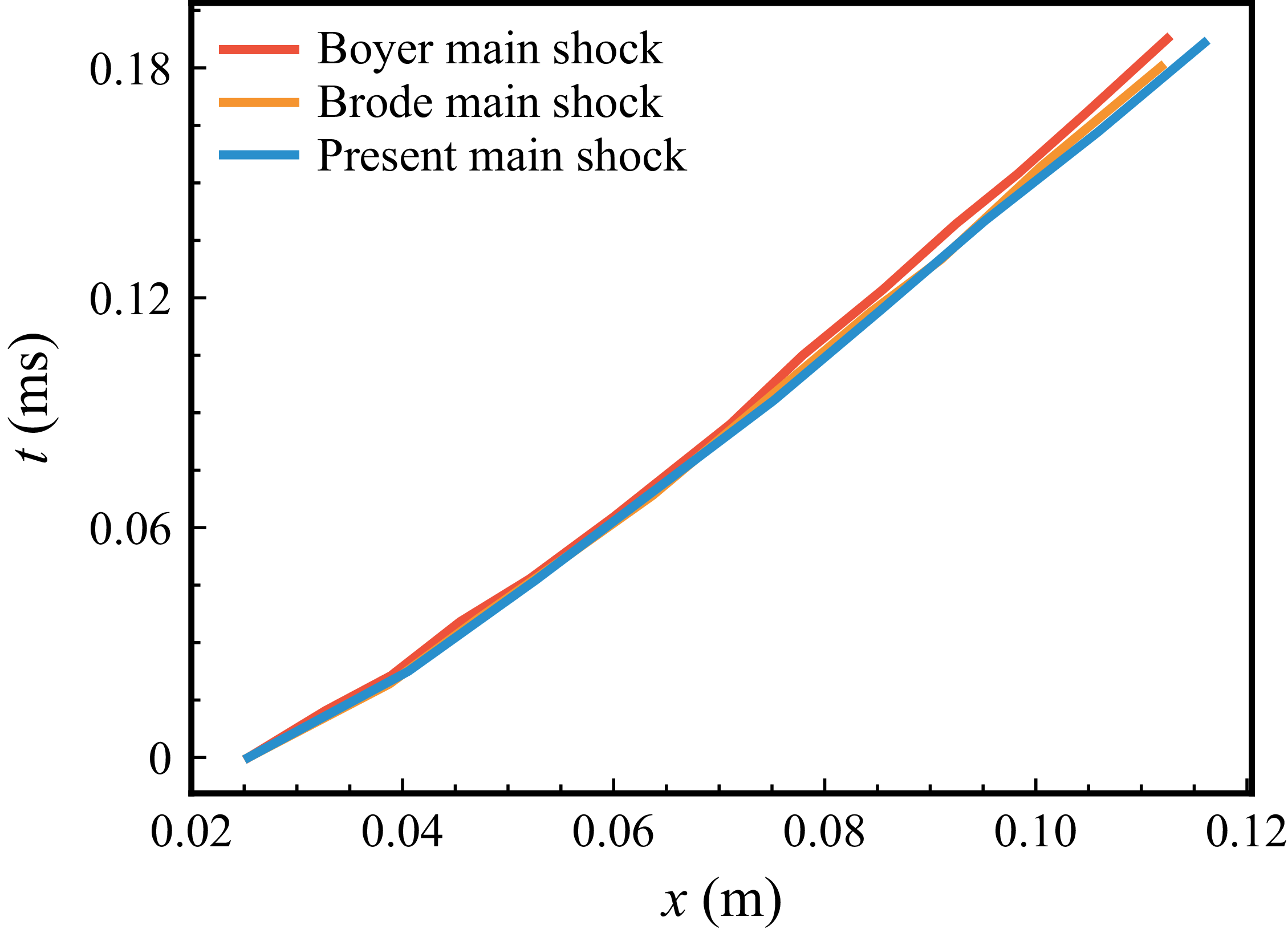
To validate the numerical methods used in this work, a test case has been performed and compared with previous results. Brode’s numerical predictions and Boyer’s experimental measurements show reasonable agreement for the finite-source blast sphere
 $p_4 = 22\ \mathrm{atm}$
,
 $p_0 = 1\ \mathrm{atm}$
,
 $T_4=T_0=299\ \mathrm{K}$
and
 $R_s = 0.0254\ \mathrm{m}$
(Brode Reference Brode1955; Boyer Reference Boyer1960; Y. et al. Reference Ling, Haselbacher and Balachandar2012). The instantaneous radial position of the shock front was determined by locating the local maximum of the pressure gradient along radial profiles traversing the flow field. To ensure robustness, the candidate positions identified by this gradient criterion were cross-verified by checking for a coincident sharp discontinuity in the density field. This detection algorithm was applied systematically at each time step to reconstruct the time-resolved shock trajectories. To further validate the current numerical framework, the results are compared with the benchmark solutions from Brode (Reference Brode1955), as shown in figure 2. The predicted evolution of the main shock exhibits good agreement with the reference data.
Numerically generated
 $x{-}t$
diagram. Under the gas flow generated from the finite-source blast sphere, the current numerical results are compared with results from Brode and Boyer. The present computed main shock result is acquired from density and pressure discontinuities.

The simulations were performed in a spherical domain of radius
 $15.75R_s$
centred on the blast origin. The non-reflective boundary conditions were applied at the outer boundary to model an unbounded atmosphere. The domain size ensures a buffer between the farthest shock position reached in any simulation time and the boundary, guaranteeing that the shock interactions and merging events are free from spurious numerical wave reflections.
3.3. Grid convergence study
Based on the parameters adopted above, case 1-a was selected for the grid convergence study. The simulations were performed in a three-dimensional spherical computational domain using an unstructured mesh composed of tetrahedral elements. Three different grid resolutions were tested, characterised by uniform cell sizes
 $\delta =0.012$
(coarse),
 $0.008$
(medium) and
 $0.006$
(fine). As shown in figure 3(a), the temporal evolution of the main shock position exhibits excellent agreement across all three resolutions. The relative difference in shock position between the medium and fine meshes is minimal, indicating asymptotic convergence. Moreover, the shock merging time also demonstrates robust convergence, with negligible discrepancies observed between the medium and fine grids. The radial pressure profiles at
 $\hat {t}=44.2$
are compared in figure 3(b). The outward-propagating merged shock front is resolved identically across the different grids. However, the internal secondary shock structures are accurately captured only by the medium and fine meshes. These results confirm that the mesh resolution
 $\delta =0.008$
yields sufficient accuracy to capture the shock merging dynamics. As a result, this resolution was adopted for all subsequent numerical simulations.
(a) Trajectories of the main shock results under different grid resolutions. (b) The radial pressure profiles results at
 $\hat {t}=44.2$
under different grid resolutions.

3.4. Energy release of the finite-source blast sphere
As the finite-source blast evolves physically, the main-shock behaviour asymptotically approaches the Taylor–Sedov similarity solution at long times. The flow characteristics in the near field and the far field become decoupled, and the time scale
 $2\tau =2R_{s}/c_{4}$
can be used to distinguish the respective temporal regions (Ling & Balachandar Reference Ling and Balachandar2018). In the present study, simulations of different finite-source blast spheres are performed to elucidate the energy release process. The density and pressure profiles for a single blast in cases 1, 2 and 3 are presented in figure 4. According to the Rankine–Hugoniot relations, the pressure jump across a decaying shock decreases with time.
Density and pressure profiles with different initial conditions of finite-source blast spheres at various times, for the density and pressure distributions of (a,d) case 1, (b,e) case 2, (c,f) case 3.

Owing to the different initial conditions of the finite-source blast sphere, the total energy release and the subsequent flow evolution vary with the characteristic time
 $\tau$
. From the density and pressure distributions, it can be observed that around
 $t=2\tau$
, the pressure profile in the near field has become nearly steady, and density fluctuations in that region remain relatively small in all cases. The distinct near-field dynamics observed across these cases is primarily governed by the variation in the initial sound speed within the source gas. As illustrated by the density and pressure profiles in figures 4(b) and 4(e), the secondary shock is clearly visible propagating in the vicinity of the origin at
 $t=6.04\tau$
.
The relaxation time required for the contact interface to approach its terminal radius is highly sensitive to the initial sound speed. In case 1 (high
 $c_4/c_0$
), the interface rapidly approaches its asymptotic radius, as shown in figure 4(a). Conversely, in case 3 (low
 $c_4/c_0$
), the pressure equilibration process is slow; the interface takes much longer to travel towards its terminal position, and exhibits large-amplitude oscillations (see figure 4(c) for the early-time evolution), while the theoretical terminal radius is determined by the initial pressure ratio
 $p_4/p_0$
and the source size
 $R_s$
. The observed oscillations are driven by the repeated reflections of compression and expansion waves within the low-density region, a process susceptible to instabilities, which can further modulate and diffuse the interface’s motion. For the second blast, the critical factor is the existence of a persistent, low-density core region. The time scale condition
 $\Delta t\gt 2 \tau$
ensures that the large-scale pressure gradients in the near field have relaxed, which dictates the density for the second blast’s initiation even when the interface may still oscillate.
3.5. Shock wave characteristics of time-delayed finite-source blast spheres
For a further assessment of the flow behaviour generated by multiple finite-source blast spheres, the density and pressure profiles of cases 1-a and 1-c are presented in figure 5. Both density and pressure distributions clearly reveal the distinct locations of the main shock, the secondary shock and the gas contact interface. In the early stage of both cases, the main shock of the first blast and that of the second blast can be identified from the discontinuities. As shown in figure 5, a merged shock emerges in the later stage of case 1-a, whereas no shock merging occurs in case 1-c. These flow differences are primarily a consequence of the different time intervals between the two blasts.
Density and pressure profiles with different time intervals of finite-source blast spheres at various times, for the density and pressure distributions of (a,c) case 1-a, (b,d) case 1-c. Here, (1), (2), (3) and (4) represent the positions of first blast main shock, second blast main shock, secondary shock and merged shock.

Simulation results of main shock propagation under different cases and time interval. The position and time of the main shock wave are both in dimensionless form. The solid lines represent the first blast main shock. The dashed curves show the second blast main shock wave. The dotted lines represent the evolution of distance
 $\Delta x$
between first and second blast shock waves over time. The shadow areas in the three-dimensional graphs represent the theoretical merging time ranges for each case. (a–c) The case 1 finite-source blast sphere with different
 $\Delta t$
: (a) three-dimensional
 $x{-}t{-}\Delta t$
diagram; (b)
 $x{-}t$
relations; (c) the evolution of distance
 $\Delta x$
. Similarly, (d,e,f) case 2, (g,h,i) case 3, (j,k,l) case 4.

The evolution of the main shock front is presented in figure 6. For all cases, the main shock of the first finite-source blast sphere enters the similarity regime before the second blast is initiated. Figures 6(a–c) show results for case 1 under different time intervals. The three-dimensional
 $x$
–
 $t$
–
 $\Delta t$
diagram in figure 6(a) illustrates how the shock front depends on both the delay time
 $\Delta t$
and the evolution time
 $t$
. The lower bound and upper bound of
 $\Delta t$
for merge conditions are depicted with a shadow area in figure 6(a) to visualise theoretical merging time bounds of (2.7). The direct graphical display of the theoretical time interval in figure 6(a) proves the identical results with numerical simulations. Shock merging is observed in cases 1-a and 1-b, as seen in figures 6(b) and 6(e). Compared with case 1-b, the smaller
 $\Delta t$
in case 1-a leads to an earlier merger. In case 1-b, merging occurs only in the later stage of the simulation. This difference arises because the time delay in case 1-a lies well within the merging range, whereas in case 1-b it lies near the upper limit of that range. Once merged, the shock propagates at a speed close to that of the previous main shock, as the weakening of the individual waves during the later stage minimises any further acceleration. The separation distance
 $\Delta x$
between the first and second blast shocks is shown in figure 6(c). For cases 1-a and 1-b,
 $\Delta x$
decreases gradually, and merging occurs when
 $\Delta x$
reaches zero. When
 $\Delta t \gt 22\tau$
(case 1-c), the two main shocks remain separate and propagate independently, and
 $\Delta x$
stays positive.
Results for case2 are displayed in figures 6(d–f). Here,
 $\Delta t$
again governs the merging behaviour. Within the merging range, case 2-a produces a merged shock in the late stage, which also agrees with the representative shadow area for merging bounds in figure 6(d). Case 2-b corresponds to the limiting delay
 $\Delta t = 6.6\tau$
. No merging result is observed within the present simulated time. For the evolution in cases 1 and 2, the shock fronts remain distinct and spatially separated, exhibiting only weak interaction. During this phase, the second blast wave propagates through the flow field established by the first, with its velocity governed by the local medium properties in accordance with Taylor–Sedov scaling. Consequently, the separation distance
 $\Delta x$
decays monotonically, driven primarily by the relative propagation speeds of the two fronts (see figures 6
c,f). However, the subsequent abrupt drop in
 $\Delta x$
marks the onset of strong nonlinear interactions. As the second shock approaches within a few shock thicknesses of the first, the two discontinuities begin to coalesce. The pressure fields overlap constructively, accelerating the consolidation of the shocks into a single entity. The sharp discontinuity in the shock trajectory shown in figures 6(b) and 6(e) captures the culmination of this process. This event marks the instant of shock merger.
For case 3 (
 $c_4/c_0 = 1$
) with
 $\Delta t = 2\tau$
, the two main shocks propagate independently, as shown in figures 6(g–i). Accordingly,
 $\Delta x$
never falls to zero and declines only slowly at long times. The numerical results confirm that the time interval
 $\Delta t$
decisively regulates shock wave merging under the present finite-source blast conditions. The occurrence of merging is consistent with the predicted time interval constraint given in (2.7). The merging bound shows a plane without an effective shadow area for case 3 in figure 6(g).
The simulation results for case 4, illustrated in figures 6(j–l), provide compelling support for the theoretical predictions. Consistent with the baseline analysis, shock merging was clearly observed for time intervals (
 $\Delta t$
) falling within the predicted coalescence window (case 4-a). Conversely, for intervals lying outside this range (case 4-c), the shocks propagated independently without merging. These results demonstrate that the position of the merging boundary remains effectively invariant when the initial sound speed ratio
 $c_4/c_0$
is held constant, despite a significant variation in the initial pressure ratio
 $p_4/p_0$
. Therefore, the topology of the interaction map in figure 6(j), specifically the delineation of the merging boundary and the non-merging shadow regions, is governed primarily by
 $c_4/c_0$
, as confirmed by the consistency of the simulations across different pressure regimes.
4. Multiple blast waves within the merged region
To extend the verification of the merging time range to multiple blast waves, we consider a sequence of
 $N$
blasts initiated at a fixed finite interval
 $\Delta t$
. The first blast propagates into the initially ambient gas. Each subsequent blast is initiated within the low-density core region produced by the preceding blast, and subsequently propagates in a similar manner, eventually catching up with the leading shock. The time delay between the last blast and the first blast is
 $(N-1)\, \Delta t$
. Using the merging time interval established in the previous section, we can determine whether the shock wave of the last blast merges with that of the first blast. This leads to the maximum number of blasts
 $N_{m}$
for which all shocks in the sequence can merge. The value of
 $N_{m}$
is constrained by the upper limit of the merging time interval, satisfying
 \begin{align} (N_{m}-1)\,\Delta {t} = 2\tau \frac {c_{4}}{c_{0}}, \\[-28pt] \nonumber \end{align}
 \begin{align} N_{m} = \frac {2\tau }{\Delta {t}} \frac {c_{4}}{c_{0}} +1. \\[0pt] \nonumber \end{align}
Consequently, for blast sequences longer than
 $N_{m}$
, the shock wave generated by the (
 $N_{m}+1$
)th blast will no longer merge with the leading shock of the first blast. Any subsequent shocks will propagate independently. To determine the value of
 $N_{m}$
under multiple-blast conditions, we performed simulations for case 1 (sound speed ratio
 $c_4/c_0=11$
). Two representative configurations, denoted case 1-A and case 1-B, were examined with different time intervals and different numbers of blast events, as summarised in table 2.
Multiple finite-source blast spheres for the cases simulated.

Cross-sectional view of the flow in the
 $y{-}z$
plane (
 $x=0$
) passing through the origin: the gas flow pressure field and density field for case 1-A. The shock front shows radial symmetry. The discontinuities in gas flow show the main shock front under different variables at the same time. Here,
 $N$
is the number of blasts under evolution time
 $\hat {t}$
, the merged shock is marked with
 $m$
, and other shock waves are labelled with blast sequence number.

Cross-sectional view of the flow in the
 $y{-}z$
plane (
 $x=0$
) passing through the origin: the gas flow pressure field and density field for case 1-B. The shock front shows radial symmetry. The discontinuities in gas flow show the main shock front under different variables at the same time. Here,
 $N$
is the number of blasts under evolution time
 $\hat {t}$
, the merged shock is marked with
 $m$
, and other shock waves are labelled with blast sequence number.

Figures 7 and 8 present cross-sectional views of the flow fields for cases 1-A and 1-B, respectively. For all cases, the positions and arrival times of shock waves were extracted from the simulation data. The three-dimensional slices passing through the origin confirm the spherical symmetry of the shock front structure within the computational domain. The shock front discontinuities are clearly identifiable from the corresponding density and pressure distributions. The shock front maintains a spherical morphology throughout its propagation, consistent with the spherically symmetric computational domain and initial conditions, which are devoid of physical perturbations. While the primary shock structure is preserved, faint polygonal patterns are observable within the interior pressure and density contours. These features are identified as grid imprinting – numerical artefacts resulting from the underlying unstructured tetrahedral discretisation. Notably, these discretisation effects are localised to the post-shock region and do not influence the macroscopic dynamics of the shock propagation.
Figures 7(a) and 7(c) show the pressure and density fields at dimensionless time
 $\hat {t}=56.7$
after four blasts. The outermost merged shock is marked with ‘
 $m$
’, while the other shock waves are marked with their respective blast sequence numbers. At this stage, the shocks from the first and second blasts have already merged, whereas the subsequent shocks remain distinct. Later in the evolution, at
 $\hat {t}=95.2$
after six blasts (figures 7
b,d), additional finite-source blast spheres have been initiated, yet the merged shock still originates only from the first two blasts. This confirms that the maximum number of shocks that can merge in this sequence is
 $N_m = 2$
, consistent with the integer value predicted in table 2.
For a shorter time interval and a higher blast frequency, case 1-B exhibits a more complex multiple-wave structure (figure 8). Similarly, at
 $\hat {t}=56.4$
after six blasts (figures 8
a,c), the merged shock is formed only by the first two blasts. As the number of blasts increases to
 $N=12$
at
 $\hat {t}=95.6$
(figures 8
b,d), the pressure and density distributions reveal a set of nine distinct shock waves. The outermost wave is a merged shock comprising the shocks from the first to the fourth blasts, while the remaining waves propagate independently – a result that again aligns with the prediction in table 2. Finally, the merging and propagation of shock waves in a multiple-blast sequence are governed by three key parameters: the initial sound speed ratio of the finite-source blast sphere
 $c_4/c_0$
, the time interval between successive blasts
 $\Delta t$
, and the total number of blasts
 $N$
.
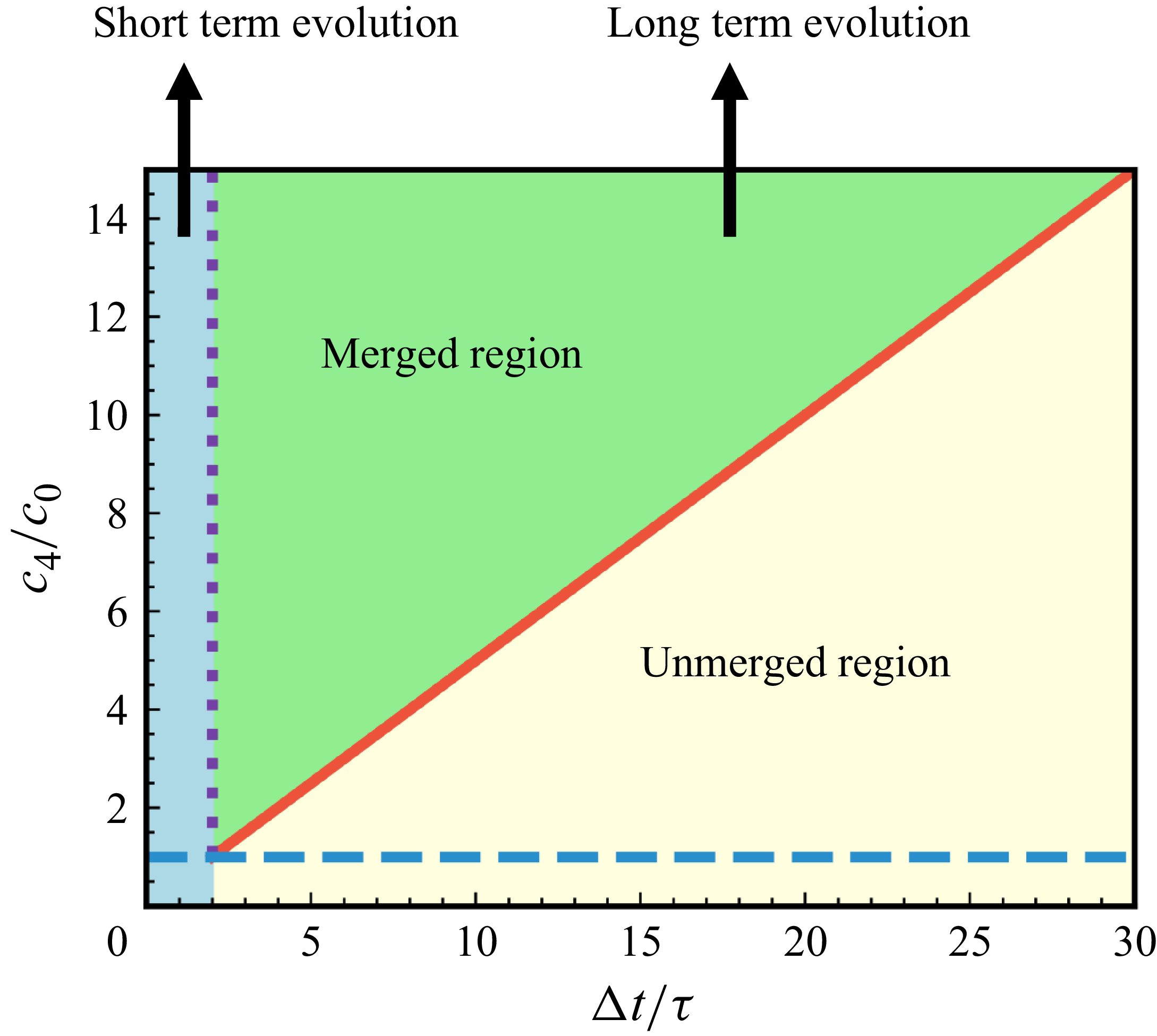
Phase diagrams of different sound speed ratios and evolution times. The solid line represents the dividing line between shock wave merging and non-merging, the dotted line separates the shock wave with short-term and long-term evolution, and the dashed line represents the critical condition of sound speed ratio 1.

A phase diagram is constructed to delineate the shock-merging behaviour as a function of the initial sound speed ratio
 $c_{4}/c_{0}$
and the evolution time, as presented in figure 9. By classifying the initial sound speed ratio of the finite-source blast sphere and the evolution time, the regions in which multiple blast shocks merge can be identified. A larger
 $c_{4}/c_{0}$
corresponds to a wider time range over which shock merging occurs.
In the phase diagram presented in figure 9, the solid line marks the boundary between the merged and unmerged shock regions, revealing an approximately linear relationship. The dotted line delineates the transition between the short-time and long-time regimes, defined at
 $t=2\tau$
. This characteristic time scale is governed by the internal energy release of the finite source, and corresponds to approximately twice the duration required for the expansion fan to reflect from the origin. Extensive numerical studies of spherical finite-source blasts, including the seminal work of Brode (Reference Brode1955) and the comprehensive analysis by Ling & Balachandar (Reference Ling and Balachandar2018), have demonstrated that the main shock transitions to the self-similar Taylor–Sedov solution within a temporal window of
 $1.5\tau$
to
 $2.5\tau$
, a process largely independent of initial conditions. Thus our selected threshold of
 $2\tau$
serves as a robust, representative midpoint for this transition, validated across the broad range of initial pressure and sound speed ratios considered in this study. Within the short-term regime (
 $t \lt 2\tau$
), the energy release from the driver gas is incomplete. On the other hand, the merging phenomena examined in this study occur predominantly within the long-term regime, where the main shock evolution adheres to Taylor–Sedov similarity. The dashed line in figure 9 indicates the critical acoustic condition where
 $c_{4}/c_{0}=1$
. We conclude that the merging boundary is fundamentally governed by the initial sound speed ratio
 $c_4/c_0$
. While the absolute pressure ratio
 $p_4/p_0$
determines the total energy release and the absolute strength of the shocks, the relative timing of their interaction is primarily dictated by
 $c_4/c_0$
. This ratio encapsulates the critical physics regarding the expansion velocity of the finite source relative to the ambient medium, thereby setting the stage for the shock chase process.
5. Merged shock in the strong-shock stage
For two finite-source blast spheres within the considered time range, the merging process differs between the early and late stages of shock propagation, similar to the different evolutionary phases of a single finite-source blast. In the late stage, the spherical shocks from the first and second blasts weaken and subsequently merge. Owing to their weakened strength, the resulting merged shock propagates at a speed close to that of the initial blast shock.
When the merging time interval is wider (as in the initial conditions of case 1), the delay between two blasts can be shortened so that merging occurs while the shocks are still strong. In this regime, the propagation obeys the Taylor–Sedov similarity solution. To examine this behaviour, three additional time intervals (denoted I, II and III) were simulated for case 1. The corresponding parameters are listed in table 3. For reference, a single-blast simulation of case 1 was also performed to verify the main shock propagation during the strong-shock stage.
Time interval of case 1 within strong-shock stage for the cases simulated.

Figure 10 presents simulation results for the main shock evolution in the strong-shock regime. In this stage, the main shock from a finite-source blast sphere follows the Taylor–Sedov similarity solution, scaling as
 $\hat {x} \sim \hat {t}^{0.4}$
. A single blast simulation (case 1) was performed. Its trajectory in the dimensionless shock distance
 $\hat {x}$
, time interval
 $\Delta \hat {t}$
and time
 $\hat {t}$
is shown in figure 10(a). The fitted scaling exponent for the single blast is
 $0.41$
, in good agreement with the theoretical value.
When two blasts are initiated with a sufficiently short delay, merging occurs while the shocks are still strong. In this situation, the velocity of the merged shock changes significantly, exceeding that of a single blast. To characterise the propagation of the merged shock, we distinguish the behaviour before and after merging. Before merging, the trajectory of the first blast’s main shock is nearly identical for different time intervals, and matches the single blast result. The trajectory of the second blast’s shock, however, is less stable owing to near-field disturbances from the gas contact interface and secondary shocks. After merging, a clear acceleration is observed. The earlier the merger occurs, the farther the merged shock propagates. This acceleration is directly linked to the two consecutive energy injections during the strong-shock stage. The increase in total energy drives a faster propagation, consistent with the energy-dependent scaling predicted by the Taylor–Sedov solution.
Figure 10(b) presents the merged shock propagation data in logarithmic coordinates of dimensionless distance
 $\hat {x}$
and dimensionless time
 $\hat {t}$
. A distinct scaling relation emerges and is compared with the single-blast case. Because the total elapsed time
 $t$
of the leading shock is interrupted by the delay
 $\Delta t$
, it does not adequately capture the motion of the merged shock. We therefore introduce a shifted time scale
 $\hat {t} - \Delta \hat {t}$
to characterise the merged shock evolution. The resulting data collapse onto a power law with exponent
 $0.4$
, consistent with the theoretical similarity solution. The different time scales used and the corresponding fitted exponents are summarised in table 4. Finally, the compensation plot in figure 10(c) confirms the scaling relation between dimensionless distance and shifted time, thereby validating the proposed scaling behaviour.
Before merge scaling of first blast shock wave:
 $\hat {x}\sim \hat {t}^{\alpha }$
. After merge scaling of merged shock:
 $\hat {x}\sim \hat {t}^{\beta }$
and
 $\hat {x}\sim (\hat {t}-\Delta \hat {t})^{\lambda }$
.

Simulation results of main shock propagation for case 1 under a short time interval. The solid black line represent the single blast results of case 1 for comparison. (a) The three-dimensional
 $x{-}t{-}\Delta t$
diagram. The solid lines represent the first blast main shock. The dashed curves show the second blast main shock wave. (b) The log scale results of dimensionless distance and time after shock merge. The dotted line shows the double times energy results of case 1, and the dashed line fits the scaling exponent 0.4. (c) The compensation diagram for merged shock to reveal a scaling law relation of dimensionless distance and time. The dashed line also fits the scaling exponent 0.4. (d) The
 $x{-}t$
diagram separated by different scaling relations before merged phenomena and after merged shocks. The solid lines represent the first blast main shock. The dashed curves show the second blast main shock wave. The vertical dotted lines at merged points distinguish the corresponding time regimes.

According to the Taylor–Sedov solution, the internal energy of the finite-source blast sphere governs shock propagation in the strong-shock stage, where the shock distance scales as
 $x\sim E_{\textit{tot}}^{1/5}$
. To describe merged shock propagation in this regime, an equivalent energy must be defined for the case of two blasts separated by a finite time delay. Figure 10(b) shows the dimensionless distance and time relation for a single finite-source blast sphere, together with the corresponding data for the merged shock. Once the second blast is initiated, the total available energy is effectively doubled. We therefore compare the merged shock trajectory, plotted against the shifted time
 $\hat {t}-\Delta \hat {t}$
, with the expected scaling for an equivalent single blast of energy
 $2E_{\textit{tot}}$
. The effective time scale for a blast wave is defined as the duration elapsed since the instantaneous release of its driving energy. However, in a time-delayed dual-blast scenario, the total energy (
 $2E_{\textit{tot}}$
) is not released instantaneously at
 $t=0$
; rather, it is injected in two distinct pulses separated by a delayed time
 $\Delta t$
. Consequently, the merged shock, once formed, propagates as if the total energy had been released at a virtual origin in time, distinct from the initial detonation. The time shift term
 $\hat {t}-\Delta \hat {t}$
introduced in our scaling law precisely accounts for this temporal offset. Physically, the shock front begins to propagate under the influence of the full combined energy only after the second blast has initiated and the shocks have coalesced. The instant of shock merger therefore marks the onset of this new self-similar regime. To ensure that the trajectory of the merged shock conforms to the standard scaling law, the elapsed time must be renormalised to a new starting point that reflects the delayed availability of the combined energy. By applying the shift
 $\hat {t}-\Delta \hat {t}$
, we effectively synchronise the time scale with the completion of the energy injection. In essence, the evolution of the dual-blast merged shock matches that of an equivalent single blast with energy
 $2E_{\textit{tot}}$
evolving over a reduced duration
 $\hat {t}-\Delta \hat {t}$
.
As shown in figure 10(b), the propagation of the merged shock closely follows the curve predicted for the doubled energy case. Therefore, we propose a modified Taylor–Sedov relation for the merged shock wave:
 \begin{align} x\sim \left(\frac {2E_{\textit{tot}}}{\rho _{0}} \right)^{\frac{1}{5} }(t-\Delta t)^{\frac{2}{5} }. \end{align}
Finally, the characteristic propagation of shock waves before and after merging in the strong-shock regime can be established. Figure 10(d) displays the dimensionless shock trajectories for the first and second finite-source blast spheres under different time intervals within this stage. Prior to merging, the individual shocks follow the classical Taylor–Sedov scaling (
 $\hat {x}\sim \hat {t}^{0.4}$
). Once merged, the combined shock propagates outwards, and its subsequent evolution is described by the modified scaling relation introduced above (
 $\hat {x}\sim (\hat {t}-\Delta \hat {t})^{0.4}$
). The overall time evolution can therefore be divided into distinct regimes, separated by the merging points, as illustrated in figure 10(d). The modified time scale
 $\hat {t}-\Delta \hat {t}$
introduced in (5.1) carries a direct physical interpretation: it represents the elapsed time measured from the effective initiation moment of the combined energy release. This implies that post-merger, the shock propagates as if the total energy
 $2E_{\textit{tot}}$
had been released in a single, instantaneous event, but with its self-similar evolution governed by the reduced duration
 $\hat {t}-\Delta \hat {t}$
. This temporal shift, in conjunction with the equivalent energy parameter, provides a complete asymptotic description of the merged shock trajectory within the framework of the strong-shock similarity solution.
The excellent agreement between the merged shock trajectory and the
 $2E_{\textit{tot}}$
scaling law, as evidenced in figure 10(b), confirms that the energy coupling during the merging process is highly efficient. This suggests that the complex nonlinear interaction involves a reconfiguration of the flow field rather than significant energy dissipation. While a minor fraction of energy may be redistributed to internal flow structures (e.g. the contact interface), the effective driving energy of the leading front remains consistent with the sum of the individual blast energies.
While the asymptotic scaling is governed by the total energy
 $2E_{\textit{tot}}$
, the rapid acceleration during the merging phase is driven by specific nonlinear hydrodynamic mechanisms. First, the merging event integrates the momentum fluxes of the converging flows, re-establishing Rankine–Hugoniot conditions at a higher intensity. Second, the coalescence of the low-density cores creates an enlarged driver region behind the shock. This geometric expansion enhances the hydrodynamic efficiency of converting internal energy into kinetic energy, thereby facilitating the shock’s swift transition to the trajectory predicted by the combined energy. Although these momentum and geometric factors dominate the transient dynamics during coalescence, the long-term propagation remains strictly governed by the total energy scaling. These transient effects diminish rapidly but likely account for the minor deviations observed in figure 10(b).
6. Conclusion
This paper presents a numerical study of the evolution and complex propagation mechanisms of main shock waves generated by two and multiple finite-source blast spheres with time-delayed energy release. We have elucidated the fundamental mechanisms governing the propagation and merging of main shock waves from finite-source blast spheres under such conditions. Theoretically and numerically, we demonstrate that the long-term shock front evolution reveals interactions between multiple blasts. A key finding is the identification of a critical time interval range within which the shock waves merge, a range fundamentally determined by the initial sound speed ratio between the compressed blast gas and the ambient medium. Numerical simulations confirm the existence and boundaries of this merging regime for both dual and multiple blast sequences.
Extending the analysis to the strong-shock stage, we derive an asymptotic solution that incorporates an equivalent total energy release and a shifted time scale. This modified solution accurately describes the accelerated propagation of the merged shock front. The merging and subsequent propagation of shock waves from time-delayed blast sources are governed by the initial sound speed ratio, the time interval, and the total number of blasts – relationships quantified by both a merging interval criterion and a modified Taylor–Sedov relation.
The theoretical framework developed here has direct relevance to high-energy density physics and astrophysics. In the context of extreme ultraviolet lithography and laser material processing, dual-pulse schemes typically involve a second pulse arriving after a controlled delay (nanoseconds to microseconds) to interact with an expanded plume. The initial blast generates a high-temperature region, corresponding to the regime of a large initial sound speed ratio (
 $c_4/c_0 \gg 1$
). The resulting merged shock dynamics significantly influences momentum transfer and energy coupling, which are critical for optimising debris mitigation strategies and enhancing the efficiency of laser-driven shock processing. Analogous dynamics occurs in astrophysical settings, such as sequential supernova explosions in binary systems, or recurrent nova eruptions. In these scenarios, the initial explosion ejects material and carves out a low-density cavity. Given the vast spatial scales and high sound speed ratios involved, the potential time window for shock merging is broad. The characteristics of the merged shock can fundamentally alter the morphology and emission properties of the resulting remnant, or influence the triggering of subsequent star formation. Ultimately, this model provides critical insights into the evolution of main shocks in multi-blast systems, substantially advancing the understanding of delayed energy release and the dynamics of finite-source blast spheres. Future work could investigate effects such as viscosity, asymmetries inherent in real explosions, or the behaviour of non-ideal gases under relevant application conditions.
Funding
This work was supported by the National Natural Science Foundation of China under grant nos 12432011, 12588201, 12372220, 12372219, 12422208, 12421002 and 52450304.
Declaration of interests
The authors report no conflict of interest.