1. Introduction
Traffic accidents cause not only higher mortality but also slower economic growth. The gross domestic product of some countries could increase by about 13% if they succeeded in halving the rate of road traffic deaths and injuries (World Bank, 2018). In Indonesia, the Indonesian Ministry of Communications and Informatics (Kominfo, 2017) reported that three fatalities occur every hour due to road traffic accidents. On a single highway segment, namely Cipali Highway, the highways administrative office recorded 634 road traffic accidents occurring from January to July 2019 (Maulana, Reference Maulana2019).
Road traffic accidents may happen for various reasons including human factors and vehicle issues, as well as road infrastructure and environment. Data from the Indonesian Ministry of Communications and Informatics (Kominfo, 2017) revealed that human factors, vehicle issues, and road environment contribute 61%, 9%, and 30% of road traffic accidents, respectively. On highways particularly, 80% of the accidents were caused by human error including speeding. About 35% of drivers on highways drive their vehicles above 100 km/h, exceeding the regulated highway speed limit in Indonesia. Furthermore, prior studies in several other countries like Ghana (Atombo et al., Reference Atombo, Wu, Zhong and Zhang2016), the United Arab Emirates (Mehmood, Reference Mehmood2009), and Italy and Spain (Machado-León et al., Reference Machado-León, de Oña, de Oña, Eboli and Mazzulla2016) also found that human factors were the major contributing factors for road traffic accidents.
The accident data suggest that investigating the underlying predictors of human behaviour in speeding deserves the full attention of research. Compliant driving behaviour could probably be the only way to sustainably improve road safety. Several prior research studies have been conducted to investigate human behaviour in speeding. Behavioural beliefs were shown to be significant factors influencing speeding, where the majority of drivers have perceived violating the speed limit as a usual driving action (Atombo et al., Reference Atombo, Wu, Zhong and Zhang2016). In addition, drivers’ emotions have also emerged as a factor triggering risky driving behaviour, predominantly speeding, thus leading to road traffic accidents (Al Reesi et al., Reference Al Reesi, Freeman, Davey, Al Adawi and Al Maniri2018).
Other prominent factors are the demographic characteristics of individuals. Younger adults showed higher probability to be involved in risky driving, including driving deviation and violations, while older adults were more frequently mistaken in determining another vehicles’ speed (Brookland et al., Reference Brookland, Begg, Langley and Ameratunga2008; Truelove et al., Reference Truelove, Freeman, Szogi, Kaye, Davey and Armstrong2017). Older adults also claimed to have higher level of discomfort during driving than younger ones (Fancello et al., Reference Fancello, Daga, Serra, Fadda, Pau, Arippa and Medda2020). Male drivers were also found to commit risky driving more than female drivers (Li et al., Reference Li, Shi, Liu and Wang2016; Atombo et al., Reference Atombo, Wu, Tettehfio and Agbo2017).
While these findings give the impression that speeding is mostly internally driven and can be controlled through governing drivers’ attributes and behaviour, it may also be deterred by imposing some sanction mechanisms. Prior research has shown that enforcement actions in the form of sanctions can increase the speed limit compliance, however, the collective wisdom does not seem to have appeared yet. Truelove et al. (Reference Truelove, Freeman, Szogi, Kaye, Davey and Armstrong2017) found a non-significant effect of apprehension due to legal sanctions on speeding. In contrast, another recent study revealed that increasing the penalty for violation did lower the speeding probability (Zhao et al., Reference Zhao, Han, Meng, Ma and Yang2019). Indeed, the link of general apprehension related to legal threats has been weak in the context of road safety (Fleiter et al., Reference Fleiter, Watson, Lennon, King and Shi2009). This weak link highlighted two research questions related to sanction. First, how would drivers’ demographics influence their perception towards sanction implementation? The influence of demographic factors on drivers’ risky driving behaviours has long been studied, but the relations between demographic factors and perceived sanctions are lacking, let alone sanctions implemented for the speeding context. Second, how would the perceived sanction influence drivers’ speeding behaviour?
Ultimately, there should be some attempt to predict if drivers will commit speeding violations given drivers’ demographics and the perceived sanction mechanisms. Therefore, this study aims (i) to investigate the effects of drivers’ demographics on their perceptions towards sanctions and (ii) to predict drivers’ speeding behaviour given their demographics, their perceptions towards sanctions, and the risky driving variables. Investigating the predictors triggering indecorous speeding behaviour would contribute to speed violation prevention programmes and benefit road traffic safety.
2. Literature review
Risky driving is associated with human behaviour, which contributes to the majority of traffic accidents and the resulting injuries. Among the indices of risky driving are dangerous overtaking, speeding, and violating traffic lights (Atombo et al., Reference Atombo, Wu, Zhong and Zhang2016). Several factors influencing risky driving have been examined in prior studies, including driving experience, attitude, age, gender, belief, emotion, and personality. Driving experience seemed to trigger risky driving. In the research by Mohamad et al. (Reference Mohamad, Abdullah, Mohamad and Karim2018), 100 young drivers aged 18 to 24 in Malaysia were surveyed, and it was found that participants with longer driving experience tended to exhibit speeding behaviour more than those with less experience. Correspondingly, Niu et al. (Reference Niu, Liu, Wang and Li2019) also found this tendency, that experienced drivers tended to neglect speeding interventions and gradually formed their own driving style.
In addition, drivers who were able to see benefits or consequences of risky driving would be able to adjust their propensity towards it (Trinh and Vo, Reference Trinh and Vo2016). However, drivers’ emotional condition and personality were also found to affect risky driving. Anger-driven drivers and drivers with highly competitive feelings exposed higher tendency to risky driving (Li et al., Reference Li, Shi, Liu and Wang2016; Atombo et al., Reference Atombo, Wu, Tettehfio and Agbo2017; Disassa and Kebu, Reference Disassa and Kebu2019). Furthermore, when drivers hold strong beliefs that they can control the vehicle, they are also inclined to violate driving regulations (Atombo et al., Reference Atombo, Wu, Zhong and Zhang2016).
Although several research studies have been conducted to examine risky driving, the investigations on speeding alone remain limited, despite the fact that speeding is the major contributing factor in road traffic accidents. Still, what predicts and activates the speeding behaviour remains to be answered. Prior studies have proposed several models to predict the speeding behaviour. These models normally were built upon the foundation of the theory of planned behaviour (De Pelsmacker and Janssens, Reference De Pelsmacker and Janssens2007; Atombo et al., Reference Atombo, Wu, Zhong and Zhang2016, Reference Atombo, Wu, Tettehfio and Agbo2017; Jovanović et al., Reference Jovanović, Šraml, Matović and Mićić2017; Mohamad et al., Reference Mohamad, Abdullah, Mohamad and Karim2018; Tekeş et al., Reference Tekeş, Erkuş and Lajunen2019). Mohamad et al. (Reference Mohamad, Abdullah, Mohamad and Karim2018) compared drivers’ speeding behaviour in Malaysia and Vietnam and revealed that self-belief is highly allied with speeding behaviour. Tekeş et al. (Reference Tekeş, Erkuş and Lajunen2019) found that speeding intention was the major contributing factor in speeding behaviour. Whereas, in other studies, personal norm was identified as a significant influence on speeding behaviour (De Pelsmacker and Janssens, Reference De Pelsmacker and Janssens2007; Jovanović et al., Reference Jovanović, Šraml, Matović and Mićić2017).
There remains a greater inclination to model speeding according to the theory of planned behaviour. However, the implication of such a model in directly preventing speeding seemed to be vague. Speeding behaviour can possibly be directly deterred by imposing some sanction mechanisms, but findings regarding the effects of sanctions on driving behaviour in road traffic systems are inconsistent.
Legal sanctions providing general apprehension certainty were not correlated with speeding behaviour (Truelove et al., Reference Truelove, Freeman, Szogi, Kaye, Davey and Armstrong2017). Instead, material and physical losses as well as personal apprehension of severity and certainty were found to be significant factors in speeding deterrence. In contrast, Tudor-Owen (Reference Tudor-Owen2019) suggested that the coupling of an automated sanction system and police presence would enhance traffic enforcement thus reducing crashes. Furthermore, there seem to be factors that mediate a sanction's effectiveness. Traffic rule compliance was associated with the perception of certainty and severity of sanction execution. Drivers mostly are not aware of the details of sanctions for traffic rule violation and indicate that their compliance will depend upon the severity of sanctions (Truelove et al., Reference Truelove, Freeman, Szogi, Kaye, Davey and Armstrong2017). In addition, monetary fines were less powerful as a sanction than penalty points on the driver's licence (Chen et al., Reference Chen, Sze, Saxena, Pinjari, Bhat and Bai2020).
Further, the implementation and perception towards sanctions were also influenced by demographic characteristics. Young drivers are more likely to avoid sanctions in various ways (Bates and Anderson, Reference Bates and Anderson2019). Also, drivers driving in areas with several regions perceived that their probability of being caught was low (Bates et al., Reference Bates, Anderson, Rodwell and Blais2020). Correspondingly, driving experience and history influenced compliance with speed limits (Chen et al., Reference Chen, Sze, Saxena, Pinjari, Bhat and Bai2020). Again, more thorough analysis on the demographic factors and the perceived sanction mechanisms, particularly on Indonesian highways, is important to provide more straightforward implications in the local context.
Despite several prior research studies having examined sanctions, the investigation of how socio-demographic variables, risky driving parameters and perceptions towards sanctions simultaneously influence speeding behaviour has never been performed. This is particularly essential to predict speeding behaviour given the combination of the stated constructs to support a more direct and comprehensive model of speeding behaviour, beyond the conceptual cognitive level as it was predicted by the theory of planned behaviour alone as in the prior studies (De Pelsmacker and Janssens, Reference De Pelsmacker and Janssens2007; Atombo et al., Reference Atombo, Wu, Zhong and Zhang2016, Reference Atombo, Wu, Tettehfio and Agbo2017; Jovanović et al., Reference Jovanović, Šraml, Matović and Mićić2017; Mohamad et al., Reference Mohamad, Abdullah, Mohamad and Karim2018; Tekeş et al., Reference Tekeş, Erkuş and Lajunen2019). In addition, there should be research on how socio-demographic factors connect with perceived sanction mechanisms to target specific deterrent and reinforcement schemes in preventing speeding.
3. Methods
3.1 Participants
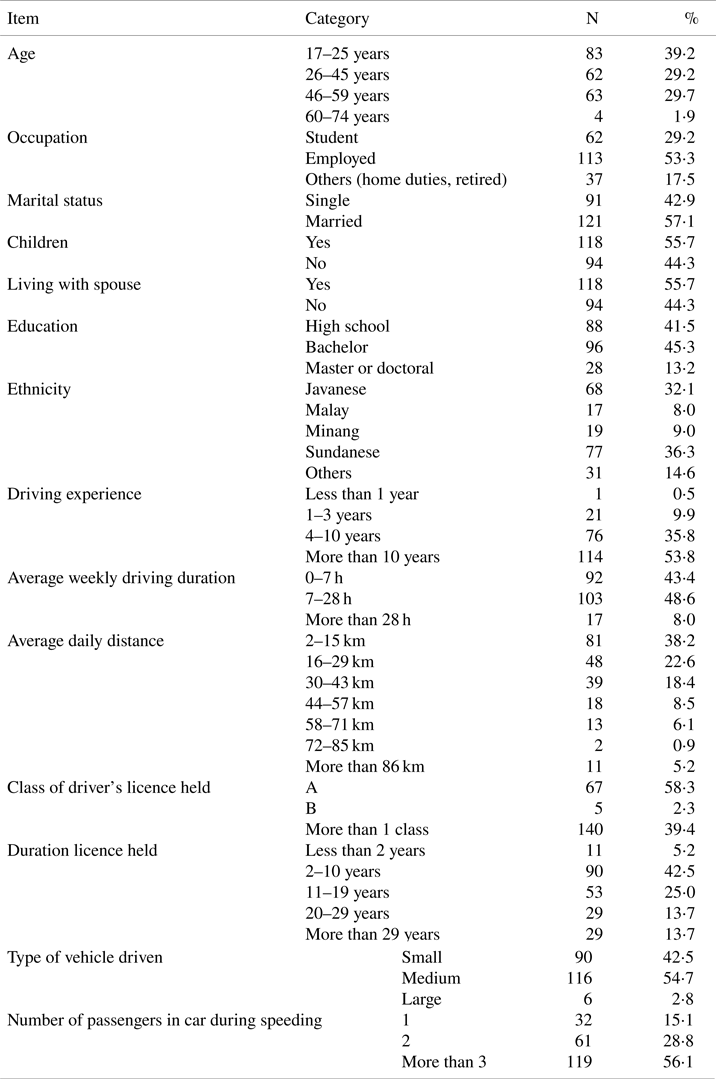
In this study, 212 randomly selected drivers holding a valid driving licence in Indonesia participated by filling out an online survey. All the participants had driven a four-wheeled vehicle on a highway at some time. The participants in this study consisted of 174 (81%) males and 42 (19%) females with ages ranging from 17 to 74 years. The majority of the participants (83%) reported having driven in excess of speed limit at some time. Following the age classification in Peng et al. (Reference Peng, Zhu, Wang and Ren2020), the participants were grouped into young adult (17–25 years, 39%), adult (26–45 years, 29%), middle-age (46–59 years, 30%), and old-age (more than 60 years, 2%). Further demographic information on participants is shown in Table 1.
Participants’ demographic information

3.2 Materials and survey design
The questionnaire developed in this study inquired about several aspects influencing driving behaviour from participants’ demographic information (e.g. age, gender, occupation, marital status, education, ethnicity, having children or not, living with spouse, driving experience, licence, and vehicle types) to sanctions. The questions were predominantly closed-ended. However, several questions including driving experience and daily driving hours were open-ended.
The online survey consisted of three sections. In the first section, participants were requested to complete the demographic survey. In the second section, participants completed the questionnaire regarding risky driving attitudes adopted from previous research by Çelik and Yilmaz (Reference Çelik and Yilmaz2006). The risky driving questionnaire uses a five-point Likert scale to measure responses about rules, risk, skill, and driving aims to assess a driver's risky driving tendency (Appendix). The third section addressed constructs related to sanctions, including legal and non-legal sanctions, adopted from the prior studies (Mehmood, Reference Mehmood2009; Truelove et al., Reference Truelove, Freeman, Szogi, Kaye, Davey and Armstrong2017; Zhao et al., Reference Zhao, Han, Meng, Ma and Yang2019). This section assessed the particiapnts’ perceptions towards implementation of sanctions current in Indonesia.
The dependent variables for this study were the risky driving attitudes and the speeding frequency. The operational definition of speeding in this study is when a driver drives 20 km/h above the stipulated speed limit, as adopted from a prior study (Cestac et al., Reference Cestac, Paran and Delhomme2011). The frequency of speeding indicates the perceived frequency of speeding during driving on a highway in a five-point Likert scale, ranging from ‘never’ to ‘always’ (Truelove et al., Reference Truelove, Freeman, Szogi, Kaye, Davey and Armstrong2017; Zhao et al., Reference Zhao, Han, Meng, Ma and Yang2019). Meanwhile, the risky driving attitudes reflect whether drivers revealed some tendency to risky driving (Çelik and Yilmaz, Reference Çelik and Yilmaz2006; Mohamad et al., Reference Mohamad, Abdullah, Mohamad and Karim2018). Drivers were also questioned regarding their perceived effective mitigation for speeding behaviour in an open-ended fashion.
3.3 Measures
Risky driving attitude was measured adopting the prior survey by Çelik and Yilmaz (Reference Çelik and Yilmaz2006) and adjusted based on Indonesian conditions. There were 15 items relevant to the research context included in the questionnaire. Four items measured violation of speeding rules. Three items measured the perception towards traffic accident. Three items measured the propensity of risk taking in driving. Five items measured violation of basic traffic rules. Three items measured risky driving attitudes. The Cronbach's alpha for risky driving was 0⋅742, indicating acceptable internal consistency. The implementation of sanctions in Indonesia was evaluated with eight items covering physical loss (e.g., ‘I think speeding will risk me being involved in an accident’), legal sanction (e.g., ‘Speeding can lead to a serious legal offence’), social sanction (e.g., ‘The valuable people in my life would disagree with my behaviour when driving over the speed limit’) and material loss (e.g., ‘I can't afford to pay a fine if I am caught driving over the speed limit’).
3.4 Procedure
The survey was conducted online. The sampling technique adopted random and convenience sampling. The sample size was determined with the population of drivers owning cars and having a valid car driving licence in Indonesia as the reference (Priatna, Reference Priatna2020). After initial development of the first questionnaire, it was tested on a few respondents to ensure the questions were clear and to remove any ambiguity in the questionnaire. To boost participation, the questionnaire link using Google Form was disseminated through several means, including individual contacts, social media and emails. All the responses were recorded automatically and were sorted accordingly to fit the targeted participants.
3.5 Statistical analysis
The analysis was conducted using Statistical Package for Social Scientist (SPSS) software version 27. To investigate the effects of demographic variables on the perceived sanction, a series of analyses was performed on each sanction mechanism. First, for the continuous variable (i.e., age, daily distance, driving hours, and driving experience), a linear regression analysis was conducted on each perceived sanction. Second, a series of t-test analyses was conducted for binary variables [i.e., gender, marital status (married vs not married), ethnicity (Javanese vs non-Javanese), residential location (Sumatra vs Java Islands), children (having child or not), living with spouse (yes or no)]. Third, a series of analysis of variance (ANOVA) was performed for variables with three or more levels (i.e., education, occupation, licence class, type of vehicles, and number of passengers). Subsequently, a hierarchical multiple regression analysis was also performed to investigate the predictors of speeding behaviour given the continuous socio-demographic parameters in block 1, the perceived sanctions in block 2, and the risky driving variables in block 3. The hierarchical multiple regression was chosen over other techniques because it allows for straight examination of each construct in the block. In addition, the hierarchical multiple regression requires fewer assumptions and could deal with the problem of independent observations (Osborne, Reference Osborne2000) which appeared in the current data structure. The test for assumptions were also performed and met prior to conducting and interpreting the hierarchical regression results.
4. Results
4.1 Effects of demographic variables on perceived sanctions
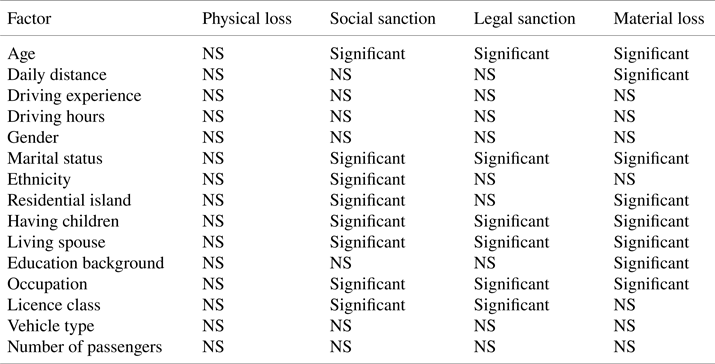
In order to investigate the effects of demographic variables on the perception towards different sanction mechanisms, a series of analyses was performed in accordance with the nature of the demographic variables. The summary of the findings is shown in Table 2. First, for the perception towards physical loss, the continuous variables of age, daily distance, driving experience, and driving hours were not significant. All other demographic variables also did not influence the perception towards physical loss.
Summary of findings

Note: NS indicates non-significant effect.
Regarding the perceived social sanction, the regression model was significant, F(4, 211) = 6⋅31, P < 0⋅001. Age was found to influence significantly the perception towards social sanction, t(210) = 3⋅29, P = 0⋅001. The regression coefficient (B = 0⋅341, 95%CI [0⋅137, 0⋅546]) indicated that older drivers corresponded to the increase in the perception towards social sanction. The t-test results revealed that married (t(210) = −3⋅41, P = 0⋅001), non-Javanese (t(210) = −2⋅79, P = 0⋅006), and Sumatra (t(210) = 2⋅04, P = 0⋅043) drivers showed higher perception towards social sanction. In addition, drivers having children (t(210) = 3⋅06, P = 0⋅002) and living with spouse (t(210) = −3⋅58, P < 0⋅001) also demonstrated higher perception towards social sanction. Moreover, occupation significantly affected the perception towards social sanction, F(2, 211) = 9⋅23, P = <0⋅001. Students showed lower perception towards social sanction than working (P < 0⋅001) and retired as well as other drivers (P = 0⋅001). Class of licence also influenced the perceived social sanction, F(2, 211) = 3⋅44, P = 0⋅034. The post-hoc test revealed that drivers having only a Class A licence showed higher perception towards social sanction than drivers with more than one licence class (P = 0⋅034).
The regression model for the perception towards legal sanction was significant, F(4, 211) = 7⋅12, P < 0⋅001. The regression coefficient of age (B = 0⋅341, 95%CI [0⋅137, 0⋅546]) showed that an increase in driver's age was associated to the increase in the perception towards legal sanction. The t-test results revealed that married drivers (t(210) = −5⋅14, P < 0⋅001) as well as drivers having children (t(210) = 4⋅93, P < 0⋅001) and living with spouse (t(210) = 5⋅33, P < 0⋅001) showed higher perception towards legal sanction. The ANOVA results revealed the significant effect of occupation on the perception towards legal sanction, F(2, 211) = 16⋅50, P < 0⋅001. Students exhibited lower perception towards legal sanction than working (P < 0⋅001) and retired as well as other drivers (P < 0⋅001). The effect of licence class was also significant on the perception towards legal sanction, F(2, 211) = 3⋅99, P = 0⋅020. The post-hoc test revealed that drivers having only a Class A licence showed higher perception towards legal sanction than drivers with more than one licence class (P = 0⋅032) and Class B licence (P = 0⋅025).
Lastly, for the perception towards material loss, the regression model was also significant, F(4, 211) = 7⋅74, P < 0⋅001. Age (t(210) = 2⋅81, P = 0⋅005) and daily distance (t(210) = 2⋅95, P = 0⋅004) significantly predicted the perception towards material loss. The regression coefficient of age (B = 0⋅336, 95%CI [0⋅100, 0⋅572]) showed that an increase in driver's age was associated with increase in the perception towards material loss. In addition, increase in daily distance also corresponded to increase in the perception towards material loss, as indicated by the regression coefficient (B = 0⋅131, 95%CI [0⋅043, 0⋅219]). Furthermore, married drivers showed higher perception towards material loss, t(210) = −4⋅78, P = <0⋅001. Also, Sumatran drivers had higher perception towards material loss than Javanese drivers, t(210) = −4⋅07, P = <0⋅001. Drivers with children (t(210) = 4⋅96, P = <0⋅001) and living with spouse (t(210) = 4⋅41, P = <0⋅001) also showed higher perception towards material loss. Moreover, the effect of education was significant, F(4, 211) = 6⋅45, P < 0⋅001, where drivers with postgraduate education consistently showed higher perception towards material loss than drivers with junior high school (P = 0⋅045), senior high school (P < 0⋅001), and bachelor degree (P = 0⋅030) education background. Occupation also significantly influenced the perception towards material loss, F(4, 211) = 10⋅05, P < 0⋅001. The post-hoc test revealed that students had lower perception towards material loss than working drivers (P = <0⋅001).
4.2 Predictors of speeding behaviour
In order to investigate the predictors of speeding behaviour, two different analyses were performed. First, a series of t-test and ANOVA was performed to analyse the effects of the categorical demographic variables such as gender, marital status, occupation, and residential islands on speeding behaviour. The t-test results revealed that having children would hinder drivers from speeding as compared with those who did not have children, t(210) = −2⋅13, P = 0⋅022. Correspondingly, drivers who were married, t(210) = 2⋅41, P = 0⋅017, and lived with their spouse, t(210) = −2⋅81, P = 0⋅030, also showed lower tendency for speeding. Next, the ANOVA results showed that occupation significantly influenced speeding behaviour, F(2, 211) = 3⋅98, P = 0⋅020. The post-hoc test indicated that students tended to speed more compared with working drivers (P = 0⋅006).
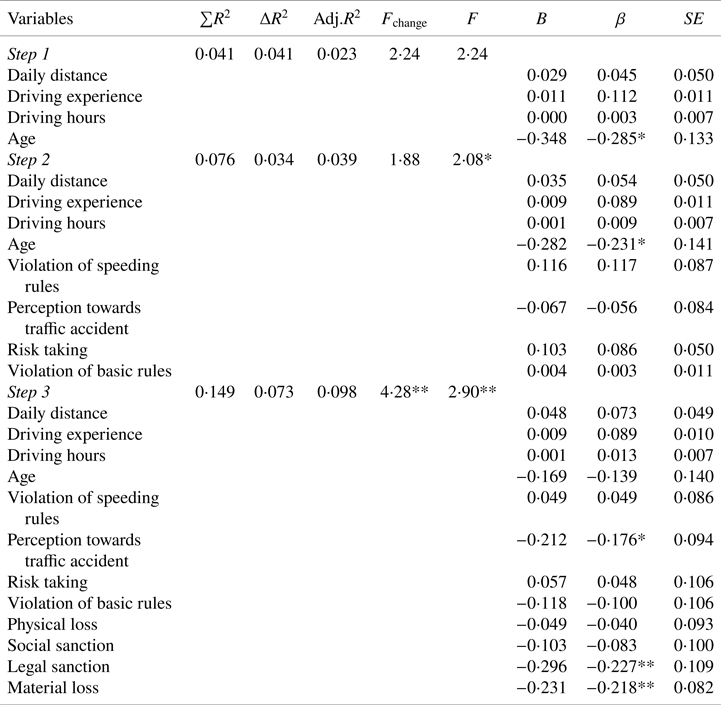
Second, a hierarchical regression analysis was performed to predict the speeding frequency of drivers. The continuous demographic variables including driver's age, driving experience (i.e., years of driving), magnitude (i.e., average driving hours in a week), and daily distance were controlled and entered in block 1. The risky driving parameters were entered in the second step while the sanction-related constructs (i.e., legal and non-legal sanctions) were entered in the last step. The results for speeding frequency are presented in Table 3.
Hierarchical regression result for speeding frequency

Note: Correlation is significant at the 0⋅01 level (**) and 0⋅05 level (*).
Model 2 was significant, F(8, 211) = 2⋅08, P = 0⋅039. As shown in Table 3, interestingly, driving hours, driving experience, and daily distance did not significantly influence the speeding frequency. However, age did affect the speeding behaviour where younger drivers were more likely to commit speeding violations (b = −0⋅285, P = 0⋅047). Model 3 was also significant, F(12, 211) = 4⋅28, P = 0⋅001. In this last step, when examining continuous driving-related demographic variables, risky driving parameters and sanction all together, several variables had significant beta coefficients. Perception towards traffic accident showed a negative relationship with higher speeding frequency (b = −0⋅176, P = 0⋅025). Furthermore, sanction-related constructs had also significant beta coefficients and accounted for an additional 7% of the variance in the frequency of speeding. Legal sanction (b = −0⋅227, P = 0⋅007) and material loss (b = −0⋅218, P = 0⋅005) were negatively related to speeding frequency. The model predicted 14⋅9% of variance in speeding frequency when also considering legal and non-legal sanctions.
5. Discussion
This study was conducted to examine the effects of driver demographics on the perception towards sanctions. When investigating the effect of demographic parameters on the deterrent mechanisms, there appeared non-significant effects of the demographic factors on driver's perception towards physical loss. In contrast, perceptions towards social sanction, legal sanction, and fine system (i.e., material loss) were found to be influenced by drivers’ demographic factors. Particularly, older drivers were found to be more concerned about social and legal sanctions as well as material loss. This finding could explain the growing body of literature in the road safety field (Hatfield and Job, Reference Hatfield and Job2006; Hatfield and Fernandes, Reference Hatfield and Fernandes2009; Møller and Haustein, Reference Møller and Haustein2014; Chevalier et al., Reference Chevalier, Coxon, Rogers, Chevalier, Wall, Brown, Clarke, Ivers and Keay2017; Breen et al., Reference Breen, Næss, Hansen, Gaarder and Stray-Pedersen2020; Cull et al., Reference Cull, Porter, Nakagawa, Smith, Rapoport, Marshall, Bédard, Tuokko, Vrkljan and Naglie2020) reporting that younger drivers tend to commit speeding and driving violations more than older drivers, due to their different perceptions towards the deterrent mechanisms. Furthermore, married drivers who live with their spouse and have children also showed higher perception towards social and legal sanctions as well as material loss compared with their single counterparts. This also applies to working drivers. This might be explained by the overall higher risk aversion in married persons (Eisenhauer and Ventura, Reference Eisenhauer and Ventura2003; Eckel and Grossman, Reference Eckel and Grossman2008). The findings of this study complement what was lacking in the prior studies about the underlying reasons for speeding tendency in younger drivers and drivers with fewer responsibilities.
Moreover, daily distance also influenced the perception towards material loss, where drivers with high daily distance were more concerned about material loss. Interestingly, ethnicity and residential island were associated with social sanction. This is particularly true in that both variables were context-dependent and would vary in different locations. Education background also affected the perception towards material loss, where drivers with higher education background tend to be more concerned about material loss as the deterrent mechanism. Also, drivers with Class A licence (i.e., for car only) exhibited greater perception towards social and legal sanctions. This might be explained by the fact that in Indonesia, drivers who can both drive a car and ride a motorbike are typically more young and physically active than car-only drivers. This would drive their lower perception towards the sanction mechanisms. This study expanded the findings of prior studies about drivers’ perceptions towards sanctions that were limited to the variables of age (Bates and Anderson, Reference Bates and Anderson2019) and location (Bates et al., Reference Bates, Anderson, Rodwell and Blais2020).
Next, the demographic continuous parameters were investigated together with the risky driving and sanction constructs to identify the predictors of speeding behaviour as indicated by speeding frequency. The hierarchical regression result revealed that age contributed significantly to speeding behaviour in step two. Younger drivers were more prone to speeding, confirming the prior studies (Chevalier et al., Reference Chevalier, Coxon, Rogers, Chevalier, Wall, Brown, Clarke, Ivers and Keay2017; Breen et al., Reference Breen, Næss, Hansen, Gaarder and Stray-Pedersen2020; Cull et al., Reference Cull, Porter, Nakagawa, Smith, Rapoport, Marshall, Bédard, Tuokko, Vrkljan and Naglie2020) in driving context. In the third step, perception towards traffic accident, legal sanction, and material loss were the main predictors. The laxer perception towards traffic accident triggered higher speeding frequency. When drivers are not afraid of harming others, they tend to deliberately deviate from the speed limit (Atombo et al., Reference Atombo, Wu, Zhong and Zhang2016). In addition, consistent with the previous research, legal sanction was found to be an effective deterrent of speeding as indicated by the negative beta coefficient. Particularly, drivers were worried when dealing with legal authority since they perceived that speeding is a form of legal offence. This is highly linked with the concept of apprehension certainty examined in Truelove et al. (Reference Truelove, Freeman, Szogi, Kaye, Davey and Armstrong2017), that drivers generally felt apprehensive that they would get caught due to speeding. Furthermore, material loss in the form of threat of a fine also plays a role in deterring the speeding frequency. This contradicts the finding in Chen et al. (Reference Chen, Sze, Saxena, Pinjari, Bhat and Bai2020) that material loss was less effective than imposing driving offence points. However, we did not include driving offence points in this investigation since such an offence point system has not been implemented in Indonesia.
To suppress speeding behaviour, sanctions in the form of legal sanctions and material loss should be well instigated. Interestingly, physical loss and social sanction does not seem to increase adherence to speed limits. This finding was also similar to that in Truelove et al. (Reference Truelove, Freeman, Szogi, Kaye, Davey and Armstrong2017). However, the present study extended Truelove et al.'s (Reference Truelove, Freeman, Szogi, Kaye, Davey and Armstrong2017) study in the examination of demographic effects on drivers’ perceptions towards legal sanction and material loss. Predominantly, age, marital status, having children, living with spouse, and occupation were found to be significant factors affecting perceptions towards legal sanction and material loss. Licence class also influenced the perception towards legal sanction, and residential location as well as education background affected the perception towards material loss.
6. Conclusion
This is the first study that has assessed the effects of demographic variables on the perceived deterrent mechanisms including physical loss, social sanction, legal sanction, and material loss. The demographic factors did not significantly influence the perception towards physical loss, while age, marital status, children, living with spouse, and occupation were found to be significant predictors of the perception towards social and legal sanctions as well as material loss. This study also highlighted that age and perceptions towards traffic accident, legal sanction, and material loss were the predictors of speeding behaviour.
Collectively, the results of this study offer several implications. First, the non-significance of perceptions towards physical loss and social sanction implied that promoting safety awareness may not be an effective means to deter violations. Second, governments should overcome speeding by implementing campaigns of awareness of legal sanctions and likely material loss for those who commit speeding violations and those having lax perceptions towards traffic accidents. The speeding prevention programme in the form of legal sanctions, such as prison sentences, should be strictly enforced to provide a deterrent effect through certainty of apprehension. Next, what remains evident is that the threat of material loss in the form of a fine could have a noteworthy effect in preventing speeding and risky driving. Third, the reinforcement of legal sanctions and the campaign about material loss (when caught speeding and/or involved in an accident) should consider demographic parameters such that these actions should be first targeted at young and single drivers. Other actions could also be tailored depending upon the demographic effects examined in this study to enhance road and traffic safety.
Funding statement.
The research was supported by the research grant of Indonesian Research Collaboration 2020 from the Directorate of Research, Universitas Gadjah Mada, Indonesia, grant reference 811/UN1/DITLIT/DIT-LIT/PT/2020.
A. Appendix
The Survey: Risky Driving Attitudes (adopted from Çelik and Yilmaz, Reference Çelik and Yilmaz2006)
Violation of Speeding Rules
Driving at 100 km/h on straight roads is permitted if there are no other vehicles within a 1⋅5 km radius.
Drivers who feel they can drive safely are allowed to drive over the speed limit.
There is no problem driving over the speed limit, if the conditions are right.
Driving 5 or 10 km over the speed limit is an acceptable action because everyone is doing it.
Perception towards Traffic Accident
I am afraid of injuring someone with the car I drive.
I couldn't go on with my life as if nothing had happened if I injured someone with the vehicle I drive.
I hope nobody gets injured if I get involved in an accident while driving.
Risk Taking
If a person has good driving skills, it is okay for them to drive over the speed limit.
Drivers have a need to be excited and have fun while driving.
Driving after drinking alcohol is not as risky as might be expected.
Violation of Basic Rules
Sometimes we need to bend the rules to keep traffic moving.
Sometimes it is necessary to ignore traffic rules violations.
It is more important to keep the traffic flow smooth than to always follow the traffic rules.
Sometimes it is necessary to bend the traffic rules in order to get to the destination on time.
It is better to drive smoothly than always following traffic rules.