Introduction
In recent years, there has been a renewed interest in the Mongol conversion to Islam in the Chinggisid uluses during the 13th and the 14th centuries.Footnote 2 This issue is of special importance, as it provides a relatively rare case in Islamic history in which the rulers adopted their subjects' religion and not vice versa.Footnote 3 Regarding the situation in the Ilkhanate, Charles Melville has already suggested that the conversion of the Mongol army started years before the official conversion of the royal family, thus preparing the ground for the conversion of Ghazan Khan (r. 1295–1304) just before his enthronement in June-July 1295.Footnote 4 The decision to convert brought political gains in the war against other contenders to the throne.Footnote 5 However, until today the question of the conversion of the mid- and lower levels of the Mongol military society in Iran has still not been tackled systematically enough, especially with regard to the initial stages of the Mongol presence in the conquered areas. Therefore, it is important that we follow the example of Judith Pfeiffer in clarifying the mechanisms of the conversion to Islam among the Mongol military elite in the decades preceding the 1290s in order to gain a better understanding of the changes the Mongols were exposed to during the formative years of the Ilkhanate and even earlier, since the beginning of their presence in the area of Greater Iran (1220s-1230s).Footnote 6
This paper deals exclusively with this early period and particularly with the question of the Islamic influences on the Mongol commanders in Khurasan.Footnote 7 Focusing on one elite family in the administration, namely that of Arghun Aqa (d. 1275),Footnote 8 it aims to gather the accessible textual, archaeological, epigraphical and numismatic remnants of the period for an investigation in the “prehistory” of the “official” Mongol royal conversion and the early stages of that process. Although many pieces of the puzzle are still missing, this will hopefully provide a better understanding of early Mongol conversion to Islam. Aghun Aqa, the OyiradFootnote 9 who became governor of Khurasan and at the peak of his career (1240s-1250s) the baskak Footnote 10 of the whole Iran, was one of the most influential Mongol administrators of the Western realms of the Mongol Empire in the 13th century.Footnote 11 In the following, he and his family will be presented, providing the necessary framework for the following discussion on their relations with Islam.
The Oyirads in Iran: a historical survey
Arghun Aqa appears in the historical sources first in the 1220s, when he entered the keshig Footnote 12 of Ögedei (r. 1229–1241) as a bitikchi. Footnote 13 There are contradictory notes on his childhood and origin,Footnote 14 but it is clear that after entering the keshig he advanced quickly, partly due to his mastering of the Uyghur script.Footnote 15 Arghun Aqa was firstly sent to areas within Greater Iran, he was known in Ögedei's time as a nöker (companion) of Körgüz, a Mongol governor of Khurasan.Footnote 16 Following the deposal of Körgüz in the early 1240s, he was himself appointed by Töregene Khatun (r. 1241–1246), a widow of Ögedei, as governor of the Western areas, with the title ulugh manqul ulus bek (Governor of the Empire of Great Mongols).Footnote 17 Mentioned in the table of Ögedei Khan's amirs,Footnote 18 Arghun Aqa succeeded in preserving his high standing for a long period of time and served under two Great Khans, Güyüg (r. 1246–1248) and Möngke (r. 1251–1259), continuing his services under Hülegü (r. 1256–1265) and Abaqa (r. 1265–1282), until his death in 1275.Footnote 19 During his lifetime, Arghun Aqa was repeatedly accused of misuse of his authority, in particular with regard to tax levying in the Khurasan and Caucasus areas. These accusations forced him to appear before the Great Khans several times.Footnote 20 Despite this, he succeeded not only in preserving his position, but also in laying the foundation for his descendants’ high social standing. At some point during Abaqa Khan's rule, Arghun Aqa also took part in military campaigns against the Golden Horde and the Chaghadaid Khanate.Footnote 21
Although Arghun Aqa himself was probably not a güregen,Footnote 22 his sons’ and daughters’ matrimonial connections with members of the Ilkhanid ruling house were numerous.Footnote 23 His best-known son Nawrūz, who was a devoted Muslim,Footnote 24 played a crucial role in the conversion of Ghazan to Islam.Footnote 25 Nawrūz was apparently one of the most powerful Muslim converts close to Ghazan, who, in his attempts to secure the throne, needed Nawrūz and his Muslim supporters.Footnote 26 In autumn 1295, before setting out to his winter quarters, Ghazan, “realizing how much he owed Nawrūz for the favours and deeds he had performed, [. . .] issued a decree awarding Nawrūz the unconditional emirate and vizierate of all lands and peoples from the Oxus to Syria, and from the banks of the eastern sea to the farthest end of the western sea”.Footnote 27 However, less than a year later, in March 1297, Nawrūz and parts of his family and supporters were executed.Footnote 28 Based on the accusation that Nawrūz had cooperated with the Mamluk Sultan, these events were linked, as far as one can judge, to Nawrūz's status and the factional wars between different power groups.Footnote 29
The damage for Arghun Aqa's family was systematic and aimed at its eradication from the Ilkhanate's political scene.Footnote 30 However, the clan, since the times of Arghun Aqa tightly connected with Khurasan, remained rooted in the area. Thus, Qāshānī reports that in 1306 Oyiratai Ghazan, son of Arghun Aqa, came from Khurasan to the court in order to confirm his governing powers in the area.Footnote 31 Partly, the preservation of the clan's position in Khurasan can be connected with the fact that two of the twelve wives of Öljeitü Khan, BujughanFootnote 32 and Bulughan Khatun KhurasaniFootnote 33, were descendants of Arghun Aqa.Footnote 34 Besides this, the descendants of Arghun Aqa, Arghun Shah, son of Oyiratai Ghazan, and the two sons of the latter, Muḥammad “Qushji” Bek and ‘Alī Bek continued to govern Ṭus and Meshhed in the decades which followed the collapse of the Ilkhanate, until the conquests of Temür.Footnote 35 The group which they governed appears in the Persian sources as the Jāʾūnī Qurbān.Footnote 36 Their origins are still a matter of controversy, but at least the ruling family can be traced back to the Oyirad presence in the area since the 1240s. Moreover, the group appears in the chronicles exactly when the Oyirads of Khurasan disappear.Footnote 37 This suggests a great amount of continuity in the presence of Arghun Aqa's family in Khurasan over more than a hundred years.Footnote 38
The remark of Kirakos
The trigger for this paper was a curious remark concerning Arghun Aqa made by Kirakos Gandzakets'i (1200-1271), the renowned Armenian historian, in the 63rd chapter of his “Patmut'yun Hayots” (History of the Armenians). There, describing the execution of the Armenian prince Ḥasan Jalal-DawlaFootnote 39 of the KhachenFootnote 40 province by Arghun Aqa in Qazvin in 1261,Footnote 41 Kirakos writes:
“The pious and virtuous prince Jalal was molested by impossible tortures, as [Muslim tax enforcers] demanded more taxes from him than he could pay. They put wood on his neck and irons on his feet. They dealt with him in this manner because of his strong Christianity, for all the Muslims were inimical to him and urged Arghun Aqa to kill him, saying: “He more [than others] is hostile to our religion and laws.” For Arghun Aqa also was Muslim [bold mine, I.L.] [. . .] When the impious ostikan [the governor, i.e. Arghun Aqa] learnt [of the attempts to contact Dokuz Khatun, favourite wife of Hulegu, for clemency – I.L.], he immediately sent executioners and had the blessed and just man killed during the night.” Footnote 42
Kirakos's evidence seems clear and is of great importance in the light of the Islamic beliefs of his son Nawrūz and the latter's importance on the one hand, and as a sign of the latent islamisation process among the Mongols in the mid-13th century on the other. However, can we trust Kirakos's report? Firstly, this remark is not corroborated by any other source that I know of, Armenian or other.Footnote 43 Secondly, it is known that the Armenians had a mainly positive image of the Mongols before the conversion of the latter to Islam.Footnote 44 However, the work of Kirakos, which was described by John A. Boyle as the most important of the Armenian historical sources on the Mongol conquest,Footnote 45 is structured around very strong anti-Mongol resentments.Footnote 46 The historian reacted very negatively, among other things, to the harsh fiscal policies of the new authorities, which were imposed on Armenia and Georgia starting with the expansion of Mongol rule westwards, and which were to a great extent implemented by Arghun Aqa and his officials since the mid-1250s.Footnote 47 Certainly, Kirakos was not objective. However, one cannot simply ignore the remark cited above, in particular since Kirakos was a contemporary witness, but also because of his otherwise trustworthy accounts.Footnote 48 Some historians, among them M. Hope, apparently trust the report of Kirakos.Footnote 49 However, it seems that only after investigating the Islamic background of Arghun Aqa can the issue of the Islamic beliefs of Nawrūz be dealt with more clearly.
Searching for Arghun Aqa: physical traces
Let us start with Arghun Aqa himself. Despite the abundant data which can be found about the activities of Arghun Aqa as a fiscal official and a governor, there are almost no material indications of his presence in Greater Iran. This fact is even more surprising taking into account his status and his and his family's long standing influence in the area. As far as I am aware, no yarliq, tamga or decree signed or issued by Arghun Aqa has been discovered until now. The chronicle of ‘Aṭā Malik al-Juvaynī, an employee and big admirer of Arghun Aqa, includes information regarding Ṭus and other cities of Khurasan being rebuilt by orders of the governor, including some particular locations, such as the palace Manṣuriyya and the forts of Ṭus. Yet none of these places can be pinpointed to any contemporary remnant and no inscription including the name of Arghun Aqa has been preserved in Khurasan.Footnote 50
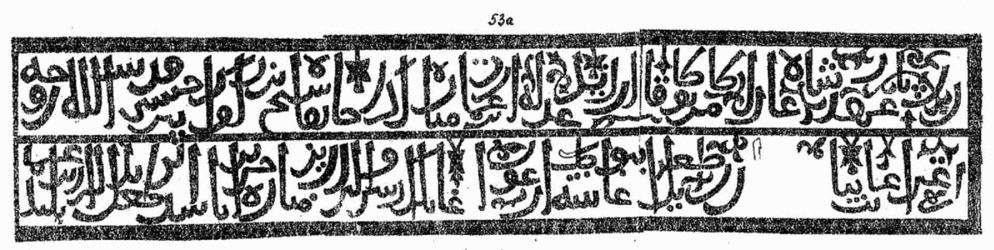
Interestingly enough, the only physical trace of Arghun Aqa's existence has been preserved far from his estate areas, in the village Gubalibaloglan in the Hajigabul district of Azerbaijan, located on the left bank of the Pirsagaat river, 127 km. southwest of today's Baku. A khanqah and a mausoleum of Sheikh Pīr Ḥussayn al-Ghada’īrī, otherwise known as Shirvanan, are situated in that area. Pīr Ḥussayn was a disciple of Shaykh Abū Sa‘īd al-Mayhanī (d. 1049) and a relative of Shaykh Abū ʿAbd Allāh Muḥammad Bākāya Shīrāzi, otherwise known as Bābā Kūhī, the Sufi poet and philosopher of the 11th century.Footnote 51 The complex in its present form appeared apparently in the mid-13th century, despite the fact that Pīr Ḥussayn died in 1071.Footnote 52 Located on the politically important trade route between Shamokhi, the capital of Shirvanshahs,Footnote 53 and Iran, the khanqah was very rich.Footnote 54 According to Waṣṣāf, when Khan Uzbeq visited it in 1318, the possessions of the khanqah included about 30,000 sheep and 20,000 cows and donkeys.Footnote 55 What is of special interest for us, however, is the minaret on the territory of the khanqah. Its construction was started around Muḥarram 654 ah (January 1256 ad), as follows from one of the inscriptions.Footnote 56 Another inscription on the minaret (Ill. I) says:
“(a) In the days of the just Padishah Mengku Buqa Qa'an – let Allah expand his justice – this minaret, which is situated at the khanqah of the respected Shaykh Pir Hussayn – let Allah to sanctify his soul –
(b) was erected with God's help due to the constant support and maintenance of Arghun Aqa, ruler in the steppe and on the land. (If) this minaret will become damaged, reconstruct it from this source.” Footnote 57
Taken from Neymat, Korpus (Baku, 1991), plate 53a (transcription of the inscription).

While establishing a khanqah does not mean that Arghun Aqa was a Muslim,Footnote 58 it suggests that he was at least “attentive”, as a Mongol governor, to the issue of Islamic legitimacy in the areas under his responsibility.Footnote 59 The use of “Möngke Buqa [bold mine – I. L.] Qa'an” is also not clear. However, the appearance of the name of Arghun Aqa in the same inscription as well as the indication of the construction date found on the other inscriptions on the same building seem to confirm the time of the establishment of the minaret in the mid-1250s and the identification of “Mengku Buqa Qa'an” as “Möngke Qa'an” (1251-1259).Footnote 60
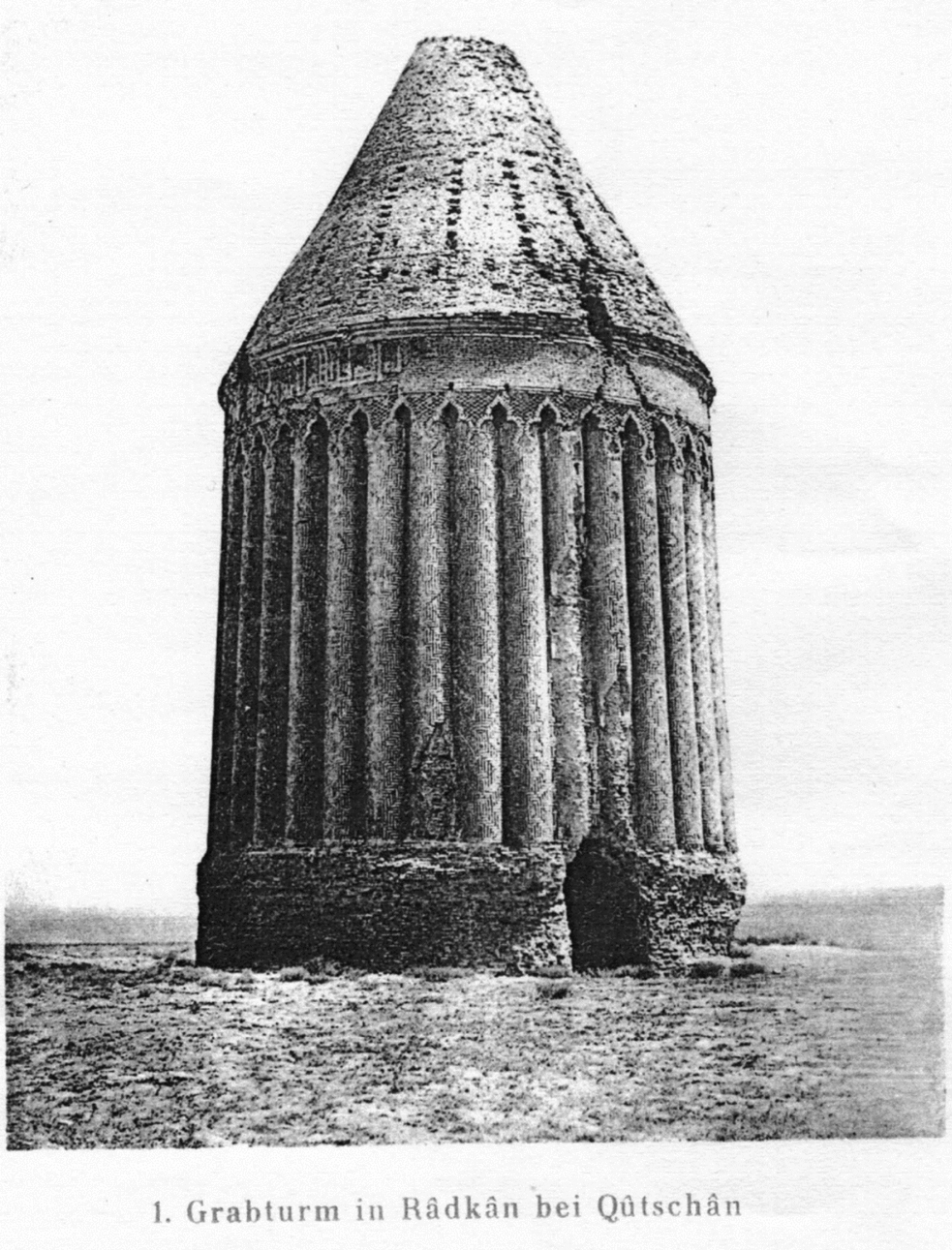
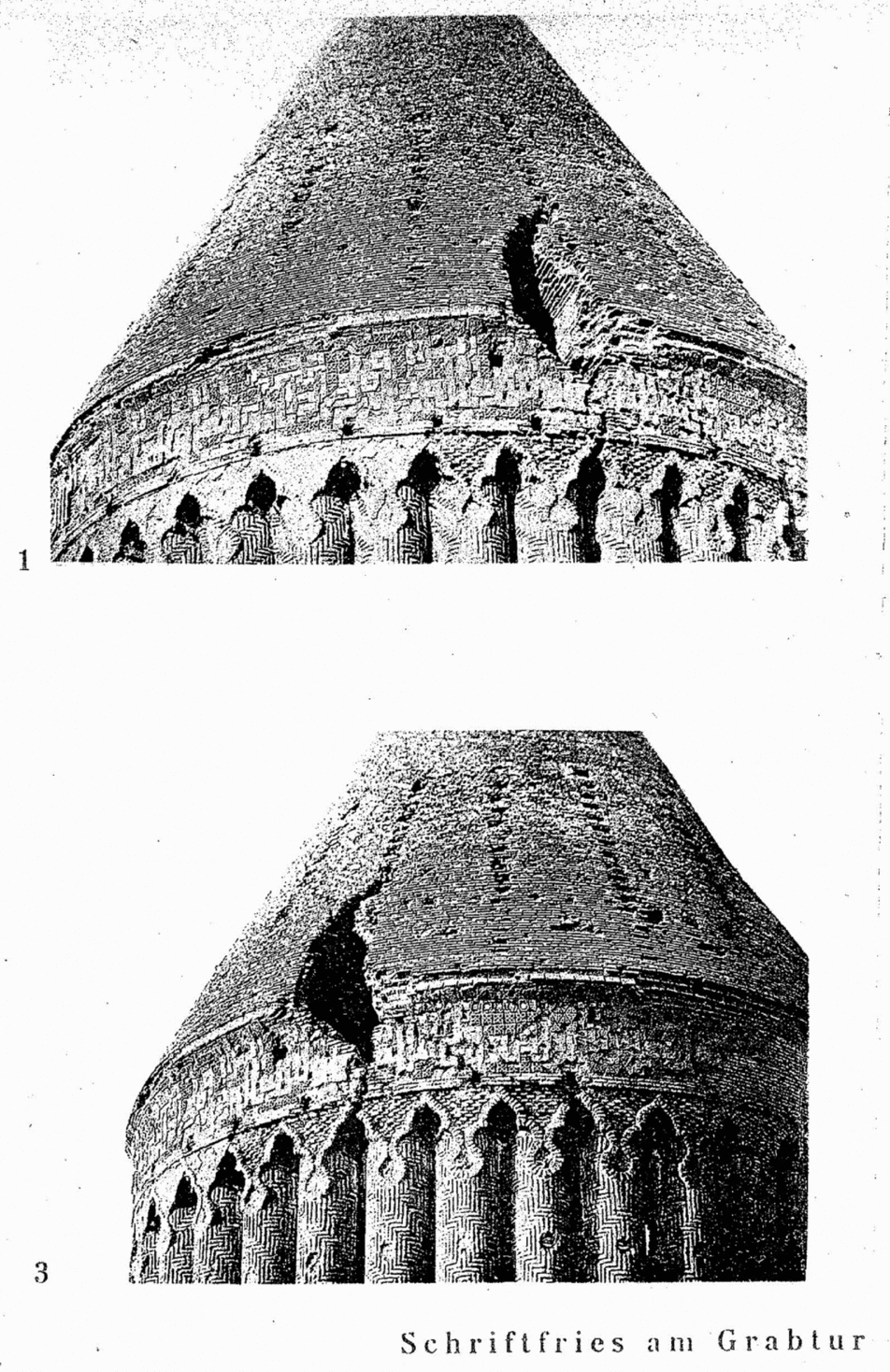
Whatever the reasons behind the support Arghun Aqa granted to the khanqah of Pīr Ḥuṣṣayn, the evidence for this connection is solid. This is, however, not the case with the so-called Mīl-i Radkān, which is locally identified as Arghun Aqa's grave (Ill. II). Indeed, Arghun Aqa passed away in the area of Radkān,Footnote 61 the famous meadow close to Ṭus.Footnote 62 The tower is a 21.8 m. high round building with a conic roof, located 20 km. to the southeast of the village. Below the roof, a Persian inscription to which the date is added in Arabic surrounds the whole structure, which appears to be a tomb tower (Ill. III).Footnote 63 Despite the fact that folk traditions connect the tower to Arghun Aqa,Footnote 64 this link cannot be confirmed, as the inscription is barely readable.Footnote 65 The date section is destroyed, leaving the words fī sana and sitta mi'a only, which leaves room for speculation concerning the date of its creation.Footnote 66 From the building style, however, van Berchem concluded that it could be from the period of Arghun Aqa's death, especially since the known tomb of the latter's daughter Emine Khatun (?)Footnote 67 in Taz-e Shahr,Footnote 68 close to Tabriz, from the early 14th century (70[?] ah, after 1300 ad) is of a similar form.Footnote 69 Not much is known about this daughter,Footnote 70 but the inscription cited by van Berchem includes citations from the Qur'an (55:26), clearly stressing the Islamic beliefs of the buried one.Footnote 71
Diez, Churasanische Baudenkmäler (Berlin, 1918), n. pag, plate 6.

Diez, Churasanische Baudenkmäler (Berlin, 1918), n. pag, plate 7.

Personal networks of Arghun Aqa and his clan
The previous chapter has discussed the material artefacts accessible to us. Textual evidence suggests that Arghun Aqa held close connections with Muslim elites both in his administration and among his personal friends, which functioned as patronage networks. Being the highest administrative representative of the Mongol court in the time of the United Empire (1206-1259) in the area of Greater Iran, Arghun Aqa for understandable reasons was involved in permanent working relations with the Muslim bureaucrats from the very beginning of his stay in Khurasan. However, of special interest is his inner circle of supporters, which consisted mainly of Persians. Two examples are particularly relevant. The first is the famous al-Juvaynī family, of Khurasanian origin, with a long tradition in the administrative service.Footnote 72 The close circle of Arghun Aqa included three men of this clan. The first one was Bahā’ al-Dīn al-Juvaynī (d. 1253), an ex-administrator of Jalal al-Dīn (1220-1231), who was appointed to the position of ṣaḥib-e divān of Khurasan around 1232–33 by the Mongol governor of Iran Chin Temür. He served in Khurasan until his death and was important for Arghun Aqa in the first years of the latter's time in Khurasan, and even served as his deputy during his absence due to the quriltai of Güyüg Khan in 1246.Footnote 73 The two others were the sons of Bahā’ al-Dīn, ‘Ala al-Dīn ‘Aṭā Malik al-Juvaynī, the well-known historian, and his older brother Shams al-Dīn Muḥammad. Both brothers served under the direct command of Arghun Aqa at least until the end of the 1250s. Later, under the patronage of Arghun Aqa, they were promoted to serve outside Khurasan. ‘Aṭā Malik started his career in 1243 in the camp of Arghun Aqa just after the latter's arrival in Khurasan and was highly dependent upon his master for promotion. He first became his secretary and was then appointed by him to help Hülegü in the administration of Khurasan, Persian Iraq and Mazandaran together with Arghun Aqa's son Gerei Malik and Amir Aḥmad Bitikchi in 1256.Footnote 74 His brother, Shams al-Dīn Muḥammad, served as ṣaḥib-e divān of the early Ilkhanate and was appointed vizier by Hülegü Khan in 1262.Footnote 75 Both brothers lost the support of the throne (Shams al-Dīn even his life) in the early 1280s, notably already after the death of Arghun Aqa in 1275, due to the accusation of collaboration with the Mamluk Sultanate (as Nawrūz in 1297).Footnote 76 Relevant in this context, however, are the early tight relations between Arghun Aqa and the Juvaynī family, as follows both from the text of Juvaynī himself and Arghun Aqa's permanent patronage of the two brothers.Footnote 77
Aside from the al-Juvaynī family we are also aware of a close friend of Arghun Aqa called Khwāja Fakhr al-Dīn Bihishtī (d. 1256).Footnote 78 Born in Khwarazm, he entered the service of Arghun Aqa in the mid-1240s as a secretary and was appointed ulugh-bitikchi (chief of the scribes) by Güyüg Khan sometime later.Footnote 79 He was also part of the inner circle of Arghun Aqa's trustees, accompanying Arghun Aqa in the latter's journey to Qaraqorum in 1247, together with Bahā’ al-Dīn al-Juvaynī. Fakhr al-Dīn also accompanied Arghun Aqa to the great quriltai of Möngke Khan in 1251,Footnote 80 and, according to Tārīkh-e Jahān Gushāy, a close friendship developed between him and Arghun Aqa.Footnote 81 Certainly, friendship and close relations do not necessarily entail the religious influence of one side on the other, but the very fact that the sources do inform us about these non-Mongol friends of Arghun Aqa seems to stress the importance of the Islamic surroundings in his personal life.Footnote 82
Aside from the use of the patronage networks, as seen in the case of al-Juvaynī’s family, the clan of Arghun Aqa successfully connected itself with some of the most notable regional elites of Khurasan, thus strengthening its position in the area. These connections were established through matrimonial relations from the first years of Arghun Aqa's presence in Khurasan and were of clearly political importance, enhancing the status of both the family of Arghun Aqa and the local clans. Thus, as early as 1252 attempts to establish marriage relations with the family of Arghun Aqa were started by Qutb al-Dīn Muḥammad, the then ruler of Kerman of the Islamic Qutlugh-Khanid dynasty.Footnote 83 Qutb al-Dīn hoped to marry the daughter of Arghun Aqa, Begi Khatun (Ilkuye Biji, according to Munish), using his “old friendship and camaraderie of long duration”.Footnote 84 However, different issues prevented him from realising his marriage plans before his death. A few years later his wife and successor Qutlugh Terkan (r.1257-1283) made another attempt to connect her family with that of Arghun Aqa, this time directly asking Hülegü Khan to permit the marriage between her son Muẓaffar al-Dīn Hajāj and Begi Khatun. Following the agreement of both Hülegü Khan and Arghun Aqa, the marriage took place in 1263/64.Footnote 85
In addition to its connections with the rulers of Kerman, the family of Arghun Aqa was also connected to the Atabegs of Yazd through Nawrūz. Indeed, Nawrūz not only married Toghan Khatun (d. 1291), the fourth daughter of Abaqa Khan, but also Sulṭan Nasab Khatun, a daughter of Atabeg ‘Ala al-Dīn wa al-Dawla (1272–1275), son of Maḥmūd Shah, the Atabeg of Yazd (1228–1242). The date of the marriage is not clear, but it probably took place no later than the death of Arghun Aqa in 1275. Nawrūz had a son with the Yazdid princess, named Sulṭan Shāh, to whom Baidu assigned the emirate of Yazd as a favour to Nawrūz in 1295.Footnote 86 Taking into account that the rulers of Yazd and Kerman were also matrimonially connected (Maḥmud Shāh of Yazd married a cousin of Qutb al-Dīn Muḥammad and his son, ‘Ala al-Dīn, married an unnamed granddaughter of Buraq Hājib, the cousin of Hajāj Sultan), the Islamic nets around the family of Arghun Aqa seem to have been very tight.Footnote 87 Yet an additional connection of the family to the Iranian ruling elites was the marriage of the niece of Nawrūz, daughter of his brother Terghan Hajji, to Fakhr al-Dīn, b. Rukn al-Dīn of Kart (1295-1307), grandson of Shams al-Dīn Kart (1245–1277), founder of the Kartid dynasty of Herat.Footnote 88 Fakhr al-Dīn is claimed to have been a good friend of Nawrūz, who even granted him brief asylum in Herat in 1297, the year of the collapse of Arghun Aqa's family at the Ilkhanid court, even though he then had to submit to the orders of Ghazan Khan and deliver his associate to the hands of Ghazan's commanders.Footnote 89 Altogether, the intensity of the matrimonial networks which connected the family of Arghun Aqa with the Islamic dynasties in Iran during the second half of the 13th century was strong, all these networks seem to have been established relatively early in the Ilkhanide history.Footnote 90 This should also be taken into consideration when evaluating the Islamic influences on the governor and his descendants.
The family of Arghun Aqa
In the following I would like to concentrate more on Arghun Aqa's family. It should be kept in mind that Nawrūz, as most if not all of his brothers and sisters, was probably already born and grew up in Iran,Footnote 91 which makes the question of the Islamic environment of Khurasan and its influence on the clan even more important. We know very little about the wives of Arghun Aqa, but know for sure he had more than one.Footnote 92 In 1249 he married a daughter of the commander of the court of Yesü Möngke, a son of Chaghadai, but nothing more is known about her.Footnote 93 Until the mid-1290s only one of his wives seems to have survived, that is, Sürmish, Nawrūz's mother.Footnote 94 Not much is known about her, and in general, no information was preserved about her or the other wives’ religious affiliations. As to what concerns the direct descendants of Arghun Aqa, there is slightly more information. He left at least fourteen sons, two daughters and quite a few grandchildren. While the names of the latter are mostly not known, one can find almost all the names of Arghun Aqa's sons.Footnote 95 The eight sons of Arghun Aqa mentioned by Rashīd al-Dīn in the Oyirad chapter of the Jami al-Tawarikh are: Gerei MalikFootnote 96, Tatarji, Nawrūz, Lagzi, Hajjī,Footnote 97 Yol Qutluq,Footnote 98 Bulquq, and Oyratai.Footnote 99 At the end of the compendium he adds three more, Yaratai [Erdai] Ghazan,Footnote 100 Narin HajjīFootnote 101 and Arghun Hajjī,Footnote 102 while Waṣṣāf adds two more, Menkli BoqaFootnote 103 and Terghan Hajjī,Footnote 104 and Shuab-i Pangāne yet another one, Barghun Hajjī.Footnote 105 It is worth stressing that more than half of the names given above have “Hajjī”Footnote 106 as an addition or substitute to the name itself. Keeping in mind the findings of Bulliet,Footnote 107 this fact can be seen as a possible indication of the Islamic beliefs of the bearers of the names. However, this cannot be certain, as the transmitters, scribes or other unknown sources could have added the additions to the names on their own initiative.Footnote 108 Therefore, whereas the assumption concerning the Islamic beliefs of some of the sons of Arghun Aqa seems plausible, it still does not help us to judge the plausibility of Kirakos's remark mentioned above.
Islamic connections
Even though from all the data brought up about the conversion of Arghun Aqa himself it cannot be confirmed for sure. He and his family seem to have been tightly connected with the Islamic environment of Greater Khurasan but when did the process of the conversion of the clan start, and how? In order to try to answer this question, the Islamic beliefs of Nawrūz are of crucial importance, as they could shed even more light on the circumstances in which his family lived in Khurasan in the first, less documented, decades of Arghun Aqa's rule in Iran.
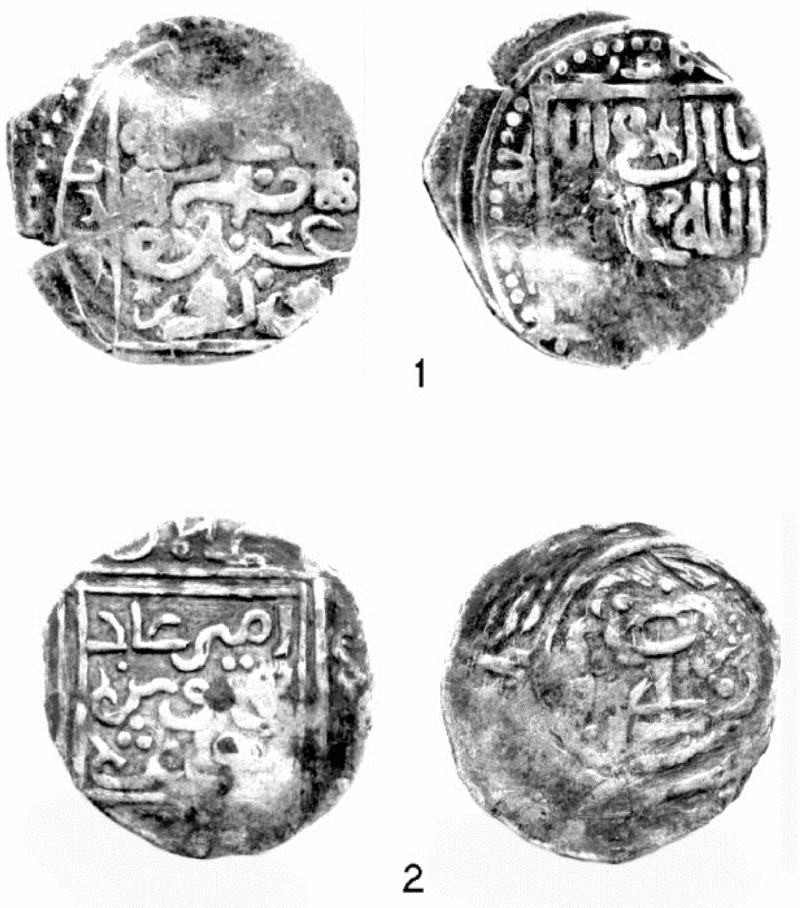
In general, most of the information which we possess about Nawrūz deals with the years of and immediately before Ghazan's enthronement in 1295. Therefore, for example, we do not have any information about his personal conversion to Islam or even about the year of his birth. Yet it seems that he converted long before the events of the 1290s.Footnote 109 As the rather unique coins from Afghanistan, published by Petrov and Aleksandrov in 2011, reveal, Nawrūz used Islamic rhetoric already in the very early 1290s (Ill. IV).Footnote 110 Then, during the years of his rebellion against the Ilkhanid rulers and support of Qaidu (the Ögedeid prince, r. 1271–1301),Footnote 111 he apparently became governor of Badakhshan for a very short period (around 692 ah/1291 ad).Footnote 112
Petrov and Aleksandrov, “Chaghadaid Dirhems with the Name of Amir Nawruz, minted in Badachshan,” Numismatika 1 (2011), pp. 8–9.

Both coins, which appeared on the market a few years ago, include several interesting elements, which represent the complex nature of the ideological message promoted by Nawrūz while minting these coins. The first coin has no clearly recognisable year.Footnote 113 Not all details of the coin can be read, but its face side clearly includes the tamgha Footnote 114 of Duwa Khan ( ), around which the words “sakka Badakhshān” (minted in Badakhshān) are written.Footnote 115 The opposite side of the coin includes such clearly Islamic elements as the names of the four righteous califs (al-Khulafa’ al-Rāshiddūn) in four segments along the edge, of which only those of ʽUthmān (above) and ʽUmar (to the right) can be seen and the other two are cut off. On the same side the words “amīr ‘ādil Nawrūz” (the just amir Nawrūz) can be found as well. The second coin is of unclear mint, but the year seems to be [69]3 ah (1293 ad).Footnote 116 Also on this coin not everything can be read. The face side of the coin includes the personal tamgha of Qaidu (
 )Footnote 117 as well as the word “Allah” above it and, probably connected to it, the words “abduhū Nawrūz” (His [Allah's?] slave Nawrūz) under it. Similar to the first coin the face side of the second had a four-segmented pattern along the edge (also probably including the names of the Rashiddūn), but none of the names have been preserved. Furthermore, some parts of the kalima, the testament of the faith, can be seen on the opposite side.Footnote 118
Taking into consideration all said above, it seems that in the way these coins combine both Chinggisid and Islamic symbolism they clearly represent the transitional phase in which Nawrūz found himself in the early 1290s. On the one hand, the coins use the tamghas of the ruling Chinggisid houses, on the other the Chinggisid message is strongly intermingled with Islamic paraphernalia. Thus, the usage of the kalima and the references to the four righteous caliphs are intended to stress the Islamic identity of the ruler, most probably used in order to gain support among the mainly Islamic population of Badakhshān.Footnote 119 However, serving as an interesting testimony for the Islamic beliefs of Nawrūz in the late 1280s-1290s, the coins do not answer the question about the origins of his faith. It was shown above that the family of Arghun Aqa has found itself in a rather dominant Islamic environment since the very beginning of its rule in Khurasan. However, one more part is missing from the puzzle which probably played a decisive role in the conversion of the clan of Arghun Aqa, namely the Sufi circles of Khurasan.Footnote 120 In general, Khurasan and the area of Ṭus in particular had been strongholds of Sufi schools of different origins for centuries already before the Mongol conquest. Being “imported” from Iraq for the first time in the late 8th - early 9th century,Footnote 121 a variety of Sufi movements existed in Khurasan in a rather marginal position until the late 10th until the early 11th centuries.Footnote 122 Starting with this period, Khurasanian Sufism went through a new stage of institutional development, with the establishment of khanqas and the expansion of its teachings to the traditional madrasas.Footnote 123 It was probably in this period that the seed of the close relationship between the local governments of Khurasan and the central powers, so typical for the Seljuk, Khwarazm and notably Mongol period, were planted.Footnote 124 This process went hand in hand with the expanding growth of the Sufi networks as well as their intellectual and religious teachings, which started more or less in the 12th century and continued into the 13th. This was also the period during which, according to Paul, the representatives of the Sufis started to get involved in local politics in the role of “intermediaries” between the local population and the governors or rulers.Footnote 125
The appearance of the followers of the Khwarazmian Sufi Najm al-Dīn Kubra (d. 1220) and their spreading all around Khwarazm and Khurasan has to be seen in the framework mentioned above.Footnote 126 During his lifetime Najm al-Dīn accepted a limited number of disciples, one of whom was the famous Saʿad al-Dīn Ḥammūya (1190/91?-1252/3?),Footnote 127 the spiritual personality behind the conversion of Ghazan.Footnote 128 Of the utmost interest is the fact that in the 13th century the main khanqah of his Sufi movement, also named after him, was located not far from Ṭus, in Saʿad al-Dīn's ancestral city of Bahrābād.Footnote 129 Spending the early years of his life in Syria, Saʿad al-Dīn returned at some point (probably around the 1230s or 1240s) to Khurasan, where he “met with a group of Mongol emirs, and more than one of them converted to Islam under his guidance”.Footnote 130 Although the names of the Mongols are not given, this remark shows a connection between Saʿad al-Dīn and the Mongols in Khurasan in the very early stages of their time there, even before the 1250s. In general, the influence of Saʿad al-Dīn and his teaching grew extensively during the Ilkhanid rule not least due to his and his son Ṣadr al-Dīn Ibrāhīm's (1246-1322) connections with the court.Footnote 131 Both Ṣadr al-Dīn and his father not only travelled extensively, but also held strong ties with Khurasan as well as probably with the area of Juvayn.Footnote 132 Interestingly, in 671 ah (1271-1272), Ṣadr al-Dīn married the daughter of ‘Aṭā Malik al-Juvaynī, even though it is unclear which political reasons and benefits lay behind this marriage.Footnote 133
The peak of the Sufi influence on the Mongol court in Iran can probably be seen in the conversion of Ghazan Khan in 1295. Important information about this event has been preserved in the personal testimony of Ṣadr al-Dīn Ibrāhīm, transmitted by ‘Alam al-Dīn al-Qāsim al-Birzālī to Shams al-Dīn Muḥammad al-Jazarī, both contemporary Mamluk historians. Charles Melville has already published an excerpt of this text in 1990.Footnote 134Although I am aware that this text has already been discussed several times in different contexts, I would still like to cite a part of it in order to highlight some of the points mentioned above. Among others, Melville cited the two following paragraphs:
“§2. Sadr al-Din said: “A number of the Mongols and of their amirs had already become Muslims before him [Ghazan – I.L.], and his vizier Nauruz was a Muslim. He knew by heart many histories and the sayings of ascetics, prayers, stories and suchlike. He was of Turkish origin (but) knew Persian, and was the husband of Ghazan's paternal aunt. Together they were agitating for the king's conversion to Islam and had talked about it among the army.
§3. There was discord between Ghazan and Baidu, at the time that I was leaving on the hajj[. . .]. I met up with Nauruz, who talked with me, and said, ‘I want (to go on) the hajj with you, regardless of whether the king permits it or not’.[. . .] Then he discussed with me Ghazan becoming a Muslim, and said, ‘He had already talked about this but I am not sure of him. . .” Footnote 135
I would like to point out a few issues which can be studied from the quotations and which strengthen, in the context of all said above, the contention that there was a connection between the Ḥammūya family and the clan of Arghun Aqa for some (probably significant) period of time before the described event. Firstly, to my understanding the text suggests that Nawrūz had been a Muslim (not clearly defined as a convert) probably for a long period of time before 1295. Besides this, one can also surmise that, while Nawrūz was known to be Hanafi, his Islamic beliefs were influenced, if not fully defined, by some sort of Sufi teaching. Indeed, the words of Ṣadr al-Dīn stressing that Nawrūz knew the sayings of ascetics further support this assumption.Footnote 136 The ties between the Ḥammūyas and Arghun Aqa's family in Khurasan seem to have been of greater importance for this case than has been assumed. The fact that Ghazan converted before leaving Khurasan, still relatively close to the centres of power both of the Ḥammūyas and the clan of Arghun Aqa, might thus have been more than a mere coincidence.Footnote 137 Additionally, we are informed that the wife of Nawrūz, Toghan Khatun, the fourth daughter of Abaqa Khan and aunt of Ghazan, was also a Muslim.Footnote 138 The source does not mention who of the two converted first or whether Toghan Khatun was brought up as a Muslim already. Of course, the lack of additional sources makes it even more difficult to clarify the situation, but taking into account all said above, it is highly probable that Nawrūz became a Muslim at least in the 1280s. Furthermore, given the geographical closeness between the main khanqah of the Hammuya and the estates of Arghun Aqa as well as their activity among the Mongols throughout the whole second half of the 13th century, one should reconsider the possible Sufi connections of Nawrūz and, on a larger scale, of his whole family with this leading Sufi network of Khurasan.Footnote 139
Conclusion
While we cannot assert Kirakos's statement that Arghun Aqa was officially a Muslim, meaning he has ever pronounced the shahāda in the presence of two witnesses, the Armenian author might have been close to the truth, although in a different way. No doubt the governor himself and his clan were closely connected to the Islamic environment of Khurasan already in the 1260s. They held close connections, often strengthened by marriage alliances, with local Muslim dynasties, Muslim administrators under Mongol rule and the Khurasani Sufi circles, notably the Kubrawīyya branch of the Hammuya family. Eventually these close and continuous contacts led to the islamisation of most of Arghun Aqa's family around the mid- to late 13th century and strengthened the inclusion of this Mongol elite clan into the local power networks of the Khurasanian elites and ruling houses long before Ghazan's conversion.
Due to the sources' limitations and their lack of interest in the islamisation of the Mongol elites prior to the Chinggisid conversion, it is not clear whether Arghun Aqa's case is a representative case of Mongol elites stationed in Muslim environment or a more exceptional one. However, it can be argued that it is exactly the conversion of this layer of the Mongol military society ‒ the middle tier connecting the Chinggisids and the rank and files ‒ that might have been crucial for the conversion of the Ilkhanate as a whole, influencing both the top and the lower levels. From this point of view, it can be even said that the conversion of Ghazan began with the arrival of Arghun Aqa in Khurasan.