INTRODUCTION
An important issue in instructed second language acquisition (SLA) research concerns the skill-specificity of practice effects (DeKeyser, Reference DeKeyser and DeKeyser2007a). The relative effectiveness of input versus output practice, or receptive versus productive practice, in L2 development has been a subject of intense debate in the field of SLA (e.g., DeKeyser, Reference DeKeyser1997, Reference DeKeyser and DeKeyser2007a; Krashen, Reference Krashen1985; Shintani, Li, & Ellis, Reference Shintani, Li and Ellis2013; Swain, Reference Swain, Susan and Madden1985; VanPatten, Reference VanPatten2002). While Krashen and VanPatten argue that input practice leads to L2 acquisition of implicit linguistic competence that can be accessed for both subsequent comprehension and production, DeKeyser, from the perspective of cognitive skill acquisition (Anderson, Reference Anderson1993), posits that L2 skills developed through input and output practice are highly specific.
While there have been a good number of empirical studies comparing the relative effectiveness of comprehension and production practice on the development of receptive and productive knowledge of L2 grammar (see Shintani et al., Reference Shintani, Li and Ellis2013, for a meta-analysis of 30 published studies between 1991 and 2010), and a good amount of comparative studies that investigated the effects of receptive and productive learning on L2 vocabulary acquisition (e.g., Griffin & Harley, Reference Griffin and Harley1996; Webb, Reference Webb2009), few L2 studies explicitly set out to investigate the skill-specificity issue from the cognitive-psychological perspective of skill acquisition, except for DeKeyser and Sokalski (Reference DeKeyser and Sokalski1996), DeKeyser (Reference DeKeyser1997), and Rodgers (Reference Rodgers2011), all on morphosyntactic structures. As for L2 speech sound learning, while some studies have investigated the effects of either auditory perceptual training or productive training on L2 speech perception and production (e.g., Bradlow, Pisoni, Yamada, & Tohkura, Reference Bradlow, Pisoni, Yamada and Tohkura1997; Leather, Reference Leather, Leather and James1990; Wang, Jongman, & Sereno, Reference Wang, Jongman and Sereno2003), they never draw on the cognitive skill acquisition literature to shed light on the issue of specificity of practice.
The present study is designed to test the skill-specificity hypothesis in a study on the learning of Mandarin tone-words by adult speakers of a nontonal language. This study focuses on L2 tone learning because most languages of the world are tonal (i.e., use pitch variations to distinguish lexical meaning) (Fromkin, Reference Fromkin2000) and L2 tone learning provides a good testing case to compare the effects of perception versus production practice, as L2 tones are not too hard to learn compared with other commonly investigated phonological contrasts, such as voice onset time (Antoniou & Wong, Reference Antoniou and Wong2016). Mandarin Chinese is a tonal language that phonemically distinguishes four tones (Chao, Reference Chao1948), with Tone 1 having a high-level pitch (marked by the diacritic “ - ” in pinyin, the standard Romanization of Mandarin Chinese), Tone 2 being high-rising (“ ´ ”), Tone 3 low-dipping (“ ˇ ”), and Tone 4 high-falling (“ ` ”). The lexical items that are minimally distinguished by these phonemic tones are tone-words (Cooper & Wang, Reference Cooper and Wang2012). For example, the syllable di can have four different meanings depending on the tone: dī 低 (low), dí 敌 (enemy), dǐ 底 (bottom), or dì 弟 (younger brother); these four words are tone-words. Successful learning of tone-words entails successful production of the tones and the ability to use the tonal contrasts to distinguish word meaning in lexical access, an aspect of language processing that native speakers (NSs) of nontonal languages have never attended to before in their L1 use. As musical ability has been recognized as a potentially important individual difference in adult L2 learning (e.g., Slevc & Miyake, Reference Slevc and Miyake2006), this study also examines the role of musical ability, more specifically tonal ability, in Mandarin tone-word learning, testing a link between musical pitch and lexical tones.
BACKGROUND
Skill Acquisition Theory and the Skill-Specificity Hypothesis
Skill acquisition theory sets out to account for “how people progress in learning a variety of skills, from initial learning to advanced proficiency” (DeKeyser, Reference DeKeyser, VanPatten and Williams2007b, p. 97). Skill acquisition theory is therefore pertinent to SLA if we agree that the ultimate goal for most L2 learners is to achieve proficiency in a set of skills that enable them to comprehend and produce the second language fast and efficiently for communication (DeKeyser & Criado, Reference DeKeyser, Criado and Chapelle2012). In the most widely accepted model of skill acquisition, that is, the ACT model of the human cognitive architecture, called ACT-R (Adaptive Control of Thought-Rational) in its later versions (Anderson, Reference Anderson1993; Anderson et al., Reference Anderson, Bothell, Byrne, Douglass, Lebiere and Qin2004), Anderson claims that the learning of a variety of skills goes through a similar trajectory of development from initial representation of knowledge to highly skilled behaviors. That is, skills are typically initially learned as declarative knowledge (or “knowledge THAT,” such as instructions, examples, or facts about general properties of objects). This initial learning is followed by a rapid stage of proceduralization, which leads to qualitatively different procedural knowledge (or “knowledge HOW,” which encodes behavior) through initial practice. Note that proceduralization does not constitute any transformation of knowledge from one type to the other, but rather that “declarative knowledge, via practice, plays a causal role in the development of procedural knowledge” (DeKeyser, Reference DeKeyser, VanPatten and Williams2015, p. 103). Procedural knowledge is then fine-tuned and automatized over a long period of time through a large amount of practice (DeKeyser, Reference DeKeyser, VanPatten and Williams2007b).
When it comes to the issue of transfer between skills, the ACT-R model predicts that “what transfers from one skill to another should be a function of the chunks and productions they share” (Anderson, Reference Anderson1993, p. 184, emphases added), in which the chunk is the basic unit of declarative knowledge and the production is the basic unit of procedural knowledge. It basically means that skill transfer depends on whether and to what extent the two skills share declarative and procedural knowledge. Declarative knowledge consists of encodings of facts and rules, and is therefore general and flexible: It can be used to develop different skills. Procedural knowledge, however, is more specific, which makes it more efficient to use under the right specific conditions. It consists of a set of if-then rules, also called productions. These “if-then or condition-action pairs” specify that if a given condition occurs in working memory, then the associated action should take place (Anderson, Reference Anderson1993, p. 4). These productions are unidirectional, that is, they do not function in reverse, from action to condition. Therefore, procedural knowledge is skill-specific, and the effect of practice is skill-specific.
When we consider language skills that appear to be mirror images of each other, such as word recognition versus word production, according to the ACT-R model, the procedural knowledge that was developed through a large amount of practice for one skill does not transfer to the opposite skill, because the skills do not share productions with the same conditions and actions. When the direction of action is the opposite, carrying out the reverse action requires “creating (learning) a new rule with a relevant starting condition and a corresponding action” (DeKeyser & Sokalski, Reference DeKeyser and Sokalski1996, p. 617). Yet, indirect transfer is possible when the two skills, or sets of productions, share a common declarative knowledge base, because using the declarative knowledge in creating production rules in one skill can improve and strengthen the common declarative base that can then be employed to facilitate its use in creating production rules in the reverse skill (Anderson, Reference Anderson1993). In short, skills acquired are highly specific and any transfer between reverse skills is indirect at best, through the shared declarative base.
Empirical Research on the Skill-Specificity Issue in SLA
In the field of SLA, empirical data on skill acquisition have been gathered on the learning of different linguistic domains, such as morphosyntactic features, vocabulary, and pronunciation. The majority of these studies set out from a pedagogical perspective, with the purpose to explore whether receptive practice or instruction leads to improvement in production and vice versa, and/or to evaluate which type of instruction is more effective. Very few studies, however, have set out to investigate the issue of skill-specificity from the cognitive-psychological perspective of skill acquisition outlined in the preceding text, except for DeKeyser and Sokalski (Reference DeKeyser and Sokalski1996), DeKeyser (Reference DeKeyser1997), and Rodgers (Reference Rodgers2011).
DeKeyser and Sokalski (Reference DeKeyser and Sokalski1996) was the first study in SLA that set out to test the specificity issue of practice effects from a skill acquisition perspective. They chose to focus on two target structures—direct object clitic pronouns, which were considered to be easy to produce but difficult to comprehend, and conditional forms of the verb, which were thought to be simple to comprehend but difficult to produce. The results in the immediate posttests are that input practice was significantly better for comprehension and output practice significantly better for production for the direct object clitic; for conditional verb forms, output practice was significantly better than input practice for both comprehension and production. In the delayed posttests (after one week), none of the comparisons between the two groups turned out to be significant for either structure, but descriptively the data showed a slight advantage for input practice in comprehension for the direct object clitic, and a slight advantage for input practice in comprehension and output practice for production for the conditional. The authors concluded that the findings “basically reflected the predictions of skill acquisition theory that input practice is better for comprehension skills and output practice for production skills, but these patterns were obscured when both testing time and the morphosyntactic nature of the structure in question favored one skill or the other” (p. 82).
DeKeyser (Reference DeKeyser1997) was a longitudinal study on the automatization of explicitly learned rules of morphosyntax, using an artificial language in a computer-controlled laboratory setting. All participants in this study were first taught the vocabulary (32 items) and the grammar rules (four, concerning number and case of nouns and gender and instrumentality of verbs) of the miniature linguistic system, and tested on what they were taught until they reached criterion. They then started a series of 15 sessions of systematic comprehension and production practice, spread over eight weeks. One group of participants practiced the rules for number of nouns and instrumentality of verbs in comprehension and the rules for case of nouns and gender of verbs in production. A second group did the other way around, that is, the rules for comprehension practice and production practice were switched. A third group practiced all rules in both comprehension production. The total amount of practice (i.e., number of items) was the same for the three groups. The author found that the learning curves for both reaction time (RT) and error rate followed a power function for both comprehension and production and that participants’ performance was far worse when they were tested on the reverse skill for a given rule than when they were tested on a skill they had practiced for that rule, in terms of both RT and accuracy.
Rodgers (Reference Rodgers2011) used a cross-sectional design with university-level L2 learners of Italian at three proficiency levels to see whether verbal morphology can be automatized in comprehension and production. He concluded that the results of the study provided evidence of increasing automatization of verbal morphology with increasing proficiency. He also pointed out that his finding of different patterns of performance in comprehension and production tasks provides support for the skill-specificity of automatization.
Shintani et al. (Reference Shintani, Li and Ellis2013) provide a meta-analysis of 35 research projects in 30 published studies that compared the relative effectiveness of comprehension-based instruction (CBI) and production-based instruction (PBI) on L2 grammar development. They concluded that CBI has an advantage over PBI in the short term in developing receptive knowledge, while PBI tends to result in more sustained productive knowledge in the long run. They also note that the initial advantage of CBI over PBI is due to the large number of studies on processing instruction in their database, a particular type of input-based instruction (for more information, see VanPatten Reference VanPatten2002).
L2 Tone-Word Learning
Earlier L2 tone training studies primarily focused on the lower-level speech sound learning (Leather, Reference Leather, Leather and James1990; Wang, Spence, Jongman, & Sereno, Reference Wang, Spence, Jongman and Sereno1999), without considering tone learning as an integrative part of word learning. It is a relatively recent development that researchers started to investigate tone-word learning (e.g., Cooper & Wang, Reference Cooper and Wang2012, Reference Cooper and Wang2013; Wong & Perrachione, Reference Wong and Perrachione2007). Past research along this line has focused on tone-word identification, or receptive tone-word learning. For example, Wong and Perrachione (Reference Wong and Perrachione2007) found that native English speakers who had no prior experience with any tone language were capable of learning to use pitch patterns for lexical identification, although large variability exists in learning success between individuals. In addition, they found that learning success was predicted by the ability to identify pitch patterns in a nonlexical context, which was associated with musical experience. Cooper and Wang (Reference Cooper and Wang2013) found that lower-level perceptual ability enhanced by short-term tone perception training significantly contributed to the ability to use tonal contrasts to distinguish word meaning. It should be noted, however, that no previous research has investigated the effect of production practice in tone-word learning, which is another gap this study attempts to fill.
Musical Ability and L2 Learning
The role of musical ability in L2 acquisition, particularly in the acquisition of nonnative phonemic contrasts, has attracted a good amount of research (see Chobert & Besson, Reference Chobert and Besson2013; Milovanov & Tervaniemi, Reference Milovanov and Tervaniemi2011, for two recent reviews). One line of research has examined the relationship between musical aptitude as measured by musical ability tests and L2 pronunciation skills. Milovanov and collaborators (Milovanov, Pietilä, Tervaniemi, & Esquef, Reference Milovanov, Pietilä, Tervaniemi and Esquef2010; Milovanov, Huotilainen, Välimäki, Esquef, & Tervaniemi, Reference Milovanov, Huotilainen, Välimäki, Esquef and Tervaniemi2008) found that Finnish NSs with higher musical aptitude were able to pronounce English words containing challenging phonemes better than participants with lower musical aptitude in both children and young adults. Slevc and Miyake (Reference Slevc and Miyake2006) found that musical ability was predictive of both receptive and productive L2 phonological abilities among late Japanese learners of English at word, sentence, and passage levels.
When it comes to research on L2 learning of lexical tones by speakers of nontonal languages, previous studies have mainly focused on examining the effects of musical expertise in L2 perception and/or production of lexical tones at the sound level. Ample evidence has been gathered that musicians are more accurate in their ability to identify and/or discriminate unfamiliar Mandarin tones (e.g., Gottfried, Staby, & Ziemer, Reference Gottfried, Staby and Ziemer2004; Wong, Skoe, Russo, Dees, & Kraus, Reference Wong, Skoe, Russo, Dees and Kraus2007). More limited evidence has been gathered that musicians’ imitations of model Mandarin tones were more nativelike than those of nonmusicians (Gottfried et al., Reference Gottfried, Staby and Ziemer2004). At the higher tone-word level, there has been less research, but some evidence suggests that musical expertise can facilitate the learning of sound-to-meaning mappings for listeners without a tonal language background (Cooper & Wang, Reference Cooper and Wang2012; Wong & Perrachione, Reference Wong and Perrachione2007). These findings suggest that musicians may be advantaged at L2 tone identification and production and tone-word identification at the very initial stage. However, these studies were limited in that they only compared group-level differences between musicians and nonmusicians. In fact, musical ability varies greatly even in the population of nonmusicians. It remains to be explored whether musical ability in the large population of nonmusicians plays a role in L2 lexical tone learning, in particular, at the higher tone-word level.
THE PRESENT STUDY
The goal of the present study was to test the skill-specificity hypothesis in L2 tone-word learning. This study examined the differential effects of systematic perception practice and production practice and the role of musical ability in learning Mandarin tone-words by native English-speaking adults. Learning Mandarin tone-words means learning to establish sound-meaning mappings in word comprehension or production. The declarative base for learning the tone-words for both groups was to develop accurate and solid knowledge about the role of tones in differentiating lexical meaning in Mandarin, the properties of the four Mandarin tones, and the spelling-meaning mappings for the target vocabulary. In following the sequential stages of skill acquisition (i.e., from declarative to proceduralization and automatization), participants from both groups were first equipped with declarative knowledge about the tones and reached criterion performance on the test of vocabulary (in the form of visual spelling-meaning mappings), before they started to engage in either perception or production practice, which constituted the main experimental manipulation for this study. Each participant went through three practice sessions on three separate days. Immediate posttests assessing learning outcomes in both perceptive and productive skills were administered on the last day of training. Musical ability tests measuring pitch/tonal perception and production were administered to all participants and used as a covariate of preexisting individual differences that may affect tone-word learning.
Though skills in Mandarin tone-word comprehension and production share the same declarative knowledge base, which could contribute to some indirect transfer between the two, skills developed through a large amount of comprehension or production practice should be highly specific because the two types of skills do not share production rules with the same conditions and actions. In fact, the directions of the condition-action pairs for word comprehension and production are the opposite, that is, for word comprehension, it goes from sound perception to sound-to-meaning mapping (with a potential intermediary step mediated by written spelling, and thus the latter could be broken down into sound-to-spelling mapping and then spelling-to-meaning mapping), whereas for word production, it goes from meaning-to-sound mapping to sound production (with a potential intermediary step mediated by written spelling for the former, which could be broken down into meaning-to-spelling and then spelling-to-sound).
One caveat though: During oral production practice, though learners’ attention is focused on articulating each word, they unavoidably hear their own production as they are producing it. We consider this part of hearing their own production an inherent secondary component of production practice, which is ecologically valid. We acknowledge that this secondary perception component in production practice makes it difficult to tease apart the individual contributions of production and perception practice to the outcome performance for the production group; however, teasing them apart for the outcome performance in the production group is not the focus of the present study. Instead, the purpose of the present study is to test the specificity hypothesis through between-subject comparisons (i.e., perception practice group vs. production practice group) on outcome performance in perception and production, respectively. As the perception practice group go through perception practice only without any oral production, and the production practice group focus on production practice with a secondary perception component, according to the specificity hypothesis of practice effect, it follows that the advantage that the perception group has on outcome performance in perception compared with the production group should be smaller than the advantage the production group has on outcome performance in production compared with the perception group.
The specific hypotheses were as follows: It was expected that after partialing out individual differences in musical ability, the production practice group should outperform the perception practice group in terms of significantly lower error rates, and faster RTs on productive posttraining tasks. When it comes to perception performance after training, it was hypothesized that the perception practice group would outperform the production practice group, but that the magnitude of the advantage the perception practice group would have on perception was expected to be smaller than the magnitude of the advantage the production practice group would have on production, due to the extra component of perception in production practice. A positive relationship between musical ability and accuracy performance in tone-word perception and production was expected, based on the findings of previous research.
Participants
Forty-one NSs of American English without speech and hearing impairments participated in this study: 21 in the perception practice group and 20 in the production practice group. All were paid for their participation. Data from two participants in the perception practice group and one in the production practice group were excluded from analysis because they were not able to reach criterion performance in the vocabulary test by the end of the second day and therefore could not complete the training sessions as planned. Thus, the data remaining for analysis were from 38 participants.
Participants had to meet each of the following requirements to participate: (a) speak English as their native language; (b) not speak a language other than English; (c) not have even minimal knowledge of a tonal language; (d) not have more than three years of music lessons in any combination of instruments (including voice); and (e) be between 18 and 35 years old. Those who did not meet any of the preceding criteria were screened out through e-mail exchanges, or at the beginning of the first day of meeting through a participant background questionnaire (Appendix A in the online supplementary material).
The 38 participants (24 females) were students (35 undergraduate; 3 graduate) at University of Maryland, aged 18–30 (median 20, mean 20.18). None spoke a language other than English: 11 participants reported no exposure to a second language, and 28 reported some experience learning a foreign language in a classroom setting, but none reported fluency in it. None had any prior knowledge of Mandarin or any other tone languages. With regard to musical experience, 32 participants had not had any formal musical training in any instrument and six reported having limited musical training experience, that is, having taken private lessons in an instrument for less than two years. All participants thus can be taken as nonmusicians, following Wong and Perrachione’s (Reference Wong and Perrachione2007) definition.
Participants in the two groups, 19 for each, were comparable in terms of age (mean 20 in the perception group; mean 20.37 in the production group) and gender distribution (13 females in the perception group; 11 females in the production group). As for previous foreign language study experience, four in the perception group and seven in the production group reported no exposure to a second language. Among those who had experience learning a foreign language in a classroom setting (i.e., 15 in the perception group and 12 in the production group), the average ages of starting to learn a foreign language were comparable between the two groups (i.e., 13.67 years in the perception group and 14 years in the production group).
Training Materials
The target words were 16 monosyllabic real Chinese words, which were comprised of four consonant-vowel (CV) monosyllables (ma, ba, ti, tu) with four Mandarin tones (high-level, high-rising, low-dipping, and high-falling). For a full list of items, see Appendix B. These syllables were chosen because (a) the segments in them are common in both Mandarin and English, and therefore pose no production problems for English NSs; (b) each of the syllables occurs with all four tones in Mandarin; and (c) the words are easy to illustrate pictorially.
Instruments
Participant Background Questionnaire.
A background questionnaire was developed to collect information about participants’ language and music history backgrounds (see Appendix A).
Instruction Sheet.
An instruction sheet was developed to give participants an introduction to Chinese and Mandarin tones (see Appendix C). The instruction highlights the role of tones in distinguishing word meaning in Chinese, and gives a description of each of the four tonal patterns. The instruction also introduces the symbols used to mark the tones in Pinyin. The instruction was printed on two sheets of paper and was also audio-recorded by the first author, the trainer in the study.
Vocabulary Test Worksheets and Cards.
Two worksheets (one with the 16 pictures for the target words, and the other with the 16 words in pinyin) and two sets of cards (one set containing 16 cards with a picture for a target word on each, and the other set containing 16 cards with a target word in pinyin on each) were developed for vocabulary tests. The worksheets were also used in the perception practice sessions.
Musical Ability Tests.
Three musical ability tests that were designed to measure pitch/tonal perception or production abilities were used as aptitude tests in order to control for preexisting individual differences in pitch perception and production in a nonlinguistic context. The three tests were from Slevc and Miyake (Reference Slevc and Miyake2006).
The Pitch Change Test. This test is a subtest from the Wing Measures of Musical Talents (WMMT) (Wing, Reference Wing1968), and was used to measure pitch perception ability. In this test, participants heard two chords (a chord is a combination of several musical notes that are played at the same time) for each item, and were asked to decide whether the two chords they heard were the same or different, and if different, whether the altered note moved up or down. There were 30 items in this test.
The Perceptive Tonal Memory Test. This test is also a subtest from the WMMT (Wing, Reference Wing1968), and was used to measure receptive tonal memory ability. In this test, a tune (a series of musical notes of 3–10 notes long) was played twice for each item, and on the second playing, one note might be altered. Participants were asked to indicate whether the two tunes were the same, and if different, which note was altered, that is, the sequential position of the note altered. This test consisted of 30 items.
The Productive Tonal Memory Test. This is a test developed by Slevc and Miyake (Reference Slevc and Miyake2006), and was used to measure productive tonal memory ability. In this test, each tune (2–7 notes long) was played twice, and participants were asked to reproduce the tune from immediate memory. Participants were asked to sing the tunes as accurately as possible in terms of pitch. Participants were asked to sing, rather than hum, and were asked to use the syllable “la la . . .” in order to avoid different behaviors that may be hard to compare or analyze. There were 18 items in this test, three items for each tune length. Participants’ singing was audio-recorded.
Posttraining Tests.
A set of four tests was administered to all participants immediately after training to assess learning outcomes in perception and production. A picture naming test and a word comprehension test were designed to measure their ability in recognizing and producing the learned words at the word level. A tone identification test and a word reading test were designed to measure their perception and production abilities at the lower sound level. All the tests were computer-administered by using DMDX software (Forster & Forster, Reference Forster and Forster2003).
Picture Naming Test. In this test, participants were presented with pictures they had learned in the study and were asked to name the pictures in Chinese orally. To correctly produce the word when seeing a picture, participants had to (a) retrieve the correct word from memory, and (b) accurately articulate it. This test consisted of 16 items, that is, all the words they learned during training.
Word Reading Test. In this test, participants were presented with Chinese words in pinyin, and were asked to pronounce them. There were two subtests or blocks. The first block was the main subtest, consisting of the 16 learned words. The second block was a generalization subtest, consisting of 16 new words, in the form of pinyin, that is, fā, fá, fǎ, fà, tōng, tóng, tǒng, tòng, bī, bí, bǐ, bì, lū, lú, lǔ, and lù, in order to test the generalization of the production gains.
Word Comprehension (Comp) Test. In this test, participants heard a word for each item and were asked to identify its meaning by selecting a picture from a choice of four options that constitute the minimal tonal quadruplet. To correctly identify the correct picture, participants had to (a) correctly perceive the sound, especially the tone, and (b) correctly associate the sound including its tone with the picture they learned. The 16 learned words were tested. The auditory stimuli were recorded by three speakers in a soundproof room. One speaker was the trainer who conducted the training throughout the study for both groups and the other two were new speakers, a male and a female, who were both NSs of Mandarin. This test consisted of two subtests in three blocks, that is, the main subtest with auditory stimuli from the trainer in one block and a generalization subtest with stimuli from the two new speakers in two blocks (one voice per block). Each block consisted of 16 items, which totaled 48 items for this test.
Tone Identification (ID) Test. In this test, participants heard a word for each item, and were asked to identify its tone by selecting the pinyin with the correct tone mark from a choice of four options that constituted the minimal tonal quadruplet. Both the 16 learned words and the 16 new words (the same as in the word reading test) were used in this test. The auditory stimuli were recorded by the same three speakers as in the word comp test. This test thus consisted of two subtests in six blocks: the main subtest in Block 1 consisting of learned words recorded from the trainer and a generalization subtest with either new speakers or new words in five blocks, which totaled 96 items.
PROCEDURE
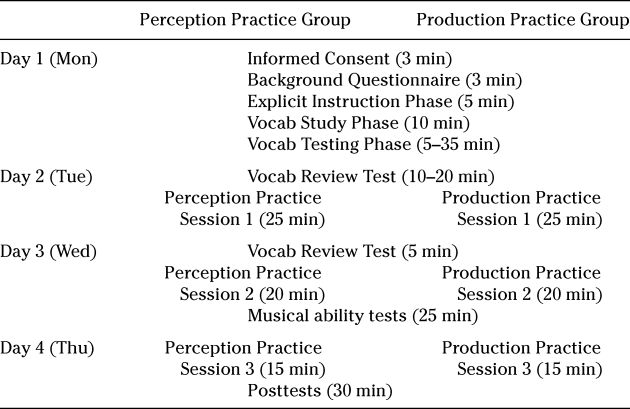
The study took place during the spring semester of 2015. Each individual participated in four sessions of an hour or less on four separate (mostly consecutive) days within a one-week period. Table 1 presents the training schedule for both treatment conditions. It is worth noting that a human trainer (i.e., the first author), as opposed to a computer, was used to conduct training for this study because human trainers are able to provide real-time feedback during production training. In order to make the two treatment conditions comparable in aspects other than the main experimental manipulation, the same human trainer was used for both training conditions.
Training schedule

On Day 1, all participants were first informed about the study and filled out the participant background questionnaire. They then started the explicit instruction phase. The participants listened to the audio instruction at a computer station while reading the instruction on two sheets of paper.
After questions were taken about the instruction, participants moved on to the vocab study phase, in which they engaged in learning declarative knowledge of the 16 target words on the computer screen. Before they started, each participant was told that their goal in this task was to remember the mappings between the words in pinyin and their meanings represented in pictures, and was informed that after the study phase they would be tested until they reached 100% accuracy. Participants were presented with the target words in pinyin (e.g., bā), one at a time, along with a picture to illustrate its meaning and its English translation. The presentation procedure for each word was as follows: A word in pinyin first appeared in the upper center of the screen, and after a one-second time interval, a picture and an English translation for the word appeared in the lower center of the screen. They all stayed on the screen for an additional four seconds. The computer screen then moved on to present the next word automatically. Each word was repeated six times, which resulted in 96 trials. In the first three repetitions of the words, the order of presentation was blocked by syllable, with the order of the tones for each syllable from Tone 1, to Tone 2, Tone 3, and Tone 4. The blocking by syllable allowed participants to see the minimal quadruplet in succession; this procedure was used to draw their attention to how changes in tone mark change word meaning with the same syllable. In addition, each syllable (with four tones) was repeated in succession such that the four meanings for each syllable were recycled three times before moving on to the next syllable. This was done to facilitate remembering the meanings and the spelling-meaning mappings. In the fourth repetition, the order of presentation was still blocked by syllable, but the order of the tones within each syllable was semirandomized such that they did not follow the same order from Tone 1 to Tones 2, 3, and 4, and the same tone did not occur together at the borders across syllables. In the last two repetitions, the order of presentation was not blocked by syllable and was randomized instead. This vocab study phase took about 10 minutes.
Immediately after the vocab study phase, participants entered the vocab testing phase, in which they were tested face to face with the trainer. They were tested in both directions, that is, from pinyin to pictures and from pictures to pinyin, until they reached criterion performance, that is, 100% accuracy in the last repetition of all 16 words in both directions. They were tested first from pinyin to pictures, which corresponded with the presentation order in the study phase. After they reached criterion in this direction, they were tested in the other direction from pictures to pinyin. When testing from pinyin to pictures, the trainer presented each word in pinyin from cards, one at a time, and the participants were asked to identify its meaning by pointing at the correct picture on the vocab test worksheet with pictures. When testing from pictures to pinyin, the trainer presented cards with pictures, one at a time, and the participants were asked to identify the word by pointing at the correct pinyin on the vocab test worksheet with pinyins. A second role the trainer took was to provide feedback each time the participants made a choice, by saying “yes, correct” or “no”/“no, the answer is . . .” depending on whether the participants corrected themselves right away. At the end of the first day’s session, participants were asked not to study or practice the Chinese words they learned outside of the sessions before the study was concluded.
On Day 2, all participants first took a vocab review test of the 16 words they learned on Day 1. They were tested until they reached 100% accuracy in both directions of testing. They then started to engage in either perception or production practice, which constituted the main experimental manipulation of the study. In both practice conditions, each practice session consisted of two phases, with the first phase focusing on tone perception or production, and the second phase at the higher level of word comprehension or production. In both phases for either perception or production practice, there were four training blocks, followed by a review block and a test.
In the perception practice condition, Phase 1 (sound-to-pinyin mapping), the trainer read aloud the target Chinese words from a preprogrammed list, one at a time, and the participants were asked to point at the pinyin with the correct tone for each sound they heard on the vocab test worksheet with pinyin. The trainer provided feedback for each trial by saying “yes, correct” or “no, the answer should be. . . .” The practice session started with four training blocks, one for each syllable. In each training block, the four words were repeated five times. The order of presentation of the four words for the first repetition for each syllable was the same and fixed from Tone 1, to Tone 2, Tone 3, and Tone 4. In the following four repetitions, the order of presentation was randomized within each repetition. After the four training blocks, there was a review block. The 16 words were repeated three times in three cycles of repetitions, and were randomized within each repetition. At the end of this phase there was a test. The task format of the test was the same as the review block except that there was no repetition. Participants’ performance in the form of correct number of words out of 16 was recorded. In Phase 2 (sound-to-picture mapping), again the trainer read aloud the target Chinese words from a preprogrammed list, one at a time, and the participants were asked to identify its meaning by pointing at the correct picture on the vocab test sheet with pictures. Other than this difference in task format, all other dimensions of the training were identical to Phase 1.
In production practice, there were also two phases. In Phase 1 (pinyin-to-sound), participants were given a pinyin, and were asked to pronounce the word. In Phase 2 (meaning-to-sound), they were given a picture, and asked to produce the word. The number of blocks, the sequence of blocks, the sequence of the presentation of words within each block, and the number of repetitions of each word for each practice phase were the same as in the perception practice condition. The participants were informed at the beginning of the practice session that the role of the trainer was to provide feedback throughout the training, and that the feedback to the accurate productions would be “yes, correct” and the feedback to the inaccurate production would be “no” or “close” depending on how accurate the production was. The participants were also informed that the trainer would provide the correct pronunciation for each word only once in each training phase when the words were presented the first time, and that the correct pronunciation would be provided after their trial.
On Day 3, all participants first took a vocab review test of the 16 target words in both directions. They then repeated the practice, either in perception or in production. After the practice session, they all took the three musical ability tests.
On Day 4, participants repeated the practice session, either perception or production practice, and then completed the set of posttraining tests. The posttraining tests were administered on the computer in a soundproof room. Both response (identification choice and production) and response time were recorded. The four tests were administered in a fixed order: the picture naming test, the word reading test, the word ID test, and the tone ID test. The test order went from productive tasks to perceptive ones in order to avoid contamination of production performance that can result from taking the perceptive tests before the production tests, especially for the production practice group who had very little exposure to NSs’ pronunciation before entering the testing phase. The test order also went from the higher word level to the lower sound level in order to avoid influence from more practice at the lower level to performance at the higher level.
In all tests, each trial started with a fixation “*” in the center of the screen for 500 ms and was replaced by a stimulus (either a picture or a word in pinyin in the productive tasks, or an auditory word plus a set of four pictures or pinyins in the perceptive identification tasks). The visual stimuli stayed on the screen until the participant made a response (either in the form of oral production into the microphone or button pressing). After a two-second blank screen, the fixation asterisk appeared again, signaling the beginning of the next trial. Participants were given up to 30 seconds to respond for each item, but were asked to respond as quickly and accurately as possible. At the beginning of each posttest session, the trainer worked with the participant to adjust the sensitivity of the threshold for the input signal strength and the threshold for the sibilant signal strength so that it did not respond to the ambient noise or nonspeech sounds but did respond to the perceived onset of the participant’s production for the stimuli. In addition, participants were instructed to avoid coughs, false starts, or hesitations, and speak clearly into the microphone for the productive tasks. During the productive tests, the trainer was standing at the back of the room, observing, and taking notes in case any false triggers happened. For the perceptive identification tasks, participants heard a word and at the same time saw either four pictures (in the word comprehension test) or four pinyins (in the tone ID test) in two rows (two in a row) at equal distance from the center of the screen. Participants were instructed to use the buttons “F,” “J,” “C,” and “M” on the keyboard, covered by small yellow stickers corresponding to the positions of the pictures on the screen to indicate their response. To familiarize them with the task formats, they were presented with practice items using English examples at the beginning of each test.
SCORING PROCEDURES
Outcome Measures
Productive Tasks.
Two educated NSs of Chinese rated the recordings of the participants’ productions for the picture naming and word reading tests. Answer sheets were provided containing the 48 stimuli (16 in picture naming and 32 in word reading), written in pinyin with no tone marks, in the order corresponding to the presentation order in the two tests. The raters were asked to add tone marks to the pinyins according to the tones they heard. They were instructed to put down a question mark if they decided that what they heard did not correspond to any of the four tones. The two raters evaluated the productions from all participants independently. The raters only disagreed for 7.35% of the entire list of recordings. Where they disagreed, they listened to the recordings again together, and resolved the issues. The NSs’ identification error rate for the participants’ productions was taken as an index for the learners’ production error rate. Those that NSs could not identify as one of the tones were scored as incorrect. Items where no response was recorded due to false triggers were excluded from analysis. As for the RT data from the productive tasks, in addition to those for error responses, the RTs for falsely triggered items were also excluded. As a result, the amount of data excluded for error rate analysis was 1.64% for picture naming and 0.99% for word reading; the amount of RT data excluded was 19.08% for picture naming and 18.42% for word reading. The error rate and average RT for each participant in each test/subtest were recorded for further analysis.
Perceptive Identification Tasks.
Identification response was scored automatically by the computer for each item, one for correct and zero for incorrect. The RTs for error responses were excluded. As a result, 13.54% of RTs were excluded for the word comprehension test, and 8.20% for the tone ID test. Again, the error rate and average RT for each participant in each test/subtest were recorded for further analysis.
MUSICAL ABILITY TESTS
Each item in the pitch change test and the perceptive tonal memory test was scored dichotomously as correct or incorrect, and a percentage accuracy score was calculated for each test. The recordings for the productive tonal memory test were hand-scored by the first author by using the Praat computer program (Boersma & Weenink, Reference Boersma and Weenink2015), which generated the frequencies (Hz) of the recorded singing. A note was considered accurate if the frequency of the stable part of the pitch was within one semitone of the target, following Slevc and Miyake’s (Reference Slevc and Miyake2006) scoring criterion. The frequencies of the notes from different octaves were used as appropriate for female and male voices. Each item was scored dichotomously. For example, an item consisting of a five-note tune was scored as correct only if all five notes produced for this tune were accurate; it was scored as incorrect if one or more notes were produced inaccurately. A percentage accuracy score was calculated.
DATA ANALYSIS PROCEDURES
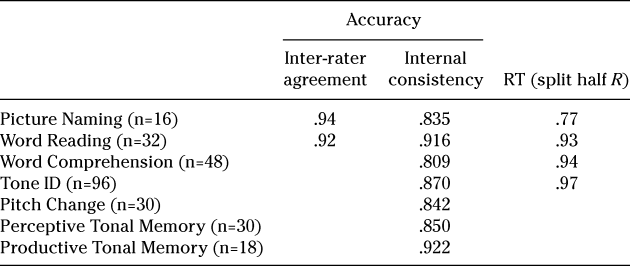
Reliability in the form of internal consistency was calculated for the accuracy data of each of the posttests and the musical ability tests using Cronbach’s alpha. Interrater reliability was calculated for the accuracy data of the productive outcome tests. Split-half reliability was calculated for the RTs of the posttests. See Table 2 for the reliability coefficients for all the tests in the study. The descriptive statistics, including means, standard deviations (SDs), and 95% confidence intervals (CI) of the two treatment groups for each of the 14 outcome measures, that is, error rates and RTs for the four main subtests (in pic naming, word reading, word comprehension, and tone ID) and the three generalization subtests (in word reading, word comp, and tone ID) were calculated.
Reliability coefficients for the outcome tests and the musical ability tests

In order to reduce the number of variables considered for modeling, exploratory factor analyses were run on the set of the three musical ability test variables (see Table 3 for descriptives) and the set of the 14 outcome measures. The analysis revealed that the three musical ability tests measure a single underlying latent construct of musical ability. The factor scores were therefore used as a covariate for further analysis. The analysis of the 14 outcome measures produced a four-factor solution, with the four RT variables from the perceptive tasks loaded on a first component, the three error rate variables from the productive tasks on a second component, the four error rate variables from the perceptive tasks loaded on a third component, and the three RT variables from the productive tasks loaded on the fourth. These outcomes were as expected. The combined mean scores of the variables loading on each of these components were calculated for further analysis. The number of outcome measures was thus reduced from 14 to 4, namely, perception error, perception RT, production error, and production RT. The normality of these composite higher-order variables was assessed. Variables with either z-score for skewness or kurtosis greater than 1.96 were considered nonnormal. Following these criteria, the distribution of the music factor scores was considered normal, but the four outcome measures all had nonnormal distributions. Inverse transformations were conducted on the four outcome measures because their distributions were all severely skewed. The transformed distributions for perception error, perception RT, and production RT then fell within the range of normal distribution, except for production error, which could not be adequately corrected.
Descriptives for the Musical Ability Tests

For significance testing, an ANCOVA was conducted for the three outcome measures that were adequately corrected, by taking the transformed outcome measures as dependent variables, treatment type as the independent variable, and the music factor scores as a covariate. Rank ANCOVA was conducted for the variable production error, the distribution of which could not be adequately corrected, by taking the ranks of the scores for production error as a dependent variable, the treatment type as the independent variable, and the ranks of the music factor scores as a covariate. The two practice groups did not differ on music factor score (p = . 678, η p 2 = .005) so the assumption of independence of the covariate and treatment effect can be assumed. In addition, the interaction between treatment type and musical ability was nonsignificant for any of the outcome variables, suggesting that the assumption of homogeneity of regression slopes was met. As we made specific a priori hypotheses regarding the effects of treatment type on each of the specific domains, that is, the error rate and RT of performance in perception and production, respectively, multiple comparisons corrections were not needed (Schochet, Reference Schochet2008). The alpha level was set at .05. The effect sizes (partial η 2) are reported, using the following criteria: small (.01), medium (.06), and large (.14) (Cohen, Reference Cohen1988).
RESULTS
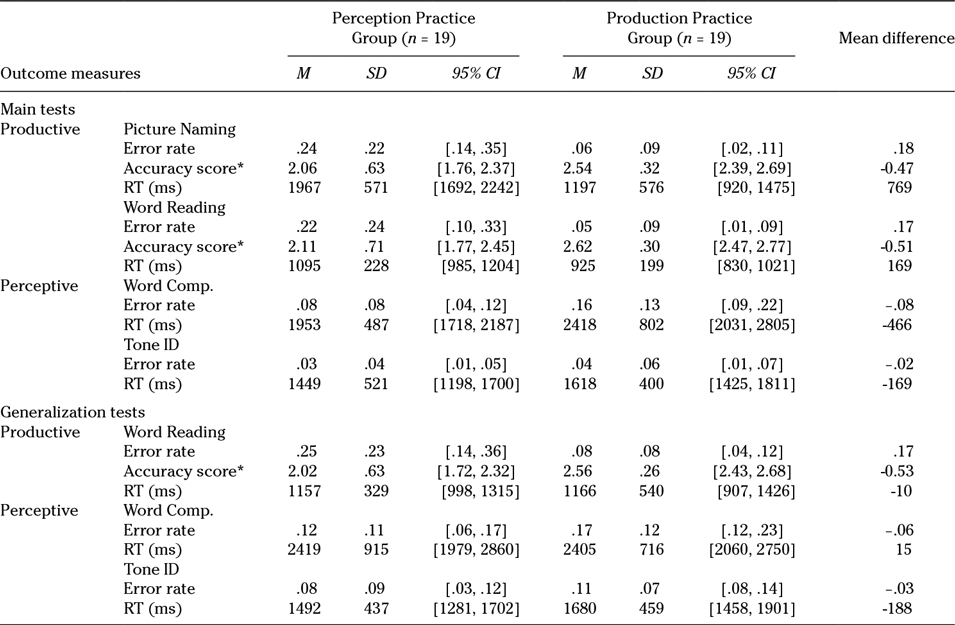
Table 4 presents the means, SDs, and 95% CIs of the two treatment groups on all 14 outcome measures, that is, error rates and RTs for the four main subtests and the three generalization subtests, along with the mean differences between the two groups for these measures. Starting from the main tests (of the learned words from the trainer), it can be seen that in both picture naming and word reading, the production practice group had much lower mean error rates (with smaller SDs) and much shorter mean RTs than the perception practice group. The mean differences seem very large, which appears to indicate that the production group outperformed the perception group on the productive tasks. With regard to performance in the perceptive tasks, the perception practice group had lower mean error rates (with smaller SDs) and shorter mean RTs than the production practice group, which seems to indicate that the perception group outperformed the production group on the perceptive tasks. It is worth noting that the magnitudes of the mean differences between the two groups seem to be smaller in the perceptive tasks than in the productive tasks.
Descriptive statistics for the outcome measures across treatment conditions

* These production accuracy scores were based on how nativelike the productions were on a four-point scale, i.e., 0: incorrect, 1: correct but sounds strange, 2: correct and sounds okay, and 3: correct and sounds nativelike.
As for the generalization tests (with new words and/or new voices), the mean error rates as well as the mean RTs were generally slightly higher than those of the corresponding main tests for both practice groups. Overall, the participants performed quite well, the highest error rate being .25. If we compare two groups’ performance in perception and production, a similar pattern to those from the main tests can be observed for error rate, that is, the production group had a lower mean error rate in production (i.e., word reading) than the perception group, and the perception group had lower mean error rates than the production group in perception (i.e., word comprehension and tone ID). A similar pattern was not observed for the RTs. The perception practice group only had a lower mean RT for tone ID compared to the production group, with a mean difference of 188 ms; the mean RT differences were very small for word comprehension and word reading.
Results from the ANCOVAs and the rank ANCOVA testing our hypotheses regarding the specificity effect of treatment on the four composite higher-order outcome measures show that the effect of treatment type was statistically significant for production error, production RT, and perception error, all with very large effect sizes. Specifically, with regard to posttraining performance in production, a statistically significant main effect of treatment type was found for both error rate, F group (1, 35) = 10.023, p = .003, η p 2 = .223, and RT, F group (1, 35) = 12.095, p = .001, η p 2 = .257. In perception, the main effect of treatment type was also statistically significant for error rate, F group (1, 35) = 8.660, p = .006, η p 2 = .198. The treatment type effect only failed to reach statistical significance on perception RT, F group (1, 35) = 3.137, p = .085, with a medium effect size, η p 2 = .082. The nonsignificant result on perception RT (with much smaller effect size), in fact, seems to go in line with our prior prediction that there should be smaller effect of treatment type on performance in perception than in production due to the extra secondary perception component in production practice. That is, the fact that the production practice group, though focused on practice pronouncing words, heard each of the target words from the NS trainer as models twice during the first training session, and unavoidably heard their own productions as they were producing them throughout the practice sessions, may have reduced the advantage that the perception practice group had in performance in perception. This lessened advantage of the perception practice group in performance in perception was manifested in the loss of advantage in responding speed; the advantage in accuracy was preserved, which is evidenced by the statistically significant effect of treatment type on perception error rate. Overall, these results confirmed our hypotheses and provide strong support to the skill-specificity hypothesis.
As for the role of musical ability in Mandarin tone-word learning, the effect of musical ability was statistically significant on perception error, F mus (1, 35) = 19.008, p < .001, with very large effect size, η p 2 = .352. Musical ability did not turn out to be a statistically significant covariate for production error, F mus (1, 35) = 2.020, p = .164, η p 2 = .055, nor for production RT, F mus (1, 35) = 1.424, p = .241, η p 2 = .039, or perception RT, F mus (1, 35) = 2.978, p = .093, η p 2 = .078. That is, musical ability does not seem to predict posttraining RTs in either perceptive or productive tasks. Nor does it predict error rates in production, but it seems to be a strong predictor of posttraining error rates in perception.
Note that the oral productions were scored dichotomously, based on whether a NS could correctly classify the tones they heard into one of the four tonal categories. This dichotomous scoring procedure is necessary because (a) it provides data for error rates, which is a major focus of analysis of the present study, and (b) it provides the base for RT analysis because only the RTs to the correct productions should be included in RT analysis. Dichotomous scoring also provides the same type of data (error rates) from the perceptive identification tasks, which constitutes another merit of such scoring method. The downside of it is that it is not good enough to capture the range of variation of those productions that fall into the category of correct responses, and a good amount of variation was expected. In order to see whether a significant correlation would be found between musical ability and more fine-grained oral production scores, a decision was made to rerate the productions based on how nativelike they were on a scale. The same two NSs of Chinese rerated all the productions on a four-point scale, that is, 0: incorrect, 1: correct but sounds strange, 2: correct and sounds okay, and 3: correct and sounds nativelike. The accuracy scores of both practice groups for each production test are presented in Table 4. The combined mean scores of the three production accuracy outcome variables, that is, picture naming and word reading in the main tests and word reading in the generalization tests, were calculated and taken as a measure of production accuracy for significance testing. Results from ANCOVA revealed a statistically significant effect for treatment type on production accuracy, F group (1, 35) = 10.591, p = .003, η p 2 = .232, suggesting that the productions by the production practice group were rated as more accurate or nativelike than productions by the perception group. In addition, musical ability was found a statistically significant covariate for performance in production accuracy, F mus (1, 35) = 5.591, p = .024, η p 2 = .138, suggesting that higher musical ability learners’ productions were rated as more accurate or nativelike than those of lower musical ability learners. This finding on production accuracy together with that on perception error rate suggests that musical ability may play a facilitative role in learning to perceive and produce L2 Mandarin tones.
DISCUSSION
In the present study, two groups of participants first acquired declarative knowledge of Mandarin tones and of the target words in the form of spelling-meaning mappings and then went through either systematic perception practice or production practice for three sessions and were tested in both productive and perceptive tasks immediately after training. The results showed that the production practice group outperformed the perception practice group in production in terms of significantly lower error rates (i.e., when oral productions were rated dichotomously based on whether a NS could correctly identify the tones), higher accuracy scores (i.e., when oral productions were rated based on how nativelike they were on a scale), and faster RTs. The perception practice group outperformed the production group in terms of significantly lower error rate. The perception group responded faster than the production group in perceptive tasks on average; however, the mean difference did not turn out to be statistically significant. In other words, the advantage of the perception group in outcome performance in perception only showed up in accuracy rate, but did not appear in RT. We suspect that it is probably because the differences in perception between the two groups were already evident in different accuracy rates, and that the perception group performed at ceiling in the speed measure, in that there was not much room for the perception group to respond faster. This reduced advantage that the perception group had in perception compared with the production group may also be due to the secondary perception component in production practice, as has been discussed earlier.
The finding that performance was always far worse when participants were tested on the reverse skill than when they were tested on a skill they had practiced confirmed our hypothesis regarding the specificity of practice effect. The findings of this study provide a strong case that for skills that appear to be mirror images of each other, that is, tone-word comprehension and production, though they share a common declarative base, the effect of practice for developing procedural knowledge in each skill is highly specific. As the procedural knowledge for the two skills consists of production rules with the reversed directions of conditions and actions, this is what is expected according to skill acquisition theory. This pattern of findings on Chinese tone-word learning corroborates the findings of DeKeyser (Reference DeKeyser1997), who looked at the learning of morphosyntactic rules of an artificial language. The data of the present study provides new empirical evidence in the phonological domain in support of the skill-specificity hypothesis.
If we compare participants’ performance in the generalization tests with that in the main tests, we can see that they performed quite well in general, though slightly worse than for the main tests, as expected. This suggests that the tonal skills they gained in training can be generalized to new words and/or new speakers. One caveat is that the generalization tests used words that were not all that different in syllable structure from the ones in the training. It remains for future research to explore whether tonal skills developed with one type of syllable structure (e.g., CV) can easily transfer to words with other types of syllable structure (e.g., CVN). With regard to the effects of treatment type, the descriptive results seem to suggest that in the generalization tests, the advantage in the practiced skill may be preserved for accuracy (i.e., 1: error rate), but much less likely so for RT, at least not consistently across tasks. Results from additional exploratory analyses seem to be in line with this observation. Separate (rank) ANCOVAs were conducted on the main tests and the generalization tests, with musical ability as a covariate. For the main tests the effect sizes of treatment type were very large for all four outcome measures (i.e., ProductionError_Main, p = .001, η p 2 = .284; ProductionRT_Main, p < .001, η p 2 = .348; PerceptionError_Main, p = .026, η p 2 = .134; PerceptionRT_Main, p = .020, η p 2 = .145). For the generalization tests, the effect sizes of treatment type were large, or medium-to-large on measures for error rates (PerceptionError_Gen, p = .021, η p 2 = .143; ProductionError_Gen, p = .037, η p 2 = .119), but very small for measures of RT (PerceptionRT_Gen, p = .349, η p 2 = .025; ProductionRT_Gen, p = .726, η p 2 = .004). Results from these exploratory analyses, then, suggest that with new items the practice effect is more likely to show up in accuracy rate than in responding speed.
With regard to the role of musical ability in L2 learning of Mandarin tones, this study found a positive relationship of musical tonal ability with posttraining perceptive identification accuracy rates and production accuracy in terms of pronunciation nativelikeness. These findings suggest that musical ability plays a facilitative role in learning to perceive and produce L2 Mandarin tones and in learning to comprehend and produce tone-words. They are consistent with earlier findings of a positive role of musical expertise in L2 identification and production of unfamiliar tones (e.g., Gottfried et al., Reference Gottfried, Staby and Ziemer2004) and in the learning of sound-to-meaning mappings in tone-word identification (e.g., Wong & Perrachione, Reference Wong and Perrachione2007). Our findings add further empirical evidence that musical ability among the large population of nonmusicians plays a facilitative role, not only at the lower sound level in learning to perceive and produce L2 tones, but also at the higher linguistic level in learning to comprehend and produce L2 tone-words. It is also worth noting that musical ability was not correlated with posttraining production error rates, which were rated based on whether NSs could correctly identify the tones, but was correlated with posttraining production accuracy that was rated based on how accurate or nativelike the productions were. These findings suggest that learners’ ability to pronounce tones so as to be identifiable by NSs is not related to musical ability, but the nativelikeness of their pronunciation is. It remains to be explored in future studies whether learners’ musical ability still plays a role in L2 tonal perception and production at the lower (sound) and higher (word) levels after longer periods of learning outside of a laboratory context, or whether it plays a role in higher-level linguistic tasks, such as sentence comprehension and production.
CONCLUSIONS AND IMPLICATIONS
This is the first study, to the best of our knowledge, that tested the skill-specificity hypothesis regarding skill acquisition in the domain of L2 vocabulary learning, taking nonnative speech sound learning into account. The results of the present study, together with DeKeyser’s (Reference DeKeyser1997), lend strong support to the hypothesis that the effect of practice is highly skill-specific in L2 learning. If the goal of L2 learning is to develop high proficiency in comprehending and speaking the language, the findings of this study highlight the importance of practice in both receptive and productive skills, as performance in them can be severely reduced if only the opposite skill is practiced. From a methodological point of view, this study confirms the importance of including musical aptitude in research design as an individual difference factor for investigating L2 learning even when the target population consists entirely of nonmusicians.
SUPPLEMENTARY MATERIAL
To view supplementary material for this article, please visit https://doi.org/S0272263116000358.