INTRODUCTION
In her interesting article, Stoel-Gammon (this issue) reviews studies concerning the interactions between lexical and phonological development. While the focus of the review is on vocabulary production from children acquiring American English, she also suggests that cross-linguistic research be undertaken to examine how universal and language-specific properties affect the interaction between lexical and phonological acquisition. In this regard, Stoel-Gammon referred to the study of Bleses et al. (Reference Bleses, Vach, Slott, Wehberg, Thomsen, Madsen and Basbøll2008) who found differences in receptive vocabulary development across languages, based on norming studies for the Communicative Development Inventories (Fenson, Marchman, Thal, Dale, Reznick & Bates, Reference Fenson, Marchman, Thal, Dale, Reznick and Bates2007). Bleses et al. showed that Danish children were slower in the early comprehension of words (and phrases). It was hypothesized that the phonetic structure of Danish may account for the difference in receptive vocabulary skills in this population (Bleses & Basbøll, Reference Bleses, Basbøll, Schmidt, Mikkelsen, Post, Simonsen and Fruensgaard2004).
In this commentary we reanalyze cross-linguistic findings to shed further light on the question why Danish children evidence a delay in the early receptive development. More specifically, we will explore if this delay can be accounted for by language factors specific to Danish or whether more universal phonetic (vs. phonological) differences across languages can account for the observable differences in early receptive vocabulary growth.
WHAT IS DIFFERENT ABOUT DANISH?
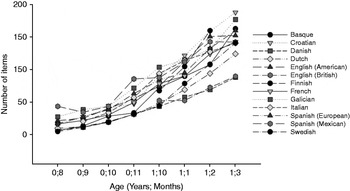
Bleses et al.'s (Reference Bleses, Vach, Slott, Wehberg, Thomsen, Madsen and Basbøll2008) reanalysis of published and non-published CDI data collected from the thirteen languages which had available comparable data for number of comprehended words, revealed both similarities and differences in relation to the comprehension abilities in children aged between 0 ; 8 and 1 ; 3. The median number of words known for each age and language is reproduced from Bleses et al. in Figure 1.
Fig. 1.Median number of words known reported by age and language.
While this figure shows that early word comprehension has curvilinear development for all languages over the ages studied, there is considerable variability between languages. The developmental trend of Danish children's early vocabulary development is equivalent in many respects to that of the other languages. However, the actual size of the early receptive vocabulary in Danish is lowest from age 1 ; 0. A similar but even more pronounced pattern could be observed for the comprehension of phrases (cf. Bleses et al., Reference Bleses, Vach, Slott, Wehberg, Thomsen, Madsen and Basbøll2008: 637).
In Bleses et al. (Reference Bleses, Vach, Slott, Wehberg, Thomsen, Madsen and Basbøll2008) we proposed that this delay may be related to some unusual phonetic characteristics of Danish. Danish has sixteen obstruent and nasal consonants and one lateral approximant and is unique with regard to the large inventory of monophthongal vowel sounds (17), two neutral schwa vowels and up to nineteen diphthongs (Grønnum, Reference Grønnum1998). A vowel length contrast is also present and all long vowels have an additional stød contrast (stød is a kind of creaky voice). Furthermore, obstruents are turned into non-lateral approximants; for example, in contrast to other Germanic languages that have (voiced or voiceless) stops, Danish has final non-lateral approximants e.g. bade [bæː ə] ‘to bathe’ (non-syllabic ‘vocoids’ in the terminology from Pike, Reference Nespor, Pena and Mehler1943; see Basbøll, Reference Basbøll2005: 115–17). This process is often referred to as ‘consonant gradation’ or ‘consonant weakening’ (see Rischel, Reference Pike1970). Consequently, Danish often presents long stretches of vocoids, i.e. vowel-like non-consonantal sounds (vowels and non-lateral approximants). Furthermore, assimilations of /ə/, where schwa is assimilated to a neighbouring vowel or sonorant consonant which then becomes syllabic, or dropped, are pervasive (e.g. bade [bæːə] is almost always reduced to bade [bæːː] in both spontaneous and more distinct speech).
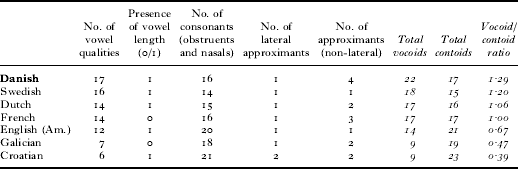
In summary, Danish has a large inventory of vocoids (22) compared to contoids (17). The high number of vocoids in Danish is unusual since consonants outnumber vowels in most languages (Crystal, Reference Crystal1997; Ladefoged & Maddieson, 1996). Consequently, the phonetic structure blurs both syllable numbers and syllable boundaries word internally as well as word externally (cf. han skal bade i en anden dragt [hansɡaˈbæːðinˈanːˈdʁɑɡd] ‘he must swim in another suit’, where the word boundaries between four words (bade i en anden) are extremely unclear due to the long stretches of vocoids). As a result of the vocoid-rich phonetic structure, Bleses et al. hypothesized that the segmentation of Danish into words is hard and may account for the slower rate of comprehension of words in Danish children.
THE CONSONANT/VOWEL ASYMMETRY
The hypothesis that children's early language abilities can be affected by phonetic structure is supported by many studies on statistical learning and distributed learning (for a recent review, see Swingley, Reference Sharp, Scott, Cutler and Wise2009). Most pertinent here is that statistical learning mechanisms appear to be recruited particularly for word segmentation and word acquisition purposes (Gervain & Mehler, Reference Gervain and Mehler2010). Nespor, Pena & Mehler (Reference Nazzi, Floccia, Moquet and Butler2003) suggested that vowels and consonants might play different roles in language processing and language acquisition. The general idea is that consonants are responsible for encoding the lexicon and therefore more important at the lexical level, whereas vowels signal morphological form and syntactic function and are therefore more important at the prosodic and syntactical level (e.g. Gervain & Mehler, Reference Gervain and Mehler2010). The evidence for this consonant/vowel asymmetry hypothesis is mainly drawn from behavioural psycholinguistic studies of adults. For example, when segmenting words from an artificial continuous stream, adults compute statistical relations over consonants, but not over vowels (Toro, Nespor, Mehler & Bonatti, Reference Swingley2008). Positron emission tomography (PET) scan studies also suggest that changing a consonant is more difficult and imposes greater processing demands than changing the vowel, thereby indirectly suggesting that consonants are more important for lexical access (Sharp, Scott, Cutler & Wise, Reference Rischel and Benediktsson2005).
The consonant/vowel asymmetry hypothesis has found some support from research investigating infants' early lexical specificity. Studies conducted by Nazzi and colleagues (see, e.g., Havy & Nazzi, Reference Havy and Nazzi2009; Nazzi & Bertoncini, Reference Ladefoged and Maddieson2009; Nazzi, Floccia, Moquet & Butler, Reference Nazzi and Bertoncini2009) have found evidence for a privileged role for consonants in early lexical development, suggesting a continuity of the consonantal advantage between infancy (acquisition) and adulthood (processing) (Nazzi et al., Reference Nazzi and Bertoncini2009: 524).
In summary, for the child learning language, the results suggest that consonants are more suitable for statistical learning than vowels.
THE CONSONANT/VOWEL ASYMMETRY HYPOTHESIS REVISITED
We propose here a modification and extension of the consonant/vowel asymmetry hypothesis. First, we compare the inventory of vocoids vs. contoids in a phonetic sense (disregarding peak function in the syllable), thus with glides counting as vocoids (Basbøll, Reference Basbøll2005: 115–17), whereby the emphasis is on phonetic contrasts rather than on abstract phonological analyses. Second, we extend the hypothesis to predict cross-linguistic differences in the rate of the early acquisition of words. The hypothesis predicts that word comprehension in infants is facilitated if the child is acquiring a language which has a large repertoire of contoids compared to the repertoire of vocoids. Conversely, a large inventory of vocoids compared to contoids impedes development. This is because many vocoids will disguise boundaries and make segmentation harder as children will not be able to use statistical learning to such a high extent as in languages with many contoids. As a preliminary test of the potential strength of this revisited consonant/vowel asymmetry hypothesis we will reanalyse the cross-linguistic CDI data from Bleses et al. (Reference Bleses, Vach, Slott, Wehberg, Thomsen, Madsen and Basbøll2008) by correlating the vocoid/contoid ratio (see below) with the learning rate of the receptive vocabulary.
VOCOID/CONTOID RATIO AND LEARNING RATE IN EARLY RECEPTIVE VOCABULARY
To test the vowel/consonant asymmetry hypothesis we have limited the comparison of languages to those where comparable information on the phonetic inventory could be obtained. The Handbook of the International Phonetic Association (International Phonetic Association, 1999) provides information on six of the relevant languages (Swedish, Dutch, French, American English, Galician and Croatian), and for Danish we have information based on a similar type of analysis from Illustrations of IPA (Grønnum, Reference Grønnum1998). Consequently, these seven languages are included in the analysis.
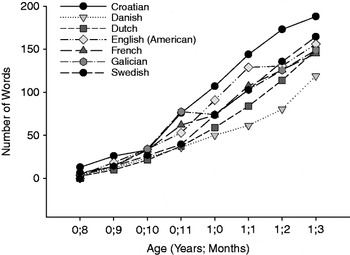
Differences in the number of items learned until the age of 1 ; 3 were examined by fitting single parameter exponential functions, using the ordinary least squares method, to each set of CDI data collected from the different languages. R2 values ranged between 0·93 and 0·99, indicating a good fit between the models and data. The fitted curves are shown in Figure 2, together with the data for the seven languages. The higher and steeper the curve, the higher is the learning rate.
Fig. 2.Development of receptive vocabulary between 0 ; 8 to 1 ; 3 reported by language. Initial differences in words known corrected by subtracting the values at 0 ; 8 from all subsequent ages. Data from British English, Finnish and Italian are not included in Figure 2 because of missing data at 0 ; 8.
We quantified the phonetic structure of each language by counting the number of vocoids (vowels and non-lateral approximants plus one additional point if the language had a length contrast) and contoids (obstruents and nasal consonants as well as lateral approximants) and a vocoid/contoid ratio (vocoids divided by contoids) was then computed. This ratio indicates how ‘vocalic’ or ‘consonantal’ each language is. The result is presented in Table 1.
Table 1.Ranking of languages based on the vocoid/contoid ratio
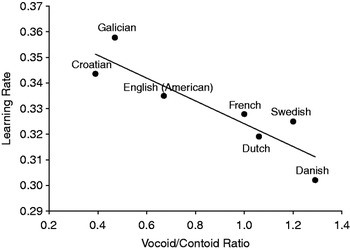
We then examined the relationship between learning rate and the vocoid/contoid ratio. The association between the vocoid/contoid ratio and learning rate is displayed in the scatterplot of Figure 3.
Fig. 3.Scatterplot showing association between vocoid/contoid ratio and learning rate. To assist with interpretation data labels have been included in the figure.
There was a statistically significant, strong negative association between the vocoid/contoid ratio and learning rate (r=−0·897, p=0·006). Languages with a higher ratio were associated with lower receptive vocabulary learning between 0 ; 8 and 1 ; 3. The Danish language has the highest vocoid/contoid ratio of the included languages and the learning rate is correspondingly the slowest.
IS THE VOCOID/CONTOID RATIO ENOUGH TO EXPLAIN CROSS-LINGUISTIC DIFFERENCES IN THE EARLY COMPREHENSION OF WORDS?
In this commentary we have taken up one of Stoel-Gammon's ideas for future research in this area, concerning how universal and language-specific properties affect the interaction between lexical and phonological acquisition. We have addressed the extent to which early delay in Danish is correlated with factors specific to Danish or whether more systematic phonetic (vs. phonological) differences across languages can be employed to account for the observable differences in early receptive vocabulary growth. Based on an extension of the consonant/vowel asymmetry hypothesis stated by Nespor and colleagues, we tested the extent to which a new vocoid/contoid ratio could account for the observed developmental patterns.
As predicted on the basis of the view that consonants are more suitable for statistical learning than vowels, languages with a low(er) vocoid/contoid ratio with no exception had a faster vocabulary rate than languages with a high vocoid/contoid ratio. In other words, the amount of ‘consonantal’ inventory relative to the amount of ‘vowel-like’ inventory predicts the acquisitional patterns found in the cross-linguistic CDI study. We conclude that the slower development of Danish children's receptive vocabulary appears to be accountable by a factor which affects the acquisition of languages more generally, and not just a factor local to Danish.
Clearly additional empirical cross-linguistic research is required to fully confirm this hypothesis. A noted limitation with the preceding analyses is the extent to which results reflect language-specific characteristics. The dependent variables used to compute learning rates and the correlation coefficient consisted of nested group data with children learning different languages also being situated in different countries. Another critical question is the extent to which associations between the vocoid/contoid ratio and receptive vocabulary learning derived from level group data can be generalized to individual infants and children. Furthermore, very few languages (all Indo-European: four Germanic, two Romance and one Slavic) are included here. In addition, the relation between vocoids and contoids is certainly not the only statistical cue in the input, as many studies have documented that language-specific cues to segmentation, e.g. allophonic variation, phonotactics or stress patterns, have an impact (see Swingley (Reference Sharp, Scott, Cutler and Wise2009) for a new review). We intend to explore these questions further.
Nevertheless, we hope to have shown that, as Stoel-Gammon suggests, cross-linguistic analyses can add new perspectives to a hypothesis which has been discussed for some time now. Furthermore, we can support Nazzi et al.'s proposed continuity of the consonantal advantage between infancy and adulthood with results from the later acquisition of past tense in Danish children aged four to eight years compared to that of Icelandic, Norwegian and Swedish children (Bleses, Basbøll, & Vach, to appear), which showed that Danish children were delayed, in particular in relation to the large weak class whose suffix does not contain any contoids.





 You have
Access
INTRODUCTION
In her interesting article, Stoel-Gammon (this issue) reviews studies concerning the interactions between lexical and phonological development. While the focus of the review is on vocabulary production from children acquiring American English, she also suggests that cross-linguistic research be undertaken to examine how universal and language-specific properties affect the interaction between lexical and phonological acquisition. In this regard, Stoel-Gammon referred to the study of Bleses et al. (Reference Bleses, Vach, Slott, Wehberg, Thomsen, Madsen and Basbøll2008) who found differences in receptive vocabulary development across languages, based on norming studies for the Communicative Development Inventories (Fenson, Marchman, Thal, Dale, Reznick & Bates, Reference Fenson, Marchman, Thal, Dale, Reznick and Bates2007). Bleses et al. showed that Danish children were slower in the early comprehension of words (and phrases). It was hypothesized that the phonetic structure of Danish may account for the difference in receptive vocabulary skills in this population (Bleses & Basbøll, Reference Bleses, Basbøll, Schmidt, Mikkelsen, Post, Simonsen and Fruensgaard2004).
In this commentary we reanalyze cross-linguistic findings to shed further light on the question why Danish children evidence a delay in the early receptive development. More specifically, we will explore if this delay can be accounted for by language factors specific to Danish or whether more universal phonetic (vs. phonological) differences across languages can account for the observable differences in early receptive vocabulary growth.
WHAT IS DIFFERENT ABOUT DANISH?
Bleses et al.'s (Reference Bleses, Vach, Slott, Wehberg, Thomsen, Madsen and Basbøll2008) reanalysis of published and non-published CDI data collected from the thirteen languages which had available comparable data for number of comprehended words, revealed both similarities and differences in relation to the comprehension abilities in children aged between 0 ; 8 and 1 ; 3. The median number of words known for each age and language is reproduced from Bleses et al. in Figure 1.
Median number of words known reported by age and language.
While this figure shows that early word comprehension has curvilinear development for all languages over the ages studied, there is considerable variability between languages. The developmental trend of Danish children's early vocabulary development is equivalent in many respects to that of the other languages. However, the actual size of the early receptive vocabulary in Danish is lowest from age 1 ; 0. A similar but even more pronounced pattern could be observed for the comprehension of phrases (cf. Bleses et al., Reference Bleses, Vach, Slott, Wehberg, Thomsen, Madsen and Basbøll2008: 637).
In Bleses et al. (Reference Bleses, Vach, Slott, Wehberg, Thomsen, Madsen and Basbøll2008) we proposed that this delay may be related to some unusual phonetic characteristics of Danish. Danish has sixteen obstruent and nasal consonants and one lateral approximant and is unique with regard to the large inventory of monophthongal vowel sounds (17), two neutral schwa vowels and up to nineteen diphthongs (Grønnum, Reference Grønnum1998). A vowel length contrast is also present and all long vowels have an additional stød contrast (stød is a kind of creaky voice). Furthermore, obstruents are turned into non-lateral approximants; for example, in contrast to other Germanic languages that have (voiced or voiceless) stops, Danish has final non-lateral approximants e.g. bade [bæː ə] ‘to bathe’ (non-syllabic ‘vocoids’ in the terminology from Pike, Reference Nespor, Pena and Mehler1943; see Basbøll, Reference Basbøll2005: 115–17). This process is often referred to as ‘consonant gradation’ or ‘consonant weakening’ (see Rischel, Reference Pike1970). Consequently, Danish often presents long stretches of vocoids, i.e. vowel-like non-consonantal sounds (vowels and non-lateral approximants). Furthermore, assimilations of /ə/, where schwa is assimilated to a neighbouring vowel or sonorant consonant which then becomes syllabic, or dropped, are pervasive (e.g. bade [bæː
 ə] is almost always reduced to bade [bæː
 ː] in both spontaneous and more distinct speech).
In summary, Danish has a large inventory of vocoids (22) compared to contoids (17). The high number of vocoids in Danish is unusual since consonants outnumber vowels in most languages (Crystal, Reference Crystal1997; Ladefoged & Maddieson, 1996). Consequently, the phonetic structure blurs both syllable numbers and syllable boundaries word internally as well as word externally (cf. han skal bade i en anden dragt [hansɡaˈbæːðinˈanːˈdʁɑɡd] ‘he must swim in another suit’, where the word boundaries between four words (bade i en anden) are extremely unclear due to the long stretches of vocoids). As a result of the vocoid-rich phonetic structure, Bleses et al. hypothesized that the segmentation of Danish into words is hard and may account for the slower rate of comprehension of words in Danish children.
THE CONSONANT/VOWEL ASYMMETRY
The hypothesis that children's early language abilities can be affected by phonetic structure is supported by many studies on statistical learning and distributed learning (for a recent review, see Swingley, Reference Sharp, Scott, Cutler and Wise2009). Most pertinent here is that statistical learning mechanisms appear to be recruited particularly for word segmentation and word acquisition purposes (Gervain & Mehler, Reference Gervain and Mehler2010). Nespor, Pena & Mehler (Reference Nazzi, Floccia, Moquet and Butler2003) suggested that vowels and consonants might play different roles in language processing and language acquisition. The general idea is that consonants are responsible for encoding the lexicon and therefore more important at the lexical level, whereas vowels signal morphological form and syntactic function and are therefore more important at the prosodic and syntactical level (e.g. Gervain & Mehler, Reference Gervain and Mehler2010). The evidence for this consonant/vowel asymmetry hypothesis is mainly drawn from behavioural psycholinguistic studies of adults. For example, when segmenting words from an artificial continuous stream, adults compute statistical relations over consonants, but not over vowels (Toro, Nespor, Mehler & Bonatti, Reference Swingley2008). Positron emission tomography (PET) scan studies also suggest that changing a consonant is more difficult and imposes greater processing demands than changing the vowel, thereby indirectly suggesting that consonants are more important for lexical access (Sharp, Scott, Cutler & Wise, Reference Rischel and Benediktsson2005).
The consonant/vowel asymmetry hypothesis has found some support from research investigating infants' early lexical specificity. Studies conducted by Nazzi and colleagues (see, e.g., Havy & Nazzi, Reference Havy and Nazzi2009; Nazzi & Bertoncini, Reference Ladefoged and Maddieson2009; Nazzi, Floccia, Moquet & Butler, Reference Nazzi and Bertoncini2009) have found evidence for a privileged role for consonants in early lexical development, suggesting a continuity of the consonantal advantage between infancy (acquisition) and adulthood (processing) (Nazzi et al., Reference Nazzi and Bertoncini2009: 524).
In summary, for the child learning language, the results suggest that consonants are more suitable for statistical learning than vowels.
THE CONSONANT/VOWEL ASYMMETRY HYPOTHESIS REVISITED
We propose here a modification and extension of the consonant/vowel asymmetry hypothesis. First, we compare the inventory of vocoids vs. contoids in a phonetic sense (disregarding peak function in the syllable), thus with glides counting as vocoids (Basbøll, Reference Basbøll2005: 115–17), whereby the emphasis is on phonetic contrasts rather than on abstract phonological analyses. Second, we extend the hypothesis to predict cross-linguistic differences in the rate of the early acquisition of words. The hypothesis predicts that word comprehension in infants is facilitated if the child is acquiring a language which has a large repertoire of contoids compared to the repertoire of vocoids. Conversely, a large inventory of vocoids compared to contoids impedes development. This is because many vocoids will disguise boundaries and make segmentation harder as children will not be able to use statistical learning to such a high extent as in languages with many contoids. As a preliminary test of the potential strength of this revisited consonant/vowel asymmetry hypothesis we will reanalyse the cross-linguistic CDI data from Bleses et al. (Reference Bleses, Vach, Slott, Wehberg, Thomsen, Madsen and Basbøll2008) by correlating the vocoid/contoid ratio (see below) with the learning rate of the receptive vocabulary.
VOCOID/CONTOID RATIO AND LEARNING RATE IN EARLY RECEPTIVE VOCABULARY
To test the vowel/consonant asymmetry hypothesis we have limited the comparison of languages to those where comparable information on the phonetic inventory could be obtained. The Handbook of the International Phonetic Association (International Phonetic Association, 1999) provides information on six of the relevant languages (Swedish, Dutch, French, American English, Galician and Croatian), and for Danish we have information based on a similar type of analysis from Illustrations of IPA (Grønnum, Reference Grønnum1998). Consequently, these seven languages are included in the analysis.
Differences in the number of items learned until the age of 1 ; 3 were examined by fitting single parameter exponential functions, using the ordinary least squares method, to each set of CDI data collected from the different languages. R2 values ranged between 0·93 and 0·99, indicating a good fit between the models and data. The fitted curves are shown in Figure 2, together with the data for the seven languages. The higher and steeper the curve, the higher is the learning rate.
Development of receptive vocabulary between 0 ; 8 to 1 ; 3 reported by language. Initial differences in words known corrected by subtracting the values at 0 ; 8 from all subsequent ages. Data from British English, Finnish and Italian are not included in Figure 2 because of missing data at 0 ; 8.
We quantified the phonetic structure of each language by counting the number of vocoids (vowels and non-lateral approximants plus one additional point if the language had a length contrast) and contoids (obstruents and nasal consonants as well as lateral approximants) and a vocoid/contoid ratio (vocoids divided by contoids) was then computed. This ratio indicates how ‘vocalic’ or ‘consonantal’ each language is. The result is presented in Table 1.
Ranking of languages based on the vocoid/contoid ratio
We then examined the relationship between learning rate and the vocoid/contoid ratio. The association between the vocoid/contoid ratio and learning rate is displayed in the scatterplot of Figure 3.
Scatterplot showing association between vocoid/contoid ratio and learning rate. To assist with interpretation data labels have been included in the figure.
There was a statistically significant, strong negative association between the vocoid/contoid ratio and learning rate (r=−0·897, p=0·006). Languages with a higher ratio were associated with lower receptive vocabulary learning between 0 ; 8 and 1 ; 3. The Danish language has the highest vocoid/contoid ratio of the included languages and the learning rate is correspondingly the slowest.
IS THE VOCOID/CONTOID RATIO ENOUGH TO EXPLAIN CROSS-LINGUISTIC DIFFERENCES IN THE EARLY COMPREHENSION OF WORDS?
In this commentary we have taken up one of Stoel-Gammon's ideas for future research in this area, concerning how universal and language-specific properties affect the interaction between lexical and phonological acquisition. We have addressed the extent to which early delay in Danish is correlated with factors specific to Danish or whether more systematic phonetic (vs. phonological) differences across languages can be employed to account for the observable differences in early receptive vocabulary growth. Based on an extension of the consonant/vowel asymmetry hypothesis stated by Nespor and colleagues, we tested the extent to which a new vocoid/contoid ratio could account for the observed developmental patterns.
As predicted on the basis of the view that consonants are more suitable for statistical learning than vowels, languages with a low(er) vocoid/contoid ratio with no exception had a faster vocabulary rate than languages with a high vocoid/contoid ratio. In other words, the amount of ‘consonantal’ inventory relative to the amount of ‘vowel-like’ inventory predicts the acquisitional patterns found in the cross-linguistic CDI study. We conclude that the slower development of Danish children's receptive vocabulary appears to be accountable by a factor which affects the acquisition of languages more generally, and not just a factor local to Danish.
Clearly additional empirical cross-linguistic research is required to fully confirm this hypothesis. A noted limitation with the preceding analyses is the extent to which results reflect language-specific characteristics. The dependent variables used to compute learning rates and the correlation coefficient consisted of nested group data with children learning different languages also being situated in different countries. Another critical question is the extent to which associations between the vocoid/contoid ratio and receptive vocabulary learning derived from level group data can be generalized to individual infants and children. Furthermore, very few languages (all Indo-European: four Germanic, two Romance and one Slavic) are included here. In addition, the relation between vocoids and contoids is certainly not the only statistical cue in the input, as many studies have documented that language-specific cues to segmentation, e.g. allophonic variation, phonotactics or stress patterns, have an impact (see Swingley (Reference Sharp, Scott, Cutler and Wise2009) for a new review). We intend to explore these questions further.
Nevertheless, we hope to have shown that, as Stoel-Gammon suggests, cross-linguistic analyses can add new perspectives to a hypothesis which has been discussed for some time now. Furthermore, we can support Nazzi et al.'s proposed continuity of the consonantal advantage between infancy and adulthood with results from the later acquisition of past tense in Danish children aged four to eight years compared to that of Icelandic, Norwegian and Swedish children (Bleses, Basbøll, & Vach, to appear), which showed that Danish children were delayed, in particular in relation to the large weak class whose suffix does not contain any contoids.