Introduction
Strata at Fossil Mountain, Utah, are part of well-known sequences in the Ibex region that have been important in establishing Lower and Middle Ordovician biostratigraphic zonation in western Laurentia. The Kanosh Shale, however, being somewhat depauperate in invertebrate species richness when compared to overlying and underlying strata, has engendered some questions regarding both its exact stratigraphic age and depositional setting (Hintze, Reference Hintze1951; Ross and James, Reference Ross and James1987; Ross et al., Reference Ross, James, Hintze and Poole1989; Boyer and Droser, Reference Boyer and Droser2003, see detailed discussion below). Here we report on a new assemblage of Organic-Walled Microfossils (OWMs) recovered from the organic-rich mudstone fraction of the Kanosh Shale at the Fossil Mountain locality. The palynomorphs recovered include small acritarchs, a suite of distinctly operculate acritarchs and some undescribed cryptospores, some of which occur in geometrically regular sheets. Palynomorphs are potentially useful in paleoenvironmental reconstruction when their provenance can be ascertained, and, this is certainly the case with the organic-walled microfossils recovered from the Kanosh Shale at Fossil Mountain, whose composition suggests terrestrially-derived organic input.
Geological setting
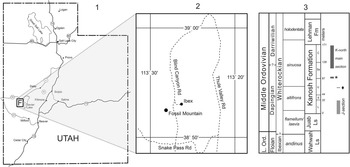
Lower and lower Middle Ordovician rocks of the Pogonip Group exposed in the Basin and Range tectonic province of western and northwestern Utah (Fig. 1.1, 1.2) were subdivided by (Hintze, Reference Hintze1951) into six formations, which, from oldest to youngest, are the House Limestone, the Fillmore Formation, the Wah Wah and Juab Limestones, the Kanosh Shale, and the Lehman Formation (Fig. 1.3). Regional paleontological and sedimentological evidence summarized by Ross et al. (Reference Ross, James, Hintze and Poole1989) suggests that the ca. 335 m thick Pogonip Group was deposited on a vast carbonate platform situated on the western margin of the low-lying Laurentian landmass. The architecture of the platform evolved from a gently (west) dipping ramp during the deposition of the Pogonip Group, to a rimmed shelf during upper Pogonip Group time. The rimmed margin, located in present-day central Nevada, was likely initiated by the vertical build-up of calathid-sponge mounds and oncolite shoals keeping pace with platform deepening during Wah Wah/Juab time (Ross et al., Reference Ross, James, Hintze and Poole1989). Detailed mapping of the lithologic contacts of the Kanosh and Lehman Formations in Utah revealed that they were markedly diachronous, suggesting that these facies prograded at first slowly, and later rapidly basinward as the rate of sea level rise decreased (or sedimentation rate increased) and the platform shallowed. Ross et al. (Reference Ross, James, Hintze and Poole1989) speculated that the organic-rich Kanosh Shale was deposited in a restricted, inner-shelf lagoon-like basin similar to the Upper Cambrian Nolichucky Shale located on the opposite side of the craton (Markello and Read, Reference Markello and Read1981). (The Nolichucky Shale is part of the Conasauga Group that contains acritarchs and cryptospores thought to indicate proximity to freshwater sources; Strother et al., Reference Strother, Wood, Taylor and Beck2004). Eventually the Kanosh lagoon shallowed and platform carbonates of the Lehman Formation were deposited. These were in turn overtopped by westward prograding quartzose sands of the Watson Ranch Quartzite and younger units.
Location map and biostratigraphic framework of sampled sections. (1) State of Utah, “F” marks the location of Fossil Mountain which is shown in detail in (2); (2) detailed map view showing the location of Fossil Mountain; (3) general stratigraphic and biostratigraphic framework for the samples collected for this report. Kanosh Members at Hintze’s K section are: L (Lower olive shale and calcarenite), S (Silty limestone), U (Upper olive shale and calcarenite), Ss (Sandstone and Shale), and C (Calcisiltite). The diamond indicates the position of samples BP09-88, 89 and the star indicates the position of samples BS08-15, 16. See text for further explanation.

Lithologically, the Pogonip Group is composed of a heterogeneous mix of relatively thin-bedded carbonates and clastics, which rest conformably on the thick-bedded limestones of the underlying Notch Peak Formation. The House Limestone is a finely crystalline and fossiliferous ledge-forming unit whereas the overlying Fillmore Formation is composed of a fossiliferous and heterogeneous mix of organic shales, calcareous siltstones, siliceous clastic limestones, and intraformational conglomerates. The Wah Wah and Juab formations are composed of silty limestones with thin interbeds of calcarenite, intraformational conglomerate, and fissile shale. The former contains silicified trilobite sclerites,whereas the latter contains an abundance of orthid brachiopods. Sponge-microbial patch reefs occur sporadically between the basal portion of the Fillmore Formation and the Juab Limestone (Hintze, Reference Hintze1973). The Kanosh is composed of interbedded shales and thin shelly limestones and calcareous sandstones and underlies resistant and thicker limestone beds of the Lehman Formation. The Kanosh is approximately 170 m thick in the Ibex area and was divided by Hintze (Reference Hintze1973) into five informal members based largely on non-shale bedding changes. The Pogonip Group is overlain by the cliff-forming Watson Ranch Quartzite, which weathers dark reddish brown.
Boyer and Droser (Reference Boyer and Droser2003) determined that storm processes concentrated most shell beds in the Kanosh and Lehman formations and by analogy, both formations were likely deposited in shelf waters above maximum storm wave base. Fair weather “background” conditions in the Kanosh were characterized by the deposition of laminated siliciclastic mudstones up to several meters thick, often containing few sedimentary structures, little evidence of bioturbation, and a sparse fauna of ostracods, trilobites, and graptolites. In contrast, the interbedded shell beds generally average less than 11 cm thick. They are commonly dominated by one or two species of orthid brachiopods, although a range of storm bed types, from monotypic accumulations of ostracods winnowed from background deposits to highly abraded polytaxic grainstones, also occur. Some of these firm, storm-related substrates were encrusted early on by stalked crinoids and bryozoa to form hardground communities in the lower Kanosh Shale (Wilson et al., Reference Wilson, Palmer, Guensburg, Finton and Kaufman1992). Bedding types in the Lehman Formation are similar, except that the number of facies is reduced, background mudstones are carbonate-rich instead of siliciclastic-rich, and shell beds are dominated by restricted marine mollusks instead of brachiopods. From an analysis of the distribution of these bed types, Boyer and Droser (Reference Boyer and Droser2003) identified four distinct distal to proximal shallowing-up cycles in an overall shallowing trend that ranges through the two formations.
Biostratigraphy
Lower and Middle Ordovician rocks in Utah have been the subject of numerous biostratigraphic studies since the late 1940s, using primarily invertebrate fossils to establish mostly intrabasinal correlations (e.g. Ross, Reference Ross1949; Hintze, Reference Hintze1952, Reference Hintze1973). These correlations were refined and extended globally by Braithwaite (Reference Braithwaite1976), who collected graptolites throughout the Pogonip Group and placed the Whiterockian Series boundary between the Wah Wah and Juab Limestones. The overlying Kanosh Shale was assigned to the Llanvirn-Llandeilo based on Didymograptus bifidus in the lower 91 meters of this unit, but Ross and James (Reference Ross and James1987) questioned this taxonomic determination.
In an extensive study of the conodonts of the Pogonip Group in the Ibex area, Ethington and Clark (Reference Ethington and Clark1981) identified a succession of unique elements that later proved to have global time significance (Webby et al., Reference Webby, Paris, Droser and Percival2004; Bergström et al., Reference Bergström, Chen, Gutierrez-Marco and Dronov2009). Tripodus laevis and Microzarkodina flabellum first occur approximately 4 and 1 m, respectively, below the top of the Wah Wah Formation. Their first appearances mark the base of the Whiterockian Series boundary in North America, although comparisons with graptolites in nearby sections suggest they may in fact denote a horizon in the uppermost Floian Stage (Bergström et al., Reference Bergström, Chen, Gutierrez-Marco and Dronov2009). The T. laevis- M. flabellum assemblage extends through the Juab Limestone and is replaced in succession by the Histiodella altifrons zone in the lowermost Kanosh Shale, H. sinuosa zone 66 m above the base of the Kanosh, and H. holodentata zone beginning in the lowermost Lehman Formation and extending into the basal part of the Watson Ranch Quartzite. As such, the uppermost Wah Wah to the middle part of the third member of the Kanosh is Dapingian, followed by the Darriwilian in the upper Kanosh to Watson Ranch Quartzite. The biostratigraphy of the collected sections is summarized in Figure 1.3.
Material and methods
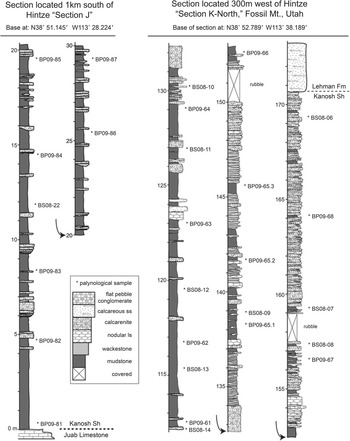
Samples were collected in 2008 and 2009 from two sections of the Kanosh Shale in the Ibex area of the Confusion Range of western Utah (Figs. 1.3, 2). The sections were first described by Hintze (Reference Hintze1973), including the lower half of the Kanosh near Hintze “Section J” (N38° W113°), and the upper half of the Kanosh exposed at Hintze “Section K-North” on the north side of Fossil Mountain (N38° 52.789', W113° 28.189'). At Section J, eight samples (BP09-81 to 87 and BS08-22) were collected from 62 m of rock immediately above the top of the Juab Limestone, representing the lower part of the Kanosh Shale. At Section K-North, 19 samples were collected from the upper half of member four (“Sandstone and Shale Member”) through all of member 5 (“Calcisiltite Member”) to the base of the Lehman Formation. Due to poor exposure in this area, four spot samples (BP09-88, 89 and BS08-15, 16) were collected from members three and four (Figs. 1.3, 2). The samples were processed using standard palynological techniques and examined using conventional white light microscopy, transmitted infrared microscopy, and scanning electron microscopy.
Stratigraphic section of the sampled sections showing the positions of the samples used in this report.

Systematic paleontology
Generic and specific taxa are treated under the provisions of the International Code of Botanical Nomenclature (ICBN; Greuter et al., 1988); acritarch genera are grouped according to the informal suprageneric classification of Downie et al. (Reference Downie, Evitt and Sarjeant1963), and then alphabetically within each of the Downie et al. (Reference Downie, Evitt and Sarjeant1963) categories. The informal subgroups of the acritarchs as proposed by Downie et al. (Reference Downie, Evitt and Sarjeant1963) were originally intended, and still function, as strictly morphological categories, which provide a first-order taxonomic framework for the acritarchs. In general, only rarely have taxonomists used these categories as a basis for improving either a biologic understanding of the acritarchs or a more refined supra-generic taxonomy; however, notable exceptions exist even in recent literature (e.g., Mays and Stilwell, Reference Mays and Stilwell2012). The Downie et al. (Reference Downie, Evitt and Sarjeant1963) suprageneric categories, have been generally accepted by several authors, and are still in use mainly in application to paleoenvironmental interpretations of diversity trends of acritarch assemblages. In these studies, acritarchs are generally grouped in morphological classes (thought to reflect different ecological tolerances) in order to analyze their relative abundance fluctuations as function of paleoenvironmental variables (Staplin, Reference Staplin1961; Al-Ameri, Reference Al-Ameri1983; Vecoli, Reference Vecoli2000; Stricanne et al., Reference Stricanne, Munnecke and Pross2006). We consider that there are perfectly good reasons for using suprageneric taxonomic categories to improve our knowledge of acritarch paleobiology; therefore, we follow this approach.
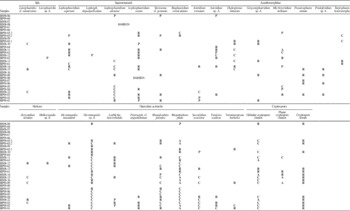
Abundance values are illustrated in Table 1 and are expressed semiquantiatively as follows: present (P), 1–2 specimens; rare (R), 3–5 specimens; common (C), 5–15 specimens; abundant (A), >15 specimens. These abundance values have been evaluated based on the amount of specimens in a particular palynological slide; no absolute palynomorph counting on a standardized sample size was performed on our material. Measurements were taken on selected, well-preserved specimens; the number of measured specimens varied according to the abundance of each taxon, but care has been taken to select—when possible—a large enough population to account for the observed morphometric variability. New species are proposed only where a minimum of ten well-preserved specimens is available. In case of not perfectly spherical vesicle, the vesicle diameter refers to the observed maximum diameter.
Distribution of acritarch and cryptospore taxa in the samples of the Kanosh Shale at Fossil Mountain, Utah. The abundance values are estimated on the number of specimens observed in palynological slides from each sample. The following notations apply: P, present (1–2 specimens); R, rare (3–5 specimens); C, common (5–15 specimens); A, abundant (>15 specimens).

Type specimens are curated at the Harvard University Paleobotanical Collections (HUPC) in Cambridge, Massachusetts. Other materials are housed at the Paleobotany Laboratory at Weston Observatory in Weston, Massachusetts and at the Départment des Sciences de la Terre, USTL, Villeneuve D’Ascq, France.
Domain Eucarya Woese et al., 1990
Kingdom Protoctista Hogg, Reference Hogg1860
Informal Group Acritarcha Evitt, Reference Evitt1963
Informal Subgroup Sphæromorphitae Downie, Evitt and Sarjeant, Reference Downie, Evitt and Sarjeant1963
Description
Simple, spheroidal to subspheroidal, vesicular organic-walled microfossils without inner bodies; vesicle surface smooth to granular in texture but lacking distinct surface ornament or processes; excystment, when apparent, by simple rupture without preformed excystment features (emended from Downie et al., Reference Downie, Evitt and Sarjeant1963).
Remarks
The Sphaeromorphitae is restricted to include forms lacking distinct sculptural elements; surficially sculptured morphotypes are transferred in the newly estabished informal subgroup Superornamenti, see below. We wish to make a distinction between surface morphology that is due to patterns of sculptural type (Superornamenti) versus surface morphology that is due to the primary wall structure itself (Sphaeromorphitae), in characters visible under light microscopy. This will allow taxonomists in the future to use primary wall structure as a morphological character in the description of simple, spherical organic-walled microfossils. In our view, this new approach is an essential first step in addressing the taxonomy of Leiosphaeridia, which has become more and more problematic especially in the study of Precambrian palynomorphs.
Genus Leiosphaeridia Eisenack, Reference Eisenack1958
Leiosphaeridia sp. cf. L. minutissima (Naumova) emend. Jankauskas, Reference Jankauskas1989
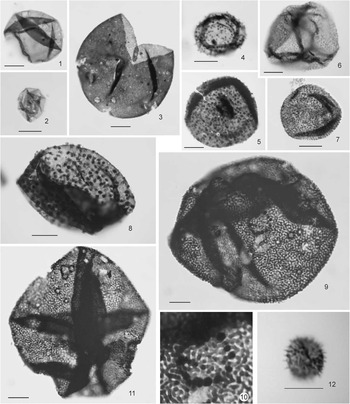
Acritarchs belonging to the informal sub-groups Sphaeromorphitae, Superornamenti, and Acanthomorphitae. All scale bars represent 10 µm, and, where indicated, locations are shown as England Finder coordinates. (1) Leiosphaeridia sp. cf. L. minutissima, slide BS08-10D; (2) Leiosphaeridia sp. cf. L. minutissima, slide BS08-22A; (3) Leiosphaeridia sp. A with a clear median split and a granular wall, sample BP09-62; (4) Lophosphaeridium aspersum, Sample BS08-12; (5) Lophosphaeridium disparipelliculum, sample BS08-12; (6) Lophosphaeridium edenense, sample BS08-22; (7) Lophosphaeridium varum, sample BS08-12; (8) Stictosoma sp. cf. S. gemmata, sample BP09-81; (9) Busphaeridium vermiculatum, holotype, sample BP09-65.2; (10) detail of figure 3.9 showing the dotted “pre-opercular” ring, x2000; (11) B. vermiculatum, isotype, slide BP09-65.2; (12) Asteridium tornatum, sample BS08-22.

Measurements
Vesicle diameter, 15–30 µm (32 specimens).
Material
Samples BS08-10, 15, 22.
Remarks
These specimens are referred to Leiosphaeridia minutissima which is commonly used as a collective taxon for thin-walled leiospheres under 70 µm in diameter. Most species of Leiosphaeridia have very little phylogenetic or systematic value because they are morphologically so simple and so wide-ranging in time and space. This taxon should not be included in the Prasinophyceae because there are no unique morphological features that it shares with prasinophycean phycomata.
Measurements
Vesicle diameter, 52 µm (1 specimen).
Material
Sample BP09-62.
Remarks
A single specimen of Leiosphaeridia with a seemingly granular wall construction, but without clear sculptural elements on the exterior wall. This specimen displays a clear median split.
Occurrence
Kanosh Shale, Utah (Dapingian-Darriwilian).
Informal Subgroup Superornamenti new informal subgroup
Description
Vesicular, spheroidal to sub-spheriodal organic-walled microfossils with simple to complex walls which possess ornament or sculpture on their external surface, but without elongate processes.
Remarks
This informal subgroup is erected to include spheroidal and sub-spheroidal vesicles which are clearly ornamented with surface sculpture visible under light microscopy, but do not possess elongate processes and therefore are not included in the Acanthomorphitae of Downie et al. (Reference Downie, Evitt and Sarjeant1963). We make a distinction between vesicle walls that possess exterior ornament and those whose external surface can be either smooth (psilate) or rough (shagreenate to granular), but whose surface texture is determined by the internal structure of the underlying vesicle wall (Sphaeromorphitae), rather than by the application of a layer of ornament, or sculpture (Superornamenti).
Genus Lophosphaeridium Timofeev, Reference Timofeev1959 ex Downie, Reference Downie1963
Type species
Lophosphaeridium rarum Timofeev, Reference Timofeev1959 ex Downie, Reference Downie1963; by subsequent designation (Downie, Reference Downie1963, p. 630).
Lophosphaeridium aspersum Quintavalle and Playford, Reference Quintavalle and Playford2006
2006 Lophosphaeridium aspersum Quintavalle and Playford, p. 38, pl. 6, figs. 1, 8, 9, 12a-b.
Measurements
Vesicle diameter, 20–40 µm (8 specimens).
Material
Samples BP09-82, 83, 61, 63, 65.2; BS08-10-12, 14, 15, 22.
Remarks
This species is well distinguished by other Lophosphaeridium species by its thin-walled vesicle bearing sparse and irregularly distributed, solid tubercles. The present specimens are virtually identical to the type material from the Canning Basin (Australia: Quintavalle and Playford, Reference Quintavalle and Playford2006) except for a larger dimensional range.
Occurrence
Kanosh Shale, Utah (Dapingian-Darriwilian). Canning Basin, Western Australia: upper Tremadocian through Darriwilian (Quintavalle and Playford, Reference Quintavalle and Playford2006).
Lophosphaeridium disparipelliculum Playford and Martin, Reference Playford and Martin1984
1984Lophosphaeridium disparipelliculum Playford and Martin, p. 202, figs. 7L-P.
2006Lophosphaeridium disparipelliculum; Quintavalle and Playford, p. 38, pl. 7, fig. 2.
Description
Vesicle spherical, single-walled of medium thickness bearing numerous, densely (up to 2 µm apart) and irregularly packed, sometimes basally fused, small verrucae that are typically round, but may form small spines when observed on the vesicle margin.
Measurements
Vesicle diameter, 37 µm; diameter of verrucae, 0.4–1.2 µm (1 specimen).
Material
Sample BS08-12.
Remarks
This specimen is slightly larger in diameter than those of the type population which ranged from 19 to 34 µm; however, in all other respects the characteristic of this form match those of the holotype.
Occurrence
Kanosh Shale, Utah (Dapingian-Darriwilian). Goldwyer and Nita formations, Canning Basin, Western Australia: Darriwilian (upper Arenig – Llanvirn: Playford and Martin, Reference Playford and Martin1984; Quintavalle and Playford, Reference Quintavalle and Playford2006).
Lophosphaeridium edenense Loeblich and Tappan, Reference Loeblich and Tappan1978
1978Lophosphaeridium edenense Loeblich and Tappan, p. 1272, pl. 14, figs. 4–5.
1999Lophosphaeridium edenense; Wicander, Playford and Robertson, p. 15, fig. 8.5.
1985Lophosphaeridium edenense; Jacobson and Achab, p. 184, pl. 3, fig. 6.
Measurements
Vesicle diameter, 36.5–64.0 µm (15 specimens).
Material
Samples BP09-81-85, 89. BS08-06, 13-15, 22.
Remarks
The present specimens conform to the original diagnosis and also to subsequent reports of Lophosphaeridium edenense Loeblich and Tappan, Reference Loeblich and Tappan1978, a species that has been so far described from Upper Ordovician strata mainly from Laurentian localities.
Occurrence
Kanosh Shale, Utah (Dapingian-Darriwilian). Indiana and Kentucky: Caradoc (Sandbian: Loeblich and Tappan, Reference Loeblich and Tappan1978). Kansas: Caradoc-Ashgill (Katian – Hirnantian: Wright and Meyers, Reference Wright and Meyers1981). Vaureal Formation, Anticosti Island, Québec: Richmondian (Katian: Jacobson and Achab, Reference Jacobson and Achab1985). Maquoketa Shale, northeastern Missouri: Ashgill (Katian – Hirnantian: Wicander et al., Reference Wicander, Playford and Robertson1999).
Lophosphaeridium varum Wicander, Playford and Robertson, Reference Wicander, Playford and Robertson1999
1999Lophosphaeridium varum Wicander, Playford and Robertson, p. 15, figs. 9.1, 9.5.
Description
Vesicle spherical, single-walled, bearing very numerous, densely (1 µm apart) and irregularly packed, sometimes basally fused, small verruca-like processes with rounded to bulbous distal extremities.
Measurements
Vesicle diameter, 35–55 µm; basal diameter of tubercles, ca. 0.5 µm; height of processes up to 1 µm (11 specimens).
Material
Samples BP09-81-84, 62, 63, 65.2, 65.3; BS08-10-12, 14, 15.
Remarks
Compared to the type material from the Upper Ordovician Maquoketa Shale of northeastern Missouri, U.S.A. (Wicander et al., Reference Wicander, Playford and Robertson1999), our specimens are somewhat larger and have processes that are less regularly distributed on the vesicle surface, occasionally forming clusters of basally fused units. Lophosphaeridium aequicuspidatum Playford and Martin, Reference Playford and Martin1984 from Middle Ordovician strata of the Canning Basin, Western Australia, differs from the present species by its thinner vesicle wall, and by its smaller and distally acuminate processes.
Occurrence
Kanosh Shale, Utah (Dapingian-Darriwilian). Maquoketa Shale, northeastern Missouri: Ashgill (Katian – Hirnantian: Wicander et al., Reference Wicander, Playford and Robertson1999).
Genus Stictosoma Wicander, Playford and Robertson, Reference Wicander, Playford and Robertson1999
Type species
Stictosoma gemmata Wicander, Playford and Robertson, Reference Wicander, Playford and Robertson1999, by original designation.
Stictosoma sp. cf. S. gemmata Wicander, Playford and Robertson, Reference Wicander, Playford and Robertson1999
1999Stictosoma gemmata Wicander, Playford and Robertson, Reference Wicander, Playford and Robertson1999, p. 24, figs. 13.2, 13.7 (cf.).
Measurements
Vesicle diameter, 30.5–35 µm (2 specimens).
Material
Samples BP09-81, 83, 89, 65.2; BS08-06, 11.
Remarks
All distinctive morphological characters of Stictosoma gemmata Wicander, Playford and Robertson, Reference Wicander, Playford and Robertson1999 are recognized in the present specimens which are, nonetheless considerably smaller than S. gemmata, originally described from the Ashgill (Katian-Hirnantian) Maquoketa Shale of northeastern Missouri, U.S.A. (Wicander et al., Reference Wicander, Playford and Robertson1999).
Occurrence
Kanosh Shale, Utah (Dapingian-Darriwilian). Maquoketa Shale, northeastern Missouri: Ashgill (Katian – Hirnantian: Wicander et al., Reference Wicander, Playford and Robertson1999).
Busphaeridium new genus
Type species
Busphaeridium vermiculatum new species, designated herein.
Diagnosis
Spheroidal vesicle of variable size; vesicle wall comprised of sinuous to U-shaped rods forming a space-filling pseudo-reticulum covering the entire vesicle surface.
Etymology
From the Latin prefix bu (large) and sphaera (ball).
Remarks
Some thick sinuous folds appear from the collapsed wall as seen in the fossil form. The wall itself is indistinct. Rather, it appears to be made up of the sculpture, which may be sitting on a very thin membrane. No previously described acritarch genera show the characteritic elongated, sinuous sculptural elements mimicking an irregular reticulum on the vesicle surface as in Busphaeridium. When observed at low magnification, leaving sculptural elements unresolved, some overall similarities could be suggested with a few published genera; however, significant differences can be found, as discussed as follows. Lophosphaeridium Timofeev, Reference Timofeev1959 ex Downie, Reference Downie1963 differs—according to its original diagnosis—in having a thick-walled vesicle wall (ornamented by solid tubercles); as pointed out by Colbath (Reference Colbath1990, p. 116) and Playford et al. (1999, p. 15), sculptural elements of Lophosphaeridium (“tubercules”) are short, stubby, simple processes that are less than twice as long as wide, thus completely different from the sinous rods characteristic for Busphaeridium. Tylosphaeridium Timofeev, Reference Timofeev1966 possesses a tuberculate vesicle wall, and large grooves. Similarly, Orygmatosphaeridium Timofeev, Reference Timofeev1959 has a densely foveate surface and for this it can readily and unambiguously distinguished from Busphaeridium.
Busphaeridium vermiculatum new species
Diagnosis
Spheroidal vesicle of moderate size, the vesicle wall is thin (<0.5 μm) and transparent, and bears tightly arranged, sinuous to U-shaped solid rods, which give an irregularly reticulate appearance to the vesicle wall.
Measurements
Vesicle diameter, 68–82 µm (10 specimens).
Holotype
The specimen illustrated in Figure 3.9, slide BP09-65.2, loc. J36/2, HUPC 65042.
Etymology
From the Latin vermiculatus, wormy.
Material
Sample BP09-65.2, 65.3.
Remarks
The holotype posseses a circular ring of discrete verrucae which appear to represent an opercular collar (Figure 3.10). However, this structure was not observed on many specimens. In addition, there is not a clear indication of a pylome in any specimens. Therefore, we decided to retain Busphaeridium within the Superornamenti, rather than the operculate acritarchs.
Type locality
Fossil Mountain, Utah, section “K-North”, sample BP09-65.2, Kanosh Shale.
Informal Subgroup Acanthomorphitae Evitt, Reference Evitt1963
Genus Asteridium Moczydlowska, Reference Moczydłowska1991
Type species
Asteridium lanatum (Volkova) Moczydlowska, Reference Moczydłowska1991, by original designation.
Remarks
This genus is distinguished from Micrhystridium Deflandre, Reference Deflandre1937, by incorporating small, spheroidal to subspheroidal vesicles bearing solid, spine-like processes. As with Micrhystridium, processes are simple (unbranched) and generally homomorphic.
Asteridium tornatum (Volkova) Moczydlowska, Reference Moczydłowska1991
1964Micrhystridium sp. Volkova, p. 82, pl. 2 fig. 9, pl. 3 figs. 17–19.
1968Micrhystridium tornatum Volkova, p. 21, pl. 4, figs. 1–4, pl. 10, fig. 8.
1991Asteridium tornatum; Moczydlowska, p. 48, pl. 1, figs. A-C.
Measurements
Vesicle diameter, 18–20 µm; length of processes, ca. 0.5–1 µm (ten specimens).
Material
Samples BP09-81, 82; BS08-14, 22.
Remarks
This species is characterized by numerous, densely packed, short, acuminate, spine-like processes evenly distributed on vesicle surface. The present specimens are indistinguishable from those reported from Cambrian strata.
Occurrence
Lower to middle Cambrian of the East European Platform (Poland: Moczydlowska, Reference Moczydłowska1991; Sweden: Vidal, Reference Vidal1981; Russia: Volkova et al., Reference Volkova, Kirjanov, Piscun, Pashkyavichene and Jankauskas1979). UK (Downie, Reference Downie1984). Canada (Alberta: Downie, Reference Downie1982). Greenland (Moczydlowska and Vidal, Reference Moczydłowska and Vidal1986). Kanosh Shale, Utah (Dapingian-Darriwilian). The fundamentally simple morphology of this species makes it likely that its distribution is probably cosmopolitan throughout the Paleozoic.
Asteridium sp. A
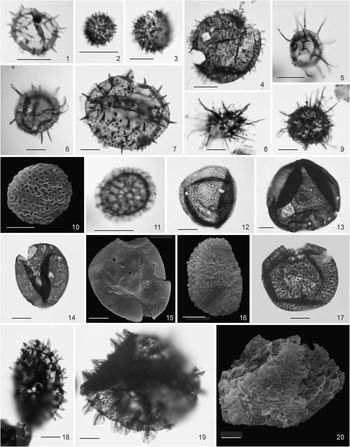
Acritarchs belonging to the informal sub-groups Acanthomorphitae, Herkomorphitae and Operculate Acritarchs. All scale bars represent 10 µm unless otherwise indicated. Where indicated, locations are shown as England Finder coordinates. (1) Asteridium sp. A, sample BS08-12; (2) Digitoglomus minutum, holotype, slide BS08-11C, loc. S42/2; (3) D. minutum, isotype, slide BS08-11D; (4) Gorgonisphaeridium sp A., sample BP09-65.1; (5) Micrhystridium stellatum, sample BS08-11C; (6) Passalosphaera minuta, sample BP09-57; (7) Petaloferidium sp. A, sample BP09-89; (8) Turpisphaera heteromorpha, isotype, sample BP09-65.1; (9) Turpisphaera heteromorpha, holotype sample BP09-65.1 (slide3) loc. P40/3; (10) Dictyotidium vietulum, sample BS08-22; (11) D. vietulum, sample BS08-15; (12) Melikeriopalla sp. A, sample B08-12/B2, loc. E42/3; (13) Dicommopalla macadamii, sample BP09-62, loc. K30; (14) Dicommopalla sp. A, sample BS08-15; (15) Dicommopalla sp. A, sample BP09-82; (16) Loeblichia heterorhabda, sample BS08-15; (17) L. heterorhabda, sample BP09-62; (18) Peteinosphaeridium sp. cf. P. angustilaminae, sample BP09-82, loc. Q40; (19) Rhopaliophora palmata, sample BP09-62; (20) R. palmata, sample BS08-15.

Description
Homomorphic, solid processes, about 20 in number, and scattered somewhat evenly on vesicle surface, very straight, with blunt tips, variable length approximately half of the vesicle diameter.
Measurements
Vesicle diameter, 8–12 µm; width of processes, less than 1 µm; length variable between about 40% and 80% of the vesicle diameter (ten specimens).
Material
BP09-83, 62-64; BS08-06, 11, 12, 14.
Remarks
This species is characterized by straight processes with rounded to mildly acuminate tips, which are sparingly distributed over the vesicle surface. We have not found a match for this form in the acritarch literature. Most Micrhystridium (Asteridium) species are characterized by a moderate to dense covering of spine-like processes, but many of the specimens found throughout the Kanosh Shale have fewer processes. We have not fully characterized these forms; therefore, we refer to them simply as Asteridium sp. A.
Occurrence
Kanosh Shale, Utah (Dapingian-Darriwilian).
Genus Digitoglomus new genus
Type species
Digitoglomus minutum new species, designated herein.
Diagnosis
Vesicle spherical, thin-walled, psilate to scabrate. Processes numerous, cylindrical, solid, simple, straight and distally rounded to bulbous, densey and radially arranged on vesicle vesicle wall.
Etymology
From the Latin digitus (finger) and glomus (ball).
Remarks
This genus accommodates forms with thick, finger-like, distally unbranched projections radiating from a spherical vesicle. The processes are generally straight and thick and can vary in length, but they are never hair-like as in Comasphaeridium Staplin, Jansonius and Pocock, Reference Staplin, Jansonius and Pocock1965, or slender and flexible like in Elektoriskos Loeblich, Reference Loeblich1970b. Filisphaeridium Staplin, Jansonius and Pocock, Reference Staplin, Jansonius and Pocock1965 possesses stiff, solid, distally differentiated (by means of branching or thickening) short spines, which are clearly set off from vesicle surface, and proximally thickened. Similarly, Gorgonisphaeridium Staplin, Jansonius and Pocock, Reference Staplin, Jansonius and Pocock1965 is readily distinguished from Digitoglomus by having numerous, generally short, solid and complexly branched processes which are well differentiated from the vesicle wall. Pachysphaeridium Burmann, Reference Burmann1970 emend. Ribecai and Tongiorgi, Reference Ribecai and Tongiorgi1999 is charachetrized by rounded vesicle bearing numerous short, thick projecting processes with bulbous distal terminations, but differs markedly from Digitoglomus n. gen. by having distinctly striated to fibrous processes that are hollow and never as densely arranged as in the latter.
Digitoglomus minutum new species
Diagnosis
Vesicle spherical, thin-walled, psilate. Processes numerous, densely packed and heteromorphic, with distal terminations rounded to blunt to indistinct and of varying lengths but always less than the vesicle diameter.
Measurements
Vesicle diameter, 8–16 µm; length of processes, 2–3 µm (ten specimens).
Holotype
The specimen illustrated in Figure 4.2, slide BS08-11C, loc. S42/2, HUPC 65843.
Etymology
The Latin minutum referring to the small size of this species.
Material
Samples BP09-65.1; BS08-10-15.
Remarks
This is a small, but distinctive form, with rounded tips on finger-like projections that enclose the vesicle. The vesicle itself is indistinct as it is completely covered by the processes, but seemingly very thin and psilate. Some resemblance can be observed with the previously reported species: Pachysphaeridium cf. rhabdocladium (Lu Lichang) Ribecai and Tongiorgi, Reference Ribecai and Tongiorgi1999 and ?Dilatisphaera sp. A, as reported by Quintavalle and Playford (Reference Quintavalle and Playford2006) from Ordovician strata of the Canning Basin, Australia. However, P. cf. rhabdocladium has hollow processes which freely communicate with the vesicle cavity, and that are significantly less numerous than in Digitoglomus minutum n. sp. ?Dilatisphaera sp. A of Quintavalle and Playford (Reference Quintavalle and Playford2006), has processes that exceed vesicle diameter in lenght and heteromorphic processes that are distally open.
Type locality
Fossil Mountain, Utah, section “K-North”, sample BS08-11, Kanosh Shale.
Genus Gorgonisphaeridium Staplin, Jansonius and Pocock, Reference Staplin, Jansonius and Pocock1965
Type species
Gorgonisphaeridium winslowii Staplin, Jansonius and Pocock, Reference Staplin, Jansonius and Pocock1965, by original designation.
Gorgonisphaeridium sp. A
Description
Spherical vesicle, single-walled, with granulate surface sculpture. Numerous (100–150) broadly conical, discrete, solid processes with simple acuminate to evexate distal extremities, regularly distributed on vesicle surface. Vesicle wall appears thicker and darker than process wall. Probable excystment structure in the form of split of vesicle wall.
Measurements
Vesicle diameter 29 µm; length of processes, 2–3 µm (five specimens).
Material
Samples BP09-81, 89, 65.1; BS08-13.
Remarks
Gorgonisphaeridium Staplin, Jansonius and Pocock, Reference Staplin, Jansonius and Pocock1965 has a rather simple morphology and it is often difficult to clearly distinguish among the more than 50 species that are currently described. We therefore prefer to leave the small number of specimens in open nomenclature. The following Ordovician Gorgonisphaeridium species show general common morphological traits but also some differences with respect to the Kanosh specimens: G. antiquum Loeblich and Tappan, Reference Loeblich and Tappan1978, has more slender and flexible processes with acuminate tips, and a more rigid and thicker wall; G. crebrum Quintavalle and Playford, Reference Quintavalle and Playford2006, has a psilate vesicle wall which is undifferentiated from the walls of the processes; G. pusillum Playford and Wicander Reference Playford and Wicander1988, has a much smaller psilate vesicle.
Occurrence
Kanosh Shale, Utah (Dapingian-Darriwilian).
Genus Micrhystridium Deflandre, Reference Deflandre1937
Type species
Micrhystridium incospicuum (Deflandre) Deflandre, Reference Deflandre1937; by original designation.
Remarks
We follow Wicander et al. (Reference Wicander, Playford and Robertson1999) and Quintavalle and Playford (Reference Quintavalle and Playford2006) concerning the interpretation of Micrhystridium as to incorporate forms possessing spherical to polyhedric, unilayered vesicles bearing simple, hollow, and acuminate processes opening into vesicle cavity. But we also follow the generally accepted scheme of including in this genus only those specimens which are less that 20 µm in overall diameter.
Micrhystridium stellatum Deflandre, Reference Deflandre1945
1945Micrhystridium stellatum Deflandre, p. 65, pl. 3, figs. 16–19.
1970Micrhystridium stellatum emend. Lister, pl. 9, figs. 1–17, pl. 10, fig. 10.
1976Micrhystridium stellatum; Achab, p. 1312, pl. 1, figs. 13, 14.
1992Micrhystridium stellatum; Eley and Legault, p. 85, pl. 2, fig. 12.
2013Micrhystridium stellatum; Lei, Servais, Feng and He, p. 335, pl. 2, fig. 19.
Measurements
Overall diameter, 18–20 μm; number of processes, 6–10 (15 specimens).
Material
Samples BP09-83-85, 62, 63, 65.3. BS08-11, 14.
Remarks
The exquisitely well-preserved specimens recovered from the Kanosh Shale are remarkably similar to the original images published by Deflandre (Reference Deflandre1945) and for this reason we think they can be legitimately identified at the species level. This appears to be the case in spite of the problem that other apparent species of Micrhystridium, found in the Kanosh Shale, do not fit at all into the species categories constructed by Deflandre (Reference Deflandre1945).
Occurrence
Kanosh Shale, Utah (Dapingian-Darriwilian). Ordovician of Belgium (Martin, Reference Martin1966). Widespread in Silurian to Devonian (e.g., North America: Cramer, Reference Cramer1968; Eley and Legault, Reference Eley and Legault1992. UK, France and Belgium: Downie, Reference Downie1963; Martin, Reference Martin1966; Stockmans and Willière, Reference Stockmans and Willière1963; Molyneux et al., Reference Molyneux, Barron and Smith2008. Baltic region: Gelsthorpe, Reference Ghelsthorpe2004; Mullins et al., Reference Mullins, Aldridge and Siveter2004. North Africa: Magloire, Reference Magloire1967; Moreau-Benoît, Reference Moreau-Benoît1984). Carboniferous and Permian of South China (Gao, Reference Gao1986; Lei et al., Reference Lei, Servais, Feng and He2013). Permian of Germany (Schaarschmidt, Reference Schaarschimdt1963). Triassic of England (Van de Schootbrugge, 2007).
Genus Passalosphaera Playford and Wicander, Reference Playford and Wicander1988
Type species
Passalosphaera minuta Playford and Wicander, Reference Playford and Wicander1988, by original designation.
Passalosphaera minuta Playford and Wicander, Reference Playford and Wicander1988
1988Passalosphaera minuta Playford and Wicander, p. 20, figs. 10D-I.
Description
Vesicle spherical, with a highly granulated surface possessing well-spaced elongate processes which taper quite gradually. Processes themselves vary in length and may be straight, sinuous or recurved near the tip. Process tips may be acuminate to slightly rounded. Excystment features not observed.
Measurements
Vesicle diameter, 25–33 µm; number of processes, 8–15; length of processes, 6–8 µm; basal diameter of processes, 1.5–2 µm (five specimens).
Material
Samples BP09-83, 86, 87, 89; BS08-15.
Occurrence
Kanosh Shale, Utah (Dapingian-Darriwilian). Coolibah Formation of southeastern Georgina Basin, Queensland: Floian-Dapingian (lower to middle Arenig: Playford and Wicander, Reference Playford and Wicander1988); Dawan Formation, Daping, Hubei Province, South China: Floian (lower-middle Arenig: Brocke, Reference Brocke1997).
Genus Petaloferidium Jacobson, Reference Jacobson1978
Type species
Petaloferidium stigii Jacobson, Reference Jacobson1978, by original designation.
Petaloferidium sp. A
Description
Vesicle spherical, psilate, single-layered, thick-walled, bearing evenly distributed verrucae, 1–2 μm in diameter and 4–5 μm apart. Processes homomorphic, apparently solid, with broadly cylindrical trunk, commonly widening in the middle part of the trunk and narrowing near distal extremities. Process tips clearly differentiated from process trunk, conspicuously bulbose to manate. Excystment structure in form of slit in vesicle wall.
Measurements
Vesicle diameter, 25–33 µm; number of processes, 8–30; length of processes, 6–8 µm; basal diameter of processes, 1.5–2 µm (six specimens).
Material
Samples BP09-83, 86, 89; BS08-15.
Remarks
The observed specimens bear an overall resemblance to Petaloferidium bulliferum Yin, Di Mila and Tongiorgi, Reference Yin, Di Milia and Tongiorgi1998 described from Lower Ordovician (Floian) strata of South China (Yin et al., Reference Yin, Di Milia and Tongiorgi1998; Tongiorgi et al., Reference Tongiorgi, Yin and Di Milia2003), but this latter shows more numerous and much shorter processes and an unsculptured vesicle wall. Petaloferidium comptum Playford and Martin, Reference Playford and Martin1984 originally described from Middle Ordovician strata of northwestern Australia, is also comparable to our specimens, but differs in having fewer and much larger processes, which are hollow, and less globular distal terminations.
Occurrence
Kanosh Shale, Utah (Dapingian-Darriwilian).
Turpisphaera new genus
Type species
Turpisphaera heteromorpha new species, designated herein.
Diagnosis
Vesicle spherical to subspherical; vesicle wall indistinct, strongly and irregularly granular, not clearly differentiated from processes. Processes markedly heteromorphic, solid, of different lengths and thickness, stiff or slender, hair-like. No excystment structure.
Etymology
From the Latin turpis (ugly) and sphaera (ball).
Remarks
The genus is erected to accommodate spherical to subspherical vesicles generally of small dimensions, without a clearly delineated wall, possessing highly heteromorphic processes and variable ornament, ranging from stiff, hair-like processes to granules, verrucae and sub-rugulae. These acritarchs have the appearance of being agglutinated organic forms.
Comasphaeridium Staplin, Jansonius and Pocock, Reference Staplin, Jansonius and Pocock1965, and Elektoriskos, Loeblich, 1970, may look superficially similar to Turpisphaera n. gen. in some of their smaller morphotypes, but they differ markedly from it because of their homomorphic processes, and distinct, vesicle walls, generally bearing unconspicuous sculptural elements.
Ferromia (Vavrdová) emend. Martin, Reference Martin1996 has distinctly granulated vescle and may bear two orders of slender processes of different lengths; however, it differs markedly from Turpisphaera n. gen. because of the preferential arrangemement of its homomorphic larger processes in a single, equatorial plane, and for the presence of a characteristic lenticular to circular cyclopylome.
Turpisphaera heteromorpha new species
Diagnosis
Vesicle spherical; vesicle wall diaphanous, not clearly delineated. Longer, stiff hair-like processes, which may be elongate conical to sinuous in shape, interspersed with variable verrucae that range from irregular gemmae, to short rugulae, but not of any particularly organized form and covering the entire surface. No excystment structure.
Measurements
Vesicle diameter, 19–22 µm; length of processes, 2–12 µm (ten specimens).
Holotype
The specimen illustrated in Figure 4.9, sample BP09-65.1 (slide 3) loc. P40/3, HUPC 65844.
Etymology
The Latin hetero and morphos referring to the variable sculpture ornamenting the wall.
Material
Sample BP09-61, 65.1, 65.2; BS08-13.
Remarks
Only a few specimens were observed. These forms are not similar to previously described acritarchs, although they do possess some of the elements of Elektoriskos pogonius Loeblich, Reference Loeblich1970b which has an irregularly granulated surface, but which is much larger and with more uniform processes.
Type locality
Fossil Mountain, Utah, section “K-North”, sample BP09-65.1, Kanosh Shale.
Informal Subgroup Herkomorphitae Downie, Evitt and Sarjeant, Reference Downie, Evitt and Sarjeant1963
Remarks
Many taxa belonging to this acritarch subgroup are now more or less routinely treated as prasinophyte algae (e.g. Colbath and Grenfeld, Reference Colbath and Grenfell1995; Guy-Olshen, Reference Guy-Ohlson1996). Tappan (Reference Tappan1980) presents a liberal treatment of fossil taxa, which she considered to belong to the prasinophycean algae. This assignment is based on morphological similarities to the phycoma stage of living species. However, the direct morphological comparison between fossil taxa and living species appears to be rather limited (Cohen et al., Reference Cohen, Knoll and Kodner2009). There is a fundamental problem with the ad hoc inclusion of Cymatiosphaera and Dictyotidium in the prasinophytes, because these acritarchs, are both narrowly conscripted in size and they are small. Prasinophyte phycomata in the modern plankton are much larger and increase in size during development.
Downie et al. (Reference Downie, Evitt and Sarjeant1963) placed Cymatiogalea Deunff, Reference Deunff1961 within the Herkomorphitae, even though they characterized the subgroup as inoperculate or with a simple, circular pylome. Servais and Eiserhardt (Reference Servais and Eiserhardt1995) included Cymatiogalea with their creation of the “Galeate” acritarchs, effectively removing this taxon from the Herkomorphitae.
Genus Dictyotidium Eisenack, Reference Eisenack1955 emend. Staplin, Reference Staplin1961
Type species
Dictyotidium dictyotum (Eisenack) Eisenack, Reference Eisenack1955, by original designation.
Dictyotidium vietulum Playford and Wicander, Reference Playford and Wicander1988
1988Dictyotidium vietulum Playford and Wicander, p. 13, figs. 6A–F.
2006Dictyotidium vietulum; Quintavalle and Playford, p. 18, pl. 1, figs. 3, 4.
Measurements
Vesicle diameter, 11–18 µm (ten specimens).
Material
Samples BP09-83, 89; BS08-12, 15, 22.
Remarks
The small dimensions and the fine reticulum on vesicle surface are the distinguish characters of this species, as described and illustrated by Playford and Wicander (Reference Playford and Wicander1988) and Quintavalle and Playford (Reference Quintavalle and Playford2006).
Occurrence
Kanosh Shale, Utah (Dapingian-Darriwilian). Canning Basin, Western Australia: late Tremadocian through Darriwilian (Quintavalle and Playford, Reference Quintavalle and Playford2006). Georgina Basin, Queensland: lower to middle Arenig (Floian; Playford and Wicander, Reference Playford and Wicander1988).
Genus Melikeriopalla Tappan and Loeblich, Reference Tappan and Loeblich1971
Type species
Melikeriopalla amydra Tappan and Loeblich, Reference Tappan and Loeblich1971, by original designation.
Melikeriopalla sp. A
Measurements
A single specimen measured 31 µm in diameter. This is considerably smaller than M. amydra, which ranges from 45 to 71 µm.
Material
Sample BS08-12.
Remarks
This is a distinctive acritarch with a thick, shallow reticulum forming polygonal “honeycomb-shaped” patterns, or fields, which may include a single dark spot (pustule) within each field. The occurrence of a central pustule in many of the fields is also apparent in the holotype of M. amydra Tappan and Loeblich, Reference Tappan and Loeblich1971 (plate 6, fig.3), so this may be an overlooked character that helps to distinguish Melikeriopalla from Dictyosphaera. There is no compelling aspect of morphology that necessarily pairs this specimen with the extant Prasinophyceae.
Occurrence
Kanosh Shale, Utah (Dapingian-Darriwilian).
Informal Subgroup Operculate Acritarchs new informal subgroup
Description
Vesicular organic-walled microfossils possessing at least one pre-formed circular apical opening, or pylome.
Remarks
The occurrence of a pre-formed excystment structure is considered to be a discrete attribute tracking cytoskeletal control that is attributable to a eukaryotic level of cellular organization (Knoll et al., Reference Knoll, Javaux, Hewitt and Cohen2006). This does not say much with regard to biological affinities within the eukaryotes, but pylomes are distinctive enough structures to be unambiguously recognized in many different acritarch species. As originally proposed by Lister (Reference Lister1970, pp. 30–40) in his exhaustive review of acritarch excystment structures, we make distinction between two types of large circular to polygonal excystment structures that are commonly observed in Paleozoic acritarchs: large, polygonal to subpolygonal near-equatorial opening of the Cymatiogalea – Stelliferidium type (belonging to the Galeate plexus of Servais and Eiserhardt, Reference Servais and Eiserhardt1995), and the small, apical rounded pylome which characterizes the Operculate Acritarchs subgroup as defined here. These differences in excystment structure are considered as significant from the point of view of functional morphology and to reflect fundamental paleobiological differences. The morphological resemblance of galeate acritarchs to certain dinoflagellate cysts, possibly reflecting biological affinities, has been previously noted by many authors (Lister, Reference Lister1970; Rasul, Reference Rasul1974; Tappan, Reference Tappan1980; Martin, Reference Martin1993; Colbath and Grenfell, Reference Colbath and Grenfell1995; Servais et al., Reference Servais, Stricanne, Montenari and Pross2004) and we concur with such views. The Operculate Acritarchs, however, differ from the Galeate plexus not only by the shape, position and dimension of the apertural elements, but also for lacking some diagnostic features of this latter informal group, such as tabulation patterns formed by alignment of process or sculptural elements along the sides of polygonal fields (e.g., Cymatiogalea), and plate-like, polygonal meshes delineated by linear sculptural elements as in typical Stelliferidium. A different biological affinity can thus be inferred for the Operculate Acritarchs.
The extant green algae (Chlorophyta), which is one of the major groups of algae that provides potential extant homolog of acritarchs (as cysts), do not form cysts today with the distinctive apertures observed in the Operculate Acritarchs; therefore is seems likely (although alternative views cannot totally dismissed) that this group belong to a non-chlorophyte (including Prasinophyceae) lineage. In fact, there is little compelling evidence to consider the Operculate Acritarchs to be the remains of algae at all. The reason is that sexual cycles in the modern algae mostly result in the release of flagellated zoospores, which occurs after the disintegration of the cyst wall, or by simple rupture. Numerous heterotrophic protists (other than dinoflagellates), on the other hand, are known to produce cysts of various sorts in which an excysting protoplast exits through a pre-formed pore. Perhaps the best example of this can be found in the testate amoebae, a well-characterized group that has a fossil record extending to the Proterozoic (Porter, Reference Porter2006).
Remarks on the Dicommopalla-Rhopaliophora acritarch plexus
Palynological assemblages of the Kanosh Shale at Fossil Mountain are dominated by operculate acritarchs which are either devoid of processes or bear a substantially variable number of small, tubular to prismatic, processes that always show a thin and transparent wall, much thinner than the vesicle walls. In most of the observed specimens, it is possible to discern, especially around the border of the pylome or in corresponding cracks in damaged vesicles, that the vesicle wall is two-layered. In these cases, a thin and transparent external layer appears to adhere closely to a thicker, more rigid, and darker inner layer. The pylome is often rimmed by a smooth elevated lip or, more rarely, by a circlet of diminutive, closely spaced processes. The observation of morphological variation within a population of several hundred specimens shows that a continuum exists among three main morphological types: (1) operculate “smooth” forms, without any processes; (2) operculate forms with numerous (50–100), relatively small processes, tubular or prismatic in shape; and (3) operculate forms bearing fewer (30–60) larger, tubular-prismatic processes. When present, the processes are clearly distinguished from the vesicle; have a very thin, transparent wall; and do not communicate with the vesicle internal cavity. Although difficult to observe, it is very likely that the processes arise from the thin, external layer of a two-layered vesicle wall. These three morphological groups can be initially considered to correspond broadly to the three taxa: Dicommopalla, Asketopalla, and Rhopaliophora. Originally, these three genera were very narrowly defined (in Loeblich, Reference Loeblich1970a; Loeblich and Tappan, Reference Loeblich and Tappan1969; Tappan and Loeblich, Reference Tappan and Loeblich1971, respectively), based on characters such as surface sculpture, which, in our opinion, are not appropriate characters for genus rank. If Dicommopalla can be easily distinguished based on the absence of processes, Asketopalla and Rhopaliophora share essentially identical gross morphological features, including overall dimensions, and number, dimension and shape of processes. However, Asketopalla was originally described (Loeblich and Tappan, Reference Loeblich and Tappan1969) as possessing a two-layered vesicle wall, whereas there is no mention of wall stratification in the original generic description for Rhopaliophora (Tappan and Loeblich, Reference Tappan and Loeblich1971, p. 404).
Playford and Martin (Reference Playford and Martin1984) noted the close morphological resemblance of Asketopalla and Rhopaliophora, as well as the difficulty of deciphering the layered nature of the wall of these acritarchs. They emended Rhopaliophora essentially to allow some more morphological intrageneric variability and to define a uni-layered structure of its vesicle wall. Playford and Martin (Reference Playford and Martin1984, p. 210) did not exclude the possibility of Asketopalla and Rhopaliophora being synonyms, with the former genus then taking priority. However, without a formal revision of the respective type species, the two genera have been retained as separate. In our material, several specimens of the plexus clearly show a bi-layered vesicle wall, similar to what has been observed by Tongiorgi et al. (Reference Tongiorgi, Yin and Di Milia2003) in Middle Ordovician Chinese acritarch assemblages. However, in several examples from the literature (e.g., Playford and Martin, Reference Playford and Martin1984; Playford and Wicander, Reference Playford and Wicander1988; Tongiorgi et al., Reference Tongiorgi, Yin and Di Milia2003) “Asketopalla”-like morphotypes (i.e., characterized by numerous, small, tubular processes, often collapsed and shrunken to give rise to “petaloid” processes showing a X- or Y-shaped cross section) have been usually attributed to Rhopaliophora pilata (Combaz and Peniguel) emend. Playford and Martin, Reference Playford and Martin1984. In the present work, we have also adopted this decision, pending a complete and formal revision of the type specimens of Asketopalla and Rhopaliophora.
Accordingly, we attributed process-lacking smooth forms to Dicommopalla sp. A, forms with numerous small processes to Rhopaliophora pilata, and forms with fewer and larger, petaloid processes to R. palmata. However, numerous morphological transitions exist among these three end-members. For example, there are transitional forms between Dicommopalla sp. A and Rhopaliophora pilata in which only few, small processes are irregularly distributed on vesicle surface, as well as numerous specimens that cannot clearly be attributed to R. pilata or R. palmata.
Genus Dicommopalla Loeblich, Reference Loeblich1970a emend.
Type species
Dicommopalla macadamii Loeblich, Reference Loeblich1970a, by original designation.
Diagnosis
Spherical to ellipsoidal vesicle, wall thin to thick, bi-layered, surface smooth, scabrate, granulate, or rugulate, bearing one or two, circular operculate pylomes with a simple or thickened margin, forming a collar. (Emended from Loeblich, Reference Loeblich1970a)
Remarks
The restrictive original diagnosis of Dicommopalla is here emended in order to allow for larger morphological variability with respect to wall thickness, surface appearance, and pylome morphology.
Dicommopalla macadamii Loeblich, Reference Loeblich1970a
1970Dicommopalla macadamii Loeblich, p. 39, text-figs. 1–12.
1999Dicommopalla macadamii; Vecoli, p. 40, pl. 6, fig. 5.
Measurements
Vesicle diameter, 35–45 µm (two specimens).
Material
Samples BP09-81, 82, 62, 65.2; BS08-11.
Remarks
This species of Dicommopalla is distinguished by the presence of a wrinkled, thin and transparent outer membrane enveloping a darker inner body bearing a rounded pylome.
Occurrence
Kanosh Shale, Utah (Dapingian-Darriwilian). Upper Ordovician (Hirnantian) of Algeria (Argiles Microconglomératiques, Vecoli, Reference Vecoli1999) and Tunisia (Djeffara Formation; Vecoli, Reference Vecoli1999). Upper Ordovician of North America; Indiana (Dillsboro Fm.; Loeblich, Reference Loeblich1970a); Kentucky (Jacobson, Reference Jacobson1978); Labrador Sea (Legault, Reference Legault1982); Missouri (Maquoketa Shale; Miller, Reference Miller1991). Middle Ordovician of Estonia (Uutela and Tynni, Reference Uutela and Tynni1991).
Dicommopalla sp. A
Description
Vesicle spherical, thick-walled, devoid of processes. Wall bi-layered with external layer smooth to scabrate to microrugulate. Rounded pylome, commonly with simple border, sometimes surrounded by an elevated rim, or collar; occasionally a second, generally smaller, pylome may be present, located opposite to the main pylome.
Measurements
Vesicle diameter, 35–50 µm; pylome diameter, 8–15 µm (ten specimens).
Material
Occurring in all productive samples.
Remarks
The double-layering of vesicle wall is not always an obvious feature and it was observed only in a few specimens under the optical microscope. The vesicle’s outer layer, when visible, appears considerably thinner than the inner one. Overall, the vesicle wall appears dark in color probably due to the thickness of inner layer, and it appears rather rigid (based on absence of arcuate folds). These features prevent the present specimens to be assigned to the only two known species of Dicommopalla (D. macadamii Loeblich, Reference Loeblich1970a, and D. rissae Bunner and Legault, Reference Bunner and Legault1989).
Occurrence
Kanosh Shale, Utah (Dapingian-Darriwilian).
Genus Loeblichia Playford and Wicander, Reference Playford and Wicander1988
Type species
Loeblichia heterorhabda Playford and Wicander, Reference Playford and Wicander1988, by original designation.
Loeblichia heterorhabda Playford and Wicander, Reference Playford and Wicander1988
1988 Loeblichia heterorhabda Playford and Wicander, p. 18, figs. 8B–J, 9.
2003 Loeblichia heterorhabda; Tongiorgi, Yin, and Di Milia, p. 74-, pl. 11, fig. 6, pl. 12, figs. 1, 2.
Measurements
Vesicle diameter, 40–52 µm (six specimens).
Material
Samples BP09-82, 83, 62, 63, 65.2; BS08-11, 12, 15, 22.
Remarks
Loeblichia is similar in overall morphology to certain Lophosphaeridium species characterized by numerous, densely packed short processes (ca. 1 µm in length), but it can be clearly distinguished by the presence of a circular pylome. The present specimens closely resemble the type material of Loeblichia heterorhabda from the Georgina Basin of Australia (Playford and Wicander, Reference Playford and Wicander1988).
Occurrence
Kanosh Shale, Utah (Dapingian-Darriwilian). Coolibah Formation of southeastern Georgina Basin, Queensland, Australia: Floian-Dapingian (lower to middle Arenig: Playford and Wicander, Reference Playford and Wicander1988); Dawan Formation, Daping, Hubei Province, South China: Floian (lower to middle Arenig: Tongiorgi et al., Reference Tongiorgi, Yin and Di Milia1995, Reference Tongiorgi, Yin and Di Milia2003).
Genus Peteinosphaeridium Staplin, Jansonius and Pocock, Reference Staplin, Jansonius and Pocock1965 emend. Playford, Ribecai and Tongiorgi, Reference Playford, Ribecai and Tongiorgi1995
Type species
Peteinosphaeridium bergstroemii Staplin, Jansonius and Pocock, Reference Staplin, Jansonius and Pocock1965 emend. Playford, Ribecai and Tongiorgi, Reference Playford, Ribecai and Tongiorgi1995, by original designation.
Peteinosphaeridium sp. cf. P. angustilaminae Playford, Ribecai and Tongiorgi, Reference Playford, Ribecai and Tongiorgi1995
1995 Peteinosphaeridium angustilaminae Playford, Ribecai and Tongiorgi, p. 17, pl. 1, figs. 1–3, text-fig. 6A1 (cf.).
2003 Peteinosphaeridium angustilaminae; Tongiorgi, Yin and Di Milia, Reference Tongiorgi, Yin and Di Milia2003, p. 87, pl. 18, figs. 7–8a, b (cf.).
Measurements
Vesicle diameter 46 (51) 60 μm; length of processes 8–10 μm, diameter of pylome 10–15 μm (ten specimens).
Material
Samples BP09-81-84.
Remarks
Our specimens are similar to the specimens of P. angustilaminae illustrated by Tongiorgi et al. (Reference Tongiorgi, Yin and Di Milia2003) from Middle Ordovician strata of South China from which they differ mainly by not showing sculptured process lamina edges. The type material of P. angustilaminae, from the Middle Ordovician of Sweden, shows much longer (up to 30 μm) and strongly sculptured (echinate to baculate) processes. Peteinosphaeridium septuosum Wicander, Playford and Robertson, Reference Wicander, Playford and Robertson1999 displays a similar overall aspect, but differs by having simple (non-furcate) processes.
Occurrence
Kanosh Shale, Utah (Dapingian-Darriwilian)
Genus Rhopaliophora Tappan and Loeblich, Reference Tappan and Loeblich1971, emend. Playford and Martin, Reference Playford and Martin1984
Type species
Rhopaliophora foliatilis Tappan and Loeblich, Reference Tappan and Loeblich1971, by original designation.
Rhopaliophora palmata (Combaz and Peniguel, Reference Combaz and Peniguel1972) emend. Playford and Martin, Reference Playford and Martin1984
1972Peteinosphaeridium palmatum Combaz and Peniguel, p. 136, pl. 2, figs. 4, 9–12.
1972Peteinosphaeridium palmatum var. dilatum Combaz and Peniguel, p. 136, pl. 2, fig. 9.
1972Peteinosphaeridium palmatum var. strictum Combaz and Peniguel, p. 136, pl. 2, fig. 10.
1984Rhopaliophora palmata emend. Playford and Martin, p. 210, figs. 9A–N.
1988Rhopaliophora palmata; Playford and Wicander, p. 25, figs. 13G–L.
1999Rhopaliophora palmata; Rubinstein, Toro and Waisfeld, pl. 2, fig. 4.
2003Rhopaliophora palmata; Tongiorgi, Yin and Di Milia, p. 105, pl. 29, fig.6, pl. 3O, figs. 1, 2.
2006Rhopaliophora palmata; Quintavalle and Playford, p. 53, pl. 10, figs. 4, 5.
Measurements
Vesicle diameter, 40–52 µm; length of processes, 8–10 µm; pylome diameter 8–18 µm (12 specimens).
Material
Samples BP09-81-87, 89, 65.2, 65.3; BS08-11-15, 22.
Remarks
This species of Rhopaliophora is distinguished mainly by a relatively low number of large (up to 10 µm basal diameter) petaloid processes. In the present material, other elements of distinction with the abundantly occurring R. pilata are the thinner, more transparent and distinctly granulate vesicle wall. Accurate descriptions of R. palmata are provided by Playford and Martin (Reference Playford and Martin1984) and Quintavalle and Playford (Reference Quintavalle and Playford2006).
Occurrence
Kanosh Shale, Utah (Dapingian-Darriwilian). Canning Basin, Western Australia: upper Tremadocian through Darriwilian (Quintavalle and Playford, Reference Quintavalle and Playford2006; Playford and Martin, Reference Playford and Martin1984). Georgina Basin, Queensland: lower to middle Arenig (Floian; Playford and Wicander, Reference Playford and Wicander1988). Yangtze Gorges area, Hubei Province, South China: lower Arenig to lower Llanvirn (Floian to Dapingian; Tongiorgi et al., Reference Tongiorgi, Yin and Di Milia2003; Brocke, Reference Brocke1997).
Rhopaliophora pilata (Combaz and Peniguel, Reference Combaz and Peniguel1972) emend. Playford and Martin, Reference Playford and Martin1984
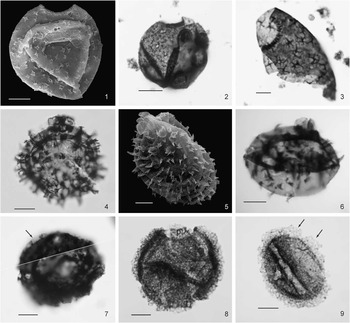
Acritarchs belonging to the informal sub-group Operculate Acritarchs. All scale bars represent 10 µm and, where indicated, locations are shown in England Finder coordinates. (1) Rhopaliophora pilata, sample BS08-15; (2) R. pilata, sample BS08-15, loc. V35; (3) R. pilata, sample BS08-15 detail of fragment showing a plicate opercular collar and large, low-lying asteriform processes; (4) Sacculidium acaciense, sample BP09-82; (5) S. acaciense, sample BS08-15; (6) S. acaciense, sample BS08-22B; (7) Tenuirica wadeiae, sample BS09-83, image in two focal planes with arrow indication the veil which encloses this form; (8) Vermimarginata barbata, holotype, sample BP09-81, p indicating the pylome, loc. M35; (9) V. barbata, sample BP09-82, arrows indicating the diffuse, reticulate processes surrounding the vesicle.

1972Peteinosphaeridium pilatum Combaz and Peniguel, p. 136, pl. 2, figs. 1–3.
1984Rhopaliophora pilata emend. Playford and Martin, p. 212, figs. 10A–E, G–M.
1988Rhopaliophora pilata; Playford and Wicander, p. 25, figs. 14D–K.
2006Rhopaliophora pilata; Quintavalle and Playford, p. 54-55, pl. 10, figs. 6, 8.
1988Rhopaliophora pilata; Martin and Yin, p. 122, pl. 16, fig. 11, non pl. 16, figs. 9, 12.
? 1999 Rhopaliophora pilata; Raevskaya, p. 249, pl. 1, fig. 9.
non 2003 Rhopaliophora pilata; Tongiorgi, Yin and Di Milia, p. 106, pl. 30, figs. 3–5.
Measurements
Vesicle diameter, 35 (45) 60 µm; length of processes, 3–5 µm; pylome diameter 8–20 µm (30 specimens).
Material
Samples BP08-81-87, 89, 61-63, 65.1, 65.2, 65.3; BS09-06, 10-16, 22.
Remarks
Playford and Martin (Reference Playford and Martin1984) and Playford and Wicander (Reference Playford and Wicander1988) provided detailed description and illustration of this species, including a good account of its morphological variability. R. pilata is clearly defined by its numerous and small, thin-walled, tubular to prismatic processes which are often preserved as collapsed and folded, in which case they assume the typical Y- or H- shape transversal contour. It is not uncommon to observe specimens in which part of the thin-walled processes have been worn out so that the distribution of process on vesicle surface appears as highly irregular (e.g., fig. 5.2). The number, and hence the density, of the processes vary considerably within a given population, but their overall shape and diminutive dimension relatively to vesicle diameter are consistent features. The vesicle wall is smooth to scabrate, rarely microrugulate, according to the original description and material. In some specimens, the pylome is rimmed by a collar of closely spaced processes (e.g., figs. 5.1, 5.2), more commonly it is surrounded by a distinct lip-like rim, although it can also appear unrimmed. The specimens described and illustrated by Tongiorgi et al. (Reference Tongiorgi, Yin and Di Milia2003) from Lower to Middle Ordovician strata of the Yangtze Gorges area, Hubei Province, South China possess much larger and more densely packed processes of petaloid forms, hence their attribution to R. pilata is considered erroneous herein. Similarly we consider as erroneous the attribution to R. pilata by Martin and Yin (Reference Martin and Yin1988) of their Chinese specimens showing a conspicuously granulate to baculate vesicle wall. The illustration of putative specimen of R. pilata by Raevskaya (Reference Raevskaya1999) from the lower Areing (Floian) Leetse Formation of the St. Petersburg region in northwestern Russia does not clearly show the morphological feature of the present species (notably the shape of the processes and the presence of a pylome); accordingly, this identification is considered as questionable.
Occurrence
Kanosh Shale, Utah (Dapingian-Darriwilian). Canning Basin, Western Australia: upper Tremadocian through Darriwilian (Quintavalle and Playford, Reference Quintavalle and Playford2006; Playford and Martin, Reference Playford and Martin1984). Georgina Basin, Queensland: lower to middle Arenig (Floian; Playford and Wicander, Reference Playford and Wicander1988). Jilin Province, northeastern China: Tremadocian through lowermost Arenig (basal Dapingian: Martin and Yin, Reference Martin and Yin1988). Alberta: uppermost Tremadocian – Arenig (Dapingian: Martin, Reference Martin1992).
Genus Sacculidium Ribecai, Raevskaya and Tongiorgi, Reference Ribecai, Raevskaya and Tongiorgi2002
Type species
Sacculidium macropylum Ribecai, Raevskaya and Tongiorgi, Reference Ribecai, Raevskaya and Tongiorgi2002; by original designation.
Sacculidium acaciense (Playford and Martin, Reference Playford and Martin1984) emend. Ribecai, Raevskaya and Tongiorgi, Reference Ribecai, Raevskaya and Tongiorgi2002
1984Multiplicisphaeridium acaciense Playford and Martin, p. 205, figs. 8A–F.
2002Sacculidium acaciense emend. Ribecai, Raevskaya and Tongiorgi, p. 170.
2006Sacculidium acaciense; Quintavalle and Playford, p. 55, pl. 11, figs. 4ab, 6ab, pl. 12, figs. 1, 2.
Measurements
Vesicle diameter, 45–60 µm; length of processes, 5–8 µm; pylome diameter, 10–15 µm (17 specimens).
Material
Samples BP09-81-84, 89; BS08-10, 13, 15, 16, 22.
Remarks
The original diagnosis of this species (Playford and Martin, Reference Playford and Martin1984) did not mention the presence of the membranous tubular-lobate extension located diametrically opposite the pylome, which is the main diagnostic feature of Sacculidium. However, the illustrations of the type material from the Ordovician of the Canning Basin, Australia clearly show the presence of this peculiar morphological feature (Playford and Martin, Reference Playford and Martin1984, fig. 8A); moreover, the presence of the lobate extension has been confirmed by the observation of the original material by M.V. in 1998. A detailed description of this species is provided in Quintavalle and Playford (Reference Quintavalle and Playford2006, p. 55–56).
Occurrence
Kanosh Shale, Utah (Dapingian-Darriwilian). Canning Basin, Western Australia: upper Tremadocian through Darriwilian (Quintavalle and Playford, Reference Quintavalle and Playford2006; Playford and Martin, Reference Playford and Martin1984).
Genus Tenuirica Playford and Wicander, Reference Playford and Wicander1988
Type species
Tenuirica wadeiae Playford and Wicander, Reference Playford and Wicander1988, by original designation.
Tenuirica wadeiae Playford and Wicander, Reference Playford and Wicander1988
1988Tenuirica wadeiae Playford and Wicander, p. 27, figs. 15A–K.
Measurements
Vesicle diameter, 30–40 µm (seven specimens).
Material
Samples BP09-81-84.
Remarks
The present species is well distinguished by the presence of a delicate and transparent membrane (which is only rarely preserved in its entirety) supported by the distal part of the processes and enveloping the entire vesicle. The funnel-shaped concave distal end of the processes is also a distinctive feature.
Occurrence
Kanosh Shale, Utah (Dapingian-Darriwilian). Georgina Basin, Queensland: lower to middle Arenig (Floian; Playford and Wicander, Reference Playford and Wicander1988).
Genus Vermimarginata new genus
Type species
Vermimarginata barbata new species, designated herein.
Diagnosis
Spherical vesicle with a circular pylome, enclosed in a mass of very thin, sinuous, solid processes, forming a diffuse, indistinct net-like structure (reticulum).
Etymology
From the Latin vermes (worm) referring to the character of the processes surrounding the vesicle.
Remarks
Vermimarginata differs from Granomarginata Naumova, Reference Naumova1961 in that it possesses a circular pylome and the enclosing, marginal structure can be resolved into tiny, sinusoidal and reticulate solid processes.
Vermimarginata barbata new species
Diagnosis
Vesicle spherical, thin and transparent, single-layered, bearing a large (about one-third of vesicle diameter) distinct, circular pylome. Vesicle totally enclosed within a tight network of very thin, sinous and flexible, anastomosed filamentous threads, forming a net-like structure (reticulum) completely sourrounding the vasicle, which appears in cross section as a more or less regular flange all along the vesicle’s margin.
Measurements
Diameter of internal body, 35–42 µm; width of external flange, 8.5 (12) 18 µm; diameter of pylome, 10–15 µm (12 specimens).
Holotype
The specimen illustrated in Figure 5.8, sample BP09-65.1 (slide 3) loc. P40/3, HUPC 65844.
Etymology
From the Latin barbe (beard), referring to the beard-like character of the vesicle margin.
Material
Samples BP09-81, 82, 89, 65.1.
Remarks
The operculum has not been seen and the pylome margin appears somewhat indistinct as it can be obscured by the surrounding reticulum. This is noted in the holotype (see “p” in Fig. 5.8). The reticulate structure of closed loops is indicated by the arrows in Figure 5.9. In surface view, however, the vesicle has a granular appearance.
Type locality
Fossil Mountain, Utah, section “K-North”, sample BP09-65.1, Kanosh Shale.
Eukaryotic Supergroup: Archaeplastida Adl et al., Reference Adl, Simpson, Farmer, Andersen, Anderson, Barta, Bowser, Brugerolle, Fensome, Fredericq, James, Karpov, Kugrens, Krug, Lane, Lewis, Lodge, Lynn, Mann, Mccourt, Mendoza, Moestrup, Mozley-Standridge, Nerad, Shearer, Smirnov, Spiegel and Taylor2005
Phylum: Chlorophyta Pascher, Reference Pascher1914 emend. Lewis and McCourt, Reference Lewis and McCourt2004
Subphylum: Charophyta Migula Reference Migula1897 emend. Karol et al., Reference Karol, McCourt, Cimino and Delwiche2001
Anteturma: Cryptosporites Richardson, Ford and Parker, Reference Richardson, Ford and Parker1984
Globular cryptospore clusters
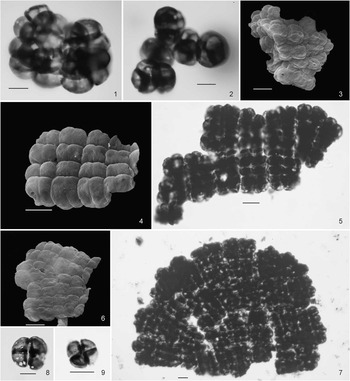
Cryptospores. All scale bars represent 10 µm unless otherwise indicated. (1) globular cryptospore cluster, sample BS08-15; (2) globular cryptospore cluster, sample BS08-15; (3) globular cryptospore cluster, sample BS08-15; (4) a planar cryptospore thallus composed of adjoining spore packets, sample BP09-89; (5) small thallus of three cryptospore packets, sample BS08-15; (6) semicircular planar thallus composed of adjoining cryptospore packets, sample BP09-57; (7) cryptospore tetrad of two adjacent dyads, sample BS08-22A; (8) small isomorphic cryptospore tetrad, sample BS08-10B.

Description
More or less globular clusters of cryptospore dyads and tetrads with thick, homogeneous walls and smooth surfaces. These specimens are all very dark with diameters well under 20 μm.
Material
BP09-81-84, 61, 63, 65.2, 65.3; BS08-06, 10, 11, 13-16, 22.
Remarks
Loose to globular clusters of quite spherical cryptospores differ from Agamachates casearinus Taylor and Strother, Reference Taylor and Strother2009 in their lack of any synoecosporal wall covering the individual packets of dyads, trains, and tetrads. These forms lack the regular geometric form that characterizes later Ordovician and Silurian cryptospore dyads and tetrads.
Planar cryptospore clusters
Description
Planar clusters of cryptospores with thick walls lacking any ornament. Apparent dyads, about 10 μm wide and 10 to 20 μm long, are organized into regular sets of 16, although in some instances the exact nature of the unit cell is not apparent. The regular sets form planar packets, which can be found attached to adjacent similar packets forming larger cryptospore spore thalli. These thalloids range in size from just a few packets (Fig. 6.6) up to larger rosettes comprised of perhaps as many as 60 packets (Fig. 6.7).
Material
BP09-89, 61; BS08-11, 13, 14.
Remarks
The occurrence of spore-like microfossils in geometrically regular planar sets has not been previously documented in the Ordovician – Devonian record of cryptospores and miospores. Although these patterns appear to reflect vegetative growth of a simple thallus, the individual cells that make up these clusters are clearly of a spore-like character with their thick walls.
Cryptospore tetrads
Description
Individual sets of four spore-like microfossils, 10 to 30 μm in diameter, with thick homogeneous walls and smooth walls, with or without an interior wall.
Material
BP09-81-84, 89, 61, 62, 65.2, 65.3; BS08-06, 10, 13-16, 22.
Remarks
Small cryptospore tetrads can occur as sets of paired dyads (Fig. 6.8) or as isomorphic tetrads (Fig. 6.9). These are not common; they represent the end members of morphologic variation within populations of irregular aggregated clusters seen in Figure. 6.1–6.3. However, they do serve to demonstrate a degree of morphological similar with previously described cryptospores, especially the late Cambrian Agamachates casearinus from which they differ in lacking a synoecosporal wall (Taylor and Strother, Reference Taylor and Strother2009).
Discussion
The palynological assemblage recorded above comprises 27 acritarch species along with several possible new cryptospore species, which will be described more fully in a subsequent report. Among the acritarch species, 14 were previously named, three are retained in open nomenclature, six are identified at the genus level, and four are new species belonging to four new genera. The acritarch assemblage is quantitatively dominated by two informal subgroups as designated here: the Operculate Acritarchs (Rhopaliophora, Dicommopalla, Peteinosphaeridium, Loeblichia), and the Superornamenti subgroup (e.g., Lophosphaeridium). Spinose acritarchs of the Acanthomorphitae subgroup and representatives of the Herkomorphitae subgroup (e.g., Dictyotidium, Melikeriopalla) are markedly subordinate, and diacromorph acritarchs are absent. Acanthomorphic acritarchs are mainly represented by small (20 µm and less) species of Asteridium, Micrhystridium, and Passalosphaera. Moreover, there is a marked difference in taphonomic preservation between the acritarchs of the Operculate and Superornamenti groups and the acanthomorphic/herkomorphic acritarchs. Specimens of the former groups appear dark to opaque (brown - dark brown, to black) under the light microscope, and are often damaged and/or corroded (surficial corrosion, cracks in the vesicles). Contrariwise, the generally smaller acanthomorphs and herkomorphs are much lighter in color (pale yellow), are not corroded, and are often exquisitely preserved. In this preservational characteristic, the Operculate and Superornamenti acritarchs are more similar to the cryptospore group.
The distribution of the observed palynomorphs through the studied sections at Fossil Mountain (Table 1) does not support any attempt at a palynological biostratigraphic subdivision. It is however worth noting some specific stratigraphic levels, which appear largely dominated by cryptospores relative to the acritarchs, such as sampling levels BP09-63, 65 and BS08-16. Samples BP09-88 and the interval from sample BP09-66 and BP-09-68, were largely barren of palynomorphs.
The age of the Kanosh Shale provided by the macro- and conodont fauna presented above, is probably Dapingian. However, the Kanosh acritarch assemblage is somewhat peculiar and does not appear to duplicate any particular previously described assemblage, although there are overlapping taxa with a couple of assemblages described from Australia. Thus, any biostratigraphic interpretation of the Kanosh assemblage must take into account paleobiogeographical as well as paleoenvironmental factors.
Middle Ordovician (Dapingian – Darriwilian) acritarch assemblages are well known worldwide and a comprehensive list of taxonomic works is found in Playford and Wicander (Reference Playford and Wicander1988). These are complemented by more recent works from China (Tongiorgi et al., Reference Tongiorgi, Yin and Di Milia1995, Reference Tongiorgi, Yin and Di Milia2003; Yin et al., Reference Yin, Di Milia and Tongiorgi1998; Brocke, Reference Brocke1997; Brocke et al., Reference Brocke, Li and Wang2000; Li et al., Reference Li, Servais and Brocke2002), Argentina (Rubinstein et al., Reference Rubinstein, Vecoli and Astini2011), the Baltic region (Ribecai and Tongiorgi, Reference Ribecai and Tongiorgi1995; Raevskaya et al., Reference Raevskaya, Vecoli, Bednarczyck and Tongiorgi2004), North Africa (Vecoli, Reference Vecoli1999; Vecoli and Le Hérissé, Reference Vecoli and Le Hérissé2004), Australia (Quintavalle and Playford, Reference Quintavalle and Playford2006, Reference Quintavalle and Playford2008), and Belgium (Vanguestaine and Wauthoz, Reference Vanguestaine and Wauthoz2011). The geographical coverage of these studies is not uniform as the majority of publications reporting detailed taxonomic and biostratigraphic analyses of Middle Ordovician acritarch assemblages concern Gondwanan and Baltic localities, while much less data are available for Laurentian (North American) areas (Wicander in Servais et al., Reference Servais, Stricanne, Montenari and Pross2004). Nonetheless, the study of the (paleo)geographical distribution of known acritarch assemblages, has led to the recognition, since the seminal paper of Vavrdová (Reference Vavrdová1974), of provincialism of marine phytoplankton during Middle Ordovician. This is seen in the differentiation of at least two major paleobiogeographic provinces: a “cold” to “cool-temperate” province associated with the northern Gondwana margin, and a “warm-water” Baltoscandian province. The first, know as “Peri- Gondwana” Province, forms a circumpolar belt extending along the northern margin of Gondwana from Argentina through eastern Newfoundland, North Africa, southern Europe, to southern Turkey and to South China (Playford et al., Reference Playford, Ribecai and Tongiorgi1995; Servais et al., Reference Servais, Li, Molyneux and Raevskaya2003). The “warm-water” phytoplankton province corresponds mainly to the Baltoscandia area, forming the “Baltic” bioprovince of Tongiorgi and Di Mila (Reference Tongiorgi and Di Milia1999).
The Peri-Gondwana Province is characterized by the genera Arbusculidium, Arkonia, Coryphidium, Dicrodiacrodium, Frankea, and Striatotheca (Li, Reference Li1987; Colbath, Reference Colbath1990; Albani et al., Reference Albani, Massa and Tongiorgi1991; Brocke et al., Reference Brocke, Fatka, Molyneux and Servais1995; Vecoli, Reference Vecoli1999; Servais et al., Reference Servais, Li, Molyneux and Raevskaya2003; Vanguestaine and Wauthoz, Reference Vanguestaine and Wauthoz2011). The differentiation of this acritarch bioprovince began in the late Tremadocian, with the first representatives of the genus Striatotheca and Coryphidium appearing in the stratigraphic record (Tongiorgi and Di Milia, Reference Tongiorgi and Di Milia1999; Brocke et al., Reference Brocke, Fatka, Molyneux and Servais1995; Servais et al., Reference Servais, Li, Molyneux and Vecoli2008). None of these Peri-Gondwanan taxa are present in the Kanosh Shale assemblage.
The taxonomic composition of the Baltic Province was incompletely circumscribed taxonomically by Vavrdová (Reference Vavrdová1974), who indicated a high abundance of large acanthomorphic vs. the rarity of diacromorphic acritarchs as the main characters of these low-paleolatitude assemblages. A more formal definition of the Baltic Province was tentatively proposed by Tongiorgi and Di Milia (Reference Tongiorgi and Di Milia1999), who considered that some species of Peteinosphaeridium and Pachysphaeridium were restricted to paleogeographical domains located at low to intermediate paleolatitudes (e.g., Baltic localities and South China). In the Kanosh assemblage, a single species of Peteinosphaeridium occurs, but in quite low abundance. It is known to occur in South China, and is morphologically similar to species found in elsewhere in Laurentia and Baltica. It is evident from the above discussion that the Kanosh Shale assemblage cannot be readily related to either of the two currently known microphytoplankton bioprovinces. The main character of the Kanosh Shale acritarch assemblage is the dominance of operculate acritarchs over other groups such as the acanthomorphs and the prasinophytes, as well as the absence of any polygonomorph species. This appears to be a peculiar character only rarely observed in normal marine acritarch assemblages of Middle Ordovician age from the majority of known localities. The operculate acritarchs are widespread, but they usually account for a minor fraction of any one given assemblage (e.g., in North Africa, Vecoli, Reference Vecoli1999; in South China, Tongiorgi et al., Reference Tongiorgi, Yin and Di Milia2003; in Baltica, Raevskaya et al., Reference Raevskaya, Vecoli, Bednarczyck and Tongiorgi2004).
Australian Middle Ordovician acritarch assemblages from the Georgina (Playford and Wicander, Reference Playford and Wicander1988) and Canning basins (Playford and Martin, Reference Playford and Martin1984) are an exception to this general rule—they, too, are characterized by abundant operculate acritarchs but with acanthomorphs, diacromorphs and forms referred to prasinophytes lacking. Concerning the Canning Basin assemblage, Playford and Martin (Reference Playford and Martin1984, p. 217) noted that “the absence of diacrodians and trispinose veryhachiids and rarity of quadrangular veryhachiids and herkomorphids are striking by comparison with approximately coeval assemblages from the Mediterranean European acritarch province distinguished by Vavrdová (Reference Vavrdová1974)”. Similarly, Playford and Wicander (Reference Playford and Wicander1988) highlighted that there were major differences between the Georgina Basin acritarch assemblages and others of Floian-Dapingian age. The differences included the dominance of “pylomate” forms (numbering 11 out of 24 taxa), and the absence of diacrodians and typical “Mediterranean” (Peri-Gondwanan) taxa. These evident taxonomic similarities between the Kanosh and coeval Australian assemblages, reflect a common paleoenvironmental signal indicative of near-shore depositional settings, rather than broader regional or global biogeographic or oceanographic influences. This assertion is supported by abundant cryptospores indicating terrigenous input into coastal environments. Palynomorphs, referred to as “Gloeocapsomorpha prisca,” which are morphologically very close to the palmelloid cryptospore sheets of the Kanosh Shale, are also profusely represented in the Australian palynological assemblage of the Coolibah Fm (Playford and Wicander, Reference Playford and Wicander1988). Lithological evidence for a shallow water depositional setting of the Kanosh Shale sequence has been discussed before. Similarly, the depositional environment of the Coolibah Fm “has been envisaged as shallow marine with fluctuating energy conditions within subtidal and/or intertidal settings” (Playford and Wicander, Reference Playford and Wicander1988, p. 6). A shallow marine setting was also indicated for the Goldwyer Formation of the Canning Basin (Playford and Martin, Reference Playford and Martin1984, p. 188), which is also taxonomically similar to the Kanosh Shale.
In summary, considering both the depositional conditions and taphonomic characteristics of palynomorphs, three admixed palynological components can be distinguished within the Kanosh assemblage: (1) an in situ, or autochthonous, component of acritarchs representative of marine to estuarine phytoplankton (e.g., spinose forms like Micrhystridium, Asteridium; and algal-like forms such as Dictyotidium); (2) a transported (allochthonous) marine component of acritarchs transported to the Kanosh Basin from coastal to intertidal settings (the operculate acritarchs); and (3) a “terrestrial” component seen in the cryptospores transported from coastal-intertidal or possibly fully terrestrial habitats.
Conclusions
Organic-walled microfossils occur profusely in the Kanosh Shale at Fossil Mountain, Utah. The Kanosh acritarch assemblage contains several taxa previously recorded mainly in Middle Ordovician (upper Arenig-Llanvirn: Dapingian-Darriwilian) sediments worldwide, and thus it is consistent with previous biostratigraphic dating of this formation as Dapingian in age. However, the overall taxonomic composition of the Kanosh assemblage appears peculiar with respect to the known main trends of paleobiogeographic differentiation of Ordovician acritarchs; it most closely resemble assemblages previously described from Australian localities, namely the lower to middle Arenig, (Floian-Dapingian) Coolibah Formation of the Georgina Basin in northwestern Queensland (Playford and Wicander, Reference Playford and Wicander1988), and the Darriwilian Goldwyer Formation of the Canning Basin of Western Australia (Playford and Martin, Reference Playford and Martin1984; Quintavalle and Playford, Reference Quintavalle and Playford2006). Both these localities were interpreted as representing somewhat restricted, shallow marine to coastal sedimentary depositional settings. Cryptospores are common to abundant throughout the section and indicate sedimentary provenance from intertidal to fully terrestrial settings. The recovery of cryptospores and associated organic fragments is just now beginning to create a picture of plant evolution during an Early Paleozoic period of the algal-embryophyte transition (Strother, Reference Strother2010).
This mixed character of the palynological assemblage from the Kanosh Shale is interpreted here as indicating transport followed by local mixing and homogenization of several assemblages originating from different areas in which different paleoenvironmental conditions prevailed (e.g., difference in salinity or nutrient availability). Evidence for this are the differences in quality preservation among specimens, the presence of cryptospores in fluctuating abundance throughout the section, and the extreme morphological variability of certain species, especially exemplified by the Dicommopalla-Rhopaliophora plexus. Thus, not all acritarchs act here as indicators of strictly marine conditions. Transport of non-marine elements into shallow marine settings (Muller, Reference Muller1959; Traverse and Ginsburg, Reference Traverse and Ginsburg1966; Forester, Reference Forester1973; Traverse, Reference Traverse1994) indicates caution when assuming of the provenance of all acritarchs. The Kanosh assemblage is lacking large acanthomorphic forms, such as Baltisphaeridium klabavense and others that would be expected in normal marine settings. Finally, the damaged acritarchs in the Kanosh, which generally match the condition of cryptospore that have a high probability of non-marine provenance, could be indicative of transport from freshwater settings.
The abundance of cryptospores with respect to acritarchs and kerogen indicates considerable input from non-marine sources. The overall character of the palynological assemblage support previous interpretation of the Kanosh Shale as a near-shore to lagoonal deposit, indicating deposition under conditions of well-oxygenated waters, and not under anoxic conditions as previously suggested in other interpretations (e.g., Ross et al., Reference Ross, James, Hintze and Poole1989), therefore supporting the conclusions of Wilson et al. (Reference Wilson, Palmer, Guensburg, Finton and Kaufman1992) and Boyer and Droser, (Reference Boyer and Droser2003). Marenco et al. (Reference Marenco, Marenco, Lubitz and Niu2013) used isotope data to conclude that the Kanosh Formation was deposited under normal marine conditions, not in an anaerobic basin. Their paleogeographic reconstruction of Laurentia (fig. 1) shows clearly that the Kanosh site at Fossil Mountain was positioned between two land masses, and, even though terrigenous input of organic matter was not considered in their model, the results of our palynological investigation indicate the likelihood of terrestrially-derived organic flux into the Kanosh depositional basin.
Acknowledgments
The assistance of Brian Pedder, Noel Schaff, and Elizabeth LaPadula in the 2009 field season is gratefully acknowledged. Acknowledgment is made to the Donors of the American Chemical Society Petroleum Research Fund for partial support of this research through grant 46740-B8 (to P.K.S.). Financial support is also acknowledged from the French ANR (Agence National pour la Recherche) grant N° 2010 BLAN 607 01 “Global Perspectives on the Terrestrialization Process” (coordinator M.V.), to which this paper is a contribution. The paper was greatly benefited by the critical reviews of Thomas Servais, Stewart Molyneux, and Malgorzata Moczydlowska. M.V. thanks Saudi Aramco for permission to publish.