

Introduction
The problem of combatting fraudulent activities in the context of globalization is becoming increasingly relevant, specifically considering the increasing sophistication of fraud schemes and their destructive nature in the economy and society. Overall, due to fraudulent schemes involving complex mechanisms of financial transactions, as well as simpler frauds, the public’s trust in government institutions and the state is being eroded. Thus, a suitable and effective legal framework for fraud prevention is necessary to ensure the protection of society. A special role in the fight against fraud is played by the criminal law element, which requires the presence of intent in the commission of fraudulent acts. This aspect has become crucial for the study of fraud as a criminal offence, particularly in the context of combatting this offence in countries such as Kazakhstan and Singapore.
Adorjan and Colaguori (Reference Adorjan and Colaguori2023) investigated the nature of the spread of fraud and cybercrime in the context of globalization. The researchers examined the effects of technological developments on the commission of these offences, which have become more widespread and accessible. Specifically, the researchers emphasized the significance of ensuring effective governance and a strong regulatory framework to overcome these challenges. The cited study also highlighted the need to strengthen international cooperation and introduce innovative approaches to enhance information security and protect consumer interests. Furthermore, the researchers highlighted the significance of informing the public and individual organizations to mitigate the risks arising from fraud and cybercrime. Rahman and Jie (Reference Rahman and Jie2024) investigated the use of the fraud triangle theory to identify fraud in Chinese listed companies. The researchers employed regression analysis to examine the correlation of various financial indicators with fraud cases, based on data from the China Stock Market & Accounting Research network. The researchers found that while leverage and liquidity are predictive of fraud, factors such as net worth, audit coverage and the proportion of independent directors are moderating factors. This study contributed to a broader understanding of fraud trends in the Chinese market and highlighted the need for effective fraud detection tools.
Shaisultanov et al. (Reference Shaisultanov, Akimzhanov, Abdrakhmanov, Bazarlinova and Bazarlinova2024) addressed the problem of the growing number of Internet frauds and the effectiveness of law enforcement agencies’ use of operational and investigative actions to counter this phenomenon. The researchers identified the principal areas of cybercrime and defined concepts in the field of operational and investigative counteraction measures. Furthermore, the findings of the study highlighted the significance of improving the legislative framework and interaction between law enforcement agencies in preventing and detecting Internet fraud. In addition, Shaisultanov et al. (Reference Shaisultanov, Akimzhanov, Abdrakhmanov, Bazarlinova and Bazarlinova2024) presented recommendations related to strengthening the measures of operational and investigative activities to combat Internet crimes. Kaiyrbekova (Reference Kaiyrbekova2024) analysed the regulatory framework for combatting pyramid schemes in Kazakhstan and compared it with the relevant international practice. Specifically, the researcher found that to counteract the activities of pyramid schemes that cause financial losses to citizens more effectively, it is necessary to improve the current legislation, considering the legal protection measures introduced. The researcher also proposed the establishment of criminal liability for all participants involved in the distribution of such pyramids. Overall, Kaiyrbekova (Reference Kaiyrbekova2024) emphasized the need to strengthen legislative regulation to ensure public confidence in the state’s financial system.
Yong, Jin, and Anwar (Reference Yong, Jin and Anwar2025) studied the issue of reviewing the functions and role of the criminal intelligence analyst in the Singapore Police Force (SPF), considering the requirements of the digital age. The researchers explored ways to successfully reform the activities of such analysts through the introduction of innovative technologies. This approach will contribute to the development of a more efficient criminal investigation system, thereby increasing the value of the SPF. Yong et al. (Reference Yong, Jin and Anwar2025) also found that criminal intelligence analysts are increasingly using the latest information sources, implementing internal developments, using machine-learning technologies and managing information operations. This will enable them to provide up-to-date information, especially in the field of preventing fraudulent activities on the Internet. Harding et al. (Reference Harding, Cooper, Sales, McDonald and Kingston2025) highlighted the concept of liminality through the lens of fraud, arguing that attackers take advantage of ambiguous opportunities to facilitate their activities. The researchers found that the purpose of fraud is not only to obtain direct material benefits but also to lure out personal data that can later become the basis for more substantial prospects. Through interactions with individuals who have personally experienced fraud, the researchers developed a new model for understanding this phenomenon. Specifically, this model factored in the significance of a particular case and the possibility of changing the role of victims to accomplices in crime within the liminal space. Furthermore, Harding et al. (Reference Harding, Cooper, Sales, McDonald and Kingston2025) suggested that recognizing these dynamics would help improve the effectiveness of financial crime-prevention strategies.
Overall, the study of fraud is at a fairly prominent level due to the growing relevance of this issue. Researchers have mostly studied fraud in the context of financial crimes, the fraud triangle theory and statutory regulation in the field of anti-fraud. However, fewer researchers have investigated the problem of fraud in the context of criminal law and the definition of fraud as a criminal offence. The purpose of the present study was to identify the specific features of criminal law regulation of fraud and to analyse the mechanisms of its prevention and counteraction in the international and national legal frameworks. The principal objectives of the study were as follows:
-
– To investigate the problem of fraud in the context of criminal law and identify the most common types of crime;
-
– To analyse international anti-fraud legislation;
-
– To study the practices of preventing and combatting fraud in Kazakhstan and Singapore.
Materials and Methods
The study used the practices of Kazakhstan and Singapore to investigate the criminal law and criminological aspects of combatting fraud. These states were chosen due to the limited research on this issue directly in these states, specifically, in the field of criminal law. However, a significant role in their selection was played by the fact that the states are at disparate levels in terms of the effectiveness of national strategies to combat fraudulent activities. For instance, Singapore has established itself as the state with the most effective approach to tackling the crime of fraud, while Kazakhstan is still on the path towards creating an effective strategy.
To interpret and analyse the regulations, the study employed the terminological method, which became crucial in the study of the concept and content of the crime of fraud, its types and the fraud triangle theory. The use of hermeneutics in the study helped not only to establish the content of these definitions but also to consider them in the context of a broader legal discourse. This enabled a more detailed investigation of how these concepts are applied in distinct jurisdictions.
During the study of legal acts, the provisions of the following documents were analysed. These include the United Nations Development Programme Policy against Fraud and other Corrupt Practices (UNDP Anti-Fraud Policy) (United Nations Development Programme 2018), as well as the Consolidated Versions of the Treaty on European Union and the Treaty on the Functioning of the European Union (2012).Footnote 1 Further analysis covered Directive (EU) 2017/1371 of the European Parliament and of the Council (2017),Footnote 2 the Criminal Code of the Republic of Kazakhstan (2014)Footnote 3 and the Normative Decision of the Supreme Court of the Republic of Kazakhstan No. 6 “On Judicial Practice in Frauds” (2017).Footnote 4 In addition, Law of the Republic of Kazakhstan No. 191-IV “On Counteracting Legalization (Laundering) of Proceeds Obtained through Criminal Means and Financing of Terrorism” (2009),Footnote 5 the Penal Code 1871: 2020 revised edition (2021)Footnote 6 and other relevant acts were considered.
During the study, the comparative method played a significant role, helping to draw a parallel between the state of fraudulent activities and the fight against them in Kazakhstan and Singapore. This method was also employed to analyse the legal regulation of state approaches in the jurisdictions of these countries and international law overall. When examining the rules, they were compared with each other; specifically, this concerned the definition of fraud (which varies depending on the jurisdiction and the state) and the principles on which anti-fraud is based. The study also employed the historical method, which was mainly manifested in the analysis of statistical data on the number of fraud cases in previous years.
Results
Fraud is a Type of Criminal Offence: Principal Forms of Fraud
Despite a thorough and fairly extensive international legal framework, there is no single clear definition of fraud, and it varies from state to state and jurisdiction to jurisdiction. However, the most comprehensive definition of fraud is set forth by the UNDP Anti-Fraud Policy (United Nations Development Programme 2018) in Item 7, which prescribes that fraud is an act or inaction whereby an individual or a legal entity knowingly misleads or conceals a fact. This is done to obtain an illegal benefit or privilege or to avoid liability. It can also be done to induce any person to take or refuse to take an action to their advantage or disadvantage.
Thus, this type of offence primarily involves deception aimed at obtaining certain benefits by the fraudster, specifically, money or other valuables. Overall, fraud manifests itself in various forms, including the provision of false data and facts, dishonest behaviour, theft of confidential data and online fraud (AlFreihat et al. Reference AlFreihat, Al Wahshat, Balas and Abueid2023; Yesimov and Borovikova Reference Yesimov and Borovikova2022). One of the most negative consequences of this offence is its influence on the activities of government agencies and international organizations, as fraudulent actions undermine public confidence in them. Such actions also contribute to instability in the economic sphere of both individual states and global society as a whole (Commonwealth Fraud Prevention Centre 2025; Hernandez, Simpson, and Gill Reference Hernandez, Simpson and Gill2021). The key elements of the offence of fraud are as follows:
-
(1) Deception, or a knowingly false statement (e.g. providing false information, forging documents, etc.). The key condition for the classification of fraud is fraudulent actions or statements that caused the injured party to make an erroneous judgment or which substantially affected the course of events (Amelin et al. Reference Amelin, Kyrychenko, Leonov, Shablystyi and Chenshova2021).
-
(2) Such a statement must be false, and the misleading party must be aware of its falsity or believe it. Thus, this implies the mandatory presence of intent and the corresponding intention for the injured party to take concrete actions or make a decision based on false information (Office of Investigative Services 2025).
-
(3) The victim’s commission of a transaction regarding the disposal of property (specifically, the transfer of material assets or rights, or the unlawful signing of documents). Therewith, it is necessary that such an action occurred due to misrepresentation and mistakes made by the victim (Kagias et al. Reference Kagias, Cheliatsidou, Garefalakis, Azibi and Sariannidis2022).
-
(4) The presence of a fraudster’s selfish motives means that their actions are aimed at unjustified financial or other property benefits at the expense of the victim.
-
(5) The factual presence of damage – the need to prove by the injured party that they suffered losses or other damage that was caused due to misrepresentation (Zahari, Said, and Muhamad Reference Zahari, Said and Muhamad2022).
Thus, these five features constitute the crime of fraud and play a crucial role not only in the classification of the crime but also in determining the guilt of the offender.
Considering that fraud mostly concerns the financial sector and the business industry, it is called a white-collar crime (Find a Criminal Defense Attorney 2025). Specifically, in criminal law, fraud is a form of theft, with no violent elements. Thus, the key types of fraud include:
-
(1) Theft of confidential information involves the illegal acquisition and subsequent use of personal data (such as bank account details or a social security number) to commit fraud. The most widespread form of identity theft is phishing, which involves sending emails or making telephone calls (Khamit et al. Reference Khamit, Mukhamadieva, Togaibaeva, Mashabayev, Salykova and Karakushev2024). In this case, criminals pose as representatives of government agencies or bank employees (trusted persons) and fraudulently intercept credentials to gain unauthorized access to the victim’s digital networks and financial data (Comply Advantage 2025).
-
(2) Social support fraud is when a person illegally receives government benefits using false information. For example, this happens if a person claims to be disabled, but is not, and then receives social disability payments.
-
(3) Banking fraud covers various types of fraud aimed at illegally obtaining funds, securities or assets owned or controlled by a financial institution (Strom Reference Strom2023).
-
(4) Supply-chain fraud refers to illegal and unfair payments made in favour of real and fictitious sellers or suppliers. An example is notifying a customer of a change in details, such as an account number, and asking them to enter the new information before the transaction.
-
(5) Credit card fraud falls under the category of identity theft and fraud and involves the illegal use of a credit card to withdraw cash or purchase goods. Generally, there are two types of fraud: with or without a credit card. For example, incidents that lead to online credit card fraud may include entering stolen data into payment forms and sending them via email or telephone (Find a Criminal Defense Attorney 2025).
-
(6) Securities fraud occurs when a person provides a false assessment of the value of a company’s shares. As a result, it may be necessary to decide on financial transactions based on false information, etc. (Kratcoski Reference Kratcoski, Kratcoski and Edelbacher2018; Sanad and Al-Sartawi Reference Sanad, Al-Sartawi, Musleh Al-Sartawi, Razzaque and Kamal2021).
It is worth noting an essential criminological aspect that directly affects the criminal behavioural pattern – the “fraud triangle”, which identifies three key factors that affect the probability of committing fraud: motivation, opportunity and rational substantiation (National Whistleblower Center 2025). Thus, motivation arises under the influence of external financial pressure or incentives, e.g. due to the need to complete tasks or cover losses. Opportunity is the second component of the fraud triangle and refers to circumstances that create favourable conditions for committing fraud. Specifically, this component is directly related to the shortcomings of internal control and supervision mechanisms (Abdrasulov, Shalabaev, and Mugauova Reference Abdrasulov, Shalabaev and Mugauova2015; Sarnecki Reference Sarnecki, Silva and Kordaczuk-Wąs2024). For example, suppose there are inadequate checks and balances, such as an unclear division of authority or a lack of supervision. In that case, it is easier for employees to commit fraud without being detected. Such opportunities arise when there are weaknesses in the security system that are exploited by criminals (Bekishev et al. Reference Bekishev, Ibrayeva, Smanova, Nussipova and Kan2019; Sánchez-Aguayo, Urquiza-Aguiar, and Estrada-Jiménez Reference Sánchez-Aguayo, Urquiza-Aguiar and Estrada-Jiménez2021).
Rationalization is a process of understanding, thanks to which people find justification for their fraudulent behaviour to themselves, enabling offenders to align their actions with their values and morals (Cheliatsidou et al. Reference Cheliatsidou, Sariannidis, Garefalakis, Azibi and Kagias2023; Spytska Reference Spytska2022). For instance, the offenders assure themselves that they are just borrowing money and will pay it back later, or that they are not causing actual harm because “everyone else is doing it”. Such justification is critically significant because it enables the offender to engage in illegal activities without feeling guilty (Marquart and Thompson Reference Marquart and Thompson2024; Spytska Reference Spytska2023).
Overall, the fraud triangle plays a crucial role in the activities of law enforcement agencies, organizations and governments as it helps to identify potential dangers and implement preventive measures. By providing social support programmes, enhancing controls to limit opportunities and fostering an ethical culture that discourages rationalization, fraud risks can be minimized.
International Anti-Fraud Legislation
The basis of the international legal framework for combatting fraud is the Treaty on the Functioning of the European Union (TFEU), namely Article 325,Footnote 7 which establishes the obligation of the EU member states to combat fraud and other crimes that pose a threat to the EU financial environment. Specifically, the Union must take all corresponding measures to guarantee the protection of member states and EU institutions. Part 2 of this Article contains the obligation of the EU member states to treat financial interests equally, which implies that states must protect the interests of the Union as if they were their own.Footnote 8 A unified approach to combatting fraud ensures that government agencies follow the requirements to prevent fraudulent actions that adversely affect the EU financial system overall (Onlanbekova and Abdrasulov Reference Onlanbekova and Abdrasulov2015; Wells Reference Wells2018).
In addition, Article 325 of the TFEU emphasizes the significance of cooperation between the EU member states in protecting the financial interests of the Union (de Pinho Negrão Reference De Pinho Negrão2024). The provisions of this Article ensure the establishment of systematic coordination between public authorities and the European Commission (EC). This enables the exchange of best practices to combat fraud and develop effective joint counteraction strategies. Part 4 defines the role of the European Parliament (EP) and the Council of the EU in the implementation of relevant legislative measures to prevent and combat fraud.Footnote 9 It also makes provision for the need to consult with the EU Court of Auditors to agree on adequate measures, which indicates the EU’s commitment to adhering to transparency and accountability in its implementation.
Therewith, Part 5 of Article 325 of the TFEU defines the EC’s obligation to submit an annual report to the EP and the Council on the implementation of this Article. Such a report allows tracking of the progress made in combatting fraud and adjusting the strategy to consider the results and problems encountered in the EU member states. Thus, this Article determines the significance of a comprehensive approach of the EU member states in the fight against fraud (Amelin et al. Reference Amelin, Kyslyi, Viacheslav, Rovnyi and Surzhyk2024; Szymański Reference Szymański2021).
Directive (EU) 2017/1371 of the European Parliament and of the Council (2017)Footnote 10 is of great significance in combatting fraud, specifically against the financial interests of the EU, through the use of criminal law. Thus, according to Article 1 of this Directive, this regulation prescribes common standards for criminal offences and penalties in the field of preventing fraud or other illegal activities in the financial sector. Overall, the Directive strengthens control over the commission of criminal offences that violate the interests of the Union in the field of finance according to EU legislation (Amelin et al. Reference Amelin, Streliuk, Podkopaiev, Yevchuk and Agayev2023; Maesa Reference Maesa2018). At the same time, Article 3 establishes that fraud is a criminal offence only when committed with intent. Specifically, this Article defines the activities that fall under the concept of fraud, which are aimed at harming the financial position of the Union. Thus, fraud, according to Article 3 of the Directive, includes:
-
(1) Activities or lack thereof about procurement and non-procurement expenditure, including the submission or presentation of false information or concealment thereof, contrary to the obligations imposed, resulting in the misappropriation of funds or assets of the Union.
-
(2) Actions or inaction about non-own value-added tax (VAT) revenues – the use of false statements or documents that cause an unlawful reduction in the EU budget or the budget it manages.
-
(3) Taking or failing to take action about own VAT revenues – submission of false VAT documents, leading to a reduction in the EU budget and non-disclosure of tax data in breach of its obligations; submission of false tax documentation to conceal actual non-payment of VAT or the unlawful emergence of a right to a VAT refund (Brière Reference Brière2024).
Article 5 of the DirectiveFootnote 11 establishes the obligation of EU member states to implement measures to ensure criminal liability for aiding, abetting and assisting in the commission of fraudulent activities and other analogous offences. It also ensures that any attempt to commit these crimes should be treated as a criminal offence and subject to criminal liability. Overall, the Directive aims to unify the definitions, penalties, jurisdiction and limitation periods relating to fraud and other offences in the field of financial interests of the EU.
Another regulatory document that defines fraud-prevention measures is the UNDP Anti-Fraud Policy (United Nations Development Programme 2018). The provisions of this Act emphasize the significance of fraud awareness and the performance of the duty of UNDP staff to report fraud (Item 9). It is also established that in the formulation of a new anti-fraud programme, it is necessary to fully consider all the risks of criminal acts (Item 11). Specifically, for this purpose, responsible persons should assess the effectiveness of the measures taken to minimize potential risks, including monitoring and proper procurement planning (Ketners et al. Reference Ketners, Jargalsaikhan, Miller, Miliienko and Malkhasyan2025). In the case of an elevated level of fraud risk, Item 13 of the Anti-Fraud Policy ensures that managers can contact the Supreme Audit Institution (de Siqueira, Mtewa, and Fabriz Reference De Siqueira, Mtewa, Fabriz, Sayapin, Atadjanov, Kadam, Kemp, Zambrana-Tévar and Quénivet2022).
These regulations form the basis for preventing and combatting fraudulent incidents within the EU and the international arena overall. The documents emphasize that the key feature that classifies fraud as a criminal offence is the presence of an intentional act. Specifically, awareness of this type of crime and systematic risk assessment are significant means to combat fraud.
Criminological Aspects of Combatting Fraud in Kazakhstan
The basis for the fight against fraud in the Republic of Kazakhstan is the Criminal Code of the Republic of Kazakhstan (2014),Footnote 12 namely Article 190, which establishes that fraud is the acquisition of another’s property or the acquisition of the right to such property as a result of abuse of trust or deception. Specifically, the provisions of the Normative Decision of the Supreme Court of the Republic of Kazakhstan add to this definition that such acquisition occurs due to the voluntary transfer of property or rights by the owner.Footnote 13 In addition, this Resolution defines an essential component of the qualification of the crime of fraud – the establishment of a perpetrator’s mercenary purpose. A significant role in the anti-fraud policy in the Republic of Kazakhstan belongs to anti-money laundering, which contributes to the prompt response and prevention of threats to laundering of proceeds of crime, including fraud.Footnote 14 By integrating anti-money-laundering mechanisms into a broader anti-fraud policy, a comprehensive approach is taken to maintain the state’s financial system at an adequate level (Zhamiyeva and Albekova Reference Zhamiyeva and Albekova2023).
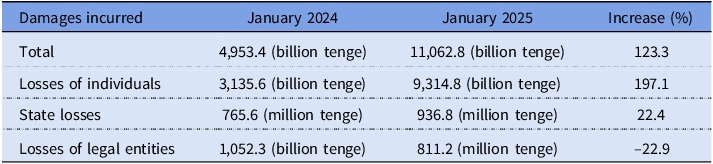
In January 2025, 4,300 cases of fraud were reported in the Republic of Kazakhstan, which is 0.1% greater than in January 2024 (i.e. in January 2024, there were approximately 4,296 reported cases). According to Finprom (2025) data, a separate part of the crimes classified as fraud was committed via the Internet – 48.9% of the 4,300 incidents (i.e. approximately 2,103). Table 1 shows the data on the amount of losses caused by fraud for January 2024 and 2025 (Absatar Reference Absatar2025).
Material damage in closed criminal cases for fraud (Kazakhstan)

Source: compiled by the authors based on Finprom (2025).
Thus, comparing the data from Table 1 for January 2024 and 2025, in 2025, there was a significant increase of 123.3% in the losses caused by fraud (two times (by 6,109.4 billion tenge) more than in 2024). Both in 2024 and 2025, individuals suffered significantly more losses than the other two subjects; however, in 2025, the amount of losses increased by 197.1% (which is three times (6,179.2 billion tenge) more than in 2024). In addition, there was an increase in losses incurred by the Republic of Kazakhstan, by 22.4% (171.2 million tenge) compared to 2024. On the other hand, the number of losses incurred by legal entities decreased by 22.9% (by 241.1 million tenge less than in January 2024) (Finprom 2025). This Table demonstrates not only an increase in fraud cases in Kazakhstan but also a substantial increase in the losses incurred by the state, its citizens and legal entities.
To counteract and combat fraud in the Republic of Kazakhstan, the Anti-Fraud Center (AFC) was established in 2024. Its activities include collecting and processing information on payment transactions and transfers of funds that have signs of fraud. The AFC also creates blocklists in a unified Application Programming Interface format to transmit information to financial market entities (Yeung et al. Reference Yeung, Bekmurzayeva, Huang and Suleimenova2020). Another important task of the AFC is to accumulate, store and exchange information on detected cases of fraud in the financial services market and transfer data on payments with signs of a crime to law enforcement agencies (Anti-Fraud Center 2025). The creation of the Center helped prevent 12,000 fraud-related offences in 2024. Specifically, the AFC has identified the most common types of fraud in the Republic of Kazakhstan as telephone fraud, false investments, social media and messaging fraud, loan scams, fake online stores and sellers, dropshippers and mirror sites used by criminals (Ozbekov, Mashabaev, and Siubayeva Reference Ozbekov, Mashabaev and Siubayeva2022; Sakenova Reference Sakenova2025).
Awareness-raising is of particular significance for combatting fraud, which is effectively implemented by the Government of Kazakhstan, particularly through active cooperation with the Organization for Security and Cooperation in Europe (2024). This awareness has been raised through joint training on the illegal use of blockchain technology and virtual assets. Such seminars, in cooperation with leading international organizations, form an integral part of the Republic of Kazakhstan’s policy in the field of development of the state digital infrastructure to protect the financial system from fraud and other criminal offences.
Combatting the Crime of Fraud in Singapore
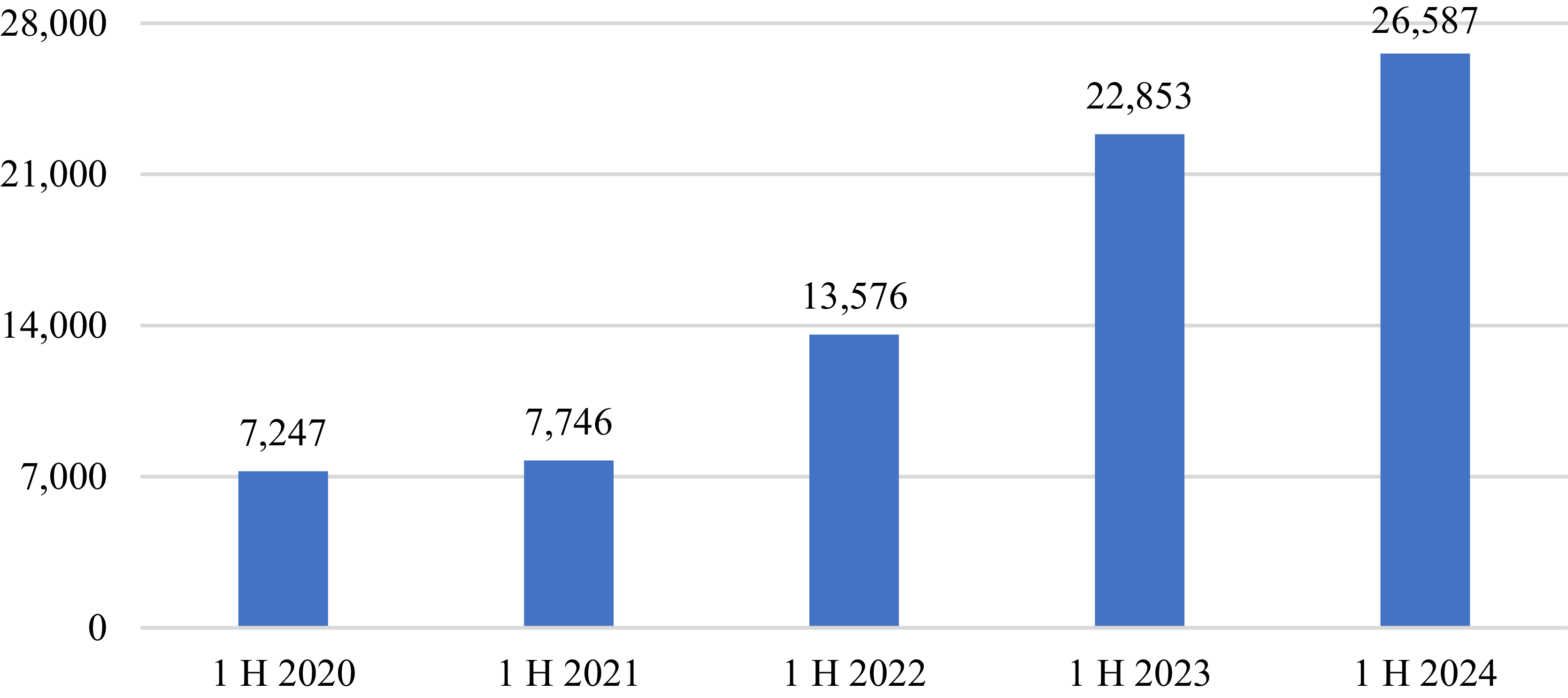
Considering that Singapore is a country with a developed economy, substantial wealth and, most importantly, a highly developed digital infrastructure, it is of particular interest to fraudsters. Investment, credit card and phishing frauds, including online fraud, are particularly common in the country. Figure 1 shows the data on the number of fraud incidents for 2020–2024 (Singapore Police Force 2024).
Total number of fraud cases in Singapore in the first half of the year (1 H) for 2020–2024.
Source: compiled by the authors based on Singapore Police Force (2024).

Thus, as presented in Figure 1, the number of detected incidents in the first half of the year from 2020 to 2024 increased substantially. Specifically, comparing the data on fraud crimes for the first half of 2020 and 2021, there was an increase of 6.9% (+499 fraud cases); for 2021 and 2022 – a rise of 75.3% (+5,830 incidents); in 2022 and 2023, the number of fraud crimes increased by another 68.3% (+9,277 incidents); and in 2023 and 2024, there was an increase of 16.3%, which is 3,734 more fraud cases (Singapore Police Force 2024).
However, despite the systematic increase in the number of fraud incidents, according to the Global Fraud Index for 2024, Singapore was ranked first among the countries that are most protected from fraud (Sumsub 2024). This indicates the effectiveness of Singapore’s public policy in preventing and combatting fraud. Overall, the state has developed a strong and effective regulatory framework aimed at protecting against financial crimes, especially fraud. The Criminal Procedure Code is significant for combatting various forms of deception, including fraud.Footnote 15 For example, Article 415 of the Penal Code (PC) prescribes that fraud is when the victim is deceitfully enticed to transfer their property or assets to another person. Furthermore, Article 417 of the PC criminalizes such criminal acts and prescribes imprisonment for up to three years (in cases specified by the PC, the term may be extended to five and 10 years) or a fine (or a combination of these types of punishment) (Chong Reference Chong2020).
The SPF plays a key role in combatting and preventing fraud, with specialized structures and measures to counter the changing fraud landscape. Through comprehensive public involvement and the use of technological innovations, the SPF has been successful in countering illegal transactions (Ang Reference Ang2022). With that, the effectiveness of countering fraud is ensured by focusing the SPF’s efforts on core areas of activity – counterintelligence and information services, independent investigations, border activities, public engagement, and public safety and order (Singapore Police Force 2025).
A significant step in combatting fraud was the establishment of the Anti-Scam Command (ASCom) by the police in 2022, which coordinates the SPF’s activities to prevent and detect fraud-related crimes, while also contributing to the efficiency and coherence of actions in this area (Ministry of Digital Development and Information 2025). A key area of ASCom’s updated strategy was to expand cooperation with financial institutions, specifically, with leading banks in Singapore, including Oversea-Chinese Banking Corporation, Development Bank of Singapore, Hongkong and Shanghai Banking Corporation, United Overseas Bank, Commerce International Merchant Bankers and Standard Chartered (Lobo, Patel, and Mai Reference Lobo, Patel and Mai2024). These banks decided to jointly organize work at ASCom to improve the SPF’s capacity to detect and investigate fraud promptly.
This upgrade will facilitate the exchange of practices and knowledge in monitoring cash flows, seizing bank accounts used for fraudulent transactions, and implementing measures that will enable a swift response to such crimes. A prominent achievement of ASCom was the implementation of projects such as Project COMBAT, which uses the latest technologies to inform potential victims of fraud before they suffer, and helps to warn the public about potential crimes (Dass Reference Dass2021). In total, since the beginning of this cooperation, over 1.5 million Singapore dollars have been recovered as a result of the prompt resolution of fraud cases (Chua Reference Chua2022).
Another area of countering fraud is cooperation with international organizations, specifically, the Infocomm Media Development Authority (IMDA). Starting in 2019, the IMDA strengthened its protection system against fraudulent messages and calls, which included: blocking fraudulent numbers during telephone calls and, subsequently, calls from local fake numbers; blocking robocalls using automatic recognition algorithms; and blocking messages containing dangerous content and hyperlinks. Overall, the IMDA actively cooperates with representatives of national telecommunications networks to implement effective anti-fraud measures that increase the security of communication networks. The primary focus of cooperation with Singapore is on assistance in the regulatory sphere, research, and awareness-raising activities aimed directly at disseminating information on the problem of fraud (Ministry of Digital Development and Information 2025).
Thus, thanks to the development of a strong legal framework, as well as the effective work of the SPF and other anti-fraud agencies, the methodology for preventing cases of this crime remains effective. With that, the state pays special attention to ensuring public awareness of fraud and analogous crimes and public involvement. Through outreach activities and educational programmes, the Singapore Government seeks to raise awareness of common fraudulent schemes and preventive measures.
Discussion
In the context of technological advancement and globalized trade, the trend of increasing fraud in the international arena has reached dangerous proportions. This issue is becoming one of the most pressing for governments and international organizations. It is vital to treat fraud as a criminal offence, as it serves as a deterrent, helps to ensure the reliability of financial systems, and protects the state and its citizens from extensive economic losses. For both Kazakhstan and Singapore, it is crucial to integrate criminal law and criminology aspects in the fight against fraud. This is explained by the fact that each state faces individual challenges arising from fraudulent activities. For instance, in the case of Kazakhstan, despite substantial legislative changes related to fraud prevention, their effectiveness is questionable due to the consistently elevated level of fraud and the necessity of strengthening enforcement mechanisms. Singapore, on the other hand, has demonstrated a proactive approach to tackling fraud, particularly in the digital sphere, where fraudulent activities are on the rise.
Glebovskiy (Reference Glebovskiy2021) investigated the fraud triangle theory and its relation to the process of criminogenesis, focusing on the analysis of the effects of various factors on the criminal behaviour of employees. The researcher found that personal traits, environmental dynamics and the culture of the enterprise largely influence the probability of misconduct among employees. Glebovskiy (Reference Glebovskiy2021) emphasized the significance of investigating such factors to implement effective anti-fraud measures. The study demonstrated the interaction between moral principles and external pressure that influences the commission of fraud. Specifically, the researcher presented a concept that allows integrating these factors into a holistic system of combatting corporate crime. Comparing the study by Glebovskiy (Reference Glebovskiy2021) with the present study, both considered the fundamental factors of fraudulent behaviour. However, if Glebovskiy (Reference Glebovskiy2021) mainly focused on the dynamics of individual and collective behaviour within the framework of criminogenesis, the present study involved a comprehensive analysis of the international legal framework and the study of the specifics of Kazakhstan and Singapore. Furthermore, the current study emphasized the value of legislative aspects and anti-fraud measures, while Glebovskiy (Reference Glebovskiy2021) focused mainly on the analysis of psychological and environmental factors. Despite the differences, both studies ultimately aim to contribute to fraud awareness and prevention. Specifically, the studies were consistent in emphasizing the significance of establishing effective mechanisms to combat fraud as a criminal offence.
Liu and Piao (Reference Liu and Piao2024) analysed the regulatory framework and policy measures related to Internet fraud to identify effective methods of combatting this form of cybercrime. The researchers formulated a definition of Internet fraud, analysed its key forms and effects, and explored the national (Chinese) and international legal framework regulating Internet fraud. The researchers found that a comprehensive approach involving the government, businesses and individuals is needed to improve cybersecurity awareness and strengthen protection against online fraud. Liu and Piao (Reference Liu and Piao2024) highlighted the need to improve the legislative framework and develop international cooperation to ensure effective counteraction to the changing nature of cyber threats. Compared to the present study, both studies emphasized the significance of the legal framework for preventing and combatting fraud. However, the focus of the present study was on the experience of criminal law counteraction to various types of fraud overall, using the practices of Kazakhstan and Singapore as examples. Liu and Piao (Reference Liu and Piao2024) focused mainly on the study of Internet fraud in a more global international context. Furthermore, the current study included a more detailed consideration of fraud from a criminological standpoint, while Liu and Piao (Reference Liu and Piao2024) focused primarily on regulatory measures. Despite these differences, both studies were consistent in calling for comprehensive legal measures to be taken to ensure effective counteraction to fraud.
Utanov et al. (Reference Utanov, Aueshova, Bugybay, Sautbayeva and Ablaeva2024) analysed the provisions of Article 190 of the Criminal Code relating to the crime of fraud. The researchers investigated the legal framework on criminal liability and the application of penalties related to fraudulent activities. Specifically, the researchers found that, despite the current legislation, there are still gaps in its application and determination of liability for fraud. Furthermore, the researchers emphasized the necessity of relevant reforms to ensure greater effectiveness of anti-fraud measures in Kazakhstan. Comparing the study by Utanov et al. (Reference Utanov, Aueshova, Bugybay, Sautbayeva and Ablaeva2024) with the present study, both dealt with the legal aspects of combatting fraud in Kazakhstan, especially regarding the application of Article 190 of the Criminal Code. However, the present study contained a more detailed analysis of international legal acts and a comparative approach to the problem of combatting fraud in Singapore. While Utanov et al. (Reference Utanov, Aueshova, Bugybay, Sautbayeva and Ablaeva2024) focused on the analysis of the regulatory framework of the Republic of Kazakhstan and law enforcement issues, the present study included a broader concept. Specifically, this was because the present study analysed the anti-fraud strategies of several countries, as well as international cooperation in this area. Overall, the two studies agreed on the significance of improving the legal framework to ensure effective anti-fraud measures in Kazakhstan.
Khan (Reference Khan2024) investigated the changing landscape of cybercrime in Singapore, focusing on the considerable increase in the number of offences related to Internet fraud. The researcher noted that conventional law enforcement methods are insufficient to address the complex challenges in the field of cybercrime; therefore, it is necessary to revise the strategies for combatting cybercrime (including online fraud). Furthermore, the researcher noted the need for stakeholder cooperation, including government agencies and the private sector. Comparing the findings of Khan (Reference Khan2024) with the present study, both emphasized the significance of modifying the legal framework and law enforcement strategies to combat new types of fraud. While the current study focused specifically on the issue of fraud as a criminal offence in Kazakhstan and Singapore, Khan (Reference Khan2024) examined the crime of fraud in the more global context of cybercrime in Singapore. Both studies emphasized the need for cooperation between law enforcement and other actors to achieve greater effectiveness in combatting fraud. However, the present study took a more in-depth look at concrete legal provisions, specifically Sections 415 and 417 of the PC, while Khan (Reference Khan2024) examined the principal strategies of law enforcement in Singapore. Ultimately, the two studies agreed in recognizing the need for comprehensive crime-fighting methods in an increasingly digitalized global world.
Sokanović (Reference Sokanović2020) analysed the legislative framework and criminological aspects related to fraudulent crimes in Croatia. The researcher examined the concept and classification of fraud and highlighted the legal provisions governing the fight against these types of crimes. Furthermore, Sokanović (Reference Sokanović2020) revealed the problem of combatting fraud at the regional level, specifically by comparing the situation of Croatia with Germany, Switzerland and Austria. The researcher emphasized that despite the current legislation, the practice of its application continues to be inconsistent and requires improvement to combat fraud effectively. Comparing the findings of Sokanović (Reference Sokanović2020) with the current study, they concern both the definition and classification of fraud and legal instruments to combat it. The present study focused on the examination of international regulations and analysis of individual laws and practices of Kazakhstan and Singapore, whereas Sokanović (Reference Sokanović2020) concentrated on conducting a more in-depth regional analysis in the context of the Balkan countries. Furthermore, the current study provided a more comprehensive analysis of fraud-prevention methods outside the legal framework, while Sokanović (Reference Sokanović2020) mainly criticized the regulatory provisions of Croatian legislation. Overall, both studies agreed on the necessity of implementing effective legal measures and systematically improving legislation to combat fraud.
The conducted study concluded that to ensure effective counteraction to fraudulent activities, it is essential to develop a complete and clear legal framework in this area. Specifically, researchers have repeatedly emphasized the necessity of establishing cooperation between states and international organizations, as well as with the private sector. This will enable a more effective implementation of methods to prevent fraud, which is becoming increasingly widespread.
Conclusions
By its very nature, fraud is a criminal offence that involves deception aimed at unlawfully obtaining a benefit or causing damage to another party. This offence includes various forms of misconduct, including misrepresentation, concealment of material facts and abuse of trust. The key features of the crime of fraud are as follows: providing false information that creates an erroneous impression on the part of the victim; intentionality of false statements, which implies that the perpetrator is aware of this falsity or believes in it; direct disposal of property by the victim after being misled; lucrative motives on the part of the perpetrator; and the fact of damage caused by fraudulent actions.
A key role in combatting fraud is played by legal and regulatory frameworks, which differ from jurisdiction to jurisdiction, but generally aim to prevent fraud and protect victims. Specifically, the legal framework for combatting this type of criminal offence is provided by the TFEU, which establishes the obligations of EU member states to prevent any fraud and other crimes that pose a potential danger to the financial condition of the EU. Overall, the legal acts related to the prevention and combatting of fraud emphasize that the defining criminological feature that classifies fraud as a criminal offence is the fact of an intentional act.
The anti-fraud environment in Kazakhstan has undergone significant changes, primarily due to comprehensive legislative reforms aimed at enhancing transparency and accountability. As a result, the Kazakh government has taken a series of measures, including the creation of specialized fraud-prevention units in law enforcement agencies, increased liability for such crimes and expanded cooperation with international organizations, which has helped to raise public awareness of fraud. These efforts demonstrate the state’s readiness to create a legal environment where fraud is not only punished but also prevented through proactive measures.
Singapore’s anti-fraud policy has proved to be one of the most effective, even though it demonstrates a different, but still effective, strategy from Kazakhstan. Singapore follows a comprehensive plan that includes strict legislation to combat various types of fraud, such as financial fraud and cybercrime. The SPF plays a key role in this strategy, which provides for counterintelligence operations, border management, fraud investigation, public relations and general security. A major step in the fight against crime was the formation of ASCom, which coordinates the SPF’s fraud activities and cooperates with financial institutions in Singapore, specifically, with leading banks. Cooperation with the IMDA also ensures the effectiveness of fraud prevention, which involves raising public awareness of fraud and methods of combatting it.
The limitation of the present study was in the analysis of certain regulations in the field of criminal law counteraction to fraud, and the experience of such struggle in only two states, Kazakhstan and Singapore. Further research could be aimed at investigating the practices of combatting fraudulent activities or certain types of fraud in other countries, such as Luxembourg, the United Kingdom and the United States.
Competing interests
No potential competing interests were reported by the authors.
Seifulla Zhumatayev is a doctoral student at the Department of Law, Caspian University.
Nurlan Apakhayev, PhD, is a Professor at the Department of Law, Q University.
Kanat Karbekov, PhD, is an Associate Professor at the Department of Law, Almaty Humanitarian–Economic University.
Nurlan Tleshaliyev, PhD, is a researcher at the Department of Law, Caspian University.
Makpal Nussubaliyeva is a doctoral student at the Department of Law, Caspian University.