Heart failure (HF) is a progressive, debilitating syndrome that affects cardiac output. It is characterized by the inability of the heart to pump sufficient blood to meet the body's demands and maintain normal filling pressures. Symptoms such as dyspnea, fatigue, and fluid retention often lead to other problems such as exercise tolerance, peripheral edema, and pulmonary congestion (1). All symptoms and complications eventually result in high level of disability and reduced longevity (Reference Mosterd and Hoes2). The severity of HF is estimated using the New York Heart Association (NYHA) classification (Reference Marvin3).
HF is a major public health problem, associated with high mortality and morbidity around the globe. It imposes a great economic burden on societies because of both high prevalence and frequent requirement of hospitalization (Reference Braunschweig, Cowie and Auricchio4). Many people at the moment are living with this life-threatening disease (Reference Ponikowski, Anker and AlHabib5). For instance, in the United States, the lifetime probability of developing HF is estimated to be one in five (Reference Bui, Horwich and Fonarow6). Indeed, in developing countries, the prevalence of HF is as high as three times the prevalence in the United States (Reference Hekmatpou, Mohammadi, Ahmadi and Arefi7). In Iran the primary cause of hospital admission was recognized as heart failure in 3 percent of cases (Reference Callender, Woodward and Roth8). The disease has a poor prognosis (Reference Cowie, Wood and Coats9) and, the survival rate is low, especially within first years of diagnosis (Reference Go, Mozaffarian and Roger10).
The current background pharmacological therapies for HF include angiotensin-converting-enzyme (ACE) inhibitors, beta-blockers, and/or angiotensin receptors blockers (ARBs), diuretics, and aldosterone antagonists. These treatments are aimed to relieve and stabilize symptoms and prolong patient survival (Reference Kaye and Krum11). Ivabradine (Procoralan®) is a novel treatment option added to background therapy indicated for HF patients with sinus rhythm, baseline heart rate ≥75 bpm, NYHA class II to IV, and systolic dysfunction (Reference Swedberg, Komajda and Böhm12). Ivabradine is a heart rate lowering agent that acts specifically on the sinus node and inhibits the cardiac pacemaker if current (Reference Kansal, Cowie and Kielhorn13). It may represent a new class of agents to control the disease (Reference Griffiths, Paracha and Davies14).
The efficacy of ivabradine, in addition to standard of care (SoC) has been investigated in a large randomized placebo-controlled trial (Systolic Heart failure treatment with the IF inhibitor Ivabradine Trial [SHIFT]) with the primary endpoint of a composite of cardiovascular death or hospitalization for worsening HF. The results of SHIFT showed that ivabradine+SoC produced a significant reduction in the number of primary composite endpoint events in comparison with SoC alone (hazard ratio [HR]: 0.82; 95 percent confidence interval [CI], 0.75–0.90, p < .0001) primarily driven by a significant decline in both hospital admissions for worsening HF (first event HR: 0.74; 95 percent CI, 0.66–0.83, p < .0001) and mortality rates due to HF (HR: 0.74; 95 percent CI, 0.58–0.94, p = .014) (Reference Swedberg, Komajda and Böhm12).
Several studies have assessed the cost-effectiveness of ivabradine. In the United States, for example, the medication was found to be associated with cost savings and better clinical outcomes (Reference Kansal, Cowie and Kielhorn13). In the view of many scholars, the treatment with ivabradine in heart failure is likely to be cost-effective in different countries with the incremental cost-effectiveness ratio (ICER) of approximately USD $10,000 to USD $25,000 per quality-adjusted life-years (QALYs) gained (Reference Kansal, Cowie and Kielhorn13–Reference Yao, Freemantle and Flather17).
Given increasing constraints on healthcare resources in Iran, there is a growing interest in assessing the cost-effectiveness of novel treatments. However, despite the increasing prevalence of HF in Iran, the economic consequences of adding ivabradine to HF treatment regimen have not been studied so far. The objective of this study was to develop an economic model based on the context of Iran to evaluate the cost-effectiveness of adding ivabradine to standard treatment of patients with HF from a payer perspective.
METHODS
Model Description
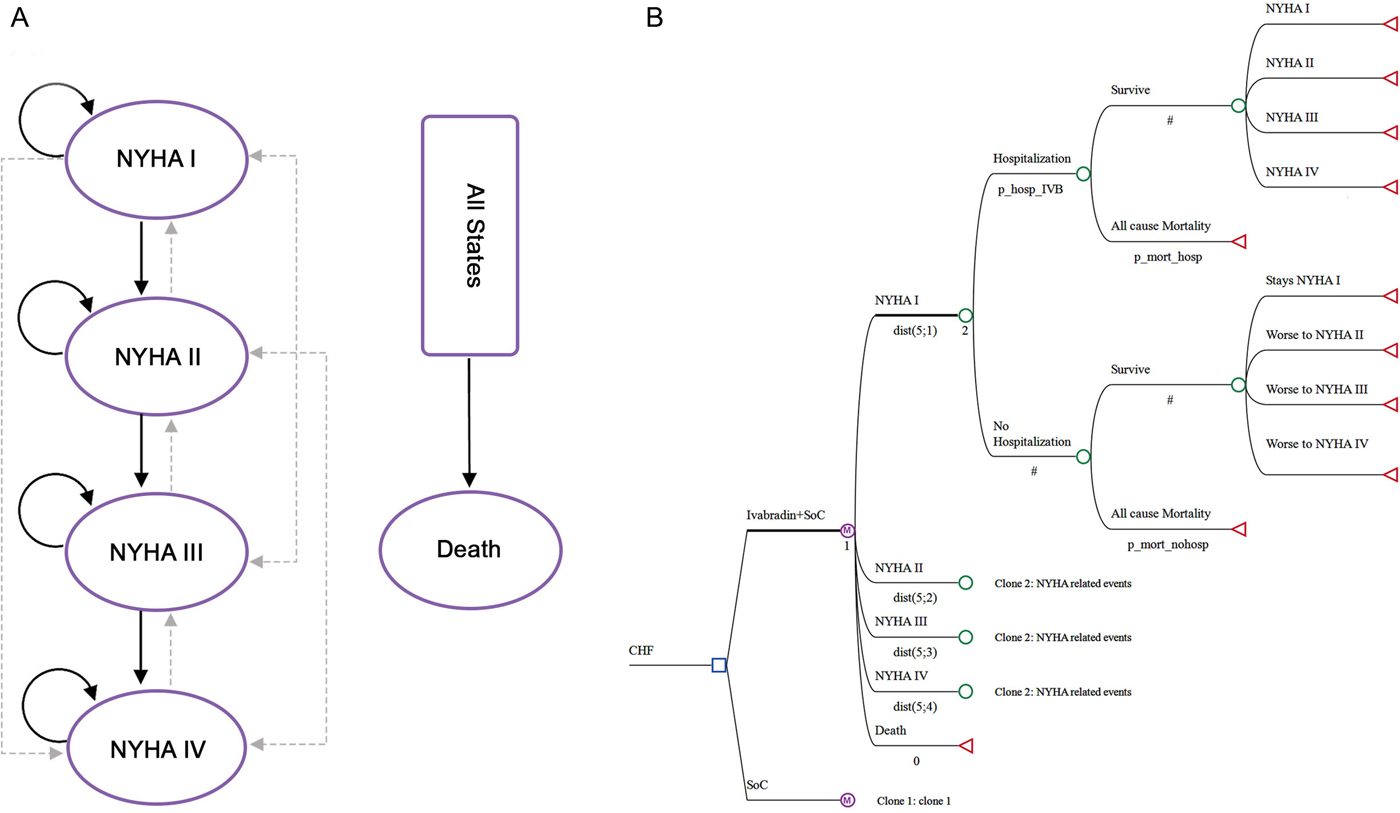
A Markov model was used to simulate a cohort of 1,000 patients with HF with an average age of 60 years and heart rate ≥75 bpm using TreeAge Pro 2018, R1 (TreeAge Software, Williamstown, MA; software available at http://www.treeage.com). The patients were treated with either ivabradine+SoC or SoC alone. The model consists of monthly cycles over a 10-year time horizon. The model defined HF progression in four health states based on the NYHA classes (NYHA I, II, III, and IV) and death. The subjects were allowed to move through the four NYHA health states or to death during each cycle. Within each health state, patients could also experience either hospitalization for worsening of HF or not. At the end of each cycle, patients could stay in the same NYHA class, improve to a better health state, deteriorate to a higher NYHA class, or die (Figure 1).
Markov model structure. A: Schematic markov model showing transitions between potential health states for chronic heart failure. B: Model structure in TreeAge pro 2018 Software. CHF, congestive heart failure; SoC, standard of care; NYHA, New York Heart Association. p_hosp_IVB, probability of hospitalization with ivabradine; p_mort_hosp, probability of mortality when hospitalized; p_mort_nohosp, probability of mortality when not hospitalized.

The measurement of effectiveness was based on QALYs, and the costs were measured in 2017 US Dollars (exchange rate: USD $1 = IRR 32,943 [Iranian Rial]). The specified outcome of the model was the ICER. ICER was determined by comparing each of the treatment strategies according to the following formula:
 $${\rm ICER} = {\matrix{{\rm Cost\;\ of\;\ ivabradine\;\ plus\;\ SoC }-\cr{\rm \;\ Cost\;\ of\;\ SoC}} \over \matrix{{\rm Effectiveness\;\ of\;\ ivabradine\;\ plus\;\ SoC}-\cr{\rm \;\ Effectiveness\;\ of\;\ SoC}}$$
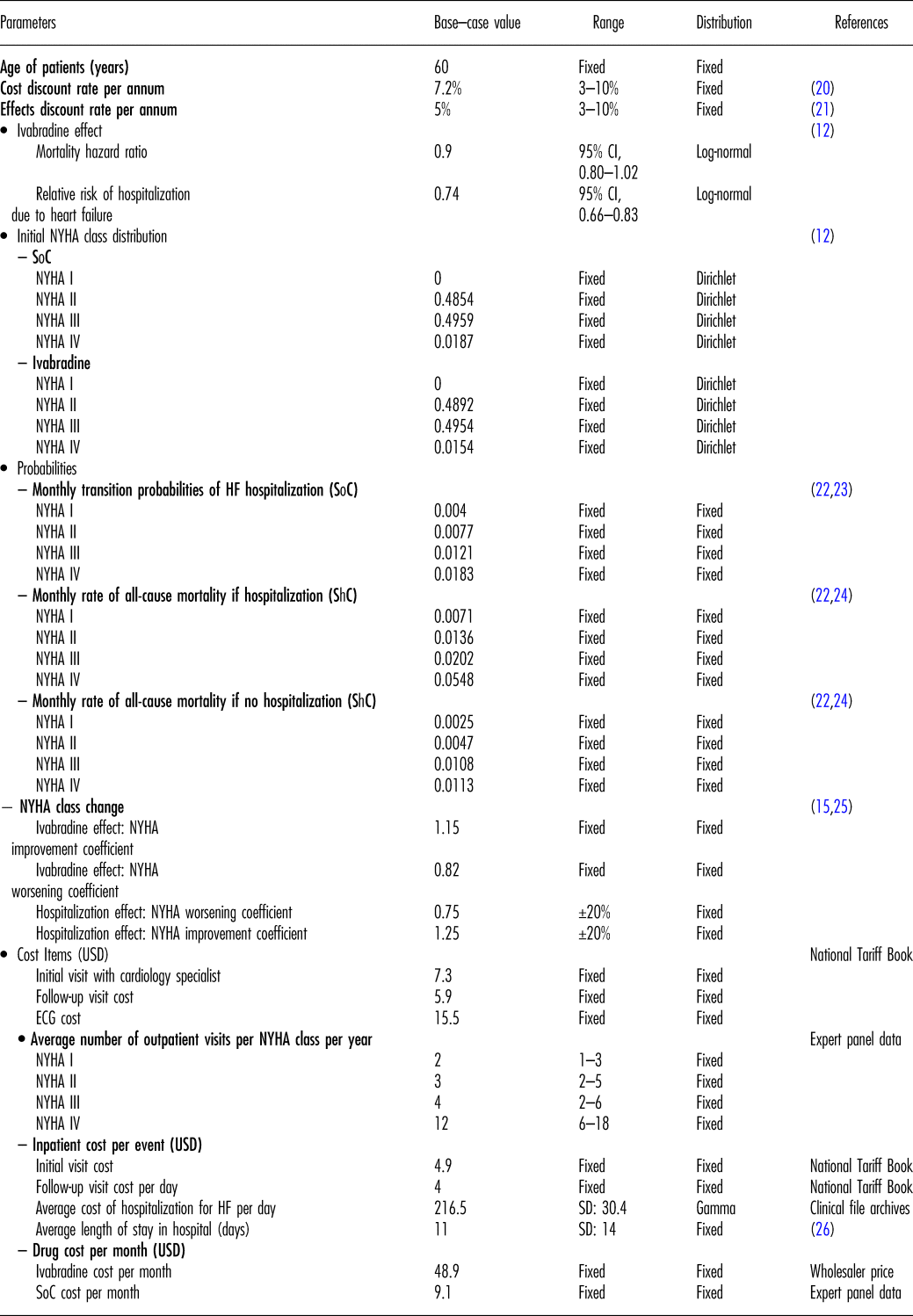
The resulting ICER described the relative cost of 1 additional QALYs (cost per QALYs gained). Finally, the ICER was compared with the Iran cost-effectiveness threshold range of 1 to 3 gross domestic product (GDP) per capita (USD $6,550 to USD $19,650) based on the World Health Organization (WHO) recommendation. An annual discount rate of 7.2 percent and 5 percent were used to costs and outcomes, respectively (18;19). The analysis was taken from an Iranian payer perspective. A summary of key model assumptions can be found in Table 1 (Reference Abdoli20–Reference Griffiths, Paracha, Davies, Branscombe, Cowie and Sculpher26).
Model Parameters

CI, confidence interval; HF, heart failure; NYHA, New York Heart Association; SD, standard deviation; SoC, standard of care.
Model Inputs
Clinical Inputs
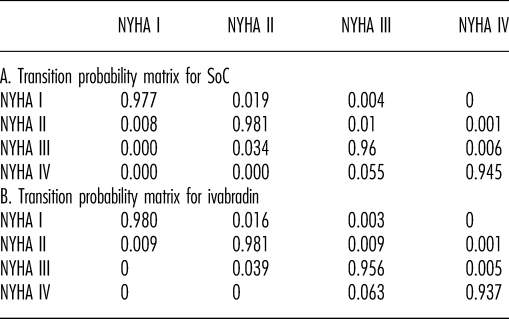
The baseline transition probabilities between NYHA classes for patients receiving SoC were extracted from the literature and are presented in Table 2 (panel A) (Reference Ford, Adams and Graves27).
Transition Parameters Used in the Decision Model

NYHA, New York Heart Association; SoC, standard of care.
Mortality rate and monthly transition probabilities of HF hospitalization for SoC were derived from the literature (Reference Ahmed, Aronow and Fleg22–Reference Muntwyler, Abetel, Gruner and Follath24;Reference Edwards, Barton, Nherera, Trevor and Hamilton28). These rates and probabilities were adjusted for ivabradine+SoC based on reported HR in the SHIFT study (see Table 1, ivabradine effect). Other clinical inputs of the model (i.e., initial NYHA class distribution and adverse events) were taken from SHIFT study data (Reference Swedberg, Komajda and Böhm12).
The addition of ivabradine results in changes to three transition probabilities: first, in hospitalization incidence rate; second, in mortality incidence rate; and third, in disease improvement and worsening. The effects of ivabradine on baseline transition probabilities (i.e., disease improvement or worsening) were retrieved from NICE single technology appraisal and are presented in Table 1 as ivabradine NYHA improvement/worsening coefficient (25). Applying these coefficients to the baseline transition probability matrix, the transition probability matrix of patients receiving ivabradine was calculated (Table 2, panel B). It was assumed that none of the patients had any contraindication of medicine consumed. Indeed, the compliance and adherence of patients were assumed to be 100 percent for both treatment strategies. In addition, the treatment effect of ivabradine is assumed to remain constant over the full model time horizon.
Resource Use and Costs
All direct medical costs including drug acquisition costs, hospitalization, medical care, HF management, and adverse events were taken into account. The cost of SoC was defined according to the SHIFT study patterns medications and the average of standard daily dosages of background therapies (Reference Swedberg, Komajda and Böhm12). The cost of drugs was based on the retail product price. The cost of ivabradine was estimated based on the dosage and the proportion of patients in the SHIFT study (7 percent for 2.5 mg and 93 percent for 5 or 7.5 mg).
The total cost of hospitalization was estimated using the cost per day for each ward (i.e., intensive care unit, cardiac care unit, and general medical) and multiplied by the length of stay and the hospitalization rate. The length of stay in each ward was obtained from local experts’ assessment. The costs of HF management (physician visits, outpatient procedures, laboratory tests, and cardiological tests) were retrieved from local experts and national tariffs. Although costs in Iran vary across public and private sectors, all cost values were considered as the real price in public sector in 2017. The costs were obtained from hospital records and national tariffs. A summary of cost data used in the model is presented in Table 1.
Quality of Life and Utility Values
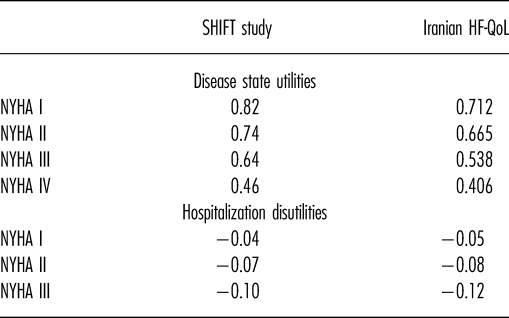
The utility scores for NYHA classes were based on the estimated quality of life (QoL) extracted from a previous study that had been carried out in Iran using a standard questionnaire entitled Iranian Heart Failure Quality of Life (IHF-QoL) (Table 3) (Reference Naderi, Bakhshandeh and Amin29). Unfortunately, there are no data available in Iran showing the HF hospitalization associated disutility. Because the quality of healthcare services are different in middle-income countries such as Iran than high-income countries in which the SHIFT trial was done, the authors assumed that the disutility of hospitalization for patients in Iran is 20 percent more than that reported in the SHIFT patient-reported outcomes sub-study (Reference Griffiths, Paracha and Davies30). However, this assumption was investigated in a sensitivity analysis.
Utility Values

NYHA, New York Heart Association; HF-QoL, Heart Failure Quality of Life study.
Simulation and Data Analysis
The uncertainties are addressed using both deterministic and probabilistic sensitivity analyses. For deterministic sensitivity analyses, we assigned a range of values to the uncertain assumptions and parameters to which the model was the most sensitive. The upper and lower bounds of parameters were defined by 95 percent confidence intervals (CIs) where possible or plausible variation around the base case values.
For probabilistic sensitivity analysis (PSA), we used a second-order Monte Carlo simulation with 5,000 iterations to evaluate the effect of uncertain parameters simultaneously on the results and to produce the cost-effectiveness scatter plot and cost-effectiveness acceptability curve over a willingness to pay (WTP) range of USD $5,500 to USD $16,500. Gamma, beta, normal, and log-normal statistical distributions were used for costs, probabilities, utilities, and hazard ratios, respectively. All input values, their respective distributions, and ranges are shown in Table 1.
RESULTS
Base-Case Result
The findings of base case analysis indicated that the discounted QALYs for ivabradine+SoC would be 3.71 compared with 3.30 for SoC. Moreover, it has been revealed that ivabradine+SoC would be more costly versus SoC alone, in a 10-year time horizon (USD $5,212 versus USD $3,005, respectively). The result also demonstrated that hospitalizations would be reduced with ivabradine therapy and, hence, the potential QoL loss and costs associated with these events would be avoided.
Overall, ivabradine+SoC was associated with a gain of 0.41 QALYs and was USD $2,207 more expensive per patient versus SoC alone. As a result, the incremental cost per additional QALYs for ivabradine+SoC versus SoC has been estimated as USD $5,437, indicating that ivabradine+SoC was a cost-effective strategy (Supplementary Table 1).
The cost component analysis showed that, among the considered cost categories, drug acquisition costs account for 54 percent and 22 percent of total costs in ivabradine+SoC and SoC alone, respectively.
Deterministic Sensitivity Analysis
The findings of the deterministic sensitivity analysis are presented in the Tornado diagram featured in Supplementary Figure 1.
The strongest drivers of the model were ivabradine mortality HR, ivabradine price, and ivabradine improvement coefficient. Results for the one-way sensitivity analyses are presented in Supplementary Table 2.
The results of the sensitivity analysis indicated that the ICER tended to remain below the threshold of USD $6,550 per QALY in all scenarios, with the exception of the ivabradine HR for cardiovascular mortality, where the ICER exceeded USD $6,550 per QALY when the HR was set at the upper limit of its 95 percent CI. The results also suggested a robustness of results to clinically plausible changes in assumptions, including relative risk of hospitalization with ivabradine, hospitalization associated disutility, and NYHA classes utility.
Because the SHIFT trial was used to extract most of clinical efficacy and safety data, it was assumed that the distribution in Iranian patients for whom one treatment with ivabradine or SoC are similar to that observed in the SHIFT trial. Although there were a minor differences in patient distribution among different health states between ivabradin and SoC groups, investigating this assumption in sensitivity analysis showed that when the initial NYHA distributions for both treatment groups are set to be the same as that in the whole SHIFT patient population, the ICER decreased by only 2.25 percent (Supplementary Table 1). Accordingly, this assumption is unlikely to have led to misleading conclusions.
PSA
Performing the PSA, it has been shown that ivabradine is expected to have a 60 percent chance of being cost-effective accepting a threshold of USD $6,550 per QALY (Supplementary Figure 2).
The cost-effectiveness acceptability curve indicated that ivabradine was likely to be cost-effective compared with SoC for WTP thresholds of more than USD $5,400 per QALY (Supplementary Figure 3). Furthermore, the cumulative proportion of patients in each health state over a 120-month (10-year) time horizon was depicted in Supplementary Figure 4.
DISCUSSION
In the current study, a Markov model was used to assess the cost-effectiveness of ivabradine compared with SoC in a 10-year horizon for HF patients in Iran from a payer perspective. Patients included in the study were those in sinus rhythm with left ventricular systolic dysfunction and had a baseline heart rate ≥75 bpm. The results indicated that adding the ivabradine to SoC would improve HF patients’ QoL in terms of reducing hospitalization and mortality as well as associated costs of care.
Sensitivity analysis was undertaken to reflect how robust the results were to the model parameters and assumptions and found the findings did not dramatically change in most of the scenarios. As has been noted, the model was most sensitive to acquisition costs for ivabradine, the efficacy of ivabradine for reducing mortality, and time horizon.
The PSA indicated that the model was robust based on the distribution of parameters such as clinical efficacy hazard ratio, costs, and utilities. In addition, the PSA demonstrated that ivabradine was the optimal strategy as it was cost-effective in more than 60 percent of simulations at a WTP threshold of 1 GDP per capita.
The results are consistent with the studies conducted in other countries such as United Kingdom (Reference Griffiths, Paracha and Davies14), Greece (Reference Kourlaba, Parissis and Karavidas16), and Spain (Reference Fernandez de, Gonzalez, Lopez de and Lopez-Sendon31).
The strength of the study is to use available sources of data to predict cost-effectiveness of ivabradine as a new HF management drug. To the best of our knowledge, this is the first analysis to evaluate the cost-effectiveness of introducing ivabradine into Iran.
The results of our economic model need to be treated with some degree of caution. Some of the data for clinical efficacy of ivabradine was derived from a randomized controlled trial (RCT), which was designed to specifically test the efficacy and tolerability of ivabradine in a selected patient population and was undertaken in a controlled situation with specified inclusion and exclusion criteria, and the applicability of these results to the Iranian population and clinical practice is difficult to assess.
This study has some limitations. The first potential limitation is the possible oversimplification of complicated clinical outcomes. The second limitation is the fact that patients’ adherence was assumed to be perfect as in the SHIFT trial, which would be different in the real world. The third limiting factor is the assumption that SHIFT results were applicable for the Iranian population and within Iran healthcare settings. Future observational studies may shed light on these assumptions. The fourth limitation is that the payer perspective does not capture true healthcare and patient direct and indirect costs. Hence, a complete analysis from a broader (societal) perspective may be worthwhile. The fifth limitation is the fact that, although the time frame looks adequately long, it is probable that a longer time frame such as lifetime horizon will affect results. However, long-term inputs are lacking to inform a longer time horizon. Of note, the results ought to be considered in the strict Iran setting and on the basis of the present time resource and drug prices. We caution the reader that the generalizability of this study results in other healthcare settings may be limited and the differences in costs between middle-income countries (such as Iran) versus high-income countries should be considered.
In summary, our results support adding ivabradine treatment of HF in Iran. These important findings can be put into perspective to introduce the drug into the Iran pharmaceutical market. More studies, especially with local data and from a societal perspective, are required to verify the results of the present study.
To the best of our knowledge, this study is the first economic evaluation of the cost-effectiveness of ivabradine for the treatment of HF patients in Iran. Ministries of health, health insurance organizations, and national drug regulatory agencies in Iran and other middle-income countries can use the results of this study for policymaking in developing and implementing clinical guidelines, pricing, and reimbursement of ivabradine in HF. Economic evaluations of medicines in low- or middle-income countries are uncommonly performed. A greater number of economic evaluations, such as the one presented, are required to assess the cost-effectiveness of new medicines in such countries for providing guidance in policy decision making.
In conclusion, the cost-effectiveness model suggests that the addition of ivabradine to SoC therapy was associated with improved clinical outcomes and also increased costs. From an Iranian healthcare system, the analysis indicates that the clinical benefit of ivabradine can be achieved at a reasonable cost in eligible HF patients.
It should be noted that this analysis cannot be a substitute for real-life direct comparisons amongst the alternative treatments. Hence, post-launch observational studies are required to verify the conclusions.
SUPPLEMENTARY MATERIAL
The supplementary material for this article can be found at https://doi.org/10.1017/S0266462318003598
Supplementary Table 1: https://doi.org/10.1017/S0266462318003598
Supplementary Figure 1: https://doi.org/10.1017/S0266462318003598
Supplementary Table 2: https://doi.org/10.1017/S0266462318003598
Supplementary Figure 2: https://doi.org/10.1017/S0266462318003598
Supplementary Figure 3: https://doi.org/10.1017/S0266462318003598
Supplementary Figure 4: https://doi.org/10.1017/S0266462318003598
CONFLICTS OF INTEREST
The authors have nothing to disclose.