As parents' depressive symptoms increase, the quality of parenting declines and developmental delays and problems in children increase (Goodman et al., Reference Goodman, Rouse, Connell, Broth, Hall and Heyward2011; Lovejoy, Graczyk, O'Hare, & Neuman, Reference Lovejoy, Graczyk, O'Hare and Neuman2000). This is particularly true in early development, when mothers' depressive symptoms predict children's withdrawal, poor communication, delayed language competence, insecure attachment, poor cognitive development, and other problems (e.g., Black et al., Reference Black, Baqui, Zaman, McNary, Le and El Arifeen2007; Dix, Meunier, Lusk, & Perfect, Reference Dix, Meunier, Lusk and Perfect2012; Downey & Coyne, Reference Downey and Coyne1990; Feng et al., Reference Feng, Shaw, Kovacs, Lane, O'Rourke and Alarcon2008; Goodman et al., Reference Goodman, Rouse, Connell, Broth, Hall and Heyward2011). However, the impact of mothers' depressive symptoms is neither direct nor uniform from family to family; rather, it varies widely depending on a variety of parent, child, and contextual factors (Dix & Meunier, Reference Dix and Meunier2009; Feldman & Masalha, Reference Feldman and Masalha2007; Goodman et al., Reference Goodman, Rouse, Connell, Broth, Hall and Heyward2011). In this article we examine variability across children and attempt to specify why some children are affected by mothers' depressive symptoms more than other children are. We address three primary questions: Do mothers' depressive symptoms constitute a greater risk for 3-year-olds who as infants were high rather than low in negative emotionality? If so, is this increased risk due to maternal reactivity, that is, to the tendency of mothers with depressive symptoms to react negatively to children who are high in negative emotionality? Is this increased risk also due to children's differential vulnerability, that is, to the tendency of negatively emotional children to adjust poorly when exposed to the negative parenting of mothers high in depressive symptoms? By addressing these questions we evaluate a model of mothers' depressive symptoms that stresses reactivity to aversive child inputs, examine mechanisms responsible for the adverse effects of depressive symptoms on early development, and specify the conditions under which risk to children is high.
Negative Emotionality, Negative Parenting, and Early Development
Children high in negative emotionality express strong and frequent negative emotions and have difficulty adapting to novelty, stress, and change (Bates & Pettit, Reference Bates, Pettit, Grusec and Hastings2007; Rothbart & Bates, Reference Rothbart, Bates, Damon, Lerner and Eisenberg1998). Although malleable on the basis of experience (e.g., Hanington, Ramchandani, & Stein, Reference Hanington, Ramchandani and Stein2010), often negative emotionality is conceptualized as high reactivity of the central nervous system and, when environments are unfavorable, is thought to constitute genetic vulnerability (Belsky & Pluess, Reference Belsky and Pluess2009; Monroe & Simons, Reference Monroe and Simons1991). Molecular–genetic studies demonstrate its association with a variety of genetic markers (dopamine receptor D4, serotonin transporter linked polymorphic region, monoamine oxidase A, transfection host P1, 5-hydroxytryptamine receptor 2A; Belsky & Pluess, Reference Belsky and Pluess2009; Hayden et al., Reference Hayden, Klein, Dougherty, Olino, Laptook and Dyson2010). Regardless of its genetic or environmental origins, researchers have proposed that negative emotionality plays an important role in the development of socioemotional competence and psychopathology (Bates & Pettit, Reference Bates, Pettit, Grusec and Hastings2007; Cicchetti, Ackerman, & Izard, Reference Cicchetti, Ackerman and Izard1995; Collins, Maccoby, Steinberg, Hetherington, & Bornstein, Reference Collins, Maccoby, Steinberg, Hetherington and Bornstein2000; Rothbart & Bates, Reference Rothbart, Bates, Damon, Lerner and Eisenberg1998). Children high in negative emotionality are at risk for problems related to self-control, withdrawal, depression, anxiety, and conduct disorders (for a review, see Bates & Pettit, Reference Bates, Pettit, Grusec and Hastings2007). However, the emergence of such problems largely depends on the quality of parenting. In general, low-competent parenting predicts problematic outcomes more strongly for children who are high rather than low in negative emotionality (Bates & Pettit, Reference Bates, Pettit, Grusec and Hastings2007; Belsky, Hsieh, & Crnic, Reference Belsky, Hsieh and Crnic1998; Belsky & Pluess, Reference Belsky and Pluess2009; Collins et al., Reference Collins, Maccoby, Steinberg, Hetherington and Bornstein2000; Feldman, Greenbaum, &Yirmiya, Reference Feldman, Greenbaum and Yirmiya1999; Morris et al., Reference Morris, Silk, Steinberg, Sessa, Avenevoli and Essex2002).
Of particular importance for the adjustment of children high in negative emotionality may be parenting that is hostile or negative. Negative parenting elicits negative emotion in children and undermines parent–child interaction, effects that should be particularly likely when children are high in negative emotionality. Parents who are critical, rejecting, angry, and dismissive of children's ongoing needs have children who experience high distress (Gianino & Tronick, Reference Gianino, Tronick, Field, McCabe and Schneiderman1988), form insecure attachments (DeKlyen, Speltz, & Greenberg, Reference DeKlyen, Speltz and Greenberg1998; De Wolff & van IJzendoorn, Reference De Wolff and van IJzendoorn1997), and over time develop poor emotion and behavior regulation (Bradley & Corwyn, Reference Bradley and Corwyn2007; Calkins, Smith, Gill, & Johnson, Reference Calkins, Smith, Gill and Johnson1998; Eisenberg, Fabes, & Murphy, Reference Eisenberg, Fabes and Murphy1996; Karreman, van Tuijl, van Aken, & Dekovic, Reference Karreman, van Tuijl, van Aken and Dekovic2006; Shipman & Zeman, Reference Shipman and Zeman2001). When parents are highly negative, children demonstrate elevated cortisol responses and related physiological reactivity (Calkins et al., Reference Calkins, Smith, Gill and Johnson1998; Dougherty, Klein, Rose, & Laptook, Reference Dougherty, Klein, Rose and Laptook2011; Hagan et al., Reference Hagan, Roubinov, Gress-Smith, Luecken, Sandler and Wolchik2011) and are at risk for both internalizing and externalizing disorders (Belsky et al., Reference Belsky, Hsieh and Crnic1998; Lim, Wood, Miller, & Simmens, Reference Lim, Wood, Miller and Simmens2011; Morris et al., Reference Morris, Silk, Steinberg, Sessa, Avenevoli and Essex2002). These relations are stronger when children are high in negative emotionality (Bates & Pettit, Reference Bates, Pettit, Grusec and Hastings2007; Kiff, Lengua, & Zalewski, Reference Kiff, Lengua and Zalewski2011).
Although this research verifies that low-competent parenting places children high in negative emotionality at particular risk, research has just begun to specify the role that negative emotionality may play in the development of children whose mothers are high in depressive symptoms. To our knowledge, only three studies have examined this relation. When mothers are high in depressive symptoms, infants high in negative emotionality have been found to be at particular risk for developmental delays in the first year (Black et al., Reference Black, Baqui, Zaman, McNary, Le and El Arifeen2007) and for depression-like symptoms at 18 months (Gartstein & Bateman, Reference Gartstein and Bateman2008). In contrast, Owens and Shaw (Reference Owens and Shaw2003) found that negative emotionality did not moderate the impact of mothers' depressive symptoms on mean levels of early externalizing problems, although declines in externalizing were faster from ages 2 to 6 among children low in negative emotionality. To date, this work has examined a limited number of child outcomes and has relied on depressed mothers' potentially biased evaluations of either their children's adjustment, negative emotionality, or both.
The current study extends these initial efforts. Reducing reliance on the reports of depressed mothers, it examines a diverse set of observed and mother-reported adjustment indices at age 3, tests whether observed negative parenting mediates depression's differential effects, and evaluates the extent to which processes in depressed mothers (maternal reactivity), in negatively emotional children (child vulnerability), or both contribute to the increased risk that negatively emotional children may face when mothers' depressive symptoms are high. We evaluated adjustment by focusing on four aspects of development in the first 3 years. First, we assessed the child's social competence, specifically tendencies to express emotion appropriately and engage in connected and cooperative social exchanges. Second, we examined the early emergence of behavior problems (e.g., internalizing, externalizing). Third, we assessed mother–child attachment and related separation distress. In early development, insecure attachment and poor regulation of emotion in the Strange Situation (Ainsworth, Blehar, Waters, & Wall, Reference Ainsworth, Blehar, Waters and Wall1978) predict a range of adjustment problems (Cassidy & Shaver, Reference Cassidy and Shaver2010), and by age 3, a child's high separation distress is linked with poor emotion regulation, delayed cognitive development, and problematic parent–child relationships (Jacobson & Wille, Reference Jacobson and Wille1984; Shouldice & Stevenson-Hinde, Reference Shouldice and Stevenson-Hinde1992). Fourth, we assessed the child's responsiveness to the mother. In early development, children who are negative and unresponsive with mothers display low receptiveness to maternal socialization, poor development of conscience, and difficulty regulating behavior in terms of internalized behavioral standards (Kochanska, Reference Kochanska1997; Kochanska, Coy, & Murray, Reference Kochanska, Coy and Murray2001; Kochanska & Murray, Reference Kochanska and Murray2000; Maccoby & Martin, Reference Maccoby, Martin, Mussen and Hetherington1983). Measured here at 36 months, each of these variables is associated with delays or problems as development proceeds.
The Maternal Reactivity Hypothesis
Two principal processes can account for why children's negative emotionality might moderate the impact of mothers' depressive symptoms. Individual differences in children are thought to elicit the environments that affect their development (Scarr & McCartney, Reference Scarr and McCartney1983). As Collins and colleagues write, “temperamental characteristics may set in motion a chain of reactions from others that put children at risk or protect them from developing behavior and psychological problems” (Collins et al., Reference Collins, Maccoby, Steinberg, Hetherington and Bornstein2000, p. 222). One environmental factor likely to be elicited by children's negative emotionality is hostile or negative parenting. Research has shown that, more than other children, children high in negative emotionality elicit negative emotion and harsh, negative, and restrictive parenting (Anderson, Lytton, & Romney, Reference Anderson, Lytton and Romney1986; Collins et al., Reference Collins, Maccoby, Steinberg, Hetherington and Bornstein2000; Lee & Bates, Reference Lee and Bates1985; Paulussen-Hoogeboom, Stams, Hermanns, & Peetsma, Reference Paulussen-Hoogeboom, Stams, Hermanns and Peetsma2007, Reference Paulussen-Hoogeboom, Stams, Hermanns and Peetsma2008). Evidence demonstrates that such negative parenting is regulated to a degree by genetic factors in children (Forget-Dubois et al., Reference Forget-Dubois, Boivin, Dionne, Pierce, Tremblay and Perusse2007; Neiderhiser et al., Reference Neiderhiser, Reiss, Pedersen, Lichtenstein, Spotts and Hansson2004), although the centrality of genetic factors linked specifically to children's negative emotionality have yet to be demonstrated. Research also shows that, when children's negativity and unresponsiveness are manipulated experimentally, parents become more negative and unresponsive (Anderson et al., Reference Anderson, Lytton and Romney1986; Bell & Chapman, Reference Bell and Chapman1986). This work suggests that children high in negative emotionality may be at risk for developmental problems and delays because they elicit negative responses from parents that undermine early adjustment.
However, only some parents will respond to negatively emotional children with highly negative parenting, and depressive symptoms in parents may be one principal factor that increases the probability of these responses. Reacting with relatively few negative emotions and behaviors during exchanges with angry, inflexible, or demanding children may be particularly difficult for mothers who have significant depressive symptoms. These symptoms are known to predict negative parenting (Lovejoy et al., Reference Lovejoy, Graczyk, O'Hare and Neuman2000) and do so because they activate a series of processes that promote negative cognition, emotion, and evaluation of parenting options (for a review, see Dix & Meunier, Reference Dix and Meunier2009). Depressive symptoms are thought to lower thresholds for the level of aversive stimulation needed to elicit negative emotion (Lahey, Conger, Atkeson, & Treiber, Reference Lahey, Conger, Atkeson and Treiber1984). They promote negative appraisals of children and a low sense of parenting efficacy (Dix & Meunier, Reference Dix and Meunier2009; Teti & Geland, Reference Teti and Gelfand1991). They increase parent-oriented and reduce child-oriented goals (Dix, Gershoff, Meunier, & Miller, Reference Dix, Gershoff, Meunier and Miller2004) and make exerting effort with children difficult (Downey & Coyne, Reference Downey and Coyne1990; Kochanska, Kuczynski, Radke-Yarrow, & Welch, Reference Kochanska, Kuczynski, Radke-Yarrow and Welch1987). All of these processes are known to predict parents' negative emotion and behavior with children.
That depressive symptoms activate processes that promote parents' reactivity to aversive input implies that evocative-gene and related child-driven environmental effects on development ought to be increasingly likely as mothers' depressive symptoms increase. This proposal is a variant of models that emphasize the dynamic interplay or match of parent and child characteristics in the development of psychopathology (Kiff et al., Reference Kiff, Lengua and Zalewski2011; Lerner & Lerner, Reference Lerner, Lerner, Carey and McDevitt1994; Thomas & Chess, Reference Thomas and Chess1977). In this case the parent component of this match is hypersensitivity to aversive inputs from children. The child component is a tendency to produce these aversive inputs, and the mechanism by which development is affected is the elicitation of negative parenting. Researchers have rarely tested models that stress that negative child characteristics promote problematic adjustment because they elicit problematic parenting if children are reared by parents who are reactive to these characteristics. Research showing that parenting mediates the impact of children's individual differences on adjustment typically does not specify characteristics of parents that might accentuate or reduce the impact these child characteristics have on parents. Parent characteristics aside, the sizeable literature demonstrating that particular children elicit problematic parenting rarely demonstrates that the elicited parenting is responsible for the child's subsequent development. We could locate only one study that examined whether elicitation of problematic parenting was responsible for the interaction of parent and child characteristics in the prediction of child adjustment. Black et al. (Reference Black, Baqui, Zaman, McNary, Le and El Arifeen2007) showed that the tendency of depressed mothers to provide poor home environments mediated the greater association of these symptoms to low mental development at 12 months when infants were high rather than low in negative emotionality. In the present study we use statistical procedures (see Muller, Judd, & Vincent, Reference Muller, Judd and Vincent2005) that evaluate directly whether the relation of negative parenting to children's characteristics is responsible for differences in children's adjustment over time. We examine whether the tendency of mothers with depressive symptoms to react to negatively emotional children with negative parenting accounts for the increased risk these children may face across the first 3 years.
The Child Vulnerability Hypothesis
The second perspective that can explain why negative emotionality might moderate the impact of mothers' depressive symptoms stresses child vulnerability. Children high in negative emotionality may be particularly sensitive or vulnerable to the negative parenting of mothers who are high in depressive symptoms. This mechanism is implied in several models of the development of adjustment problems. Diathesis–stress models emphasize that stressful environments undermine development to the extent that children possess genetic susceptibility to these environments (Goodman & Brand, Reference Goodman, Brand, Gotlib and Hammen2009; Monroe & Simons, Reference Monroe and Simons1991). Differential susceptibility theory emphasizes that children high in negative emotionality are high in developmental plasticity and are particularly sensitive to both positive and negative environments (Belsky & Pluess, Reference Belsky and Pluess2009; Boyce & Ellis, Reference Boyce and Ellis2005). Both predict that children high in negative emotionality should be particularly vulnerable to the negative and insensitive parenting of depressed mothers (Belsky & Pluess, Reference Belsky and Pluess2009). In the presence of such parenting, children high in negative emotionality ought to be more likely than other children to become fearful, angry, disorganized or distressed, to have difficulty regulating their emotions, and to develop poor quality relationships with parents (Rothbart & Bates, Reference Rothbart, Bates, Damon, Lerner and Eisenberg1998). Approaches that stress children's vulnerability to negative environments imply not that children high in negative emotionality will receive more negative parenting from depressed mothers than other children will but that they will adjust more poorly than other children when exposed to such parenting.
Researchers have not examined whether child vulnerability can explain the potentially greater impact that mothers' depressive symptoms may have on some children than others. Research in areas other than parental depression, however, demonstrates such vulnerability effects to low-competent parenting for children high in negative emotionality (Bates & Pettit, Reference Bates, Pettit, Grusec and Hastings2007; Belsky & Pluess, Reference Belsky and Pluess2009). Relative to other children, children high in negative emotionality are affected more, both positively and negatively, by variations in the quality of parenting (Bradley & Corwyn, Reference Bradley and Corwyn2007; Pluess & Belsky, Reference Pluess and Belsky2010; Stright, Gallagher, & Kelley, Reference Stright, Gallagher and Kelley2008; van Aiken, Junger, Verhoeven, van Aken, & Dekovic, Reference van Aken, Junger, Verhoeven, van Aken and Dekovic2007). In this study we tested whether child vulnerability can explain why children high in negative emotionality might be at particular risk when exposed to the negative parenting of mothers high in depressive symptoms; in other words, we examined whether these children were affected more adversely by the negative parenting that is increasingly common as mothers' depressive symptoms increase.
Overview
Using a large sample followed from infancy to age 3, we examined the interactive effects of mothers' depressive symptoms and infant negative emotionality in the prediction of a series of 36-month adjustment measures. Measures were both mother reported and observed. By using observations of infants' negative emotionality and their 36-month adjustment, we reduced the possibility that mothers' negative perceptions of infants and of 36-month adjustment would be associated due to depression-related biases in mothers' judgment. By including mother-report measures of child adjustment, we were able to assess adjustment more broadly than had we relied exclusively on laboratory observations. Three hypotheses were tested. First, depressive symptoms in mothers predict adjustment problems in 3-year-olds more strongly for children who as infants were high rather than low negative emotionality. Second, the greater risk mothers' depressive symptoms pose for these children is due to maternal reactivity, that is, the tendency for negatively emotional children to elicit increasingly negative parenting as mothers' depressive symptoms increase. Third, as mothers' depressive symptoms increase, greater risk for children high in negative emotionality is due to child vulnerability, that is, to their tendency to be affected more adversely by the negative parenting that commonly accompanies mothers' depressive symptoms.
Method
Participants
Participants were mothers and children who took part in the 10-site NICHD Study of Early Child Care and Youth Development. They were contacted in the hospital shortly after the birth of the target child. Families were excluded if the birth involved significant medical complications or if the mother was under 18, not fluent in English, known to abuse drugs, or lived outside of the catchment area. Of the 5,265 families that initially met eligibility requirements, a subset was created through conditional random sampling to ensure diversity of education, economic levels, and ethnicities. The final NICHD sample consisted of 1,364 families. Mothers included in the sample were an average of 28 years old and had 2 years of post high school education (M = 14.23). For 85% of families the child's father lived in the home. Family incomes varied, and sampling ensured that low-income families were included. The average income to needs ratio was 2.86; 80.4% of the participants described themselves as White, 12.9% as Black or African American, and 6.1% as Hispanic. Among the 1,364 families participating in the study, 984 had complete data on all measures used here.
Procedure
Children and their parents were assessed regularly, beginning when children were 1 month old and continuing until they were 15 years old. Assessments were done both in the family's home and in laboratory settings. This article used data from the 6-, 15-, 24-, and 36-month assessments. Mothers reported their depressive symptoms at each of these time points. At 6 months, infant negative emotionality was observed during a mother–child interaction; negative parenting was observed during mother–child interactions at 6, 15, and 24 months; and child outcomes were both observed and mother reported at 36 months. Observational measures were based on the coding of videotapes done at a central location by trained coders blind to mothers' and children's characteristics.
Assessments of mothers
Mothers' depressive symptoms
At 6, 15, and 24 months, mothers completed the Center for Epidemiological Study Depression Inventory (Radloff, Reference Radloff1977). The inventory elicits ratings of the extent to which 20 statements characterized mothers over the last week (e.g., “I had crying spells,” “My sleep was restless,” “I felt lonely”). The scale has excellent internal consistency and good split-half (0.78) and Spearman–Brown (0.88) reliability. It distinguishes psychiatric from normal populations and is correlated with measures of psychopathology and negative affect (Radloff, Reference Radloff1977). Scores in this sample were somewhat lower than those reported in other samples. The mean depression score was 8.94 (SD = 6.52), with 15.3% of mothers reporting an average score that was at or above the clinical cutoff of 16 (Radloff, Reference Radloff1977). Depressive symptoms assessed at one age predicted depressive symptoms assessed at each other age (rs = .52–.58, all ps < .001). Although exposure to mothers' depressive symptoms consistently predicts poor outcomes in young children, relatively brief exposure does not always demonstrate these effects (Campbell, Cohn, & Meyers, Reference Campbell, Cohn and Meyers1995). For this reason, we examined the extent to which children were exposed to mothers' depressive symptoms over the first 2 years by creating a total depression score from the 6-, 15-, and 24-month assessments. To maximize the independence of mothers' reports of their depressive symptoms and their evaluations of children on the two 36-month mother-report measures, 36-month depressive symptoms were not included in this composite.
Negative parenting
Observational measures of mothers' negative parenting were taken from mother–child interactions at 6, 15, 24, and 36 months. During these assessments, mothers and children were observed for 15 min interacting with age-appropriate toys in a semistructured laboratory procedure. Observations were divided into two parts, an initial free-play period in which mothers were instructed to play as they would normally, followed by a period in which they were to use a standard set of toys. On 4- or 7-point scales, trained coders rated videotapes of these interactions for the frequency and intensity of negative affect directed by the mother to the child. The Winer (Reference Winer1971) W values for assessing the reliability of independent coders were 0.81, 0.62, 0.76, and 0.82 at 6, 15, 24, and 36 months, respectively. Negative parenting assessed at one age predicted negative parenting assessed as each other age (rs = .20–.26, all ps < .01). To create a reliable measure of children's exposure to negative parenting, not at one point in time but across early development, standardized negative parenting scores were averaged across the four assessments. Thus, negative parenting reflected four observations totaling 1 hr across 1.5 years.
Assessments of infants and children
Infant negative emotionality
When infants were 6 months old, their expressions of emotion were observed during a 15-min semistructured interaction with the mother. On 4-point scales, coders rated infant behavior on two components of expressed emotion: negative affect and positive affect. These scores were significantly related (r = –.39, p < .001) and were combined to create a single index of negative emotionality (negative expression minus positive expression). The W values for calculating reliability of independent coders were 0.90 and 0.75 for negative and positive expression, respectively. Although prior studies using the NICHD data have operationalized negative emotionality using mothers' reports of difficult temperament (Bradley & Corwyn, Reference Bradley and Corwyn2008; Pluess & Belsky, Reference Pluess and Belsky2010), we used observed negative emotionality to eliminate bias that might result from the influence of mothers' depressive symptoms on their assessments of their infants. By assessing negative emotionality at 6 months, we sought to demonstrate that the potential risk it embodies is early emerging and evident in infancy. Because children of depressed mothers begin to suppress expression of emotion in toddlerhood (Dix et al., Reference Dix, Meunier, Lusk and Perfect2012), later assessment might have led us to underestimate the negative emotionality of children who mothers are high on depressive symptoms.
Child adjustment at 36 months
Children's 36-month adjustment was assessed using both observation and maternal report. Mothers reported children's social competence and behavior problems by completing two questionnaires: the Child Behavior Checklist (CBCL/2–3) and the Adaptive Social Behavior Inventory (ASBI). The CBCL/2–3 is a comprehensive, 99-item measure focused on behavioral and emotional problems in early childhood (Achenbach, Reference Achenbach1992). During the 36-month laboratory visit, mothers used this measure to rate the extent to which their children manifest a variety of problem behaviors currently or over the previous 2 months. The measure yields nine scale scores (e.g., internalizing, externalizing, aggression, anxiety–depression, somatic complaints). It demonstrated good test–retest reliability (rs = .71– .93) and good interparental agreement (r = .60, p < .001).
Completed during the 36-month home visit, the ASBI is a 30-item questionnaire designed to assess not only problem behaviors but also positive competence (Hogan, Scott, & Bauer, Reference Hogan, Scott and Bauer1992). It yields three principal scale scores: expressiveness, destructiveness, and compliance. These scores reflect children's tendencies to express themselves and their emotions effectively, to engage in behaviors that harm persons or property, and to display compliant behavior with others. The scales have good internal consistency (average α = 0.76).
Following Belsky, Friedman, and Hsieh (Reference Belsky, Friedman and Hsieh2001), we simplified the dozen scores yielded by the CBCL and ASBI by computing a principal-axis factor analysis with promax rotation. This yielded two factors with eigenvalues greater than 1. The first factor, Behavior Problems, accounted for 46% of the variance and consisted of high ratings on the ASBI disruptive behavior scale (0.63) and the CBCL's internalizing (0.80), externalizing (0.90), somatic problems (0.50), and sleep problems (0.52) scales. The second factor, Social Competence, accounted for 40% of the variance and consisted of high ratings on ASBI expression (0.89) and compliance (0.57). These factor scores were used in all analyses of behavior problems and social competence.
Observational measures were obtained from two 36-month mother–child interactions. In the first, the Strange Situation (Ainsworth et al., Reference Ainsworth, Blehar, Waters and Wall1978), children experienced two separations from, and subsequent reunions with, their mothers in an unfamiliar laboratory context that included an adult stranger. The first separation was designed to last 3 min and the second to last 5 min. Children's reactions to this stressful situation and their use of their mothers to calm them effectively upon reunion were observed. Two principal measures were derived from this interaction, separation distress and attachment security. Rated by trained coders, separation distress was the average intensity of the child's negative emotion and discomfort in those phases when the child was left alone and with a stranger (see Belsky et al., Reference Belsky, Friedman and Hsieh2001). On this measure the W value for calculating reliability of independent coders was 0.69. Security of attachment was coded using the system developed by the MacArthur Working Group for assessing attachment in early childhood (Cassidy, Marvin, & the MacArthur Attachment Working Group of the John D. and Catherine T. MacArthur Network on the Transition from Infancy to Early Childhood, Reference Cassidy and Marvin1992). This system divides children according to the standard, three-category classification: secure attachment and two primary forms of insecure attachment (avoidant, ambivalent). Because our hypotheses did not differentiate among types of insecure attachment, we collapsed these categories into a dichotomous measure that differentiated simply attachments that were secure from those that were insecure. Agreement between independent coders on this binary classification was 80%.
A second observation was used to assess the child's responsive behavior with the mother. Responsive behavior was observed at the 36-month laboratory visit during a 15-min semistructured interaction in which mothers played with their children and attempted to introduce them to a range of toys. Using 7-point scales, trained coders rated children's behavior on five characteristics: enthusiasm, persistence, negativity, felt security, and affection for the mother. The W values for assessing reliability of independent coders averaged 0.73 for these five variables. To simplify these scores, we computed a principal-axis factor analysis with promax rotation. This resulted in a single factor with an eigenvalue greater than 1. The factor accounted for 58% of the variance. Child negativity (–0.55), felt security (0.83), enthusiasm (0.72), persistence (0.54), and affection for the mother (0.79) loaded strongly on this factor, which we label responsive behavior with the mother. The factor score was used in all analyses of children's responsive behavior.
Control variables
To ensure that relations among our primary variables were not due to their associations with basic demographic factors, six variables were evaluated as potential controls: ethnicity, mothers' age, fathers' living in the household, mothers' education, income to needs ratio, children's gender, and mothers' marital status.
Results
Overview of analyses
Primary analyses followed regression procedures specified by Baron and Kenny (Reference Baron and Kenny1986) and Muller et al. (Reference Muller, Judd and Vincent2005) for evaluating mediated moderation. Preliminary tests showed that relations between demographic factors and our primary variables were modest (average r = .15, p < .01). Analyses demonstrated that including demographic factors in our analyses had no substantive effect on our results. Thus, we report the results of analyses done without these variables. The focus of our analyses was twofold. We examined the hypothesis that mothers' depressive symptoms were associated with more problematic adjustment if children were high rather than low in negative emotionality. To assess this, our first set of regression analyses attempted to establish the basic interaction effect we were trying to understand. These analyses predicted each 36-month child outcome from mothers' depressive symptoms, children's negative emotionality, and their interaction. This interaction is critical to both the maternal reactivity and child vulnerability hypotheses but in itself does not specify the processes that might lead children's negative emotionality to moderate the impact of mothers' depressive symptoms.
Two additional regression analyses were necessary to assess the mediation of this interaction, that is, whether it was mediated by maternal reactivity and child vulnerability. Following Baron and Kenny (Reference Baron and Kenny1986) and, more specifically, Muller et al. (Reference Muller, Judd and Vincent2005), we performed two additional sets of regression analyses. To support maternal reactivity, the data had to show that depressive symptoms predicted negative parenting more strongly when children were high rather than low in negative emotionality (Regression 2) and that negative parenting in turn predicted poor adjustment independent of other variables (Regression 3). To support child vulnerability, the data had to show that depressive symptoms predicted negative parenting (Regression 2) and that negative parenting had a greater impact on children who were high rather than low in negative emotionality (Regression 3, the negative emotionality by negative parenting interaction). The expectation-maximization algorithm, one of the most commonly used maximum likelihood estimation methods, was used to impute missing data (Schafer & Olsen, Reference Schafer and Olsen1998).
Descriptive statistics and bivariate relations
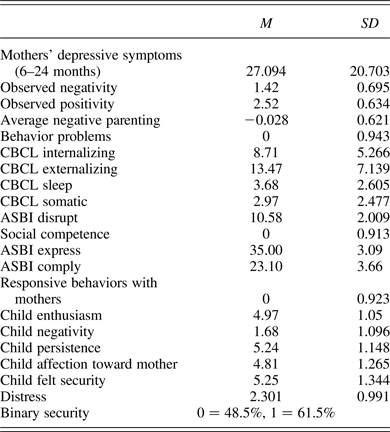
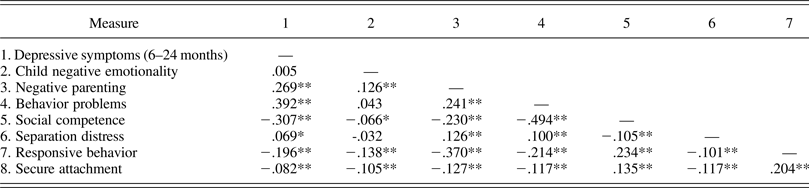
Table 1 displays the means and standard deviations of the study's principal variables. Table 2 presents bivariate relations among these variables. As predicted, in bivariate tests mothers' depressive symptoms were associated with 36-month child behavior problems, low social competence, unresponsive behavior with the mother, high separation distress, and insecure attachment. Mothers' depressive symptoms also predicted negative parenting but did not predict infant negative emotionality. Negative parenting predicted relatively poor child adjustment on all 36-month measures.
Descriptive statistics for primary variables

Note: CBCL, Child Behavior Checklist; ASBI, Adaptive Social Behavior Inventory.
Bivariate correlations among primary variables
*p < .05. **p < .01.
Regression 1: Predicting 36-month adjustment from mothers' depressive symptoms, child negative emotionality, and their interaction
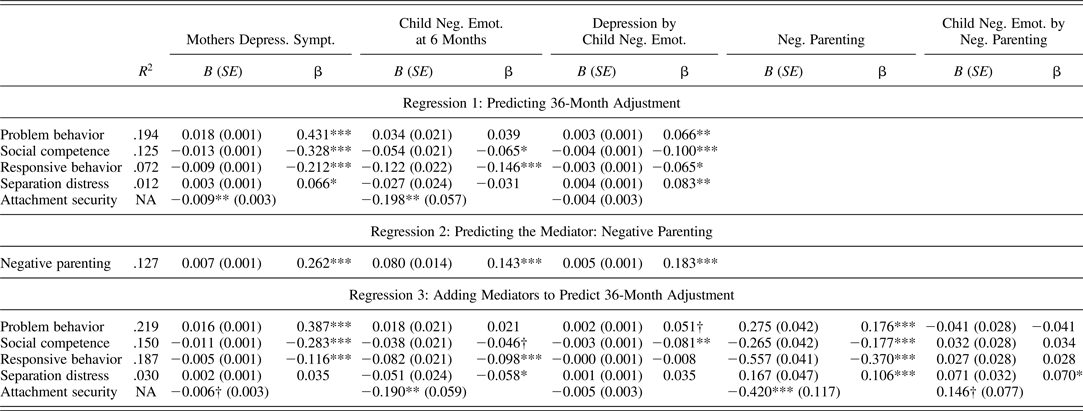
The first set of regression analyses predicted the five child-adjustment variables from mothers' depressive symptoms, 6-month negative emotionality, and their interaction (see Table 3, Regression 1). Analyses were done separately for each of the five child outcomes. Because attachment security was dichotomous, it was evaluated using logistic regression. First, the results demonstrated that mothers' depressive symptoms consistently predicted negative 36-month child outcomes independent of infant negative emotionality and its interaction with mothers' depressive symptoms. The more depressive symptoms mothers reported across the first 3 years, the more children at age 3 displayed behavior problems, low social competence, separation distress, low responsive behavior with the mother, and insecure attachment with the mother.
Relation of mothers' depressive symptoms to negative parenting and 36-month child adjustment: Depression by negative emotionality interactions and their mediation (depression from 6 to 24 months)
Note: Because attachment security is dichotomous, R 2 is not applicable (NA). †p < .07. *p < .05. **p < .01. ***p < .001.
Second, infant negative emotionality predicted three measures of 36-month adjustment independent of mothers' depressive symptoms and their interaction with infant negative emotionality. The more negatively emotional infants were observed to be at 6 months, the more likely they were to be low in social competence, unresponsive with the mother, and insecurely attached at 3 years.
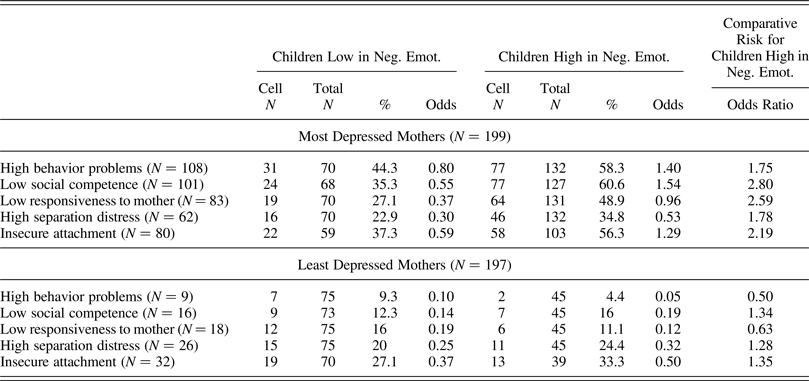
Third, as predicted by both the maternal reactivity and child vulnerability hypotheses, 6-month negative emotionality moderated the relation of mothers' depressive symptoms to 36-month child outcomes. The interaction of mothers' depressive symptoms and child negative emotionality was significant for four of the five child adjustment measures (Table 3, Regression 1). Effect sizes were modest, with R 2 ranging from .01 to .19 (see Table 3). Figure 1, Figure 2, Figure 3, and Figure 4 display the simple slopes related to these interactions. Child behavior problems, low social competence, low responsive behavior with the mother, and separation distress were each associated with mothers' depressive symptoms more strongly among children who were high rather than low in negative emotionality. Table 4 presents an effect size display related to the depressive symptoms by negative emotionality interaction. It shows that, when mothers' depressive symptoms were above clinical cutoffs, the odds for problematic development (most negative quartile) on average were more than twice as high for children who were high rather than low in negative emotionality (M = 2.22). In contrast, when mothers were essentially without depressive symptoms, the odds for problematic development on average were virtually identical for children who were high rather than low in negative emotionality (M = 1.02). Note that, consistent with differential susceptibility theory, children high in negative emotionality actually appeared to be less likely than children low in negative emotionality to display behavior problems and low responsiveness to mothers when mothers' depressive symptoms were low.
(Color online) Simple slopes for the interaction of mothers' depressive symptoms and infant negative emotionality in the prediction of behavior problems.
(Color online) Simple slopes for the interaction of mothers' depressive symptoms and infant negative emotionality in the prediction of social competence.
(Color online) Simple slopes for the interaction of mothers' depressive symptoms and infant negative emotionality in the prediction of responsive behavior with mothers.
(Color online) Simple slopes for the interaction of mothers' depressive symptoms and infant negative emotionality in the prediction of children's separation distress during the Strange Situation.
Odds that children high and low in negative emotionality will be in the most negative quartile on each 36-month child outcome when mothers have the most and fewest depressive symptoms
Note: The most depressed mothers were in the top 15.3%, at or above the clinical cutoff of 16; the least depressed were in the bottom 15.2%. A median split determined whether negative emotionality was high or low. Total N is the number of children high (or low) in negative emotionality for mothers in each depression group (differences across dependent variables reflect occasional missing data). Cell N is the number of children in each cell who were not only high versus low in negative emotionality but also in the upper quartile on each dependent variable. Because attachment is dichotomous, entries in the percentage columns are the percentage of insecurely attached children, not the percentage in the upper quartile.
Regression 2: Negative parenting as a potential mediator
Following procedures detailed by Muller et al. (Reference Muller, Judd and Vincent2005), Regression 2 evaluated relations between our primary predictors and negative parenting, the potential mediator. These relations are central to both the maternal reactivity and child vulnerability hypotheses. Mothers' depressive symptoms, child negative emotionality, and their interaction were used to predict negative parenting. First, the results showed that the more depressed mothers reported being, the more negative their parenting. This supports one component of our test of child vulnerability; it demonstrates that the environment for children becomes increasingly negative or stressful as mothers' depressive symptoms increase. Second, the interaction of depressive symptoms and children's negative emotionality was significant. This supports one component of the maternal reactivity hypothesis: as this hypothesis implies, simple slopes analysis verified that mothers' depressive symptoms predicted negative parenting more strongly when, as infants, children were high (β = 0.294, p < .001) rather than low in negative emotionality (β = 0.208, p < .001). Children's negative emotionality also predicted negative parenting independent of depressive symptoms and their interaction with negative emotionality.
Regression 3: Evaluating mediated moderation and the roles of maternal reactivity and child vulnerability
Following Muller et al.'s (Reference Muller, Judd and Vincent2005) procedure for determining factors that may be mediating an interaction or moderating effect, a third set of regression analyses predicted 36-month child outcomes from five predictors: mothers' depressive symptoms, children's negative emotionality, the interaction of depressive symptoms and negative emotionality, negative parenting, and the interaction of negative parenting with negative emotionality. To evaluate whether negative parenting and its interaction with negative emotionality mediate the significant interaction of depressive symptoms and negative emotionality present in Regression 1, predictors from Regression 1 were included. This is required to ensure that the potential mediators predict the dependent variables independent of the effects they are mediating. The results of these analyses are displayed at the bottom of Table 3. Given evidence from Regression 2 that depressive symptoms predicted negative parenting more strongly when children were high rather than low in negative emotionality, support for maternal reactivity would be confirmed if in Regression 3 negative parenting now predicted 36-month child outcomes independent of all other predictors. For all four outcome variables that had demonstrated the moderating role of negative emotionality in Regression 1, this prediction was upheld in Regression 3. Independent of depressive symptoms, negative emotionality, and their interaction, negative parenting significantly predicted behavior problems, low social competence, low responsive behavior with the mother, and separation distress. Sobel tests demonstrated that mediation for all four of these variables was significant (all |Z| > 2.90, ps < .01).
For the child vulnerability hypothesis to be supported, Regression 3 would have to reveal a significant negative emotionality by negative parenting interaction; that is, children who were high rather than low in negative emotionality would have to be affected more adversely by the negative parenting that Regression 2 demonstrated was increasingly likely as mothers' depressive symptoms increased. This interaction was significant only for separation distress. As predicted by the child vulnerability hypothesis, simple slopes analysis demonstrated that negative parenting predicted separation distress more strongly when children were high (β = 0.237, p < .001) rather than low (β = 0.067, ns) in negative emotionality.
Discussion
This study examined whether mothers' depressive symptoms have particularly adverse effects on the early development of children high in negative emotionality, and if so, which processes are responsible for this differential impact. Drawn from a large sample of infants followed to age 3, the data demonstrated that, as mothers' depressive symptoms increased, infants high in negative emotionality were at particular risk and that the tendency for depressive symptoms to increase mothers' negative reactions to these children appeared in part to be responsible for this increased risk. As mothers' depressive symptoms increased, children who were high in negative emotionality at 6 months were particularly likely to be exposed to negative parenting, and negative parenting, in turn, predicted a range of problematic observed and mother-reported indices of adjustment when children were 3 years old. The findings are a step toward understanding why mothers' depressive symptoms have effects that are variable and often indirect (Dix & Meunier, Reference Dix and Meunier2009; Goodman et al., Reference Goodman, Rouse, Connell, Broth, Hall and Heyward2011; NICHD Early Child Care Research Network, 1999; Teti, Gelfand, & Pompa, Reference Teti, Gelfand and Pompa1990). They are some of the first to specify which children are at particular risk as mothers' depressive symptoms increase and to link differences in children's early adjustment explicitly to the relation of their individual characteristics to variations in the parenting they appear to elicit from mothers who are reactive to these characteristics.
Children's negative emotionality and the impact of mothers' depressive symptoms
For children low in negative emotionality, mothers' depressive symptoms predicted poor adjustment, but adjustment was particularly poor for children high in negative emotionality. For these children depressive symptoms were stronger predictors of children's behavior problems, low social competence, separation distress, and low responsive behavior. When mothers were at or above the clinical cutoff for depressive symptoms, for example, children who were high in negative emotionality as infants were 2.8 times more likely at age 3 to be low in social competence, 1.8 times more likely to display behavior problems, and 2.6 times more likely to be unresponsive to the mother (see Table 4). In contrast, when mothers were without depressive symptoms, children who were high in negative emotionality as infants were essentially either no more likely, or less likely, at age 3 to manifest poor adjustment than were infants low in negative emotionality. By the time they reach their third birthday, negatively emotional children, if their mothers' depressive symptoms are high, manifest particular strain in the mother–child relationship and behaviors that appear to reflect poor emotional control, self-regulation, and socioemotional competence.
Each adjustment variable measured here at 36 months is associated with problems as development proceeds. Low responsive behavior with mothers predicts poor conscience development, low willing cooperation, and low effortful or self-control (Feldman et al., Reference Feldman, Greenbaum and Yirmiya1999; Kochanska, Reference Kochanska1997; Kochanska et al., Reference Kochanska, Coy and Murray2001; Spinrad et al., Reference Spinrad, Eisenberg, Gaertner, Popp, Smith and Kupfer2007), effects that are evident as much as 5 years later (Kochanska & Murray, Reference Kochanska and Murray2000). High emotional distress upon separation from mothers, although not usually predictive of problems in early development, by age 3 is linked to poor emotion regulation and parent–child relationships and potentially delayed cognitive development (Jacobson & Wille, Reference Jacobson and Wille1984; Shouldice & Stevenson-Hinde, Reference Shouldice and Stevenson-Hinde1992). Behavior problems and low social competence in early childhood each predict adjustment problems in children years later during elementary school (Bornstein, Hahn, & Haynes, Reference Bornstein, Hahn and Haynes2010; Egeland, Kalkoske, Gottesman, & Erickson, Reference Egeland, Kalkoske, Gottesman and Erickson1990). Thus, the findings are clear in showing that, as mothers depressive symptoms increase, developmental risk for children who are high in negative emotionality as infants is significantly greater than for other children.
Maternal reactivity: Elicitation of negative parenting from mothers with depressive symptoms
The data support analyses that stress fit between parent and child characteristics, in this case between children's negative emotionality and mothers' apparent reactivity to that negative emotionality. On four of five measures, as mothers' depressive symptoms increased, the particularly high risk that negatively emotional children face appeared to be partly attributable to the negative reactivity to these children that mothers high in depressive symptoms displayed. Given links between negative emotionality and a number of genetic markers (Belsky & Pluess, Reference Belsky and Pluess2009), the results are consistent with analyses that stress evocative gene–environment relations (Neiderhiser et al., Reference Neiderhiser, Reiss, Pedersen, Lichtenstein, Spotts and Hansson2004; Scarr & McCartney, Reference Scarr and McCartney1983). As implied by the maternal reactivity hypothesis, they appear to reflect the interplay of aversive demand from children and negative reactivity to that demand in mothers with depressive symptoms. Although reactivity to children's crying and other demanding behaviors has evolved to ensure parents' attention to, and protection of, infants and young children, mothers' depressive symptoms appear to set in motion adaptations to infant and child demand that make parenting excessively negative and parent oriented. They promote negative emotion with children, negative appraisals of children's behavior, motivation for self- rather than child-oriented goals, negative appraisals of parenting competence, and favorable evaluations of negative child rearing behavior (for a review, see Dix & Meunier, Reference Dix and Meunier2009). These adaptations lead to parenting that elicits highly negative emotion from children, reduces positive and responsive patterns of parent–child interaction, and resists rather than promotes children's interests.
A number of mechanisms in children may be responsible for the increased risk negative parenting confers. Negative parenting, particularly negative reactions to children's expressions of emotion, has been shown to promote problems with the development of regulatory control over emotion, attention, and behavior. Tronick and his colleagues propose that in early development negative responses to children's negative emotions lead children to become overly aroused, to have difficulty managing this arousal, and to cope with arousing interactions in ways that undermine their ability to remain effectively engaged (Gianino & Tronick, Reference Gianino, Tronick, Field, McCabe and Schneiderman1988; see also Eisenberg et al., Reference Eisenberg, Fabes and Murphy1996; Spinrad et al., Reference Spinrad, Eisenberg, Gaertner, Popp, Smith and Kupfer2007). Negative parenting has been linked to heightened physiological reactivity and, in particular, to increased cortisol production among preschool children who have been exposed to the negative parenting of depressed mothers (Dougherty et al., Reference Dougherty, Klein, Rose and Laptook2011; Hagan et al., Reference Hagan, Roubinov, Gress-Smith, Luecken, Sandler and Wolchik2011). Negative parenting is also associated with the development of poor strategies for regulating negative emotion. It is linked to negative expectations of mothers and, potentially, other social partners (Dix & Buck, Reference Dix, Buck, Campbell and Loving2011; Shipman & Zeman, Reference Shipman and Zeman2001) and to reduced exposure to aversive maternal behavior, with suppression of emotional communication and initiative with mothers (Dix, Cheng, & Day, Reference Dix, Cheng and Day2009; Dix et al., Reference Dix, Meunier, Lusk and Perfect2012; Dix, Stewart, Gershoff, & Day, Reference Dix, Stewart, Gershoff and Day2007; Feng et al., Reference Feng, Shaw, Kovacs, Lane, O'Rourke and Alarcon2008). A pattern of high stress reactivity, poor self-regulation, and withdrawal from interaction with mothers may limit children's ability to engage events fully, to develop a sense of self-efficacy, and to use parents as a base for exploration, an aid in the regulation of stress, and a tool for the acquisition of information and skill normally acquired from countless interactions with positive, responsive parents.
For some time it has been known that children high in negative emotionality elicit negative parenting and that genetic and behavioral factors in children are likely responsible for this. Despite the prominence of the proposal that individual differences in development are partly attributable to differences in the parenting children elicit, few studies have tested this proposal directly. Researchers have rarely demonstrated that the negative parenting elicited by children high in negative emotionality is responsible for the increased risk for adjustment problems these children face. One of the few studies demonstrating comparable mediation was done with children exposed to trauma. Punamaki, Samir, and Sarraj (Reference Punamaki, Samir and Sarraj1997) found that the increased risk for adjustment problems evident in children exposed to violence could be traced to the negative parenting to which they were particularly likely to have been exposed. Similarly, the present data support a model in which child characteristics are important in part because they elicit problematic parenting. Theoretically, this demand–reactivity dynamic should apply to parent characteristics other than depressive symptoms and to child characteristics other than negative emotionality. Not only depressed mothers but also mothers who make negative attributions for children's difficult behavior (Dix, Reference Dix1993; Dix & Lochman, Reference Dix and Lochman1990), who have a low sense of competence and control (Bugental & Shennum, Reference Bugental and Shennum1984; Teti & Gelfand, Reference Teti and Gelfand1991), and who have difficulty regulating their negative emotions (Slep & O'Leary, Reference Slep and O'Leary2007; Vasta, Reference Vasta1982) are also more likely to react to difficult child behavior with negative emotion and overly negative discipline. Not only negatively emotional children but also children who are highly active or socially unresponsive, who have significant medical problems, or who display emerging behavior disorders elicit more negative emotion and negative, unresponsive parenting than do other children (Anderson et al., Reference Anderson, Lytton and Romney1986; Bell & Chapman, Reference Bell and Chapman1986; Bryan & Dix, Reference Bryan and Dix2009). The data presented here suggest that the interplay of children's characteristics and parents' reactivity to these characteristics may be important for understanding why some children are at increased risk for early adjustment problems.
Child vulnerability
The data provide little consistent evidence for child vulnerability as an explanation for the greater impact that mothers' depressive symptoms have on children who are high rather than low in negative emotionality. Separation distress was the only outcome for which increases in negative parenting associated with mothers' depressive symptoms predicted problematic outcomes more strongly for children who were high rather than low in negative emotionality. Sizeable differences across studies in samples, measures, and procedures make it difficult to know why support for this mechanism obtained in other studies was not obtained here. One possibility may lie in how negative emotionality was assessed. Across studies, measures are multifaceted, encompass a range of interrelated characteristics, and vary from maternal reports of sleep problems, activity, or irritability, to observations of early parent–child interaction (Owens & Shaw, Reference Owens and Shaw2003) and of children's responses to controlled laboratory stimuli. Some of these measures may tap components of negative emotionality that are linked closely to the aversive child behaviors that elicit negative parenting; others may tap components linked more directly to children's central nervous system arousability and related factors that perhaps are responsible for child vulnerability. The extent to which either maternal reactivity and child vulnerability effects depend on the specifics of these measurement practices is unknown. Because support for child vulnerability from prior studies using the NICHD data has been based on mothers' reports of difficult child temperament (Bradley & Corwyn, Reference Bradley and Corwyn2008; Pluess & Belsky, Reference Pluess and Belsky2010), we reanalyzed the data using these reports. We still found no consistent evidence that child vulnerability could explain the differential impact at 36 months of mothers' depressive symptoms on children who were high versus low in negative emotionality. Like negative emotionality, parenting is also complex. Some components of parenting may affect development via child vulnerability, others via maternal reactivity. Had other aspects of the environments created by mothers high in depressive symptoms been assessed (e.g., chaotic home environments or maternal withdrawal) their impact on children might have been attributed to children's vulnerability to these aspects of depressive environments.
Limitations
A number of factors limit the conclusions that can be drawn from these data. First, although the sample was diverse, generalizing to less advantaged populations, clinical samples, or groups from different cultural backgrounds should be done with caution. Second, like other researchers (e.g., Owens & Shaw, Reference Owens and Shaw2003), we measured negative emotionality during observation of infant behavior with the mother. The validity and reliability of this assessment is supported by interrater agreement and consistent, theoretically coherent results. Like maternal report measures, this method relies on information from a single source or context. The results may differ when negative emotionality is assessed with other measures or in other contexts. It is important to determine, for example, the extent to which the child's negativity is general across diverse contexts or evident primarily with mothers. Third, the conclusion that, when negative emotionality is high, the reactivity of mothers with depressive symptoms is a basis for children's developmental problems does not preclude other pathways. Effects sizes were modest, and the path related to maternal reactivity did not fully mediate the interaction effects we observed. Note, however, that using a nonclinical sample and measuring negative emotionality in a relatively unemotional context should have resulted in underestimation of effect sizes.
Conclusion
This study demonstrated individual differences in the extent to which mothers' depressive symptoms affect children's early adjustment. It demonstrated that depressive symptoms were particularly likely to undermine the adjustment of children who were high in negative emotionality as infants and that one mechanism for this increased risk is the negative reactivity of depressed mothers to the negative characteristics of these children. The results show the importance of the tendency for children to evoke responses that shape their development and of the role of mothers' depressive symptoms in regulating the extent to which difficult child characteristics evoke negative low-competent parenting. The findings suggest that it may be important to determine whether the tendency for other child characteristics to evoke low-competent parenting may similarly account for the developmental problems of children in other risk groups (e.g., high activity, significant medical problems). Furthermore, the demonstrated mediational role of negative parenting in this increased risk implies that, when infants are high in negative emotionality, interventions that reduce the negative parenting of depressed mothers have potential to significantly reduce that risk.