Introduction
Windmill nystagmus is considered a rare variant of periodic alternating horizontal nystagmus with a superimposed periodic alternating vertical nystagmus.Reference Choi, Shin, Kim, Kim, Choi and Kim1 After the first observation, reported by Sanders and Glaser in 1973,Reference Sanders, Glaser and Smith2 three other cases were presented after 43 years by Choi et al.,Reference Choi, Shin, Kim, Kim, Choi and Kim1 and, more recently, Lee et al.Reference Lee, Jo, Kim, Choi and Kim3 described a patient who developed a windmill nystagmus three months after visual loss. This particular kind of nystagmus is characterised by a clock-like rotation of the beating direction of a jerk nystagmus, usually 90° out of phase. Unlike the periodic alternating nystagmus, windmill nystagmus alternates the direction also in the vertical plane.
All the reported cases concern blind patients or subjects with profound visual loss; hence, their abnormal eye movements may be ascribed not only to an impairment of the velocity storage mechanism as in the classical periodic alternating nystagmus, but also to a malfunction of the gaze-stabilising networks caused by the lack of visual feedback. An observation of windmill nystagmus in patients with no visual deficit has never been reported.
We describe the case of a sighted woman affected by non-congenital, episodic, short-cycle, periodic alternating nystagmus and periodic episodes of benign paroxysmal positional vertigo (BPPV), who developed a particular windmill nystagmus provoked by bilateral posterior canalolithiasis.
Case report
An 85-year-old female patient, who had suffered from periodic episodes of BPPV during the previous years, presented to her ENT specialist (NC) with a new episode of BPPV. A videonystagmographic recording performed a month before by her specialist documented a classical jerk-type horizontal periodic alternating nystagmus (a short video is available on The Journal of Laryngology & Otology website (Appendix 1)). The brain magnetic resonance imaging (MRI) with gadolinium scan revealed moderate cerebral and cerebellar atrophy with signs of chronic subcortical ischaemia, compatible with age. The patient was sent to our centre for further evaluations.
During our videonystagmographic examination, the subject did not present any spontaneous nystagmus, only square-wave saccadic intrusions. The Dix–Hallpike manoeuvre elicited a paroxysmal anticlockwise rotatory nystagmus in the right side and a paroxysmal clockwise rotatory nystagmus in the left side, both with latency and fatigability. She was symptomatic in both sides.
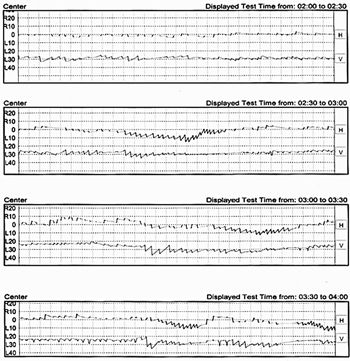
After reaching the sitting position, a prolonged video recording documented, after 1 minute, the appearance of a windmill nystagmus with anticlockwise up-beating nystagmus, followed by a clockwise down-beating nystagmus. Each cycle lasted 2 minutes and was followed by a brief burst of horizontal left-beating nystagmus (a short video is available on The Journal of Laryngology & Otology website (Appendix 2), and Figure 1).
Bursts of horizontal left-beating nystagmus (arrows). H = horizontal; V = vertical

Bithermal caloric stimulation findings were normal. Left-sided asymmetry and horizontal optokinetic nystagmus were found, with a mean peak slow-phase velocity of 19° per second on the left side and 9° per second on the right side. Horizontal random saccadic evaluation at 10° and 30° showed only a minimal increase in latency. The horizontal tracking of sine waves revealed a velocity gain compatible with age.
The patient underwent liberatory manoeuvres, which resulted in complete resolution of the BPPV. The windmill nystagmus has not been observed again during follow up.
Discussion
Acquired periodic alternating nystagmus is a rare disorder in which a spontaneous horizontal nystagmus periodically reverses direction. RobinsonReference Robinson4 proposed a model based on brainstem neural network instability that generates slow-phase vestibular and optokinetic nystagmus. In 1998, Dow and AnastasioReference Dow, Anastasio, Jordan, Kearns and Solla5 demonstrated that periodic alternating nystagmus might also be evoked in normal subjects with a prolonged low frequency rotation; they hypothesised the presence of an unstable positive velocity storage loop stabilised by central adaptation under cerebellar control. A cerebellar lack of inhibition on the velocity storage mechanism is likely to impact the pathogenesis of this mechanism, and prolonged rotations could produce a decrease in the central adaptation, resulting in low frequency oscillations that resemble periodic alternating nystagmus.
• Periodic alternating nystagmus is characterised by spontaneous horizontal nystagmus that periodically reverses direction
• Windmill nystagmus is a peculiar and rare variant of periodic alternating nystagmus
• This paper presents the unique case of a normally sighted patient with windmill nystagmus triggered by benign paroxysmal positional vertigo
• This represents the first observation of a new type of windmill nystagmus, probably provoked by a velocity storage mechanism malfunction
The velocity storage mechanism is a sort of integrator of GABAΒ-sensitive neurons that converts the small time constant response at the level of the canal afferents to a long time constant response at the level of the medial and superior vestibular nuclei.Reference Yakushin, Raphan and Cohen6 This network has been mainly studied in relation to horizontal nystagmus, and we have poor knowledge about its function in vertical or roll plane.Reference Bertolini, Bockisch, Straumann, Zee and Ramat7 The effect of this network is primarily on the horizontal vestibulo-ocular reflex, which explains the evidence indicating that periodic alternating nystagmus is usually horizontal; vertical velocity storage is present, but it is generally weaker.Reference Choi, Shin, Kim, Kim, Choi and Kim1 Conceptually, Raphan and CohenReference Raphan and Cohen8 consider that the velocity storage mechanism has a three-dimensional mathematical structure, with the orientation's properties linked to gravity and spatial perception on the vertical plane. The interconnections between the neurons of the vestibular nuclei of each side are fundamental for the maintenance of the velocity storage mechanism function, which is lost when the neural projections between the medial and superior vestibular nuclei of the two sides are damaged.Reference Yakushin, Raphan and Cohen6
Concerning windmill nystagmus, a very rare type of periodic alternating nystagmus, the hypothesised pathophysiology is based on malfunctions of the velocity storage mechanism and the gaze-stabilising networks due to a lack of signals from visual feedbacks.Reference Choi, Shin, Kim, Kim, Choi and Kim1 Our case is a possible clinical demonstration that the velocity storage mechanism stored the peripheral input in the vertical and roll plane too, and successively reproduced it under the form of a windmill nystagmus. This also represents verisimilar clinical proof of the storage of gravitational and otolithic input in the central circuitry of the velocity storage mechanism.
Our findings confirm that periodic alternating nystagmus may be evoked by disturbances of peripheral input, like that observed in two previous case reports of Ménière's disease with periodic alternating nystagmus provoked by hydropic attacks.Reference Chiu and Hain9,Reference Murofushi, Chihara, Ushio and Iwasaki10 Moreover, windmill nystagmus, a type of periodic alternating nystagmus, seems to be elicited by peripheral pathologies. Thus, a peripheral input like BPPV may, in some predisposed individuals, trigger a periodic oscillation of the eyes, reproducing the previously induced nystagmus. As observed by Kim et al.,Reference Kim, Chung, Kim, Hwang, Kim and Lee11 when central was compared with peripheral periodic alternating nystagmus, the latter appeared to be a temporary phenomenon; likewise, our ‘peripheral’ windmill nystagmus showed this distinctive characteristic.
In contrast to the cases previously described by other authors,Reference Choi, Shin, Kim, Kim, Choi and Kim1,Reference Sanders, Glaser and Smith2 our patient did not have any visual impairments, and she could still use visual fixation to suppress the nystagmus. This might suggest that visual deprivation and enduring instability in gaze-holding networks are not the main mechanisms underlying windmill nystagmus. It is probable that the instability of the velocity storage mechanism in its vertical component, although weaker than its horizontal counterpart, is strong enough to provoke the windmill nystagmus. Choi et al.Reference Choi, Shin, Kim, Kim, Choi and Kim1 previously reported that windmill nystagmus could also occur in the presence of a residual visual function. In their opinion, the visual pathway used for immediate suppression of the spontaneous nystagmus is separated from the network which advises the adaptive pathways that the images are unstable on the retina.Reference Choi, Shin, Kim, Kim, Choi and Kim1
Moreover, our patient presented a known classic, horizontal, periodic alternating nystagmus, so she was predisposed to a probable impairment in cerebellar inhibition of the velocity storage mechanism, even if MRI did not show specific cerebellar lesions other than moderate atrophy. A further interesting finding was the presence of left horizontal jerks bursts during the interval (called ‘neutral phase’) between the two rotatory cycles of nystagmus, which seemed to resemble the down-beat nystagmus often observed during the periods of classic horizontal, periodic alternating nystagmus.Reference Daroff and Dell'Osso12 This can be explained by malfunctions of the velocity storage mechanism and gaze-stabilisation network associated with damage to the short-adaptation pathways that generally lead to the remarkable regularity observed in most cases of periodic alternating nystagmus.
Our case is the first documented confirmation that nystagmus of peripheral origin with a vertical-rotatory component, as in posterior canal BPPV, can induce, after a certain latency, the equivalent of a periodic alternating nystagmus in the vertical axis, namely windmill nystagmus.
Conclusion
This case report represents the first observation of windmill nystagmus triggered by BPPV, provoked by bilateral posterior canalolithiasis, occurring in a normally sighted patient with a known classical horizontal, periodic alternating nystagmus.
Competing interests
None declared
Appendix 1. Supplementary video material
A short video demonstrating classical jerk-type horizontal periodic alternating nystagmus is available online at The Journal of Laryngology & Otology website, at https://doi.org/10.1017/S0022215119002469.
Appendix 2. Supplementary video material
A short video demonstrating periodic alternating nystagmus of rotatory type, with anticlockwise nystagmus followed by clockwise nystagmus, is available online at The Journal of Laryngology & Otology website, at https://doi.org/10.1017/S0022215119002469.