Depression accounts for nearly half of the global burden of disease associated with psychiatric disorders (Whiteford et al., Reference Whiteford, Degenhardt, Rehm, Baxter, Ferrari, Erskine and Vos2013) and is among the most costly chronic health conditions to society (Merikangas et al., Reference Merikangas, He, Burstein, Swendsen, Avenevoli, Case and Olfson2011). Risk for depression is low in childhood, rises dramatically during adolescence (Merikangas et al., Reference Merikangas, He, Brody, Fisher, Bourdon and Koretz2010; Rohde, Lewinsohn, Klein, Seeley, & Gau, Reference Rohde, Lewinsohn, Klein, Seeley and Gau2012), and peaks in early adulthood (ages 18–24; Rohde et al., Reference Rohde, Lewinsohn, Klein, Seeley and Gau2012). The long-term consequences of depression during phases of important social and occupational development, such as adolescence, can be significant. Moreover, interventions targeting depressive symptoms during late adolescence are limited (e.g., TADS Team, 2007). Thus, identifying prospective risk factors for depression may help us to identify intervention targets that can mitigate risk during this key developmental phase. Sleep disturbance has been identified as one of these prospective risk factors. Yet, little is known about the psychophysiological processes through which sleep disturbances presage depression. One possibility is that persistent sleep disturbance alters the functioning of the hypothalamic–pituitary–adrenal (HPA) axis, which has been implicated in the pathogenesis of depression (e.g., Baumeister, Lightman, & Pariante, Reference Baumeister, Lightman, Pariante, Pariante and Lapiz-Bluhm2014). The purpose of this study was to determine whether daily functioning of the HPA axis mediated the well-established link between sleep and depression over time.
Sleep disturbance is pervasive in depression, with 50%–90% of depressed patients reporting problems with sleep (Casper et al., Reference Casper, Redmond, Katz, Schaffer, Davis and Koslow1985; Lewinsohn, Rohde, & Seeley, Reference Lewinsohn, Rohde and Seeley1998a; Soehner, Kaplan, & Harvey, Reference Soehner, Kaplan and Harvey2014). However, sleep disturbance not only is a symptom of depression but also can act as a robust predictor (Baglioni et al., Reference Baglioni, Battagliese, Feige, Spiegelhalder, Nissen, Voderholzer and Riemann2011; Cho et al., Reference Cho, Lavretsky, Olmstead, Levin, Oxman and Irwin2008; Irwin et al., Reference Irwin, Archer, Olmstead, Brown, Teplin, Patel and Breen2018; Lee et al., Reference Lee, Cho, Olmstead, Levin, Oxman and Irwin2013). Several studies in pediatric samples have shown that sleep problems prospectively predict depressive symptoms (Gregory et al., Reference Gregory, Caspi, Eley, Moffitt, Oconnor and Poulton2005; Raniti et al., Reference Raniti, Allen, Schwartz, Waloszek, Byrne, Woods and Trinder2017; Roberts & Duong, Reference Roberts and Duong2014). Adolescents who regularly sleep 8.5 hr per night are at the lowest risk for depression and anxiety (Ojio, Nishida, Shimodera, Togo, & Sasaki, Reference Ojio, Nishida, Shimodera, Togo and Sasaki2016), and sleep disorders (e.g., pediatric sleep apnea) are prospectively associated with increased depression risk (Chang, Chen, & Liu, Reference Chang, Chen and Liu2017). Further, experimental sleep deprivation has a negative effect on mood and emotion regulation (Palmer & Alfano, Reference Palmer and Alfano2017). In contrast, effective treatment of sleep problems ameliorates depressive symptoms in adolescents (Blake, Sheeber, Youssef, Raniti, & Allen, Reference Blake, Sheeber, Youssef, Raniti and Allen2017) and adults (Ashworth et al., Reference Ashworth, Sletten, Junge, Simpson, Clarke, Cunnington and Rajaratnam2015; Ye et al., Reference Ye, Zhang, Chen, Liu, Li, Liu and Jiang2015). Yet, the neurobiological processes through which the well-established association between sleep disturbance and depression occur remain unclear.
One pathway through which sleep disturbance may increase risk for depression is through alterations to the functioning of the HPA axis (Buckley & Schatzberg, Reference Buckley and Schatzberg2005). In healthy individuals, cortisol is highest in the morning, rises dramatically within the 30–45 min after waking, and declines throughout the remainder of the day. The initial rise in cortisol is referred to as the cortisol awakening response (CAR), and the decline across the day is referred to as the diurnal cortisol slope. Individuals reporting persistent sleep problems exhibit a general upregulation in cortisol throughout the day, which is the final secretory product of the axis. Total sleep time is negatively correlated with circulating cortisol across the day (Chrousos, Vgontzas, & Kritikou, Reference Chrousos, Vgontzas, Kritikou, De Groot, Chrousos and Dungan2016). Experimental sleep disruption in the form of repeated arousals throughout the night also induce elevated cortisol the subsequent day (Chrousos et al., Reference Chrousos, Vgontzas, Kritikou, De Groot, Chrousos and Dungan2016), and individuals reporting greater sleep disturbances demonstrate flatter cortisol slopes across the day (Kumari et al., Reference Kumari, Badrick, Ferrie, Perski, Marmot and Chandola2009; Zeiders, Doane, & Adam, Reference Zeiders, Doane and Adam2011) and a larger CAR (Kumari et al., Reference Kumari, Badrick, Ferrie, Perski, Marmot and Chandola2009). This may occur in part through the exaggerating effect that sleep deprivation has on receptors for adrenocorticotropic hormone (ACTH) on the adrenal cortex, which trigger the secretion of cortisol (Meerlo, Sgoifo, & Suchecki, Reference Meerlo, Sgoifo and Suchecki2008; Suchecki, Lobo, Hipólide, & Tufik, Reference Suchecki, Lobo, Hipólide and Tufik1998). In turn, having a larger CAR has been identified as a prospective predictor of depressive symptoms (Hsiao et al., Reference Hsiao, Chang, Kuo, Huang, Liu, Lai and Chan2013; Kuhlman et al., Reference Kuhlman, Irwin, Ganz, Crespi, Petersen, Asher and Bower2017), depressive episode onset 1 (Adam et al., Reference Adam, Doane, Zinbarg, Mineka, Craske and Griffith2010) and 2.5 years later (Vrshek-Schallhorn et al., Reference Vrshek-Schallhorn, Doane, Mineka, Zinbarg, Craske and Adam2013), and depression recurrence (Hardeveld et al., Reference Hardeveld, Spijker, Vreeburg, Graaf, Hendriks, Licht and Beekman2014). It is important to note, however, that some studies have failed to observe this association (Carnegie et al., Reference Carnegie, Araya, Ben-Shlomo, Glover, O'Connor, O'Donnell and Lewis2014; LeMoult, Ordaz, Kircanski, Singh, & Gotlib, Reference LeMoult, Ordaz, Kircanski, Singh and Gotlib2015) while others have found the prospective association between CAR and depressive symptoms varies by stress exposure (Schuler et al., Reference Schuler, Ruggero, Goldstein, Perlman, Klein and Kotov2017). To our knowledge, only one study has tested HPA axis functioning as a mediator between sleep disturbances and depressive symptoms, finding that in prostate cancer survivors, diurnal cortisol slope and total diurnal cortisol exposure indirectly linked sleep problems with depressive symptoms over 4 months (Hoyt, Bower, Irwin, Weierich, & Stanton, Reference Hoyt, Bower, Irwin, Weierich and Stanton2016). However, we are unaware of any studies examining these pathways in adolescents.
The purpose of this study was to determine whether CAR and diurnal cortisol slope contribute to the association between sleep disturbances in late adolescence and depressive symptoms in early adulthood, when risk for depression is highest. In this study, we focus on two indices of HPA axis functioning: CAR and diurnal slope. CAR has been repeatedly identified as a prospective predictor of depression (Adam et al., Reference Adam, Doane, Zinbarg, Mineka, Craske and Griffith2010; Kuhlman et al., Reference Kuhlman, Irwin, Ganz, Crespi, Petersen, Asher and Bower2017; Vrshek-Schallhorn et al., Reference Vrshek-Schallhorn, Doane, Mineka, Zinbarg, Craske and Adam2013), and diurnal cortisol slope was selected given that basal cortisol is consistently elevated in depressed children and adolescents compared to controls (Lopez-Duran, Kovacs, & George, Reference Lopez-Duran, Kovacs and George2009). We hypothesized that having more sleep disturbance would be associated with higher depressive symptoms 2 years later, and that having a larger CAR and less decline in cortisol from waking to bedtime would mediate this prospective association.
Method
Participants
Participants in the current study were from a longitudinal study designed to understand how psychosocial factors, family processes, and daily experiences contribute to early risk for poor health (Chiang et al., Reference Chiang, Kim, Almeida, Bower, Dahl, Irwin and Fuligni2017; Guan et al., Reference Guan, Bower, Almeida, Cole, Dahl, Irwin and Fuligni2016). Enrollment for the larger study (n = 316) began in 10th and 11th grades and included follow-up assessments 2 and 4 years after enrollment. The current study focused on participants during the transition from late adolescence to early adulthood (e.g., the second and third assessments of the larger study), which spanned from 12th grade to 3 years after high school. The inclusion criteria for the present study were having at least 2 complete days of data for diurnal HPA axis functioning, sleep at the second assessment, and depressive symptoms at the third and final assessment. Cases without complete data on any of these variables were listwise deleted. Of note, no participants were excluded for missing saliva samples, and all of the 157 participants included had complete data for all 3 days of diurnal HPA axis regulation. At the second assessment, 53.5% of participants were enrolled in high school, 36.9% were in college, and 9.6% were not in school. Participants were from diverse backgrounds: 46.5% of the sample was Latino, 14.0% was Asian, 31.2% was European, and 8.3% reported “other” for ethnicity. This demographic distribution is similar to that of the Los Angeles metropolitan area (US Census Bureau, 2009). Adolescents in this sample had parents with a wide range of educational backgrounds: 14.8% had parents who did not complete high school, 15.6% had parents with a high school diploma, 46.6% had parents with some college including vocational training, and 23.0% had parents with a bachelor's degree or higher. There were no differences in household income, p = .34, parent education, p = .16, body mass index (BMI), p = .42, or depressive symptoms, p = .73, between the sample in the present analyses and the 316 participants initially enrolled in the larger study. However, the present analytic sample had a higher proportion of female participants, χ2 = 7.33, p = .007, and a nonsignificantly lower proportion of Asian participants than the initially enrolled sample, χ2 = 6.78, p = .079.
Procedures
Participants were recruited from four Los Angeles high schools that were selected based on racial and ethnic diversity as well as the willingness of the school to allow our team to recruit from their student population. Recruitment involved in-class presentations, distribution of study flyers and recruitment forms during presentations, and postal mailings to students’ homes. Study visits occurred in participants’ homes between October and August.Footnote 1 Adolescents completed all questionnaires using an electronic tablet. Upon completion of the questionnaires, participants were instructed to collect five saliva samples each day for the next 3 consecutive days (see detail below). Study staff returned to participants’ homes to collect completed materials, and adolescents were compensated for their time. Data for the present analyses focused on self-reported sleep disturbance, depressive symptoms, and salivary cortisol assessed when participants were 17–18 years of age, and depressive symptoms assessed 2 years later, when participants were 19–20 years old. See Figure 1 for a study procedures timeline.
Timeline of study procedures.

Measures
Sleep disturbance
Participants completed the 19-item Pittsburgh Sleep Quality Index (PSQI) about their sleep over the past month (Buysse, Reynolds, Monk, Berman, & Kupfer, Reference Buysse, Reynolds, Monk, Berman and Kupfer1989). The PSQI returns a global sleep disturbance score that can range from 0 to 21; higher scores indicate worse sleep disturbance, and scores greater than 5 indicate clinically meaningful problems with sleep (Dietch et al., Reference Dietch, Taylor, Sethi, Kelly, Bramoweth and Roane2016). The PSQI global scores were computed from seven component scores that can range from 0 to 3. These sleep components include subjective sleep quality, sleep latency, sleep duration, habitual sleep efficiency, sleep disturbances, use of sleep medication, and daytime dysfunction. In the present sample, the internal reliability of the seven components of the PSQI was α = .62. It should be noted that the internal reliability of the PSQI in adolescent and young adult samples tends to be lower than in the original validation sample (e.g., Lund, Reider, Whiting, & Prichard, Reference Lund, Reider, Whiting and Prichard2010). In this sample, the reliability was partly driven by Component 6, use of sleep medication, which was rare (14%) in our sample even in participants with the poorest sleep. Due to the instability of individual PSQI component scores (Cole et al., Reference Cole, Motivala, Buysse, Oxman, Levin and Irwin2006; Mollayeva et al., Reference Mollayeva, Thurairajah, Burton, Mollayeva, Shapiro and Colantonio2016), no analyses were conducted with individual component scores.
Depressive symptoms
Depressive symptoms in the past week were assessed via the Center for Epidemiologic Studies Depression Scale (CES-D; Radloff, Reference Radloff1977). The CES-D is a 20-question, self-report instrument with excellent reliability and validity (Radloff, Reference Radloff1977). Scores on the CES-D can range from 0 to 60, and a score greater than 15 suggests clinically significant symptoms of depression (Radloff, Reference Radloff1977). The CES-D has demonstrated good sensitivity and specificity, with major depressive episodes determined via semistructured clinical interview (Mulrow et al., Reference Mulrow, Williams, Gerety, Ramirez, Montiel and Kerber1995; Stockings et al., Reference Stockings, Degenhardt, Lee, Mihalopoulos, Liu, Hobbs and Patton2015). This measure also demonstrated excellent internal reliability in the current sample, age 17–18 α = .91 and age 19–20 α = .92.
HPA axis functioning
Participants provided saliva samples using Salivettes (Sarstedt, Inc.) 5 times per day across 3 consecutive days: waking, 15 and 30 min after waking, before dinner, and at bedtime. They were instructed to collect saliva prior to eating, drinking, or brushing their teeth, to avoid tobacco and caffeinated products half an hour prior to collection, and to store samples in their refrigerators until study staff returned to collect the completed materials. To encourage compliance, reminders of when to provide saliva samples were sent via text throughout the day. Participants used electronic time stampers (Dymo Corporation, Stamford, CT) and stamping booklets to record time and completion of each saliva sample. The electronic time stampers were preset with a security code that precluded participants from tampering with the date and time. Returned saliva samples were stored at –80 °C until they were shipped for assay. Saliva samples were assayed for cortisol concentrations (nmol/L) by the Laboratory of Biological Psychology at the Technical University of Dresden, Germany, using high-sensitivity chemiluminescence-immunoassays (IBL International, Hamburg, Germany). All saliva samples for an individual were assayed on the same plate in duplicate, and coefficients of variation were <8%.
We computed two indices of diurnal HPA axis functioning: CAR and diurnal slope. Both indices were averages across the 3 sampling days to reduce the influence of day-to-day within-person variability on the indices (Adam & Kumari, Reference Adam and Kumari2009). CAR was computed by subtracting the concentration of salivary cortisol at waking from the concentration at 30 min postwaking to reflect reactivity of the system following waking (see Stalder et al., Reference Stalder, Kirschbaum, Kudielka, Adam, Pruessner, Wüst and Hellhammer2016, for CAR expert consensus guidelines). On average, the +30 min sample was collected 32 min (SD = 10) after waking. There were 12 participants whose 30-min postwaking sample was taken more than 15 min early or late, and 48 participants whose 30-min postwaking sample was taken more than 5 min early or late. There were no significant differences in CAR magnitude between participants with sample timings more than 15 min or 5 min late or early, F (1, 155) = 1.28, p = .26 and F (1, 155) = 0.01, p = .92, respectively. The pattern of results was not different when the number of minutes between the waking and 30-min postwaking sample was included as a covariate in the models. Consistent with previous studies using the CAR index (Kuhlman, Geiss, Vargas, & Lopez-Duran, Reference Kuhlman, Geiss, Vargas and Lopez-Duran2015; Kuhlman et al., Reference Kuhlman, Irwin, Ganz, Crespi, Petersen, Asher and Bower2017; Kuhlman, Repetti, Reynolds, & Robles, Reference Kuhlman, Repetti, Reynolds and Robles2016), negative CAR values were recoded as 0 to reduce the influence of a delay between actual waking and the waking saliva sample on CAR magnitude (Okun et al., Reference Okun, Krafty, Buysse, Monk, Reynolds, Begley and Hall2010). We also computed the slope of diurnal cortisol decline throughout the day. Consistent with previous studies (Kuhlman et al., Reference Kuhlman, Repetti, Reynolds and Robles2016, Reference Kuhlman, Irwin, Ganz, Crespi, Petersen, Asher and Bower2017), we subtracted cortisol concentrations at waking from cortisol concentrations at bedtime, and divided that value by the number of hours between the waking and bedtime samples.
Data analysis
All continuous variables were examined for normality and found to be normally distributed. To test the hypothesized associations and mediating processes between late adolescent sleep problems, CAR, and later depressive symptoms, we fit a mediator model with bootstrap resampling for assessing indirect effects (Hayes, Reference Hayes2013; Preacher & Hayes, Reference Preacher and Hayes2008). There are several methods of statistically testing mediation (see MacKinnon, Fairchild, & Fritz, Reference MacKinnon, Fairchild and Fritz2007, for a thorough review and comparison of statistical approaches to mediation). The most traditional has been the causal steps approach. This approach requires that first there be a significant effect of the independent variable (IV) on the dependent variable (DV), a significant effect of the IV on the mediator (M), and a significant effect of M on the DV. Theoretically, the difference in the effect of the IV on the DV with and without M can then be used to infer mediation (MacKinnon et al., Reference MacKinnon, Fairchild and Fritz2007). However, the requirement of these three significant pathways in any given data set substantially reduces the power to detect mediation, contributing to Type II errors. The currently recommended method for testing mediation instead uses bootstrap resampling, which does not require a significant effect of the IV on the DV to test for mediation (although a theoretical association is critical for study design and interpretation of the results). Instead, the product of the effect of the IV on M and M on the DV when accounting for the IV can be used to infer mediation. The relative mathematical equivalence of these (difference vs. product) approaches has been well established, despite their differences in assumptions, power, and utility (MacKinnon et al., Reference MacKinnon, Fairchild and Fritz2007).
In the present analyses, we employed the PROCESS macro for SPSS developed by Preacher and Hayes (Reference Preacher and Hayes2008). All analyses generated 95% bias-corrected and accelerated bootstrap confidence intervals (CIs) for the indirect effects using 5,000 bootstrap samples. In this model, the independent variable (IV: sleep problems) affects the dependent variable (DV: depressive symptoms) through the mediator (CAR or diurnal slope). The indirect effect of the mediator is its unique effect on the outcome (Preacher & Hayes, Reference Preacher and Hayes2008). This approach uses ordinary least squares regression to establish the association between (a) the IV (sleep problems) and the mediator (CAR), (b) the mediator and the DV (depressive symptoms) while accounting for the IV, (c) the IV and the DV, and (d) ab, the cross-product of a and b. If the upper and lower bounds of the bootstrap CI for ab do not contain zero, the mediated effect is considered statistically significant (Hayes, Reference Hayes2013).
We also explored the impact of several potential covariates on the key variables in our models using bivariate χ2, Pearson correlations, or analysis of variance depending on variable structure. These included sociodemographic (sex, parent education, household income, and ethnicity), theoretical (depressive symptoms at the time of the sleep and HPA axis assessment and BMI), and methodological variables (time between the sleep/HPA axis and final depressive symptoms assessment, waking time on saliva collection days, and minutes between the waking and 30 min postwaking saliva samples) that are known to be associated with the development of depression or HPA axis functioning. Waking time was determined via self-report of waking time on the saliva collection diary, which is a reliable measure of waking time when compared to polysomnography (Okun et al., Reference Okun, Krafty, Buysse, Monk, Reynolds, Begley and Hall2010). All models were first tested unadjusted for covariates. Then, any covariates that significantly influenced independent, mediator, or dependent variables were then included in our mediation model to determine whether hypotheses were supported above and beyond the role of these covariates.
Results
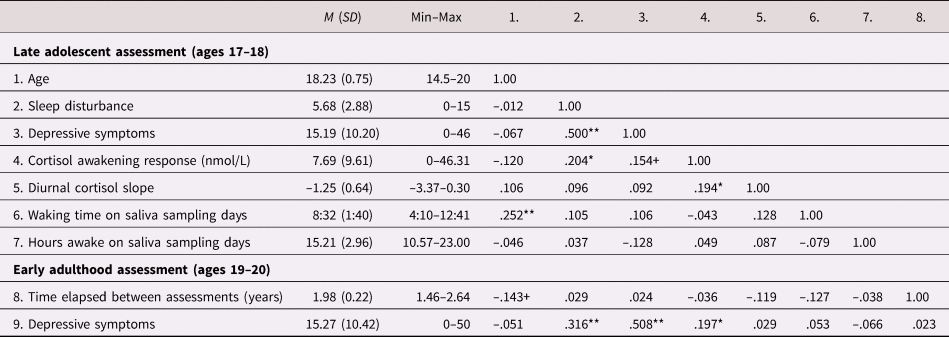
Participants in this study were, on average, 18.23 (SD = 0.75) years old at time of the sleep disturbance assessment and diurnal cortisol sampling. At this assessment, participants reported a wide range of sleep disturbance, with 49.7% exceeding the threshold for clinically meaningful sleep problems. Participants exhibited a typical diurnal pattern of cortisol regulation. Upon waking, the majority (65.6%) of participants exhibited an increase in cortisol, and almost all adolescents (97.4%) exhibited a decline in cortisol from waking to the last sample of the day. Finally, participants reported a wide range of depressive symptoms at both assessments with 42.7% and 32.6% of the sample exceeding the clinical cutoff at the first (age 17–18) and second assessments (age 19–20), respectively. See Table 1 for descriptive statistics for all key continuous variables in the analyses and the bivariate correlations between them.
Descriptive statistics and bivariate correlations between key study variables

**p < .01. *p < .05. +p < .10.
Family household income, parent education, time between assessments, waking time on saliva sampling days, and minutes between waking and 30-min postwaking sample were not associated with any of the key variables of interest, ps > .11. Female participants reported higher depressive symptoms at age 19–20 than male participants, p = .045, Asian participants exhibited a larger CAR than any other ethnic group, p = .018, participants with a higher BMI exhibited a smaller CAR, p = .032, and participants reporting more depressive symptoms at age 17–18 also had nonsignificantly larger CARs, p = .055, more sleep disturbances, p < .001, and greater depressive symptoms at age 19–20, p < .001. Thus, we tested our models with and without sex, ethnic background, BMI, and depressive symptoms at age 17–18.
Sleep as a prospective predictor of depressive symptoms
Individuals who reported more sleep disturbance also reported higher depressive symptoms 2 years later, b = 1.15, SE = 0.28, p < .001, and reports of sleep disturbance accounted for 10% of the variance in later depressive symptoms, R 2 = .10, F (1, 155) = 17.24, p < .001. The prospective association between sleep and depressive symptoms 2 years later remained significant after accounting for sex, Asian ethnic background, and BMI, b = 0.88, SE = 0.31, p = .005. However, sleep disturbances at age 18 were not a significant predictor of later depressive symptoms when accounting for concurrent depressive symptoms, b = 0.14, SE = 0.32, p = .67.Footnote 2
Sleep disturbance and diurnal indices of HPA axis functioning
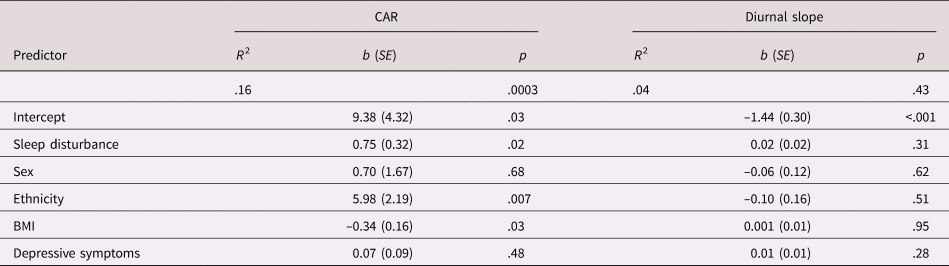
Greater sleep disturbance was associated with having a larger CAR, b = 0.68, SE = 0.26, p = .01, and sleep disturbance accounted for 20% of variability in CAR, R 2 = .20, F (1, 155) = 6.76, p = .010. This pattern did not change when adjusting for covariates (age 17–18 depressive symptoms, sex, ethnic background, and BMI), b = 0.75, SE = 0.32, p = .02. Sleep disturbance was not associated with the slope of diurnal cortisol decline, b = 0.02, SE = 0.02, p = .24. This pattern did not change when adjusting for covariates, b = 0.02, SE = 0.02, p = .31. See Table 2 for the results of these models.
Unstandardized coefficient estimates predicting age 17–18 CAR and diurnal slope from sleep disturbances over the past month and key covariates

HPA axis functioning and depressive symptoms
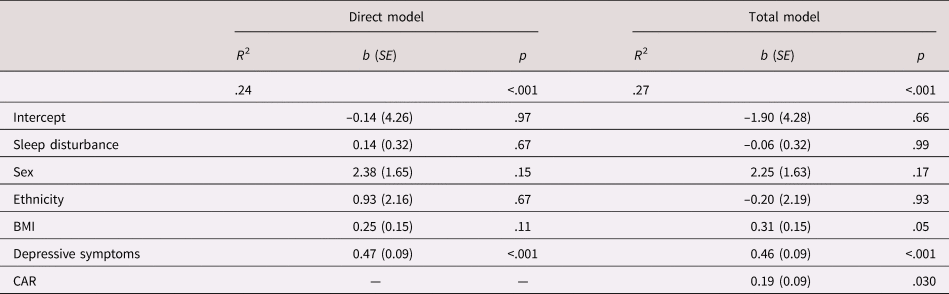
We then examined the association between diurnal indices of HPA axis functioning and depressive symptoms 2 years later. Having a larger CAR was associated with having more depressive symptoms 2 years later, b = 0.15, SE = 0.07, p = .023. This observation remained when covariates were added to the model, b = 0.19, SE = 0.09, p = .030. Overall, the covariate adjusted model of sleep problems and CAR accounted for 27% of variance in depressive symptoms 2 years later, R 2 = .27, F = 7.98, p < .001. See Table 3 for results of the direct and total models predicting age 19–20 depressive symptoms.
Unstandardized coefficient estimates predicting age 19–20 depressive symptoms from age 17–18 sleep disturbances, CAR, and key covariates

Diurnal cortisol slope was not associated with depressive symptoms 2 years later, b = –0.03, SE = 1.25, p = .98, and this pattern did not change when adjusting for covariates, b = –0.05, SE = 1.24, p = .97.
Cortisol awakening response mediates the association between sleep and depressive symptoms
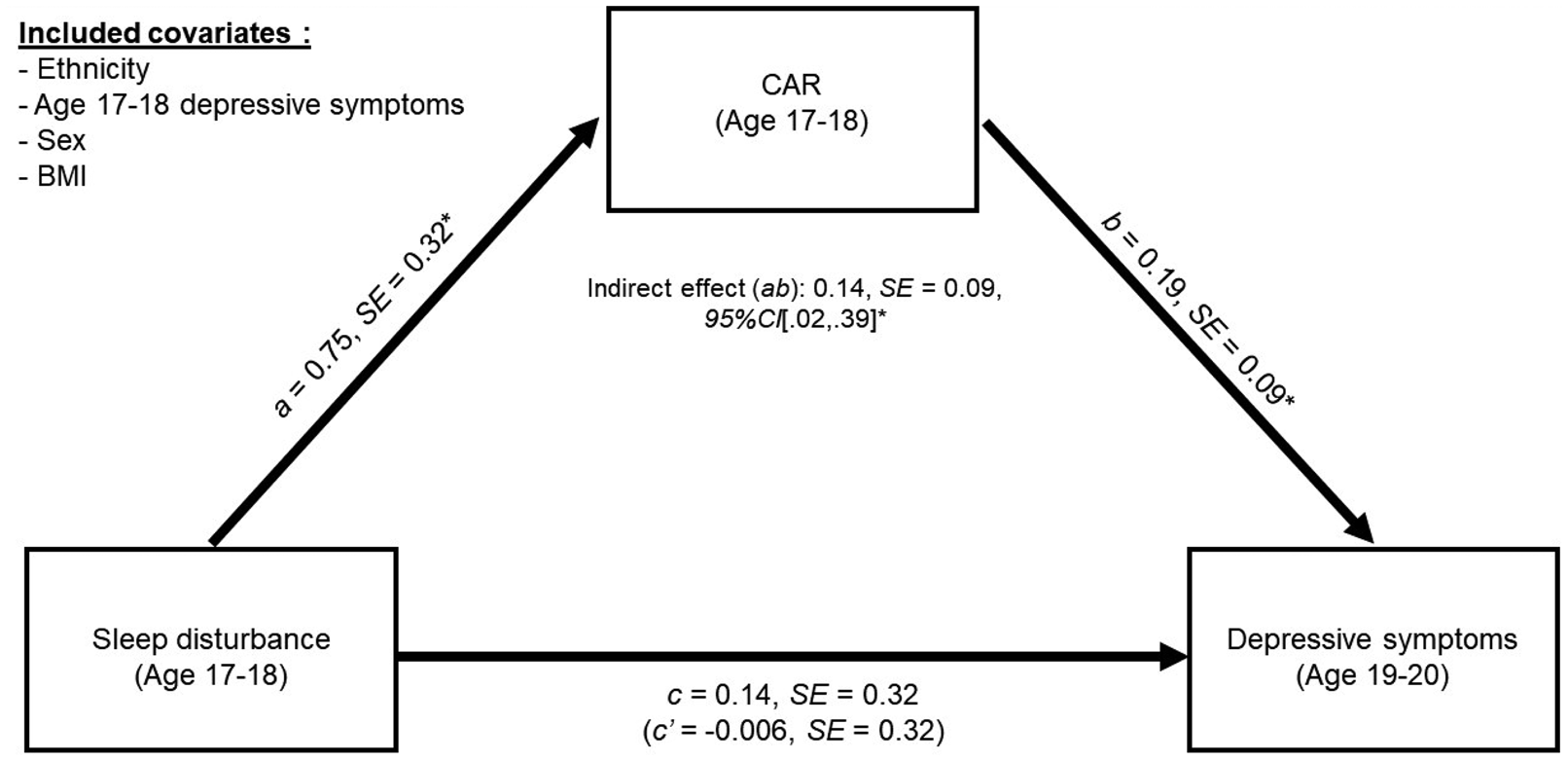
Finally, we tested whether CAR mediated the link between sleep disturbances and later depressive symptoms. In the unadjusted model, there was a significant total effect of sleep disturbance and CAR on depressive symptoms 2 years later, c = 1.15, SE = 0.28, 95% CI [0.60, 1.69]. This total effect was composed of a significant direct effect of sleep disturbance on later depressive symptoms, c 1 = 1.04, SE = 0.28, 95% CI [0.49, 1.60], and a significant indirect effect of sleep disturbance on later depressive symptoms through CAR, ab = 0.10, SE = 0.07, 95% CI [0.005, 0.31]. See Figure 2 for the results of the adjusted model depicting the significant indirect effect of sleep on later depressive symptoms via CAR at the time of the sleep assessment. The indirect effect of sleep disturbances on later depressive symptoms via a larger CAR remained significant after including previous depressive symptoms, sex, BMI, and ethnicity in the model, adjusted ab = 0.14, SE = 0.09, 95% CI [0.02, 0.39]. The fully unstandardized and adjusted indirect effect was small, d = 0.04, SE = 0.02, 95% CI [0.0001, 0.09].Footnote 3 This suggests that sleep disturbance is associated with depressive symptoms 2 years later through the impact on CAR, independent of concurrent depressive symptoms at the time of the sleep assessment, though there are likely other mediators contributing to this phenomenon.
Cortisol awakening response (CAR) mediates the association between sleep disturbance in late adolescence and depressive symptoms in early adulthood. *p < .05.

Discussion
Sleep disturbance among adolescents is rampant with far-reaching health consequences (Shochat, Cohen-Zion, & Tzischinsky, Reference Shochat, Cohen-Zion and Tzischinsky2014), including increased risk for depression and depressive symptoms. Reports of both sleep disturbance and depressive symptoms across the transition from late adolescence to early adulthood were high in our sample, although consistent with that observed in other adolescent samples (Doane, Gress-Smith, & Breitenstein, Reference Doane, Gress-Smith and Breitenstein2015). Yet, not all adolescents who experience sleep disturbances will later develop depression. We found that greater symptoms of sleep disturbance were associated with depressive symptoms 2 years later through the effects of sleep disturbance on CAR. These results extend previous observations that both sleep disturbance and CAR prospectively predict depressive symptoms while also extending these findings to show that the effect of sleep disturbance on functioning of the HPA axis may contribute to the pathogenesis of depression over time.
There are several possibilities for how sleep disturbance may be contributing to larger CAR. First, sleep deprivation may operate as a psychobiological stressor to the body. CAR increases in the context of daily stressors as a way of mobilizing resources to meet the demands of the day (Fries, Dettenborn, & Kirschbaum, Reference Fries, Dettenborn and Kirschbaum2009). Further, experimental sleep deprivation causes individuals to mount larger cortisol responses to stress (Minkel et al., Reference Minkel, Moreta, Muto, Htaik, Jones, Basner and Dinges2014; van Dalfsen & Markus, Reference van Dalfsen and Markus2018). Second, sleep deprivation may alter adrenal sensitivity to ACTH. A combination of animal and human research has argued that the magnitude of cortisol increase in response to waking is a measure of adrenal sensitivity to ACTH (Clow, Hucklebridge, Stalder, Evans, & Thorn, Reference Clow, Hucklebridge, Stalder, Evans and Thorn2010). Briefly, ACTH receptors in the adrenal gland are inactive during sleep, thus inhibiting the synthesis and secretion of cortisol. Upon waking, the immediate rise in glucocorticoids represents the sensitivity of adrenal ACTH receptors. There is strong experimental evidence from animal models that sleep deprivation increases adrenal sensitivity to ACTH (Meerlo et al., Reference Meerlo, Sgoifo and Suchecki2008; Suchecki et al., Reference Suchecki, Lobo, Hipólide and Tufik1998), as evidenced by less secretion of ACTH necessary to stimulate a robust glucocorticoid response following stress. These two mechanisms are not mutually exclusive, and both may be at play in this sample. This may be especially true during adolescence when sleep disturbance can largely be attributed to the distress and time constraints associated with social and academic demands. The amount of sleep necessary to achieve academically is 1 hr shorter in adolescence than that needed for optimal mental health (Fuligni, Arruda, Krull, & Gonzales, Reference Fuligni, Arruda, Krull and Gonzales2018).
Consistent with several previous studies (Adam et al., Reference Adam, Doane, Zinbarg, Mineka, Craske and Griffith2010; Kuhlman et al., Reference Kuhlman, Irwin, Ganz, Crespi, Petersen, Asher and Bower2017; Vrshek-Schallhorn et al., Reference Vrshek-Schallhorn, Doane, Mineka, Zinbarg, Craske and Adam2013), a larger CAR was associated with greater depressive symptoms 2 years later in this sample. Enhanced adrenal sensitivity to ACTH is one of the earliest HPA axis dysregulations observed in depressed patients (Ehlert, Gaab, & Heinrichs, Reference Ehlert, Gaab and Heinrichs2001). One of the implications of enhanced adrenal sensitivity to ACTH is increased exposure to circulating glucocorticoids. Glucocorticoids increase attention to negatively valenced information and impede retrieval of affective memory, which may play a direct role in effective emotion regulation, coping with stressful life events, and the pathogenesis of depression (Erickson, Drevets, & Schulkin, Reference Erickson, Drevets and Schulkin2003; Lupien, McEwen, Gunnar, & Heim, Reference Lupien, McEwen, Gunnar and Heim2009). In addition, increased adrenal sensitivity may play an indirect role in the pathogenesis of depression through inflammation. Glucocorticoids play a central role in regulating inflammation (Baschant & Tuckermann, Reference Baschant and Tuckermann2010). However, chronic exposure to glucocorticoids can induce glucocorticoid resistance within immune cells leaving inflammation to be poorly regulated, which has also been linked to the pathogenesis of depression (Miller, Maletic, & Raison, Reference Miller, Maletic and Raison2009). Here we provide evidence that sleep disturbance, a disrupted basic physiological process and source of psychological distress, may be an important behavioral factor that leads to depression through an index of HPA axis functioning, namely, CAR.
In contrast, we did not find that variability in diurnal cortisol slope prospectively predicted depression, nor that diurnal cortisol slope mediated the link between sleep problems and depressive symptoms over time. While CAR may indicate adrenal sensitivity to ACTH, diurnal cortisol regulation is largely controlled by the hypothalamus in an effort to maintain homeostasis throughout the body (Tsigos & Chrousos, Reference Tsigos and Chrousos2002) and by clock genes in the adrenal cortex that maintain circadian regulation of cortisol release (Oster et al., Reference Oster, Damerow, Kiessling, Jakubcakova, Abraham, Tian and Eichele2006). The specificity of our results to CAR and not diurnal cortisol slope may underscore the utility of developing a better understanding of how different HPA axis indices represent underlying neurobiology in ways that increase our understanding of the pathogenesis of disease. Certainly, all HPA axis indices measured using cortisol represent possible dysregulations at any point in the hormonal cascade; our results suggest that increases in CAR magnitude may be a more sensitive measure of alterations to HPA axis function that have long-term implications for health in a fairly healthy community sample.
It is important to acknowledge that sleep disturbances were not directly related to depressive symptoms 2 years later after controlling for past depressive symptoms. This was true even when the sleep item in the depressive symptom inventory was removed from the scale. This observation in our data introduces the possibility that depressive symptoms are maintained over time, in part, through upregulations in CAR or other neuroendocrine indices. However, this does not appear to be the case in our sample. Both the bivariate and adjusted associations between age 17–18 depressive symptoms and CAR were nonsignificant (see Tables 1 and 2). This may indicate that independent of whether an individual is currently experiencing clinically significant depressive symptoms, persistent sleep disturbances have the potential to upregulate CAR and may presage depressive symptoms over time. Alternatively, it may suggest that among depressed adolescents, it is the sleep disturbance symptoms that have implications for HPA axis function, which presage broader symptom maintenance. This is critical for clinical scientists to better understand because sleep disturbance may also be an indicator of depression severity. For example, depressed adolescents with sleep disturbances report more severe depressive symptoms (McGlinchey, Reyes-Portillo, Turner, & Mufson, Reference McGlinchey, Reyes-Portillo, Turner and Mufson2017), and measures of sleep disturbance prospectively predict suicidal ideation in young adults above and beyond depressive symptoms (Bernert, Hom, Iwata, & Joiner, Reference Bernert, Hom, Iwata and Joiner2017). Future investigations may consider testing other social, behavioral, and biological factors that mediate the link between specific depressive symptoms and the emergence of depression over time.
The results of this study should be considered within the context of its limitations. First, despite the longitudinal nature of the study design, these results are correlational, and causal associations cannot be inferred. While the period of sleep disturbances assessed by the PSQI in this sample entirely preceded saliva collection days, these occurred in close proximity to one another. Thus, it is likely that the sleep disturbances reported on the PSQI were sustained during the CAR collection period. However, average sleep time on the nights preceding saliva collection did not differ between adolescents with and without clinically significant sleep problems, p = .53. That being said, CAR is a relatively unstable neuroendocrine index in part due to day-to-day variability in sleep, diet, mood, and other factors (Kuhlman, Robles, Dickenson, Reynolds, & Repetti, Reference Kuhlman, Robles, Dickenson, Reynolds and Repetti2019; Ross, Murphy, Adam, Chen, & Miller, Reference Ross, Murphy, Adam, Chen and Miller2014). The results of our models do not change when accounting for sleep duration on the nights preceding each day of saliva sampling. A more comprehensive assessment of the distal and proximal characteristics of poor sleep as predictors of CAR and other measures of neuroendocrine functioning will be important considerations in studies aiming to replicate and extend these results. There is a bidirectional association between sleep problems and depressive symptoms in both adolescents (Roberts & Duong, Reference Roberts and Duong2014) and adults (Bouwmans, Conradi, Bos, Oldehinkel, & de Jonge, Reference Bouwmans, Conradi, Bos, Oldehinkel and de Jonge2017). Thus, only experimental studies of sleep deprivation or interventions could truly inform the causal associations between sleep disturbance, CAR, and depression. Further, there are likely a number of important behavioral, cognitive, and biological mediators that explain the link between sleep problems and depressive symptoms that need to be identified and interrogated as mechanisms of action in effective depression prevention trials that target sleep. Sleep disturbance and depression in this study were operationalized using a continuous measure of symptoms assessed via a self-report questionnaire. Thus, no confirmation of a depressive episode or insomnia was made, and exploration of how these processes may differ when sleep is measured objectively would contribute further to our understanding. However, the data supporting the external validity of the CES-D (Stockings et al., Reference Stockings, Degenhardt, Lee, Mihalopoulos, Liu, Hobbs and Patton2015) as well as the consistency of our results with previous studies looking at both sleep (Alvaro, Roberts, & Harris, Reference Alvaro, Roberts and Harris2013) and CAR (Adam et al., Reference Adam, Doane, Zinbarg, Mineka, Craske and Griffith2010; Vrshek-Schallhorn et al., Reference Vrshek-Schallhorn, Doane, Mineka, Zinbarg, Craske and Adam2013) as prospective predictors of diagnosed episodes of depression inspire confidence. Further, self-report of sleep problems, often via the PSQI, remains the most common method of assessing insomnia in clinical settings, thus underscoring the potential translational utility of our findings to clinical scientists and practitioners. That being said, the internal reliability of the PSQI in our sample was lower than previously published samples, suggesting that the sleep problems reported in our sample may be more reflective of the adolescence-specific constraints on sleep (e.g., homework, school start time, and socializing) than insomnia, for which this measure was validated. Finally, our measure of CAR in this study was computed using the difference between cortisol at waking and 30 min after waking. Our measures of CAR are largely consistent with best practices in the measurement of CAR (Stalder et al., Reference Stalder, Kirschbaum, Kudielka, Adam, Pruessner, Wüst and Hellhammer2016), however differ somewhat from the most updated best practices, which suggest examining the area under the curve across three or more morning samples and recommend using track cap compliance devices (e.g., MEMS caps) for sample collection. As CAR magnitude becomes established as a prospective predictor of depression in more samples, it will be important to further characterize the most sensitive measures of CAR that capture this underlying neurobiological process. In particular, 34.4% of our participants did not exhibit a CAR. This is similar to the rates of CAR nonresponse observed in other samples (Kuhlman et al., Reference Kuhlman, Repetti, Reynolds and Robles2016, Reference Kuhlman, Irwin, Ganz, Crespi, Petersen, Asher and Bower2017), although the factors underlying the absence of CAR still need to be characterized.
Conclusions
The prevalence of sleep disturbance and depression are both high during adolescence. The best available interventions for adolescent depression only remit 37% of depressive episodes (e.g., TADS Team, 2007), and treating depression during adolescence does not yet appear to reduce the costs of adolescent depression to society, such as later health service utilization (Lewinsohn, Rohde, & Seeley, Reference Lewinsohn, Rohde and Seeley1998b). In contrast, sleep problems can be effectively treated in adolescents (Blake et al., Reference Blake, Sheeber, Youssef, Raniti and Allen2017), which appear to also confer reductions in depressive symptoms. Given that adolescent depression is associated with a more severe course of illness (Rohde et al., Reference Rohde, Lewinsohn, Klein, Seeley and Gau2012), intervening in a preventative manner on a core risk factor such as sleep may be a lucrative area of further investigation. Here we identify a biological pathway through which sleep disturbance may lead to depression over time, namely, via the impact of sleep disturbance on CAR. This finding may afford greater precision in preventing adolescent depression. Furthermore, CAR is heritable and ecologically valid (Fries et al., Reference Fries, Dettenborn and Kirschbaum2009; Wüst, Federenko, Hellhammer, & Kirschbaum, Reference Wüst, Federenko, Hellhammer and Kirschbaum2000), making it a candidate biomarker for future studies evaluating the effectiveness of sleep interventions aimed at depression prevention.
Financial Support
The composition of this manuscript was made possible by the National Institute of Mental Health through a career development award that was awarded to Dr. Kuhlman (K08MH112773), and the collection of this data was made possible by the Eunice Kennedy Shriver Institute of Child Health and Human Development (Grants R01HD062547 and P2C-HD041022) and the National Institute on Aging (Grants P30-AG017265 and P30-AG028748).