


Introduction
In this investigation, I draw from ethnographic participation with a community of long form improvisational theater (improv) performers in Washington, DC to explore a type of language play based on intertextuality. Specifically, I focus on interactions recorded backstage (while performers are getting ready for their show) when group members spontaneously and collaboratively shift frames to create games. Adopting a process approach to intertextuality, or the relationships among texts, I explore how texts are entextualized, decontextualized, and recontextualized (cf. Bauman & Briggs Reference Bauman and Briggs1990) in the creation of these games as a creative, interactional resource, which are a major aspect of how this community does being a community both onstage, and crucially offstage as well. Building on the work of Blommaert (Reference Blommaert2005:47), who suggests that entextualization “turns intertextuality into an empirical research programme,” I investigate how the meaning and interpretation of use of entextualization is cued through framing. First, to understand the function of intertextual play, I consider which texts are used by group members and crucially how they are entextualized, illustrating how this process serves an important function in the why of intertextuality, demonstrating community reaffirmation, as evidenced in member socialization.
Because the practice of long form improv cultivates abilities in pattern recognition, improv performers are very familiar with the process of intertextuality (even if they do not refer to it as such). This familiarity is evident in a description of the improviser's task written by Keith Johnstone, an important founding figure in the improv world:
The improviser has to be like a man walking backwards. He sees where he has been, but he pays no attention to the future. His story can take him anywhere, but he must still ‘balance’ it and give it shape, by remembering incidents that have been shelved and reincorporating them. Very often an audience will applaud when earlier material is brought back into the story. They couldn't tell you why they applaud, but the reincorporation gives them pleasure (Reference Johnstone1979:116, emphasis mine).
Improvisers enact their performances while constantly paying attention, noticing “incidents” to be used again later in the performance, and in Johnstone's words, remembering and shelving them. Adopting Bauman & Briggs's (Reference Bauman and Briggs1990) terminology, performers pay attention for opportunities to hang on to texts, and by noticing them, render them extractable (entextualizing them), moving them from the original interactional context in which they were used (decontextualizing them), and looking for an opportunity to use them again (to recontextualize them). Skilled reincorporation of prior text is understood as being at the heart of what makes improv funny onstage, but as I illustrate here, entextualization, the “process of rendering a given instance of discourse as text, detachable from its local context” (Silverstein & Urban Reference Silverstein and Urban1996:21) is also highly valued by improvisers offstage, and can itself serve as a contextualization cue, or a mechanism for signaling interpretation of meaning (Gumperz Reference Gumperz1982:16).
R. Keith Sawyer, a prominent researcher in improv, and one of the few to approach the subject from a conversational approach, suggests that improv is a particularly valuable site for learning about conversational interaction, because performances help the analyst to get at the “mechanics, the structuring principles of interaction, rather than the motivations or intentionality of participants,” exploring the “how” rather than the “why” of everyday talk (Sawyer Reference Sawyer and Sawyer1997:173). However, in the present ethnography, the aim of more than two years' close observation, description, analysis, and interpretation of entextualization in the context of this troupe's interactions was to enrich the understanding of the how of this interactional resource precisely though consideration of the why.
An example
If ethnography is a process of discovery by which the researcher uncovers interactional norms through patient exploration and participant observation, in this project, this process was also richly informed by moments of confusion. Many times over the course of the ethnography, while participating in and observing what appeared to be everyday conversational interactions among community members, I would realize that I had simply gotten lost. Of course, as with any group, everyday interactions involve enjoying shared access to a repertoire of prior texts that an outsider would not be privy to, and there were a number of inside jokes that I was aware I was not catching. Also, given that these are performers, even offstage, I was expecting that there would be times that they would seem to be “on”; but there was something more, something to do with how exactly they were “on,” how these conversations became something else that led me to recognize these moments as involving a specific way of framing intertextuality. I begin here with a quick example to illustrate the subtlety involved in this shift. Example (1) below is taken from a backstage interaction before a performance recorded in the Spring of 2006, when Rachel reads aloud a quote from the performance program that she thinks is silly. Group members decide to take turns passing around the program, playfully reading aloud quotes they deem to be equally silly. When it comes to Greg's turn, he “reads” aloud the following:
(1)
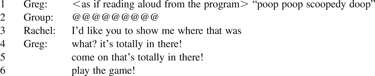
Greg's imperative “play the game” in line 6 struck me because, like Rachel, I had doubted very much that “poop poop scoopedy doop” was actually printed in the performance program, but it had escaped me that the very way he had structured this contribution to the pattern, along with Rachel's challenging of its veracity, and his mock incredulity at her attack, all were “game moves” that signaled that a “game world” (Goffman Reference Goffman1961) had emerged. I had missed a frame shift into the performance frame, and more importantly, I had missed the moment when these conversational moves became entextualized, playfully decontextualized from the conversation and recontextualized as game moves within the performance frame. When I went back to transcribe and re-examine this interaction, I discovered that I had missed the collaborative emergence, “the process whereby participants in a conversation collaborate to create their interactional context or frame” (Sawyer Reference Sawyer2003:5) and how a frame shift was negotiated. Further, I had missed the identification of texts to be played with and the subsequent group negotiation of an intricate set of rules surrounding these texts (for example, how the program would be read and how the playful challenges of “quotes” were being utilized).
This game will be considered in more detail in the analysis section to follow, along with two other spontaneous games (of twelve collected over the course of fifteen evenings of recording backstage), but I include this quick example not only to give a sense of the subtlety surrounding these spontaneous games but also to illustrate how participation in the game, and therefore membership in this group, requires a developed ability to actively track and utilize such unfolding intertextuality in interaction. My analysis considers these games in increasing order of difficulty as measured by the degree to which each demands recognition of intertextuality as the cue to a shift in frame in order to play along. In the later examples where the frameshift is accomplished less explicitly, I show how Greg, one of the most experienced performers in the group, orients newer members of the group to the shift in frame, and also how he provides instruction in the mechanics of use of this linguistic feature within the game. Thus, I consider the meaning contribution of the frame in interpreting the indexical meanings of this feature of language, and why use of intertextuality is interactionally significant, given that intertextuality can at times be the only signal that a frame shift has been enacted (that a game has begun). To provide some context for this analysis. I begin here with some background on improvisational theater, considering how improv skills that cultivate awareness of language, such as “heightening,” listening, pattern recognition, and the “rule of three,” also serve to cultivate intertextual ability.
The study and background
Improv is a style of unscripted, playful, and humorous theatrical performance, based on a suggested idea elicited from the audience. Data come from ethnographic participation with an improv troupe in Washington, DC, belonging to the Washington Improv Theater (WIT) ensemble. My own understanding and analysis of the meanings of interactional norms within this community is informed by nearly ten years of experience as an improv student, teacher, and performer.
The seven participants in the particular troupe under investigation are four men and three women in their twenties and thirties—young professionals who at the time of observation all worked and resided in the Washington, DC area. Josh,Footnote 1 Myfanwy, and Nunez are founding members of the troupe, which at the time of observation had been in existence for three years. Juliette is the newest member of the troupe, and Greg, while a relatively new member of this community, had recently moved from Chicago, a city with a long-established improv community and the home of improv, where he performed with one of the nation's premier troupes.
Participants in this study perform long form improv, one of two main styles of improv performance, differing from the more popularly known short form format in many ways, including the length and pace of interactions. Fundamentally, both styles of improv share two main characteristics: (i) there is no script (performances are created in the moment) and (ii) performances are collectively improvised, and emergent, so “each performer's actions are influenced by the others” (Sawyer Reference Sawyer and Sawyer1997:175). However, while short form interactions are quick-paced, based on highly structured short (pun-based) games, long form interactions are slower, comprised of relatively longer and more quotidian interactions that transition organically from one to the next, emerging retrospectively into a structure more closely resembling a theatrical play. Long form performers strive for humor that is achieved organically, often through identifying and cultivating patterns that emerge within the unfolding performance. Pattern recognition depends on careful listening and reliance on the collective imagination of the team, rather than one individual's ability to be clever. Practitioners of long form understand this process to be a more satisfying way of creating humor, believing that when audience members can watch the process unfold, and make connections for themselves, they “respond much more enthusiastically than if they had just heard a punch line” (Halpern, Close, & Johnson Reference Halpern, Close and Johnson1994:29).
I observed members of this group in four main interactional contexts: onstage, backstage, at rehearsals, and in the interview setting. All of the data analyzed in the present investigation are taken from recordings taken during the roughly thirty minutes in which performers are backstage preparing for their performances. Although not physically onstage during this time, they do perform for one another, and if performance is understood as “resting on an assumption of responsibility to an audience for a display of communicative virtuosity” (Bauman Reference Bauman2004:9) the backstage context provides rich opportunities for analyzing performance because fellow group members demand a high level of communicative ability. Fellow performers best understand the skills necessary for performing improv, and backstage before a show there is no director or coach, so members actively evaluate their own and provide meta-commentary and feedback on one another's improv skills in the backstage context more than any other.
Erving Goffman's (Reference Goffman1961) work on the creation of game worlds can help us understand what these participants do when they spontaneously shift into a game in this backstage context. For Goffman, game worlds exist in the real world, but they are surrounded by a barrier that contains the game world, allowing for some properties from the real world to be selectively included. “Games place a ‘frame’ around a spate of immediate events, determining the type of ‘sense’ that will be accorded everything within the frame” (Goffman Reference Goffman1961:20). Within the world of a game, three mechanisms work to maintain the frame: rules of irrelevance, realized resources, and transformation rules. Thus, in order to play a game, players need to know which aspects of the “real world” are relevant, and which should be ignored. These rules of irrelevance tell players which “irrelevant visible events will be disattended” (25). For instance, in a game of checkers, the material of the checker would be a detail that is understood to be unimportant, and a bottle top or a coin could be used to play the game just as easily as the “real” game pieces that came in the box. For the purposes of this investigation, in playing an intertextual game, the rules of irrelevance include which aspects of language have been selected as significant, and which can be ignored. For example, recall that in (1), to play the game, it was irrelevant whether “poop poop scoopedy doop” was actually printed in the performance program; members have agreed for the purposes of playing the game to pretend that it was.
However, many of the events, roles, identities, locations, and so on that exist in the real world do make it into the world of the game. These are the realized resources—the real world resources and events that are used to create the world of the game. The ways in which these resources get changed are then the transformation rules. For example, recall that in (1), performers were using the performance program (a physical object from the real world) as a realized resource. While they appeared to be reading out of it, they were not actually reading the text that was printed on the page in front of them. Thus, the transformation rules included the spontaneous creation and apparent reading aloud of texts. Thus, to play this intertextual game, players achieved agreement as to what did and what did not exist within the game world, what was be transformed, and how. The success or failure of the game itself reveals how fully group members have come to share understanding of all of these aspects. If group members pay attention for the right aspects of language, the unfolding interaction itself serves as a roadmap to tell group members how to navigate intertextuality within the world of the game.
Incidentally, while working on this article in an airport, I became aware of a game emerging right in front of me, which I include here briefly by way of illustrating that the potential for a game is ever present for those who are paying attention. Sitting at the terminal, I became distracted by a man and his young son making a bit of a clamor as they were rushing past me down the terminal hallway. Looking up, I noticed that the father was striding with purpose and that his young son (probably around three or four years of age), while holding his father's hand, was at the same time jumping and careening around. I leapt to the conclusion that the boy was simply being naughty, and was about to return back to my writing, when I noticed that a boy about the same age as the one passing by was watching in rapt attention, intently focused on how this boy was careening around. Looking back then more carefully, I noticed (for the first time) that the hallway was carpeted in alternating swatches of grey, black, and white carpet, and that the “careening” boy had constructed a set of rules for walking based on the color of carpet. These rules were (as best I could quickly discern them): when walking on black carpet, take small, rapid strides; when on grey carpet, take longer strides, as long as your legs will enable, and when you come to white carpet, jump! Rather than merely being naughty, this boy, while attending to his father's need for rapidity of motion, was constrained by adherence to his set of “walking down the airport hallway” rules.
I looked back to the boy at my gate who was now craning his neck so that he could continue watching the pair disappear down the carpeted terminal. When I saw him suddenly smile, I speculated that he too had grasped the set of rules, and I knew that the three of us (whether we all knew it or not) now shared the transformative rules for this spontaneous carpet walking game. While most people there at the airport had failed to notice that a game had ever occurred, or indeed that there were three different colors of carpeting, much less how the different colors could be used as realized resources, the “careening” boy had transformed these resources, reading the pattern as a set of rules for walking. Because the second boy was attuned to the possibility of the emergence of a game, he recognized the frameshift into “play,” and then had only to pay close attention to what resources would be transformed and how in order to grasp the rules and potentially play along.
For the improv group under investigation, in the same way that the second boy was (as indeed was I) rewarded for craning his neck in order to be able to extrapolate the “walking down the airport hallway” transformation rules, when improv group members pay close attention to interaction, and recognize text that can be (or has been) extracted and transformed to be utilized as a constitutive game rule, they are rewarded by being able to engage and “play the game.” While language is of course available to each of us as a resource, this group's play is characterized by their awareness of aspects of language, such as the mechanics of intertextuality and contextualization cues as they may be used to cement a frameshift. These creative intertextual game performances thus reveal the specific ways in which they enjoy and are rewarded for being attuned to using language creatively as an interactional resource.
Intertextuality
Intertextuality refers to the relationships among texts. Drawing from scholarship of the literary theorist Mikhail Bakhtin (Reference Bakhtin, Holquist, Emerson and Holquist1975/1981, Reference Bakhtin1984, Reference Bakhtin, Emerson and Holquist1986) on dialogism, understood as intertextuality in Kristeva's (Reference Kristeva, Roudiez, Gora and Jardine1967/1980) account of his work, and through the work of linguists Barbara Johnstone (Reference Johnstone and Johnstone2002) and Norman Fairclough (Reference Fairclough1992), I understand intertextuality as a process of referring to, drawing upon, or reshaping earlier texts within the context of a later one. In this project, texts are considered as written and spoken material that are bounded in some way, such that when they become embedded in some later text, they are identifiable and recoverable as a resource. And while this analysis considers texts of a somewhat smaller scope than are considered in Silverstein & Urban (Reference Silverstein and Urban1996)—fables or shamanistic rituals, for example—and are fleeting and ephemeral, by calling into focus the process of intertextuality I align my work with scholars such as Becker (Reference Becker and Johnstone1994), who are primarily concerned with the ways that in “recontextualizing prior text,” we “shape old text to new contexts” to create new meanings (173).
Intertextuality has been well-documented by researchers in the interactional sociolinguistic tradition such as Tannen (Reference Tannen1989/2007:46), who tells us that “repetition is at the heart of language.” For example, the rich work on intertextuality in family interaction (Gordon Reference Gordon2002; Tannen Reference Tannen2006; Tovares Reference Tovares2006) has shown the function of prior texts as they get recruited into family arguments, family play, and family identity. Damari's recent (Reference Damari2010) work is another example of how relationships and identities are intertextually woven, with particular focus on the role of stances taken towards prior texts as a means for negotiating cultural identities for a binational couple. My work is also informed by the scholars collected in Silverstein & Urban's (Reference Silverstein and Urban1996) Natural histories of discourse. As these editors recognize, the collection itself “might be read as (in)directly showing—textuality and entextualization practices turn out to be about ‘identity’,” which I support with exploration of how this works in understanding why (10). Finally, I rely primarily in this investigation on Bauman & Briggs's (Reference Bauman and Briggs1990) elegant unpacking of the constitutive elements of intertextuality. As they show, in order for intertextuality to occur, some chunk of language must be made into a text or entextualized, which is often only recognizable as having been rendered extractable once it has been removed from its interactional setting or decontextualized, and in turn recontextualized into another setting.
[Entextualization] is the process of rendering discourse extractable, of making a stretch of linguistic production into a unit—a text—that can be lifted out of its interactional setting. A text, then, from this vantage point, is discourse rendered decontextualizable (Bauman & Briggs Reference Bauman and Briggs1990:73).
This discussion sheds light on the role of framing in this process, given that many of the prior texts come from immediately local interactions, but are given additional meanings through a frameshift into performance. This process showcases recognition on the part of these performers of both texts and frame, and awareness of the meaning potentials of both.
Analysis
I now analyze three spontaneous games (of twelve observed) taken from fifteen backstage recordings, which I refer to as Change the quote!; OK, Mr. Questions; and I'll send you the link. I use the moment of entextualization (as recognized through a recontextualization) as a point of entry into these games, considering how this feature accomplishes (and often communicates) a frame shift, beginning with Change the quote! in which the frame shift is cued explicitly, moving ultimately to I'll send you the link in which both the negotiation of the rules and the shift into the game frame rely entirely on recognition of the process of intertextuality. Further, I consider each game in turn by exploring two aspects of intertextuality: (i) what texts are drawn upon (prior texts) and (ii) how they are transformed or entextualized.
The Change the quote! game
As discussed briefly in the introduction, Change the quote! emerged after Rachel read aloud a quote from the performance program (a student endorsement of WIT's training program), complaining that the same quote had been in the program for too long and needed to be replaced with a new one. Although the game evolved into a rather complex set of rules, it began very simply with Josh suggesting that group members follow suit and read aloud quotes from the program that they thought needed to be changed. Observe in example (2) how Josh explicitly entextualizes Rachel's contribution (thereby cueing the shift into the game frame) by naming the realized resource the program, as something to pass around and read aloud from. This moment is indicated in bold in the transcript below.
(2)

Thus far, the rules of this game seem to be quite simple: the prior text—“this class helped me find a piece of myself I was not aware had been lost. Thank you”—is tangible; it appears in the program. As the game progresses, however, local texts become entextualized, through the next contribution to the game. As these new locally realized resources get recontextualized, the relationship between prior text and the performance program shifts; thus a transformational rule is negotiated.
Because Rachel started the game, Josh (sitting next to her in the circle)Footnote 2 is the next to go. After Rachel hands the program to him, he reads aloud, “this class helped me realize that I am gay… Thank you WIT,” and he seems to be playing the game. He appears to have found a quote in the program that speaks to the revelatory power of WIT's improv classes, intertextually linking this contribution to Rachel's by ending the quote with an expression of thanks to WIT. But group members know this quote to be fabricated based on their shared knowledge of this prior text—both what is actually in the performance program and what would be likely to appear there. For his violation of the how of intertextuality thus far negotiated, Greg and Nunez challenge Josh by saying “that's not in there” and “show me where that is” in example (3).
(3)
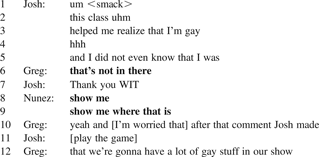
Greg and Nunez's playful meta-commentary draws attention to how Josh's contribution has changed the rules of the game. Additionally, when in line 10, Greg worries aloud that Josh's contribution will now influence their subconscious minds onstage, he makes another intertextual reference from a conversation occurring only a few minutes earlier, thus entextualizing an additional local resource—their particularly playful way of thinking about the influence that backstage conversations have on their subconscious minds, manifesting onstage in performance.
Josh ends the sequence of frame-external meta-commentary by himself contributing one final piece of frame-external meta-commentary in line 11 with “play the game.” By calling attention to the game frame, his comment thus re-establishes it, propelling the game forward to the third contributor, Nunez. Because there is special significance to the number three in humor, referred to within improv circles as the “rule of three,” Nunez's contribution to this emerging game may be understood as being of crucial significance. As this game unfolds, the third participant decides (by the form of his contribution), the nature of the intertextual game going forward. Consider that Nunez can either choose to contribute something that he actually finds inside the program (and so follow the pattern established by Rachel), or, he can choose to invent something (thus cementing Josh's choice). Nunez chooses the latter option by contributing something not actually found in the program, “this class really helped me decide on a good haircut.” In so doing, he makes a choice to be playful and silly, but in a very specific (and now agreed upon) way.
(4)

Recalling that Josh's contribution in (3) had been received with legitimate challenges as to the validity of the source-text quote from outside the game frame, consider now how repetition of these same challenges works differently in example (4). In line 6, when Greg says, “that's not in there,” and Juliette says, “show me,” in line 4, these are now recontextualizations, and not meta-commentary. As evidence of this transformation, players now disattend to the illocutionary force of the challenges within the game frame. Rather than being challenges or directives, the phrases “show me where that is” and “play the game” are now themselves game moves. The same is true of Greg's worry about the influence of this conversation on their performance. What had been stretches of discourse have now become texts; they have been entextualized, and can now be decontextualized and recontextualized to play this game going forward.
Given that a number of interaction-internal prior texts have now been entextualized, players are now presented with the challenge of remembering “that's not in there,” “show me,” and “play the game,” as well as the expressed concern “I'm afraid now that X has talked about Y, the whole show is going to be about Y.” Having identified these texts, we can now skip ahead to the end of the game (after the program has made it all the way around the gathered circle of performers) to see which were maintained.
Finally, after the rest of the group had participated in the game by contributing game moves, it then came around to Greg's turn, which I presented in (1), repeated here in (5).
(5)
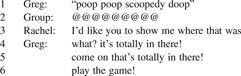
As we can see, the active pieces of text that have endured to the end of the game were: (i) an invented and humorous comment allegedly printed in the WIT program; (ii) a locally entextualized mock challenge to the validity of the prior text, as given by Rachel in line 3 (“I'd like you to show me where that was”); (iii) a locally entextualized mock defense by the contributor as to the validity of their prior text, as seen in lines 4–5 above “what? it's totally in there! come on that's totally in there!”; and (iv) a locally entextualized injunction to play the game by the contributor of the quote. The textual resource of expressed mock concern about thematic influence of conversation backstage to the onstage performance has dropped out or been forgotten by the end of the game.
As we saw here, two main types of text were available for use as resources in the playing of this intertextual game: those external to the current interaction (in this case, drawn from shared knowledge about their improv community, including knowledge of what is printed in the performance program and what kinds of things likely could appear there) and those entextualized from within the current interaction (in this case, utterances that were at their original appearance actual challenges, but over the course of the emergence of the game, got transformed to lose their illocutionary force and perlocutionary effect as challenges and directives). As I proceed through this analysis, I call particular attention to the latter—those that get entextualized as part of enacting the frame shift as an understudied aspect of the process of intertextuality.
The OK, Mr. Questions game
In OK, Mr. Questions the shift into the game frame is accomplished much less explicitly: the game demands that players have tracked the unfolding interaction closely enough to know which prior texts are being playfully transformed and crucially how this is being done without explicit direction. Prior texts in this game draw from an extensive set of prior texts involving group members' shared knowledge about the so-called “rules” of improv, as I describe below. First, listening is of fundamental importance in improv. As is illustrated by the playing of this game, if you do not listen, you simply cannot improvise. Additionally, the concept of yes-and (willingness to both accept (yes) and build on or heighten (and) the offers made by other performers) also becomes relevant to this discussion. Denial, the opposite of yes-and, makes an improvised interaction come to a grinding halt. Finally, questions are understood to be highly problematic because they delay the creation of the reality within the world of the scene. From an interactional standpoint, consider how asking a question like “Who are you?” actually forces the other person to come up with ideas on the spot while a statement like “Mom, this is the last time I am letting you borrow my Delorean” by contrast advances the scene by both establishing a character and a relationship and by giving the other person something to react to and build upon. The importance of listening, yes-and, and no questions are but a few of the rules of improv, but these are enough to understand the playful recontextualizations that occur over the course of OK, Mr. Questions.
OK, Mr. Questions emerged as a response to Greg's having asked the group to speculate about how long they had until their show would start. The director had just come backstage to the green room (their warm-up space backstage) to announce that the house (the main seating area within the theater) had been opened, meaning that audience members were now taking their seats in anticipation of the show. After the director leaves the green room, Greg asks the group “well, the house just opened, what does that mean for when we go on?” to which he receives the sarcastic, but playful answer “I don't know Mr. Question” from Josh, bolded in example (6) below. As this statement is repeated in line 4, it becomes entextualized when it is heard by Greg as an “offer” or a contribution to the creation of a game frame. “Accepting” this offer of the character identity of “Mr. Questions,” Greg launches into an intertextual game drawing on group members' shared understanding of questions being antithetical to improv.
(6)

In line 8, Nunez cements the shift into the game frame by himself claiming the character “denial” (also a violation of “the rules” of improv), inhabiting this character expertly by denying not one but three people in the course of a few seconds of interaction in lines 12, 14, and 16. To Josh who says, “I'm gonna play ‘not listening,’” in line 10, Nunez denies by saying, “no you're not, you're gonna listen.” To Juliette who says, “oh, I wanted that one,” in line 11, he says, “fuck you, we're an alliance here.” Finally he denies even Rachel's assumption of the character “disagreement,” by responding, “nuh unh, no you're not!” Performers' engagement with this intertextual game indexes their shared knowledge of the rules of improv even as together they savor the act of systematically violating them.
Although the shift into the game frame is less explicit here—no one actually says “let's do the opposite of all of the improv rules,”—the frame shift is nonetheless signaled rather overtly when Greg and Nunez (and subsequently Josh and Rachel) directly name the characters they will inhabit before jumping into the game frame. The specific character choices they make invoke the “rules of improv” as prior text, and the way they enact these characters (i.e. by contributing moves that violating the rules) signals an inverted relationship between recontextualizations (the game moves), and the prior texts (the rules). While all members have access to the rules of improv (the prior text that should tell them what character identities are possible), the specific focus of this article is how texts become locally entextualized. Here we see that players need to have been tracking the interaction closely to see (i) which specific texts are being accessed and (ii) how they are being transformed. Thus, again, successful engagement in this game indexes not only shared access to and knowledge of prior text, but a level of skill at recognizing entextualization as it unfolds.
Because this particular game involves doing everything “wrong,” the fact that engaging in this way results in terrible confusion is actually illustrative of the effectiveness of the rules, which Greg uses here as a teaching tool by calling attention to how playing OK, Mr. Questions results in a confusing train wreck of an improv scene. This moment of socialization of less experienced players is indicated in bold in example (7).
(7)

In lines 79 and 80, Greg steps outside the frame to address the group saying, “you guys, does anyone notice we're in hell?” What makes this interaction particularly fun is that while Greg steps out of the game frame to make this comment, Nunez stays within the frame to playfully deny it, saying, “nun unh, we're in a phone booth on the moon!” Here, groups members' playful use of texts extends to awareness of meta-commentary, which Fairclough (Reference Fairclough1992:122) identifies as itself a type of intertextuality “where the text producer distinguishes several levels within her own text, and distances herself from some level of the text, treating the distanced level as if it were another, external text.” I call attention to this skill of activating and managing multiple layers of intertextuality simultaneously as possible within the performance frame, and as having been cultivated through the practice of improv, but also as something that is explicitly socialized. We see this again in the following example, when Greg again steps out of the frame to instruct newer members to the unfolding entextualization and frameshift.
The I'll send you the link game
I'll send you the link is the most complex game of the three. Here, both interaction-internal and external texts get entextualized and because there is no explicit cuing of the frame shift, this entextualization itself is the only indication that a game has begun. The game involves citing increasingly absurd examples of videos that one might find on the internet, but with no direct naming of the transformational rules. Instead, the shift into the game frame relies solely on group members' recognition of the use of entextualization itself to signal the game's beginning. Further, this game emerges in such a way that there is only one opportunity to glean all of the information about which texts to transform, and thus how to engage.
This interaction begins as group members are savoring the humor of an e-mail sent to the group by Myfanwy, containing links to websites featuring jokes about Chuck Norris, which reminds Josh of a related comedy video called “Young Chuck Norris” created by the comedy program Saturday Night Live (SNL).
(8)

At this point, the interaction is still very much a conversation (and not a game), and Josh's contribution to the conversation is very closely tied to the prior interaction: Chuck Norris had just been mentioned, as had the idea of sending e-mails containing links to websites. Additionally, Josh explicitly links his contribution to Myfanwy's in line 10 with anaphoric “that” saying: “I was gonna send you the link to it after that e-mail.”
Josh's mention of the “Young Chuck Norris” video is an intertexual reference, drawing from group members' shared body of knowledge of comedians and comedy programs. Observe, however, that in this case, Josh's use of this “Young Chuck Norris” text is somewhat problematic. He mentions a text that few group members seem to be familiar with, and further, fails to describe it sufficiently, leaving many members of the group unsure about how he actually feels about this text, as evidenced by Michael's question in lines 17 and 18, “so did you like it?” In failing to communicate how he feels about it, Josh's contribution can be viewed as a problematic, if not a failed attempt at intertextuality. As we will see, Greg takes this gaffe as an opportunity for entextualization.
While Juliette and Nunez explain to Josh that they did not see the “Young Chuck Norris” video, Greg jumps into the interaction by describing a video about the original occurrence of the Big Bang, which he claims to have found on the internet. However, something about his contribution alerts group members that a frame shift has occurred and that his contribution is to be understood as referring back to (and thus entextualizing) Josh's treatment of the SNL “Young Chuck Norris” video text. Observe in example (9) that Josh and Nunez begin laughing in line 31 when Greg talks about how amazing the video was. Emphatic stress on the word “amazing,” combined with the intertextual similarity of his contribution to Josh's (as well as the improbability of the existence of a video of the Big Bang) signals a playful transformation, a cue that Josh's contribution has been entextualized. As bolded in example (9), Josh and Nunez signal through laughter their awareness of this entextualization and thus their recognition of the occurrence of a shift into the game frame.
(9)

Several members of the group seem to be confused at this point, as evidenced by Michael's question to Greg “are you joking or?” in line 35. Their confusion about whether or not a frame shift has occurred may be owing to the very subtle way in which it was accomplished. Unlike the cues seen in the first game, “why don't we take turns passing around the program…” or in the second, “Mr. Questions, okay, I'll inhabit that character tonight,” there is no explicit reference to the performance frame. Instead, Greg has merely “broken through into performance” (Hymes Reference Hymes, Ben-Amos and Goldstein1975) by means of his entextualization of Josh's contribution.
To engage in this game requires that participants have noticed three things: (i) the structure of Greg's Big Bang video contribution closely parallels Josh's description of the “Young Chuck Norris” video, beginning with an inquiry about whether anyone else had seen this particular online video. If you missed this cue, (ii) Greg displays strong but vague and ultimately uninterpretable affective alignment to the text by saying, “it's like ‘wow’ in your face,” which is an intertextual link to Josh's uninterpretable enthusiasm for a vaguely described video. Finally, (iii) Greg links his contribution explicitly to Josh's by use of manifest intertextuality (Fairclough Reference Fairclough1992) extracting Josh's prior text directly in lines 32 and 33 with, “uh I'll look for the link and send it,” paralleling Josh's “I was gonna I was gonna send you the link” (in (8), line 10). By entextualizing Josh's contribution, Greg retroactively changes Josh's description of the “Young Chuck Norris” video as a game move (the first in a pattern). Josh's description of this video, uninterpretable enthusiasm, and subsequent promise to forward the link (which had been stretches of discourse) have both now been entextualized, made into extractable units—game moves available for recontextualization.
Because Greg's Big Bang video is the second game move, it falls to the next person in the circle, Michael, to contribute the third (and crucial) contribution to the pattern. If Michael does not contribute a game move that both sustains the game frame and exemplifies an understanding of what texts are being transformed and how, this game will likely not be successful. In example (10), Josh, believing Michael to have not noticed the frame shift, explicitly cues Michael in lines 39 and 41 as before and whispers, “he's setting a pattern.” Interestingly, although Michael seems by his initial silence to have apparently missed the cue for when to engage, he does seem to have extrapolated the rules for doing so, because when he does engage, his contribution reveals a level of intertextual competence not reflected in his initial lack of performance. Although Michael had to be prompted, he does appear to know exactly what and how to contribute to this game, and why this is significant given this opportunity to display communicative virtuosity to his audience. In example (10), Michael jumps into the game by (i) issuing a query about whether folks have seen some imaginary online video, (ii) displaying a strong affective but uninterpretable alignment to this text, and (iii) promising the group that he will send them a link to it.
(10)

The locally entextualized promise to send the link to the group (received with laughter and clapping) is particularly interesting, because applause is a more coveted response than laughter in improv. Applause indexes both appreciation of the skill of the player in addition to appreciation of the humor of the joke. While laughter indexes their enjoyment of this game, Greg's applause here may be understood as indexing an appreciation of Michael's intertextual accomplishment.
Within this last example, Greg again steps out of the frame to draw attention to the unfolding process of intertextuality, offering meta-commentary to Juliette (who recall is the newest member of the troupe) in line 52, “this is number three in the pattern.” While doing this ostensibly to help Juliette in her development as a performer, Greg also brings her into the interaction, as up until this point she is the only person in the group to have been completely silent. His efforts at inclusion do seem to be successful inasmuch as she immediately joins the interaction, as may be seen in example (11), by playfully critiquing Michael's contribution (which should have been “heightened” relative to Greg's).
(11)

Using stage whispers, Juliette, Greg, Michael, and Josh cue their meta-commentary as operating outside the game frame, despite Josh's injunction to again (as seen in Change the quote! above) maintain the game frame in line 68, “I don't know, but we're still in the scene.” Their meta-commentary about Michael's choice of a third item to an emerging pattern reveals shared knowledge of the “rule of three,” which as we have discussed is the contribution that cements a game but also entails an understanding that within an emerging pattern, the third contribution to the pattern should be somehow more “heightened” than the second, which in turn should have been “heightened” relative to the first.
Michael's protest here alludes to the fact that he feels that he had been set an impossible task: after all, what could be bigger than the occurrence of the Big Bang? When the group offers some good-natured ribbing about his choice, Michael responds by playfully questioning Greg's own choice of text, maintaining that with the second contribution to the pattern, Greg went from “one to a hundred,” selfishly leaving nowhere for the other players to build or “heighten” with the third element. While his troupemates' meta-commentary appears to operate at the level of the what of intertextuality—that which should have been recontextualized, Michael's protest can best be understood as a playful critique of the how of intertextuality, questioning Greg's establishment of an operable framework for someone to implement the “rule of three.”
But what of the why? We may also step back for a moment, and observe that the game itself is meta-commentary about intertextuality because it is built on an entextualization of Josh's gaffe of not making clear his orientation to the “Young Chuck Norris” text. Negotiating orientations to prior texts is, after all, one of the primary functions—the why of intertextuality. As with other external prior texts we have considered (e.g. the “rules of improv” and the WIT performance program), negotiating shared knowledge about comedy and other comedians is an important practice, central to this improv group's identity, but it is how it is accomplished that becomes central. Recalling Blommaert's observation above that entextualization “turns intertextuality into an empirical research programme,” it is through exploration of entextualization that we understand how membership in this group is negotiated, as I now consider.
Discussion: Intertextuality—The what, how, and why
Turning now from the what and how of intertextuality to consider the why of intertextuality, namely what intertextuality means and what it does for this group, we begin by recalling Becker's observation that “social groups seem to be bound primarily by a shared repertoire of prior texts” (Becker Reference Becker and Johnstone1994:165). As we have explored, a major part of how this group (or indeed any group) spends their time together and does “being a community” includes referencing interactional-external texts including improv knowledge, local community practices, and the work of other performers. But crucially, it is through negotiation of a shared orientation to these texts that group members discuss and develop their own beliefs, sensibilities, and styles. While this analysis has called attention to the importance of intertextual ability itself (as it occurs through entextualization of interactional-internal texts) it has done so to showcase the group's shared value of this skill as an integral resource for community membership. As Rachel explained to me in her interview, she is the happiest in improv when she can make an intertextual connection. When she feels like her intertextual skills are not all that they could be, she does not really enjoy performing.
(12)

Rachel indicates here that intertextual ability is not only important onstage, but offstage as well “in practice and in class” (line 9). A great deal of meaning seems to come simply from utilizing their unique style of intertextuality, which includes (as we have seen) embedded intertextuality in the form of shared knowledge of improv texts (understandings about the rule of three and heightening), the ability to listen carefully to entextualize prior text from local interactions, remember, and then creatively and skillfully recontextualize these texts. Finally, and crucial to this analysis is the additional ability to communicate subtleties about orientation to that text that actualizes entextualization as an interactional resource. Meta-commentary, which entails awareness of and the ability to navigate multiple levels of frame simultaneously, is itself an intertextual practice frequently deployed by members of this group with great relish in interaction.
Summary
In this analysis, I have considered the social function of two aspects of intertextuality simultaneously: having access to a range of prior texts to evoke, and having skill at recognizing local texts and finding opportunities to reincorporate them. These entail both awareness of and ability to manipulate frameshifts as well. Group members not only achieve agreement about which aspects of language are important, including which texts will be reshaped in the game, but also how these texts will be used. Specifically, I have pointed to entextualization, considering how this feature of language can be used, for example, to serve as a framing device, enacting a shift into the performance frame. In showcasing their awareness of multiple levels of linguistic structure, use of this feature also displays the why of intertextuality—what use of this feature can do for a community. Successful engagement in these games indexes not only shared access to and knowledge of prior text, but a level of skill at recognizing entextualization as it unfolds, with particular focus on the affective orientation to the texts that this practice enables. Using instances of meta-commentary, I identified moments of new member socialization (Wortham Reference Wortham2005) to understand the contextual significance of entextualization: Basically, to be a part of the group, you need to be able to “play the game!”
The data explored in this analysis shed light on the creativity and complexity involved in the interactional process of establishing a frame, by considering improv interactions that take place offstage, when performance is a choice and an interactional achievement rather than a given. For analysts interested in observing the mechanics of enacting the shift in frame, such contexts, when the potential frames for selection are even greater, are especially illuminating. Thus, having explored both the process and the function of intertextuality I hope to have added to the use of entextualization as a means of investigating intertextuality as a multifaceted notion whose relationship to identity may also be procedural in nature. Intertextuality may be understood not only as a process but as an interactional practice that implicates awareness of what texts get evoked, how, and, crucially, why. It is hoped that such continued integration of perspectives on intertextuality enriches our understanding of how intertextuality works as one of the myriad ways that language may be used to navigate meaning in interaction.
Appendix: Transcription conventions
- xxx
inaudible, undecipherable
- -
truncated word
- ?
rising intonation
- .
falling, final intonation
- ,
continuing intonation
- …
silence
- :
elongated vowel
- TALK
emphatic stress
- @
a pulse of laughter
- <manner>
angle brackets enclose descriptions of the manner in which an utterance is spoken
- talk-
- - talk
lined up dashes indicate latching onto the speech of another, the continuance of speech without a pause
- [talk]
square brackets enclose simultaneous talk


