





Plain language summary
This study explores how different types of German texts – ranging from spoken conversations to technical writing – can be automatically analyzed and categorized based on how “immediate” or “distant” their language feels. Rather than simply labeling texts as spoken or written, we use a more nuanced model that sees language as existing along a continuum between intimacy and detachment. To do this, we compile a large, carefully structured corpus of over 120 million words from 20 different text types, including emails, podcasts, song lyrics, legal documents, and more. Using machine learning, specifically a Random Forest classifier, we analyze each text based on a set of linguistic features like personal pronouns, lexical density, and word contractions. These features help the model determine whether a text leans more toward language of immediacy (typical of casual, emotional, or personal language use) or language of distance (formal, structured, and impersonal). The classifier performs very well – correctly categorizing over 98 percent of test cases – and reveals that lexical features seem much more important for classification than grammatical structures. In particular, song lyrics exhibit a strong association with immediacy, despite being realized in written form. This research demonstrates that a linguistically informed, automated classification approach can provide valuable insights into language use across different media and communicative contexts. The proposed method and tools are scalable and potentially transferable to other languages and research domains.
Introduction
The study of various spoken and written text types, viewed along a multifaceted continuum rather than as distinct categories, is a central concern of modern descriptive linguistics and forms the basis of register studies that illuminate how language adapts across different communicative contexts. Spoken discourse, traditionally located at one end of the continuum, is characterized by spontaneity, creativity, and a high degree of informality, which manifest as phenomena like fragmentary utterances, elliptical constructions, and emotional markers, to name just a few. Its close examination offers insights into the dynamic nature of language. Written texts, on the other hand, tend to be more planned, organized, less subject to change once realized, and syntactically complex, making them an ideal data resource for examining elaborate structures and long-term language change.
Though this simple spoken-written labeling seems straightforward at first glance, it very quickly turns out to be under-complex as soon as different communicative situations and digital channels come into play. In order to overcome the spoken-written binarism, the linguistic framework “language of immediacy and language of distance” (Koch and Oesterreicher Reference Koch and Oesterreicher1985) introduces a conceptual continuum between the two poles. The former refers to communication that is typically more intimate, affective, and closely associated with private face-to-face interaction. The latter shows tendencies toward a more detached and neutral tone, typically found in one-way communication with delayed or no immediate feedback. “Conceptually written language of distance” refers to language that, regardless of the medium, exhibits formal, structured, and planned features typical of traditional writing, while “conceptually spoken language of immediacy” refers to language that mimics the informal, spontaneous, and interactive qualities typically associated with speech, even when in written form. We observe numerous gradations and hybrid forms between the extremes.
It should be noted that influential attempts in other philological traditions have similarly sought to move beyond the mere spoken-written dichotomy (cf. Werner Reference Werner2021a). Notably, the Multi-Dimensional Analysis (MDA) framework, associated with Douglas Biber (Biber Reference Biber1988) and his predecessors, provides an empirical approach to modeling language variation across multiple dimensions of textual and linguistic features.
Koch and Oesterreicher’s communicative model (KOM) explains how functional context and medial realization shape the concrete form that language takes. For example, a formal parliamentary monologue (spoken) may exhibit features of “language of distance” similar to those found in technical texts or academic writing, whereas informal emails or chat messages, despite being written, may display characteristic features of “language of immediacy.” But while KOM provides a conceptual framework for understanding the continuum between immediacy and distance, it is not corpus-based in its original formulation. Building on this foundation, Landert and Jucker (Reference Landert and Jucker2011) propose a communicative model that clearly distinguishes between public and private discourse, extending KOM into three independent scales (public accessibility, privacy of content, and linguistic immediacy), providing empirical grounding for how texts negotiate private and public elements. Recent corpus-linguistic studies have similarly examined texts that blend features of both poles, analyzing how such intermediate forms function across communicative contexts (e.g., Al-Surmi Reference Al-Surmi2022; Biber, Reppen, and Wizner Reference Biber, Reppen and Wizner2024; Werner Reference Werner2021b), highlighting the diversity of linguistic strategies in blended texts, and offering insights with potential implications for areas such as language learning and processing.
The distinction between “language of immediacy” and “language of distance” is still one of the most widely received linguistic models, even for digital media (Dürscheid Reference Dürscheid, Feilke and Hennig2016). It is based on the assumption that the medial dichotomy “spoken” versus “written” provides limited insight into linguistic variation across communicative contexts, whereas gradable differences in conception – shaped by factors such as interlocutor familiarity, emotional involvement, and spontaneity – help explain lexical and grammatical variation. Written communication may adopt features of immediacy, and spoken language may incorporate features of distance.
While Biber’s MDA provides empirically grounded ways to quantify functional linguistic variation, KOM lacks a universally accepted catalogue of concrete immediacy and distance features. Koch and Oesterreicher (Reference Koch and Oesterreicher1996, Reference Koch and Oesterreicher2007) distinguish between universal features and language-specific features, grounding their analysis in parameters of conditions of communication and strategies of verbalization. However, they do not provide a realistically algorithmizable classification guide. Later reflections by the authors emphasize the conceptual flexibility of the model: as Oesterreicher and Koch (Reference Oesterreicher, Koch, Feilke and Hennig2016, 30–32) note, an exact quantification of what they call discourse traditions (i.e., text types) is neither possible nor warranted, and positions along the parameters always represent options that must be explicitly interpreted in context. This underscores that the KOM is primarily a descriptive and explanatory framework rather than a prescriptive or fully operationalizable system.
Subsequent theoretical contributions often stay at a rather general level or are difficult to implement, and practical approaches have to deal with the obvious fact that meaningful features are in many cases language-dependent (Ágel and Hennig Reference Ágel and Hennig2010). Moreover, the relationship between individual features and other variety markers has not yet been sufficiently clarified. Ágel and Hennig (Reference Ágel, Hennig, Ágel and Hennig2006) build on selected features from Koch and Oesterreicher and supplement them with their own proposals. Based on this, they develop a comprehensive, theoretically robust system, though its operationalization can at best be carried out semi-automatically, requiring a substantial time investment.
Toward a fully automatable solution, Ortmann and Dipper (Reference Ortmann and Dipper2019) calculate 17 linguistic features discussed in the literature (e.g., word and sentence length, proportion of selected sentence types or POS classes) and use them to reliably classify examples from five language registers (newspaper articles, recited speeches, talk subtitles, movie subtitles, and chat protocols). Ortmann and Dipper (Reference Ortmann, Dipper and Calzolari2020) also apply this machine learning approach to historical German texts, with significantly lower classification accuracy. The combined findings are incorporated into the design of a linguistically motivated “score for conceptual orality,” using a slightly reduced feature set (Ortmann and Dipper Reference Ortmann, Dipper, Imo and Wesche2024). In all cases, the authors operate on pre-processed (POS tagging, lemmatization) authentic data from publicly available sources that represent each text type or register, respectively, with a five- to six-digit number of tokens. Broll and Schneider (Reference Broll and Schneider2023) evaluate a methodologically similar approach on subcorpora of two million tokens each and compare 17 features that can be calculated without prior linguistic annotation with 12 features that require lemma or part-of-speech tagging; the high overall classification accuracy is broadly comparable to Ortmann and Dipper (Reference Ortmann and Dipper2019).
Against this background, the increasing heterogeneity and computational scale of modern digital corpus collections render text classification along the above-mentioned immediacy-distance continuum that is amenable to algorithmic methods an obvious desideratum. Ensemble methods that apply state-of-the-art machine learning algorithms to linguistically motivated features seem a promising way to obtain results that are both empirically valid, reliable, and interpretable. However, not least due to restrictions on publicly available resources, there have hardly been any attempts to evaluate this on a maximally broad stratified contemporary dataset.
The aim of the present study is twofold: On one hand, we attempt to locate a wide range of different text types in the immediacy-distance continuum, using predictive analytics on the example of the German language. On the other hand, we want to find out which linguistically meaningful features that have already been the subject of scientific discourse are particularly powerful. Rather than engaging in debates about the adequacy and limitations of the theoretical KOM (e.g., Feilke and Hennig Reference Feilke and Hennig2016), our aim is to operationalize its empirical application and to examine which linguistic patterns are most strongly associated with classification along the immediacy-distance continuum and to what extent they contribute to distinguishing text types. We regard this as applied basic research in text linguistics and multidimensional text description, not relying on a static notion of text type.
Data, methods, and results
The corpus dataset
COrLiCo (Corpus for the Oral–Literate Continuum) is designed to cover both poles of “conceptual immediacy” and “conceptual distance,” as well as a range of communicative situations situated between them. The selection of text types is guided by theoretical considerations from KOM and by informed linguistic judgment regarding their expected position on the continuum, rather than by prior empirical validation. At the same time, the corpus includes some communicative niches that have so far received little systematic linguistic attention, allowing the proposed classifications to be tested and refined empirically in subsequent analyses. For the first time, it brings together over 20 presumably relevant text types with equal quantitative proportions in a joint resource. The balance of the subcorpora enables statistically sound and unbiased comparative statements. The corpus comprises a total of 120 million tokens and focuses on language use in the 21st century. Most of the data are drawn from established resources such as the Archive for Spoken German (AGD; Stift and Schmidt Reference Stift and Schmidt2014) and the German Reference Corpus (DeReKo; Kupietz et al. Reference Kupietz, Lüngen, Kamocki, Witt and Calzolari2018), each of which represents the most comprehensive collection of its kind for German. The remaining components either aggregate existing specialized corpora, consist of randomly selected subsamples thereof, or have been curated specifically for the present study.
Pole 1 (“conceptual immediacy”) is represented by transcripts of spoken language, often from face-to-face situations, totaling 10 million tokens and taken from the following sources: (1) German Today (“Deutsch Heute”): spontaneous speech from AGD with regional variations of German. (2) Research and Teaching Corpus of Spoken German (“Forschungs- und Lehrkorpus Gesprochenes Deutsch”): spoken German from AGD in various interaction types. (3) Selected corpora from the Bavarian Archive for Speech Signals (BAS) that have been made accessible for academic use within the CLARIN infrastructure (Reichel et al. Reference Reichel, Schiel, Kisler, Pörner and Calzolari2016).
Pole 2 (“conceptual distance”) is represented by elaborate, highly planned specialist texts, also totaling 10 million tokens: (1) Written corpus of Engineering Sciences: articles from automotive specialist journals. (2) Language of genetic engineering: technical articles, draft laws, patents, and so forth on the subject of biotechnology. (3) Legal jargon: laws and ordinances from the Corpus of German Federal Law (Fobbe Reference Fobbe2023). (4) Linguistic terminology: scientific articles and dictionary entries from the grammatical information system grammis (Schneider and Lang Reference Schneider and Lang2022).
Between the two poles: COrLiCo contains the following 5-million-token archives, the contents of which can presumably be located somewhere within the immediacy-distance continuum: (1) Regional tabloid press. (2) Local daily newspapers. (3) National weekly newspapers. (4) National news magazines. (5) Lifestyle magazines. (6) Interviews from different classic sections (politics, business, culture, sport) of the three magazines Stern, Spiegel, and Zeit. (7) Fiction: popular novels and short stories of the 20th and 21st centuries. (8) Addresses: keynotes held by top officials, taken from the German Political Speeches Corpus (Barbaresi Reference Barbaresi and Calzolari2018). (9) Plenary protocols taken from the Europarl Corpus (Koehn Reference Koehn2005). (10) Real-time live text commentaries taken from the corpora of football linguistics (Meier-Vieracker, Reference Meier-Vieracker2017). (11) Emails: pseudonymized mail archives from CodE Alltag 2.0 (Krieg-Holz, Eder, and Hahn Reference Krieg-Holz, Eder, Hahn and Calzolari2020). (12) Wikipedia talk pages, that is, administration pages where editors can discuss improvements to articles. (13) Online comments from the Tagesschau news portal. (14) Randomly selected postings from German-language (de.*) Usenet newsgroups. (15) Randomly selected texts from the parsed German web corpus sdeWaC (Faaß and Eckart Reference Faaß, Eckart, Gurevych, Biemann and Zesch2013), with no claims to representativeness, to gain initial insights into the positioning of heterogeneous web pages. (16) Instant Messaging, chat logfiles (Lüngen et al. Reference Lüngen, Beißwenger, Herold, Storrer, Dipper, Neubarth and Zinsmeister2016), and DeReKo Twitter messages. (17) YouTube user comments taken from the Nottingham German YouTube Language Corpus (Cotgrove Reference Cotgrove2024). (18) Movie and TV series subtitles from opensubtitles.org. (19) Podcast transcripts of publicly available conversational podcasts (no scripted storytelling formats). (20) Song lyrics covering a wide range of styles, from singer-songwriters to hip-hop, and including all German-language hit singles since 1970 (Schneider Reference Schneider and Calzolari2020).
All these primary data are enriched with lemmata and word class annotations according to the Stuttgart-Tübingen-Tagsets (STTS), which allows us to formulate complex morpho-syntactic patterns as described in the following section.
Despite having the same overall token count, the average text sizes for the two conceptual poles differ significantly (349 vs. 1,723 words), resulting in a substantially larger number of immediacy language data points (28,663 texts) compared to distance language data points (5,804 texts) available for classifier training. Given that training aims for high overall accuracy, there is a risk that the accuracy for the minority class (specificity) will be lower than that for the majority class (sensitivity). To address this, we downsample the training data: a random selection of texts from the pool of immediacy texts is made to match the number of distance texts. All data are then split into a development set and a validation set in an 80/20 ratio. The development set is further divided into a training set and a test set (for unbiased evaluation of parameter adjustments during model training), again in an 80/20 ratio. To prevent overfitting on the test set, the performance of the final classifier is assessed using the validation set after the development phase is complete (see below).
An alternative approach to address the issue of significantly varying text lengths would be to segment all texts into equal-sized portions, thereby ensuring that each archive contains the same number of data points. However, we argue against this method in the present case. A fundamental principle in corpus linguistics, sometimes overlooked, is that texts must remain intact for quantitative investigations to retain their explanatory power. The analytical potential of a text can only be fully realized when it is preserved in its entirety. Accordingly, it is essential to analyze cohesive and unabridged texts, as observations at the level of sentences, words, or morphemes emerge from individual text-generation processes. Sinclair (Reference Sinclair and Wynne2005, Reference Debeer, Hothorn and Strobl11) similarly cautions against constructing linguistic datasets from text fragments, noting that authors’ choices of specific linguistic constructions often depend on their position within the text. He advocates that “samples of language for a corpus should wherever possible consist of entire documents or transcriptions of complete speech events or should get as close to this target as possible. This means that samples will differ substantially in size.”
Feature set
We implement a binary classifier using supervised learning. Assuming that both conceptual poles are adequately represented in the compiled authentic text data, our first step is to construct a set of linguistic patterns (i.e., a feature set) suitable for estimating a probabilistic model that formally represents this dichotomy. In other words, we experimentally translate the notions of “language of immediacy” and “language of distance” into a catalogue of characteristics designed for efficient and robust machine processing.
Our feature set reflects theoretical assumptions that situate the analysis within the context of the work discussed above. It includes universal attributes (e.g., word length) and language-specific ones, such as German particles, which are typical of spoken and discourse-oriented language. Many features relate to linguistic complexity: texts reflecting the language of distance – typical of written registers – tend to be longer and more structured than those reflecting immediacy.
We aim to avoid a one-sided dependency by employing features from diverse sources and linguistic levels (grammar, lexicon, pragmatics). In this way, our approach combines top-down and bottom-up strategies: following the top-down perspective, we test existing assumptions about the characteristics of human language; following the bottom-up perspective, we evaluate observed quantitative distributions in terms of their methodological relevance and significance.
For large digital datasets, automated processing is essential. Accordingly, we focus on complex patterns that can be captured using commonly employed NLP annotations. We rely exclusively on shallow annotations (part-of-speech tags and lemmas), which are expected to have low error rates. Deeper annotations (morphological, syntactic, dependency, or constituent structures) are excluded to reduce both theoretical bias and susceptibility to errors. The following list provides a comprehensive overview of all features used in this study, specifying the relevant STTS tags and citing corresponding literature.
-
• V_N: ratio of full verbs (VV*) to nouns (N*).
-
• lexDens: lexical density as proportion of content words – adjectives and adverbs (AD*), verbs (V*), nouns (N*) – to all word forms.
-
• DEM: proportion of demonstrative pronouns (PDS) – used to refer to people, objects, or facts within the realm of perception – to all word forms.
-
• DEMshort: ratio of short forms of demonstrative pronouns (PDS) (e.g., der, die, das, den, dem) to all demonstrative pronouns (i.e., dies, diese, diese, diese, diese). To distinguish them from definite articles, we also consider their lemmata (die, d vs. diese, dies, die, d).
-
• PRON1st: proportion of 1st person pronouns (PPER) with lemma ich/wir to all word forms.
-
• PRON2nd: proportion of 2nd person pronouns (PPER) with lemma du/ihr to all word forms.
-
• MTLD: assesses vocabulary variety through multiple calculation steps and directions, making it less sensitive to text length or sampling variation (McCarthy and Jarvis Reference McCarthy and Jarvis2010).
-
• bloss, lediglich: share of the particles bloß and lediglich among all word forms, reflecting stylistic or pragmatic nuance like emphasis or immediacy (Zifonun, Hoffmann, and Strecker Reference Zifonun, Hoffmann and Strecker1997, 877).
-
• kriegen: proportion of the verb kriegen relative to all word forms. Typical of colloquial German, it occurs more often in spoken or informal registers (Zifonun, Hoffmann, and Strecker Reference Zifonun, Hoffmann and Strecker1997, 1829).
-
• autosem_mean: average length of content words (nouns, verbs, adjectives), measured in characters, within a text. Captures morphological complexity, as longer words often arise through inflection or compounding (Baerman, Brown, and Corbett Reference Baerman, Brown and Corbett2015).
-
• VERBshort: ratio of shortened verb forms after ich to corresponding forms without shortening, for example, first person singular verbs not ending with -e like ich geh or ich geh’ versus ich gehe.
-
• elision_ART: ratio of indefinite articles with elision (e.g., ne, ein’, ei’m) to corresponding forms without elision (e.g., eine, einen, einem).
-
• elision_VA: ratio of auxiliary verbs with elision (e.g., wär’, war’n, hätt, wurdst) to corresponding forms without elision (e.g., wäre, waren, hätte, wurdest).
-
• contracted: proportion of contracted forms (e.g., gibt’s, haste, kannste) relative to all word forms.
-
• INTERJ: proportion of interjections (ITJ) that express spontaneous emotions (ächz, au, seufz, etc.), mark pauses (äh, hm, etc.), or demand attention (hey, ey, etc.) to all word forms.
-
• PTK_ANT: proportion of response particles (PTKANT) like ja, jaaa, nein, nee, bitte, danke as typical discourse indicators to all word forms.
-
• PTK_MOD: proportion of modal particles that indicate the communicative purpose or express expectations and attitudes (e.g., auch, bloß, denn, doch, eben, eh) to all word forms.
-
• stretch: proportion of “stretch words” – words in which letters are repeated to indicate elongated pronunciation (e.g., soooo, suuuper, tschüßiiiii) – relative to all word forms. Such forms often emulate emotional prosody or expressive intonation in written language, making them meaningful markers of immediacy.
-
• repetition: proportion of repeated words used as rhetorical devices to reinforce or emphasize a statement to all word forms. Such repetitions are stylistically and pragmatically salient, often reflecting expressive or interactive language (immer immer wieder or sehr, sehr gut).
-
• subord: ratio of subordinating conjunctions (KOUS, KOUI) to full verbs (VV*) as an indicator of hypotaxis, that is, the structural subordination of clauses.
-
• passive: constructed passive voice, highly simplified measured as ratio of past participles (V*PP) before or after werden-auxiliaries to all verb forms: Der Bürgermeister wurde gestern abgewählt [The mayor was voted out of office yesterday] or Das Problem soll geklärt werden [The issue is to be resolved].
-
• am_prog: progressive aspect like in Paula ist am Singen [Paula is singing], also known as “Rheinische Verlaufsform” [Rhenish progressive form], which is typical for casual speech (Zifonun, Hoffmann, and Strecker Reference Zifonun, Hoffmann and Strecker1997, 1877), measured as proportion of am-verb sequences to all word forms.
To mitigate the risk of circularity, this feature set incorporates elements from linguistically independent theoretical frameworks. For example, lexical complexity measures (e.g., average content-word length, lexical diversity) draw on psycholinguistic and corpus-linguistic research on processing effort and morphological richness. Morphosyntactic features such as demonstrative pronouns or particles are motivated by pragmatic and interactional linguistics, where they are linked to deixis, speaker involvement, and conversational grounding. Register- and genre-sensitive lexical markers (e.g., colloquial verbs like kriegen) stem from research on formality and register (e.g., Zifonun, Hoffmann, and Strecker Reference Zifonun, Hoffmann and Strecker1997).
Algorithm
The classification algorithm should not only achieve the highest possible precision and recall but also enable reliable conclusions to be drawn: Which features are particularly influential? In which direction do they have an effect? Thus, unlike current large language models (LLMs), it should not act as a black box in terms of explainability.
The classifier is implemented in R Version 4.3.0 (R Core Team 2024), the party package (Hothorn et al. Reference Hothorn, Buehlmann, Dudoit, Molinaro and van der Laan2006) for conditional random forests, the permimp package (Debeer, Hothorn, and Strobl Reference Debeer, Hothorn and Strobl2021) for the conditional variable importance; we extract additional goodness-of-fit statistics with the Hmisc (Harrell Jr. Reference Harrell2022) and caret package (Kuhn Reference Kuhn2008). The plots shown here are created using ggplot2 (Wickham Reference Wickham2016).
We choose Random Forest (Breiman Reference Breiman2001), particularly its implementation as Conditional Random Forest (Strobl et al. Reference Strobl, Boulesteix, Zeileis and Hothorn2007; Strobl et al. Reference Strobl, Boulesteix, Kneib, Augustin and Zeileis2008), a non-parametric classification machine learning method that computes a multitude of decision trees at training time. The final classification for each data point is always based on the decision made by most trees. All features from the above list are included.
Random Forest is generally robust and can handle interdependent predictors due to two sources of randomness: bootstrap sampling of observations and subsampling of predictor variables at each split (mtry). By considering only a random subset of predictors at each node, correlated variables compete less systematically, which mitigates dominance effects and stabilizes variable importance estimates. To further reduce variable selection bias, we use the unbiased control option (controls = cforest_unbiased(ntree = 2000, mtry = 19)), which implements conditional inference trees. This approach avoids the preference for predictors with many categories or larger scales, which in classical classification trees may be selected more often because they offer more potential split points. This, in turn, informs the variable importance computed for the forest (cf. Strobl et al. Reference Strobl, Boulesteix, Zeileis and Hothorn2007).
Evaluation on the conceptual poles
In a first step, we check whether the trained classification algorithm delivers good results for distinguishing immediacy texts (pole 1) from distance texts (pole 2), where the latter acts as “positive” class.
Almost all texts in the validation set are accurately categorized. The model correctly classifies 1,114 instances as “language of distance” (true positives) and 1,174 instances as “language of immediacy” (true negatives), with only 16 (false positives) and 18 (false negatives) misclassifications, respectively. The overall accuracy is 98.54 percent, with a 95 percent confidence interval ranging from 97.96 percent to 98.98 percent.Footnote 1 The very low p-value (<2e-16) confirms that the accuracy of the model is significantly better than random guessing. The No Information Rate (NIR), which represents the accuracy achieved by always predicting the most frequent class, is with 51.25 percent significantly lower than the accuracy of the model. Cohen’s Kappa (0.9707) indicates an almost perfect match between the predictions and the actual classes, factoring in chance agreement. Finally, McNemar’s Test p-value (0.8638) suggests that there is no significant difference in the types of errors made by the model, indicating balanced performance between false positives and false negatives. In terms of class-specific performance, the model exhibits excellent sensitivity (98.41%) and specificity (98.66%), meaning it correctly identifies the vast majority of distance and immediacy instances. High positive (98.58%) and negative (98.49%) predictive values round off the good picture, and a balanced accuracy of 98.53 percent indicates consistent performance across both classes. Overall, the model is highly effective and reliable, with consistently high performance metrics across various measures.
Upon closer inspection of the few misclassifications, it becomes evident that categorizing heterogeneous texts based on a formal feature set inevitably introduces a gray area, as texts may contain features with differing directional effects. In such cases, the Random Forest classifier weighs all factors similarly to a human evaluator, occasionally arriving at debatable results. For instance, among the false negatives, we find a significant proportion of specialized texts that include colloquial example sentences (often extracted from spoken language corpora) to illustrate scientific assertions. For instance, in a scientific article on modal particles, one might encounter numerous authentic real-life examples such as Ich weiß überhaupt nicht, was du für’n Problem damit hast [I have absolutely no idea what your problem with it is] which, due to their spoken language features (e.g., the word contraction für’n and a high proportion of personal pronouns), result in the classification of an otherwise predominantly prototypical distance text as conceptually immediate. Among the false positives, on the other hand, we find predominantly texts consisting of only one single sentence. Inevitably, such short texts with extremely few and often erratic features are difficult to categorize as belonging to either pole.
In a second step, we identify the features that most strongly influence automated text classification. Simple correlations are of limited use here, as they do not capture each feature’s actual contribution to model performance; instead, we calculate Permutation Importance (Mean Decrease Accuracy) to quantify their practical impact. The method involves permuting, or shuffling, a feature’s values and assessing the impact on model accuracy.
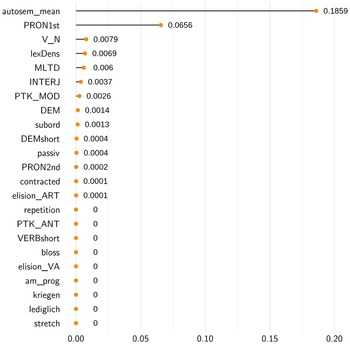
Figure 1 illustrates that the mean length of content words (autosem_mean) and the proportion of first-person pronouns (PRON1st) have the strongest impact on the model’s decisions, followed by the ratio of full verbs to nouns (V_N), lexical density (lexDens), and lexical diversity (MTLD). The classification is, therefore, driven primarily by lexical features. Longer content words, captured by autosem_mean, are more typical of written texts, reflecting higher morphological complexity arising from inflection, derivation, or compounding. In contrast, shorter words dominate oral language, consistent with speakers’ tendency to favor words that are easy to produce and process in real time.
Conditional variable importance for all features.
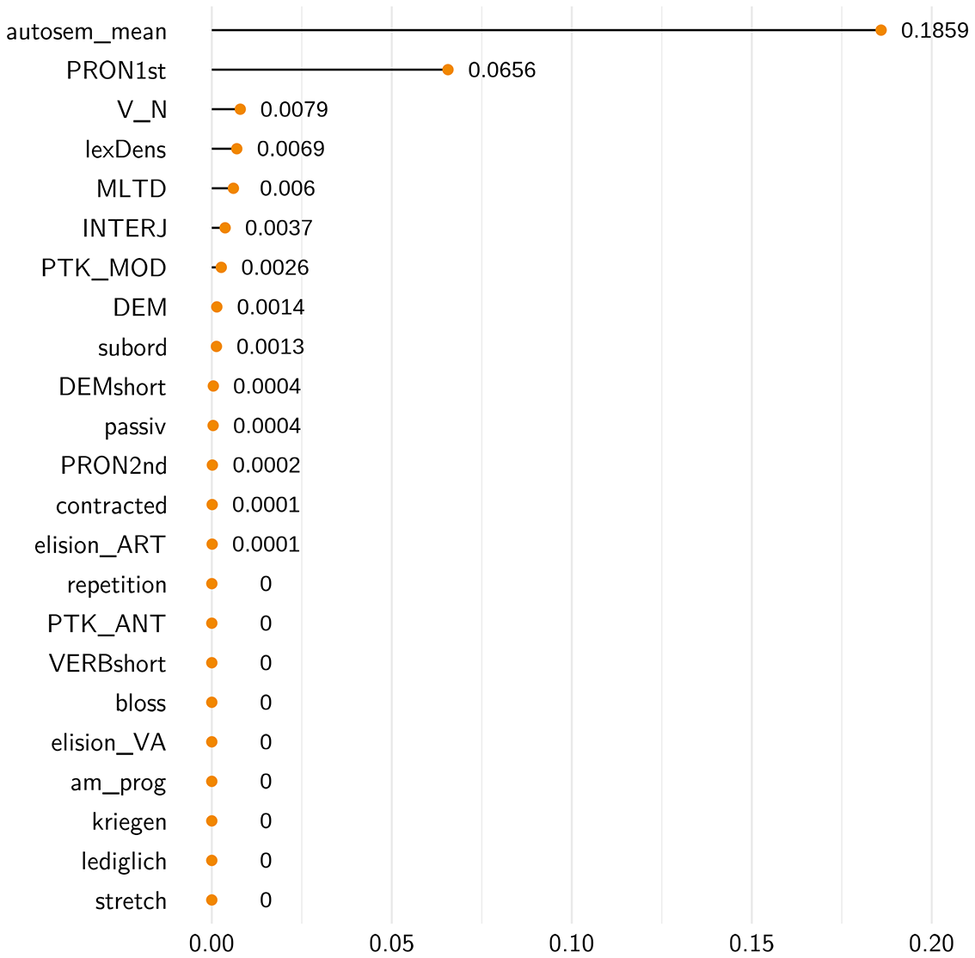
Figure 1. Long description
The dot plot displays 23 features on the vertical axis and importance values from 0.00 to 0.20 on the horizontal axis.
At the top, autosem_mean has the highest importance with a long horizontal line ending at an orange dot at 0.1859.
Below it, P R O N 1st has the second highest importance at 0.0656.
The next group shows a sharp decline in importance:
* V_N at 0.0079
* lexDens at 0.0069
* M L T D at 0.006
* I N T E R J at 0.0037
* P T K_M O D at 0.0026
* D E M at 0.0014
* subord at 0.0013
Features with near-zero importance include D E Mshort and passiv at 0.0004, P R O N 2nd at 0.0002, and contracted and elision_A R T at 0.0001.
The remaining nine features at the bottom all have an importance value of 0: repetition, P T K_A N T, V E R Bshort, bloss, elision_V A, am_prog, kriegen, lediglich, and stretch.
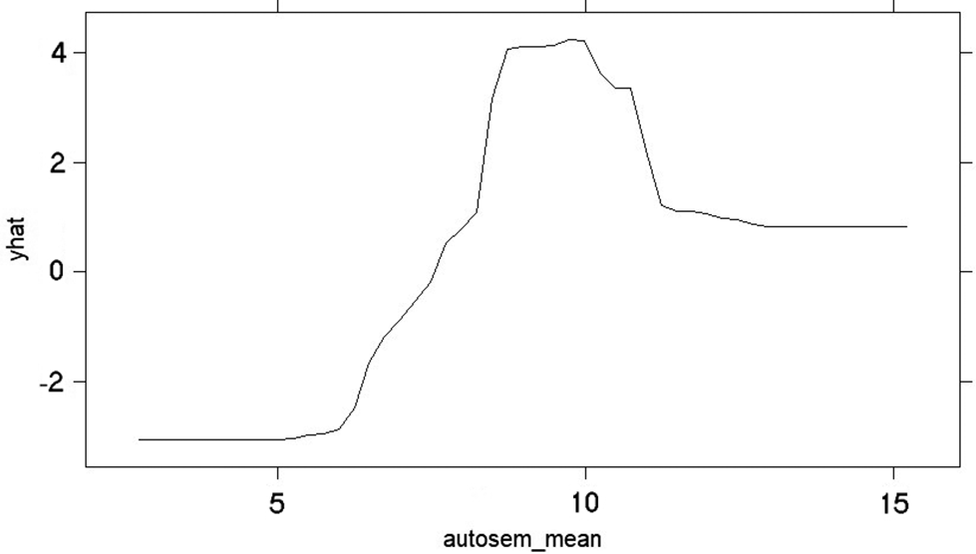
Figure 2 shows a partial dependence plot, generated with the pdp package (Greenwell Reference Greenwell2017), illustrating the relationship between autosem_mean and the centered logit of the prediction (yhat). Higher yhat values indicate a greater likelihood that the text is labeled “literary.” Word lengths up to about six tokens are associated with a low probability of classification as conceptually literate, while lengths of approximately 9–11 tokens correspond to a sharply increased probability. Lengths greater than 11 tokens still indicate a high probability (inverse logit ≈ 0.73), though slightly lower than the peak between 9 and 11 tokens.
Partial dependence of literary probability on autosem_mean.
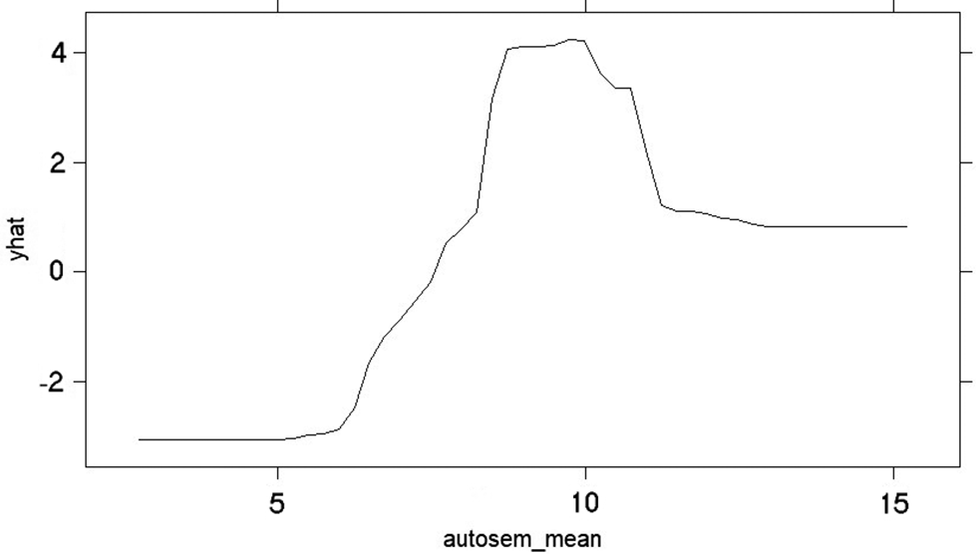
Figure 2. Long description
The horizontal X-axis is labeled autosem_mean with numerical markers at 5, 10, and 15. The vertical Y-axis is labeled y hat with numerical markers at -2, 0, 2, and 4. The data line begins at a constant value of approximately -3 from the start of the axis until autosem_mean reaches 6. At this point, the line rises sharply and jaggedly, reaching a peak value slightly above 4 when autosem_mean is approximately 10. After this peak, the line drops steeply to a value of 1 at autosem_mean 11.5. It then continues with a very slight downward slope before leveling off into a horizontal plateau at a y hat value of approximately 0.8 for the remainder of the graph.
From a linguistic perspective, this pattern reflects the well-established tendency for conceptually distant, literate registers to favor morphologically complex and lexically specific (often Latinate or abstract) content words, whereas conceptually immediate texts are characterized by shorter and semantically general lexical items.
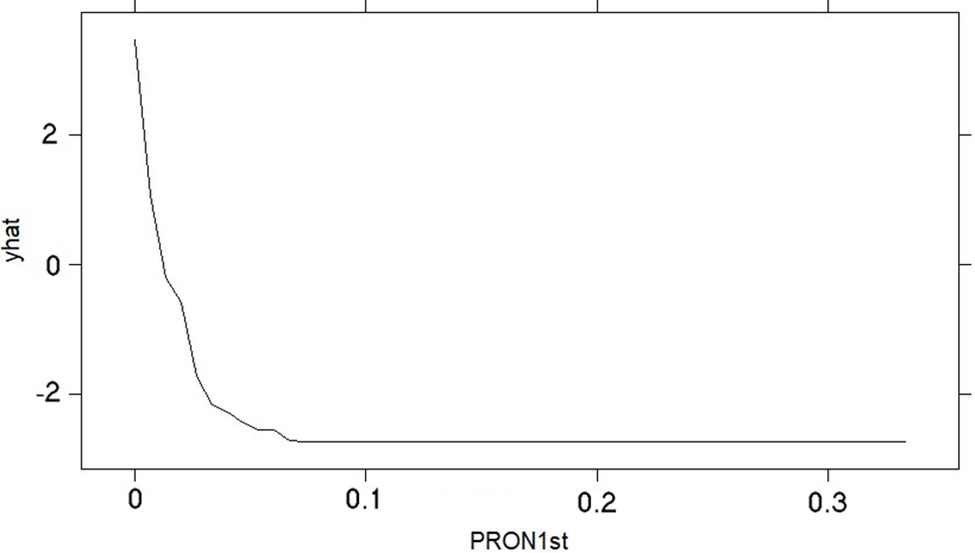
The prominence of PRON1st reflects the interpersonal orientation of spoken language, where references to the speaker (ich, wir) are frequent, versus the more impersonal or formal style of written texts. Figure 3 shows that only a proportion of less than 0.1 correlates with a higher probability of a classification as conceptually literate. The highest probability is observed in texts where the proportion of PRON1st is 0.
Effect of PRON1st on literary probability.
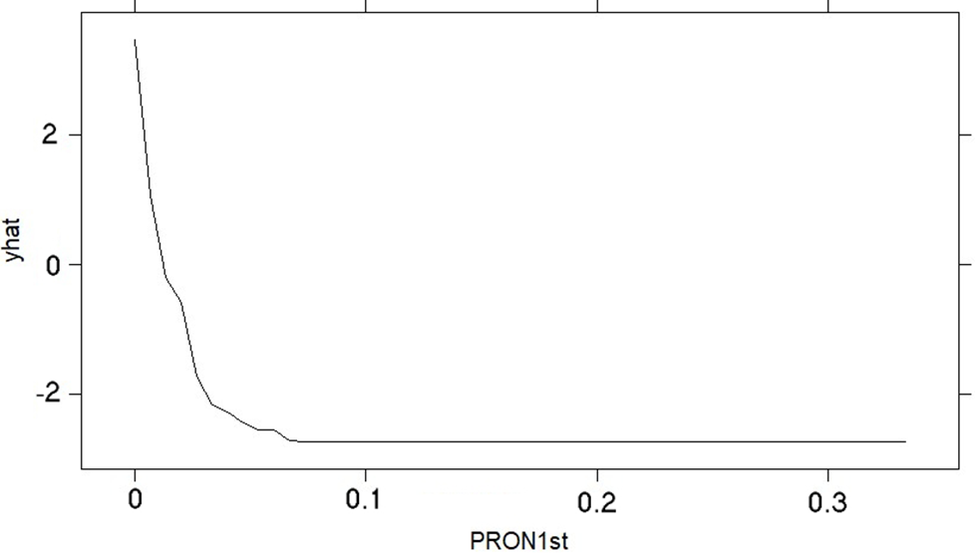
Linguistically, this pattern aligns with the notion that literary or conceptually distant registers minimize explicit self-reference, favoring an objective, observer-oriented perspective rather than a speaker-centered, interactive style.
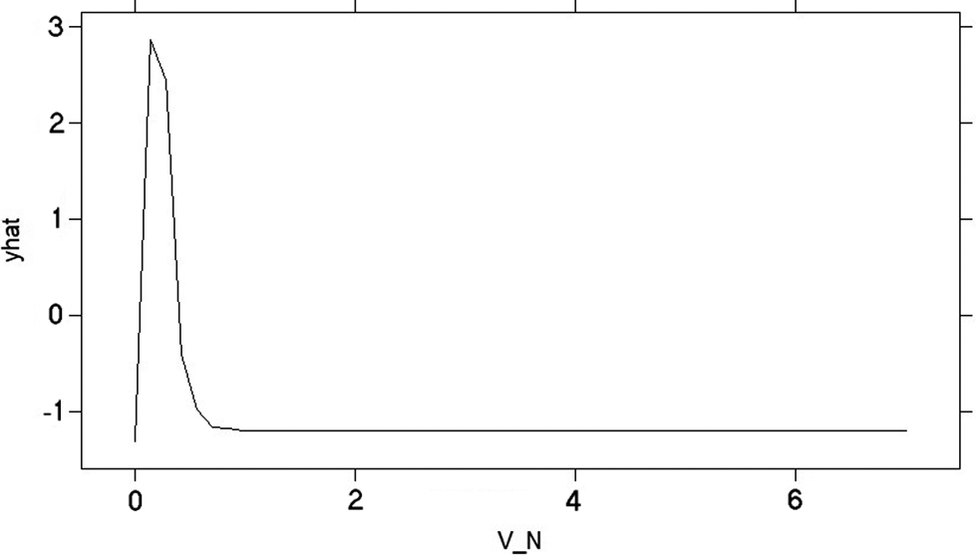
Similarly, the ratio of full verbs to nouns (V_N) highlights differences in structural patterns: oral texts tend to employ more verbs to support narrative immediacy, whereas written texts favor nouns, contributing to informational density. The partial dependence plot in Figure 4 shows that ratios below 1 are associated with a high probability of classification as conceptually literate, while ratios above 1 correspond to a low probability. This reflects a linguistic tendency for conceptually distant, literate texts to rely more on nominal constructions, which convey stable concepts and reduce the immediacy of actions, in contrast to verb-rich, interactive oral discourse.
Partial dependence of literary probability on V_N ratio.
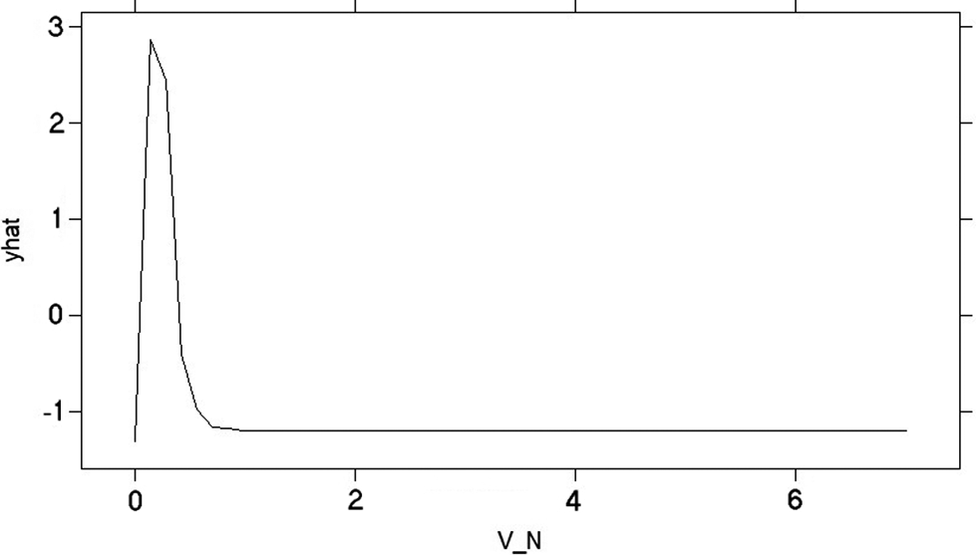
Figure 4. Long description
The horizontal X axis is labeled V underscore N with numerical markers at 0, 2, 4, and 6. The vertical Y axis is labeled yhat with numerical markers at minus 1, 0, 1, 2, and 3. The data curve begins near V underscore N equals 0 at a yhat value of approximately minus 1.3. It exhibits a steep, nearly vertical linear increase to a sharp peak of approximately 2.9 at V underscore N 0.2. From this peak, the curve drops rapidly, passing through yhat 0 at roughly V underscore N 0.4. By V underscore N 0.8, the curve levels off into a horizontal asymptotic line at a yhat value of approximately minus 1.2, which remains constant through the end of the plotted range at V underscore N 7.
Lexical density (lexDens) and lexical diversity (MTLD) further differentiate registers, as written texts typically exhibit a broader and more semantically dense vocabulary, while oral texts rely on more frequent repetition of common items.
Morphological features, such as contractions or the omission of word components, may be characteristic of spoken language but have only a subordinate measurable influence on classification outcomes. Syntactic and pragmatic features contribute minimally. This is unsurprising, as lexical features not only capture stylistic differences but also reflect linguistic complexity. Since these complexity-related measures already contribute strongly to the classification, additional features play a comparatively smaller role.
Application to non-polar texts
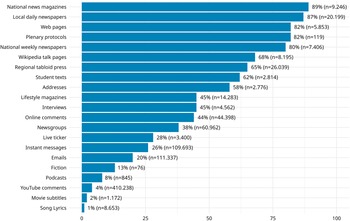
The trained Random Forest classifier is then applied to the remaining 20 archives. For each text, it determines its position within the feature-based multidimensional continuum. Figure 5 shows the resulting proportions per archive, rounded to the nearest percent.
Text distribution and percentage classified as “distance” within the immediacy-distance continuum.
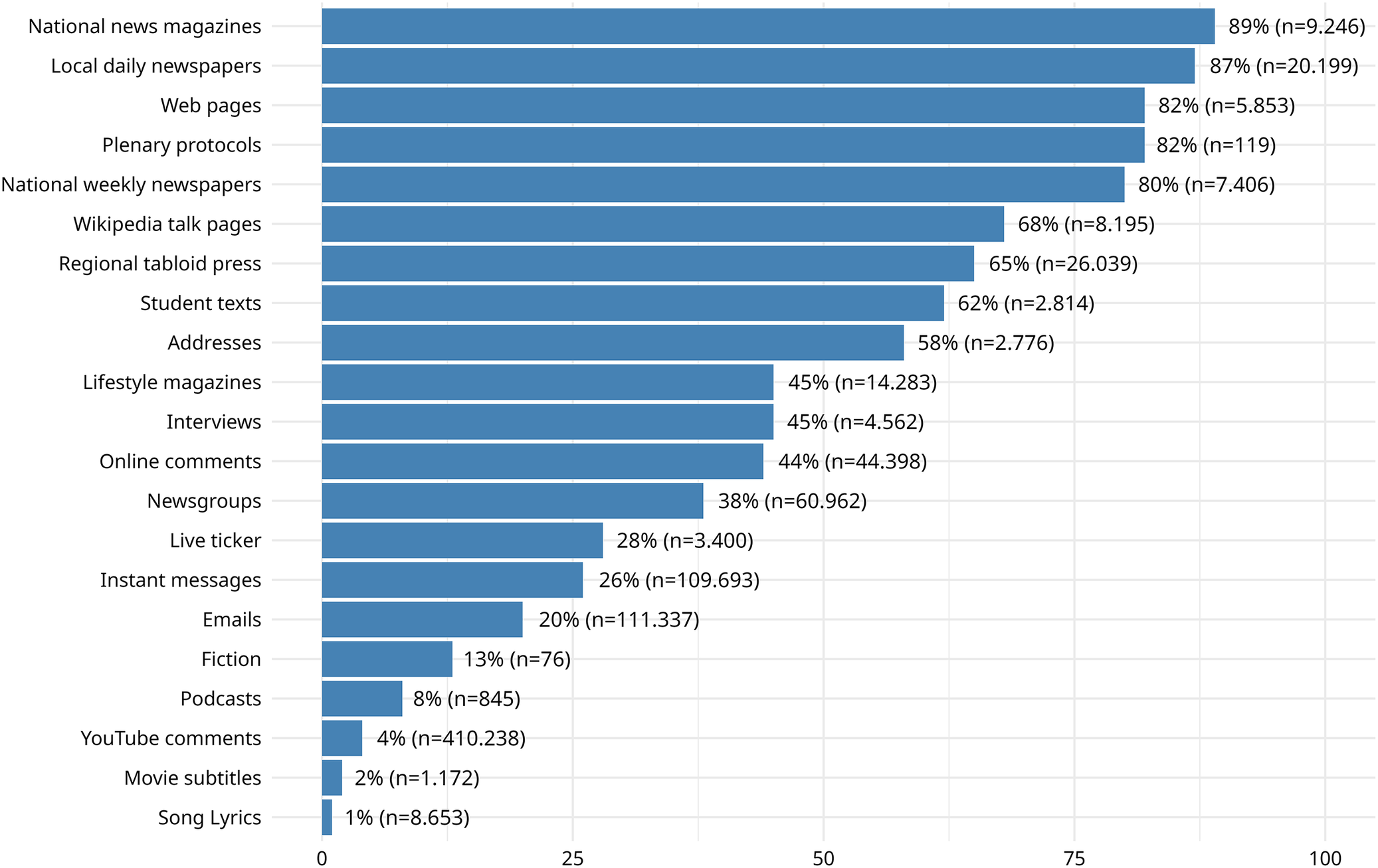
Figure 5. Long description
The x-axis represents the percentage from 0 to 100 in increments of 25. The y-axis lists media categories. The data points from top to bottom are as follows.
* National news magazines: 89% (n=9.246)
* Local daily newspapers: 87% (n=20.199)
* Web pages: 82% (n=5.853)
* Plenary protocols: 82% (n=119)
* National weekly newspapers: 80% (n=7.406)
* Wikipedia talk pages: 68% (n=8.195)
* Regional tabloid press: 65% (n=26.039)
* Student texts: 62% (n=2.814)
* Addresses: 58% (n=2.776)
* Lifestyle magazines: 45% (n=14.283)
* Interviews: 45% (n=4.562)
* Online comments: 44% (n=44.398)
* Newsgroups: 38% (n=60.962)
* Live ticker: 28% (n=3.400)
* Instant messages: 26% (n=109.693)
* Emails: 20% (n=111.337)
* Fiction: 13% (n=76)
* Podcasts: 8% (n=845)
* YouTube comments: 4% (n=410.238)
* Movie subtitles: 2% (n=1.172)
* Song Lyrics: 1% (n=8.653)
The previously mentioned low impact of morpho-syntactic features may be partly due to the fact that many features commonly associated with “language of immediacy” in the research literature turn out to be so rare, even in our broadly stratified corpus, that they do not make a significant contribution to the decision-making process. For instance, features such as “stretch” or “am_prog” occur only 26,723 and 1,637 times, respectively, among a total of 886,733 texts in the corpus, which naturally diminishes their influence on the overall model. Nonetheless, we can clearly affirm the directional effects of these features: 22,672 texts with “stretch>0” are classified as “language of immediacy” (85%), while 1,437 texts with “am_prog>0” also show this classification (88%). Similarly, the feature “kriegen” correlates with the classification as “language of immediacy” in 8,475 out of 10,740 instances (79%). So when these features do appear, they indeed correlate with statistically more powerful features in the algorithm.
Further discussion
COrLiCo comprises nearly 900,000 individual texts. The word-level distribution appears reasonably balanced, with approximately 55 million “language of distance” tokens compared to 65 million “language of immediacy” tokens. At the text level, however, the classifier categorizes fewer than 200,000 texts as exhibiting “language of distance” and more than 700,000 as exhibiting “language of immediacy.” This is because the substantial variation in text lengths – already noted in the training data – becomes even more pronounced in the continuum archives. For instance, YouTube comments average 12 words, emails and instant messages 45 words, newsgroups 540 words, live ticker 1,470 words, podcasts nearly 6,000 words, plenary transcripts more than 42,000 words, and fiction texts more than 65,000 words.
However, we do not observe a consistent correlation trend between text length and classification, neither for planned nor for spontaneously created texts. Emails shorter than the average are approximately six times more likely to be classified as “language of immediacy” rather than “language of distance” (65,140 vs. 11,603). Emails longer than the average are only about twice as likely to be classified as “language of immediacy” rather than “language of distance” (23,368 vs. 10,316). For instant messages, the distributions are roughly equal: messages shorter than the average are classified as “language of immediacy” 67,079 times and as “language of distance” 24,426 times; messages longer than the average have a similar ratio, with 12,113 classified as “language of immediacy” and 3,982 as “language of distance.” And in the case of online comments, the effect even reverses: comparatively short texts (i.e., shorter than the average of 112 words) are classified as “language of immediacy” in 15,971 instances and as “language of distance” in 9,757 instances; for longer texts, we observe an opposite tendency with 8,824 versus 9,652.
Song lyrics, while traditionally regarded as a lyrical genre, exhibit a high density of immediacy features. This pattern is well established in the Anglophone literature: Kreyer and Mukherjee (Reference Kreyer and Mukherjee2007) analyze the style of song lyrics, and Werner (Reference Werner2021b) proposes a parameter profile for mainstream pop lyrics, outlining how songs can be positioned along dimensions such as emotional involvement versus detachment or spontaneity versus reflection. The present analysis demonstrates that these tendencies also hold for German pop lyrics. Contextual factors are crucial: the performative nature of lyrics – “written to be sung” – aims to create presence and emotional engagement with the listener.
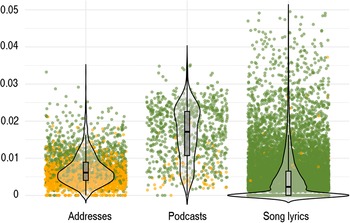
Expanding on the discussion in sections “Evaluation on the conceptual poles” and “Application to non-polar texts,” the effects of individual features can be illustrated using DEM, defined as the ratio of demonstrative pronouns to all words in a text. Figure 6 presents violin plots showing the distributions of DEM across three subarchives: political addresses/keynotes, conversational podcasts, and song lyrics. Addresses are significantly more often classified as conceptually distant, likely due to their formal language. Podcasts are much more frequently classified as conceptually immediate, reflecting their conversational, spontaneous, and interactive style, while song lyrics fall almost entirely into the latter category, as noted above. Nevertheless, across all subarchives, the classifier tends to categorize texts with few or no demonstratives (DEM ≈ 0) as conceptually distant (orange points), while higher DEM values are more common in conceptually immediate texts (green points).
Density distributions for the feature DEM (proportion of demonstrative pronouns).
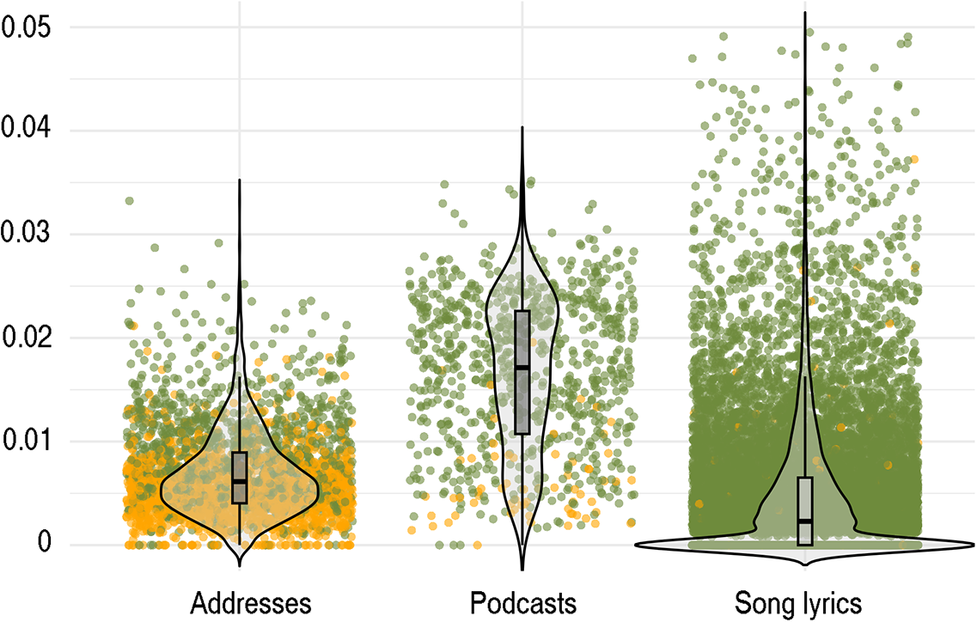
Figure 6. Long description
The Y axis represents density values ranging from 0 to 0.05 with increments of 0.01. The X axis contains three categories: Addresses, Podcasts, and Song lyrics. Each category features a vertical violin plot containing a box plot and overlaid with semi-transparent green and orange dots.
* Addresses: The distribution is concentrated at the bottom, with a wide base near 0.005 and a thin tail extending up to 0.035. The median is approximately 0.006.
* Podcasts: The distribution is more elongated and centered higher than Addresses. The violin is widest around 0.018, with a tail reaching 0.04. The median is approximately 0.017.
* Song lyrics: This category shows the highest density and widest spread. The violin plot has a very wide base near zero but a long, dense vertical tail of data points reaching above 0.05. The median is low, around 0.003, indicating a heavily skewed distribution with many high-value outliers.
It is also noteworthy that some archives classified as at least slightly predominantly “language of immediacy” – such as newsgroups or lifestyle magazines – show patterns similar to the false negative misclassifications discussed earlier. In these cases, integrated colloquial speech with prototypical oral features, frequently appearing in verbatim quotes, influences overall classification in texts that are generally distance-oriented.
Feature selection
By combining features grounded in pragmatics, syntax, lexis, sociolinguistics, and corpus linguistics (see section “Feature set”), our model avoids directly operationalizing the theoretical construct and instead examines whether independently motivated linguistic properties converge in predicting positions along the immediacy-distance continuum. Nonetheless, we omit certain potentially expected features when consistent measurement across all text sources is not feasible. Sentence length, for example – proven informative in other studies (e.g., Ortmann and Dipper Reference Ortmann and Dipper2019, Reference Ortmann, Dipper and Calzolari2020, Reference Ortmann, Dipper, Imo and Wesche2024) – is not included due to the lack of reliable punctuation in the spoken language data. However, this seems not to be a weakness, either methodologically or in terms of classifier performance. Methodologically, the omission is justified: longer sentences tend to contain shorter phrases and clauses, while shorter phrases tend to contain longer words (a quantitative law, as described by Hřebíček Reference Hřebíček1995), so sentence-level information is partially captured by other features. From a performance perspective, the classifier already achieves near-ceiling accuracy, indicating that including sentence length would likely provide little improvement.
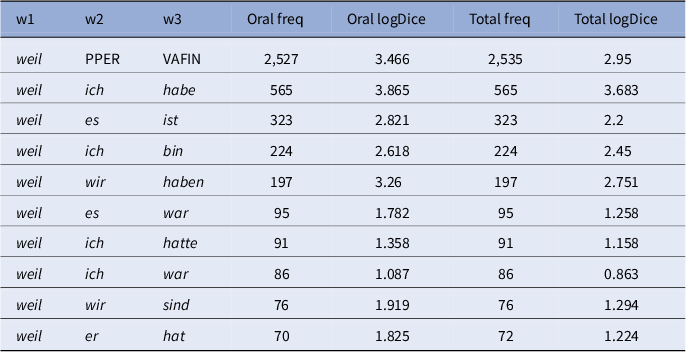
We acknowledge the concern that our classifier relies on a selective feature set. To illustrate the plausibility of our choices, we compare the classification results with an additional linguistic phenomenon not included in the training data: verb-second word order after the conjunction weil [because]. Standard German grammar places the conjugated verb at the end of a subordinate clause, but colloquial German frequently uses verb-second word order in this context. Examining constructions such as weil es ist schon spät [because it is already late], coded as weil + PPER + VAFIN in STTS, we find a striking alignment with our classification: texts classified as “language of immediacy” contain 2,527 occurrences, compared to only eight in conceptually distant texts.
Table 1 presents frequencies and association measures for all occurrences (first data row, with STTS tags for word 2 and word 3) and for the most frequent trigrams of weil with verb-second word order. It exhibits higher logDice association scores (Gablasova, Brezina, and McEnery Reference Gablasova, Brezina and McEnery2017) in immediacy texts than in the corpus overall. These results demonstrate that our chosen features reliably correlate with other meaningful linguistic patterns not explicitly included in the feature set.
weil with verb-second word order trigrams
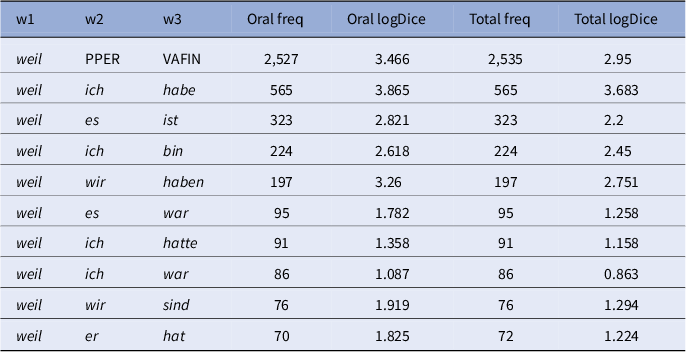
Table 1 Long description
The table contains seven columns: w 1, w 2, w 3, Oral freq, Oral logDice, Total freq, and Total logDice. All rows begin with weil in the w 1 column.
* Row 1: w 2 is P P E R, w 3 is V A F I N. Oral freq 2,527, Oral logDice 3.466, Total freq 2,535, Total logDice 2.95.
* Row 2: w 2 is ich, w 3 is habe. Oral freq 565, Oral logDice 3.865, Total freq 565, Total logDice 3.683.
* Row 3: w 2 is es, w 3 is ist. Oral freq 323, Oral logDice 2.821, Total freq 323, Total logDice 2.2.
* Row 4: w 2 is ich, w 3 is bin. Oral freq 224, Oral logDice 2.618, Total freq 224, Total logDice 2.45.
* Row 5: w 2 is wir, w 3 is haben. Oral freq 197, Oral logDice 3.26, Total freq 197, Total logDice 2.751.
* Row 6: w 2 is es, w 3 is war. Oral freq 95, Oral logDice 1.782, Total freq 95, Total logDice 1.258.
* Row 7: w 2 is ich, w 3 is hatte. Oral freq 91, Oral logDice 1.358, Total freq 91, Total logDice 1.158.
* Row 8: w 2 is ich, w 3 is war. Oral freq 86, Oral logDice 1.087, Total freq 86, Total logDice 0.863.
* Row 9: w 2 is wir, w 3 is sind. Oral freq 76, Oral logDice 1.919, Total freq 76, Total logDice 1.294.
* Row 10: w 2 is er, w 3 is hat. Oral freq 70, Oral logDice 1.825, Total freq 72, Total logDice 1.224.
General findings
This study advances our understanding of the immediacy-distance continuum by providing empirical evidence from the application of supervised machine learning to a uniquely broad, stratified corpus. Examining texts individually allows us to capture variation in immediacy and distance that would be obscured by aggregating at the media level.
By applying machine learning to linguistically motivated features, we have ensured that the classifications are interpretable and reasonably grounded in linguistic theory. This also enhances the reliability and applicability across different languages and contexts. Our findings challenge traditional oral-written dichotomies by illustrating the nuanced spectrum that exists in actual communicative practices. The varying degrees of “language of immediacy” and “language of distance” identified in different text types underscore the need for a more gradient understanding of language use.
As discussed above, authentic utterances across different discourse modes differ in several respects. Interestingly, our analysis reveals that a few lexical properties are sufficient for classification decisions. This emphasizes the significance of lexical information and suggests that the specific choice and context of words play a crucial role in real communication situations. In this regard, the findings confirm intuitive assumptions on a maximally stratified dataset. By contrast, syntactic and pragmatic features have only a limited impact on the model. This does not imply that they are irrelevant; rather, their comparatively low frequency offers a plausible explanation for their reduced influence. In machine learning classifiers, features that occur more frequently naturally carry greater weight.
In conclusion, we present a scalable and transferable framework for future research in relevant domains based on ample corpus data and linguistically informed computational language analysis. It demonstrates that carefully selected lexical and morphological features can robustly capture structural and functional distinctions, even in the absence of more complex syntactic or pragmatic measures. The developed model facilitates the compilation of virtual immediacy-distance datasets.
Future research could extend our methods to other languages. While some features are German-specific, our results show that complexity measures contribute most to classification, indicating that the approach can be transferred across languages if language-specific features are adapted or supplemented. By doing so, linguists and researchers in related fields can continue to refine their understanding of the complex interplay between “language of immediacy” and “language of distance” in human communication. This nuanced understanding is crucial for research on language variation and change, and it offers valuable insights into how language is taught, learned, and standardized.
Data availability statement
The classifier and its source code are available at https://grammis.ids-mannheim.de/download, along with derived bag-of-words versions of the corpus, facilitating its systematic evaluation and reuse across different research contexts.
Acknowledgments
The authors thank the anonymous reviewers for their helpful comments.
Author contributions
Conceptualization: R.F.S. and S.B.; Software: S.B.; Visualization: R.F.S. and S.B.; Writing and reviewing code and paper: R.F.S. and S.B. Both authors approved the final submitted draft.
Funding statement
The authors declare that no specific funding has been received for this article.
Competing interests
The authors declare that no competing interests exist.
Ethical standard
The authors affirm that this research did not involve human participants.

 Open access


Rapid Responses
No Rapid Responses have been published for this article.