INTRODUCTION
Over the last two decades, delirium has been increasingly noted as a preventable and underrecognized clinical syndrome. As a result, several clinical tools have been developed to aid in its detection (Meagher, Reference Meagher2001). In the United Kingdom, the National Institute for Clinical Excellence (NICE) recommended that nonpalliative patients at risk of developing delirium should be routinely screened (NICE, 2010, CG 103). Patients in the palliative care setting are commonly at risk of delirium, where it affects up to 88% of patients with advanced cancer and between 30 and 50% of all palliative care patients (Spiller & Keen, Reference Spiller and Keen2006). Patients who develop delirium have higher rates of mortality, institutionalization, and complications, as well as longer inpatient stays than nondelirious patients (Lawlor et al., Reference Lawlor, Gagnon and Mancini2000a ; Reference Lawlor, Faisinger and Bruera2000b ). The disorder often goes unrecognized due to a failure to use standardized methods of detection and, once diagnosed, is often poorly managed (Fang et al., Reference Fang, Chen and Liu2008). This is also true for the palliative care setting, with the problem again being exacerbated by the low use of screening methods (Smith & Adcock, Reference Smith and Adcock2012) and the poor documentation of delirium in medical notes (Barnes et al., Reference Barnes, Kite and Kumar2010).
In the palliative care setting, it remains an important clinical diagnosis since it is common, may represent the terminal phase of care, and is considered by patients and families as an important aspect of the dying process. It is distressing to patients and relatives, for whom maintaining an ability to carry out end-of-life tasks is deemed of great importance (Steinhauser et al., Reference Steinhauser, Christakis and Clipp2000).
This study aimed to compare the use of routine screening for use of the term “delirium” as a stated diagnosis, the use of terms highly suggestive of delirium in the absence of a stated diagnosis, and the use of evidence-based management strategies across three different palliative care settings in the West Yorkshire area. A further aim was to investigate whether use of the term “delirium” was associated with improved management of cases.
METHODS
We used a retrospective review of case notes in three different palliative care settings in one city: a hospital specialist palliative care team (SPCT) and two hospices, one with 32 inpatient beds (H1) and the other with 19 (H2).
The medical case notes were reviewed for: completion of a confusion screening tool such as the Abbreviated Mental Test Score (AMTS) (Hodgkinson, Reference Hodgkinson1972), the Mini-Mental State Examination (MMSE), or the Confusion Assessment Method (CAM) (Inouye et al., Reference Inouye, van Dyke and Alessi1990); documentation of a diagnosis of delirium; or the presence of clinical descriptions, terms, clusters of symptoms, or synonyms suggesting delirium. Synonyms suggestive of delirium included, for example, acute confusion, agitation, and restlessness. Clinical descriptions included a combination of confusion, poor sleep, and “sundowning.”
Where delirium, synonyms, or descriptions suggesting delirium were documented, notes were further reviewed to ascertain subsequent management interventions directly related to the delirium. Management interventions were grouped according to the domains suggested by the NICE clinical guidelines on delirium management (NICE, 2010, CG 103). These included considering any reversible cause or environmental issues, involving the family, and, if necessary, prescribing psychotropic medications.
In the hospital setting, the SPCT's own clinical notes were reviewed for referrals made between January and March of 2012. All referrals that involved a face-to face-review of a patient by one of the SPCT members were included (clinical nurse specialists, palliative medicine trainees, or consultants). Referrals in which only telephone advice was given, or where advice on the use of the Liverpool Care Pathway (LCP) was being sought without a request for assessment, were excluded from analysis. The hospital palliative care clinical notes consisted of an initial assessment clinical booklet, which included a summary of the patient's condition and progress, and photocopies of relevant clinical progress notes. It was not possible to review medication or the main ward-based medical records. All notes were reviewed from the start of the referral and assessment until contact with the palliative care team ceased.
In both the hospices, medical records were reviewed for consecutive admissions from January to February 2012. These records included all medical and nursing notes, which were documented on multidisciplinary progress notes, and all relevant charts. All admissions included an admission clerking pro forma, which contained relevant background medical information, the current reasons for admission, the clinical history and examination, an AMTS, and an admission management plan. The full clinical notes were then also reviewed for the entire length of admission.
Statistical Analysis
The study hypothesis was that the prevalence of delirium would not differ significantly between the three settings and that a documented diagnosis of delirium (as opposed to synonym clusters and descriptions suggestive of delirium) would be linked with the more frequent presence of management plans. Statistical analysis was performed using SPSS Version 18 (SPSS Inc., Chicago, IL, USA). Data were analyzed using the chi-squared test.
RESULTS
General
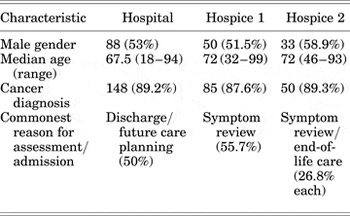
A total of 319 notes were reviewed: 166 in hospital, 97 in H1, and 56 in H2. Table 1 outlines the included patients' characteristics.
Characteristics of patients in the three palliative care settings

Use of Screening Tools
No screening tools for delirium were used in the hospital, and only the AMTS was used in the hospices. The AMTS was completed in 19 (19.6%) and 15 (26.8%) cases in hospices 1 and 2, respectively.
Prevalence
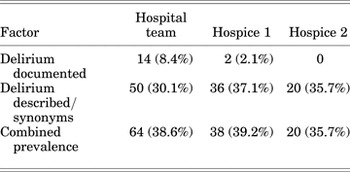
The prevalence of documented delirium ranged from 0 to 8.4%. Taking documented diagnoses, synonym clusters, and suggestive descriptions into account, the prevalence rose to a range of 35.7–39.2%. Table 2 illustrates each of the ways in which this prevalence was identified from the notes.
The prevalence of delirium as estimated by the different study methods at admission to the hospice or at initial assessment in the hospital

Within the hospices, it was also found that the prevalence of symptoms and synonyms suggestive of delirium increased as the admission progressed, with the total prevalence of delirium increasing to 53.6% in H1 and 66.1% in H2 when the full admission period was considered. Only one of these additional cases was accounted for by a stated diagnosis of delirium.
Management
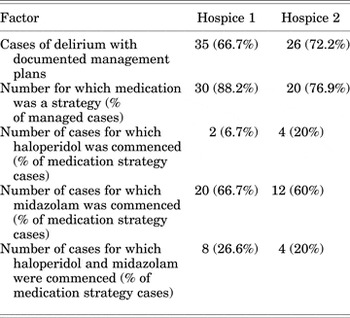
Strategies clearly aimed at managing delirium were documented in 56.3% of cases in the hospital, compared with 66.7 (H1) and 72.2% (H2) in the hospices. The most common management strategy across the settings was the addition of medication. This accounted for 50% of the hospital strategies, as compared to 88.2 in H1 and 76.9% in H2. Table 3 details which medications were used in the hospice settings and highlights the tendency toward midazolam over haloperidol.
The use of midazolam and haloperidol at hospice 1 and 2 in managing delirium (Similar data were not available for the hospital setting)

The second most prevalent management strategy was the consideration of the cause of the delirium. This was documented in 45% of hospital cases as compared with 44.1% in H1 and 34.6% in H2.
In the hospital, the difference in delirium being addressed when there was a diagnosis of delirium compared with no diagnosis was significant using the chi-squared test (p < 0.01). This was not statistically significant in the hospices.
DISCUSSION
Delirium is a common and distressing disorder in the palliative care setting. In view of this, there is an obvious need to ensure that it is both thoroughly screened for and then managed appropriately.
The results obtained from our study, which are felt likely to be representative of wider palliative care practice, suggest that this is not the case. The use of formal screening tools to identify cases of delirium were only noted in 19.6–26.8% of hospice-based patients and were completely absent in those seen by the hospital-based service. There are potential explanations for this shortfall, which should be addressed. The first is that the NICE guideline on delirium (NICE, 2010, CG 103), which recommends the use of formal screening in high-risk populations, excluded palliative care patients from its guidance. It is our opinion that this should not be interpreted as having negated the need for screening in the high-risk palliative care population, particularly as other applicable guidelines have not made this exclusion (Royal College of Physicians and the British Geriatric Society, 2006).
Second, absence of the use of any form of formal screening tools by the hospital-based palliative care service can, in part, be understood within the context of the service having a consultation/liaison role, with most key aspects of care being undertaken by the referring ward team. The practices of the referring teams were not reviewed within this study, and it may be that screening had already been carried out prior to referral. This does, however, raise the issue of ownership and responsibility for screening, and it is the authors' view, in the interests of ensuring that cases of delirium are not missed, that palliative care teams operating in the hospital setting ensure that screening is carried out at the point of their own initial assessment regardless of whether the base ward has already carried this out.
Our study also revealed that “delirium” was used as a diagnostic term infrequently by palliative care staff in all three settings. It was again felt likely that this infrequent use of the term would be representative of wider palliative care practice. The hospital-based team was most proficient at stating the diagnosis (8.4% of cases), which contrasted with one of the hospices, in which the term was not used once in any of the 56 cases examined. Estimations of prevalences obtained by searching for clusters of terms and synonyms suggestive of delirium were remarkably consistent across the three sites (38.7, 39.2, and 35.7% at the hospital, H1, and H2, respectively) and suggested that the true prevalence of delirium within such settings is likely to be much higher than established by merely considering the term “delirium.”
It had been hypothesized by the authors that the failure to designate “delirium” as a diagnosis and a reliance on less definite descriptive alternative terms would be associated with reduced use of evidence-based management. This was borne out in the results obtained from the hospital but not for those obtained in the hospices. The failure to display an association in the hospices was most likely explained by the fact that the term “delirium” was hardly ever used in these settings. It is the opinion of the authors that the association between the clear use of the term and more robust management strengthens the argument that the term should be clearly stated in medical notes when this is the likely diagnosis, rather than resorting to less precise terms and descriptions. Such an initiative will only be possible if palliative care staff are adequately trained in identifying delirium and making the diagnosis.
The results obtained from this study also revealed that not all cases of delirium received targeted management (only 56.3, 66.7, and 72.2% of estimated cases did so, at the hospital, H1, & H2, respectively). At a superficial level, this may appear appropriate given that many patients would have been close to the end of life and overzealous intervention may not have been in their best interest. It should be noted, however, that the study included a wide range of potential interventions, including the use of medication, the consideration of likely causes, the management of environmental factors to promote cognition and safety, and the provision of information to and involvement of family members. It is difficult to argue that a case of delirium, even in the very final phase, would not merit any of these interventions.
In addition, for those cases where some form of management was implemented, the most frequent strategy was the prescription of psychotropic medications — in particular, haloperidol and midazolam. This strategy was particularly prevalent in hospice-based patients, where up to 88.2% of the managed delirium cases received a psychotropic prescription as compared to 50% of those in hospital. In the hospice settings, midazolam was the most frequent psychotropic agent used (up to 66.7% of prescriptions), followed by a combination of midazolam and haloperidol (up to 26.6% of prescriptions), and then haloperidol alone (up to 20% of prescriptions). This is a reversal of NICE's delirium guidance (NICE, 2010, CG 103), which states that haloperidol or olanzapine should be considered for those who are distressed or are considered to be a risk to themselves or others, but does not recommend the use of benzodiazepines for pharmacological treatment of delirium. As mentioned, the NICE guidance excludes palliative care patients from the scope of its advice, and it could be argued that the use of midazolam is more in keeping with the needs of those close to the end of life. Certainly, there is evidence that midazolam (Pandharipande et al., Reference Pandharipande, Shintani and Peterson2006), unlike other benzodiazepines, does not increase the incidence of delirium; however, its effect on those already laboring under the effects of reduced consciousness and perceptual abnormalities is likely to be potentially adverse. It should also be noted that a proportion of the hospice-based patients (26.5 and 30.8% of cases of managed delirium at H1 and H2, respectively) were also being treated on the LCP, which may suggest that the principal aim of the use of midazolam was to control terminal agitation. This still leaves a number of patients (30.5 and 26% of managed cases at H1 and H2, respectively) for whom midazolam was used within the context of a likely delirium where the patient was not on the LCP. In view of the absence of specific guidelines for the pharmacological management of delirium in palliative care patients, there is an obvious need for further research to equip clinicians with clear prescribing advice. In the meantime, it is the authors' opinion that caution should be exercised in the use of midazolam in delirious patients.
LIMITATIONS OF THIS STUDY
Although the authors feel that the palliative care settings reviewed were typical of those found throughout the United Kingdom, there is an obvious danger in generalizing the results of this study too widely. This was a relatively small study that used the presence of clusters of terms, descriptions, and synonyms to build a picture of the likely prevalence of delirium. Although this produced consistent estimates across the three study settings, it was, of course, an inexact method, and the results should be interpreted accordingly.
CONCLUSION
This study revealed that there was a lack of routine screening for delirium in these palliative care settings. There was also a lack of precision in the diagnosis of delirium, with staff favoring the use of terms suggestive of delirium rather than using the term “delirium” as a definitive diagnosis. Where the delirium was stated as a diagnosis in the hospital setting, the ensuing management was better. Many cases of probable delirium did not receive targeted management, and where they did, there was an overreliance upon psychotropic medication. Further research, followed by the provision of guidance and training, would most likely improve the management of this prevalent and distressing disorder.