




No CrossRef data available.
Article contents
Attentional functioning and white matter integrity among survivors of malignant brain tumors of childhood
Published online by Cambridge University Press: 01 March 2004
Abstract
Children surviving treatment for malignant brain tumors commonly have problems maintaining their premorbid levels of intellectual development and academic achievement. Our group has been especially interested in the effects of treatment on normal appearing white matter (NAWM) on MRI and the influence of NAWM volumes on neurocognitive functioning. The present study assessed NAWM and attentional abilities among 37 long-term survivors of malignant brain tumors, ranging in age from 1.7 to 14.8 (Mdn = 6.5) years at diagnosis, who had been treated with cranial radiation therapy with or without chemotherapy 2.6 to 15.3 (Mdn = 5.7) years earlier. On the Conners' Continuous Performance Test, the Overall Index and 7 of the other 10 indices were significantly deficient compared to age- and gender-corrected normative values. After statistically controlling for the effects of age at diagnosis and time elapsed from treatment, 5 of the 8 indices were significantly associated with cerebral white matter volumes and/or specific regional white matter volumes of the prefrontal/frontal lobe and cingulate gyrus. No gender effects were observed. The results of the present study further support the contention that NAWM is an important substrate for treatment-induced neurocognitive problems among survivors of malignant brain tumors of childhood. (JINS, 2004, 10, 180–189.)
Information
- Type
- Research Article
- Information
- Journal of the International Neuropsychological Society , Volume 10 , Issue 2 , March 2004 , pp. 180 - 189
- Copyright
- © 2004 The International Neuropsychological Society
INTRODUCTION
Children surviving treatment for malignant brain tumors commonly have problems maintaining their premorbid levels of intellectual development and academic achievement (Mulhern et al., 1992; Ris & Noll, 1994; Roman & Sperduto, 1995), ultimately depressing their quality of life as adults (Mostow et al., 1991). It has become clear that such problems stem from a decline in their rate of learning rather than from a loss of previously acquired skills and abilities. For example, one recent investigation of children treated for medulloblastoma, the most common malignant brain tumor of childhood, estimated that their post-treatment learning slope was only 30% of what was needed to maintain their pretreatment intellectual trajectories (Palmer et al., 2001).
Numerous known sources of injury to the developing central nervous system may be associated with the treatment of malignant brain tumors, including tumor invasion of brain parenchema, increased intracranial pressure, seizures, mechanical injury from tumor resection, perioperative complications, and radiation- and chemotherapy-induced neurotoxicity (Ris & Noll, 1994). The impact of these sources of injury on the neurocognitive status of surviving children appears to be modified by the age of the patient at the time of treatment and the time elapsed from completion of treatment in that younger children and those evaluated further from treatment more likely to exhibit deficits (Mulhern et al., 1998; Ris et al., 2001; Walter et al., 1999).
Notwithstanding these known sources of brain damage, the biological mechanisms mediating the development of chemotherapy- and irradiation-induced neurocognitive deficits are poorly understood among children treated for malignant brain tumors. Both chemotherapy and radiation therapy have the shared capacity to result in leukoencephalopathy by targeting myelin-producing oligodendrocytes, astrocytes, the microvasculature, or mature myelin directly (Filley & Kleinschmidt-DeMasters, 2001). Quantitative analyses of brain morphology following the treatment for malignant brain tumors of childhood with radiation therapy with or without chemotherapy have shown objective evidence for white mater loss and/or failure to develop white matter at an age-appropriate rate compared to patients treated for low grade tumors with surgery alone (Mulhern et al., 1999; Reddick et al., 2000). Deficient development of white matter in children treated for malignant brain tumors has been associated with IQ loss (Mulhern et al., 1999). In addition, it has been suggested that the increased risk for IQ deficits among younger patients can largely be explained by white matter pathology (Mulhern et al., 2001).
However, it is likely that measures of IQ and academic achievement, which have traditionally defined the endpoints in this area of research, merely represent the distal result of a cascade of deficits involving more basic neurocognitive processes, such as attention, processing speed, and working memory. These processes, and their relationships with IQ, have been more extensively studied among patients with other forms of cancer who receive central nervous system treatment with chemotherapy with or without radiation therapy, principally children treated for acute lymphoblastic leukemia (ALL; Brouwers et al., 1984; Espy et al., 2001; Lockwood et al., 1999; Rodgers et al., 1999; Schatz et al., 2000). Some time ago, Brouwers and colleagues (1984) demonstrated a significant association between problems with attention switching and evidence of cortical atrophy and calcifications on CT. More recently, Schatz et al. (2000) demonstrated that IQ deficits among children treated for leukemia with irradiation, as compared to non-irradiated patients, can largely be accounted for by deficits in information processing speed and working memory. Many of these cognitive processes fall under the umbrella of “executive” or goal-directed cognitive processes. Executive functions are thought to be primarily mediated by control mechanisms in the frontal cortex, and include the ability to integrate multiple sources of information, keep track of multiple goals, ignore distracting information, and focus on new information or activities (e.g., Baddeley, 1996).
“Attention” is a broad term that refers to a group of interrelated cognitive processes, including the ability to alert or orient to stimuli, selectively attend to stimuli while ignoring distracting information, sustain focused attention, and disengage and reengage focus on new stimuli (Posner & Peterson, 1990). Posner and Peterson's model makes a distinction between a posterior attention system and an anterior attention system. The posterior system is primarily responsible for orienting to sensory stimuli, while the anterior system is involved in regulation of cognitive operations (Posner & Peterson, 1990). “Executive attention” is required for more complex tasks, such as those that involve planning (Posner & DiGirolamo, 1998). Executive attention is associated with the anterior system, which exerts control over areas involved in target detection and response (Posner & DiGirolamo, 1998). The Continuous Performance Test (CPT) has been used empirically to tap the anterior attention system (e.g., Hager et al., 1998).
Prior studies from our laboratory have attempted to associate treatment-related white matter changes with attention, as measured by the Overall Index score from the Conners' Continuous Performance Test (Conners, 1995), and memory deficits, as measured by the List A Trials 1 to 5 score on the California Verbal Learning Test (Delis et al., 1994) among children treated for malignant brain tumors. The initial study did not demonstrate a significant relationship between normal white matter volumes following cranial irradiation and attentional and memory deficits (Mulhern et al., 2001). More recently, Reddick (2003) has replicated our earlier finding of the relationship between white matter loss and IQ decline (Mulhern et al., 1999), and further demonstrated that the relationship between white matter loss and IQ decline is mediated by loss of attentional abilities. However, neither of these reports included detailed analyses of regional white matter loss or more specific indices of different attentional abilities. In that functional and morphologic MRI studies have implicated the relative importance of frontal and prefrontal structures (e.g., cingulate gyrus, dorsolateral prefrontal cortex) in executive functions, attention, and working memory (e.g., Casey et al., 2000), one would expect that white matter pathology in these areas would have the greatest adverse impact on attentional abilities. This relationship has recently been supported by a study showing white matter volume differences among children medicated for ADHD, unmedicated children with ADHD, and healthy controls (Castellanos et al., 2002).
The objectives of the present study were to examine the integrity of attentional processes among survivors of malignant brain tumors of childhood, and to associate levels of attentional functioning to white matter development in a-priori regions of interest. We hypothesized that (1) attentional functioning would be impaired relative to normal, healthy peers; (2) more impaired attentional functioning would be associated with lower IQs; and (3) decreased volumes of normal cerebral white matter, especially in the frontal and prefrontal areas, would be associated with greater impairment of attentional functioning.
METHODS
Research Participants
Study participants were recruited from an IRB-approved clinical trial for patients diagnosed with cancer at a single pediatric medical center (Thompson et al., 2001). To be eligible for participation, the patient was required to be between the ages of 6 and 18 years, and have completed therapy with documented disease control for two years or longer. It was also required that participants have English as their primary language. Of the 108 consenting participants from the 117 approached for participation, our study focused on the 57 patients diagnosed with malignant brain tumors who were treated with surgical resection and cranial irradiation, with or without chemotherapy. Of these 57 patients, 17 were excluded because of technical problems with the study (e.g., missing psychological or MRI exams, incorrect or incomplete MRI sequences, or movement artifacts on MRI). A visual inspection of the processed images for each patient revealed that an additional 3 patients' imaging was significantly (>15 degrees of rotation) out of alignment from the desired transverse plane.
Therefore, 37 participants (20 male, 17 female) were included in the final analysis. Patients ranged in age from 1.7 to 14.8 (Mdn = 6.5) years at treatment, and had been treated with cranial radiation therapy with or without chemotherapy 2.6 to 15.3 (Mdn = 5.7) years earlier. Primary tumor histologies consisted of medulloblastoma (n = 17), astrocytoma (n =7), ependymoma (n = 5), PNET (n = 4), germinoma (n = 2), oligodendroglioma (n = 1), and craniopharyngioma (n = 1). Tumors were located in the posterior fossa region (n = 23), third ventricle region (n = 6), and cerebral hemispheres (n = 8; right frontal = 1, left frontal = 5, right temporal = 1, right parietal = 1). Eighteen patients received chemotherapy consisting of one or more of the following agents: cisplatin, carboplatin, cyclophosphamide, vincristine, and MOPP. All patients received cranial radiation therapy: 16 had local radiation therapy to the primary tumor site alone: 11 conventional (49.2–59.4 Gy), 1 hyperfractionated (70.2 Gy), and 1 brachytherapy (65.5 Gy). Twenty-four patients received local and whole brain irradiation: 3 received local irradiation with hyperfractionation (66.0, 66.0, 69.8 Gy), and 21 received conventional local irradiation (50.4–56.3 Gy) with all 24 patients receiving whole brain irradiation of 23.4 to 44.0 Gy (Mdn = 35.2 Gy). Standard fractionation for conventional irradiation was 1.8 Gy. All patients routinely received screening for endocrinopathies and hearing loss with correction provided as an institutional standard of care.
The mean estimated IQ of the sample, using an abbreviated version of the WISC–III (Wechsler, 1997; Information, Similarities, Block Design) was 83.2 (SD = 19.7), significantly below normal expectations for age in the general population (p < .001). Mean subtest scores for Information (M = 6.89, SD = 3.59), Similarities (M = 7.89, SD = 3.56), and Block Design (M = 6.70, SD = 4.03) were all below normal expectations (ps < .001).
Procedures
All procedures were completed at a single outpatient clinic visit which included the Conners' Continuous Performance Test, and MRI.
Conners' Continuous Performance Test (CCPT)
The CCPT (Conners, 1995) is a widely used computer-administered test of visual attention, originally developed to assist in the diagnosis of Attention Deficit Hyperactivity Disorder (ADHD). The CCPT provides age- and gender-corrected standard scores on multiple indices of attentional abilities for both healthy children and adolescents as well as those diagnosed with ADHD. The CCPT is approximately 14 min in duration and is computer scored. The patient is instructed to press the space bar on the computer keyboard when they see any letter other than X and to withhold responding when the letter X appears. Pressing the bar after any letter other than X is termed a “hit,” not pressing the bar after any letter other than X is an error of omission, and pressing the bar after the X is an error of commission. Letters are presented for 250 ms. The task is composed of six blocks of 60 trials with approximately 10% of the stimuli shown as X. Within each block, 20 trials each are presented with an interstimulus interval of 1, 2, or 4 s.
Eleven different age- and gender-corrected indices of attention are derived from the person's performance in addition to an Overall Index, a weighted algorithm of the 11 component scores, each representing different attentional attributes: Errors of Omission (higher scores reflect problems with focused or selective attention), Errors of Commission (higher scores reflect impulsivity, disinhibition), Hit Reaction Time (reverse scored so that higher scores reflect slower processing speed), Hit Reaction Time Standard Error and Hit Reaction Time Variability Standard Error (higher scores represent inconsistency of responding), Attentiveness (higher scores represent poor perceptual sensitivity), Risk Taking (higher scores reflect a conservative response style intended to minimize commissions), Hit Reaction Time Block Change and Hit Reaction Time Standard Error Block Change (higher scores reflect problems with sustained attention), Hit Reaction Time Interstimulus Interval Change and Hit Reaction Time Standard Error Interstimulus Interval Change (higher scores reflect problems in adapting response tempo to stimuli).
MRI evaluations
MRIs were performed on a 1.5 T Magnetom (Siemens Medical Systems, Iselin, NJ) whole body imager using the standard circular polarized volume head coil. T1, T2, and PD images were acquired on all patients as transverse 5-mm thick slices with a 1-mm gap interleaved to avoid cross-talk between slice excitations. T1 images were acquired using a gradient-echo FLASH-2D imaging sequence (TR/TE = 266/6 ms, 90° flip angle, 192 phase encodes, three acquisitions). T2 and PD images were acquired simultaneously using a dual spin-echo sequence (TR/TE1/TE2 = 3500/19/93 ms, two echoes, 192 phase encodes, one acquisition). The imaging protocol for this study was chosen because it is a routine element in the evaluation of patients at our institution. Standard positioning beams on the magnet and head immobilization devices built into the head coil by the manufacturer were sufficient to ensure adequate head positioning and immobilization in these studies.
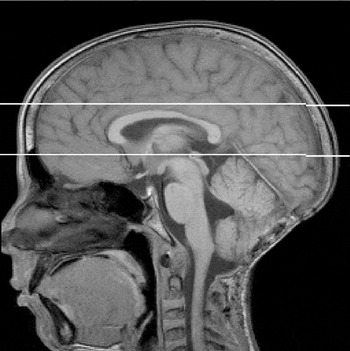
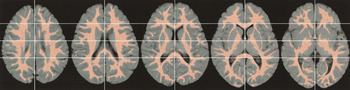
Image registration, a process of alignment so that the individual points in an image correspond to the same anatomical tissue in a related image, was performed within each examination. A single transverse section at the level of the basal ganglia, including both genu and splenium of the corpus callosum, and generally showing the putamen and the lateral ventricle was selected as the index slice for this investigation, allowing for quantification of both interhemispheric and intrahemispheric white matter tracts. Post-MRI processing was conducted on five slices: the index slice, the two adjacent slices above the index slice, and the two adjacent slices below the index slice (Figure 1). The representative index slice was chosen to sample cortical gray matter, white matter, central gray matter structures, and ventricular CSF (Figure 2) and has been shown to be highly predictive of full cerebrum volumes in other patient populations (Glass et al., in press).

Sagittal MRI showing the superior and inferior boundaries of the five images processed for normal appearing white matter volumes.

An example of segmentation and classification of the eight regional NAWM volumes (lighter shading) at each of the five levels of MRI from superior to inferior (left to right). The index slice is represented as the third image from the left.
Volumes of brain parenchyma on MR images were quantitatively assessed using a fully automated hybrid neural network segmentation and classification method. The resulting classified regions were mapped to a color scheme similar to that used for positron emission tomography. For contrast purposes, the background was colored black. A histogram was then completed to determine the number of pixels present, which was then multiplied by pixel volume to determine the sampled volume of each tissue type. Robust reliability and validity have been previously established for these methods (Reddick et al., 1997, 1998).
Regional areas of interest were neuroanatomically defined using an adaptation of the methodology of Reiss et al. (1996). Four planes were passed through the transaxial index slice: (1) a midsagittal plane, dividing the slice into right and left hemispheres; (2) a coronal plane passing through the most anterior aspect of the genu of the corpus callosum, (3) a coronal plane passing through the most posterior aspect of the splenium of the corpus callosum; (4) a coronal plane perpendicular to the midsagittal plane at the midpoint between the anterior and posterior coronal planes (Figure 2). These planes were extended to the two slices above and the two slices below the index slice, resulting in 8 regions of interest: left and right prefrontal, left and right frontal, left and right parietal/temporal, and left and right parietal/occipital regions.
In many cross-sectional studies of the relationships between brain volumes and cognitive performance, intracranial volumes (ICV) may be corrected for age and/or gender. In our sample, there was no significant relationship between age at the time of the MRI exam and ICV [r(37) = .09, p = .598]. Because ICV in healthy male children has been reported as approximately 10% greater than in healthy female children with the technique of Reiss et al. (1996), we compared male and female patients and found differences in ICV nonsignificant [t(35) = −.590, p = .559]. Therefore, in this analysis, brain volumes were not corrected for age at the time of participation or gender.
Statistical Approach
Preliminary analyses failed to find any differences between patients with supratentorial (cerebral hemispheres and third ventricle region) and non-supratentorial tumors for NAWM volumes and these groups were therefore combined. Using the age- and gender-corrected T-scores for all indices except Errors of Omission (which only yields a percentile rank score), we first conducted comparisons of CCPT performance to test norms to identify deficit areas. We then tested the strength of associations between the CCPT scores and estimated IQ. Finally, we tested the associations between CCPT scores and NAWM volumes using multiple regression and partial correlation techniques. Bivariate correlations between age at irradiation and CCPT variables ranged from r = .01 to r = .24 (Mdn = .11), and between time elapsed from irradiation and CCPT variables ranged from r = .05 to r = .45 (Mdn = .09) with few values reaching statistical significance. However, in the interest of consistency of our findings and the ability to interpret the results, age at irradiation and time elapsed from irradiation were always forced into the regressions first.
In exploratory analyses with multiple comparisons, the potential for Type-1 errors is increased. One potential solution would be data reduction in the form of factor analysis of the CCPT. However, we had no CCPT conceptual model or previous factor analyses of the CCPT available to guide us. In addition, there was concern that we might miss an important relationship between individual indices and IQ or brain volumes. To address Type-1 error as a threat to the reliability of the findings, when the probability of a Type-1 error was 50% or greater at p < .05 (e.g., 10 t tests), we adopted a more conservative p-value of < .01. All tests of statistical significance report two-tailed probabilities .
RESULTS
CCPT Performance
Based upon t tests for independent groups, the mean performance of patients was significantly worse than age- and gender-corrected test norms on the Overall Index and on 7 of the 10 component indices (Table 1): Hit Reaction Time (RT), Hit RT Standard Error (SE), Variability of RT SE, Attentiveness, Risk Taking, Hit RT Interstimulus Interval (ISI) Change, and Hit RT SE ISI Change. Because of the number of comparisons, we adopted a more conservative p-value of <.01. This pattern suggested that, compared to healthy peers, the sample as a whole failed to detect target stimuli, were slow to respond to targets, had significant variability in their speed of response to target stimuli, had difficulty in discriminating target from non-target stimuli, adopted a conservative response style to avoid responding to non-targets, and had difficulty in adapting their response tempo to changes in the interstimulus intervals. Errors of Commission, Hit RT Block Change, and Hit RT SE Block Change were not significantly different from normal age- and gender-corrected test norms, suggesting that the sample as a whole did not display impulsive responding and that patients were able to maintain a stable level of sustained attention over the duration of the test.
CCPT scores in comparison to age- and gender-corrected norms (n = 37)

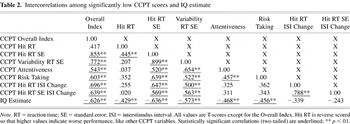
The intercorrelations among CCPT indices that were significantly depressed relative to normative values revealed, as expected, that the Overall Index was significantly correlated with all other indices (Table 2). In order to reduce the Type-1 error associated with the 36 correlations, a more conservative p-value of .01 was adopted. With the exception of Hit RT, most of the other indices were significantly correlated with each other, suggesting a strong influence of shared variance among indices.
Intercorrelations among significantly low CCPT scores and IQ estimate

Attention and IQ
Also illustrated in Table 2 are the significant relationships between IQ estimated by the short administration explained earlier and the CCPT indices that were significantly lower than normal expectations. Six of the eight correlations reached statistical significance, ranging from −.456 to −.636. Multiple regression analyses were conducted to determine the CCPT variables with the greatest influence on IQ. For all analyses, the patient's age at diagnosis and time elapsed from diagnosis were first forced into the regression model. Incremental predictive value is indicated by significant standardized beta coefficients with the total variance explained by the model presented for comparison purposes. When all indices were available, the Overall Index but none of the other CCPT variables entered into the equation (beta = −.690, p = .001; model R2 = .513, p = .001). When this analysis was repeated without the Overall Index, which is a composite measure, the Reaction Time Standard Error was the only CCPT variable to enter the equation (beta = −.672, p = .001; model R2 = .507, p = .001).
Attention and NAWM Volumes
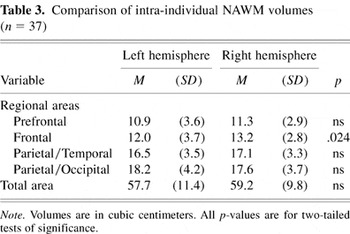
An analysis of the mean values for NAWM volumes for the 8 regions of interest (Figure 2), using t tests for dependent groups, found no significant differences between right and left prefrontal or parietal/mid-temporal volumes. Right frontal NAWM was greater (mean difference = 1.5 cc or 10%) than on the left (Table 3). Although the total right hemisphere NAWM value was greater (mean difference = 1.5 cc) than on the left, the value did not reach statistical significance because it represented a difference of only 2.6%.
Comparison of intra-individual NAWM volumes (n = 37)

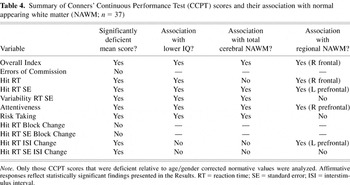
For those CCPT scores that were below normal expectations based upon the standardization sample, the associations between NAWM volumes and CCPT scores were explored using separate step-wise multiple regression analyses. For all analyses, the patient's age at diagnosis and time elapsed from diagnosis were first forced into the regression model. Incremental predictive value is indicated by significant standardized beta coefficients with the total variance explained by the model presented for comparison purposes. Total cerebral NAWM volume showed significant incremental prediction of the Overall Index (beta = −.497, p = .002; model R2 = .165, p = .006), Hit RT SE (beta = −.475, p = .005; model R2 = .256, p = .019), Variability RT SE (beta = −.450, p = .009, model R2 = .200, p = .059), Attentiveness (beta = −346, p = .045; model R2 = .165, p = .109), and Risk Taking (beta = −.411, p = .015; model R2 = .214, p = .044) scores. Lower volumes of NAWM were always associated with worse CCPT performance.
We further explored the relation between the eight regional NAWM volumes and the CCPT scores that were below normal expectations compared to the standardization sample. In separate regression analysis for each of the seven indices, we again controlled for the patient's age at diagnosis and time elapsed from diagnosis by forcing these variables into the regression first. Then, all 8 NAWM regions were allowed to enter in a stepwise fashion. Right Prefrontal NAWM showed significant incremental prediction of Attentiveness (beta = −.420, p = .012; model R2 = .228, p = .034), Left Prefrontal NAWM showed significant incremental prediction of Hit RT SE (beta = −.416, p = .011; model R2 = .220, p = .020) and Hit RT ISI Change (beta = −.357, p = .019; model R2 = .310, p = .006), and Right Frontal NAWM showed significant incremental prediction of the Overall Index (beta = −.497, p = .002; model R2 = .299, p = .008) and Hit RT (beta = −.412, p = .014; model R2 = .202, p = .056).
DISCUSSION
The present study demonstrates that survivors of malignant brain tumors of childhood have attentional deficits that can be at least partially characterized by their performance on a computerized continuous performance test. Their pattern of performance suggests that, compared to healthy peers, the sample as a whole failed to detect target stimuli, were slow to respond to targets, had significant variability in their speed of response to target stimuli, had difficulty in discriminating target from non-target stimuli, adopted a conservative response style to avoid responding to non-targets, and had difficulty in adapting their response tempo to changes in the interstimulus intervals. However, since these results are based upon comparisons to test norms rather than a parallel control group of healthy children, they must remain tentative. Among patients in our sample, attentional deficits were strongly associated with their intellectual development as measured by IQ. The present study is the first to document that reduced cerebral NAWM is significantly associated with deficits in attention among patients treated for malignant brain tumors. More specifically, even after adjusting for age at diagnosis and time elapsed from diagnosis, patients with smaller volumes of normal appearing prefrontal/frontal lobe and cingulate gyrus white matter had greater problems with attention (Table 4). These identified regional NAWM volumes include Brodmann's areas 9, 10, 24, 32, and 46 which are known to be activated on PET and fMRI examinations during attentional tasks (Cabeza & Nyberg, 2000).
Summary of Conners' Continuous Performance Test (CCPT) scores and their association with normal appearing white matter (NAWM; n = 37)

These results build upon the previous work of our group and others that has demonstrated that intellectual decline over time among children treated for cancer is due to failure to acquire information at an age-expected rate (Palmer et al., 2001), that this phenomenon results from deficits in attention, processing speed, and working memory (Brouwers et al. 1984; Lockwood et al., 1999; Espy et al., 2001; Rodgers et al., 1999; Schatz et al., 2000), and that a putative biological mechanism underlying these changes is a loss of normal white matter or a failure to continue to develop normal white matter at an age-appropriate rate (Mulhern et al., 1999, 2001; Reddick et al., 2000).
The normal expectation is that the proportion of intracranial volume comprised by white matter will increase into early adulthood with the prefrontal areas among the last to complete myelination (Reiss et al., 1996), perhaps making prefrontal structures more vulnerable to the effects of childhood injury and normal aging as assessed by tests of executive functioning (Casey et al., 2000). White matter but not gray matter volumes normally decline in the healthy aging population (Guttmann, 1998). Previous reports on the association of white matter and cognitive function have been mixed, mostly relying on IQ as an outcome measure. Andreason et al. (1993) conducted IQ testing and MRI on 67 healthy adult volunteers and found a correlation of 0.35 between gray matter volume and Full Scale IQ but only a small, nonsignificant correlation of 0.14 between white matter volume and Full Scale IQ. Similarly, Reiss (1996), in a study of brain morphology of 85 healthy children 5–17 years of age, found a significant association between volume of cerebral gray matter and IQ but not between cerebral white matter volume and IQ. After controlling for the effects of gender, prefrontal gray matter alone accounted for approximately 20% of the variance in IQ.
The absence of a strong correlation between normal white matter and IQ in healthy children and adults is in contrast to reports of significant associations of white matter abnormalities with cognitive dysfunction in normal aging and ADHD populations. For example, in a quantitative review conducted by Gunning-Dixon and Raz (2000), the presence of white matter abnormalities on MRI was associated with worse performance on tests of processing speed, immediate and delayed memory, and executive functions among healthy adults 38 to 79 years of age. In addition, several studies have documented differences in brain volumes between healthy children and those diagnosed with ADHD, including decreased volume of the frontal and prefrontal regions, and, more relevant to the present study, reduced right frontal white matter volumes (Filipek et al., 1997; Castellanos et al., 1996, 2002).
Some white matter changes may be incidental, may represent a nonspecific reduction in brain reserve, or may merely be a marker for another neuropathological process that is yet undetected. If white matter abnormalities are shown to be directly associated with cognitive deficits, at least one author has suggested that there may be a threshold effect for volume of normal white matter only below which cognitive impairment becomes apparent (Inzitari, 2000). This would explain why, among healthy children and adolescents, the volume of normal white matter accounts for a relatively smaller proportion of the variance in cognitive function than among children with pathological conditions affecting white matter or among the aging who are progressively losing normal white matter.
All patients in this series had received craniospinal irradiation with or without chemotherapy and other events with potential adverse effects on white matter development. Competing theories regarding the mechanisms underlying irradiation-induced radiation damage to white matter include either (1) a direct, irradiation-induced gradual loss of glial cells or their precursors resulting in demyelination and/or inhibition of white matter development; or (2) an indirect effect of irradiation on white matter mediated through damage to the microvasculature and resulting in hypoxia/ischemica. More recent work with animal analog models suggests that the second theory may be more valid (Hopewell & van der Kogel, 1999). Although it had been previously demonstrated that children treated for malignant brain tumors with irradiation have abnormally low volumes of normal white matter (Mulhern et al., 1999; Reddick et al., 2000), whether this is a result of demyelination or failure of the normal myelination process is not known.
The present study does have several limitations that potentially impact on the interpretation and generalization of the results. Because this study used a cross-sectional design, developmental trends in attentional performance and NAWM could not be assessed, supporting the need for future longitudinal research with healthy comparison groups. Second, although the Conner's Continuous Performance Test yields a number of indices of attentional functioning, it does not comprehensively assess attentional processes as conceptualized by contemporary theories (e.g., Fletcher, 1998). Therefore, some attentional deficits, such as impairments in attention shifting and divided attention, and their potential association with NAWM could not be assessed. Third, although the index slice chosen for analysis may accurately represent the proportion of white matter in the brain, areas known to be associated with attentional processes, such as the superior colliculus and regions of the parietal lobe, were not visualized, potentially limiting the ability to associate other areas of NAWM with attention deficits. Finally, because of the technical difficulties in separating the MRI signal intensities of abnormal white matter from normal gray matter with our current technique, we were limited to analysis of the association between white matter and IQ and attention. Current studies, using fluid-attenuated inversion recovery (FLAIR) images will enable us to accurately discriminate between abnormal white and normal gray matter.
Unfortunately, subtle cognitive processing problems related to deficits in attentional functioning may not be appreciated by physicians, parents, or teachers that care for children treated for malignant brain tumors. From our experience, and as illustrated by the data from this study, inattentiveness and slow processing tend to be prominent symptoms of treatment-induced brain damage in these children. The symptoms overlap with the “sluggish cognitive tempo” syndrome as discussed by Carlson and Mann (2002). Problems arise when caretakers falsely attribute these symptoms to laziness, lack of motivation, daydreaming, or emotional maladjustment rather than making appropriate accommodations with regard to classroom activities and homework. Whether intensive cognitive/behavioral interventions (e.g., Butler & Copeland, 2002) or pharmacological treatment (e.g., Thompson et al., 2001) will prove effective is yet unknown.
Future studies of brain morphology among children treated for malignant brain tumors will need to assess whether inhibition of white matter development is relatively greater in prefrontal areas than other areas of the brain. Recent fMRI studies reinforce the importance of prefrontal structures to attentional functioning. For example, Casey's (1997) investigation of healthy children and Banich et al.'s (2000) study of healthy adults found selective activation of the prefrontal region on tasks requiring maintenance of an attentional set and, more specifically, suggested that the dorsolateral prefrontal cortex plays a primary role in selective attention. We are presently investigating whether loss of normal white matter impacts on fMRI activation during a selective attention task among children treated for cancer.
ACKNOWLEDGMENTS
This work was supported in part by Cancer Center Support (CORE) Grant P30CA21765, R01 CA78957 (R.K.M.), U01 CA81445, and R01CA90246 (W.E.R.) from the National Cancer Institute and by the American Lebanese Syrian Associated Charities (ALSAC).
References
REFERENCES
Andreason, N.C.,
Flaum, M.,
Swayze, V.,
O'Leary, D.S.,
Alliger, R.,
Cohen, G.,
Ehrhardt, J., &
Yuh, W.T.C.
(1993).
Intelligence and brain structure in normal individuals.
American Journal of Psychiatry,
15,
130–134.Google Scholar
Baddeley, A.D.
(1996).
Exploring the central executive.
Quarterly Journal of Experimental Psychology,
49,
5–28.Google Scholar
Banich, M.T.,
Milham, M.P.,
Atchley, R.A.,
Cohen, N.J.,
Webb, W.,
Wszalek, T.,
Kramer, A.F.,
Liang, Z.,
Barad, V.,
Gullett, D.,
Shah, C., &
Brown, C.
(2000).
Prefrontal regions play a predominant role in imposing an
attentional ‘set’: Evidence from fMRI.
Cognitive Brain Research,
10,
1–9.Google Scholar
Brouwers, P.,
Riccardi, R.,
Poplack, D., &
Fedio, P.
(1984).
Attentional deficits in long-term survivors of childhood acute
lymphoblastic leukemia (ALL).
Journal of Clinical Neuropsychology,
6,
325–336.Google Scholar
Butler, R.W. &
Copeland, D.R.
(2002).
Attentional processes and their remediation in children treated for
cancer: A literature review and the development of a therapeutic
approach.
Journal of the International Neuropsychological Society,
8,
115–124.CrossRefGoogle Scholar
Cabeza, R. &
Nyberg, L.
(2000).
Imaging Cognition II: An empirical review of 275 PET and fMRI
studies.
Journal of Cognitive Neuroscience,
12,
1–47.Google Scholar
Carlson, C.L. &
Mann, M.
(2002).
Sluggish cognitive tempo predicts a different pattern of impairment
in the attention deficit hyperactivity disorder, predominately
inattentive type.
Journal of Clinical Child and Adolescent Psychology,
31,
123–129.CrossRefGoogle Scholar
Casey, B.J.,
Giedd, J.N., &
Thomas, K.M.
(2000).
Structural and functional brain development and its relation to
cognitive development.
Biological Psychology,
54,
241–257.Google Scholar
Casey, B.J.,
Trainor, R.J.,
Orendi, J.L.,
Shubert, A.B.,
Nystrom, L.E.,
Giedd, J.N.,
Castellanos, F.X.,
Haxby, J.V.,
Noll, D.C.,
Cohen, J.D.,
Forman, S.D.,
Dahl, R.E., &
Rapoport, J.L.
(1997).
A developmental functional MRI study of prefrontal activation
during performance of a go-no-go tasks.
Journal of Cognitive Neuroscience,
9,
835–847.CrossRefGoogle Scholar
Castellanos, F.X.,
Giedd, J.M.N.,
Marsh, W.L.,
Hamburger, S.D.,
Vaituzis, A.C.,
Dickstein, D.P.,
Sarfatti, S.E.,
Vauss, Y.C.,
Snell, J.W.,
Lange, N.,
Kaysen, D.,
Krain, A.L.,
Ritchie, G.F.,
Rajapakse, J.C., &
Rapoport, J.L.
(1996).
Quantitative brain magnetic resonance imaging in attention deficit
hyperactivity disorder.
Archives of General Psychiatry,
53,
607–616.Google Scholar
Castellanos, F.X.,
Lee, P.L.,
Sharp, W.,
Jeffries, N.O.,
Greenstein, D.K.,
Clasen, L.S.,
Blumenthal, J.D.,
James, R.S.,
Ebens, C.L.,
Walter, J.M.,
Zijdenbos, A.,
Evans, A.C.,
Giedd, J.N., &
Rapoport, J.L.
(2002).
Developmental trajectories of brain volume abnormalities in
children and adolescents with attention-deficit/hyperactivity
disorder.
Journal of the American Medical Association,
288,
1740–1748.CrossRefGoogle Scholar
Conners, C.K.
(1995).
The Conners' Continuous Performance Test.
Toronto, Canada:
Multi-Health Systems.
Delis, D.,
Kramer, J.,
Kaplan, E., &
Ober, B.A.
(1994).
California Verbal Learning Test for Children.
New York:
Harcourt, Brace, Jovanovich, Inc.
Espy, K.,
Moore, K.M.,
Kaufman, P.M.,
Kramer, J.H.,
Matthay, K., &
Hutter, J.J.
(2001).
Chemotherapeutic CNS prophylaxis and neuropsychologic change in
children with acute lymphoblastic leukemia: A prospective study.
Journal of Pediatric Psychology,
26,
1–9.Google Scholar
Filley, C.M. &
Kleinschmidt-DeMasters, B.K.
(2001).
Toxic leukoencephalopathy.
New England Journal of Medicine,
345,
425–432.CrossRefGoogle Scholar
Filipek, P.A.,
Semrud-Clikeman, M.,
Steingard, R.J.,
Renshaw, P.F.,
Kennedy, D.N., &
Biederman, J.
(1997).
Volumetric MRI analysis comparing subjects having attention deficit
hyperactivity disorder with normal controls.
Neurology,
48,
589–601.Google Scholar
Fletcher, J.M.
(1998).
Attention in children: Conceptual and methodological issues.
Child Neuropsychology,
4,
81–86.Google Scholar
Glass, J.O.,
Ji, Q., &
Glas, L.S.,
& Reddick, W.E.
(in press).
Prediction of total cerebral tissue volumes in normal appearing brain
from sub-sampled segmentation volumes.
Magnetic Resonance Imaging.
Gunning-Dixon, F.M. &
Raz, N.
(2000).
The cognitive correlates of white matter abnormalities in normal
aging: A quantitative review.
Neuropsychology,
14,
224–232.CrossRefGoogle Scholar
Guttmann, C.R.G.,
Jolesz, F.A.,
Kikinis, R.,
Killiany, R.J.,
Moss, M.B.,
Sandor, T., &
Albert, M.S.
(1998).
White matter changes with normal aging.
Neurology,
50,
972–978.CrossRefGoogle Scholar
Hager, F.,
Volz, H.,
Gaser, C.,
Mentzel, H.,
Kaiser, W.A., &
Sauer, H.
(1998).
Challenging the anterior attentional system with a continuous
performance task: A functional magnetic resonance imaging approach.
European Archives of Psychiatry and Clinical Neuroscience,
248,
161–170.Google Scholar
Hopewell, J.W. &
van der Kogel, A.J.
(1999).
Pathophysiological mechanisms leading to the development of late
radiation-induced damage to the central nervous system.
Frontiers of Radiation Therapy in Oncology,
33,
265–275.Google Scholar
Inzitari, D.
(2000).
Age-related white matter changes and cognitive impairment.
Annals of Neurology,
47,
141–143.Google Scholar
Lockwood, K.A.,
Bell, T.S., &
Colegrove, R.W.
(1999).
Long-term effects of cranial radiation therapy on attention
functioning in survivors of childhood leukemia.
Journal of Pediatric Psychology,
24,
55–66.CrossRefGoogle Scholar
Mostow, E.N.,
Byrne, J.,
Connelly, R.R., &
Mulvihill, J.J.
(1991).
Quality of life in long-term survivors of CNS tumors of childhood
and adolescence.
Journal of Clinical Oncology,
9,
592–599.Google Scholar
Mulhern, R.K.,
Hancock, J.,
Fairclough, D.L., &
Kun, L.E.
(1992).
Neuropsychological status of children treated for brain tumors: A
critical review and integrative analysis.
Medical and Pediatric Oncology,
20,
181–191.CrossRefGoogle Scholar
Mulhern, R.K.,
Kepner, J.L.,
Thomas, P.R.,
Armstrong, F.D.,
Friedman, H.S., &
Kun, L.E.
(1998).
Neuropsychologic functioning of survivors of childhood
medulloblastoma randomized to receive conventional or reduced-dose
craniospinal irradiation: a pediatric oncology group study.
Journal of Clinical Oncology,
16,
1723–1728.Google Scholar
Mulhern, R.K.,
Reddick, W.E.,
Palmer, S.L.,
Glass, J.,
Elkin, D.,
Kun, L.E.,
Taylor, J.,
Langston, J., &
Gajjar, A.
(1999).
Neurocognitive deficits in medulloblastoma survivors and white
matter loss.
Annals of Neurology,
46,
834–841.Google Scholar
Mulhern, R.K.,
Palmer, S.L.,
Reddick, W.E.,
Glass, J.O.,
Kun, L.E.,
Taylor, J.,
Langston, J., &
Gajjar, A.
(2001).
Risks of young age for selected neurocognitive deficits in
medulloblastoma are associated with white matter loss.
Journal of Clinical Oncology,
19,
472–479.Google Scholar
Palmer, S.L.,
Goloubeva, O.,
Reddick, W.E.,
Glass, J.O.,
Gajjar, A.,
Kun, L.E.,
Merchant, T.E., &
Mulhern, R.K.
(2001).
Patterns of intellectual development among survivors of pediatric
medulloblastoma: A longitudinal analysis.
Journal of Clinical Oncology,
19,
2302–2308.Google Scholar
Posner, M.I. &
DiGirolamo, G.J.
(1998).
Executive attention: Conflict, target detection, and cognitive
control. In
R. Parasuraman (Ed.),
The attentive brain (pp.
401–423).
Cambridge, MA:
MIT Press.
Posner, M.I. &
Peterson, S.E.
(1990).
The attention system of the human brain.
Annual Review of Neuroscience,
13,
25–42.Google Scholar
Reddick, W.E.,
Glass, J.O.,
Cook, E.N.,
Elkin, T.D., &
Deaton, R.
(1997).
Automated segmentation and classification of multispectral magnetic
resonance images of brain using artifical neural networks.
IEEE Transactions in Medical Imaging,
16,
911–918.CrossRefGoogle Scholar
Reddick, W.E.,
Mulhern, R.K.,
Elkin, T.D.,
Glass, J.O.,
Merchant, T.E., &
Langston, J.W.
(1998).
A hybrid neural network analysis of subtle brain volume differences
in children surviving brain tumors.
Magnetic Resonance Imaging,
16,
413–421.CrossRefGoogle Scholar
Reddick, W.E.,
Russell, J.M.,
Glass, J.O.,
Xiong, X.,
Mulhern, R.K.,
Langston, J.W.,
Merchant, T.E.,
Kun, L.E., &
Gajjar, A.
(2000).
Subtle white matter volume differences in children treated for
medulloblastoma with conventional or reduced-dose cranial-spinal
irradiation.
Magnetic Resonance Imaging,
18,
787–793.CrossRefGoogle Scholar
Reddick, W.E.,
White, H.A.,
Glass, J.O.,
Wheeler, G.C.,
Thompson, S.J.,
Gajjar, A.,
Leigh, L., &
Mulhern, R.K.
(2003).
Developmental model relating white matter volume with
neurocognitive deficits in pediatric brain tumor survivors.
Cancer,
97,
2512–2519.Google Scholar
Reiss, A.L.,
Abrams, M.T.,
Singer, H.S.,
Ross, J.L., &
Denckla, M.B.
(1996).
Brain development, gender and IQ in children: A volumetric imaging
study.
Brain,
119,
1763–1774.Google Scholar
Ris, M.D. &
Noll, R.B.
(1994).
Long-term neurobehavioral outcome in pediatric brain tumor patients:
Review and methodological critique.
Journal of Clinical and Experimental Neuropsychology,
16,
21–42.Google Scholar
Ris, M.D.,
Packer, R.,
Goldwein, J.,
Jones-Wallace, D., &
Boyett, J.
(2001).
Intellectual outcome after reduced-dose radiation therapy plus
adjuvant chemotherapy for medulloblastoma: A Children's Cancer
Group Study.
Journal of Clinical Oncology,
19,
3470–3476.Google Scholar
Rodgers, J.,
Horrocks, J.,
Britton, P.G., &
Kernathan, J.
(1999).
Attentional ability among survivors of leukaemia.
Archive of Disease in Childhood,
80,
318–323.Google Scholar
Roman, D.D. &
Sperduto, P.W.
(1995).
Neuropsychological effects of cranial radiation: current knowledge
and future directions.
International Journal of Radiation Oncology and Biological Physics,
31,
983–998.CrossRefGoogle Scholar
Schatz, F.,
Kramer, J.H.,
Ablin, A., &
Matthay, K.K.
(2000).
Processing speed, working memory and IQ: A developmental model of
cognitive deficits following cranial radiation therapy.
Neuropsychology,
14,
189–200.CrossRefGoogle Scholar
Thompson, S.,
Leigh, L.,
Christensen, R.,
Xiong, X.,
Kun, L.E.,
Heideman, R.,
Reddick, W.E.,
Gajjar, A.,
Merchant, T.,
Pui, C.H.,
Hudson, M.M., &
Mulhern, R.K.
(2001).
Immediate neurocognitive effects of methylphenidate on
learning-impaired survivors of childhood cancer.
Journal of Clinical Oncology,
19,
1802–1808.Google Scholar
Walter, A.,
Mulhern, R.K.,
Gajjar, A.,
Heideman, R.,
Reardon, D.,
Sanford, R.A.,
Xiong, X., &
Kun, L.E.
(1999).
Survival and neurodevelopmental outcome of young children with
medulloblastoma at St. Jude Children's Research Hospital.
Journal of Clinical Oncology,
17,
3720–3728.Google Scholar
Wechsler, D.
(1997).
Wechsler Intelligence Test for Children Third Edition.
New York:
The Psychological Corporation.
Sagittal MRI showing the superior and inferior boundaries of the five images processed for normal appearing white matter volumes.
An example of segmentation and classification of the eight regional NAWM volumes (lighter shading) at each of the five levels of MRI from superior to inferior (left to right). The index slice is represented as the third image from the left.

CCPT scores in comparison to age- and gender-corrected norms (n = 37)
Intercorrelations among significantly low CCPT scores and IQ estimate
Comparison of intra-individual NAWM volumes (n = 37)
Summary of Conners' Continuous Performance Test (CCPT) scores and their association with normal appearing white matter (NAWM; n = 37)
 You have
Access
- 96
- Cited by