Introduction
Globally, wheat (Triticum spp.) is an important cereal crop and its breeding for high yielding varieties generally leads to reduced genetic diversity that can change gene frequencies of local and traditional wheat lines (Malik et al., Reference Malik, Sharma, Verma, Kundu, Sharma and Chatrath2013). The Himalayan high lands are the reservoir for a large number of wheat landraces because of the preponderance of locally developed traditional crop varieties owing to high agro-climatic heterogeneity and local socio-cultural diversity (Partap et al., Reference Partap, Singh, Choudhary and Sethi2001). The primitive cultivars, landraces and wild relatives of crop plants are the reservoir of trait specific genetic variability which can be effectively utilized in breeding programs.
The post-harvest losses in wheat have been estimated to be 3.28 kg/q and highest during storage (Basavaraja et al., Reference Basavaraja, Mahajanashetti and Udagatti2007). The major loss is caused by various insect pests during storage and among them rice weevil is a major threat. Rice weevil is cosmopolitan in distribution due to international exchanges. Both larvae and adults cause damage to the seed; adults feed on endosperm, causing reduction in the carbohydrate contents; while, larvae feed on the germ reducing the protein content and vitamins (Belloa et al., Reference Belloa, Padina, Lastrab and Fabrizio2000). Inadequate and improper storage facilities in the developing countries result in the high degree of damage. Injudicious use of chemical pesticides for the control of Sitophilus oryzae leads to pesticidal toxicity, residues and development of resistance in insect. Therefore, it is important now to develop wheat varieties with greater resistance to the stored grain pest.
Substantial genetic variation has been reported in germplasm for resistance to storage insects (Shafique and Ahmad, Reference Shafique and Ahmad2003) and different genotypes react differently to infestation by insect pests during storage. A number of workers (Rao and Sharma, Reference Rao and Sharma2003; Lale and Kartay, Reference Lale and Kartay2006; Tripathi et al., Reference Tripathi, Bhalla, Prasad and Srinivasan2012) correlated physical characteristics of seeds to render the cultivars less suitable for feeding, oviposition and development of insect pests. Physical characteristics of the seed such as colour, kernel hardness, testa thickness and seed size among others are known to influence the resistance of cereal cultivars to infestation by rice weevil (Ashamo, Reference Ashamo2001).
The use of resistant wheat cultivars, in conjunction with other control methods to form an integrated pest management programme may provide a more efficient system to maintain insect population in stored wheat at an acceptable level. Earlier work (Jha et al., Reference Jha, Srivastava and Dhar2012; Arve et al., Reference Arve, Chavan and Patel2014; Khan et al., Reference Khan, Khan, Subhan ud, Khan and Waheed-ullah2014 etc.) tried to find resistance in wheat germplasm against S. oryzae but their studies were based only on cultivated varieties, which have narrow genetic base. So there is an urgent need to find resistance elsewhere and landraces may provide good source of resistance against S. oryzae. Rice weevil is a pest of tropical areas; hence the landraces from temperate areas may have resistance against this pest. In view of the significance of wheat in food security and the avoidable losses caused by S. oryzae, the present study was conducted to examine wheat landraces from north-western Himalaya (temperate area) with variability in physical seed parameters for possible sources of resistance against S. oryzae.
Materials and methods
A total of 100 wheat landraces (Supplementary Table S1, available online) from different regions of north-western Himalaya with considerable variability were obtained from National Bureau of Plant Genetic Resources (NBPGR), Regional Station, Bhowali, Uttarakhand, India. These landraces were evaluated for their reaction to S. oryzae under no-choice artificial seed infestation conditions and also for their physical quantitative parameters viz., hardness, length, width, length × width, test weight and physical qualitative parameter seed colour to work out if these were related to resistance/susceptibility.
Screening of wheat landraces against S. oryzae
The cultures of test insect, S. oryzae were maintained on the local wheat variety under controlled conditions of temperature (28 ± 2°C) and relative humidity (70 ± 5%) in the Biological Oxygen Demand incubator in the Entomology Laboratory, Division of Plant Quarantine, NBPGR, New Delhi, India. For screening purpose, 100 healthy seeds of each landrace were placed in separate 100 ml plastic jars with perforated lids for aeration and prepared samples were conditioned at 70% relative humidity (Jha et al., Reference Jha, Srivastava and Dhar2012). Ten pairs of newly emerged adults from the stock culture were released in each jar and replicated three times in completely randomized design under no-choice test. The adults were allowed to oviposit for 72 h and then removed. About 30 d after infestation (DAI) as adult emergence was initiated, observations were recorded at a regular interval of 24 h till 20 d (till emergence). Growth index (GI), an important parameter determining the host suitability was calculated as adult emergence (%)/mean development time (days) (Tripathi et al., Reference Tripathi, Bhalla, Prasad and Srinivasan2012). On the basis of GI, landraces were grouped/categorized on the scale of (0.00–2.00): as resistant (0.00–0.50), moderately resistant (0.51–1.00), moderately susceptible (1.01–1.50) and susceptible (1.51–2.00).
Evaluation of physical parameters of seed
Quantitative
Seed hardness was determined by compression test using a texture analyser (model: TA + Di, Stable Micro Systems, UK). Pressure was exerted on the individual grain until it cracked and the cracking point was recorded and expressed in Newton (Mohsenin, Reference Mohsenin1980). Seed length and width was measured using Vernier calliper and expressed in mm. Test weight was obtained by weighing 100 uniformly sized seeds in an analytical balance and expressed in grams.
Qualitative
Seed colour was recorded in three colour categories viz., green, red and white after 1 month of harvest using modified Minimal Descriptors (for characterization and evaluation) of Agri- horticultural Crops, Part I (Mahajan et al., Reference Mahajan, Sapra, Srivastava, Singh and Sharma2000).
Data on quantitative traits were statistically analysed for range and pattern of variations using INDOSTAT statistical package (INDOSTAT Services, Hyderabad, India). Statistical analyses for simple linear correlation were performed using statistical analysis software, version 9.2 (SAS, 2009) to indicate the measure of relation and strength of relationship between various physical parameters with GI of S. oryzae.
Results
Screening of wheat landraces against S. oryzae
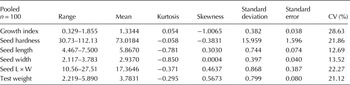
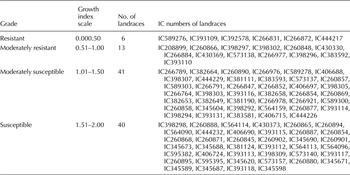
The developmental suitability of food material/genotype was determined on the basis of GI. Landraces with a low GI were considered as resistant and those with a high GI as susceptible. Laboratory screening of wheat landraces in terms of GI revealed significant variations (Supplementary Table S2, available online) in their reaction to S. oryzae with 28.63% coefficient of variation (CV). GI of different landraces ranged from 0.329 to 1.855 with an average of 1.334 (Table 1). On the basis of GI, landraces were grouped into four categories. Out of 100 landraces studied for their differential reaction to S. oryzae, six landraces viz., IC589276, IC393109, IC392578, IC266831, IC266872 and IC444217 were found resistant with GI ranging from 0.33 to 0.49, 13 as moderately resistant with GI ranging from 0.52 to 0.97, 41 as moderately susceptible with GI ranging from 1.01 to 1.50 and 41 landraces were found susceptible with GI ranging from 1.51 to 1.86 (Table 2).
Statistical summary of quantitative characteristics of wheat landraces

CV, coefficient of variation; Seed L × W, seed length × width.
Frequency distribution of wheat landraces on the basis of growth index (GI) of Sitophilus oryzae

IC numbers in different categories are arranged in ascending order of GI values.
Physical seed parameters of wheat landraces
The quantitative physical parameters viz., hardness, length, width, length × width, test weight and qualitative parameter seed colour revealed significant variability among different landraces (Supplementary Table S2, available online).
Quantitative
Seed hardness of different landraces ranged from 30.7 to 112.1 newton with an average of 72.6 newton. It was minimum in IC564096 (30.7) and maximum in IC589276 (112.1). Seed hardness revealed significant variations among different landraces with 21.86% CV (Table 1). Average hardness of resistant, moderately resistant, moderately susceptible and susceptible landraces categorized on the basis of GI was 88.9, 83.5, 73.1 and 67.94 newton, respectively (Supplementary Table S3, available online).
Seed length of different landraces ranged from 4.47 to 7.5 with an average of 5.88 mm. Seed length was minimum in IC266831 and maximum in IC398298. Seed width of different landraces ranged from 2.12 (IC430369) to 3.78 mm (IC345589) with an average of 2.94 mm. Mean seed length × width was 17.4 mm2 ranged from 10.56 to 27.51 mm2, being minimum in IC393110 and maximum in IC345589. Seed length, width and length × width revealed significant variations among different landraces with coefficient of variation of 12.89, 13.52 and 22.27%, respectively (Table 1). Average seed length × width of resistant, moderately resistant, moderately susceptible and susceptible landraces was 12.9, 13.3, 17.4 and 19.1 mm2, respectively (Supplementary Table S3, available online).
Test weight of 100 landraces under study revealed significant variations with 21.12% CV. Test weight ranged from 2.22 to 5.89 gm with an average of 3.80 gm. Test weight was lowest in IC266976 and highest in IC345589 (Table 1). Average test weight of resistant, moderately resistant, moderately susceptible and susceptible landraces was 3.21, 3.12, 3.55 and 4.26 gm, respectively (Supplementary Table S3, available online).
Qualitative
On the basis of seed colour, wheat landraces were categorized as green (40), red (44) and white (16) (Supplementary Table S2, available online).
Resistance of rice weevil vis-à-vis seed parameters
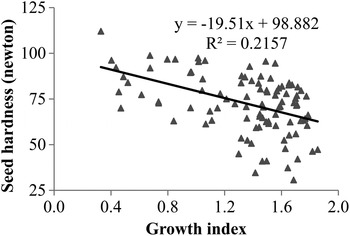
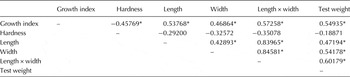
Seed hardness: Hardness had significant negative relation with GI of S. oryzae (r = −0.457) (Table 3). The regression line of seed hardness with GI (y = −19.51x + 98.882, R 2 = 0.2157) revealed left to right downward sloping trend from the origin indicating that GI increases with the decrease in seed hardness (Fig. 1).
Relationship between growth index of Sitophilus oryzae and seed hardness of wheat landraces.

Correlation matrix of growth index (GI) of Sitophilus oryzae and quantitative physical parameters of wheat landraces

* Significant at P = 0.01.
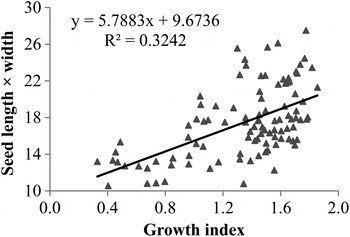
Seed length × width: The GI of S. oryzae was significant positively correlated with length (r = + 0.538), width (r = +0.469) and length × width (r = +0.573) (Table 3). This indicated that large sized seeds (length × width) are preferred by S. oryzae for feeding and development. The regression line of seed length × width with GI (y = 5.7883x + 9.6736, R 2 = 0.3242) revealed left to right upward sloping trend from the origin (Fig. 2).
Relationship between growth index of Sitophilus oryzae and seed length × width of wheat landraces.

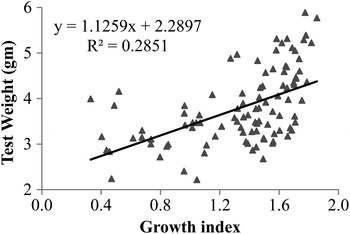
Test weight: The seed test weight had significant positive relation with GI (r = +0.549) (Table 3). The regression line of test weight with GI (y = 1.1259x + 2.2897, R 2 = 0.2851) revealed left to right upward sloping trend from the origin similar to length × width (Fig. 3).
Relationship between growth index of Sitophilus oryzae and test weight of wheat landraces.

Intra factor correlation among different quantitative seed parameters: Hardness has significant negative relation with length (r = −0.292), width (r = −0.326), length × width (r = −0.351) and test weight (r = −0.189). Length × width has positive correlation with test weight i. e. +0.602 (Table 3).
Seed colour: Both resistant and susceptible landraces were found in all the three colour categories viz., green, red and white, which revealed that there was no clear-cut relation between GI of the insect and seed colour.
Discussion
All wheat landraces under study infested by the rice weevil indicated that none of them immune (0% infestation) to S. oryzae. However, much variation among the landraces was observed in terms of degree of damage by S. oryzae. Arve et al. (Reference Arve, Chavan and Patel2014) screened seven wheat varieties and did not find any variety immune to rice weevil. Chouhan et al. (Reference Chouhan, Jakhmola, Bhadauria and Dwivedi2005) reported varied influence of wheat varieties on biological activities of rice weevil and found that variety DL 803–3 was least preferred by rice weevil. It is well-known that different host and varieties of host crop also differ in their response to infestation and influence on life history characters of stored product insects (Bamaiyi et al., Reference Bamaiyi, Dike and Amd2007; Ladang et al., Reference Ladang, Ngamo, Ngassoum, Mapongmestsem and Hance2008).
Negative correlation and left to right decreasing regression line of seed hardness with GI of S. oryzae indicated that soft seeds were preferred by S. oryzae possibly due to limited scraping ability of mouth parts of the larvae and adult. Sultana and Yadav (Reference Sultana and Yadav2014) also found negative correlation of hardness with different insect parameter used for finding resistance. Zakka et al. (Reference Zakka, Lale and Umeozor2013) proved that grain hardness served as a barrier to the penetration of the endosperm by Sitophilus zeamais and found that seeds of improved maize varieties which were harder comparatively, proved to be less susceptible to infestation. The resistance exhibited by the improved maize varieties has been attributed to mechanical barriers provided by thick testa and hard grains (Ashamo, Reference Ashamo2001; Lale and Yusuf, Reference Lale and Yusuf2001; Lale and Kartay, Reference Lale and Kartay2006). The physical characteristics of the seed coat affect oviposition and/or egg-hatch in beetles (Lale and Makoshi, Reference Lale and Makoshi2000; Lale and Kartay, Reference Lale and Kartay2006).
Significant positive relation of GI of S. oryzae with length × width and left to right increasing regression line indicated that large sized seeds were preferred by S. oryzae for feeding and development. It is also important to note that as reported by Rao and Sharma (Reference Rao and Sharma2003) wheat grain size was positively correlated and highly significant with mean progeny emergence of S. oryzae. Ram and Singh (Reference Ram and Singh1996) evaluated 63 wheat cultivars against S. oryzae and found susceptibility to be correlated positively with grain size and negatively with hardness.
Significant positive relation and left to right increasing regression line of test weight with GI showed similar trend like seed length × width. Akpodiete et al. (Reference Akpodiete, Lale, Umeozor and Zakka2015) evaluated 18 maize varieties and found the role of physical characteristics like colour, length, breadth and width of the grain on the stability of resistance of these varieties to maize weevil, S. zeamais. Although physical factors have been reported to be more important than chemical factors in conferring resistance on cereal cultivars (Lale and Mustapha, Reference Lale and Mustapha2000), the presence of secondary compounds such as soluble phenolics and tannins present in the cultivar play some role in imparting resistance (Adedire et al., Reference Adedire, Akinkurolere and Ajayi2011). This aspect however, was not considered in this study. Lale and Kartay (Reference Lale and Kartay2006) studied the role of testa thickness, seed size and kernel hardness of three maize cultivars in the resistance to S. zeamais and found significant differences in resistance of cultivars Coma, Ogbia muno and Bende with respect to seed size and kernel hardness.
Parameters as length × width and test weight indicate the size of the seeds. Results revealed that small sized landraces possess more resistance to S. oryzae. It can be concluded that larger grains provide more food and space for insect growth than the smaller grains. Grains with less mass offer more resistance to pest attack than the larger ones. However, this proved true to some extent in some cultivars but not for all under study. Chouhan et al. (Reference Chouhan, Jakhmola, Bhadauria and Dwivedi2005) also suggested that the volume of grain influenced the biological activity of the pest positively, while density influenced the activity negatively.
On the basis of GI, variations among the landraces with respect to their resistance/susceptibility to S. oryzae were observed. Results indicated that softer and larger seeds were suitable for growth and development of S. oryzae. The seed colour had no role in conferring resistance. Physical sources of resistance may be less promising than chemical sources, but physical properties of seeds can provide resistance via both the mechanisms; non-preference and antibiosis.
Supplementary material
To view supplementary material for this article, please visit http://dx.doi.org/10.1017/S1479262115000672
Acknowledgements
Authors are grateful to ICAR-Indian Agricultural Research Institute, Post Graduate School and ICAR-National Bureau of Plant Genetic Resources, New Delhi for providing the facilities and financial support to carry out the present study. They are thankful to the concerned scientists and technical staff involved in collection and maintenance of wheat landraces at NBPGR Regional Station, Bhowali, Uttarakhand. The senior author is also grateful to the Department of Science and Technology (GOI), New Delhi for the award of INSPIRE fellowship.