When Islamic extremists assassinated Egyptian President Anwar Sadat hoping to end the secular regime he led, another military officer and dominant-party official from Sadat’s inner circle, Hosni Mubarak, quickly replaced him. The regime continued, controlled by the same leadership group and following the same basic rules. But not all authoritarian leadership changes follow this pattern. When Zine Ben Ali, the dictator of Tunisia until January 2011, fled the country after weeks of protests, military and civilian elites who had previously supported his rule cooperated to move the country toward democracy. In contrast, the Shah of Iran’s ouster by similar protests in 1979 resulted in the seizure and consolidation of power by a radically different autocratic regime led by Muslim clerics. These examples illustrate the three possible outcomes when a dictator is ousted: regime survival under new leadership, democratization, and replacement by a new autocratic regime. Many studies have investigated democratization. Multi-country investigation of the other two outcomes, however, is more rare, Footnote 1 though case studies show that these outcomes have important consequences. Yet in the nearly 75 years since World War II, only about 45 percent of leadership changes in autocracies led to regime change, and more than half of regime breakdowns were transitions from one autocracy to another. In other words, fewer than one-quarter of leadership changes resulted in democratization.
We introduce new data that make possible the investigation of the other two outcomes and other previously difficult subjects. Among these is the question raised by the Arab Spring: under what circumstances is the ouster of a dictator likely to lead to renewed autocracy or chaos rather than democratization? As the Arab Spring unfolded, activists and journalists responded with exuberance to the prospect of democratization in countries long oppressed by autocratic rule. Observers with longer memories, however, worried about whether the ferment would lead to democracy, future instability, or reinvigorated dictatorship, as happened after the Shah of Iran’s ouster. Lucan Way raises exactly this question. Footnote 2 He suggests using the 1989–1991 post-communist transitions to make predictions about the Arab Spring. The new data, however, enable scholars to base expectations on the experience of nearly all post-World War II transitions, rather than a small and unusual group of cases. Although it is difficult to make precise predictions about what will happen in a single country, e.g., Libya next year, our data can help establish baseline odds of the likelihood of democratization in a country like Libya, conditional on observable structural factors as well as how the dictatorship ended and the amount of violence during the dictatorship’s collapse. The data can also be used by qualitative scholars to identify transitions with specific characteristics for further in-depth study.
The new data lay the groundwork for better theorization and analysis of autocratic transitions and, in doing so, can also help deepen our understanding of democratization. The theory of regime change underlying the data draws from the definition implicit in the qualitative literature on transitions. Footnote 3 Regimes are defined as basic informal and formal rules that determine what interests are represented in the authoritarian leadership group and whether these interests can constrain the dictator. These interests in turn influence the dictatorship’s policy choices, including its responses to opposition challenges, and thus how well it deals with challenges and how it eventually collapses.
The data identify transitions, whether to democracy or a new autocracy, when basic rules about the identity of the leadership group change. Regime breakdown and characteristics of the government that follows breakdown are coded independently of each other, making it possible to more precisely investigate why some autocratic regime breakdowns lead to democratization while others do not.
The Autocratic Regimes Data Set Footnote 4 uses hitherto uncollected information to identify all autocratic regime breakdowns between 1946 and 2010 in countries with populations greater than one million. The data are in the form of 4,587 country-year observations; they identify transitions from autocracy to new autocracy, as well as transitions to and from democracy. The data include the exact start and end dates of autocratic regimes, and whether democracy or autocracy precedes (for country-years after 1946) and succeeds them. They also provide information about how the outgoing regime collapsed (e.g., ousted by coup, popular uprising, election loss) and the amount of violence during the transition.
In what follows, we describe the new data and provide examples of how they can be used to answer interesting and policy-relevant questions. By comparing our measure with leadership changes and democratization (two proxies for autocratic breakdown often used in empirical research), we show that the data used to test theories can determine the answers one gets. Substituting leader change, as measured by Archigos, for regime change underestimates autocratic stability by about 50 percent. Using Polity democratization thresholds as a proxy for autocratic regime breakdown overestimates the survival of autocratic regimes by 100 percent. These differences can lead to substantial under- or over-estimates of the effects of causal factors thought to influence authoritarian breakdown.
In examples that demonstrate possible applications for the data, we address two important subjects, war and democratization. Several studies show that dictators who fear punishment after ouster are more likely to start wars. To these findings, we add preliminary evidence that dictators who are ousted along with their regimes and those whose regimes are replaced by a new autocracy face higher odds of punishment than those whose ouster either does not coincide with regime change or leads to democratization. These findings, if confirmed, will contribute to our understanding of why dictators start wars.
Our other examples center on regime change. As noted, fewer than half of post-World War II autocratic breakdowns resulted in democratization. Though democratization has become more likely since the end of the Cold War, our data suggest more pessimistic predictions for the contemporary Middle East. Preliminary evidence indicates that countries with regimes led by dictators with wide personal discretion over policy making (such as those in Libya under Qaddhafi and Yemen under Saleh) are less likely to democratize after regime breakdown, as are dictatorships forced from power and dictatorships ended by violence. These findings contribute to our theoretical understanding of democratization. They also suggest that even if foreign military intervention helps to end repressive dictatorships, it may not contribute to democratization.
Central Concepts
Our definition of regimes emphasizes the rules that identify the group from which leaders can come and determine who influences leadership choice and policy. These characteristics are central to distinguishing autocracies that make decisions in one way from those that make decisions in another. Informal rules must be included in the definition because many autocracies hide the de facto rules that shape and constrain political choices behind a façade of formal democratic institutions. Footnote 5 This definition reflects one of the most common normal language uses of the term regime, which, for example, treats the entire period of rule by the Somoza family in Nicaragua as one regime despite changes in leadership and formal electoral rules. Conventional usage identifies the subsequent Sandinista dictatorship as a different regime, though Sandinista rule followed Somoza without a democratic interlude. Existing data sets do not specifically identify transitions from one autocratic regime to another when there is no intervening democratic interlude.
This definition of regime follows from a theory linking these rules defining the leadership group to the representation of specific interests in autocratic decision-making. The interests, in turn, influence domestic policy choices and international behavior. We expect organized entities represented in the leadership group to exert more influence on policy than represented but unorganized or unrepresented groups. In many dictatorships, the best-organized groups represented in the leadership group are the military and the ruling party, but less organized societal groups can also be represented. Ethnic interests, for example, have been important in many dictatorships, both in reinforcing solidarity among regime supporters and in motivating regime ouster by those excluded from benefits because of their ethnicity. A dictatorship led by an all-military body dominated by one ethnic group represents different interests than one led by an all-military body dominated by a different ethnic group. For that reason, a coup that replaces the first with the second is coded as a regime change in our data, even though both are led by officers and they may have similar levels of “autocraticness” (as measured by Polity scores). The interests represented in the leadership group influence whether and how autocratic regimes fall, but also help to explain and predict the behavior of dictatorships while they remain in power. Coding autocratic regimes in this way helps explain and better predict the behavior of dictatorships.
The “leadership group” concept we use to classify autocratic regimes resembles what Susan Shirk and Philip Roeder call the Selectorate. Footnote 6 This group makes key policies, and regime leaders must retain the support of its members to remain in power, even though leaders may also have substantial ability to influence the group’s membership. Formal rules rarely determine membership in the leadership group.
We define the leadership group as the small group that actually makes the most important decisions. We do not believe that most members of dictatorial ruling parties influence leadership selection or policy. In contrast, Bruce Bueno de Mesquita et al. use the word Selectorate to identify the much larger number of citizens who formally influence the selection of leaders. Our leadership group is closer to what they call the Winning Coalition, the subset of the Selectorate from which leaders come, but limited to those who could really become leaders. Footnote 7 For Bueno de Mesquita et al., the concepts Selectorate and Winning Coalition are embedded in a unified theory of government that encompasses all forms, from democracy (large Selectorate, large Winning Coalition) to dominant party rule (large Selectorate, small Winning Coalition) to monarchy (small Selectorate, small Winning Coalition) along a continuum based on the ratio between the number of individuals in the Winning Coalition and the number of individuals in the Selectorate.
This theory is a creative extension of William Riker’s theory of minimum-winning coalitions in democracies, which posits that a ruling coalition of 50 percent (plus) of voters can tax those outside the coalition to distribute benefits to those inside. The smaller the number in the coalition in excess of those needed to remain in office, the more can be distributed to them. Though dictators do not require majority support, they do require some support and the same logic should hold. Accordingly, Bueno de Mesquita et al.’s theory posits that leaders with smaller Winning Coalitions can distribute more private goods to those inside at the expense of those left outside. Further, as the size of the Winning Coalition shrinks relative to the size of the Selectorate, the leader can distribute less to those in the Winning Coalition while retaining even more loyal supporters. This model defines regimes by the relative size of the Winning Coalition and Selectorate, without reference to any other characteristics. The model was not originally proposed to explain regime change, and in fact cannot, because for de Mesquita et al. regime type (defined by the relative size of these two groups) is fixed and cannot change. Footnote 8
We agree with Bueno de Mesquita et al. that the group whose support the dictator requires in order to retain office is central to understanding autocracies. However, our theory emphasizes the interests represented in the leadership group rather than the size of this group. We therefore use their substantive characteristics as the basis for classifying regimes. The differences between regimes also depend on the extent to which members of the leadership group can limit the discretion of the dictator. We expect the interests represented in the leadership group to have more influence when they have more ability to constrain the dictator. We incorporate these ideas into the classification of regime types because prior research suggests that the decision-making norms and power distribution within these groups influence how autocratic leaders exercise power. Footnote 9 For this reason, for instance, we distinguish military regimes from personalist dictatorships; the leadership group has more ability to constrain leader behavior in the former even though both types of dictatorship might have the same formal institutions and the same relative size of Winning Coalition and Selectorate.
The history of Iran illustrates our definition of regime. Since 1925, two successive autocratic regimes have governed Iran, with no democratic interludes. The first, a monarchy, lasted until 1979, and the second retains power today. Despite the continuity of autocratic governance, the two regimes bear little resemblance to each other and demand quite different policy responses. Reza Shah Pahlavi founded the first regime, and then his son, Mohammad Reza Shah Pahlavi, succeeded him. In this regime, the shah made basic decisions about domestic politics, foreign policy, and the oil industry in consultation with a small group of advisers he chose. Following the Iranian revolution in 1979, a new set of actors seized power, ending the monarchy and establishing a theocracy with a clerical Supreme Leader. They arrested most of those still in the country who had held powerful positions under the shah, and a new elite of clergy and Republican Guard leaders occupied decision-making positions. Since 1979, this new elite has dominated Iranian foreign and domestic policy. While this regime has been in force, two Supreme Leaders have ruled, Ruhollah Khomeini and Ali Khamenei, but the basic rules governing who can rise to top leadership positions and who determines how much influence other politicians can exercise have not changed.
This brief summary of modern Iran’s experience highlights differences between our definition of regime and those implied by other data sets. The first is that multiple autocratic leaders can rule during a single autocratic regime. In Iran’s monarchic dictatorship, Reza Shah Pahlavi was replaced by his son. Today’s theocratic dictatorship has also had two leaders. Autocratic regimes often last well beyond the tenure of any single ruler so the ouster of a dictator should not be equated with regime collapse.
The second point is that a single, continuous period of authoritarianism—or spell—can conceal multiple, consecutive autocratic regimes. Though Iran has been autocratic for its entire independent history, Footnote 10 two distinct regimes have governed it. Each of these regimes has featured rules that identified a unique set of elites and established methods for choosing policies and leaders. As a result, elites in each regime have made very different domestic and international policy choices.
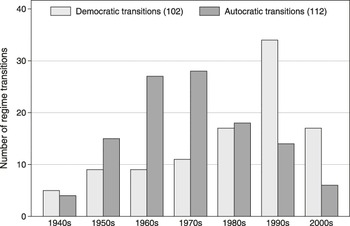
Iran’s history of consecutive autocratic regimes is not unusual. A new dictatorship follows autocratic breakdown more often than democratization does. Figure 1 compares the frequency of autocracy-to-autocracy transitions with democratizations in each decade since World War II. Autocratic breakdown leads to democracy more often now than in earlier decades, as shown in the right-hand columns of the figure, but transitions to subsequent autocracy remain common.
Autocratic transitions and democratic transitions

The frequency of autocracy-to-autocracy transitions has implications for how we study many questions in comparative politics and international relations. Theories, for example, link economic performance to autocratic survival, but analysts have sometimes used democratization (e.g., Polity scores) as a proxy for autocratic regime collapse, leading to underestimates of autocratic vulnerability to economic crisis. Footnote 11 Efforts to explain whether and how foreign policy tools, such as economic sanctions and military intervention, influence autocratic survival have also sometimes assessed only their effect on democratization. Footnote 12 Both academics and policy-makers, however, want to know whether foreign-induced autocratic collapse might lead to a new dictatorship or a failed state, as well as whether such policies contribute to democratization. Our new data make it possible to assess these alternatives.
As this discussion highlights, there are at least three ways of thinking about autocratic political survival—leader survival in office, regime duration, and continuous authoritarian spell—and two outcomes of interest when discussing transitions from autocratic rule—democracy and subsequent autocracy. The substantive differences among leader tenure, regime duration, and continuous years of autocracy (spells) determine how we should test particular theories. For example, theories about the political effects of economic performance lead us to expect that high growth would lengthen leaders’ tenure in office and prolong autocratic regime duration. High growth would not be expected to lengthen autocratic spells, however, because long autocratic spells often include multiple autocratic regimes and dictators, each of which might have been ousted for poor economic performance.
Nevertheless, one of these measures has sometimes been used as a proxy for another. In their highly respected Democracy and Development, for example, Adam Przeworski and his coauthors use spell data to assess whether economic crisis has more damaging effects on the survival of democracy or dictatorship. They conclude that economic crises do not destabilize dictatorships. Footnote 13 Because they use spell data, however, they actually show that economic crisis fails to increase the odds of democratization. Spell data are appropriate for most of the uses to which Przeworski et al. put them, but they are not appropriate for identifying the causes of authoritarian breakdown or for comparing the causes of democratic and autocratic breakdown. If we want to know whether economic problems contribute to the breakdown of dictatorships, we need to include all breakdowns in the analysis, not just those that result in democratization.
In what follows, we explain the key concepts measured in the new data and then show how regime duration differs from leader tenure and length of autocratic spells. We follow each comparison with substantive applications to show how the data can be used to extend theoretical ideas and answer new questions. The aim is to improve the way we think about autocratic regimes, leader tenure, and transitions, and in turn enhance our understanding of autocratic political survival.
Measuring Autocratic Regimes
The data set identifies 280 autocratic regimes during the period from 1946 to 2010 in independent countries with more than one million inhabitants in 2009. Each country-year is coded as:
-
Autocratic;
-
Democratic;
-
Not independent;
-
Occupied by foreign troops;
-
Ruled by a provisional government charged with overseeing a transition to democracy; or
-
Lacking a central government.
Thus, in contrast to José Antonio Cheibub, Jennifer Gandhi, and James Raymond Vreeland’s (CGV) data set, Footnote 14 autocratic is not a residual category, and periods of anarchy and provisional government can be excluded from analysis if the researcher wishes.
These data extend, update, and add new variables to the autocratic regime classification done by one of us, Barbara Geddes, in her 1999 article “What Do We Know about Democratization after Twenty Years?” Footnote 15 She proposed the original classification to test theoretical arguments about different kinds of dictatorship: dominant-party rule; rule by the military as an institution; and rule by dictators unconstrained by either a strong party or a unified military, which she labeled personalist. Because she sought to test arguments about how differences among these kinds of dictatorship affected the likelihood of breakdown, she classified only autocratic cases in these categories, excluding democracies, monarchies, other less common forms of autocracy, and periods of anarchy. She also excluded all periods of autocracy lasting less than three years and regimes in countries that achieved independence at the end of the Cold War. In subsequent years, Barbara Geddes and Joseph Wright put the regime classifications into country-year format, updated them, and added some of the country-years originally omitted. Footnote 16
The new data emphasize identifying the beginnings and ends of autocratic regimes rather than inferring them from yearly democracy codes. We recoded the start and end dates for each distinct regime using more rigorous criteria, described later. The data now include more information about the emergence and collapse of autocracies; we identify the exact political events used to code regime collapse and add several variables that describe how the autocratic regime fell. For each regime collapse, we code the amount of violence (based on the reported number of deaths during the transition event) and the mode of transition, that is, whether the outgoing autocratic regime lost power by losing an election, military coup, popular uprising, insurgency, foreign invasion, or elite-determined rule changes. The data note the pivotal political events that mark changes in the most basic rules for choosing leaders and policies. Exact dates allow scholars to assess the chronology of other key political events—e.g., leadership changes, military coups, terrorist attacks, or protests—that occur during the same calendar year as regime collapse.
To define regime start dates, we use the following rules. A span of years is coded as autocratic if any of the following occurred and the same basic rules and leadership group persist in subsequent years:
-
• An executive achieved power through undemocratic means. “Undemocratic” refers to any means besides direct, reasonably fair, competitive elections in which at least ten percent of the total population (i.e., 40 percent of adult males) was eligible to vote; or indirect election by a body, at least 60 percent of which was elected in direct, reasonably fair, competitive elections; or constitutional succession to a democratically elected executive. The start date is the date the executive achieved power.
-
• The government achieved power through democratic means (as just described), but subsequently changed the formal or informal rules, such that competition in subsequent elections was limited. The start date is the date of the rule change or action (e.g., the arrest of opposition politicians) that crossed the threshold from democracy to autocracy.
-
• Competitive elections were held to choose the government, but the military prevented one or more parties that substantial numbers of citizens would be expected to vote for from competing or dictated policy choice in important areas. The start date is the date when these rules take effect, usually the first election in which popular parties are banned.
Autocratic regimes end when any of the following occur:
-
• A competitive election for the executive, or for the body that chooses the executive, occurs and is won by a person other than the incumbent or someone allied with the incumbent; and the individual or party elected is allowed to take office. The end date is the election, but the end is only counted if the candidate or party elected is allowed to take power.
-
• The government is ousted by a coup, popular uprising, rebellion, civil war, invasion, or other coercive means, and replaced by a different regime (defined, as mentioned, as a government that follows different rules for choosing leaders and policies). The end date is the date of the ouster, death, resignation, flight, or arrest of the outgoing regime leader or the date when an insurgency takes the capital.
-
• The ruling group markedly changes the basic rules for choosing leaders and policies such that the identity of the group from which leaders can be chosen or the group that can select major policies changes. The end date is the date of the rule change.
Narratives describing events that begin and end regimes, along with the reasons for identifying some events rather than others as pivotal, are posted on the website along with the data set.
As these rules imply, our requirements for coding democratic country-years include minimal conditions for suffrage and party competition not included in CGV’s coding, and we do not use their alternation rule. Nevertheless, our set of democratic country-years is quite similar to theirs. Footnote 17
Most regime beginnings and ends are easy to identify and are uncontroversial. When a coup led by military officers ousts a monarch, it is clear that the rule identifying members of the leadership group has changed from members of a ruling family to high ranking officers. In this example, the coup that ousts the monarchy identifies both the end date of the first regime and the beginning of the second. Identifying some beginnings and ends, however, requires consideration of context. Coups that replace a current military leader with another, for example, may be either leader changes in an on-going regime or regime transitions. If the leader’s successor is from the same inner circle as the ousted leader, we code a leadership change. If both the leader and the leadership group change (e.g., to include representatives of different ethnic groups), we code the coup as a regime change because the rule defining the leadership group changes with the leader in the latter situation but not the first.
In addition to identifying the start and end dates of regimes, the new data classify leadership groups as dominant-party, military, personalist, monarchic, oligarchic, indirect military, or hybrids of the first three. Footnote 18 These classifications refer to whether control over policy, leadership selection, and the security apparatus is in the hands of a ruling party (dominant-party dictatorships), a royal family (monarchies), the military (rule by the military institution), or a narrower group centered around an individual dictator (personalist dictatorships). The new categories were needed in order to include all autocratic country-years in the data set. Oligarchy identifies regimes in which leaders are chosen through competitive elections but most of the population is disenfranchised, e.g., South Africa before 1994. Indirect military rule refers to regimes in which formal political leaders are chosen through competitive elections, but the military either prevents parties that would attract large numbers of voters from participating or controls key policy choices. Though most of these regime classifications have existed for some time, the new data set is the first to include all country-years and make the data publicly available. The regime-type classifications are included as a convenience for analysts who wish to use them. The data on regime transitions do not depend on the regime classifications and can be used alone.
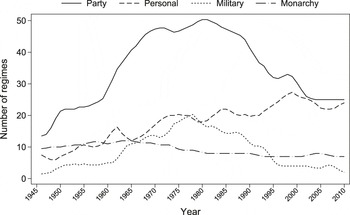
Figure 2 shows the distribution of authoritarian regime types over time. Dominant-party dictatorships were the most common type for most of the post-1946 period, but declined by about half at the end of the Cold War. Footnote 19 Military regimes peaked at the height of the Cold War and dropped from the 1980s on. These developments reflect the strategic support of dictatorships to advance US and Soviet geo-political agendas during the Cold War. The proportion of personalist dictatorships, by contrast, has increased steadily throughout the period, such that these regimes now rival dominant-party rule as the most common form of autocracy. The number of monarchies has remained stable for the past 50 years or so, reflecting the durability of monarchies that survived the first decades after World War II.
Autocratic regimes across time

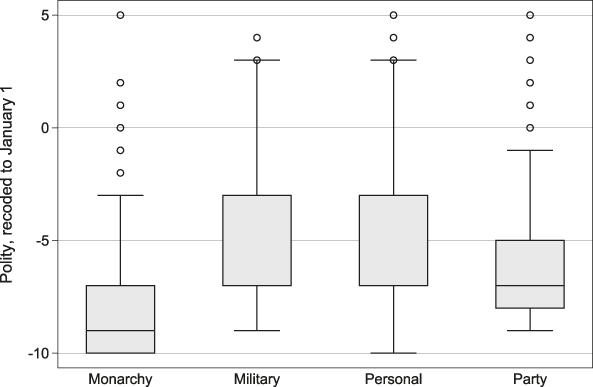
These regime classifications capture something different from degree of democracy or repressiveness. Figure 3 shows how they map onto one of the most commonly used measures of democraticness, combined Polity scores. The figure shows that some regimes we classify as autocratic receive fairly high Polity scores (the outliers in the graph). Footnote 20 Polity scores vary a lot both within each regime type and across them. Monarchies typically have the lowest scores, followed by dominant-party regimes. Military and personalist dictatorships receive comparable combined Polity scores, usually somewhat higher than those for other types.
Regime types and polity scores

Besides the identification of transitions from one autocratic regime to another, the main difference between our data and the CGV data is our definitions of—and hence rules for coding—regime types. In keeping with our theoretical emphasis on the interests represented in the leadership group, we distinguish “military rule,” by which we mean rule by an officer constrained by other officers—sometimes labeled rule by “the military as an institution”—from rule by a military strongman, which we label personalist. Footnote 21 We define personalist regimes as autocracies in which discretion over policy and personnel are concentrated in the hands of one man, military or civilian. In the real world, that discretion is often maintained by balancing the interests of multiple competing groups within the dictator’s support coalition; the military, or the faction of it that supports the dictator, is one among the groups balanced. Distinguishing more collegial military rule from rule by a military strongman requires coding and combining a number of items designed to assess the dictator’s power relative to other officers. Examples of these items include one that identifies who controls the security apparatus and one about whether the dictator has had other officers killed or jailed. Footnote 22 In the CGV data set, in contrast, non-democratic country-years are identified as military-led if the dictator wears or ever wore a uniform, thus grouping military strongmen with constrained military dictators in one category.
The specific coding rules used to produce the CGV data are motivated by a commitment to simple, objective, and unambiguous coding rules more than by theoretical differences with other analysts. Footnote 23 All else equal, easily replicated, simple coding rules are best, but we see a tradeoff between simplicity and capturing concepts of interest. Because we want to be able to explore theories about bargaining within the dictator’s inner circle, we use a more complicated coding scheme that better captures traits of the leadership group than coding a single trait of the dictator’s. Our coding of dominant-party rule also uses somewhat complicated coding to distinguish regimes in which a ruling party can at times constrain the dictator from unconstrained rule by civilian strongmen. As Andreas Schedler has noted, complex concepts are not always operationalizable using simple objective indicators. Footnote 24
Our coding rules are thus less minimalist and objective than those used to produce the CGV dataset, but less based on judgment than the qualitative coding used by Steven Levitsky and Lucan Way or by Stephan Haggard and Robert Kaufman. Footnote 25 Haggard and Kaufman, for example, code cases of democratization based on whether the “mobilization of redistributive grievances on the part of economically disadvantaged groups or representatives of such groups (parties, unions, NGOs) posed a threat to the incumbency of ruling elites.” Footnote 26 This requires a complex judgment of a complicated historical record. None of our coding required such complex judgments. Some of our coding does depend on judgments about the in-context meaning of certain events and what observable characteristics of the leadership group indicate features that are not directly observable. For example, when we code as a regime change a coup led by officers from one ethnic group that ousts a military government dominated by a different ethnic group (in countries where case studies describe ethnicity as central to political conflict), we use an observable, officers’ ethnicity, to indicate a change in the interests represented in the leadership group, which are not directly observable. In short, we sometimes make judgments about what characteristics and events mean, given the domestic political context. Individual coders are not asked to make these judgments, however, or to assess anything vague, such as whether the press is free. Instead, they provide factual information, for example: How did the regime fall (followed by several explicit choices)? or How many people died during the transition event? In this way, we have tried to maximize replicability and interpretability. Our judgments determine what factual information coders are asked to find and how we interpret the factual information. Footnote 27
Which Measure Is “Right”? Autocratic Leaders versus Autocratic Regimes
The theory one wants to investigate determines which measure of autocratic survival should be used, as well as how concepts should be operationalized. In the two sections that follow, we show the differences, first between autocratic leaders’ tenure and autocratic regime survival, and second, between autocratic regime survival and autocratic spell duration. We do so by comparing our data with other data often used to analyze transitions to emphasize that leader tenure, regime duration, and spells measure different concepts, each appropriate for use in some studies but not others.
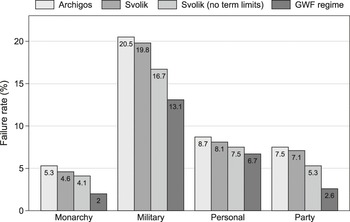
To show how much leader tenure and regime duration differ from each other, we use leadership data from Milan Svolik as well as Archigos; both include the entry and exit dates of political leaders. Footnote 28 Figure 4 displays this comparison, plotting leadership and regime failure rates per year by type of dictatorship. Footnote 29 Because some autocratic leaders are subject to term limits, we also include leader failure rates from Svolik excluding term-limited leaders (a useful feature of this data set). Footnote 30 The figure shows that leadership failure rates (excluding those due to natural death or foreign invasion) are higher than regime failure rates. The bars labeled Archigos, Svolik, and Svolik (no term limits) refer to the measures of leader tenure used. The right-hand bar in each cluster is the regime failure rate. The number inside each bar is the probability that the leader will be ousted or the regime will end in any particular year.
Dictator exit and regime failure rates

As would be expected, the rates of leader ouster and regime failure are similar for personalist dictatorships, where one-man rule predominates. Though cases of intra-regime leadership succession sometimes occur in personalist dictatorships—as in the Duvalier dictatorship in Haiti—they happen less often than in other kinds of autocracy. In monarchies, leader ouster rates are about double regime failure rates, though both are very low (about 5 percent and 2 percent per year, respectively). Footnote 31 Dominant-party dictatorships exhibit a similar trend, though leadership turnover is a bit higher than in monarchies, leading to even greater disparity between leader and regime failure rates. Leader ouster is most frequent in military dictatorships, ranging from about 16 percent to about 20 percent per year depending on the data used. Regime failure rates are lower (about 13 percent), though still high compared to other kinds of autocracy.
Though the size of the gap between leader and regime failure rates differs across type of dictatorship, regime failure rates are lower than leader ouster rates in all types. The average time to leader ouster is about seven years in the Archigos data, half the average for regime duration. Dictatorships persist after the fall of the dictator about half the time, indicating that leadership turnover can and often does occur during autocratic regimes, just as it does in democracies. This means that using leader survival to test arguments about regime survival underestimates autocratic durability by about 50 percent. More important, it underestimates it more for some types of autocracy and some time periods than for others.
Theoretical Application: Regime Type, Transition, and Leader Fate
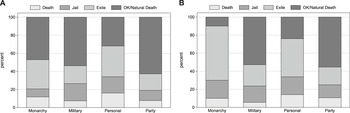
Recent theories use dictators’ expectations about their post-ouster fates to explain their decisions about things as varied as holding elections, repressing citizens, and starting wars. This research suggests that the risk of post-exit punishment causes dictators to behave differently than they would otherwise. Footnote 32 Here, we explore how the new data can be used to further develop an understanding of the fates of dictators after ouster as a way of improving explanations of their pre-ouster behavior. We use Archigos data on whether leaders are exiled, imprisoned, or killed immediately after leaving office. The left portion of figure 5 shows the proportion punished, by autocratic regime type.
Autocratic leaders’ post-exit fate by regime type

Note that our regime classifications correspond to big differences in how leaders fare after leaving power. In personalist dictatorships, most leaders (69 percent) face exile, imprisonment, or death after ouster; in dominant-party dictatorships, by contrast, significantly fewer (37 percent) do. Monarchs and military dictators lie in between. In short, leaders’ treatment after they fall from power depends on the type of dictatorship. This finding suggests an additional reason why personalist dictators start more wars. Footnote 33
The right portion of figure 5 shows the same information, but includes only those leaders who lost office at the same time their regimes collapsed. For all regime categories except military, the percentage of leaders who face punishment after losing office is higher when the regime falls than when it survives their ouster. Simultaneous regime breakdown causes a stark change of fortune for monarchs, who face a strong chance of exile, imprisonment, or death if the monarchy is abolished; this risk decreases by nearly half when the monarchy persists after the individual vacates the throne. The removal of living monarchs is of course rare so any conclusions have to be tentative, but when a ruling family replaces a monarch, they seldom arrest or kill him. For dictators in other types of autocracy, bad fates are also more likely when the regime ends too. This makes intuitive sense; if the regime persists, those most likely to determine the ex-leader’s fate are his erstwhile allies, but if the regime fails, his fate falls into the hands of enemies.
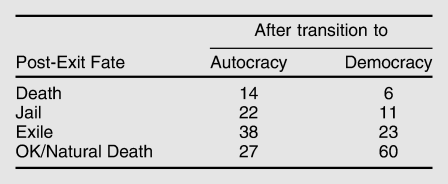
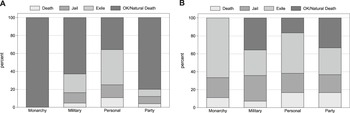
The new data also enable us to delve into how the post-exit fates of leaders vary depending on whether democracy or new autocracy succeeds the initial dictatorship. Table 1 shows the post-exit fates for dictators following transitions to new autocracies compared to their post-exit fates after democratization. The likelihood of a “good” fate—where leaders are not exiled, imprisoned, or killed—is more than twice as high when democratization occurs rather than the establishment of a new autocracy. Footnote 34 While democracy affords protections to former dictators after the fall of all types of autocracy, figure 6 shows that democratization after party-based autocratic rule increases the chance of a good fate from 36 percent to 80 percent. For military regimes this figure rises from 37 percent to 63 percent. Thus the odds of the leader surviving a transition in these contexts are substantially better if the dictatorship democratizes than if it falls to new dictatorship. While democracy also protects the former incumbent in personalist regimes—raising the chances of a good fate from 16 percent to 36 percent—democratic transitions still entail a substantial risk for ousted personalist leaders.
Democratic transitions protect dictators

Column percentages reported. Incumbent leader at the time of the regime collapse event.
Sources: Geddes, Wright, and Frantz (2014) and Goemans et al Reference Goemans, Gleditsch and Chiozza2009.
Autocratic leaders’ post-exit fate after transition

Personalist leaders may face bad fates even after democratization because their regimes lack institutions (like a professionalized military or well-developed party) that persist after regime change and could potentially provide protection or enforce guarantees of immunity made before ouster. The high probability of facing arrest or death after ouster helps explain why personalist dictators infrequently negotiate their transitions from power. This finding has obvious policy implications. A third party trying to help end a period of violent conflict in a dictatorship might be able to nudge a military or dominant-party regime toward democratization by cutting aid, but would probably need to offer safe exile as well to a personalist dictator in the same circumstances.
In sum, departing leaders are more likely to suffer costly fates during transitions to subsequent autocracy than during democratization, perhaps because the leader of the old regime poses a threat to the new one. Footnote 35 Should the ex-dictator survive the transition period, a new dictatorship is more likely than a democracy to address the threat he poses with force. The greater likelihood of punishment after ouster by a new dictatorship also suggests that autocrats facing challenges from insurgencies or popular protests (which increase the chance of transition to a new autocracy, as shown below) might be more likely to try to rally support by attacking a neighbor than would dictators whose main fear is losing elections. This example illustrates the nuanced investigation of aspects of authoritarian decision-making thought to be affected by dictators’ expectations about their future made possible by our data.
Autocratic Regimes and Autocratic Spells
An autocratic spell refers to the consecutive calendar years a country is ruled by some form of dictatorship. In other words, it is the length of time a country is undemocratic, regardless of any other characteristics of rule. Spells only end when democracy interrupts them.
Researchers are not usually interested in autocratic spells per se. Rather, they use data that code country-years as democratic or not, and thus end up equating autocratic regimes with autocratic spells in empirical analyses. This is unproblematic if the research aims to investigate causes of democratization, but it leads to bias if the purposes of the research include explaining autocratic breakdown or what happens after it. To answer questions about what is likely to happen after the Arab Spring, for example, and what might increase the likelihood of democratization, we need data that identify autocratic breakdown independent of whether democratization follows. Such data would also be needed to further test Levitsky and Way’s (Reference Levitsky and Way2010) argument that international linkages had stronger effects on the likelihood of democratization after 1990. The outcomes of interest for Levitsky and Way are persistence of competitive authoritarian regimes, democratization, and intensified dictatorship. Using spell data, the analyst cannot distinguish persistence of the initial competitive authoritarian regime from the imposition of a new or more severe one. Footnote 36
Because spell data are often used as proxies for regime survival, we discuss the intricacies of the two data sets that measure them, Polity and CGV, in order to show the size of the bias that results. Polity scores measure the “qualities of democratic and autocratic authority in governing institutions.” Footnote 37 They depend on characteristics such as the competitiveness of elections and executive constraints. Autocracy is typically distinguished from democracy using combined autocratic and democratic Polity scores, generating a 21-point scale that ranges from -10 to 10. The length of the spell usually corresponds to the length of time during which a country’s combined Polity score consecutively falls below 6 or 7. Footnote 38
Some studies instead use the Polity Durable variable, Footnote 39 which identifies the years in which combined Polity scores increase or decrease by three points or more. Using Polity Durable, the length of a spell corresponds to the length of time until a country’s combined score moves three points from one year to the next. Spells computed using the Polity Durable variable are much shorter than those using the combined Polity score threshold because 3-point jumps are frequent.
Polity scores measure regime characteristics that reflect aspects of democraticness, but do not identify the group that selects leaders and implements policy changes, and thus do not identify many of what would be called regime changes by most analysts. For example, most observers view the ouster of civilian president Milton Obote of Uganda by General Idi Amin as a regime change. Both regimes were autocratic, but the groups who held power and controlled policy dramatically altered in terms of ethnic composition and party versus military institutional organization. Because executive power was relatively unconstrained under both leaders, however, the combined Polity scores associated with their tenures are similar. Using combined Polity scores as a proxy for regime would miss the 1971 Ugandan regime change, while lumping the Obote and Amin dictatorships into one single, continuous regime.
The problem is not that a few country-years are miscoded, but that using movements up and down the Polity spectrum to identify regime changes misses most autocracy-to-autocracy transitions because regime ends are only identified if the country democratizes. Use of the Polity Durable variable leads to the opposite problem. With this measure, Iran’s 1979 revolution would be identified as an episode of democratization, because the country’s combined Polity score increased by several points. Yet few of us view the post-1979 Iranian government as democratic.
The second data set used to capture autocratic spells, CGV, codes whether countries are democratic or not, and if not, classifies the dictatorship, according to whether the leader is civilian, military (measured as having ever worn a uniform), or monarchic. Footnote 40 These leader codes can be used to infer autocracy-to-autocracy transitions based on this one trait.
The CGV data code as military all autocracies led by men who have ever been officers. In contrast, the coding of military regimes in our data builds on theories of institutionalized military rule advanced by Guillermo O’Donnell and Alfred Stepan. Footnote 41 Institutionalized military rule involves consultation within the officer corps and implies constraint by other officers on the dictator. In our data set, regimes are only coded as military when dictators govern in collaboration with other officers. The Ugandan dictatorship led by Amin, for example, is coded as military by CGV but personalist in our data because Amin marginalized most of the military from decision making. The difference in these coding rules is quite large and substantively important. CGV code more than twice the country-years that we do as military. Footnote 42 Which data should be used depends on whether the analyst expects or suspects that military strongmen behave differently than regimes led by more collegial juntas in the context under investigation.
Although the CGV data set classifies country-years by leader type, it does not provide regime start and end dates. Regime changes must be inferred from changes among civilian, military, and hereditary rulers. Such inferences identify some regime changes though not all of them, and also mistakenly classify some leader changes within stable regimes as regime breakdowns. Periods of rule by successive men wearing uniforms imply a single, long regime in the CGV data, as do successive civilian dictators, regardless of whether basic rules changed.
As an example, men who wore or had worn uniforms governed Bolivia from 1964 to 1979, but standard understandings would not consider this period a single regime because the informal rules defining the leadership group changed first in 1969 and again in 1971. In late 1964 General René Barrientos, supported by a populist faction of the military, seized power in a coup; he quickly created a support party, allied with civilian social groups, appointed civilians to key government posts, and was elected president in 1966. This regime was led by a military man but the leadership group included only the populist faction of the military along with representatives of civilian interest groups. When Barrientos died in 1969, General Alfredo Ovando, commander-in-chief of the army, seized power from Barrientos’ civilian constitutional successor to impose government by a junta of top military officers, ushering in a short period of collegial military rule without explicit links to civilian groups. Collegial military rule ended in 1971 when Colonel Hugo Banzer, an exiled, ex-officer supported by a right-wing faction of the military and two of Bolivia’s main political parties, seized power and established a regime under his personal control. In our data set, the populist military-civilian alliance established under General Barrientos from 1964 to 1969 is coded as one regime, the period of collegial military rule led by Bolivia’s commanding officers from 1969 to 1971 is coded as a second regime, and the government of ex-Colonel Banzer is coded as a third. Using the leader’s background as the only basis for identifying regime beginnings and ends misses these kinds of regime changes, which are common in poor countries.
There are also regimes in which the top leader is at one time an officer and at other times civilian. In Mexico, for example, General Manuel Ávila Camacho was followed as president by his hand-picked successor and fellow dominant-party stalwart, the civilian lawyer Miguel Alemán. Using the CGV leader coding as a proxy for regime change would inappropriately code the dominant-party regime in Mexico as two regimes, one military and the other civilian. There are a number of other instances of party-based regimes led by current or former officers for part of the time, including the post-1981 period in Communist Poland led by General Wojciech Jaruzelski. Consequently, using CGV data to identify autocratic regime beginning and end points results in both type I and type II errors.
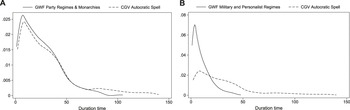
We explore how much regimes and spells differ from each other by comparing our data to the Polity and CGV measures most often used in research. We calculate Polity autocratic spells by looking at the time until an autocratic country (those with combined Polity scores of 6 or lower) reaches a score of 7. The median duration of a Polity autocratic spell is 28 years, double the median duration of autocratic regimes in our data (14 years). Footnote 43 The median duration of autocratic spells using the CGV democracy or dictatorship classification is 23 years.
When we disaggregate by regime type, we see a more nuanced picture. The left portion of figure 7 compares the CGV spell data with our data for dominant-party and monarchic regimes, while the right portion compares it with our duration measures for military and personalist regimes. Spell durations are similar to the durations of dominant-party regimes and monarchies, though the right tail of the autocratic spell distribution is substantially longer. Thus using autocratic spell as a proxy for regime duration will not change estimates much in applied research on monarchies and dominant-party dictatorships. For military and personalist regimes, however, the median regime lasts only eight years, compared to 23 years for CGV spells. In these kinds of dictatorship, a typical autocratic spell contains multiple autocratic regimes.
Duration of autocratic regimes and non-democratic spells

In short, the duration of autocratic spells is usually longer than that of autocratic regimes. This can be important, not only because we care how long autocracies last, but also because we want to understand why they collapse, why their collapses are sometimes violent and at other times negotiated, and why they sometimes result in democratization and at other times in renewed autocracy. To investigate these things, we need to correctly identify when regimes end. When Polity or CGV democracy/dictatorship data are used to identify regime changes, a substantial number of regime ends are omitted from analysis. The omitted authoritarian breakdowns are not randomly distributed across autocracies, levels of development, and other characteristics, but rather disproportionately involve military and personalist dictatorships in poorer countries.
Theoretical and Policy Applications: What Promotes Democratization?
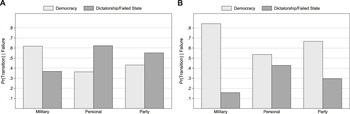
We begin this section by showing that the baseline probability of democratization, given regime collapse, varies across autocratic regime types. The left panel of figure 8 shows that only in military dictatorships is democratization more likely than transition to subsequent autocracy. Personalist dictatorships are least likely to democratize. Though dominant-party regimes democratize more frequently than personalist dictatorships, during the full post-war period a dominant-party’s loss of power was more likely to result in subsequent autocracy than in democracy. Footnote 44
Autocratic regime type and democratization

The right panel of figure 8 shows the same baseline probabilities of democratization, after autocratic collapse, using only post-Cold War data (1990 to 2010). While the prospects for democratization have become much higher during the past two decades, the pattern across autocratic regime types remains unchanged: military dictatorships are most likely to democratize and personalist ones least likely. Descriptive data of the kind shown here cannot, of course, tell us why these patterns exist. We do not know if democratization is least likely after personalist dictatorships because of structural factors that gave rise to personalist rule in the first place; or if personalist rule undermines civil society or domestic institutions, which in turn reduces the prospects for democratization; or if personalist regimes are simply less likely to end in a manner conducive to democratization because their leaders resist negotiating. The reasons for these patterns can only be investigated, however, after we know that they exist. The new data make that knowledge possible.
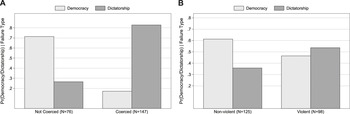
The new data also shed light on the likely consequences of some specific kinds of policy interventions. They suggest that if democratization is the goal, aid to peaceful opposition groups may be more likely to help than aid to armed opponents or military intervention. Our data include two variables that may be useful to policy makers trying to predict the consequences of different actions. Both code the characteristics of regime collapse, making it possible to assess the likely consequences of interventions that would affect not only whether the regime falls but how it falls. Our measure of violence during the regime collapse event takes one of four values: 0 for no deaths, 1 for 1–25 deaths, 2 for 25–1,000 deaths, and 3 for more than 1,000 deaths. With this information, we can examine the baseline probability of democratic transition, given regime collapse, for violent and non-violent regime failures (shown in the left panel of figure 9). Footnote 45 Non-violent regime collapses predominate, and they are more likely to result in democratization.
Mode of autocratic collapse and subsequent regime

The data also include a variable for the means of autocratic collapse. In the right panel of figure 9, we collapse these categories into two: coerced transitions, which include foreign invasions, coups, uprisings, and ouster by insurgents; and non-coerced, which include elections and rule changes made by insiders. The pattern for coerced regime failures is even stronger than for violent collapse: fewer than one in five coerced regime breakdowns result in democracy, while nearly three-quarters of non-coerced collapses do.
While this evidence concurs with recent analysis of the relative success of non-violent campaigns to achieve political goals, Footnote 46 it does not conclusively show that non-violent, uncoerced transitions are more likely to lead to democracy because we do not control for other factors—such as structural characteristics of society or incumbent regime characteristics—that may explain both the chances of democratization and the level of violence during regime collapse.
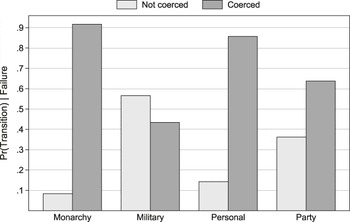
How transitions occur varies considerably across different autocratic contexts. As figure 10 shows, coercion contributes to most ousters of dominant-party regimes, personalist dictatorships and monarchies. Some form of coercion causes more than 80 percent of personalist regime ousters and more than 60 percent of dominant-party regime breakdowns. Military dictatorships exhibit a different pattern, with non-coerced transitions more frequent than coerced ones.
Coerced regime collapse by incumbent autocratic regime type

This evidence reinforces what we know from past research about transitions. Military dictatorships are more likely to negotiate their transitions, rather than cling to power at all costs, making it less likely that their exits will be violent and more likely that they will democratize. Footnote 47 As noted above, personalist dictators and monarchs are more likely to face exile, arrest, or death after their regimes end, so they have good reasons to resist negotiation if they think they can retain power. We also know that individuals and parties linked to personalist dictatorships have limited prospects for successful future political careers after regime failure. Footnote 48 Refusal to negotiate or reneging on past negotiated agreements, however, increases the likelihood that the opposition will resort to force, as happened recently in Libya and Yemen. Such coercion—especially when coupled with the institutional vacuum typical of personalist dictatorships—reduces prospects for democratization.
More than one-third of opposition movements use force to dislodge autocratic incumbents. This fraction is higher for personalist dictatorships, where violent transitions are the norm. Nearly all transitions from personalist dictatorships to another autocracy are forced, but so are about two-thirds of transitions from personalist rule to democracy. We see developing a better understanding of when coercion will contribute to democratization as a fruitful topic for future research.
Implications for the Arab Spring
During the last “spring” when communist regimes in Eastern Europe and Central Asia fell, not all autocratic breakdowns led to democratization. New autocracies were consolidated in Belarus, Uzbekistan, Azerbaijan, and several other post-communist countries. No one knows how the Arab Spring will turn out, but our new data enable some tentative predictions. We can also use them to compare outcomes in the Middle Eastern and North African (MENA) dictatorships with those in communist countries. Of the 16 communist countries in 1988, five states (Czechoslovakia, East Germany, South Yemen, the Soviet Union, and Yugoslavia) ceased to exist within the next few years, and one—Afganistan—descended into warlordism. Five of the remaining ten democratized and in the rest, the old communist-led regime survived the crisis and continues in power today. Twelve of the new states created by the collapse of communism immediately democratized, though two of those democracies lasted only a short time. Nine became autocracies, though three of those eventually democratized. One remained controlled by international actors through 2010. Many of these countries suffered civil wars. If we combine the new states with the surviving old ones, their rate of democratization after old regime collapse is 61 percent, a little below that for the entire group of post-1990 dominant-party transitions.
As Way notes, although the Arab Spring was set off by waves of unprecedented popular opposition reminiscent of the collapse of communism in Romania and East Germany, outcomes in MENA countries are unlikely to be similar. Footnote 49 So far, two-thirds of the original autocracies in MENA countries have survived, in contrast to fewer than one-third of the communist regimes in power in 1988. The fate of the dictatorship in Syria is undecided. Of the four regimes that have ended, only one—Tunisia—has democratized. Outcomes remain uncertain in Egypt, Libya, and Yemen.
The Arab Spring raises two questions for forecasters and policy makers: What will happen where the old regime has already fallen? Is democratization likely if additional regimes are ousted? Our preliminary analysis shows that democratization is more likely to follow dominant-party than personalist regimes (refer to figure 8). Of the regimes that have already fallen, Tunisia was coded as dominant-party and Egypt as a dominant-party hybrid. Footnote 50 The dictatorships in Yemen and Libya were coded as personalist. The only remaining dominant-party hybrid in the MENA countries is Syria, which is deteriorating as we write. The only personalist regime still in power is in Iraq, artificially maintained by foreign support. The results shown in the right panel of figure 8 lead us to expect that, on average, two out of three current dominant-party regime breakdowns will lead to democracy, as will about half of personalist breakdowns. These estimates, however, do not take into account the consequences of violence and coercion during the transition, which reduce prospects for democracy.
Nearly all other MENA countries are ruled by monarchs, who are unlikely to fall and, if they do, unlikely to democratize. Footnote 51 In the post-1945 period, democracy replaced monarchy in only one of eight countries in which autocratic monarchy ended: Nepal in 1991, where the king agreed to a transition to constitutional monarchy, and again in 2006, after a brief return to unconstitutional monarchy. The total number of monarchies was small to begin with, so predictions based on their experience have to be tentative, but so far, the ouster of monarchs has rarely led to democracy and has arguably left most people worse off in the countries once ruled by monarchs. The overthrow of the monarchy led to long, bloody civil war in three countries—Yemen, Ethiopia, and Afghanistan; the Libyan monarch was replaced by Qaddhafi, the Iranian by Khomeini, the Egyptian by the Mubarak regime that ended recently, and the Iraqi by an unstable series of coup leaders that eventually resulted in Saddam Hussein. In Nepal, where the constitutionalization of the monarchy was negotiated rather than coerced, the aftermath was less dire, though far from what participants had hoped: the continuation for many years of a long, violent Maoist insurgency; renewal of repressive unconstitutional monarchy; redemocratization; and currently a chaotic, flawed democracy apparently unable to govern. Footnote 52 This record should give pause to anyone advocating intervention in monarchies to aid opposition forces.
In short, with no information beyond knowing the kind of autocracy prevalent in MENA, we would predict relatively high rates of old regime survival and low rates of democratization compared to other parts of the world. Kurt Weyland suggests that the rapid spread of largely spontaneous popular protest during the Arab Spring contributed to the failure of most opposition movements to achieve their goals. He draws a parallel with the unsuccessful popular uprisings in Europe in 1848, and contrasts such popular outbursts with the organized on-the-ground networks of successful opposition parties (like the one that defeated the dominant party in Mexico in the 2000 election). Footnote 53 Our data support his argument; popular uprisings are less likely to result in democratization than are opposition election victories. Popular uprising may be one of the few opposition strategies available, however, where autocratic regimes have prevented the development of mass opposition party networks. As figure 10 shows, popular uprising or some other form of coercion has ended most monarchies, personalist dictatorships, and dominant-party regimes. Those are the kinds of dictatorship that dominate the Middle East, and so far all transitions have involved coercion.
Our findings about the consequences of violence during transitions further dim expectations for the Arab Spring. Violence during transitions reduces prospects for democratization, suggesting that democracy was more likely after the recent autocratic collapse in Tunisia, where the level of violence was moderate, than after those in Egypt, Libya, Yemen, and Syria, all of which would be coded in our highest violence category. Violence has played a much larger role in the ouster of autocratic regimes in MENA countries than in the fall of communism.
Conclusions drawn from the results shown here have to be tentative. The new data, however, make it possible for others to go beyond what we have done to predict which autocratic breakdowns are likely to result in democracy and which are not. Such studies will improve our theoretical understanding while aiding policy makers in decisions about how to respond to instability and potential regime collapse in countries with autocratic government.
Conclusion
We have introduced a new data set that makes possible the quantitative analysis of theoretical questions about autocratic regime survival in the face of economic crisis, popular protest, and other challenges, as well as policy-relevant questions about how to influence what happens after autocratic breakdown. The data set adds to what is available in several ways. Most importantly, it identifies beginning and end dates for autocratic regimes, defined as the set of basic formal and informal rules that determine who influences the choice of leaders—including rules that identify the group from which leaders can be selected—and policies. In addition, it provides new data on how autocracies collapse and how much violence accompanies the transition. The data also allow analysts to distinguish periods of autocratic government from periods of provisional government and warlordism, which is not possible in other commonly-used measures of democracy/non-democracy. They identify all country-years from 1946 to 2010 as democratic, autocratic, provisional, foreign-occupied, or lacking a central government. Finally, it includes updated and augmented regime-type classifications in a user-friendly format. As we show in a number of the examples, these classifications are associated with different political outcomes, such as the likelihood of violent collapse and post-breakdown democratization.
By comparing our data with existing data sets, we show that autocratic regimes last about twice as long, on average, as individual dictators, which means that using leadership tenure data as a proxy for regime duration may lead to underestimates of autocratic resilience in the face of challenges. Using continuous spells of autocratic rule as a proxy for regime duration may lead to bias in the other direction because spells average nearly twice as long as regimes.
As is always true, which data are “better” depends on the theory being explored. We need to think about what the theory implies about observable human behavior and then use data appropriate for testing those implications. Some theories imply that individual leaders will survive longer in office. Bruce Bueno de Mesquita and Alastair Smith, for example, argue that revolutionary threats increase the likelihood of autocratic leader ouster. Footnote 54 Such a theory should be tested using data that identify the start and end dates that mark the tenure of individual leaders (e.g., Archigos). Other theories, however, have implications for systems of government, that is regimes, not individual leaders. For example, Jay Ulfelder suggests that some types of autocracy are more vulnerable to breakdown in the face of contentious collective action than others. Footnote 55 Theories about regime transition should be tested using data that identify the start and end dates for regimes. In the past, analysts interested in autocratic regime collapse have sometimes used leader tenure or continuous years of autocracy as proxies for regime duration. The new data provide an alternative to those proxies.
We also include a number of examples of how the new data can help answer questions of interest to scholars and policy makers. We highlight the importance of including both democratic and autocratic outcomes in studies aimed at understanding regime change, as well as in analyses of events like the Arab Spring and assessments of appropriate foreign policy choices in such situations.
The first examples extend research in international relations showing that fear of punishment after ouster can lead dictators to embark on international conflict to shore up domestic support. We show preliminary evidence that punishment is more likely after regime collapse in some types of dictatorship than others and when regimes fall along with the dictator. This suggests that these circumstances also increase the likelihood of foreign adventures. These findings imply that an outside government that wants to foster regime change should focus on providing the dictator with a safe exit from power since a dictator who fears arrest or execution after ouster is less likely to negotiate a peaceful transition and more likely to attack his neighbors.
Our preliminary investigation of the conditions that increase the likelihood of democratization after autocratic breakdown has implications for what to expect following the Arab Spring. We show that personalist dictatorships are less likely to democratize than dominant-party regimes, which suggests baseline expectations about the countries in which dictators have already fallen: a 67 percent probability of democracy after the dominant-party regimes (Tunisia and Egypt) and 50 percent after the personalist (Libya and Yemen), all else equal. Most of the autocracies remaining in the MENA countries now, however, are monarchies, which are unlikely to be ousted and very unlikely to be followed by democracy if they do end. The way old regimes were ousted in the MENA countries can also be expected to lower the likelihood of democratization. Autocratic regimes that end in violence are less likely to democratize, as are those that are forced out as opposed to negotiating transitions.
Despite optimism regarding the demise of autocracy as a form of government after the Cold War, about one-third of the world’s countries and many of its people are still ruled by autocratic governments. Footnote 56 To better understand what might undermine contemporary autocracies and whether their collapse is likely to lead to democracy, the reimposition of autocratic rule, or future instability and violence, we need better data that more carefully measure autocratic regime and transition characteristics. Our new data set provides it.