Introduction
The use of forages for beef animals in tropical regions is crucial for meat production systems. In Brazil, for example, approximately 80% of the animals are finished in 100% grass-fed systems (Cooke et al., Reference Cooke, Daigle, Moriel, Smith, Tedeschi and Vendramini2020; Costa et al., Reference Costa, Difante, Costa, Gurgel, Ferreira and Santos2021). However, these regions experience two well-defined seasons: the rainy season, from October to March (spring and summer), during which 70–90% of the forage mass is produced; and the dry season, from April to September (fall and winter). This seasonal variation leads to fluctuations in forage mass production and decrease in its nutritional value. During the dry season, forages are of lower quality compared to the rainy season, negatively impacting animal performance, the environmental ecosystem and system profitability (Detmann et al., Reference Detmann, Valente, Batista and Huhtanen2014; Casagranda et al., Reference Casagranda, Wiśniewska-Paluszak, Paluszak, Mores, Moro, Malafaia, Azevedo and Zhang2023; Hubbart et al., Reference Hubbart, Blake, Holásková, Mata Padrino, Walker and Wilson2023). Therefore, improving forage fibre digestibility, especially during the dry season, is an important strategy to maximise animal performance and enhance economic and environmental sustainability.
Supplementing concentrated feed to address nutritional deficiencies in animals resulting from shifts in plant chemical composition has been widely adopted in grass-fed meat production systems, potentially improving nutrient utilisation by grazing cattle (Detmann et al., Reference Detmann, Valente, Batista and Huhtanen2014; Batista et al., Reference Batista, Detmann, Titgemeyer, Filho, Valadares, Prates, Rennó and Paulino2016, Reference Batista, Detmann, Gomes, Rufino, Paulino, Valadares Filho, Franco, Sampaio and Reis2017; Scholz Berça et al., Reference Scholz Berça, Prates Romanzini, Da Silva Cardoso, Eduardo Ferreira, Pastori D’aurea, Bertelli Fernandes and Andrade Reis2022). Additionally, the inclusion of direct-fed microbials (DFM) has been extensively investigated in ruminant nutrition. These additives have the potential to enhance the availability of forage nutrients to animals by directly modulating ruminal fermentation (McAllister et al., Reference McAllister, Beauchemin, Alazzeh, Baah, Teather and Stanford2011; Carvalho et al., Reference Carvalho, Paulino, Detmann, Chizzotti, Martins, Silva, Lopes and Moura2017; Mombach et al., Reference Mombach, da Silva Cabral, Lima, Ferreira, Pedreira and Pereira2021; Lopez et al., Reference Lopez, Sarturi, Johnson, Woerner, Henry, Ciriaco, Silva and Rush2024).
Studies have indicated that DFMs might enhance dry matter (DM) and fibre digestibility (Cappellozza et al., Reference Cappellozza, Joergensen, Copani, Bryan, Fantinati, Bodin, Khahi, Ninodeguzman, Arriola, Lima, Farooq and Vyas2023) and stimulate the growth of fibre-degrading microorganisms (Adesogan et al., Reference Adesogan, Arriola, Jiang, Oyebade, Paula, Pech-Cervantes, Romero, Ferraretto and Vyas2019; Firkins and Mitchell Reference Firkins and Mitchell2023). These growth factors (e.g., B vitamins amino acids and organic acids) are beneficial for rumen microbial communities (Parra et al., Reference Parra, Costa, Palma, Camargo, Lima, Harper, Meale and Silva2021; Baker et al., Reference Baker, Kraft, Karnezos and Greenwood2022), which can enhance the performance of pasture-raised animals. Moreover, incorporating Bacillus subtilis into ruminant diets can stimulate rumen fermentation, promote the growth of beneficial microorganisms and decrease methane (CH4) emissions (Sun et al., Reference Sun, Wang and Deng2013; Jia et al., Reference Jia, Dong, Tu and Diao2023; Sarmikasoglou et al., Reference Sarmikasoglou, Sumadong, Dagaew, Johnson, Vinyard, Salas-Solis, Siregar and Faciola2024). Additionally, the combination of B. subtilis and B. licheniformis has the potential to produce fibrolytic enzymes, improve fibre digestibility (Cappellozza et al., Reference Cappellozza, Joergensen, Copani, Bryan, Fantinati, Bodin, Khahi, Ninodeguzman, Arriola, Lima, Farooq and Vyas2023; Oyebade et al., Reference Oyebade, Taiwo, Idowu, Taylor, Queiroz, Adesogan, Vyas and Ogunade2023) and enhance starch degradation (Sun et al., Reference Sun, Wang and Deng2013; Shi et al., Reference Shi, Zhang, Lu and Wang2017; Cappellozza et al., Reference Cappellozza, Joergensen, Copani, Bryan, Fantinati, Bodin, Khahi, Ninodeguzman, Arriola, Lima, Farooq and Vyas2023).
Recently, the inclusion of DFM in concentrated supplements to improve the utilisation of forages substrates, such as B. subtilis, the combination of B. subtilis and B. licheniformis, Enterococcus faecium and Saccharomyces cerevisiae, has been evaluated as a strategy to enhance forage fermentability in the rumen (Pan et al., Reference Pan, Harper, Queiroz, Copani and Cappellozza2022; Cappellozza et al., Reference Cappellozza, Joergensen, Copani, Bryan, Fantinati, Bodin, Khahi, Ninodeguzman, Arriola, Lima, Farooq and Vyas2023; Silva et al., Reference Silva, Amâncio, Magnani, Meurer, Reolon, Timm, Cappellozza, Branco and Paula2024). Most fibrolytic bacteria depend on anaerobic conditions for the development of cellulosomes and the release of their cellulases (Bayer et al., Reference Bayer, Chanzy, Lamed and Shoham1998). Yeast products may contribute to enhanced fibre degradation by scavenging oxygen from the newly ingested feed, thereby facilitating the colonisation of fibrolytic bacteria (Jouany, Reference Jouany2006; Firkins and Mitchell, Reference Firkins and Mitchell2023). Furthermore, the incorporation of hydrolysed yeast as a prebiotic may effectively stimulate the growth of cellulolytic bacteria, fibre degradation and increase the concentration of short-chain fatty acids (SCFA) in the rumen, such as acetate (Baker et al., Reference Baker, Kraft, Karnezos and Greenwood2022). However, despite the well-known beneficial effects of inactive Torula yeast in modulating digestion in non-ruminants (Leeper et al., Reference Leeper, Ekmay, Knobloch, Skírnisdóttir, Varunjikar, Dubois, Smárason, Árnason, Koppe and Benhaïm2022; Verstrepen et al., Reference Verstrepen, Calatayud-Arroyo, Duysburgh, De Medts, EkMay and Marzorati2023; Timlin et al., Reference Timlin, Dickerson, Fowler, McCracken, Skaggs, EkMay and Coon2024), there are no studies evaluating this inactive yeast in ruminants. Moreover, to our knowledge, few studies have explored the possible synergistic effects of different Bacillus species (e.g., B. subtilis, licheniformis, amyloliquefaciens, coagulans), dry inactivated and hydrolysed Torula yeast on the ruminal fermentation of tropical forages.
Therefore, the objective of our study was to evaluate and screen different combinations of DFMs for future in vivo trials, with the potential to enhance ruminal fermentation of tropical forages using the in vitro gas production (GP) technique. We hypothesised that the inclusion of DFMs and/or DFMs plus hydrolysed/inactive Torula yeast on a forage-based diet would alter rumen fermentation parameters (e.g., increase SCFA and ammonia nitrogen (NH3-N) and improve nutrient availability.
Materials and methods
Experiment location and ethic committee approval
The study was conducted at the Instituto de Zootecnia, Beef Cattle Research Center, located in Sertãozinho, São Paulo, Brazil. The care and handling of the experimental animals were approved by the Animal Use Ethics Committee of the Instituto de Zootecnia under the protocol no 249-19.
Experiment 1 (Exp. 1)
Experimental design
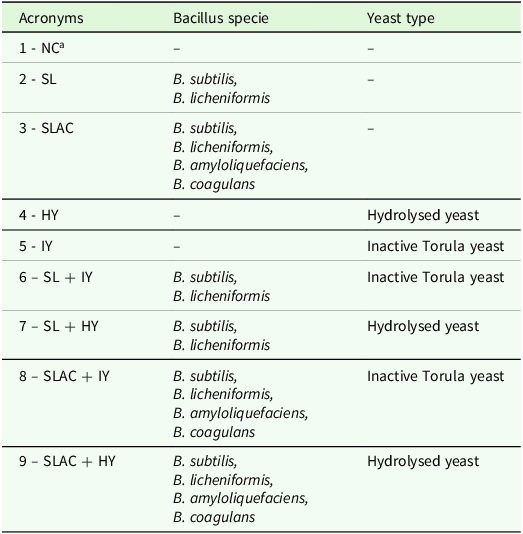
The first trial (Exp. 1) was conducted to evaluate and screen the effects of different DFMs and hydrolysed Torula yeast combinations on the ruminal fermentation of Urochloa brizantha (cv. Marandu) hay. The experiment was designed in a randomised block design in a 3×3 factorial scheme that included nine treatments (Table 1): 1) negative control (NC); 2) B. subtilis and B. licheniformis (SL); 3) B. subtilis, B. licheniformis, B. amyloliquefaciens and B. coagulans (SLAC); 4) hydrolysed Torula yeast (HY); 5) dry inactive Torula yeast (IY); 6) B. subtilis, B. licheniformis and dry inactive Torula yeast (SL + IY); 7) Bacillus subtilis, B. licheniformis and hydrolysed Torula yeast (SL + HY); 8) B. subtilis, B. licheniformis, B. amyloliquefaciens, B. coagulans and dry inactive Torula yeast (SLAC + IY) and 9) B. subtilis, B. licheniformis, B. amyloliquefaciens, B. coagulans and hydrolysed Torula yeast (SLAC + HY).
Composition of direct-fed microbial additives for each treatment

a NC = control.
These additives were incorporated into a premix composed of corn and corn gluten in varying amounts to ensure all test products had similar crude protein (CP) content. All treatments received an equal amount of these ingredients (0.1 g/0.001 kg of forage). The additive levels were determined in previous unpublished in vitro studies. The quantity of DFM used was equivalent to 1e9 CFU/head/d, while hydrolysed Torula yeast and dry inactive Torula yeast inclusion were equivalent to 10 g/head per d and 680 ppm, respectively. All dosage calculations assumed an 80 L rumen capacity. All test products were provided by Phibro Animal Health, Teaneck, NJ, USA.
In this study, we used a 30-bottle automated in vitro GP system (Ankom Technology, Macedon, NY, USA) equipped with wireless pressure sensors connected to a computer to evaluate the ruminal fermentation patterns of the tested ingredients. Treatments were assessed over three consecutive 48-h fermentation incubations to measure SCFA and NH3-N concentrations in the rumen. Each treatment was individually incubated in 250 mL bottles and randomly arranged in the incubator. Each fermentation batch included 3 replicates of each treatment, plus 3 blanks (containing only rumen/mineral/buffer solution), totalling 81 observations.
Experiments 2 and 3 (Exp. 2 and Exp. 3)
Experimental design
The selection of DFMs for these trials was based on the ruminal parameters observed in Exp. 1. Consequently, the second and third assays evaluated two types of forage: Urochloa brizantha cv. Marandu hay (low-quality forage, Exp. 2, the same used in Exp. 1) and Brachiaria decumbens grass (medium-quality forage, Exp. 3). These substrates were chosen to simulate an entire dry season, encompassing two distinct phases: the severe dry season characterised by low-quality forage and the transitional phase between the end of the rainy season and the beginning of dry season, featuring medium-quality forage. Thus, the five selected treatments evaluated in both forages were: 1) NC; 2) SL; 3) SLAC; 4) SL + HY and 5) SLAC + IY plus SLAC + HY at 1:1 concentration. The premix inclusions and dosages were the same as in Exp. 1.
The experimental design and operational procedures were consistent for both forage types. Thus, a 40-bottle automated in vitro GP system (Ankom Technology, Macedon, NY, USA) equipped with wireless pressure sensors connected to a computer was used to evaluate the ruminal fermentation patterns of the tested ingredients. Treatments were assessed in three consecutive 72-hours fermentation incubations to determine the GP profiles and ruminal fermentation parameters. In each incubation, ingredients were individually placed in 250 ml bottles, which were randomly arranged in the incubator. Thus, each fermentation batch included 4 replicates of each treatment, plus 3 blanks (containing only rumen/mineral/buffer solution), totaling 129 observations. Both low and medium-quality forages assays were performed simultaneously.
Operational procedures
All experiments followed the same operational procedures.
Ruminal fluid collection and buffer solutions preparation
Rumen fluid was collected from three Nellore steers (average body weight of 550 kg) that were cannulated in the rumen. The steers were maintained on Brachiaria decumbens pasture with mineral salt supplementation. Rumen fluid collections were performed 2 h before the morning feeding (Yáñez-Ruiz et al., Reference Yáñez-Ruiz, Bannink, Dijkstra, Kebreab, Morgavi, O’Kiely, Reynolds, Schwarm, Shingfield, Yu and Hristov2016). A total of 2000 ml of rumen fluid was collected from each animal, immediately filtered through four layers of cheesecloth and kept in pre-warmed (39 °C) thermal bottles. The samples were then promptly transported to the laboratory.
The buffer mineral solution was adapted from the methodology described by Menke and Steingass (Reference Menke and Steingass1988). The final solution was composed by 50 ml of rumen fluid and 100 mL of buffer mineral solution (1:2 v/v, 150 ml). The rumen fluid was mixed with the buffer mineral solutions in a water bath at 39 °C under anaerobic conditions, maintained by continuous N2 infusion.
In vitro gas production
The trial followed the methodologies proposed by Benedeti et al., (Reference Benedeti, Fonseca, Shenkoru, Marcondes, Paula, Silva and Faciola2018). Samples were introduced into the bottles and hydrated with 5 ml of deionised water to prevent particle dispersion. Each bottle received 1.00 ± 0.05 g (DM basis) of forage and 0.1 g of premix containing the additive. The headspace was flushed with N2 to maintain anaerobic conditions. After incubation, the bottles were sealed and placed in a ventilated incubator (EI-450T, ENGCO, Piracicaba, SP, BR) at 39 °C with constant agitation (83 rpm) for 72 h. The system recorded cumulative pressure every 5 minutes, with data logged every 60 minutes.
The cumulative pressure data at 24, 48 and 72 hours were converted to mL according to Tagliapietra et al., (Reference Tagliapietra, Cattani, Hansen, Hindrichsen, Bailoni and Schiavon2011), using the formula: GP (ml) = (Pc/Po) × Vo, where Pc is the cumulated pressure change (kPa) in the bottle headspace; Vo is the bottle headspace volume (95 ml) and Po is the atmospheric pressure read by the equipment at the beginning of the measurement. The final GP volumes were corrected for inoculum contribution by subtracting the final GP of the blank bottles (Pell and Schofield, Reference Pell and Schofield1993). The in vitro digestible organic matter (IVDOM) was calculated according to Menke and Steingass (Reference Menke and Steingass1988) as: IVDOM (g/kg DM) = 31.55 + 0.8343GP200, where GP200 is the net GP (ml/200 mg DM) at 72 h.
Ammonia-nitrogen, pH and short-chain fatty acids
The solution pH was measured at the beginning and end of each 72-h incubation. Concurrently, a subsample was collected from each bottle to determine SCFA and NH3-N concentrations. The collected material was filtered through four layers of cheesecloth. To preserve the samples for NH3-N analysis, 0.2 ml of a 500 ml/l H2SO4 solution was added. The NH3-N concentration was determined using the colorimetric method described by Chaney and Marbach (Reference Chaney and Marbach1962).
The total SCFA concentrations and profiles were determined using gas chromatography (Nexis CG-2030AF, Shimadzu, Montevideo, Uruguay) equipped with a fused silica capillary column (30 m × 0.53 nm × 0.5 µm film thickness, Sulpelco, Darmstadt, Germany) and a flame ionisation detector (FID). Nitrogen was used as the carrier gas at a flow rate of 34.5 ml/min (Leventini et al., Reference Leventini, Hunt, Roffler and Casebolt1990; Timm et al., Reference Timm, Amâncio, Loregian, Magnani, Helm, de Lima, Marcondes, Branco, de Paula, Benedeti and Tavares2024). The initial temperature was set at 100 °C for 2 minutes, then increased to 130 °C at a rate of 10 °C/minute. Subsequently, the temperature was raised to reach 170 °C, at a rate of 15 °C/minute and held for 11 minutes. The detector and inlet temperatures were 230 and 250 °C, respectively, and 0.5 µl samples were injected in split mode.
Enteric methane production
As the Ankom RF is a vented system, a second closed system consisting of 33 serum bottles (3 bottles per treatment plus 3 blanks) was used to investigate vitro enteric CH4. Each 100 ml serum bottle was filled with 0.2 g of each ingredient and 0.02 g of each supplement containing the additive. Bottles were inoculated with 20 mL of rumen/buffer solution, with the headspace continuously flushed with N2. After sample incubation, the bottles were sealed and placed in a ventilated incubator (EI-450T, ENGCO, Piracicaba, SP, BR) at 39°C with constant agitation (83 rpm) for 72 h. At the end of each fermentation batch, CH4 concentrations were measured using high-performance gas chromatography. A gas chromatograph (GC-Nexis 2030AF, Shimadzu, Montevideo, Uruguay) equipped with a capillary column (GS Carbonplot, Agilent Technologies, Santa Clara, CA, USA 30 m × 0.32 mm) and a dielectric barrier discharge (BID) ionisation detector was used. The temperature was programmed to start at 35°C and remain there for 3 minutes, then increase to 140°C at a rate of 25°C/minute and hold for 4 minutes. The detector and inlet temperatures were 140 and 170 °C, respectively. Samples were injected in split mode, using Helium gas as a carrier.
Chemical analysis
All feeds were ground through a 1 mm screen using a Wiley mill (Thomson Scientific Inc., Philadelphia, PA). Chemical analyses were conducted following AOAC methodology (Association Official of Analytical Chemists 2006). Samples were analysed for DM (method 934.01), ash (method 938.08) and CP (method 990.13). Organic matter (OM) was calculated as the difference between DM content and ash. Neutral detergent fibre (NDF) was determined using the methodology proposed by Van Soest et al., (Reference Van Soest, Robertson and Lewis1991) and adapted for the fibre determiner (TE-149, Tecnal, Piracicaba, SP, BRA). The chemical composition of the ingredients, including Urochloa brizantha hay (low-quality forage), Brachiaria decumbens grass (medium-quality forage) and premix, is presented in Table 2.
Chemical composition of Urochloa brizantha (cv. Marandu) hay (low-quality forage), B. decumbens grass (medium-quality forage) and diluting vehicle (vehicle) used in Exp. 1 and 2

a Vehicle was composed by a mixture of corn and corn gluten.
Statistical analysis
All statistical analyses were performed in SAS version 9.4 (SAS Institute Inc.). All results were assessed for residual normality and variance homogeneity. For Exp. 1, data were collected and analysed in a randomised block design in a 3×3 factorial scheme by fitting the data using generalised linear mixed model (GLIMMIX procedure) and considering DFMs inclusion as fixed factors and fermentation batch as a random factor. Factor one was considered the levels of Bacillus, and factor 2 was considered the Yeast types.
For Exp. 2 and 3, data were collected and analysed in a randomised block design by fitting the data using generalised linear mixed model (GLIMMIX procedure) and considering DFMs inclusion as fixed factors and fermentation batch as a random factor. For all the analyses, differences detected at P ≤ 0.10 were considered significant.
Results
Experiment 1
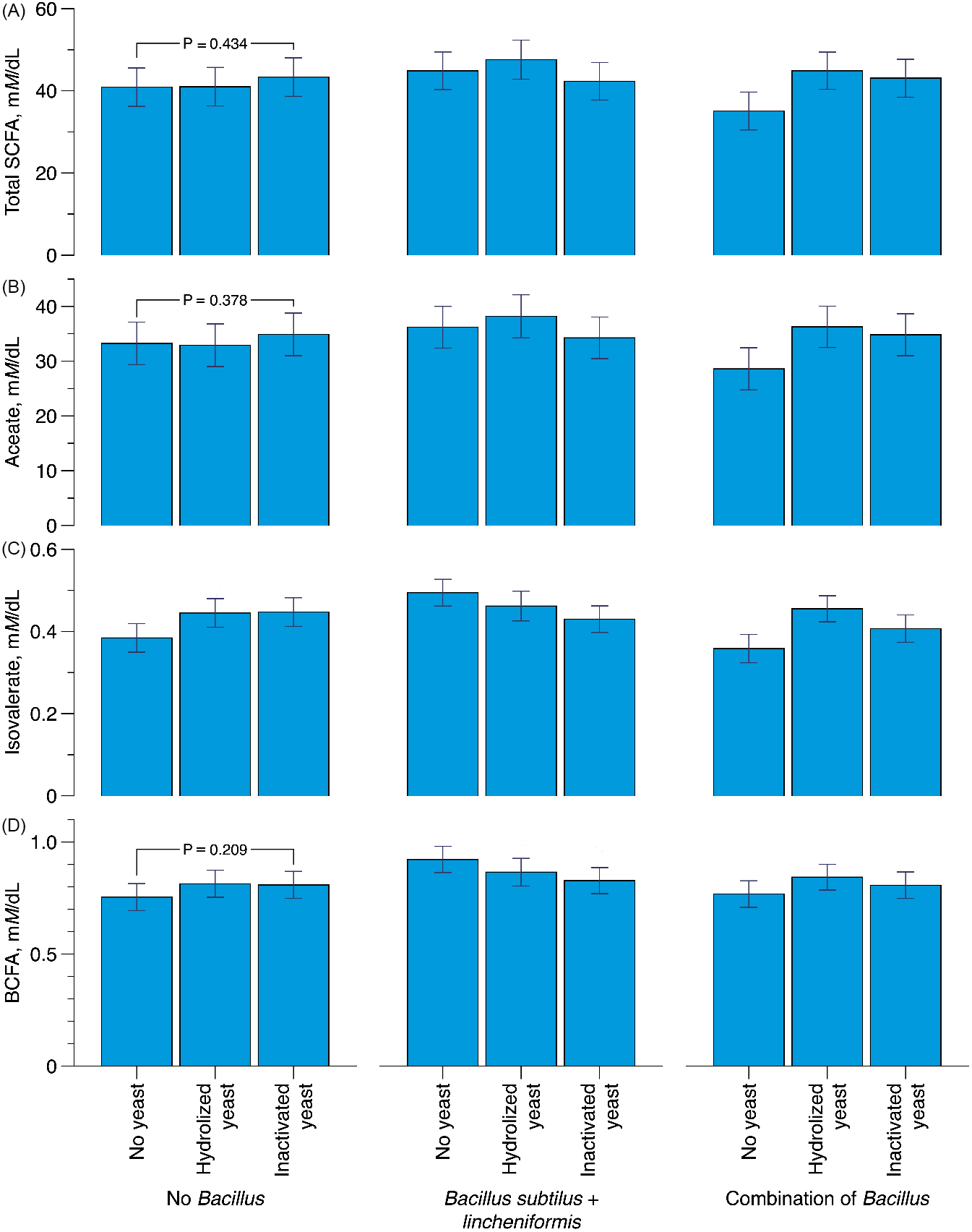
There was a significant interaction between Bacillus and yeast affecting total SCFA (P = 0.03), acetate (P = 0.02), valerate (P = 0.03), isovalerate (P = 0.03) and total branched-chain fatty acids (BCFA; P = 0.07) in terms of molar concentration (Figure 1). Additionally, there was an interaction between Bacillus and yeast affecting isovalerate (P = 0.01) and valerate (P = 0.01) in terms of proportion (Figure 2). In treatments without Bacillus (NC, HY, IY), inactivated yeast (IY) resulted in higher isovalerate molar concentration (mM/dL) compared to treatments without yeast (NC; P = 0.01). Regarding proportion comparison (mol/100 mol), the no yeast treatment (NC) also had lower isovalerate concentration than other treatments (HY, IY) (P = 0.01).
Effects of direct-fed microbial (DFM) on short chain fatty acids variables (in mM/dl) within a gas production system in Exp. 1 (Urochloa brizantha cv. Marandu hay). BCFA = branched-chain fatty acids; SCFA = short-chain fatty acids.

Effects of direct-fed microbial (DFM) on short chain fatty acids variables (in mol/100 mol) within a gas production system in Exp. 1 (Urochloa brizantha cv. Marandu hay).

For treatments with B. subtilis + B. lincheniformis (SL, SL+IY, SL+HY), hydrolysed yeast (SL+HY) led to higher total SCFA (SP < 0.01) and acetate (P < 0.01) molar concentrations compared to inactivated yeast (SL+HY; mM/dl). Conversely, the no yeast treatment (SL) showed higher isovalerate (P = 0.04) and BCFA (P = 0.02) levels than inactivated yeast (SL+IY; mM/dl). Additionally, regarding proportion comparison (mol/100 mol), the no yeast treatment (SL) had a higher isovalerate concentration compared to other treatments (SL+IY, SL+HY; P = 0.07).
For combined Bacillus species treatments (SLAC, SLAC+IY, SLAC+HY), the no yeast treatment (SLAC) exhibited lower total SCFA (mM/dl), acetate (mM/dl), isovalerate (mM/dl), BCFA (mM/dL) and valerate (mol/100 mol) than hydrolysed yeast (SLAC+HY; P < 0.01). The no yeast treatment (SLAC) also had lower SCFA (mM/dL), acetate (mM/dl) compared to inactivated yeast treatment (SLAC+IY; P = 0.09).
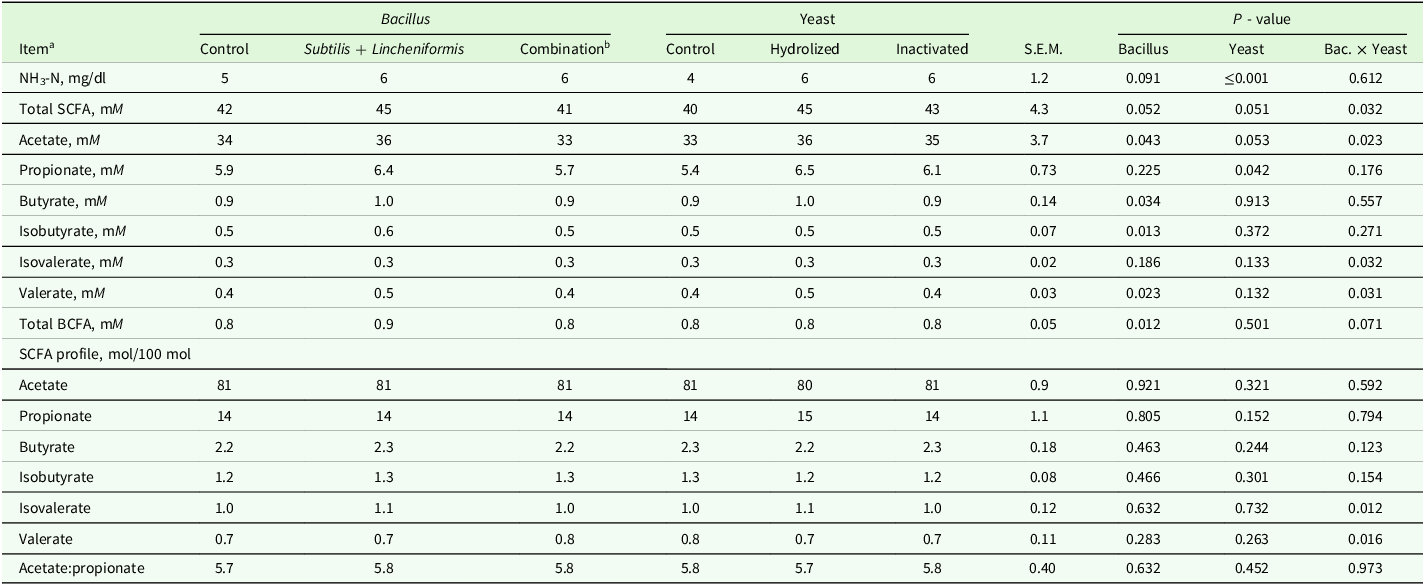
Since no interaction was observed for the remaining variables, we analysed the results by considering Bacillus and yeast comparisons separately. For Bacillus, the combination of Bacillus (SLAC, SLAC+IY, SLAC+HY) resulted in higher NH3-N levels than the control treatment (NC, P = 0.09; Table 3). Additionally, B. subtilis+ B. lincheniformis (SL, SL+IY, SL+HY) led to higher concentrations of butyrate and isobutyrate (mM) compared to the other treatments (NC, SLAC, SLAC+IY, SLAC+HY; P < 0.03). In terms of yeast comparison, the control treatment (NC) exhibited lower NH3-N concentration (P < 0.01) and propionate (mM; P = 0.04) compared to hydrolysed yeast (HY, SL+HY, SLAC+HY). However, for propionate, the control was similar to inactivated yeast (IY, SL+IY, SLAC+IY). No significant differences were found among treatments for the remaining ruminal fermentation variables (P > 0.10).
Effects of direct-fed microbial (DFM) on ruminal fermentation variables within a gas production system in Exp. 1 (Urochloa brizantha cv. Marandu hay)

a NH3-N = ammonia nitrogen; SCFA = short-chain fatty acids; BCFA = branched-chain fatty acids.
b Combination = combination of B. subtilis, B. licheniformis, B. amyloliquefaciens, B. Coagulans.
Experiment 2 (low-quality forage)
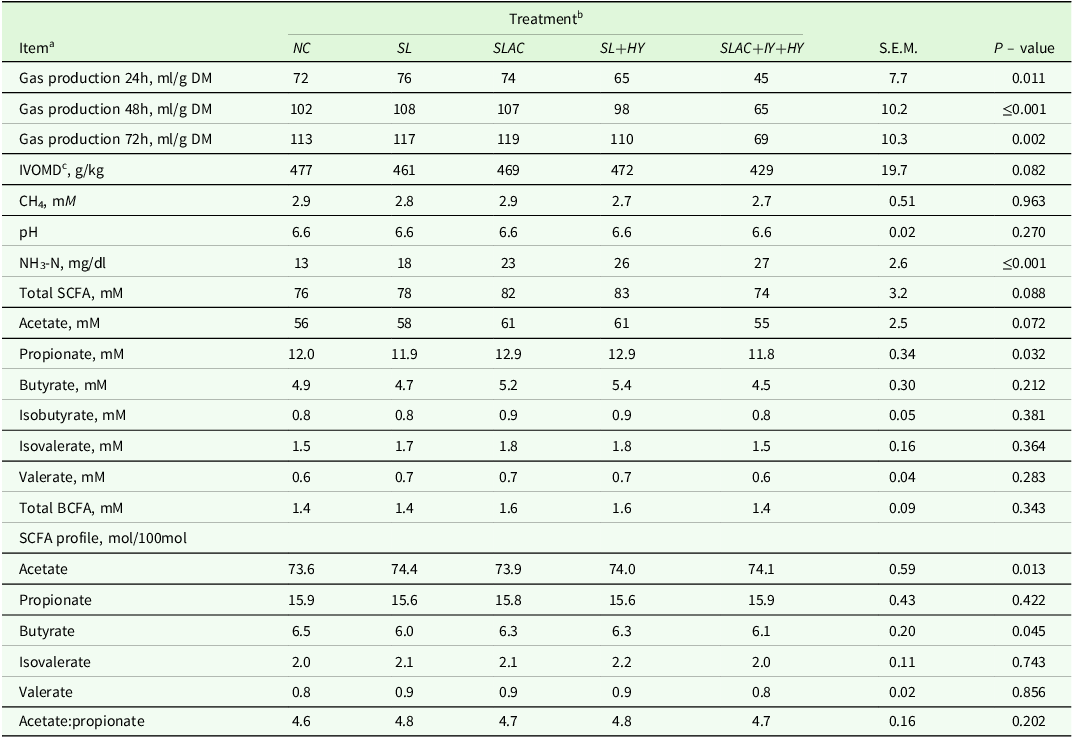
For total GP at 24, 48 and 72-h (ml/g DM), the combinations of SLAC + IY and SLAC + HY had the lowest values (P < 0.01; Table 4). The estimated IVOMD for the combination of SLAC + IY and SLAC + HY exhibited the lowest values (P = 0.08). No significant differences were found among treatments for CH4 concentrations (P = 0.96).
Effects of direct-fed microbial (DFM) on ruminal fermentation variables within a gas production system in Exp. 2 (low-quality forage, Urochloa brizantha cv. Marandu hay)

a BCFA = branched-chain fatty acids; NH3-N = ammonia nitrogen; SCFA = short-chain fatty acids.
b NC = control diet no additive inclusion; SL: Bacillus subtilis and B. licheniformis; SLAC: B. subtilis, B. licheniformis, B. amyloliquefaciens and B. coagulans; Sl+HY : B. subtilis and hydrolysed yeast; SLAC+IY + SLAC+HY: B. subtilis, B. licheniformis, B. amyloliquefaciens, B. coagulans and dry inactive Torula yeast and hydrolysed yeast;
c The in vitro organic matter digestibility (IVOMD) was calculated according to Menke and Steingass (Reference Menke and Steingass1988) as IVOMD (g/kg DM) = 31.55 + 0.8343GP.
The SLAC + HY and the combination SLAC+IY + SLAC+HY had higher NH3-N concentrations (mg/dl) compared to NC and SL (P < 0.001), but did not differ from SLAC. The SL + HY treatment exhibited a higher concentration of total SCFA compared to the combinations of SLAC + IY and SLAC + HY (P = 0.08). Regarding acetate concentration, SL + HY had a higher value compared to NC and the combinations of SLAC + IY and SLAC + HY (P = 0.07). Additionally, SL + HY had the highest propionate concentration (P = 0.03). No significant differences were found among treatments for pH, butyrate, isobutyrate, isovalerate, valerate and total BCFA (P > 0.20).
For the SCFA profile (mol/100 mol), SL, SL + HY, and the combination of SLAC + IY and SLAC + HY had higher proportion of acetate compared to NC (P = 0.01). The NC treatment had a higher proportion of butyrate than the combinations of SLAC + IY and SLAC + HY (P = 0.044). The proportions of propionate, isovalerate and valerate, as well as acetate: propionate ratio, were similar among all treatments (P = 0.42, 0.74, 0.86 and 0.20, respectively).
Experiment 3 (medium-quality forage)
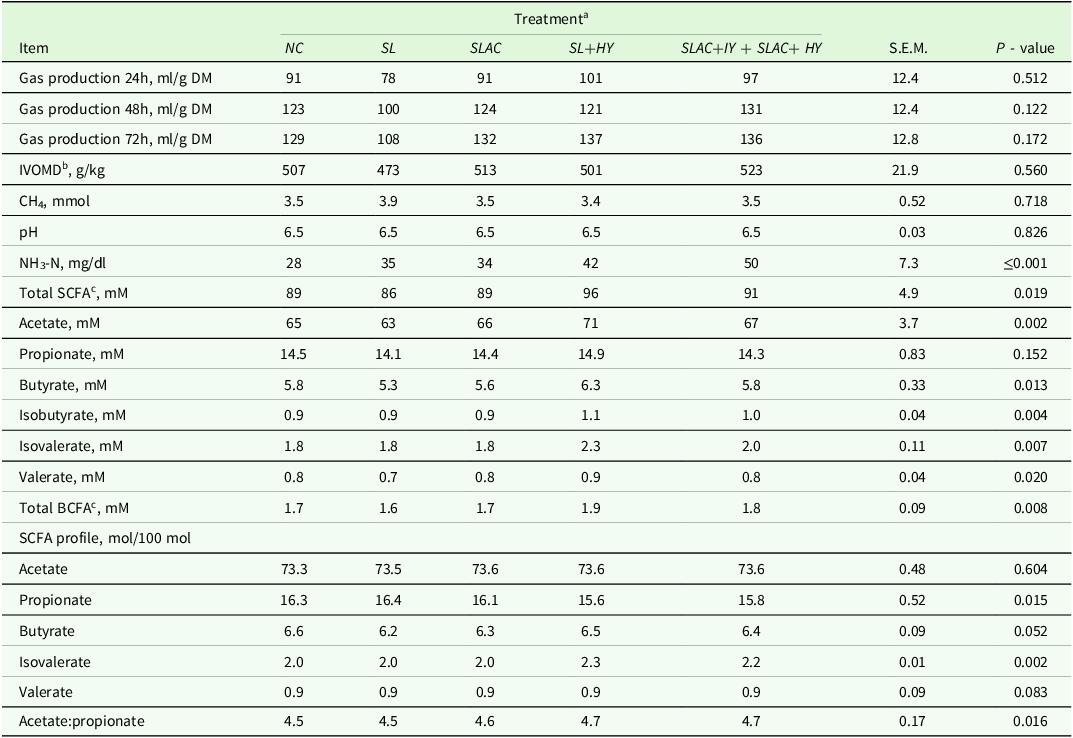
We found no differences among treatments for total GP at 24, 48 and 72 h, IVOMD, CH4, propionate concentration and pH (P > 0.10; Table 5). The combination of SLAC + IY and SLAC+ HY had higher NH3-N concentrations compared to NC, SL and SLAC (P < 0.001). The SL + HY treatment had higher values for total SCFA and acetate concentrations compared to NC, SL and SLAC (P < 0.02). For butyrate concentrations, SL + HY had higher values than SL (P = 0.01). Additionally, SL + HY had higher isobutyrate concentration compared to SL (P = 0.004). The SL + HY also had higher values of isovalerate, valerate and total BCFA concentrations compared to NC, SL and SLAC (P < 0.02).
Effects of direct-fed microbial (DFM) on ruminal fermentation variables within a gas production system in Exp. 3 (medium-quality forage, Brachiaria decumbens grass)

a NC = control diet no additive inclusion; SL: Bacillus subtilis and B. licheniformis; SLAC: B. subtilis, B. licheniformis, B. amyloliquefaciens and B. coagulans; Sl+HY : B. subtilis and hydrolysed yeast; SLAC+IY + SLAC+HY: B. subtilis, B. licheniformis, B. amyloliquefaciens, B. coagulans and dry inactive Torula yeast and hydrolysed yeast.
b The in vitro organic matter digestibility (IVOMD) was calculated according to Menke and Steingass (Reference Menke and Steingass1988) as IVOMD (g/kg DM) = 31.55 + 0.8343GP.
c BCFA = branched-chain fatty acids; NH3-N = ammonia nitrogen; SCFA = short-chain fatty acids.
For the SCFA profile (mol/100 mol), we found no difference among treatments for the acetate proportion (P = 0.60). The SL had a higher propionate proportion compared to SL + HY (P = 0.01). Both NC and SL+ HY had higher butyrate proportions compared to SL (P = 0.052). For isovalerate proportions, SL + HY and the combination of SLAC + IY and SLAC + HY had higher values compared to NC, SL and BSLAC (P = 0.002). Regarding valerate, SL + HY had a higher proportion than NC, SL and SLAC (P = 0.08). The acetate: propionate ratio was lower for NC and SL compared to SL + HY and the combination of SLAC + IY and SLAC + HY (P = 0.016). Furthermore, SL + HY had a higher acetate: propionate ratio than all treatments except the combination of SLAC + IY and SLAC + HY (P = 0.016).
Discussion
Experiment 1
In our study, we hypothesised that combinations of DFMs and yeast products could modulate ruminal fermentation to enhance the degradability of medium and low-quality forage.
In Exp. 1, we observed that treatments with these additives resulted in higher NH3-N concentrations compared to the control in both Bacillus and yeast comparisons. As reported by Cappellozza et al., (Reference Cappellozza, Joergensen, Copani, Bryan, Fantinati, Bodin, Khahi, Ninodeguzman, Arriola, Lima, Farooq and Vyas2023), the inclusion of DFMs based on B. licheniformis and B. subtilis in rumen fermentation might create a synergism between proteins and fibrolytic enzymes, contributing to the increased NH3-N concentrations observed. The use of DFMs enhances rumen nutrient digestibility (Cappellozza et al., Reference Cappellozza, Joergensen, Copani, Bryan, Fantinati, Bodin, Khahi, Ninodeguzman, Arriola, Lima, Farooq and Vyas2023).
The mode of action of Bacillus spp. includes a diverse range and quantity of enzymes that improve the degradability of fibre, starch, protein and lipids (Luise et al., Reference Luise, Bosi, Raff, Amatucci, Virdis and Trevisi2022). We speculate that the higher NH3-N concentrations in these treatments may increase microbial protein synthesis due to more ammonia being available in the medium (Sun et al., Reference Sun, Wang and Deng2013; Pan et al., Reference Pan, Harper, Queiroz, Copani and Cappellozza2022; Cappellozza et al., Reference Cappellozza, Joergensen, Copani, Bryan, Fantinati, Bodin, Khahi, Ninodeguzman, Arriola, Lima, Farooq and Vyas2023). According to Silva et al., (Reference Silva, Amâncio, Magnani, Meurer, Reolon, Timm, Cappellozza, Branco and Paula2024), the inclusion of DFM based on Bacillus strains and yeast may benefits microbial communities, stimulating better bioassimilation and increasing microbial protein synthesis. Furthermore, Sun et al., (Reference Sun, Wang and Deng2013) observed that the inclusion of B. Subtilis in lactating dairy cow diets, increased ruminal NH3-N concentrations and milk protein, which aligns with our findings.
The optimal concentration of NH3-N in ruminal fluid for efficient microbial protein synthesis ranges from 15 to 25 mg/dl throughout the day (NRC, 2001; NASEM, 2016). In Exp. 1, we observed values below this range. We believe these results may be due to the low CP content in the forage used in the trial. The absence of additional protein and energy sources likely contributed to the low NH3-N values, as only one premix was incubated with the forage. Additionally, in vitro systems do not allow the entry or absorption of substrates, which might alter the normal results of ruminal parameters (Hristov et al., Reference Hristov, Lee, Hristova, Huhtanen and Firkins2012).
Hydrolysed yeast had the highest concentrations of propionate and isovalerate, while B. subtilus plus lincheniforms exhibited the greatest concentrations of butyrate and isobutyrate. Additionally, the interaction between yeast and Bacillus showed that both hydrolysed and inactivated yeast combined with Bacillus species increased the total SCFA, acetate and BCFA concentrations. These results may be attributed to the probiotic effects of hydrolysed yeast, which stimulate the growth of cellulolytic bacteria, enhance fibre degradation, and increase the proportion of SCFA (Baker et al., Reference Baker, Kraft, Karnezos and Greenwood2022). The presence of Bacillus species likely stimulates the production of fibrolytic enzymes and enhances fibre digestion, as reported by Cappellozza et al., (Reference Cappellozza, Joergensen, Copani, Bryan, Fantinati, Bodin, Khahi, Ninodeguzman, Arriola, Lima, Farooq and Vyas2023). This effect, combined with the characteristics of the forage, which contains a high amount of fibrous carbohydrates for degradation in the ruminal environment, likely contributed to the greater SCFA concentrations observed. Furthermore, Bacillus spp. can produce a large number of enzymes that enhance nutrient digestibility in the rumen (Luise et al., Reference Luise, Bosi, Raff, Amatucci, Virdis and Trevisi2022). In summary, the combination of factors related to the forage substrate characteristics and the feed additives likely contributed to the greater SCFA concentrations observed in treatments with yeast plus Bacillus.
Cappellozza et al., (Reference Cappellozza, Joergensen, Copani, Bryan, Fantinati, Bodin, Khahi, Ninodeguzman, Arriola, Lima, Farooq and Vyas2023) suggested that the improvement in fibre breakdown contributes to elevated concentrations of SCFA and BCFA in the ruminal environment. This insight potentially explains the observed higher concentrations of isobutyrate and total BCFA for this treatment. The higher valerate and isovalerate concentrations (mol/100 mol) for the combination of Bacillus without yeast could be attributed to the diverse microbiome involved in fibre degradation with the different Bacillus strains. Forage-based diets promote greater microbial diversity, which can lead to unpredictable changes in the proportions of SCFA (Adesogan et al., Reference Adesogan, Arriola, Jiang, Oyebade, Paula, Pech-Cervantes, Romero, Ferraretto and Vyas2019).
Based on the overall results of NH3-N and SCFA concentration and profiles, the following treatments were selected for evaluation in Exp. 2: SL, SLAC, SL + HY, and a combination of SL + IY and SL + HY. These treatments were tested on two different substrates: Urochloa brizantha hay (low quality) and Urochloa decumbens grass (medium quality). These substrates were chosen to represent pasture conditions during the dry season in Brazil, as previously mentioned.
Experiments 2 and 3
In Exp. 2, our findings revealed NH3-N concentrations within the normal range. However, in Exp. 3, we observed NH3-N concentrations that exceeded the normal range for medium-quality forage. Since we work in a closed in vitro system, where there is no entry of substrates and no removal of final fermentation products (Hristov et al., Reference Hristov, Lee, Hristova, Huhtanen and Firkins2012), we can infer that there was an accumulation of NH3-N for the SLAC + IY plus SLAC + HY treatment with medium-quality forage.
These results may be a consequence of improved ruminal protein degradation of medium-quality fibre. As reported by Silva et al., (Reference Silva, Amâncio, Magnani, Meurer, Reolon, Timm, Cappellozza, Branco and Paula2024), including DFM on forage-based diets may be improving microbial protein synthesis because it promotes better N bioassimilation, as we mentioned before. This fact might be linked to the increased diet fermentability, which enhances NH3-N absorption and may improve N utilisation on rumen environment (NASEM, 2016). Though not measured in this study, the inoculation of Bacillus strains and yeast may have improved in vitro DM and NDF digestibility, as concluded by Cappellozza et al., (Reference Cappellozza, Joergensen, Copani, Bryan, Fantinati, Bodin, Khahi, Ninodeguzman, Arriola, Lima, Farooq and Vyas2023) on a study that evaluated different forage sources.
We observed that for both low and medium-quality forage, the SL + HY and SLAC + IY plus SLAC + HY treatments had the highest concentrations of total SCFA and acetate, compared to NC. The use of yeast products may enhance fibre degradation by scavenging oxygen from newly ingested feed, which helps fibrolytic bacteria colonise the feed (Jouany Reference Jouany2006; Firkins and Mitchell, Reference Firkins and Mitchell2023). This process can improve fermentation rate and SCFA synthesis (Pan et al., Reference Pan, Harper, Queiroz, Copani and Cappellozza2022; Cappellozza et al., Reference Cappellozza, Joergensen, Copani, Bryan, Fantinati, Bodin, Khahi, Ninodeguzman, Arriola, Lima, Farooq and Vyas2023). Additionally, the inclusion of B. subtilis in ruminant diets promotes the growth of anaerobic microorganisms in the ruminal environment (Sun et al., Reference Sun, Wang and Deng2013).
In symbiosis with the hydrolysed yeast, which acts as a prebiotic for B. subtilis, the in vitro environment may have become more favourable for the growth of microbial species involved in fibrous carbohydrate degradation (McAllister et al., Reference McAllister, Beauchemin, Alazzeh, Baah, Teather and Stanford2011; Parra et al., Reference Parra, Costa, Palma, Camargo, Lima, Harper, Meale and Silva2021; Baker et al., Reference Baker, Kraft, Karnezos and Greenwood2022). For medium-quality forage (Exp. 3), SL + HY had higher concentrations of total SCFA, acetate, butyrate, iso-butyrate, iso-valerate, valerate and total BCFA concentrations (mM). These results may be related to the probiotic effects of hydrolysed yeast in combination with the Bacillus, as discussed in the results from Exp. 1. These BCFA are end products of branched-chain amino acids, which are important for the growth of fibrolytic and cellulolytic bacteria (Calsamiglia et al., Reference Calsamiglia, Ferret and Devant2002; Adesogan et al., Reference Adesogan, Arriola, Jiang, Oyebade, Paula, Pech-Cervantes, Romero, Ferraretto and Vyas2019). The effects of SL + HY mentioned above may have contributed to the higher BCFA proportions observed for medium-quality forage.
For the SCFA profile (mol/100 mol), we observed that SL had the highest acetate proportion and the highest acetate: propionate ratio for low-quality forage. This result may be linked to the characteristics of the microorganisms in the feed additive, since B. subtilis and licheniformis have the potential to produce fibrolytic enzymes and enhance fibre digestibility (Cappellozza et al., Reference Cappellozza, Joergensen, Copani, Bryan, Fantinati, Bodin, Khahi, Ninodeguzman, Arriola, Lima, Farooq and Vyas2023; Oyebade et al., Reference Oyebade, Taiwo, Idowu, Taylor, Queiroz, Adesogan, Vyas and Ogunade2023). This improvement could be attributed to the diverse microbiome involved in fibre degradation, as discussed in Exp. 1.
For the medium-quality forage, SL had the highest proportion of propionate, likely due to the ability of B. subtilis and B. licheniformis to enhance starch degradation (Sun et al., Reference Sun, Wang and Deng2013; Shi et al., Reference Shi, Zhang, Lu and Wang2017; Cappellozza et al., Reference Cappellozza, Joergensen, Copani, Bryan, Fantinati, Bodin, Khahi, Ninodeguzman, Arriola, Lima, Farooq and Vyas2023). Propionic acid is the main product of non-fibrous carbohydrate fermentation (Owens and Goetsch, Reference Owens, Goetsch and Church1988; Owens and Basalan, Reference Owens and Basalan2016). In this process, pyruvate conversion pathways, such as acrylate and succinate, produce propionic acid as the final product (Higgs et al., Reference Higgs, Chase, Ross and Van Amburgh2015; Owens and Basalan, Reference Owens and Basalan2016). This suggests an enhancement in the degradation of the starch contained in the premix used in incubation. However, SL + HY had the highest proportions of butyrate, isovalerate, and valerate, as well as the highest acetate: propionate ratio. We believe these results are directly linked to the effects of yeast-based products as prebiotics and the use of Bacillus strains in the ruminal environment. Furthermore, recent studies have shown that these additives may also modulate rumen microbiome composition and reduce methane emissions (Ban and Guan, Reference Ban and Guan2021; Cheng et al., Reference Cheng, Zhang, Ren, Zhang and Xu2023; Sarmikasoglou et al., Reference Sarmikasoglou, Sumadong, Dagaew, Johnson, Vinyard, Salas-Solis, Siregar and Faciola2024). While our study observed higher NH3-N and SCFA concentrations, some results, such as the variations in specific SCFA profiles, suggest there may be additional underlying mechanisms at play. Therefore, further research could explore these unexpected outcomes, potentially uncovering new benefits of Bacillus and yeast products.
The GP parameters of low-quality forage indicated that the combination of SLAC + IY and SLAC + HY resulted in lower GP at 24, 48, and 72 h. According to Allen (Reference Allen1991), a lower fibre fermentation rate can be linked to lower starch content and higher indigestible fractions. These findings likely influenced the total SCFA production for SLAC + IY plus SLAC + HY in low-quality forage, as this treatment exhibited the lowest total SCFA (mM) compared to other treatments. However, no significant differences were observed in the GP production parameters during the experiment with medium-quality forage. This could be due to the substrate’s characteristics, as forages typically contain a higher concentration of carbohydrate fraction B (Allen, Reference Allen1991; Sniffen et al., Reference Sniffen, O’Connor, Fox and Chalupa1992; Higgs et al., Reference Higgs, Chase, Ross and Van Amburgh2015), which degrades after more than 24 hours in the rumen environment (NASEM, 2016). These characteristics may have facilitated a more uniform fermentation process, potentially mitigating the effects of additives in this context. Our study demonstrated that incorporating yeast-based products alongside Bacillus strains can enhance forage degradation and optimise the fermentation environment for the tropical forages evaluated.
Conclusion
Combining Bacillus strains with dry inactive and hydrolysed Torula yeast on low and medium-quality forage can enhance the concentration and profile of total SCFA, including acetate and BCFA. These combinations also increase NH3-N concentration in the rumen, potentially improving microbial protein synthesis and nutrient utilisation. Therefore, using DFMs, especially B. subtilis and B. licheniformis, in combination with hydrolysed yeast, may improve feed utilisation for low-quality forage in grazing beef cattle. Future in vivo studies are needed to evaluate these combinations on beef cattle performance during the dry season in tropical regions.
Acknowledgements
The authors gratefully acknowledge the Conselho Nacional de Desenvolvimento Científico e tecnológico (CNPq) for providing a scholarship for the first author (Grant # 140031/2022-7).
Author contributions
FR: Data curation, formal analysis, investigation, methodology, visualisation, writing – original draft, writing – review & editing. ARC: Data curation, formal analysis, investigation, methodology, writing – review & editing. EM: Data curation, formal analysis, investigation, methodology, supervision, validation, visualisation, writing – review & editing. MIM: Data curation, formal analysis, writing – review & editing. DG and BH: Funding acquisition, resources, writing – review & editing; PDBB: Formal analysis, methodology, visualisation, writing – original draft, writing – review & editing. FDR: Conceptualisation, funding acquisition, resources, validation, visualisation, and writing – review & editing. GRS: Conceptualisation, funding acquisition, project administration, resources, supervision, validation, visualisation, writing – review & editing, and methodology. RB: Conceptualisation, funding acquisition, project administration, resources, validation, visualisation, writing – review & editing, and methodology. EMP: Conceptualisation, data curation, formal analysis, funding acquisition, investigation, methodology, resources, supervision, validation, visualisation, writing – original draft, and writing – review & editing. All authors gave their final approval of the version to be published and agreed to be accountable for all aspects of the work and to ensure that questions related to the accuracy or integrity of any part of the work were appropriately investigated and resolved.
Funding statement
Phibro Animal Health LTDA for funding support. And Sao Paulo Research Foundation (FAPESP; Grant #2017/50339-5; 2018/19743-7) for the purchase of the laboratory equipment’s used in the present trial.
Competing interests
The authors declare that they have no known competing financial interests or personal relationships that could have appeared to influence the work reported in this paper.
Ethical standards
The care and handling of the experimental animals was approved by the Animal Use Ethics Committee of the Instituto de Zootecnia under the protocol no 249-19.