Implications
The introduction of crossbreeding with terminal sires in extensive sheep production systems can increase productivity compared with pure breeding while maintaining the adaptation to the environment through the maternal side. Both, sheep producers and the industry, could take advantage of this tool improving lamb growth performance up to weaning, carcass traits and heavier commercial cuts. Terminal crossbreeding may contribute to improved income for the extensive production system producers.
Introduction
Sheep breeding in Chile, Argentina and Uruguay is largely aimed at the production of wool. However, as a result of fluctuating wool prices, meat production has increased its contribution in sheep enterprises during recent years (Abella et al., Reference Abella, Cardellino, Mueller, Cardellino, Benítez and Lira2010). Due to its excellent adaptation to a variety of breeding environments and easy management the Corriedale, a dual-purpose breed is the dominant breed in most of these countries and is used for wool and prime lamb production.
Corriedale lambs have to be slaughtered at an older age in order to reach a similar weight relative to crossbred lambs, with a significant increase in the cost of production (Bianchi and Garibotto, 2009). Otherwise the commercial cuts are smaller, requiring a big effort to export these cuts to Northern hemisphere markets. When the lambs reach finishing weights (i.e. carcass of >17 kg), these are always over fat, and the meat processors have to trim the excess fat, with more costs for the meat plant, which is reflected through lower prices to the producers. It is in the interest of the sheep industry to meet the external market requirements in terms of size and weight from the cuts.
It has been suggested that there are significant advantages for lamb production of using a terminal sire over Merino ewes (Scales et al., Reference Scales, Bray, Baird, O’Connell and Knight2000), or ewes from extensive hill sheep systems (Carson et al., Reference Carson, Irwin and Kilpatrick2001). For example, the latter authors pointed out that when using Texel rams on Cheviot and Scottish Blackface ewes, under a hill farm environmental condition in Northern Ireland, weaning weights were increased by 12.5% and 21.2%, respectively, in comparison to the purebred lambs. Furthermore, the use of a terminal cross consistently improved carcass composition.
Chilean sheep production systems are mostly based on pure breeds and there is paucity information with regards to the use of terminal sires. However, during recent years, some efforts have been made to introduce terminal sire breeds to the Magallanes Region of southern Chile (Latorre, Reference Latorre2004). Latorre (Reference Latorre2004) reported a positive economic impact, in particular when using Poll Dorset or Texel rams.
Consequently, there is interest in using terminal sire breeds to improve growth and carcass quality of lambs. In view of this background, the objective of this study was to investigate the effects of Poll Dorset, Suffolk and Texel rams on performance and carcass traits of the crossbred progeny, reared on a range of extensive commercial farms in Western Patagonia.
Material and methods
Treatments and animals
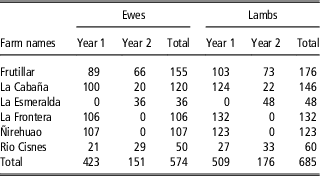
The study was conducted during 2004 and 2005 on a total of six sheep farms, representative of the main range farming region of Aysén, located in Western Patagonia, Chile (44°30' – 45°55' S, 71°18' – 72°02' W, 394 to 739 m a.s.l.). The number of ewes and lambs evaluated per farm on each year of study are presented in Table 1.
Number of ewes and lambs evaluated per farm on each year of study

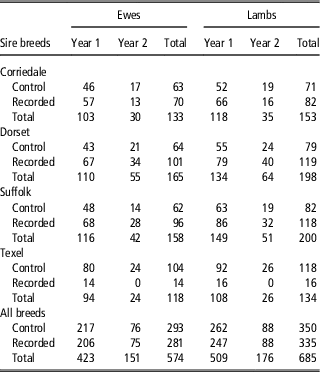
On each farm, a minimum of 20 and a maximum of 107 purebred Corriedale ewes were allocated each year to one of four treatments, balanced for ewe live weight, condition score (Russel et al., Reference Russel, Doney and Gunn1969) and age. Four different sire breeds (treatments) with a total of 10 Corriedale rams, 10 Poll Dorset rams, nine Suffolk rams and seven Texel rams, each from different bloodlines, were used in the study over the two seasons. Some of the rams used were under a genetic recording scheme in New Zealand (Jopson et al., Reference Jopson, Newman and McEwan2009; Young and Wakelin, Reference Young and Wakelin2009), thus, a total of 16 rams (five Corriedale, five Poll Dorset, five Suffolk and one Texel) were selected on the basis of their breeding values and represented the top 10% of recorded animals from flocks in New Zealand. The second source of rams (20) was selected from two Chilean flocks not participating in genetic improvement programmes. The rams were inspected and confirmed as physically sound by a veterinarian and selected on the basis of conformation and locomotion and were considered to be representative of each breed. Full details of the number of ewes and lambs evaluated per sire breed and per sire source on each year of study are given in Table 2.
Number of ewes and lambs evaluated per sire breed and per sire source on each year of study

Lambing management
To reduce variation in lambing dates, during May of each year, the ewes were submitted to an oestrus synchronisation regime based on intravaginal sponges containing 20 mg flugestone acetate for 12 days (Chronogest®; Intervet UK Ltd, Milton Keynes, UK), followed by an intramuscular injection of 300 IU serum gonadotrophin (Folligon®; Intervet Chile Ltd, Santiago, Chile). At 48 h after removal of the sponges, the heat was detected with the use of vasectomised teaser rams with markers to identify ewes in oestrus. Once detected as being in heat, they were allocated to sire breeds and inseminated by laparoscopy with frozen-thawed semen. The ewes grazed naturalised pastures throughout gestation without supplemental feeds.
Lambing occurred outdoors and the lambs were tagged and weighed within 24 h of birth with ranges in lambing dates of 26 days in 2004 and 35 days in 2005. At lambing, the incidence of assisted births using a two-point scale (assisted, not assisted), lambing date, lamb sex and litter size was recorded by experienced shepherds. Across the 2 years of the study, a total of 685 lambs were evaluated. Ewes and lambs were grazed together on extensive range land where the vegetation was dominated by Festuca pallescens, Poa pratensis, Carex gayana and Trifolium repens. Typically, pasture dry matter yield range between 700 and 1900 kg/ha in this area, mainly produced in late spring and early summer (Hepp, Reference Hepp1996; Adler et al., Reference Adler, Milchunas, Sala, Burke and Laurenroth2005; Utrilla and Jaurena, Reference Utrilla and Jaurena2017). Weaning occurred on a single day each year when lambs averaged 93 days of age. All lambs were weighed at birth, 5 to 10 weeks of age (corrected to an 8-week weight) and at weaning.
Lamb carcass evaluation
At weaning, 24 Corriedale, 21 Poll Dorset, 31 Suffolk and 21 Texel male lambs were selected at random on the basis of farm origin for carcass assessment. Slaughter took place at a local abattoir, with slaughter weights being recorded after 18 h of fasting. Lamb were stunned, and the carcasses were eviscerated and skinned according to normal commercial practices, weighed hot and held at 5°C for 8 h. The hot carcass weight (HCW) included kidney-pelvic fat. The day after slaughter, cold carcasses were weighed (CCW) and graded for confirmation using a four-point scale to represent very good, good, average or poor muscling, according to the Chilean standard for lamb carcasses (Instituto Nacional de Normalización, Chile, 1978). Further slaughter data consisted of fat grade and kidney knob and channel fat grade (KKCF), using a three-point scale to represent deficient, normal or excessive fat covering. Carcass length from the last sacral vertebra to the first cervical (atlas) vertebra was also recorded.
Carcasses were split with a band saw between the 12th and 13th ribs and the fat depth over the eye muscle (Longissimus dorsi) was measured (mm) on both sides of the carcass with a sharpened steel rule. The area of the eye muscle between the 12th and 13th ribs was drawn on a transparent plastic paper and measured later using millimetric paper (Ruiz de Huidobro et al., Reference Ruíz de Huidobro, Cañeque, Onega and Velasco2000). Tissue depth (grade rule (GR)) was also measured, as described by Kirton and Johnson (Reference Kirton, Duganzich, Mercer, Clarke, Dobbie and Wilson1979).
Carcasses were then divided into commercial cuts according to the Chilean standard jointing procedure for lambs (Instituto Nacional de Normalización, Chile, 2000). Commercial cuts were prepared and trimmed by experienced butchers and the trimmed cuts and trimmings were weighed.
Statistical procedures
All statistical analyses were conducted using GenStat statistical package (Payne et al., Reference Payne, Murray, Harding, Baird and Soutar2007).The lamb performance data were analysed by residual maximum likelihood procedure including the fixed effects of sire breed, sire source and interactions, and the random effect of individual ewe and ram. For each variable, the fixed effects of litter size, sex, year, farm and age at weaning were initially used as covariates. Non-significant (P>0.10) covariates and interactions were removed from the models. The effects of sire breed and source on lamb carcass characteristics were adjusted for a constant age at weaning (92.7 days), given that lambs need to be slaughtered at a fixed age to fit in with the seasonal nature of the extensive systems of lamb production in Patagonia. Significance for main effects and interactions was declared at P⩽0.05.
Results
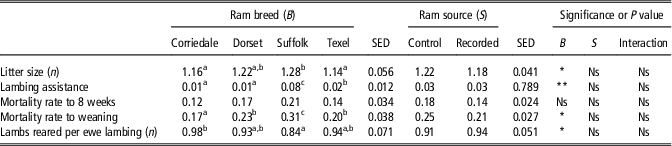
The effects of sire breed and source on litter size, lambing assistance, mortality and lambs weaned per ewe lambing are presented in Table 3.
Effect of ram breed and source on litter size, lambing assistance, mortality and lambs weaned per ewe lambing

Ns=not significant.
a,b,cValues in the same row without common superscript differ (at least P<0.05).
Significantly different: *P<0.05, **P<0.01; Ns: P>0.05.
Ewes sired with Suffolk rams had larger (P<0.05) litters than when sired with Texel or Corriedale rams, with ewes sired with Dorset rams being intermediate. Suffolk and Texel cross lambs required more assistance (P<0.01) at birth than Corriedale lambs, with Dorset cross lambs being intermediate for this trait. Although no differences (P>0.05) on mortality rates were detected up to 8 weeks, Suffolk cross lambs had a higher (P<0.05) mortality rate from birth to weaning than Corriedale lambs, with Dorset and Texel crossbred lambs being intermediate. Thereby, the number of lambs weaned per ewe lambing was lowest (P<0.05) for Suffolk sired lambs with ewes sired by Corriedale weaning the highest number of lambs.
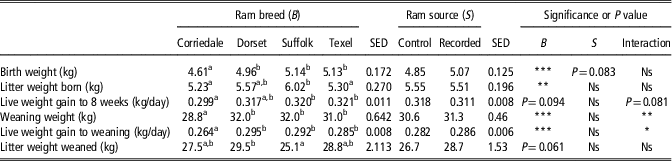
The effects of ram breed and source on lamb birth weights, live weight gain and weaning weights are presented in Table 4.
Effect of ram breed and source on lamb performance up to weaning

Ns=not significant.
a,bValues in the same row without common superscript differ (at least P<0.05).
Significantly different: *P<0.05, **P<0.001, ***P<0.01; Ns: P>0.05.
Corriedale lambs were lighter (P<0.001) at birth than lambs from the other three ram breeds at birth. Lamb birth weight tended to be higher (P=0.083) when recorded rams were used as sires. Total weight of lambs born per ewe, followed a similar pattern, with ewes mated to Suffolk rams producing more (P<0.01) kg of lamb than ewes sired with Texel or pure Corriedale rams, with ewes mated to Dorset rams being intermediate. The live weight gain of lambs up to 8 weeks tended to be higher (P=0.094) for Suffolk and Texel sired lambs compared with Corriedale lambs, with Dorset sired lambs being intermediate and for this period.
Lamb live weight gain from birth to weaning was higher (P<0.001) in crossbred lambs compared with Corriedale lambs. Thus, crossbred lambs averaged 2.9 kg heavier (P<0.001) in live weight at weaning than the Corriedale. Litter weight weaned tended to be lower (P=0.061) for Suffolk sired lambs in comparison with Dorset sired lambs, with Corriedale and Texel sired lambs being intermediate. Furthermore, significant sire breed x sire source interactions were detected for live weight gain (P<0.05) and weaning weight (P<0.01), with lower live weight gain and weaning weight for Suffolk cross lambs sired by recorded sires, whereas for Corriedale, Dorset and Texel sired lambs was the opposite.
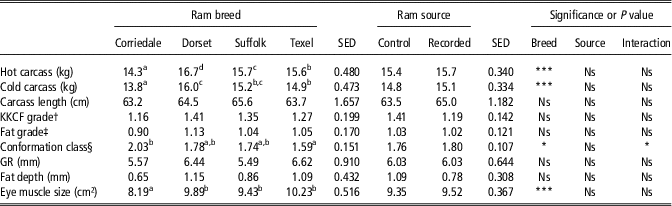
The effects of sire breed and source on lamb carcass characteristics (adjusted for age at weaning) are presented in Table 5.
Effects of ram breed and source on lamb carcass characteristics (adjusted for age at weaning)

KKCF=kidney knob and channel fat grade; GR=grade rule; Ns=not significant.
a,b,c,dValues in the same row without common superscript differ (at least P<0.05).
† KKCF (deficient=1 and excessive=3).
‡ Fat grade (deficient=1 and excessive=3).
§ Chilean conformation classification (very good=1 and poor=4).
Significantly different: **P<0.05, ***P<0.001; Ns: P>0.05.
Crossbred lambs reached higher HCW (P<0.001) and CCW (P<0.01) compared with Corriedale lambs, with the heaviest carcass weights belonging to Dorset sired lambs. Carcass length was not affected by sire breed (P>0.05). Ram breed did not alter KKCF, fat grade, GR and fat depth measurements (P>0.05).
A significant interaction between sire breed and sire source on lamb carcass characteristics was detected for conformation classification score (P<0.05), with higher conformation classification score for Corriedale lambs sired by recorded sires, whereas for crossbred lambs was the opposite.
Dorset, Suffolk and Texel sired lamb carcasses had significantly (P<0.001) greater eye muscle size than Corriedale lamb carcasses.
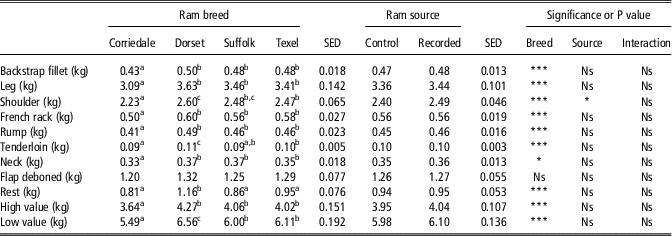
The different cuts of meat (Table 6) were all significantly affected by sire breed to a lesser or greater extent, except for deboned flap, as a result of the Corriedale lambs being smaller and having a lighter carcass than the rest of the breeds. Dorset sired lambs had a larger (P<0.001) shoulder cut than Corriedale lambs, with Suffolk and Texel sired lambs intermediate. Lambs sired by recorded rams presented heavier shoulder cuts than lambs sired by rams with the absence of genetic recording (P<0.05).
Effects of ram breed and source on lamb meat cut characteristics (adjusted for age at weaning)

Ns=not significant.
a,b,cValues in the same row without common superscript differ (at least P<0.05).
Significantly different: *P<0.05; ***P<0.001; Ns: P>0.05.
Backstrap fillet, Tenderloin and Leg cuts were analysed as higher value cuts and the rest as lower value cuts. The weight of high-value cuts was greater for all three terminal sired lambs (P<0.001) compared with Corriedale. On the other hand, Dorset sired lambs had a larger (P<0.001) proportion of lower value cuts in relation to Corriedale lambs for these traits, with Suffolk and Texel sired lambs being intermediate.
Discussion
Lamb survival and growth characteristics
In the present study, crossbred lambs were heavier at birth than Corriedale lambs, as reported by Bianchi et al. (Reference Bianchi and Garibotto2001) and by Latorre (Reference Latorre2004). Furthermore, in agreement with Dawson and Carson (Reference Dawson and Carson2002), lamb birth weight tended to be higher when recorded rams were used as sires.
In the current study crossbred lambs required more assistance at birth than Corriedale lambs, with ewes mated with Suffolk requiring the most assistance. These results are in agreement with previous studies (Bianchi et al., Reference Bianchi and Garibotto2001; Carson et al., Reference Carson, Irwin and Kilpatrick2001). Furthermore, recent studies (Dwyer and Bünger, Reference Dwyer, Lawrence, Brown and Simm2012) pointed out that terminal sired (Texel and Suffolk) crossbred lambs required more assistance at birth than lambs either from a Hill breed selected for hardiness (Scottish Blackface) or a crossbred representing a maternal line (Mule, Scottish Blackface x Border Leicester). This might be attributed to the heavier birth and litter weights recorded for crossbred lambs. For example, in the current study, ewes mated to Suffolk sires had a litter weight 0.79 kg heavier than when mated to Corriedale rams. However, as suggested by Dwyer and Bünger (Reference Dwyer, Lawrence, Brown and Simm2012) litter size, shape and a mismatch between lamb birth weight and maternal size or pelvic dimensions are likely to be contributing to the increase in birth difficulty observed.
It has been widely reported that for extensive production systems, high mortality rate to weaning is expected (e.g. Kelly, Reference Kelly1992; Scales et al., Reference Scales, Bray, Baird, O’Connell and Knight2000; Hinch and Brien, Reference Hinch and Brien2014). In relation to this, Claro (Reference Claro1978) found up to 19.8% of mortality on lambs born to Corriedale ewes in Magallanes Region in Chile (southern Patagonia). The high mortality rate observed in this study, in special reference to Suffolk, is in line with the work reported in the literature (e.g. Leymaster and Jenkins, Reference Leymaster and Jenkins1993; Dwyer et al., Reference Dwyer and Bünger1996; Dwyer and Lawrence, Reference Dwyer and Lawrence1998), showing that Suffolk sired lambs had lower survival to weaning compared with other genotypes. Further, it has been suggested that male Suffolk sired lambs appear to be more vulnerable than females as they are slower to stand and suck as neonates (Dwyer, Reference Dwyer2003). Overall, in the current study, lamb output per ewe was lowest in Suffolk crossbred lambs. Thereby, Macfarlane et al. (Reference Macfarlane, Matheson and Dwyer2010), suggested that both, birth difficulty and vigour, might be included in Suffolk breeding programmes to help reduce health and welfare problems associated with these traits in Suffolk sheep, and in flocks producing crossbred lambs sired by Suffolk rams. Nevertheless, some authors (Scales et al., Reference Scales, Bray, Baird, O’Connell and Knight2000) suggest that, despite the disadvantages of needing greater assistance at lambing and higher mortality, there are significant advantages for lamb production of using a terminal sire over Merino ewes. However, much care should be taken when choosing a terminal sire breed on extensive systems in mountainous farms of Western Patagonia, as it is important to focus on the overall output per farm as well.
In the present study, ewes sired with Suffolk rams had larger litters than Texel or Corriedale, with Dorset ram having intermediate litter size. There is some evidence showing that the genotype of the embryo (i.e. breed of ram used) may affect embryo success, for example Gallivan et al. (Reference Gallivan, Kemp, Berger and Young1993) and Freking et al. (Reference Freking, Leymaster and Young2000), reported larger litter size of ewes mated to Romanov rams, suggesting an advantage in embryonic survival of ewes mated to Romanov rams. Furthermore, Schmidova et al. (Reference Schmidova, Milerski, Svitakova, Vostra Vydrova and Vostry2016) pointed out that Suffolk rams in Suffolk sheep have a low but detectable influence on litter size of their mates. Although in the current work, it is not possible to determine if the larger litter size of ewes mated to Suffolk rams actually resulted from superior embryonic survival, it might be worth noting that overall average prolificacy recorded in Patagonia, Chile, for the Corriedale breed was 113% (Sales, Reference Sales2005), compared with 162% of prolificacy for well managed Suffolk flocks in Chile (Squella et al., Reference Squella, González and Quezada2007).
The use of specialized terminal sire breeds on Corriedale ewes produce lambs with higher live weight gains to weaning, compared with Corriedale lambs. A similar effect has also been shown by Bianchi et al. (Reference Bianchi and Garibotto2001) and by Latorre (Reference Latorre2004) on lambs born to Corriedale ewes. Differences between the Corriedale and the Suffolk, Poll Dorset and Texel sired lambs in terms of development and growth were clearly observed. In agreement with work done by Hanrahan (Reference Hanrahan1999) and by Dawson and Carson (Reference Dawson and Carson2002), the differences between recorded sired lambs and non-recorded sired lambs were in the expected direction for growth rate to weaning and weaning weight, but were non-significant, suggesting that the recorded rams were no better than the non-recorded rams under this environment. More recently, Marquez et al. (Reference Marquez, Haresign, Davies, Emmans, Roehe, Bünger, Simm and Lewis2012), reported that lambs sired by high index rams were on average, across breeds, significantly heavier at all ages and that their average daily gain was greater than low index sired lambs, however, within Suffolk sired lambs, there were little differences between high and low index sires for the traits studied. Marquez et al. (Reference Marquez, Haresign, Davies, Emmans, Roehe, Bünger, Simm and Lewis2012) suggested that the lack of difference in performance between recorded and non-recorded Suffolk sired lambs was due to environmental constraints, where the genetic potential of Suffolk rams may not have been achieved. Therefore, it is possible that for the current study, the lack of an effect of recorded rams on lamb growth rates was due to environmental constraints, overriding their genetic potential.
In line with previous work done in north-eastern Patagonia (Alvarez et al., Reference Álvarez, Rodríguez Iglesias, García Vinent, Giorgetti and Baselga2010), the current study showed that lamb overall weaning weights could be improved and thus, the proportion of lambs sold at weaning. This can be done by the introduction of rams from a terminal sire breed, in particular, Poll Dorset, on extensive systems in Western Patagonia. The use of Suffolk rams would be less advantageous because the mortality rate observed is higher.
Carcass characteristics
The present study showed that the carcass weight of lambs born from Corriedale ewes was significantly increased by the use of a range of terminal sire breeds. The positive effects of using a terminal sire breed on the carcass weight of lambs have been extensively reported in the literature (e.g. Scales et al., Reference Scales, Bray, Baird, O’Connell and Knight2000; Carson et al., Reference Carson, Irwin and Kilpatrick2001; Mousel et al., Reference Mousel, Notter, Leeds, Zerby, Moeller and Lewis2012). Although some reports (Bianchi et al., Reference Bianchi and Garibotto2001; Kremer et al., Reference Kremer, Barbato, Castro, Rista, Roses, Herrera and Neirotti2004) observed this effect to a lesser extent, especially with Texel sired lambs, when a lower growth rate to weaning has been recorded (e.g. Jones et al., Reference Jones, Lewis, Young, Wolf and Warkup2002; Leeds et al., Reference Leeds, Notter, Leymaster, Mousel and Lewis2011). It is worth noting that in the current trial, Dorset sired lambs outperformed Texel sired lambs.
The absence of an effect of sire breed on KKCF, fat grade, GR and fat depth is similar to the results of Shackelford et al. (Reference Shackelford, Leymaster, Wheeler and Koohmaraie2012) using lambs which were heavier at slaughter.
As in the current study, Kirton et al. (Reference Kirton and Johnson1997) reported no differences between pure Romney lambs and crossbred lambs from several breeds on GR tissue depth at a same carcass weight of 19.5 kg. However, Bianchi et al. (Reference Bianchi and Garibotto2001) reported that at a constant carcass weight, Suffolk sired lambs had lower tissue depth (9.4 mm), with Corriedale, Texel, Hampshire Down and Southdown sired lambs showing a larger but similar GR. In the current study, data were adjusted to a constant age at weaning, and overall differences in GR tissue depth recorded were small and non-significant, ranging between of 5.5 and 6.6 mm, in line with the lower age at slaughter and suggesting a potential development in case that lambs need to be finished on another source of forage on a post-weaning period.
As it was observed earlier (Jones et al., Reference Jones, Lewis, Young, Wolf and Warkup2002), Texel sired lambs had higher conformation classification score compared with Corriedale, with both Suffolk and Poll Dorset cross lambs showing an intermediate value. A significant interaction was detected between sire breed and source for lamb carcass conformation. The superiority of Texel crossbred lambs for conformation is well documented in the literature (e.g. Carson et al., Reference Carson, Irwin and Kilpatrick2001; Dawson et al., Reference Dawson, Carson, Mc Clinton, Kilpatrick and Moss2003). In north-eastern Patagonia, Alvarez et al. (Reference Álvarez, Rodríguez Iglesias, García Vinent, Giorgetti, Rodríguez and Baselga2013) has shown that terminal crossbreeding with Ile de France, Texel and CRIII (a composite breed) rams could be implemented to improve carcass conformation. Overall, the study has demonstrated that carcass conformation of lambs from Corriedale ewes was substantially improved by all terminal sire breeds.
Terminal sired lambs had on average 20.3% larger area of the eye muscle than Corriedale lambs in this trial. Although no differences were detected between the three terminal sires on this trait, it might be worth noting that the area of eye muscle of Texel sired lambs were 6% larger than the average of Suffolk and Dorset sired lambs, in line with the observations of Cruickshanks et al. (Reference Cruickshank, Muir, MacLean, Goodger and Hickson1996), however these latter authors found these significant breed differences at heavier HCW, whereas in the current study, on average, HCW was 3.6 kg lighter. There is much evidence reported in the literature indicating that the use of a terminal sire breed will increase the area of the eye muscle of dual-purpose or wool breeds. For example, Scales et al. (Reference Scales, Bray, Baird, O’Connell and Knight2000) reported that estimated eye muscle size of lambs from Merino ewes was significantly increased by all terminal sire breeds.
Most commercial cuts of lambs from Corriedale ewes were considerably improved by all terminal sire breeds. Overall, no differences were detected between the three terminal sires on these traits, although with Dorset sired lambs, the weight of the shoulder was higher in relation to Texel crossbred, with Suffolk sired lambs being intermediate, with higher weights detected when improved Dorset rams were used as sires. This situation might partially explain the higher proportion of low-value cuts observed with Dorset sired lambs in relation to Suffolk or Texel sired lambs.
Among the three terminal sire breed, the reported higher saleable meat yield and larger proportion of high-value cuts of Texel crossbred lambs (e.g. Cruickshank et al., Reference Cruickshank, Muir, MacLean, Goodger and Hickson1996; Hopkins and Fogarty, Reference Hopkins and Fogarty1998; Kremer et al., Reference Kremer, Barbato, Castro, Rista, Roses, Herrera and Neirotti2004) were not detected in this trial, probably because of the early endpoint adapted to fit in with the systems of production of Western Patagonia. However, the better conformation and the non-significant trend for a larger loin area observed with Texel sired lambs, suggests that with heavier and older lambs, this pattern might change.
In line with Hanrahan (Reference Hanrahan1999), no major differences were detected between recorded sired lambs and non-recorded sired lambs for carcass traits and this may be due to environmental (nutritional) constraint and the early endpoint adopted.
In conclusion, the use of a terminal sire with Corriedale ewes improved weaning weight and carcass weight under Western Patagonia conditions. Crossbred lambs in particular Dorset cross lambs, had higher growth rates and weaning weights than Corriedale lambs. Moreover, crossbreeding Corriedale ewes with Dorset, Suffolk or Texel sires increased lamb weight at weaning and improved carcass characteristics. Overall, the use of recorded sires did not increase the performance of lambs under the conditions evaluated.
Acknowledgements
The authors wish to express their sincere thanks to the sheep producers associated to the Sociedad Comercial Corriedale Aysen, for their help and hard work in undertaking this study. The authors are also grateful to the Fundación para la Innovación Agraria (FIA), and Instituto de Investigaciones Agropecuarias (INIA), who provided funding for this project.
Declaration of interest
No conflict of interests declared.
Ethics statement
The work described in this paper was conducted in accordance with the requirements of the Chilean Law 20380 on Animal Protection and with the approval of the INIA Bioethics Committee.
Software and data repository resources
None.