


The herbicide 2,4-D has been used worldwide for weed control in agriculture for the last 70 years and is a key tool for burndown applications on fields under no-tillage cropping systems (Foloni Reference Foloni2016). In Brazil, physical particle drift related to improper utilization of 2,4-D has been a recurrent problem because of 2,4-D’s low-dose toxicity and rapid effect on sensitive nontarget crops. Sublabel doses of 2,4-D reduced the potential fiber yield of cotton (Gossypium hirsutum L.) by 32% to 62%, even with doses as low as 3.3 and 6.7 g ae ha−1, respectively (Constantin et al. Reference Constantin, De Oliveira Júnior, Fagliari, Pagliari, De Arantes, Cavalieri, Framesqui and Gonçalves2007). Similar studies with other 2,4-D sensitive crops such as nontransgenic soybean (Johnson et al. Reference Johnson, Fisher, Jordan, Edmisten, Stewart and York2012) and tomato (Fagliari et al. Reference Fagliari, de Oliveira and Constantin2005) have shown extensive yield losses and deleterious effects. Cotton and soybean are highly variable in their responses to 2,4-D exposure, with growth stage and weather conditions at application identified as key factors (Egan et al. Reference Egan, Barlow and Mortensen2014).
The spray droplet spectrum is one of the primary factors influencing the movement of fine driftable droplets to off-target fields that can be controlled through drift-reduction techniques (Antuniassi et al. Reference Antuniassi, Moreira, Pinheiro and Lucio2016). In fact, the spray solution content impacts the volume median diameter (VMD) and the percentage of spray volume with droplets smaller than 105 μm (V105) (Miller and Butler Ellis Reference Miller and Butler Ellis2000). Other drift-control tools commonly utilized to improve the spray droplet spectra while mitigating off-target movement are drift-reduction nozzles (Ferguson et al. Reference Ferguson, O’Donnell, Chauhan, Adkins, Kruger, Wang, Urach Ferreira and Hewitt2015). Although both chemical and mechanical tools have shown individual effects to control spray drift under field conditions, specific associations among them can result in different interactions. For example, a 2,4-D dimethylamine (DMA) formulation applied through drift-reduction nozzles had higher spray drift potential than did a 2,4-D choline formulation (Contiero et al. Reference Contiero, Biffe, Constantin, De Oliveira Júnior, Braz, Lucio and Schleier2016).
A 2,4-D formulation (GF-3073) comprised of 2,4-D choline and proprietary components was developed for use on 2,4-D–resistant crops and is under the registration process in Brazil and other Latin American countries. This formulation provides a reduced potential for off-target movement of physical particles by significantly decreasing the percentage of spray volume with fine spray droplets (Richburg et al. Reference Richburg, Wright, Braxton and Robinson2012). GF-3073 applied through different spray nozzles resulted in 18% to 25% greater VDM and 47% to 62% lower V105 than did a standard 2,4-D DMA formulation (Moreira et al. Reference Moreira, Antuniassi, Pinheiro, Lucio, Jesus, Santana and Berna2016). In addition to reducing the potential for spray drift under laboratory conditions, the choline formulation of 2,4-D is less volatile than the ester and DMA formulations (Richburg et al. Reference Richburg, Wright, Braxton and Robinson2012). Injury levels of 76%, 13%, and 5% were noted for cotton exposed to the 2,4-D ester, DMA, and choline formulations, respectively, when under plastic tunnels for 48 hours (Sosnoskie et al. Reference Sosnoskie, Culpepper, Bo Braxton and Richburg2015).
The data on GF-3073 from wind tunnel deposition studies with two spray nozzles have shown reduction of the drift index (DI) by 30% and 47% in comparison to a 2,4-D DMA formulation (Moreira et al. Reference Moreira, Antuniassi, Pinheiro, Lucio, Jesus, Santana and Berna2016). But additional data from field studies concerning diverse climatic conditions and sprayer equipment are needed to confirm the reduced potential for spray drift of this formulation. In particular, there is a need for GF-3073 to be evaluated in the soybean production regions of Brazil, where spray drift was estimated to occur in 50% of field pesticide applications (Friedrich Reference Friedrich2004). Although there are no official statistics concerning spray drift incidents in Brazil, growers generally rank 2,4-D at or near the top of the list of herbicides implicated in crop injury complaints. Thus, the objective of this research was to determine the effect of 2,4-D formulations and spray nozzles on 2,4-D spray drift under conventional field conditions.
Materials and Methods
Six trials were conducted under field conditions during the summer growing seasons of 2014/2015 and 2015/2016 at five different locations across southern and central regions of Brazil (Table 1). The trials were conducted at accredited field stations and reflected a range of environmental conditions and agronomic practices observed in the no-till soybean cropping systems in Brazil. Glyphosate-resistant soybean was used as a sensitive species to determine 2,4-D spray drift and was sown in rows spaced 50 cm apart and seeded at a standard rate of 36 seeds m−2 (Table 1). In addition, ‘Ap 533’ hybrid tomato seedlings were grown in 5-L plastic pots containing coconut fiber substrate in conventional shade houses with open sides and daily spray irrigation. The tomato was used as a second bioassay species to evaluate the spray drift of the 2,4-D treatments due its high sensitivity and apparent visual symptoms to 2,4-D exposures (Fagliari et al. Reference Fagliari, de Oliveira and Constantin2005).
Trial locations in Brazil over two growing seasons.

a Syn 1152 RR (1), BMX Potência RR (2) and M8210 IPRO (3) soybean varieties.
b BMX Potência RR (1 and 2) and NS 7000 IPRO (3) soybean varieties.
In each trial, the soybean rows were sown parallel to the direction of the predominant wind of the region during the summer growing season according to historical weather records of each field station (Figure 1). Plots were 30 m wide by 24 m long (720 m2) containing 60 soybean rows and buffer zones containing four sweet corn (Zea mays L.) rows. Additionally, potted tomatoes were moved from the shade houses to the field and distributed on a grid across the plot, 5 m apart. Applications were performed 1 m away from the plot edge perpendicular to the rows when wind direction was parallel to the soybean rows with less than 30° of angle deviation. Spray drift treatments were applied in 100 L ha−1 with tractor sprayers at 276 kPa equipped with a 7-m-wide boom operating at 6.8 km h−1 at 50 cm above the canopy of the soybean plants. At the time of application, soybean was at the three-leaf stage and 25 cm tall, potted tomato was at the three-leaf stage and 20 cm tall, and sweet corn was at six-leaf stage and 60 cm tall.
Plot designa and 2,4-D spray drift simulation. a For soybean, each experimental unit was four crop rows, whereas for tomato, each experimental unit was five potted plants.
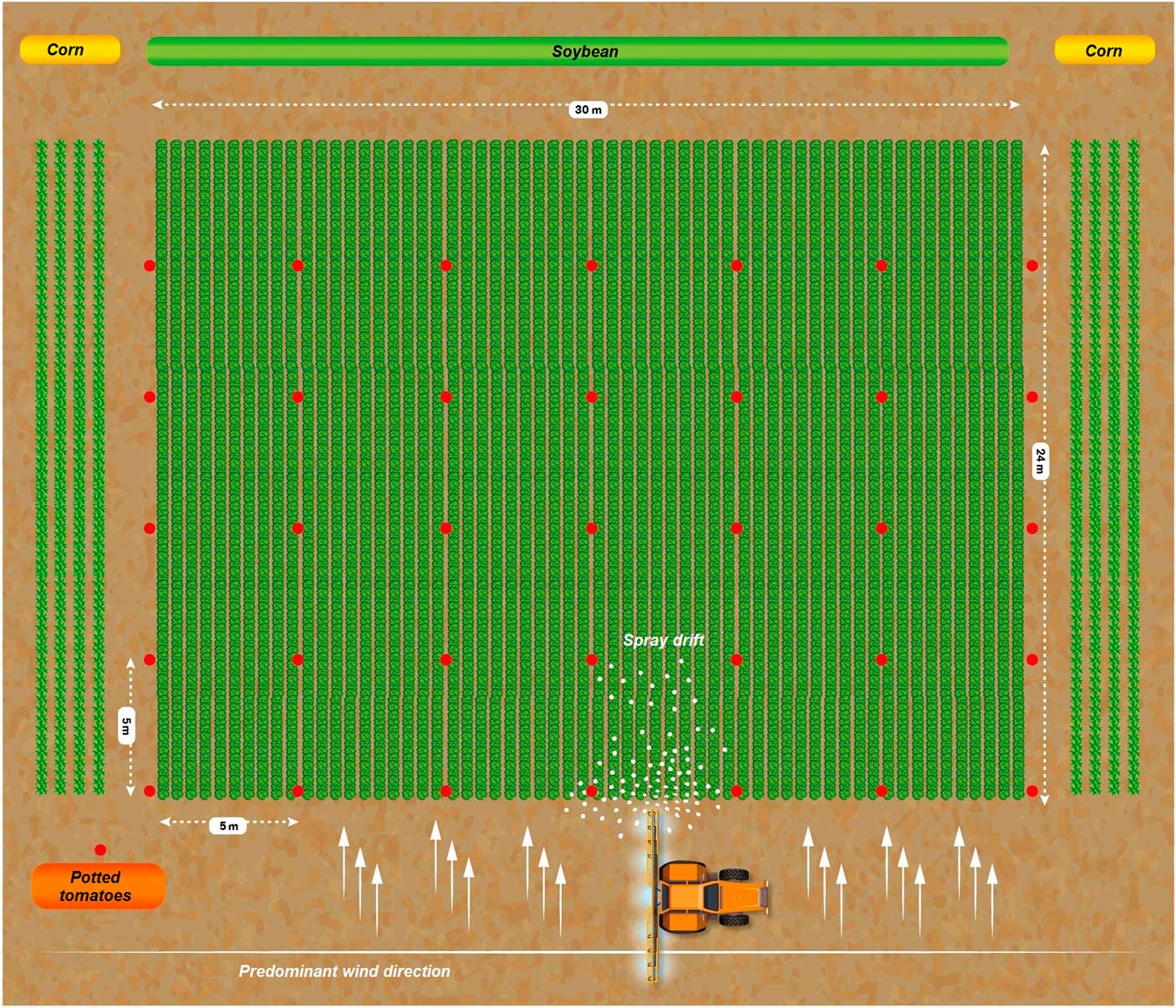
The experiment design was a completely randomized design arranged as a factorial, using 15 experimental units for soybean and seven experimental units for potted tomato. For soybean, the experimental units contained four crop rows (2 m wide by 24 m long), whereas for tomato, each experimental unit contained five potted plants (5 m wide by 20 m long). Factor A was 2,4-D choline and 2,4-D DMA formulations (GF-3073 and DMA® 806 BR, 456 and 669 g ae L−1, respectively; Dow AgroSciences, Indianapolis, IN). GF-3073 is an experimental 2,4-D choline formulation containing Colex-D® technology (Dow AgroSciences, Indianapolis, IN). Factor B was XR and AIXR nozzles (extended range flat-fan spray nozzles and air induction extended range flat-fan spray nozzles, respectively; TeeJet Technologies, Springfield, IL). GF-3073 and 2,4-D DMA formulations were applied at 1,170 g ha−1 of 2,4-D acid equivalent. XR and AIXR nozzles had 110° spray angles and 0.57 L min−1 flow rate at the reference spray pressure of 276 kPa.
Air temperature, relative humidity, and wind speed were measured using a Lutron LM-8000 environmental meter (Lutron Electronics, Coopersburg, PA) coupled to the end of the boom, with the wind speed sensor downwind. Real-time data displayed by the device were recorded using a GoPro Hero 5 portable digital camera (GoPro, Inc., San Mateo, CA) coupled to the boom 50 cm in front of the meter. Thus, the environmental variables were independently measured for every experimental unit of soybean or potted tomatoes during the applications of the different treatments.
The distance from the plot edge to the farthest injured plant with any 2,4-D symptoms such as leaf chlorosis, epinasty, and/or necrosis was assessed for every four soybean rows at 10 and 20 days after treatment (DAT). Additionally, the same evaluation was performed with the potted tomatoes at 10 DAT, which were identified and moved back to the shade houses approximately 18 hours after treatment. The spray drift–affected area in which soybean or potted tomatoes suffered apparent visual symptoms from 2,4-D exposure was determined by the following calculation:
 $${\rm Area}\,{\equals}\,\mathop{\sum}{\left[ {\left( {y_{i} {\plus}\mathop{{y_{{i{\plus}1}} }}\limits_{{i\,{\equals}\,1}}^{{N_{i} {\minus}1}} } \right)\,/\,2} \right]\,\left( {x_{{i{\plus}1}} {\minus}x_{i} } \right)} ,$$
where y i is the distance from the plot edge to the farthest injured plant with any 2,4-D apparent visual symptoms at the ith experimental unit, x i is the width of the assessed area at the ith experimental unit, and N i is the total number of experimental units. This calculation is known as area under the curve and provides a quantitative estimation of the spray drift–affected area of the entire plot with data from each experimental unit. In agricultural research, area under the curve calculation have been commonly applied to disease-progress studies in plant epidemiology (Shaner and Finney Reference Shaner and Finney1977).
Finally, the data on distance from the plot edge to the farthest injured plant were subjected to analysis of variance with mixed model using the JMP program (version 12.2.0, SAS Institute Inc., Cary, NC):
 $$\eqalignno { {\rm Distance}_{{ijkl}} \,{\equals}\,&mean{\plus}a_{i} {\plus}b_{j} {\plus}a{\times}b_{{ij}} {\plus}c_{k} {\plus}a{\times}c_{{ik}} {\plus}b{\times}c_{{{\rm jk}}} \cr & {\plus}a{\times}b{\times}c_{{ijk}} {\plus}d_{{ijkl}} {\plus}error_{{ijkl}} ,$$
where formulations (a i ), nozzles (b j ), and their interaction were modeled as fixed effects; location (c k ) and their interactions were modeled as random effects; and wind speed (d ijkl ) at application was included as a covariate. Subindex l in the model above refers to each experimental unit: each group of four soybean rows and five potted tomato plants where evaluations were independently made. The spray drift–affected area was analyzed with a similar mixed model in which formulations and nozzles were combined as a unique factor due to the value conversion in relation to the standard characterized by the 2,4-D DMA formulation applied through the XR nozzle. Significance of treatment effect was evaluated with F-approximate test (α=0.05) and least square means from different treatments were compared with Tukey’s test.
Results and Discussion
Air Temperature, Humidity, and Wind Speed
Air temperature and humidity showed slight variation among the applications within the same trial, while the wind speed differed numerically among these applications in most situations (Table 2). The wind speed variation was not large among the applications in two out of six trials (<30%), while in the other cases the variation ranged from 58% to 100%. Indeed, wind speed is a process that presents considerable fluctuation in time and space, and its forecast for agricultural purposes is difficult in Brazil and other Latin America countries. Pesticide applications often occur when wind speeds are above the recommended range (3 to 10 km h−1), which is the cause of spray drift in approximately 50% of situations in Brazil (Friedrich Reference Friedrich2004). Thus, our study simulated conventional situations of variable wind speed as well as wind speed above 10 km h−1 at the time of application of the different treatments.
Air temperature, humidity, and wind speed at real-time assessment.

a Values (mean ± SE) independently measured for every experimental unit.
Distance of the Farthest Injured Plant
For soybean, the effect of formulations and nozzles was significant at 10 DAT (F1, 5.0=32.08, P=0.0024; F1, 10.0=30.78, P=0.0002; respectively) as well as at 20 DAT (F1, 4.9=20.97, P=0.0060; F1, 9.9=39.71, P<0.0001; respectively). The effect of the interaction between formulations and nozzles and the covariate wind speed was not significant at 10 DAT (F1, 10.0=0.19, P=0.6699; F1, 350.9=0.27, P=0.0965; respectively) and 20 DAT (F1, 10.0=0.43, P=0.5262; F1, 353.4=0.00, P=0.9729; respectively). Relative to the 2,4-D DMA formulation, GF-3073 reduced the distance of the farthest injured plant at 10 DAT by 8.2 m (39%) and 4.4 m (53%) for the XR (13.5 m) and AIXR (9.3 m) nozzles, respectively (Table 3). At 20 DAT, GF-3073 reduced this variable by 8.7 m (40%) and 4.3 m (54%) for the XR (14.4 m) and AIXR (9.3 m) nozzles, respectively. Applying GF-3073 through the AIXR nozzle decreased the distance of the farthest injured plant by 67% at 10 DAT and 70% at 20 DAT in comparison to the 2,4-D DMA formulation applied with the XR nozzle.
Distance from the plot edge to the farthest injured plant with any 2,4-D symptoms, and spray drift–affected area relative to the standardFootnote a in glyphosate-resistant soybean as a function of 2,4-D formulation and spray nozzle at 10 and 20 days after treatment (DAT). Data generated from six trials in the 2014/2015 and 2015/2016 growing seasons.

a 2,4-D DMA formulation and XR nozzle (not included in the Tukey’s test).
b Values (mean ± SE) followed by different letters are significantly different by Tukey’s test.
For potted tomatoes, the effect of formulations and nozzles was significant at 10 DAT (F1, 4.8=61.78, P=0.0006; F1, 5.0=14.78, P=0.0120; respectively), while the effect of the interaction between formulations and nozzles and the covariate wind speed was not significant (F1, 5.1=1.31, P=0.3025; F1, 259.0=0.36, P=0.5473; respectively). Relative to the 2,4-D DMA formulation, GF-3073 reduced the distance of the farthest injured plant at 10 DAT by 12.7 (27%) and 7.0 m (51%) for the XR (17.5 m) and AIXR (12.7 m) nozzles, respectively (Table 4). GF-3073 applied through the AIXR nozzle decreased the magnitude of this variable at 10 DAT by 60% in comparison to the 2,4-D DMA formulation applied with the XR nozzle.
Distance from the plot edge to the farthest injured plant with any 2,4-D symptoms, and spray drift–affected area relative to the standardFootnote a in potted tomato plants as a function of 2,4-D formulation and spray nozzle at 10 days after treatment. Data generated from six trials in the 2014/2015 and 2015/2016 growing seasons.

a 2,4-D DMA formulation and XR nozzle (not included in the Tukey’s test).
b Values (mean ± SE) followed by different letters are significantly different by Tukey’s test.
In wind tunnel deposition studies, the amount of spray drift deposited on nylon strings 2 m downwind from the nozzles was simulated in a wind tunnel at a wind speed of 9 km h−1 to evaluate the DI of 2,4-D formulations. In this case, GF-3073 reduced the DI by 30% and 47% for the XR and AIXR nozzles, respectively, compared to a standard 2,4-D DMA formulation (Moreira et al. Reference Moreira, Antuniassi, Pinheiro, Lucio, Jesus, Santana and Berna2016). A premix of 2,4-D and glyphosate with Colex-D® technology also reduced the DI by 57% and 52% for the XR and AIXR nozzles, respectively, compared to a tank-mixture of 2,4-D and glyphosate DMA formulations (Antuniassi et al. Reference Antuniassi, Moreira, Pinheiro and Lucio2016). Thus, the results of the present study are in accordance with the data from laboratory trials and show that GF-3073 was capable of reducing the 2,4-D spray drift under field conditions even with wind speeds above the recommended limit of 10 km h−1.
Spray Drift–Affected Area
For soybean, the spray drift–affected area relative to that of the 2,4-D DMA formulation applied through the XR nozzle varied as a function of the treatments at 10 DAT (F2, 9.5=18.85, P=0.0009) and 20 DAT (F2, 9.9=25.02, P<0.0001). Additionally, the wind speed at application was not a significant covariate in the model at either assessment date (10 DAT, F1, 13.1=0.10, P=0.7552; 20 DAT, F1, 13.9=0.00, P=0.9584). Relative to the 2,4-D DMA formulation, GF-3073 decreased the magnitude of this variable by 38% and 52% at 10 DAT and by 31% and 49% at 20 DAT for the XR and AIXR nozzles, respectively (Table 3). Moreover, GF-3073 applied through the AIXR nozzle decreased the relative nontarget area to the standard by 68% at 10 DAT and 67% at 20 DAT.
For potted tomatoes, the effect of the treatments was significant at 10 DAT (F2, 10.0=28.75, P<0.0001), while the effect of the covariate wind speed was not significant (F1, 13.8=0.05, P=0.8117). GF-3073 reduced the nontarget area by 27% and 49% at 10 DAT for the XR and AIXR nozzles, respectively, compared to that of the 2,4-D DMA formulation (Table 4). Additionally, GF-3073 applied through the AIXR nozzle decreased the nontarget area relative to the standard by 60% at 10 DAT.
The air induction nozzles are well known tools designed to produce a greater proportion of large-diameter spray droplets as well as fewer drift-prone, fine spray droplets (McGinty et al. Reference McGinty, Baumann, Hoffmann and Fritz2016). For example, the application of several chemicals through the AIXR nozzles increased the VMD in all situations compared to the standard XR nozzle (Ferguson et al. Reference Ferguson, O’Donnell, Chauhan, Adkins, Kruger, Wang, Urach Ferreira and Hewitt2015; Martini et al. Reference Martini, Avila, Camargo, Moura, Marchezan and Pivetta2015). In another study, both 2,4-D choline and DMA formulations showed lower drift potential when applied through the ADIA nozzle (flat fan with air induction) in relation to the XR nozzle (Contiero et al. Reference Contiero, Biffe, Constantin, De Oliveira Júnior, Braz, Lucio and Schleier2016). Thus, GF-3073 and the air induction nozzles are a powerful combination for reducing 2,4-D movement to nontarget crops in the areas where 2,4-D-resistant crops are grown.
Our cross-geographic and multiseason trials present the first data about the GF 3073 (Colex-D® technology) confirming the reduced potential for spray drift under conventional field conditions. Thus, both our field trials and previous laboratory studies have shown advances in this technology to reduce the risk of herbicide injury to environmentally sensitive areas and nontarget crops. Additionally, these studies have demonstrated that the association between this formulation and drift-reduction nozzles provides effective reduction of 2,4-D spray drift. However, the Colex-D® technology will only provide effective on-target applications when applicators adopt the best management practices indicated on the stewardship programs. The recommended drift reduction strategies, such as selecting the proper nozzle, adjusting boom height, changing the carrier volume, restricting applications during adverse environmental conditions, and providing buffer zones, are still important to prevent off-target movement of 2,4-D (Anonymous 2017; Felsot et al. Reference Felsot, Unsworth, Linders, Roberts, Rautman, Harris and Carazo2010).
Acknowledgments
The authors are thankful for the efforts and technical assistance of colleagues and partners at Dow AgroSciences, University of Cruz Alta, Catholic University of Paraná, UDI Research, and Bahia Foundation. Additionally, Pablo Valverde, David Simpson, and Jerome Schleier III provided helpful comments on the manuscript.
®™ Trademark of The Dow Chemical Company (“Dow”) or an affiliated company of Dow.



