

Introduction
‘Pioneered’ by Robert W. Cox,Footnote 1 the neo-Gramscian perspective aims to provide a superior explanation for the functioning and changing nature of the international system than mainstream ‘problem-solving’ neorealist IR theory,Footnote 2 which is beset by fundamental epistemological and methodological flaws.Footnote 3 Alternatively, Cox advocates critical theory, designed to revitalise agency and engender social emancipation, and built on an historicist epistemology, which ‘does not take institutional and social and power relations for granted but calls them into question by concerning itself with their origins and how and whether they might be in a process of changing’, and what forces have the emancipation potential to transform the prevailing order. All truth, in short, is historically/socially contingent,Footnote 4 and all concepts continually adjusted to explain the ‘changing reality’.Footnote 5
A key motive of Cox’s deconstruction of traditional IR theory is to recover the concept of hegemony from state-centric American IPE theorists, whose ‘hegemonic stability theory’ interprets the term as being analogous to ‘dominance’.Footnote 6 Far better, Cox insists, is to follow Antonio Gramsci’s lead and conceptualise hegemony as a form of class rule, with class itself understood as an historical relationship rather than static analytical category.Footnote 7 The raison d’état for a particular state depends on social relations: the condensation of a hegemonic relationship between dominant classes and class fractions. A country’s particular ‘foreign policy’, therefore, emerges from ongoing complex social processes (that is, class struggles) within its particular historical bloc (HB), which itself is in constant dialectical interaction with global social forces.Footnote 8
This critical theory of hegemony rooted in historical materialism is superior to mainstream IR theory, Cox claims, due to its: (i) dialectic; (ii) vertical imperial focus; (iii) better conceptualisation of the ‘internal’ relationship between the state and civil society; and (iv) emphasis on the production process.Footnote 9 Cox’s model, therefore, is formally located within a production paradigm: changes within the production sphere arising from the dialectical interplay of historically contingent social forces could be exploited by progressive political groups as part of a counter-hegemonic drive towards human emancipation.Footnote 10
Following his ‘method of historical structures’ (see below) and drawing on the work of the Braudel Annals School, Eric Hobsbawm, and world-system scholar Immanuel Wallerstein, Cox maintains that the traditional historical template for the rise and fall of successive hegemonic orders has now been surpassed.Footnote 11 Thanks to globalisation processes launched by Washington from the late 1940s onwards – encompassing both the ‘internationalization of the state’ (IOS) and the ‘internationalization of production’ (IOP) – and consolidated in the 1970s world economic crisis, it is no longer pertinent to think in terms of state-centred world hegemony. Instead, we are living through a new, transnationalist capitalist age, with the core economic regions enmeshed in a single but complex transnational economic space ‘transcending all country borders’.Footnote 12
And just as domestic economies are subordinated to the demands of transnational capital and finance, so the modern state itself is being transformed. The postwar Keynesian welfare state has been replaced by a weakened ‘internationalised’ (‘hyperliberal’) state, which ‘willy nilly became more effectively accountable to a nébuleuse personified as the global economy’,Footnote 13 or ‘transnational managerial class’.Footnote 14
Despite their significant differences,Footnote 15 all subsequent neo-Gramscians have built on Cox’s transnational thesis, positing the emergence of a bourgeoning class-conscious ‘transnational capital class’ and ‘transnational HB’ (see below).
While appreciative of the breadth and richness of this analysis, we consider, however, that this transnational thesis presents an incomplete account of the evolution of the contemporary world order, which stems from Cox’s failure to develop a convincing theoretical framework to explain social change. This weakness, in turn, is a direct corollary of deeper running inconsistencies in the ontological, epistemological, and methodological positions adopted (not to mention a partial reading of Gramsci himself).
In order to develop a more coherent theoretical and conceptual framework to analyse the dynamics of global politics, this critique of neo-Gramscian thought will begin, therefore, by briefly outlining Cox’s ontological standpoint.
I. ‘Historicising structure’
Underpinning Cox’s epistemological disagreements with ‘problem-solving’ theories lay a deeper ontological division, in particular regarding the structure-agency question. While distancing himself from those who focused primarily on agency (for example, idealism, pluralism, or constructivism), the nature of his own particular emancipation project meant Cox was especially critical of structuralists (for example, neorealism, world-systems theory, and Structural Marxism), whom he denounced for being driven by a search for an ‘inner essence’ or a particular ‘logic’ (for example, power-maximisation, division of labour, or capital).Footnote 16 Critical theory required the elaboration of a structurally grounded, yet non-determinist, explanation of social change, and with agency very much at the forefront. The solution hit upon was to historicise structure itself.
Cox defines so-called ‘historical structures’ as ‘persistent social practices, made by collective human activity and transformed through collective human activity’, constituted by the interaction between ‘a particular combination of thought patterns, material conditions, and human institutions’ (see below). Said structures represent a ‘framework for action’, imposing ‘pressures and constraints’, which social actors may work with or attempt to resist but could not ignore; indeed, even where agents do manage to ‘resist a prevailing historical structure’ they must ‘buttress’ their actions ‘with an alternative, emerging configuration of forces, a rival structure’.Footnote 17
As indicated, any given historical structure is formed by the interaction of ‘three categories of forces (expressed as potentials)’, namely: (i) material capabilities; (ii) ideas; and (iii) institutions,Footnote 18 represented schematically, in a reciprocal non-determinist triangular format; with each of the ‘forces’ able to exert an influence on, and be affected by, either of the other two forces. This ‘method of historical structures’ is then applied to three particular levels or spheres of activity,Footnote 19 each one again engaged in a reciprocal, non-determinist relation with the other, namely: (i) social forces produced by the social relations of production (SROP);Footnote 20 (ii) forms of state (FOS);Footnote 21 and (iii) world order (WO).Footnote 22 In theory, therefore, each of these ‘spheres’ is constituted by its own particular configuration of ‘material’, ‘ideational’, and ‘institutional’ forces. In reality, however, these spheres do not exist in isolation but rather impact on, and are impacted by, the other respective spheres as part of a genuine historical process. ‘Changes in the organisation of production’, Cox continues, ‘generate new social forces which, in turn, bring about changes in the structure of states; and the generalisation of changes in the structure of states alters the problematic of world order.’Footnote 23
Yet despite acknowledging the ‘juxtaposition and reciprocal relationships’ between the structure (‘economic sphere’) and the superstructures (‘political, ethical and ideological spheres of activity’) within the HB,Footnote 24 Cox claims these ‘historical structures’ are not ‘out there’, constituting an objective reality, but ‘intersubjective’ and ‘socially constructed’: ‘they become part of the objective world by virtue of their existence in the intersubjectivity of relevant groups of people’. In short, ‘the objective world of institutions is real because we make it so by sharing a picture of it in our minds’.Footnote 25
Importantly, therefore, Cox is reducing structures to historically conditioned intersubjective relations (human consciousness and practice): ideology and subjectivity are now to be taken as causal within the production and reproduction of WO. Furthermore, while seemingly acknowledging the ontological difference between structure and agency – affirming structures ‘are in one sense prior to individuals’ – Cox then contradicts this notion, asserting that ‘structures are not in any deeper sense prior to the human drama itself’ and ‘are not “givens” (data), they are ‘mades’ (facts) – made by collective human action’.Footnote 26
It is this latter interpretation that predominates in Cox’s work, expressed in his conceptualisation of hegemony as a particular historically defined structure that is internalised (though not necessarily consciously) by social agents: ‘a structure of values and understandings about the nature of order that permeates a whole system of states and non-state entities’ and is derived ‘from the way of doing and thinking of the dominant strata of the dominant state or states’.Footnote 27
Unfortunately, in their drive to transcend structure-agency dualism, Cox and many other neo-Gramscians opt for a solution similar to that of Anthony Gidden’s ‘structuration theory’ namely, to merge structure and agency together (that is, central conflation), considering them ‘mutually constitutive’ phenomena, like two sides of the same coin.Footnote 28 The main problem of failing to distinguish ontologically between structure and agency, according to Margaret Archer (see below), is that it prevents any real dialectic interaction between the two and hence hindering practical research;Footnote 29 an error repeated by other ‘elisionist’ perspectives such as social constructivism and post-structuralism.
Since Cox claims to be forwarding a novel neo-Gramscian perspective on WO, it is appropriate to turn to Gramsci himself and uncover his perspective on the structure-agency debate. A key reference here is Marx’s ‘Preface’ to the Critique of Political Economy (1859) – among the very first works he translated once incarcerated – and which remains one of the theoretical touchstones for the Prison Notebooks, considered ‘the most important authentic source for the reconstruction of the philosophy of praxis’.Footnote 30
Citing Marx, Gramsci interprets the essence of the ‘Preface’ as indicating that ‘it is on the level of ideologies that men become conscious of conflicts in the world of the economy’.Footnote 31 In a similar vein, Gramsci explains that the establishment of hegemony passes through three stages, or ‘moments’, distinguishing between the first ‘moment’ – the ‘relation of social forces’, described as ‘objective’ and ‘independent of human will’, which ‘provides a basis for the emergence of the various social classes’ – and the second ‘ethico-political’ ‘moment’, the ‘relation of political forces’, where dominant groups transcend the corporate limits of their economic class concerns to launch a broad society-wide hegemonic project.Footnote 32 Indeed, one could regard Gramsci’s entire prison research project as being concerned with ‘how the historical movement is born out of the structure’ in order to reveal just how ‘the formation of active political groups’ takes place and whether said groups are capable of engineering dramatic societal change and establish their hegemony.Footnote 33
It becomes clear from these and other passages that Gramsci holds structure and agency to be: (i) ontologically distinct; the former existed independently of an agent’s consciousness of it; (ii) temporally differentiable, the former pre-existing the latter; and (iii) inseparable, engaged in a dialectal materialist relationship, in which the latter served to reproduce or transform the former.Footnote 34
At the same time, and despite their ‘methodological distinction’, Gramsci insists, there is a dialectical unity between socioeconomic relations (structure) on one hand, and political, ethical, and cultural practices/issues (agency) on the other,Footnote 35 which finds expression in the HB, defined as ‘the complex contradictory and discordant ensemble in the superstructure is the reflection of the ensemble of the social relations of production’.Footnote 36
Similarly, with regards his conceptualisation of the state, Gramsci criticises the traditional organic separation of ‘political society’ from ‘civil society’, when in reality they are only methodologically distinct due to their own particular ‘functions’, and engaged in a dialectical and non-exclusionary relationship. The State is better understood as an enlarged ‘integral State’, incorporating both ‘civil society’ and ‘political society’.Footnote 37
Gramsci’s conceptualisation of the structure-agency relationship, it is argued here, dovetails closely with Roy Bhaskar’s transformational model of social activity (TMSA)Footnote 38 and Margaret Archer’s morphogenetic approach,Footnote 39 both situated within a critical (or scientific) realist philosophy of science. In order to highlight the flaws in neo-Gramscian theory, it is convenient to underscore the main characteristics of critical realism.
II. An emergentist materialist philosophy of science
‘Founded’ by Roy Bhaskar,Footnote 40 critical realism proports to carry out an essential under-labouring role in conceptualising key phenomena (for example, ontology, epistemology, causality, structure-agency, etc.) enabling theory construction and therein analysis of the social world. Central to Bhaskar’s research project is the reassertion of the primacy of ontology over epistemology after centuries of neglect. It is, after all, ‘the nature of objects that determine[d]s their cognitive possibilities for us’.Footnote 41 In order to do so he follows Immanuel Kant and Louis Althusser, in drawing a clear epistemological distinction between intransitive and transitive dimensions of science.
As an ontological materialist, and coinciding with the ‘positivists’,Footnote 42 Bhaskar affirms that there does exist a reality ‘out there’, external to us, consisting of ‘intransitive entities (or ‘objects of knowledge’) – defined as ‘the real things and structures, mechanisms and processes, events and possibilities of the world’ – and independent of our interpretation or theorisation of them.Footnote 43 Digressing from positivism, however, Bhaskar opines that reality is far more complicated than that perceived by our senses. Instead, and concurring with neo-Kantian ‘interpretists’, our knowledge of these intransitive entities can only be ‘transitive’ (epistemological relativism), since it is necessarily filtered through a cognitive framework: the paradigms, theories, categories, concepts, models, and research methodology and techniques applied to understand that reality. These are socially and historically determined, affected by a ‘subject-to-subject’ dynamic (intersubjectivity) and the observer’s own particular perspective.Footnote 44
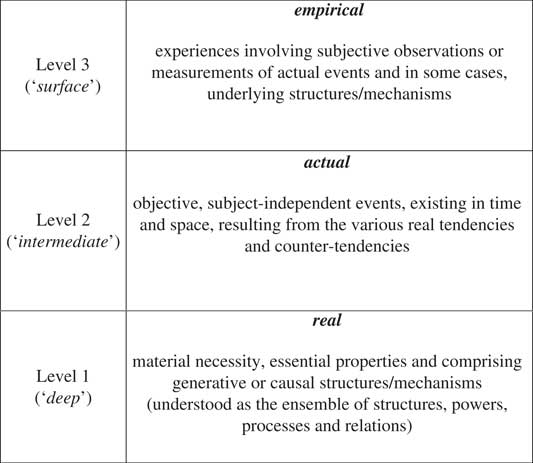
The fact the transitive and intransitive dimensions do not match up explains why knowledge, though broadly accumulative, is periodically subject to modification – á la Kuhn’s paradigm shiftFootnote 45 – as scholars seek to readjust their cognitive framework to better reflect layers of the ‘intransitive’ dimension they are detecting.Footnote 46 The cause of this transitive/intransitive disconnect, according to Bhaskar, is that reality is hierarchically structured, comprising three vertically interrelated ontological domains, where higher levels are emergent from, though not reducible to, their lower ones (Figure 1):Footnote 47
Ontological stratification model.

According to this ontological stratification model, none of the domains are in phase with each other, nor do they manifest themselves in a pure unaltered form at a higher layer. Events (actual), for example, have their origins in the interaction of a number of diverse, and often conflicting, non-observable generative or causal mechanisms emerging from a multi-layered ‘deeper’ (real) level, operating within ‘open’ systems.Footnote 48 The resultant ‘emergent properties’ provoke causal powers in their own right and may be operable across various physical, chemical, biological, psychological, and social ontological layers.Footnote 49 Indeed, the social world functions exactly the same as the natural world, albeit with slight differences, namely that the former: (i) is built up social relations and reproduced/altered by human activity (ontology); (ii) takes place in an ‘open’ system, temporary closure being impossible (epistemology); and (iii) is studied by agents who are themselves a product of the same field it they seek to analyse (relational).Footnote 50
As a result, positivist epistemology is discounted. Deeper strata of structures and underlying mechanisms (the ‘real’) are simply imperceptible at the surface level (the ‘empirical’). However unintentionally, David Hume had initiated a grave ‘wrong turn’ in philosophy by asserting that all knowledge derives from ‘experience’, thereby limiting ontology to the observable. This results in causal laws being defined as discernible constants and conjunctions, and the adoption of a methodology, which, completing the circular logic, presumes the existence of such constant regularities. The result is that ‘three domains of reality are collapsed into one’.Footnote 51
By conflating ‘reality’ with ‘our conception of that reality’, Bhaskar declares, positivism is guilty of epistemic fallacy. Ontology issues cannot be framed within epistemological terms: it is simply erroneous to conclude that every statement about ‘being’ can be transposed into a statement about ‘knowledge’ of being, or that what we know (reality) is merely part of what we can know (theory).Footnote 52 Simply put, ‘[t]hings may exist without our knowing them.’Footnote 53
Yet positivism is not alone in committing the epistemic fallacy. Neo-Kantian interpretism similarly collapses ontology into epistemology by defining reality in terms of a subjective philosophy of the mind: the ‘double hermeneutic’. The social world, though, could not simply be reduced to the ‘sum of people’s beliefs, hopes and expectations’.Footnote 54 Even if ‘our access to the social world is necessarily via our understanding of these interpretative processes’, William Outhwaite insists, ‘it does not follow that this is all that exists, or can be known to exist’.Footnote 55 This is the very trap Coxian neo-Gramscians fall into, by reducing structure to intersubjectivity, despite the fact that they lie at different ontological levels.
A critical realist rejection of positivism does not imply the jettisoning of causality, since it is a universal principle, a necessary a priori truth shaping all our experience.Footnote 56 But rather than deducing causal laws from an empirical study of events (the transitive dimension), it seeks to uncover ‘the structures and mechanisms … that govern or facilitate the course of events’Footnote 57 (the intransitive dimension).
Ontological assumptions necessarily determine both epistemology and methodology.Footnote 58 Critical realism’s methodology is retroduction;Footnote 59 a dialectical process Andrew Sayer describes as a movement from: Concrete to Abstract, Abstract to Concrete.Footnote 60 The criterion for ‘testing’ the ‘truthfulness’ of any given generative mechanism uncovered ultimately depends on its superior ‘explanatory power’ to account for the observable effects, when compared to competing hypotheses. Rather than positivist-style causal predictions, critical realists offer context-dependent ‘evidential statements’ with regards to particular ‘tendencies’Footnote 61 or ‘demi-regularities’.Footnote 62
Though critical realism as a philosophy of science does not have any particular theoretical attachment, it naturally dovetails with Marxism.Footnote 63 Marx himself held reality to be ontologically stratified and obscured from view,Footnote 64 dedicating his key works to analysing how the mechanisms of the capitalist economy (and associated class domination) was manifested in certain institutional (for example, the state) and ideational (for example, ideology) phenomena, often resulting in the separation of the ‘economic’ from the political’.Footnote 65
Sean Creaven has merged Engel’s anti-reductive sociohistorical dialectical materialism (the underlabourer of Marxist social science) with Bhaskar’s stratified ontological model to elaborate his own overtly historical materialist critical realist social theory, termed emergentist Marxism, in which sociocultural emergents are hierarchically structured with regards their explanatory power.Footnote 66 Coinciding with Gramsci’s own dialectical materialist philosophy of praxis, Creaven avows that ideas and other ‘superstructural properties’ of social structures such as ‘hegemonic projects’ are emergent from, and anchored in, underlying ‘objective’ material structures (the forces and relations of production and deeper structures).Footnote 67
At the same time, Creaven is at pains to stress the anti-reductive nature of this dialectical process. Though elements of superstructures do broadly arise from, and enjoy a dialectical relationship with, the economic structures of material production and class exploitation, sociocultural structures, and ideological forms are notoriously complex and contradictory (often having their origins in previous socioeconomic systems) and are never mere passive reflections of material elements. Though they do serve to legitimise, and hence reproduce, certain social relations of production, they may also inspire social agency to mobilise (via class struggle) in order to transform said economic structures (especially where productive forces clash with limits imposed by existing relations of production).Footnote 68
To shed more light on just how social structures are reproduced and occasionally transformed within an overdetermined, ontologically stratified open system, that Jonathan Joseph developed his own materialist theory of hegemony. This most closely resembles that of Gramsci himself and the perspective adopted in this present article.
Drawing on the conceptualisations of structure-agency set out by Bhaskar, Gramsci, and Nicos Poulantzas, Joseph posits that hegemony possesses a ‘dualist’ nature, making an analytical distinction between: (a) structural hegemony, and (b) surface hegemony, albeit that they are engaged in a dialectical relation within an open system.Footnote 69
The structural aspect of hegemony, for Joseph, is concerned with the deeper underlying material conditions in society (for example, the mode of production). Its ‘function’ is to secure the reproduction of social structures and achieve the unity and cohesion of the social formation (that is, shapes relations both within a ruling bloc and between it and the rest of society). Structural reproduction takes place largely via unconscious practices, reflecting hegemony’s broad acceptance/assimilation across society. Notwithstanding, it is never guaranteed given the emergent nature of the multiple dialectically interacting factors influencing social relations. In the organisation and reproduction of capitalism, for example, a plethora of social, economic, political, legal, and cultural mechanisms intervene to assure capital accumulation, organise the capital-wage relation, protect private property, etc. In this reproductive process the state plays a pivotal functional role (hegemony, as noted, necessarily operating both through and across the state). At the same time, the state is never just the mouthpiece for capital, located as it is at a higher ontological level and thus subject to other causal mechanisms.
Surface hegemony, on the other hand, constitutes hegemony’s ‘political moment’ (akin to Gramsci’s second moment) with concrete intentional hegemonic projects, strategies and practices emerging out of the society’s fundamental structure (deeper hegemony). The agents that lead these struggles are conscious political actors (dominant groups and class factions) who aim to conserve, advance, or transform particular political programme via societal restructuring (for example, recasting relations between classes, groups, and institutions, etc.) and alliance formation. Though these hegemonic projects remain dependent on structural hegemonic conditions, they are not reducible to it, enjoying their own set of mechanisms, properties, and powers, and hence hegemonic expression and programme. As such, there exists the possibility that the function of reproduction (for example, capital accumulation) may not be realised via the particular hegemonic projects (and associated modes of regulation, state strategies, etc.) or, in the case of a genuine transformational struggle, could actually seek to undermine it, engendering conflict and crisis.
In short, hegemonic projects, constructed by a conscious ruling bloc, do offer the possibility of systemic transformation, but these emerge out of concrete material structures (underlying forces and relations of production), which strategically limit access to resources and options available to agents. The success of any given hegemonic project therefore does not depend merely on the formation of alliances, but how well these relate to underlying structures. And while politics, culture, ideas, discourse, and consciousness enjoy a degree of autonomy in society (a result of their overdetermined causal mechanisms) their assimilation into a particular hegemonic project would force an alignment with deeper social and material structures. Ideologies, though plural, and a product of human practices, would, in the words of Gramsci, be ‘arbitrary’ and ‘individual fancies without the material forces’.Footnote 70 As ‘historically organic ideologies’Footnote 71 they are ‘real historical facts’ and ‘instruments of domination’,Footnote 72 arising out ‘deep hegemony’.
III. Neo-Gramsciansim: a brief critique
Sharing with Marx the view that capitalism, as a mode of production, displays certain structural properties, Gramsci reiterates his historical materialist credentials throughout the Prison Notebooks,Footnote 73 considering it ‘possible to isolate and study necessary laws of regularity’ of the ‘universal homo oeconomicus’, albeit that such patterns of behaviour do not constitute ‘laws’, in any ‘naturalistic’ or ‘speculative’ determinist sense, but rather ‘tendencies’ (for example, the rate of profit to fall).Footnote 74 The aforementioned ‘hegemonic projects’, emerge from these underlying ‘objective’ structural processes, seeking to preserve, reproduce, or transform social relations in the wake of fundamental changes in production: ‘incurable structural conditions have revealed themselves (reached maturity), and that, despite this, the political forces which are struggling to conserve and defend the existing structure itself are making every effort to cure them, within certain limits, and to overcome them.’Footnote 75
Although Cox maintains he is working within a historical materialist paradigm – an assertion reiterated by his advocatorsFootnote 76 – the results are at times, ambiguous, again as a direct consequence of his original ontological position. Despite laudable intentions, his absolute dread of ‘economism’, led him to grant each of his ‘categories of forces’ the same degree of importance and relative autonomy,Footnote 77 therein bestowing ideas with far more independence than afforded by either Marx or Gramsci. Cox categorically dismisses as metaphysical speculation the notion that superstructure is in any way determined by the mode of production ‘in the last analysis’ or that capitalism itself is driven by an underlying ‘logic’ or set of ‘tendencies’, or independent of an agents’ proper conception of it.Footnote 78
But by shunning basic tenets of Marxian thought and method Cox is therein negating the necessary causal mechanism effects of capitalism as a mode of production. How then could one uncover a particular ‘historical structure’? The methodology Cox opts for is to ‘infer’ them ‘from observable historical patterns of conduct’Footnote 79 on a case-by-case basis, which, being tantamount to empiricism, means he is guilty of committing the ‘epistemic fallacy’ (underlying causal mechanisms considered unobservable and therefore empirically unmeasurable).
Rather than a Marxist theory of capitalism, neo-Gramscians are in effect proposing a ‘historicist conception’ of the economy. Rejecting any underlying ‘logic’ Coxians Andreas Bieler and Adam David Morton, for example, advocate ‘Critical Economy’, claiming ‘categories are always situated within historical circumstances and assessed within the particular context from which they derived’.Footnote 80 Instead of assuming a single mode of production Cox identifies twelve different modes of SROP, conceptualised as ‘monads’; that is ‘self-contained structures’ each with its own ‘developmental potential’.Footnote 81 Moreover, since Cox’s social structures derive from the HB, rather than the capitalist system per se, it is not the capitalist mode of production that determines what and how things are produced but the ‘social context of production’.Footnote 82 The focus shifted, Hannes Lacher has observed, from analysing how surplus is generated (Marx) to how it is distributed (Weber).Footnote 83
Crucially, once ontological primacy is granted to the conjunctural level, Cox’s historicism is prevented from hypothesising on global capitalism’s structural tendencies or saying anything meaningful about the production/reproduction of relations of class. For while Marx considered history as being driven by the implicit social antagonism existent between capital and labour under capitalism, Cox tends to define class in rather static, positional, and subjective ‘identity’ terms (that is, dependent on class consciousness)Footnote 84 insulated within discrete HBs (each one with its own accumulation regime and mode of SROP), and thus stripping it of its real significance as an instigator of social change.
Accordingly, while Cox’s historicist methodology could be considered useful for analysing historical concreteness and the dynamics of a particular HB apparatus within the capitalist paradigm it offers no tools to theorise on how systemic transformation occur across the wide-ranging group of diverse HBs that make up any given WO. Nor does it forward a convincing account of the structural properties, dynamics, or possibilities for fundamental change of capitalism itself, en route to a new emancipatory mode of production (critical theory’s ultimate goal). Capitalism, in a word, is omnipresent at the empirical level in Cox’s framework but remains largely undetectable at the theoretical level.Footnote 85
Evidently, this lack of ontological depth is reflected in an inadequate theorisation of the modern state. True to his epistemological position Cox insists the state also has to be ‘historicised’ and understood as a ‘social relation’: a particular FOS is shaped by the changing class dynamics of its specific HB. But again, there appears no difference between structure and agency (see structuration theory). To wit, neo-Gramscians Bieler and Morton classify states as ‘intersubjective categories’, only becoming a reality (or ‘objective’) once they are accepted as states at the intersubjective level among the populace.Footnote 86 Indeed, it is this particular conceptualisation of the state as an intersubjective category that enabled Cox to theorise on its transformation (from a Keynesian to a ‘hyperliberal’ FOS) and even weakening, accountable to the exigencies of the nébuleuse.
Cox also remains somewhat ambiguous on the relationship between the state and society. On the one hand, as noted above, he denies any separation between the two spheres, basing his ‘state-society complex’ on Gramsci’s ‘integral State’. Yet on the other hand, he appears to grant the state autonomy from SROP and WO.Footnote 87 ‘States’, he explains, ‘determine the whole complex structure of production from which the state then extracts sufficient resources to continue to exercise its power’.Footnote 88 Cox depicts the postwar Keynesian FOS, for example, as being in some ways independent of (that is, external to) its national economy, and thus able to redistribute wealth and promote non-capitalist interests.Footnote 89 Of course, once the idea of an autonomous politically neutral state is accepted then progressive social change can occur via the liberal democratic electoral system: a view shared by liberals and social democrats, but certainly not Marx or Gramsci.
Cox’s methodological dualism and unconvincing conceptualisation of the state are manifested in the too formal division between the ‘national’ and ‘international’ when considering the globalisation process (notably the IOS). States are portrayed as playing ‘an intermediate though autonomous role between the global structure of social forces and local configurations of social forces within particular countries’;Footnote 90 concerned with adjusting the (internal) domestic economy to the demands of the (external) international, effectively reduced to a ‘buffer’Footnote 91 or ‘transmission belt’Footnote 92 between these separate spheres.
While Cox’s empirical work dedicated to comparing different capitalist FOS has much to commend it, an over-emphasis of their variance arguably comes at the cost of failing to underscore their essential similarities. The aforementioned Keynesian FOS, for example, was always capitalist in nature, set within a global division of labour, and concerned with guaranteeing ongoing capital accumulation.
Yet for Marxists, Gramsci included, the state is not just another institution. Poulantzas refers to it as ‘the condensation of the relationship of forces between classes and class fractions … within the state itself’.Footnote 93 Joseph underscores its importance as ‘a strategic terrain for the implementation and facilitation of hegemonic projects’.Footnote 94 Equally, in line with Marx’s ‘capital-in-general’ definition, both Poulantzas and Joseph recognise the capitalist state is more than a condensation of class struggle or a simple instrument in the hands of the dominant classes. It necessarily enjoys a degree of autonomy from any one particular faction of the capitalist class.Footnote 95 Without this relative autonomy the state would be unable to perform its critical ‘function’ in reproducing capitalism (guaranteeing accumulation, creating and demarcating space, protecting private property, and regulating and reorganising SROP, etc.),Footnote 96 compatible with Joseph’s ‘structural hegemony’. For Leo Panitch the state’s fundamental task boils down to ‘organising, sanctioning and legitimizing class domination within capitalism’.Footnote 97
To be fair, most contemporary neo-Gramscians would distance themselves from the ‘transmission belt’ metaphor (including even Cox himself).Footnote 98 Bieler and Morton, for example, have also drawn on Poulantzas, to interpret globalisation as involving a dialectical relationship between transnational and national social forces, and which favours the reproduction of a new configuration of social forces within different FOS. This process of internalisation or induced reproduction of capital, does not consider capital ‘an autonomous force, beyond the power of the state’, but rather ‘represented by classes or fractions of classes within the very constitution of the state’.Footnote 99
This represents a significant improvement on the Coxian line, chiming somewhat with Gramsci’s argument about the inextricable link between relations within a national society (‘hegemonic system within the state’) and relations between international forces (‘the combination of states in hegemonic systems’),Footnote 100 as well as his theory of ‘passive revolution’ (understood as taking place within the context of the uneven development of capitalism).Footnote 101 The irony is, of course, that in order to rescue neo-Gramscian thought from accusations of pluralism, Bieler and Morton take inspiration from Poulantzas, a thinker that Cox himself dismisses as a ‘Theological Marxist’.
Last but not least, the Coxian lack of ontological depth also has grave effects on their conceptualisation of hegemony. Having downgraded both the importance of the mode of production and class dynamics within the HB, neo-Gramscians have little option but to locate the source of fundamental structural change at the voluntaristic intersubjective/ideological level (see ‘epistemic fallacy’), driven by elite agency. Despite reiterating his materialist credentials, Cox defines hegemony as: ‘a structure of values and understandings about the nature of order’, derived from ‘the way of doing and thinking of the dominant strata of the dominant state or states’;Footnote 102 an hegemonic order is ‘inscribed in the mind … an intersubjective sharing of behavioural expectations’, manifested once a ‘leading nation’s conception of the world becomes universalized’.Footnote 103 Similarly, hegemonic instability is defined in politico-ideological terms (‘a crisis of representation’): the incapacity of elites to lead subordinate groups to the next stage (‘an uncertainty of direction among the dominant groups and a fragmentation and absence of cohesion among the subordinate groups’).Footnote 104
This conceptualisation of hegemony as an essentially cultural (consensual) phenomenon, is the dominant interpretation among Coxian neo-Gramscians,Footnote 105 following Perry Anderson’s highly influential, but ultimately oversimplified dualist reading of Gramsci, characterising him as reducing the social world to a crude binary opposition classification (that is, domination/hegemony, coercion/consensus, state/civil society, politics/economics, war of movement/war of position, and implicitly national/international).Footnote 106 The implication here, of course, is that hegemony is consensual taking place in civil society, while domination is coercive, exercised by the state.Footnote 107
Yet by interpreting hegemony as ‘consent’ to ruling class ideology, neo-Gramscians are, as Panitch argues, not only overlooking vertical pressure and counter-hegemonic resistance from subordinate classes – a very un-Gramscian ‘top down’ expression of power relations – but they are once again drifting into liberal thought, giving the false impression that class supremacy is merely ideological, and thus presumably could be overthrown by ideologically means too.Footnote 108 Such a view might be shared by the Frankfurt School critical theorists and post-Marxists such as Ernest Laclau and Chantal Mouffe,Footnote 109 but not by Gramsci himself.
Indubitably, there is much to admire about the neo-Gramscian account of the establishment of American world hegemony in the postwar period, and the vital role institution-building (for example, the United Nations, the Bretton Woods institutions, the OEEC/OECD, Marshall Plan, and NATO) played in underpinning Pax Americana.Footnote 110 Coinciding directly with Gramsci’s second moment of hegemony,Footnote 111 Cox explains how these organisations, as part of a IOS process, came to constitute a complex ‘machinery’ designed to ‘supervise the application of the system’s norms’, and promote the ‘harmonisation of national policies’, and how, reinforced by the US-led IOP, Western dominant SROP and FOS were restructured in line with the interests of American hegemony,Footnote 112 a compromise John Ruggie would term ‘embedded liberalism’.Footnote 113
For all its many attributes, however, the neo-Gramscian account of the launching of the postwar hegemonic world order under Pax Americana largely ignores the importance of coercion. Yet for Gramsci coercion remains fundamental to exercising hegemony, not just reserved for use in disciplining opponents (‘those groups which do not “consent” neither actively nor passively’), but applied to society as whole, even for allies, especially when ‘spontaneous consent fades away’.Footnote 114 The ‘parliamentary regime’ itself, Gramsci explains, is ‘characterised by the combination of force and consent … without force predominating excessively over consent’, and occasional recourse to fraud and corruption.Footnote 115
Furthermore, Gramsci makes it clear that in any struggle for hegemony, the importance of the third moment of his ‘relations of forces’ analysis – the ‘the relation of military forces’, consisting of two different forms of oppression (the ‘military level’ and the ‘politico-military’ level) – is ‘from time to time … directly decisive’.Footnote 116
Nor is coercion limited to ‘political society’. Gramsci, along with all Marxists deems the capitalist mode of production to be an exploitative system beset by class conflict, and one which relied heavily on the use of coercion (along with fraud and corruption) for its reproduction. This comes not only through the subtle ‘dull compulsion of economic relations’,Footnote 117 the state itself (that is, ‘political society’) plays a critical role in guaranteeing ongoing surplus value extraction within ‘economic society’, be it as a market regulatory (for example, protecting private property, enforcing contracts, etc.), restorer of profitability/nurturer of businesses (‘manufacturing the manufacturers’) or working-class discipliner. Even laissez-faire economics, Gramsci reflects, are ‘introduced and maintained by legislative and coercive means’.Footnote 118
In short, Gramsci considered consensus and coercion as being dialectically integrated within an organic whole. One could summarise Gramsci’s conceptualisation of hegemony thus:
domination (or coercion), corruption and fraud
+
intellectual and moral leadership (or consent)Footnote 119
With some notable exceptions,Footnote 120 neo-Gramscian accounts of hegemony make sparse reference to coercion and militarism, and when they do it is arguably under-conceptualised and not satisfactorily woven into a holistic theory of hegemony.
Yet the establishment (and maintenance) of American hegemony in the postwar era was absolutely unthinkable without the Cold War, manifested at the ideological level by Truman’s replacement of Roosevelt’s universal, liberal internationalist ‘one world’ discourse with a more suitable hegemonic, anti-communist ‘free world’ version.Footnote 121 Without this ‘friend-foe’ dichotomy Washington would have found it very difficult to finance and justify: (i) the establishment of a national security state (and associated ‘permanent war economy’ and international military Keynesianism arrangements);Footnote 122 (ii) the setting up of collective security umbrellas (for example, NATO) and the associated abandonment of foreign policy independence among US allies; (iii) the installation of hundreds of foreign military bases (or ‘empire of bases’)Footnote 123 right across the Eurasia ‘rimland’ in line with Nicholas Spykman’s geopolitical template;Footnote 124 and (iv) sponsoring military intervention (both overt and covert) in sovereign states. And all of these measures were as much a part of Pax Americana (both consolidating the domestic HB and underwriting US power projection) as the creation of the Bretton Woods intuitions.
The incomplete neo-Gramscian conceptualisation of both hegemony and the state come together with regards to their account of the demise of Pax Americana in the early 1970s and its subsequent replacement by a burgeoning transnational hegemony. Not only is insufficient attention paid to the deeper structural causes (for example, declining rate of profit, rising class struggles, and the crisis of American hegemony) but far too much emphasis is placed on the instrumental role of a global bourgeoisie (supported by a transnational intellectual stratum)Footnote 125 imposing its economic and political norms on the rest.
According to Cox the new ‘hyperliberal’ (neoliberal) WO is marked by ‘a global class structure alongside or superimposed upon national class structures’ at ‘the apex’ of which sits a ‘transnational managerial class’ or ‘nébuleuse’ made up of transnational corporate executives and investors; the most internationalised branches of state government/bureaucracies (for example, central bankers, finance, and trade ministers, etc.); and heads of key international organisations and think tanks.Footnote 126 Thanks to such formal/informal socialisation processes, Stephen Gill avers, a transnational ‘identity’ and ‘shared consciousness’ has developed among the ‘members’Footnote 127 and a new self-conscious transnational capitalist class emerged, in possession of ‘its own ideology, strategy, and institutions of collective action’ and pursuing ‘the progressive transnationalization and liberalization of the global political economy’.Footnote 128
Though significant differences among them exist, all subsequent neo-Gramscians have been concerned with transnational class formation and whether we are witnessing the emergence of a genuine class-conscious neoliberal transnational HB, at the expense of national HBs.Footnote 129 But once again, while the Coxian account of globalisation does acknowledge social discord (between production and finance, transnational and national capital and, concomitantly, potentially also among sections of the working classes) such tensions are not tantamount to genuine class conflict, rather sectoral disputes within a pluralist system. Indeed, the very nucleus of any future transnational HB is held to be an alliance between transnational capital and internationally orientated established workers.Footnote 130
Concurrently, neo-Gramscians argue, this hegemonic project has transformed the modern state itself, with transnational and local levels competing with its traditional monopoly of authority and loyalty.Footnote 131 The classic Westphalian interstate WO has been superseded by a ‘new medievalism’ in what amounts to a transnationalisation of the state.
According to Gill, the emergent nébuleuse is imposing its supremacy over the lower classes via new constitutionalism – ‘a doctrine and associated set of social forces which seeks to place restraints on the democratic control of public and private economic organisations and institutions’ – an elite neoliberal discourse aimed at reducing the autonomy of states, limiting their economic options to those fiscal and monetary policies favourable to the unhindered transnational flow of global capital as articulated in the ‘Washington Consensus’. The most common way these augmented surveillance measures – termed disciplinary neoliberalism – are socially embedded is via the newly restructured Bretton Woods institutions (that is, WTO, IMF, and World Bank) and regional integration processes.Footnote 132
Another group of neo-Gramscian scholars has explored transnationalism: the so-called Amsterdam School.Footnote 133 These writers, admittedly, have drawn more directly on the work of Marx and Gramsci than the Coxians, adopting a more historically materialist analysis of the dynamics of transnational class formation within an emergent transnational civil societyFootnote 134 and the extent to which this ‘class’ is increasingly exercising hegemony in the global system at the expense of states.Footnote 135
One of the Amsterdam School’s most prominent scholars is Kees van der Pijl. In his influential monograph, Transnational Classes and International Relations, he studies the consolidation of a transnational bourgeoisie in the ‘English-speaking West’ via the web of haute finance and expressed in ‘transnational imagined communities’ such as the Freemasonry and elite fora (for example, the Bilderberg Groups and the Trilateral Commission). As such, and drawing on Cox’s FOS analysis, van der Pijl characterises the WO of the last two centuries as a conflict between these ‘Lockean’ and ‘contender’/‘Hobbesian’ state-society complexes, currently manifested in their respective ‘hyperliberal’ and ‘neo-mercantilist developmental’ forms.Footnote 136
The ‘Lockean states’ (‘the true bourgeois political formation’), van de Pijl describes as largely self-regulating civil societies, concerned with ‘protecting private property at home and abroad’.Footnote 137 Thanks to ongoing transnational class formation, and a variation of Cox’s IOS, termed the ‘international socialization of state functions’,Footnote 138 the core is being converted into a ‘Lockean heartland’ – a ‘free space for capital, created with the help of states but shielded from democratic politics’– which is likely to continue expanding outward.Footnote 139 In the ‘contender states’, on the other hand, where the local bourgeoise is weak, it is the ‘state class’ that is in control, attempting to close off the transnational process in order to direct economic development, promote national interests, and ‘catch up’ with the ‘Lockean states’.Footnote 140
Transnational class formation in the Lockean heartland has attracted other Amsterdam School academics.Footnote 141 Bastiaan van Apeldoorn, for example, emphasises the role of regional integration in transforming European capitalism, uncovering the underlying social forces responsible for the victory of the transnational ‘globalists’ (globally orientated capital) over the other two competing hegemonic projects – the neo-mercantilist ‘Europeanists’ (European based/orientated capital) and the supranational ‘social democrats’ (centre-left parties, unions, NGOs) – and how this found its expression in the neoliberal nature of the Treaty of Maastricht, helping consolidate a nascent European transnational HB.Footnote 142 The way these original hegemonic projects interacted, and the various regional, national, and social concessions granted by ‘globalists’, van Apeldoorn claims, have ensured that EU-level neoliberalism has retained a slightly different character to its Anglo-Saxon counterpart, termed embedded neoliberalism, albeit that over time such variances have been significantly reduced, as manifested in the present Treaty of Lisbon.Footnote 143
We are indebted to the neo-Gramscians for enriching our understanding of the complexities of the transnationalisation process, specifically transnational class formation and the dynamics of regional integration, as well as supplying us with a useful set of concepts and analytical tools for theory construction.
At the same time, we claim the overall vision presented is somewhat incomplete, displaying a general tendency to focus too much on the agency of capital, in the form of top-down elite projects, and less on the discordant and conflictual social relations of capitalism. As a result, the transnational liberal WO appears too consensual. Arguably, this criticism also applies to Amsterdam School thinkers, traditionally more attentive to the exigencies of capitalism and underlying social class dynamics than the Coxians.
One of the weakness of the neo-Gramscian narrative, according to Ian Bruff, is that it tends to convert national capitalisms into mere functional expressions of transnational capital,Footnote 144 while Adrian Budd considers that van der Pijl’s depiction of ‘Lockean states’ cooperating within a ‘Lockean heartland’ for mutual benefit,Footnote 145 bears more than a passing resemblance to Kautsky’s ultra-imperialism.Footnote 146 Indeed, the latter charge is reinforced by van de Pijl’s assertion that the transnational capitalist class hegemony has managed to surpass traditional geopolitics concerns ‘to the degree to which they are able to subdue internal rivalries, the challenge of successful contenders, and class struggles within their own sphere’.Footnote 147 While van der Pijl distances himself from any such Kautskyan interpretation,Footnote 148 a degree of ambiguity remains, since elsewhere he affirms that ‘traditional forms of world politics’ have been replaced by ‘the struggle for hegemony between factions of the bourgeoisie’, and how ‘hegemonic control’ has been reduced to ‘frameworks of thought and practice’Footnote 149 among ‘transnational imagined communities’.Footnote 150
IV. Towards a neo neo-Gramscian perspective
Cox and his fellow neo-Gramscians have made important contributions to expanding traditional IR/IPE theory, among them: (i) introducing Gramsci to a wider public; (ii) stressing the importance of the ethico-political/intersubjective realm within a theory of hegemony; (iii) offering an innovative model for understanding the dialectical interaction between socioeconomic and ideological-political factors at the national level; (iv) drawing attention to the dynamics of world hegemony and historically divergent global regimes of regulation and accumulation; (v) forwarding an impressive account of the process of transnationalisation and its effects on social class formation, the state, the interstate system, the global political economy, and the contemporary WO in general; and (iv) providing an worthy set of concepts and analytical tools.
But while it may claim victory over neorealism, arguably neo-Gramscianism has yet to provide a convincing explanation for the functioning and changing nature of the international system. This is a direct effect of the original laudable ‘critical theory’ objective to revitalise political agency and promote fundamental social change.
As observed, Cox’s decision to ‘historicise structure’ led many neo-Gramscians, on the one hand, to merge structure and agency – thereby precluding any explanation of how these are interrelated and hence limiting a deeper conceptualisation of emancipatory transformation – while on the other hand, granting ontological primacy to the conjunctural level – with structural change coming about as a result of ‘top down’ hegemonic projects, diverging significantly from their avowed historical materialist approach. And while accepting that many neo-Gramscians have sought to offset such elitist accusations by carrying out work on counter-hegemony, resistance, and opposition,Footnote 151 the original ontological ambiguities undermine theoretical coherence.
Cox’s eschewing of ‘deep structure’ (or an underlying ‘logic’) has meant neo-Gramscians have either negated, or simply taken for granted, the existence of a single mode of production (and associated innate tendencies) with the dynamics of class conflict, leaving them without a coherent theory of either the capitalist system or the capitalist state. As a result, when it comes to explaining questions such as why capital seeks to ‘go global’ or what are the underlying causes of economic crises, the answers tend to rely on conjunctural analysis, largely confined to Joseph’s ‘surface hegemony’.
Accounting for WO reproduction/transformation, similarly, depends on ideological and intersubjective developments within the leading state or transnational elite, and expressed as cultural hegemony. And in abandoning Marxism neo-Gramscianism’s run the risk of inadvertently embracing a form of ‘critical revisionism’: holding the route to emancipation lay via the mobilisation of centre-left counter-hegemonic social forces, within the liberal democratic institutional framework, and towards very limited objectives (for example, replacing neoliberalism with a Keynesian-type system of accumulation).
Adopting a more coherent conceptualisation of structure compatible with critical realism’s stratified ontological depth model – specifically in an emergentist materialist version – would help neo-Gramscians avoid these shortcomings, ground hegemony materially, and thereby elaborate a more compelling account of the process of social change. Only then could they steer clear of the epistemic fallacy and philosophical dualism.
This article has underscored the importance of ideas for Gramsci: the construction and maintenance of hegemony depends upon a dominant social class’s ability to generate sufficient consent among allied/subordinate social groups and classes, not only by offering economic-corporate sweeteners (the aforementioned first moment), but through the nurturing of intersubjective consciousness (the second moment). For Gramsci this ‘marks the decisive passage from the structure to the sphere of the complex superstructures’,Footnote 152 tantamount to Joseph’s ‘surface hegemony’, articulated in a universal culture and associated values and norms, as part of a broader society-wide institutionalised hegemonic apparatus Footnote 153 in which the state pays a key role, transformed into an ‘educator’, adjusting the ‘civil society’ to the ‘structure’ in the interests of the dominant classes.Footnote 154 Consistent with the emergentist materialist perspective forwarded here, nonetheless, Gramsci insists, these emergent hegemonic projects have to ground their basis in underling power relations (‘structural hegemony’).
And just as coercion is integral to the generative mechanisms engaged in the reproduction of the capitalist mode of production – reliant on unconscious practices and collective/institutional intervention (notably by the state) – so hegemonic projects will also resort to force, fraud, and corruption, as well as consensus. Coercion, indeed, is embedded in Gramsci’s conceptualisation of hegemony, the HB, the state, and WO.
Neo-Gramscians, on the other hand, do not successfully integrate coercion into a coherent theory of hegemony, a corollary of their dualist categorisation that considers ‘supremacy’, ‘domination’, and ‘force’ as being reserved for enemy classes, with ‘hegemony’ (‘the consensual aspect of power is to the forefront’) for friends and allies.Footnote 155 Gill, as noted, considers the advent of ‘disciplinary neoliberalism’ and US assertiveness as tantamount to ‘supremacy’ (that is, lacking intellectual and moral leadership), proof we are now currently living in a post-hegemonic WO.Footnote 156
These ontological, epistemological, methodological, and theoretical shortcomings undermine neo-Gramscian accounts of hegemonic transition and the dynamics of the contemporary global capitalism. It is surely premature to countenance the emergence of a globally integrated ‘transnational capital class’ emasculating state power.Footnote 157 Such a thesis downgrades the fundamental role states play (and will continue to play) in reproducing the conditions for ongoing capitalist accumulationFootnote 158 and ‘structural hegemony’ in general.
For scholars such as Peter Gowan, David Harvey, Giovanni Arrighi, Leo Panitch, Sam Gindin, and Adrian Budd, a key driving force behind this Lockean heartland convergence and ongoing neoliberal globalisation has been the not-so hidden hand of American hegemony/imperialism.Footnote 159 Indeed, when the subsequent financial crisis hit the ‘heartland’ in 2008 it was left to Washington in its role, former US Treasury Secretary Robert Rubin described as ‘chief of the fire department’,Footnote 160 to put out the flames and stabilise the global capitalist system.
For Gramsci the capitalist WO is necessarily made up of competitive capitalist states (comprising the international division of labour) and expressed in a complex interplay between ‘the relation of internal forces, international forces and the country’s geo-political position’; class relations within a hegemonic system at the national level are engaged in a dialectical interaction with relations between international social forces that ‘constitute the combinations of States in hegemonic systems’.Footnote 161 In this hierarchically structured interstate system the ‘great powers’ exercise hegemony over peripheral non-hegemonic states: ‘Just as, in a certain sense, in a given state history is the history of the ruling classes’, he explains, ‘so, on a world scale, history is the history of the hegemonic states’, who were able to offload the heavier burdens of adjusting to the exigencies of the global capitalism onto the poorer countries who accordingly are trapped in a state of underdevelopment;Footnote 162 and with the ‘world hegemonic state’ able to impose itself on all the other powers, great and small alike.Footnote 163
This notion of a hierarchical and competitive interstate system, albeit one rooted in a global capitalist system, seems to sit uneasily with the neo-Gramscian transnationalisation thesis. A basic supposition, shared by the aforementioned group of academics (Gowan, Harvey, Arrighi, et al.), is that global capitalism is afflicted by uneven and combined development, which inevitably fuels interstate competition, as the latter seek to reproduce themselves. In keeping with Cox’s original ‘critical theory’ project, many neo-Gramscians have circumvented power-politics, failing to attribute sufficient weight to geopolitics and militarism in underpinning both Pax Americana and the post-Cold War WO.
One does not have to be a neorealist to acknowledge that genuine interstate rivalry still exists between the US, EU, Japan, China, and Russia, be it of a commercial, monetary, cultural, diplomatic, or military nature, expressing itself in multiple ways, not least via geopolitical tensions in the Middle East, Eastern Europe, and East Asia.
Granted, members of the Amsterdam School, notably van der Pijl, have addressed uneven development and interstate rivalries.Footnote 164 But while not detracting from the importance of this work some inconsistencies remain. Van der Pijl’s decision to classify FOS along a Cox-inspired ‘ideal type’ binary categorisation, for example, is not without its difficulties, tending as it does: (i) to oversimplify the differences between the ‘contender’ and liberal statesFootnote 165 (every liberal state, one could argue, combines both Lockean and Hobbesian features); and (ii) to rather overstate the unity within the ‘Lockean heartland’.
On the latter point, the existence of ‘imagined transnational communities’ for example, have failed to prevent continual transatlantic clashes over a broad range of policies (for example, trade, state aid, anti-trust, currency, finance, immigration, diplomacy, environment, security, and defence); Wikileaks revelations of ‘intra-heartland’ spying activities are, in this context, unsurprising. Indeed, as van der Pijl meticulously illustrates, the very creation and subsequent evolution of the EU itself cannot be understood outside the dynamic of interstate competition (with France, Germany, and the US taking centre stage),Footnote 166 nor, for that matter, can the recent eurozone, Syrian immigration crises, ongoing negotiations over Brexit, and the possible suspension of Poland’s EU voting rights.
Furthermore, thanks to the contradictory and contested nature of globalisation processes, one could argue that future emergent hegemonic projects are just as likely to mobilise on a hyper-nationalist programme as liberal transnationalism. All in all, for the foreseeable future, as Alex Callinicos indicates, global capitalism will continue to find itself political divided into territorially defined sovereign states.Footnote 167
The neo neo-Gramscian perspective presented here does not constitute a clean break from neo-Gramscian thought – hence the prefix neo, rather than merely Gramscian – but highlights the need to better ontologically ground it and clarify the relationship between structure and agency. The best way this can be done is by returning to Gramsci himself and drawing on critical realist depth ontology in its emergentist materialist form. Not only would this serve to eradicate the methodological dualism that has so plagued neo-Gramscian thought (especially in its Coxian version), but it would help to elaborate a more convincing (that is, structural) theory of hegemony, while shedding light on hegemonic transitions, the interstate system, and the dynamics of the global capitalism in general. Only once we have a better understanding of the challenges facing progressive hegemonic projects will it make sense to countenance an alternative WO and deliver on Cox’s original critical theory objective of engendering true social emancipation.