Introduction
The executive function deficit theory is among the neuropsychological accounts of autism spectrum disorder (ASD) (Hill, Reference Hill2004). Convergent evidence supports impaired executive functions in individuals with ASD, regardless of performance-based or real-world rating measures of executive functions (Baron, Reference Baron2000; Chen et al., Reference Chen, Chien, Wu, Shang, Wu and Gau2016; Chien et al., Reference Chien, Gau, Shang, Chiu, Tsai and Wu2015; Demetriou et al., Reference Demetriou, Lampit, Quintana, Naismith, Song, Pye and Guastella2018). With emerging evidence that better executive functions predict better adaptive functioning and quality of life in patients with ASD (de Vries & Geurts, Reference de Vries and Geurts2015; Pugliese et al., Reference Pugliese, Anthony, Strang, Dudley, Wallace and Kenworthy2015), it is important to identify modifiable factors that influence executive functions in individuals with ASD. Moreover, a few studies have reported an inverse association between autistic traits and executive functions in the community-based child population (Dai, Lin, Liang, Wang, & Jing, Reference Dai, Lin, Liang, Wang and Jing2018; Hyseni et al., Reference Hyseni, Blanken, Muetzel, Verhulst, Tiemeier and White2018; Leung, Vogan, Powell, Anagnostou, & Taylor, Reference Leung, Vogan, Powell, Anagnostou and Taylor2016). However, the nature of this association remained unclear. More studies are warranted to examine executive function and autistic traits and their modifiable factors in the general child population to understand ASD better and improve the mental health in children.
Executive functions encompass a collection of cognitive processes that regulate cognitive, emotional, and behavioral functions and enable individuals to demonstrate self-regulation, perform goal-directed behaviors, and find solutions to novel problems that cannot be solved with habitual behaviors (Baron, Reference Baron2000; Diamond, Reference Diamond2013). Deficits in these processes are proposed to underlie restricted and repetitive patterns of behaviors (Mostert-Kerckhoffs, Staal, Houben, & de Jonge, Reference Mostert-Kerckhoffs, Staal, Houben and de Jonge2015) and social impairment (Leung et al., Reference Leung, Vogan, Powell, Anagnostou and Taylor2016) in ASD. Alternatively, it is posited that high executive functions may protect children with genetic risks from ASD by compensating atypical functioning in other brain systems in their early life (Johnson, Reference Johnson2012) and could mask symptoms of ASD despite persisting core deficits at cognitive and/or neurobiological levels in individuals with ASD (Livingston, Colvert, Social Relationships Study, Bolton, & Happé, Reference Livingston, Colvert, Bolton and Happé2019; Livingston & Happe, Reference Livingston and Happe2017). Although current evidence does not find impairment in a single subdomain of executive functions to be a universal feature of individuals with ASD (Demetriou et al., Reference Demetriou, Lampit, Quintana, Naismith, Song, Pye and Guastella2018), it is generally accepted that executive function deficits are widespread in individuals with ASD and individual variation of executive functions may contribute to the heterogeneity of other area of difficulty in ASD, language, (Weismer, Kaushanskaya, Larson, Mathée, & Bolt, Reference Weismer, Kaushanskaya, Larson, Mathée and Bolt2018) and adaptive functioning (Kenny, Cribb, & Pellicano, Reference Kenny, Cribb and Pellicano2018) for instance.
In contrast to the view that primary deficits in executive functions relate to ASD diagnosis and symptoms, some researchers have hypothesized that core features or comorbidities of ASD serve as limiting factors on the development of executive functions (Pellicano, Reference Pellicano2012). For typically developing children, executive functions are expected to improve with age from childhood through adolescence to adulthood due to brain maturation (Best & Miller, Reference Best and Miller2010; Happe, Booth, Charlton, & Hughes, Reference Happe, Booth, Charlton and Hughes2006). With improving executive functions, children are able to learn new knowledge and adaptive behavior skills (Sulik et al., Reference Sulik, Blair, Mills-Koonce, Berry and Greenberg2015). Children's behavioral problems or inadequate cognitive functions related to immature executive ability observed in their early life are assumed to decline with age (Sulik et al., Reference Sulik, Blair, Mills-Koonce, Berry and Greenberg2015). However, children with some neurodevelopmental difficulties may encounter difficulties in brain maturation with time. For example, executive functions in children with ASD do mature over time. Yet their maturation is slower than typically developing children (Chen et al., Reference Chen, Chien, Wu, Shang, Wu and Gau2016; Happe et al., Reference Happe, Booth, Charlton and Hughes2006) and often unable to compensate for the increasing demands of executive functions to behave age-appropriately, which may result in increased real-world executive function deficits (Pugliese et al., Reference Pugliese, Anthony, Strang, Dudley, Wallace and Kenworthy2015; Rosenthal et al., Reference Rosenthal, Wallace, Lawson, Wills, Dixon, Yerys and Kenworthy2013). Children with or without ASD can learn executive function skills and improve their performance via social interaction and participation of cognitively challenging activities (Diamond, Reference Diamond2013; Kenworthy et al., Reference Kenworthy, Anthony, Naiman, Cannon, Wills, Luong-Tran and Wallace2014). Thus, it is possible that autistic traits continuously contribute to low executive function performance through impairing children's behavior patterns, or through comorbidities during their childhood and adolescence. Understanding these possible pathways may lead to developing effective interventions to improve patients' adaptive functioning and quality of life.
The literature documents that insufficient sleep could impair working memory and other executive functions in typically developing child and adolescent populations (Astill, Van der Heijden, Van Ijzendoorn, & Van Someren, Reference Astill, Van der Heijden, Van Ijzendoorn and Van Someren2012; de Bruin, van Run, Staaks, & Meijer, Reference de Bruin, van Run, Staaks and Meijer2017). In one cohort study of 1046 children, children who slept less than the sleep duration recommended from the National Sleep Foundation in their preschool or early school years had poorer executive functions in their later life (Taveras, Rifas-Shiman, Bub, Gillman, & Oken, Reference Taveras, Rifas-Shiman, Bub, Gillman and Oken2017). Moreover, some researchers posited that chronic insufficient sleep has cumulative effects on children's executive functions (Beebe, Reference Beebe2011). However, the effect size of sleep duration on executive functions seems to increase with age (Lowe, Safati, & Hall, Reference Lowe, Safati and Hall2017) and is small (Astill et al., Reference Astill, Van der Heijden, Van Ijzendoorn and Van Someren2012) or not significant (Short et al., Reference Short, Blunden, Rigney, Matricciani, Coussens, Reynolds and Galland2018) in school-aged children. It is under debate whether executive functions of school-aged children are truly less vulnerable of sleep restriction than young adults (Astill et al., Reference Astill, Van der Heijden, Van Ijzendoorn and Van Someren2012) or methodological difficulties may contribute to the current evidence of small or no effects (Short et al., Reference Short, Blunden, Rigney, Matricciani, Coussens, Reynolds and Galland2018).
There is a growing concern about the effect of insufficient sleep on children with ASD due to the high prevalence of sleep initiation and maintenance problems in these children (Cortesi, Giannotti, Ivanenko, & Johnson, Reference Cortesi, Giannotti, Ivanenko and Johnson2010). Evidence showed that children with ASD had comparatively short nocturnal sleep duration (Humphreys et al., Reference Humphreys, Gringras, Blair, Scott, Henderson, Fleming and Emond2014; Souders et al., Reference Souders, Zavodny, Eriksen, Sinko, Connell, Kerns and Pinto-Martin2017) and a greater difference between actual nocturnal sleep duration and sleep need (Chou et al., Reference Chou, Chou, Chiang, Wu, Lee, Wong and Gau2012) as compared to typically developing children. Similarly, the inverse association between levels of autistic traits and sleep duration was noted in typically developing adolescents even after comorbid psychiatric symptoms were controlled (Salmela, Kuula, Merikanto, Raikkonen, & Pesonen, Reference Salmela, Kuula, Merikanto, Raikkonen and Pesonen2018). Moreover, a recent study showed that the diagnosis of ASD predicted more severe and chronic sleep problems in children's later life, but not reversely (Verhoeff et al., Reference Verhoeff, Blanken, Kocevska, Mileva-Seitz, Jaddoe, White and Tiemeier2018). Therefore, it is possible that ASD and autistic traits impaired children's daytime functioning partially through insufficient sleep (Cohen, Conduit, Lockley, Rajaratnam, & Cornish, Reference Cohen, Conduit, Lockley, Rajaratnam and Cornish2014). However, few studies have documented the relationships between subclinical autistic traits and sleep duration, and the effects of insufficient sleep on executive functions in children with ASD or children with autistic traits are not well-established. Only one related study reports the sleep quality is inversely correlated with some components of executive functions (selective attention) but not others (working memory and sustained attention) in patients with ASD (Limoges, Bolduc, Berthiaume, Mottron, & Godbout, Reference Limoges, Bolduc, Berthiaume, Mottron and Godbout2013).
In this study, as an attempt to characterize the relationships among autistic traits, insufficient sleep, and real-world executive functions, we examined the possible mediation relationships using a nationally representative sample from Taiwan's National Epidemiological Study of Child Mental Disorders (Chen, Chen, Lin, Shen, & Gau, Reference Chen, Chen, Lin, Shen and Gau2019). Based on the current literature, we hypothesized that insufficient sleep mediates the links between autistic traits and low executive function performance. Moreover, we examined the degree to which subcomponents of autistic traits uniquely contributed to the mediation. Our study would provide an opportunity to examine the possible relationship for how autistic traits and insufficient sleep interacted to bring a negative impact on the real-world executive functions in children.
Methods
Participants
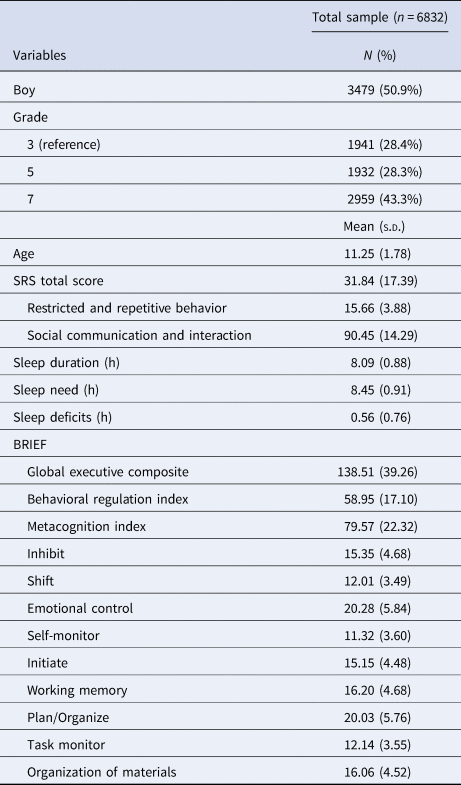
Participants in this study were from Taiwan's National Epidemiological Study of Child Mental Disorders, which is a school-based epidemiological study of DSM-5 childhood mental disorders using a nationally representative sample of third, fifth, and seventh graders (n = 10 118) from 69 schools in Taiwan during June 2015 to January 2017 (Chen et al., Reference Chen, Chen, Lin, Shen and Gau2019). The eligible students were selected with the stratified (urbanicity levels and geographic strata) clustering sampling method. Three informants completed questionnaires in the study, i.e. 9560 student participants (94.5%), 6846 parents (67.7%), and 9758 teachers (96.5%) of student participants. We only selected children whose parents completed parent-reported questionnaires in the current study (n = 6846). These children were at the mean age 11.3 (s.d. = 1.74) year old with age ranging from 8 to 14 years old, and 50.8% (n = 3479) of them were boys. We further excluded 14 children because of missing data on their sex, yielding a final sample of 6832 children to be included in the current study. The characteristics of these 6832 children are presented in Table 1. The study was approved by the Research Ethics Committee of National Taiwan University Hospital, Taipei, Taiwan (approval number: 201411056RINA) and all the student participants, their parents, and their teachers provided their written informed consent to the study before study implementation.
Demographics, autistic traits, sleep parameters, and real-world executive functions of participants

SRS, Social Responsiveness Scale; BRIEF, Behavior Rating Inventory of Executive Function-Parent Form.
Measures
The Chinese version of the Social Responsiveness Scale (SRS)
The SRS is a parent-reported 4-point Likert-type scale for quantifying autistic traits based on the frequency of each commonly observed behavior (Constantino et al., Reference Constantino, Davis, Todd, Schindler, Gross, Brophy and Reich2003). The SRS is a 65-item scale using a 4-point scale from 0 (never true) to 3 (almost always true), and it has been reported that the Chinese version of SRS has excellent reliability and validity (Gau, Liu, Wu, Chiu, and Tsai, Reference Gau, Liu, Wu, Chiu and Tsai2013). The SRS scores demonstrate a continuous distribution in the general population (Hsiao, Tseng, Huang, & Gau, Reference Hsiao, Tseng, Huang and Gau2013), which is not affected by intelligence, age, race, or the education level of respondents (Constantino et al., Reference Constantino, Davis, Todd, Schindler, Gross, Brophy and Reich2003). We further applied the two-factor model (i.e. ‘restricted and repetitive behavior' and ‘social communication and interaction'), which was derived a priori based on current views of autism symptom structure represented in support of the DSM-5 and validated for the SRS by Frazier et al. (Reference Frazier, Youngstrom, Speer, Embacher, Law, Constantino and Eng2012). In the current study, we used the SRS to measure autistic traits and access two subcomponents of autistic traits, ‘restricted and repetitive behavior’ and ‘social communication and interaction.’ A confirmatory factor analysis was conducted to examine the differences in the model fit between the unidimensional factor model and the two-factor model of SRS. The two-factor model had a better model fit than the unidimensional factor model based on the chi-square change test Δχ2(1) = 145.4, p < 0.001.
Sleep deficits
The Sleep Habit Questionnaire (SHQ) is designed to investigate sleep habits in children and adolescents aged 4–18 years old (Gau & Soong, Reference Gau and Soong2003). For the sleep need and nocturnal sleep duration about the children, the parents were asked ‘how many hours of sleep does your child need every night to maintain his/her daytime functions?’ and ‘how many hours does your child sleep every night on average?’ in the past 6 months. Space for hours and minutes are provided following the question for the student participants and parents to fill in. The data of these two questions were double-checked with the reports by the student participants. The child–parent agreement for sleep duration and sleep need were 0.36 and 0.17, respectively. Furthermore, the child–parent agreement increased across grade 3, grade 5, and grade 7 from 0.18 to 0.41 for sleep duration and from 0.10 to 0.22 for sleep need with all ps < 0.001 (online Supplementary Table S1). However, because sleep needs are variable in children and adolescents, it has been suggested sleep duration alone not be an adequate indicator of insufficient sleep in this age group (Anderson, Storfer-Isser, Taylor, Rosen, & Redline, Reference Anderson, Storfer-Isser, Taylor, Rosen and Redline2009). Following the suggestion of our early work (Gau & Merikangas, Reference Gau and Merikangas2004; Gau & Soong, Reference Gau and Soong2003) and Hysing, Pallesen, Stormark, Lundervold, & Sivertsen (Reference Hysing, Pallesen, Stormark, Lundervold and Sivertsen2013), we used the difference between perceived sleep need and nocturnal sleep duration (i.e. sleep need minor sleep duration hereafter referred to as ‘sleep deficits’) as an indicator of insufficient sleep in this study (Gau & Merikangas, Reference Gau and Merikangas2004; Hysing et al., Reference Hysing, Pallesen, Stormark, Lundervold and Sivertsen2013).
The Chinese version of the Behavior Rating Inventory of Executive Function (BRIEF)
We used the Chinese version of the BRIEF Parent form, an 86-item questionnaire for assessing daily, real-world executive function abilities in children aged 5–18 (Baron, Reference Baron2000). The BRIEF encompasses two broader indices with eight clinical subscales: (1) Behavioral Regulation Index (BRI: Inhibit, Shift and Emotional Control) and (2) Metacognition Index (MI: Initiate, Working Memory, Planning and Organizing, Organization of Materials and Monitor), and an overall index, the Global Executive Composite (GEC). The GEC represents how a child performs in solving problems in unstructured, uncontrolled environments. It has been suggested that the BRIEF has good psychometric properties, including high interrater and retest reliability and face and predictive validity (Baron, Reference Baron2000).
Statistical analysis
Analyses in this study were performed using SAS 9.4 (SAS Institute Inc., Cary, NC). For the mediation analyses, we used the PROCESS macro (version 2.16) developed by Hayes in the SAS (Hayes, Reference Hayes2013).
Missing data
Proportions of participants with missing data on the SRS score, nocturnal sleep duration, and sleep need were 5.6%, 8.9%, and 10.2%, respectively; while the percentage of missing data on all BRIEF subscales and indices ranged from 6.2% to 6.4%. We used the Expected-Maximization algorithm to impute these missing variables based on variables that were part of the planned analysis.
Data binning
In addition to analysis using the original raw data of SRS, to reduce the effects of minor observation errors, we conducted a data binning for autistic traits (i.e. the total score of SRS). We used 20 bins with each bin including 5% of participants as the predictor variable for autistic traits. However, we used 10 bins for two subcomponents of autistic traits, restricted and repetitive behavior, and social communication and interaction because there was a narrower score range in subscales than in the total score in the SRS.
Models
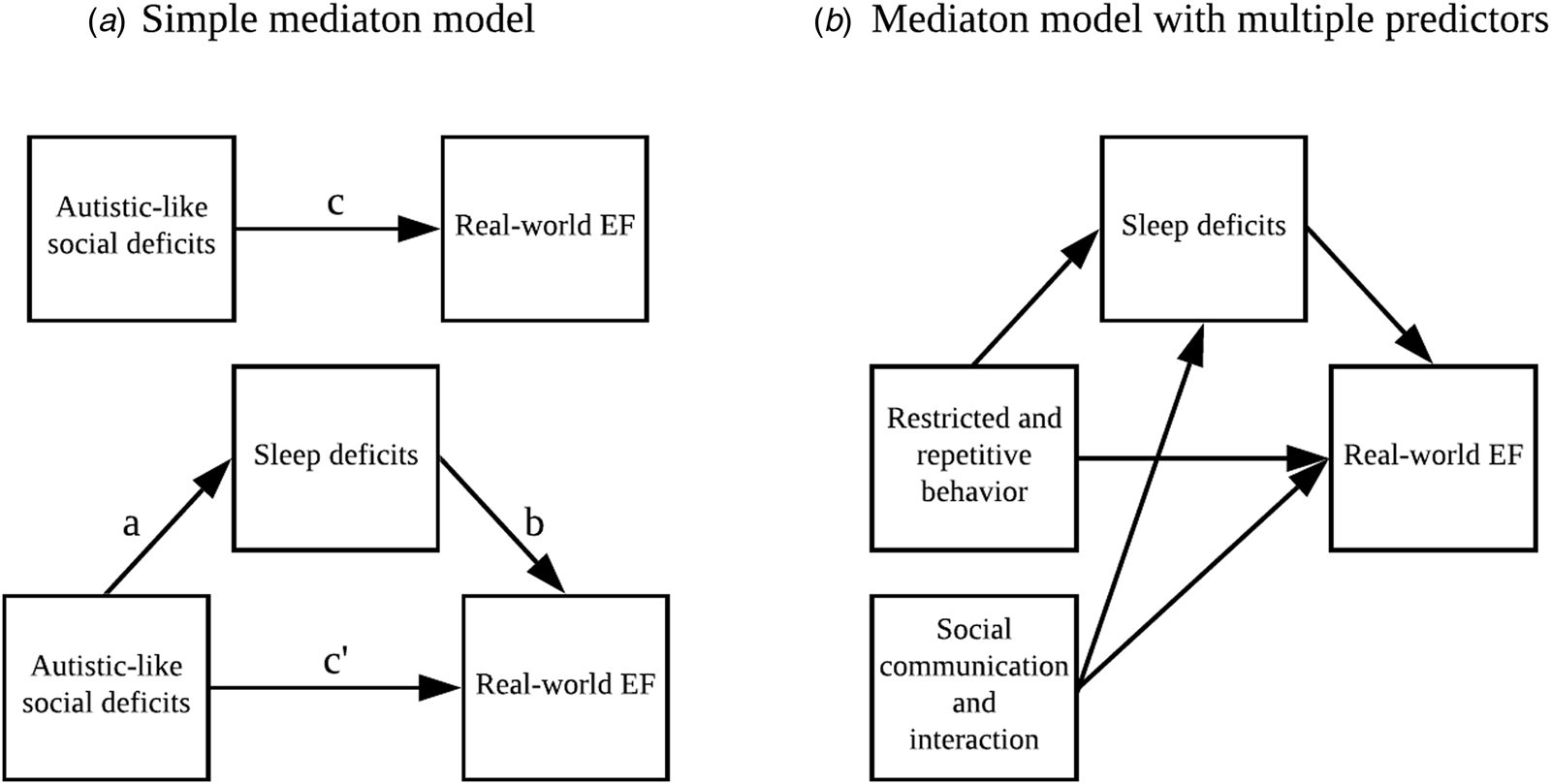
Two models were examined in the current study: (1) mediation model with covariates (Fig. 1a) and (2) mediation model with multiple predictors (Fig. 1b). In the mediation model (Fig. 1a), ‘sleep deficits’ are considered the potential mediators of the link between autistic traits and various real-world executive functions while controlling for sex and age. Following suggestion from Hayes (Reference Hayes2013), we calculated the indirect effects, the products of a (the pathway from autistic traits to sleep deficits) and b (the pathway from sleep deficits to real-world executive functions), that represent how autistic traits influence sleep deficits, and in turn influence real-world executive functions. For a mediation model with multiple predictors (Fig. 1b), the total score of SRS was replaced by ‘social communication and interaction’ and ‘restricted and repetitive behavior.’ The 95% bias-corrected (BCa) bootstrap confidence intervals (CIs) with 10 000 bootstrap samples were used to test the statistical significance of the indirect effects. The proportion of the total effect explained by the mediation variables was provided to assess the effect size of the indirect effects (Hafeman, Reference Hafeman2009). The PROCESS (version 2.16) developed by Hayes (Reference Hayes2013), in which different numbers are used to specify different preset complex models. The PROCESS (version 2.16) Model 4 was used for mediation models in this study. A sensitivity analysis was conducted to determine the differences between the analyses using the SRS scores with and without data binning.
Visualization of mediation models of autistic traits, insufficient sleep and real-world executive functions. (a) A simple mediation model of autistic traits on real-world executive functions through insufficient sleep. (b) A mediation model of social communication and interaction and restricted and repetitive behavior on real-world executive functions through insufficient sleep.

Results
Table 1 presents the descriptive characteristics, means, and s.d. of the subscales of the BRIEF, the subcomponents of the SRS, sleep duration, sleep need, and sleep deficits. The two components of the SRS, ‘social communication and interaction’ and ‘ restricted and repetitive behavior,’ were moderately correlated with each other (Pearson's r = 0.53, ps < 0.01).
Sleep deficits as a mediator in the link between autistic traits and executive functions
Table 2 presents the unstandardized coefficient estimates, indirect effects, and 95% BCa bootstrap CIs for the mediation model with the indices of the BRIEF as dependent variables. Generally, we found that children with higher autistic traits had more sleep deficits and increased sleep deficits were found associated with more real-world executive function deficits. Furthermore, we found that sleep deficits mediate the link of autistic traits and real-world executive function deficits. The mediating role of sleep deficits were found for autistic traits on all subscales of the BRIEF (GEC, behavioral regulation index, and metacognition index) in Table 2 and the BRIEF index (inhibition, shift, emotional control, self-monitor, initiate, working memory, plan/organize, task monitor, and organization of materials) in online Supplementary Table S2 after adjusting for sex and age.
Results of the mediation models of autistic traits, sleep deficits, and real-world executive functions

BCa CI, bias-corrected bootstrap confidence interval; BRIEF, Behavior Rating Inventory of Executive Function; GEC, Global Executive Composite; BRI, Behavioral Regulation Index; MI, Metacognition Index; s.e., standard error.
Note: Indirect effects (ab), direct effect (c′), total effect (c). If the 95% BCa CI of ab does not include zero, it is suggested that autistic traits exerted indirect effects on executive functions through sleep deficits.
In this mediation model, the predictor is the total score of the social responsiveness scale, the mediator is sleep deficits, and outcomes are the subscales of BRIEF.
Sex and age were covariates.
*p < 0.05, **p < 0.001.
Contribution of subcomponents of autistic traits
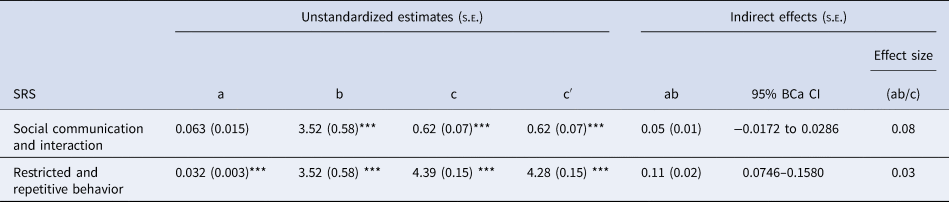
To examine whether the mediation relationship differed between two specific subcomponents of autistic traits (‘restricted and repetitive behavior’ and ‘social communication and interaction’), we simultaneously analyzed the two subcomponents of the SRS. We found that only ‘restricted and repetitive behavior’ had independent prediction on sleep deficits (unstandardized coefficient estimates = 0.063, p < 0.001), but not social communication and interaction (unstandardized coefficient estimates = 0.032, p > 0.05). As a result, the significant indirect effect was only found in restricted and repetitive behavior on executive function through sleep deficits, but not in social communication and interaction although both restricted and repetitive behavior and social communication and interaction had significant direct effects on executive function. The detailed unstandardized coefficient estimates, indirect effects, and 95% BCa bootstrap CIs for the mediation model with multiple predictors are shown in Table 3. The results of the sensitivity analysis indicated that statistical significance remained the same, regardless of the approaches with or without data binning.
Results of the mediation model of restricted and repetitive behavior and social communication and interaction of Social Responsiveness Scale (SRS), Sleep Deficit, and GEC of BRIEF

BCa CI, bias-corrected bootstrap confidence interval; BRIEF, Behavior Rating Inventory of Executive Function; GEC, Global Executive Composite; s.e., standard error.
Note: Indirect effects (ab), direct effect (c'), total effect (c). If the 95% BCa CI of ab does not include zero, it is suggested that autistic traits exerted indirect effects on executive functions through sleep deficits.
In this mediation model with multiple predictors, predictors are two subscales of the SRS (i.e. social communication and interaction and restricted and repetitive behavior) mediator is sleep deficits, and outcomes are the GEC of BRIEF.
Sex and age were covariates.
**p < 0.01, ***p < 0.001.
Discussion
To the best of our knowledge, the current work is the first study to examine sleep deficits as a mediator between the link of autistic traits and real-world executive functions and to explore whether subcomponents of autistic traits differentially influence executive functions through sleep deficits in a nationally representative sample of children. The results support our hypothesis that autistic traits exert detrimental indirect effects on children's executive functions through sleep deficits independent of sex and age. Moreover, we found that when two subcomponents corresponding to the DSM-5 defining ASD were considered simultaneously, ‘restricted and repetitive behavior,’ instead of ‘social communication and interaction,’ continued to uniquely exert indirect effects on executive functions through sleep deficits. Some speculations of potential mechanisms that might underlie the observed correlational structure are provided in the following discussion.
Our finding of the association between autistic traits and impaired real-world executive functions is consistent with previous studies (Chen et al., Reference Chen, Chien, Wu, Shang, Wu and Gau2016; Chien et al., Reference Chien, Gau, Shang, Chiu, Tsai and Wu2015; Demetriou et al., Reference Demetriou, Lampit, Quintana, Naismith, Song, Pye and Guastella2018), suggesting that executive dysfunctions might be one of the common psychopathologies in the diagnosis of ASD and dimensions of autistic features as well (Leung et al., Reference Leung, Vogan, Powell, Anagnostou and Taylor2016). Furthermore, our work replicated and extended the result of a prior study in adolescents (Salmela et al., Reference Salmela, Kuula, Merikanto, Raikkonen and Pesonen2018) that sleep deficits are inversely associated with the level of autistic traits in a sample of over 6000 typically developing school-aged children, suggesting the correlation between autistic traits and sleep deficits is not exclusively in children with clinical diagnosis of ASD but also general child population. Moreover, our mediation analyses of overall autistic traits (assessed by the total score of the SRS) are consistent with previous studies reporting that autistic traits and insufficient sleep were inversely associated with executive functions in children (Astill et al., Reference Astill, Van der Heijden, Van Ijzendoorn and Van Someren2012; Hyseni et al., Reference Hyseni, Blanken, Muetzel, Verhulst, Tiemeier and White2018).
We assessed two subcomponents of autistic traits, ‘social communication and interaction’ and ‘restricted and repetitive behavior,’ and found that both subcomponents were associated with sleep deficits, which was consistent with previous studies in children with ASD (Hollway, Aman, & Butter, Reference Hollway, Aman and Butter2013). However, the results of our analyses further point out that the mediation relationship of sleep problems between core symptoms and executive functions was only observed in restricted and repetitive behavior, but not in social communication and interaction. A recent review study suggested that restricted and repetitive behavior may be a precipitating factor of behavioral insomnia (Mazzone, Postorino, Siracusano, Riccioni, & Curatolo, Reference Mazzone, Postorino, Siracusano, Riccioni and Curatolo2018). Cognitive inflexibility, significant distress, and time-consuming rituals from restricted and repetitive behavior may delay sleep onset or determine physiological hyperarousal and emotional overreaction (Harvey, Tang, & Browning, Reference Harvey, Tang and Browning2005). In addition, hyperreactivity of sensory input may also contribute to difficulty in initializing and maintaining sleep (Mazurek & Petroski, Reference Mazurek and Petroski2015). By contrast, social communication and interaction act more like a perpetuating factor for sleep problems (Ibañez et al., Reference Ibañez, Kobak, Swanson, Wallace, Warren and Stone2018). These social deficits can interfere with the child to follow parents' sleep instruction or to seek help for insomnia (Mazzone et al., Reference Mazzone, Postorino, Siracusano, Riccioni and Curatolo2018). Our findings support the different roles of restricted and repetitive behavior and social communication and interaction for sleep problems and suggest the mediation relationship of autistic traits and impaired real-world executive functions through sleep deficits is specifically related to restricted and repetitive behavior. However, it is worth noting that some researchers suggested that social deficits may have a more profound effect on sleep. Frustration in social situations may result in anxiety, which was found to be associated with the severity of sleep problems in individuals with ASD (Hollway et al., Reference Hollway, Aman and Butter2013). Further studies are warranted to distinguish the differential roles of restricted and repetitive behavior and social communication and interaction on sleep and executive functions.
Limitations and strengths
Some methodological limitations of this study need to be mentioned when interpreting our findings. First, although we adopted some theories and hypotheses to frame these causal relationships between autistic traits, sleep deficits, and real-world executive functions, the causality was still limited due to the cross-sectional study design in this study. Second, the generalizability of this study to the clinical ASD population and other age groups is limited because we used the SRS rather than the clinical diagnosis in a general child population with the age range from 8 to 14 years old. Third, the child–parent agreement on sleep variables was not high in the current study. However, such low child–parent agreement has also observed in a previous study (Liu, Wang, Ji, Cui, & Liu, Reference Liu, Wang, Ji, Cui and Liu2018). It has been reported that greater child–parent agreement would be more easily to be found in children with more severe mental health problems because of the presence of significant symptoms (Bajeux et al., Reference Bajeux, Klemanski, Husky, Leray, Chee, Shojaei and Kovess-Masfety2018). Because the study sample is a nationally representative school-based sample, we might not observe high child–parent agreement on their reports. Finally, although the SRS is a widely used screening questionnaire to measure autistic traits and ASD severity, some researchers suggest that the score of SRS may be more appropriately interpreted as an indicator of general levels of social impairment in the non-clinical population (Hus, Bishop, Gotham, Huerta, & Lord, Reference Hus, Bishop, Gotham, Huerta and Lord2013).
By contrast, several features of this study constitute its strengths. First, the current study was conducted in a large-scale nationally representative sample, providing high statistical power to examine the possible patterns of statistical associations. Second, unlike previous ASD-related studies usually used only the categorical approach, we used the dimensional approach regarding autistic traits and found consistent results. Furthermore, among studies of subclinical autistic traits, our study is the first to access the relationship between sleep and different components of autistic traits, instead of considering autistic traits as one dimension. We found that the mediation relationship from autistic traits to real-world executive functions through sleep deficits was more profoundly in the dimension of restricted and repetitive behaviors than in the dimension of social communication and interaction. Third, instead of sleep duration, we used sleep deficits as an indicator to better capture insufficient sleep in an age group with relatively variable sleep need. Finally, we measured real-world executive functions using the BRIEF, which assessed more components of executive functions than most laboratory-based tests assessing executive functions. Furthermore, BRIEF was a sensitive and reliable tool for identifying ASD-associated cognitive deficits (Demetriou et al., Reference Demetriou, Lampit, Quintana, Naismith, Song, Pye and Guastella2018). Future studies should extend our findings using laboratory-based or performance-based executive function tests in the clinical ASD group.
Supplementary material
The supplementary material for this article can be found at https://doi.org/10.1017/S0033291719003271
Acknowledgements
We express our thanks to all the students, parents, and teachers who participated in the study.
Financial support
This work was supported by grants from the Ministry of Health and Welfare (M03B3374), National Health Research Institute (NHRI-EX104-10404PI, NHRI-EX105-10404PI, and NHRI-EX106-10404PI), and the Ministry of Science and Technology (MOST 103-2314-B-002-021-MY3).
Conflict of interest
None declared.