


In an early review essay, “Woman in France” (1854), George Eliot suggests that the growth of journalism had suppressed individual communication, so that what was “once lavished prodigally in conversation, is reserved for the volume, or the ‘article’; and the effort is not to betray originality rather than to communicate it.” Drawing a parallel with the coming of the railways, which had led the old coach roads to fall into disuse, she turns to speculation as to what might happen if this tendency to “divert information from the channel of conversation into the channel of the Press” were to intensify. Such a possibility “makes us tremble lest some further development of the electric telegraph should reduce us to a society of mutes, or to a sort of insects [sic], communicating by ingenious antennae of our own invention.”1 This playful imagining (penned before the publication of Darwin’s Origin) envisages a novel form of evolution whereby the pressures exerted on social behavior and practices by new mechanized modes of communication, from the steam printing presses to the telegraph, would in turn create a new form of humanity, enhanced by insect-like powers. It is a short step from here to our own society, in which people go about their daily lives with their eyes locked on the new extension of the human body, the “ingenious antennae” encompassed in the cell phone, which supplants face-to-face and oral communication with the digital flow of information.
Eliot’s flight of fancy illustrates how engaged she was, from early on in her career, in possible futures, and intersections of animal, human, and technological life. Although she is known for setting her works in the recent past, allowing for reflective distance on the part of her narrator, such reflection flashes forward as well as back, most famously in the opening of Felix Holt (1866) where she returns again to the glories of the “old coach-roads,” contrasted this time with the fate of “Posterity” who may be “shot, like a bullet through a tube, by atmospheric pressure from Winchester to Newcastle.”2 Often taken as a humorous exaggeration of the speed of modern rail travel, the reference is in fact highly topical, relating to the creation by the London Pneumatic Despatch Company in 1863 of an underground pneumatic railway serving the Post Office (and thus a new technological version of the mail coach). On its opening in 1863, various scientific gentlemen could not resist taking a ride (although the open carts were only constructed for letters and parcels). A popular story circulated that a lady had “astonished all spectators” by being “shot the whole length of the tube, crinoline and all, without injury to person or petticoat.”3 A trial pneumatic railway for human passengers was subsequently constructed in 1864 at Crystal Palace in Sydenham, functioning as a major tourist attraction. It would seem from Eliot’s phraseology, however, that she has in mind that futuristic picture of the woman in the crinoline being shot through the tunnel, without the protective framework of a carriage, a humorous, prosthetic imagining of human enhancement that clearly resonated in Victorian culture.
In this chapter I explore Eliot’s imaginative engagement not merely with the science of the time, but also with the machines which were created to measure, extend, and amplify human senses and capabilities, many of which she personally viewed when accompanying G. H. Lewes on his tours of Continental and (to a lesser extent) British laboratories. In “Shadows of the Coming Race,” part of Eliot’s final work, Impressions of Theophrastus Such (1879), the fictionalized narrator speaks of his concerns regarding the growing power of machines, of “micrometers and thermopiles and tasimeters which deal physically with the invisible, the impalpable, and the unimaginable,” and of a “machine for drawing the right conclusion, which will doubtless by-and-by be improved into an automaton for finding true premises.”4 To our ears, the concerns appear highly prescient, yet the tenor of the discussion is very much of its time, whether Edward Bulwer-Lytton’s novel, The Coming Race (1872) from which Eliot takes her title, or Samuel Butler’s witty response to Darwinian theory, “Darwin among the Machines” (1863, and reworked in “The Book of the Machines” in Erewhon 1872), from which I take my own.5 This was the great age for the development of experimental physiology, and of the creation of “self-recording” machines that aimed to measure every aspect of human physiological life, including the processes of thought and the flows of emotion. The ambitions of current cognitive neuroscience are in many respects reworkings of these nineteenth-century investigations that similarly aimed to map all the processes of the human body and mind. Such work raised moral, ethical, and ontological queries, particularly with reference to the unstable boundaries between animal, human and machine life. T. H. Huxley’s iconoclastic essay of 1874, “On the Hypothesis that Animals are Automata, and its History,” deliberately provoked extensive social and scientific debate on the issues, which continued to resonate over the next decades. G. H. Lewes, working on The Physical Basis of Mind at the same time as Eliot wrote Daniel Deronda, included an extensive section on “Animal Automatism” as he sought to resolve some of the conundrums created by the development of physiological psychology, and the challenges thus posed for understandings of the processes of human consciousness and the formation of selfhood.6 I focus in this chapter on Eliot’s final two works, Daniel Deronda and Impressions of Theophrastus Such, which both, in their very different ways, seek to address this new world of physiological precision and measurement that unravels ideas of human exceptionalism.
As Jessica Riskin has shown, debates about agency and the boundaries between organic and inorganic life were not new in the nineteenth century but stretched back centuries.7 Nor were Huxley’s own arguments new in 1874. He had already made similar points four years previously, for example, in an article on Descartes’ Discourse on Method in the popular Macmillan’s Magazine, but this time he selected a deliberately provocative title, and ended with an excoriating attack on bishops and other members of the clergy who refused to accept his (and by implication, Darwin’s) theories that man was part of the animal kingdom and subject to the same physical laws. Following this logic, he concluded that “all states of consciousness in us, as in them [animals], are immediately caused by molecular changes of the brain-substance.”8 Dispensing with Descartes’ distinction between animal automata and humans endowed with consciousness and free will, he argues that what we call “volition” is never the cause of an act. We are, he concludes, “conscious automata,” with all acts of seeming volition subject to the wider laws of cause and effect which govern the natural world (577).9 Crude as Huxley’s arguments were, from a philosophical perspective, they nonetheless established the terms of ensuing debate, with most major figures in the field of physiological psychology wading in to outline where they stood on the question of human automatism (with much quibbling over the meanings of the term).10 The question of automata at this period thus went far beyond concerns about the developing power of machines, encompassing the rising sciences of physiological psychology and neurology, and attempts to track, explain, and measure the hidden movements of the mind.
George Eliot famously opens Daniel Deronda with a reflection on some of the limitations of “Science, the strict measurer.”11 Her text engages at a deep level with the sciences of neurological measurement, while also creating alternate forms for exploring unconscious movements of the mind. In the very first scene, we are introduced to ideas of automatic action. The “gas-poisoned absorption” of the gambling salon is scarcely broken by “an occasional monotone in French, such as might be expected to issue from an ingeniously constructed automaton” (5, 3–4). Sound is severed from agency, and personhood, with little to distinguish this live automaton from the crowds of “human beings” (as distinct from people) who gather around the tables. The whole scene is framed under a scientific gaze and in language that carries its own freight of repulsion, being designedly rebarbative and overly scientized. Early reviewers complained bitterly of the “portentously scientific” use of terms, from the “dynamic” (3) quality of Gwendolen’s glance, to the “epidermis” (4) that clothes the watching child.12 The latter usage, in place of the more straightforward “skin,” even attracted a skit in Fun in which “Our Own Flaneur” claims to have advised Eliot on her scientific language, noting that no one “can see the word epidermis without thinking of vivisection.”13
Behind the comic exaggeration in this item there was a serious point. Contemporary advances in neurophysiology were entirely dependent on vivisection, and the general reader would indeed have encountered references to slicing through the epidermis in press coverage of the fierce anti-vivisection campaigns at that time. G. H. Lewes was an active vivisector, and whilst Eliot was writing Daniel Deronda he was involved in the “long and arduous investigation[s]” and experimentation that underpinned his work for The Physical Basis of Mind.14 He also gave a very public defense of vivisection to the Royal Commission on the Practice of Subjecting Live Animals to Experiments for Scientific Purposes.15 While defending the need for such practices, he criticized unnecessary and ill-thought-through experiments, and noted that he worked primarily with frogs (and some rabbits and pigeons, although he claimed he could not bear to work with cats and dogs), and always under anesthetic. Oddly, as part of his evidence, he drew an extended comparison between vivisection and “the real torture inflicted upon authors by critics.”16 Given that his relationship with Eliot was well known, the observation would have summoned up for his audience an associated image of George Eliot herself as a tortured laboratory animal.17 Lewes’ aim was no doubt to normalize animal experimentation, and to bring it within the protective mantle of high culture, but the effect is to highlight the problematic boundaries between animal and human life, and that of civilization and barbarism, opened up by the rapid development of neurophysiology. Experimentation was not a distanced reality for Eliot, but part of her daily domestic life with Lewes, taking place in her home during the day, and replicated in their shared reading and discussions in the evenings. There has been a tendency in criticism to link her involvement with this side of Lewes’ work to their early days, recorded in Seaside Studies and her unpublished “Recollections” of their expeditions to Ilfracombe, the Scilly Isles, and Jersey, but her final works suggest, on the contrary, a deepening involvement in the world of physiological experiment.18
In the opening scene of Daniel Deronda the scientific gaze of the narrator is mirrored in the scrutiny that Daniel directs onto Gwendolen, although this time the object of the gaze is aware of the assessment – that he was “measuring her” and “examining her as a specimen of a lower order” – and adjusts her behavior accordingly, to disastrous effect (6). Objectivity is compromised in this unfortunate entanglement of scientist and experimental subject. Eliot records Gwendolen’s responses in physiological terms – the loss of blood to the lips, the growing heat in the “orbits of her eyes” (6). Her consciousness of “that man” watching her was “something like a pressure which begins to be torturing” (6). She determines not to “flinch,” but even after she has left the gaming table, she is still “wincing” under the effects of Deronda’s “measuring gaze” (6, 9). As Tiffany Watt Smith has shown, the vocabulary of flinching and wincing was very much that of animal experimentation of the period, both with regard to the animals’ responses and those of the scientists, who involuntarily recoiled from their own experimental practice.19 Gwendolen is doubly the subject of “experiments in life,” both of the author, and of Deronda, whose “torturing” gaze (6) anticipates the more malevolent torture she is to receive at the hands of Grandcourt.20 The whole opening scene is one that tests the boundaries of volition, the gamblers’ belief in their status as free agents, and their investment in personal “luck,” set against the oppressive force of habit and the “puerile stupidity of a dominant impulse” that turns the human into an automaton (7). As in animal experimentation they are anaesthetized, “as if they had all eaten of some root that for the time compelled the brains of each to the same narrow monotony of action” (5). Like the physiological psychologists with their precision instruments, Eliot focuses on minute divisions of time, not the billions of units employed in astronomy of her opening epigraph, but the fractions of a second of nerve impulse: “development and catastrophe can often be measured by nothing clumsier than the moment-hand” (7). Gwendolen’s interaction with Deronda, which is to alter her entire future, is a matter of “five seconds” (7).
In her exploration of the “unmapped country” (257) of Gwendolen’s psyche, Eliot highlights the play of muscles, nerves, and pulse, and the seemingly simultaneous operations of thoughts and impulses within the layers of the mind, contrasting the “clumsy necessities” of the outer world of action with the “subtler possibilities” of the world within, where “a moment is room wide enough for the loyal and mean desire, for the outlash of a murderous thought and the sharp backward stroke of repentance” (36). Her desire to capture and inscribe this inner world is also that of the physiological psychologists of the era who wished to explore, as Eliot puts it in Theophrastus Such, “the invisible, the impalpable, and the unimaginable.”21 In 1869, whilst on a trip to Florence, Eliot went with Lewes to see a demonstration at the laboratory of Moritz Schiff of “an instrument for measuring the rapidity of thought.”22 Although Lewes gives no further details, it would seem that this was a development of work by Franciscus Cornelis Donders at Utrecht, who had published the previous year a celebrated paper, “On the Speed of Psychological Processes,” and created a machine he christened the noematachograph (speed-of-thought writer).23 Schiff was a leading experimentalist, notorious at that time for his work on animals (due to a campaign in Florence led by Frances Power Cobbe), but on this occasion he would appear to have been using human subjects.24 Starting from the 1840s, with the invention by Charles Wheatstone of the chronoscope (time observer) and by Carl Ludwig of the kymograph (wave inscription), it became possible, due to further enhancements by Hermann von Helmholtz, to measure physiological processes to within a thousandth of a second, revolutionizing physiology and other scientific fields. Donders’ innovation was to measure not merely reflex actions, but the time the brain took to process a task, using a phonautograph that could record the voice, thus establishing a form of experimentation still in use in current neurolinguistics.25 Schiff himself added to this research in the year of Eliot’s visit by publishing pioneering research on temperature changes in the brain of animals during mental activity (using a far more invasive system than Donders, inserting a thermocouple into the brains of various mammals).26
The possibilities unleashed by what Étienne-Jules Marey called the “graphic method” were immense, and led to the invention of numerous other devices and amalgamations of instruments designed to capture the rapid processes of both body and mind. The graphic method, Marey argued, was able to capture “movements which are so light and fleeting, changes of condition so slow or so rapid, that they escape the senses.”27 The kymograph, with its rotating drum covered with blackened paper upon which a stylus could capture movements of the blood or muscles, was soon adapted for a range of measurements. All motion, Marey observed, “consists in a relation of space to time” and the curve inscribed by these graphic instruments “furnishes us with the double notion of time and space; it characterizes completely the act which it represents.”28 As applicable to astronomy as to physiology, these forms of instrument do away with “any intermediary between the act and its graphic expression.”29 They achieve, in other words, the supreme goal of the realist novel, a form of self-inscription of life, with no distortions. Marey even confers on graphic instruments human qualities: “Patient, conscientious, infallible, these instruments do what would be impossible to a legion of observers.”30 With her opening epigraph invoking time, space, and scientific measurement, in the heavens and in human life, Eliot sets her novel firmly within the framework of these scientific debates.
From the late 1860s onward, Lewes had become more and more interested in the workings of the human mind, and the interlinked domains of research on mental physiology and medical investigations of states of mental disorder. In 1870, during a trip to Berlin, he spent time at the Charité with Carl Westphal (who was to publish his pioneering work on agoraphobia the following year), taking extensive notes of the cases he observed of aphasia, hysteria, hallucinations, and other nervous disorders.31 Eliot was to meet many of the leading lights of German science during this trip. They moved onto Vienna, where Lewes had long discussions with the physiologist and director of the psychiatric asylum, Theodor Hermann Meynert, on the brain. He was clearly eager to pass on his findings to Eliot; he notes in his diary a couple of days later, “Lesson on the brain to Polly.”32 Eliot’s “lessons” were clearly not over since, shortly after they returned to England, they headed to Oxford where, she records, they had “an interesting morning with Dr Rolleston who dissected a brain for me.”33
Lewes’ interests in the physiological form of mental processes at this period were stimulated by his growing friendship with John Hughlings Jackson, one of the recognized founders of the modern field of neurophysiology who became a regular at the Priory from 1873.34 Jackson’s interests in aphasia and epilepsy, with their associated states of double consciousness, premonitions, and déjà vu (all of which figure in Daniel Deronda), are reflected in Lewes’ reading at this time, which includes numerous works on aphasia, in addition to other work by Jackson himself and by his colleague David Ferrier (whose experimental research on the brains of monkeys was subsequently to cause public outrage).35 For Jackson, mental states outside conscious control were forms of what he terms “mental automatism.”36 Lewes explores questions of mental automatism in a range of works, culminating in “Consciousness and Unconsciousness” in Mind (1877) and its more extended form in the section on “Animal Automatism” in The Physical Basis of Mind. Lewes’ work shows he was drawing on the most recently published research, not only in France and Germany but also Italy. He discusses, for example, the work of Schiff, and the “delicate instruments” which prove “that at the time a sensation is produced the temperature of the brain is raised.” He continues, “The same is true of ideation.”37 The work he is drawing on with reference to ideation is that of Angelo Mosso, of Turin, who had first trained with Schiff (and subsequently worked with Carl Ludwig in Leipzig and with Claude Bernard and Marey in Paris).
Mosso, Lewes observes, had “invented a method of registering the effect of thought on the circulation.”38 This was either the ergograph, devised by Mosso to measure fatigue (both muscular and mental), or the more advanced hydrosphygmograph, which, by immersing an arm in water and monitoring changes in volume, could thereby measure increases or decreases of the flow of blood, and hence the additional blood flowing to the brain under different tasks. It could also measure, as Lewes reports, the different degrees of intellectual effort expended in translating Greek or Latin. Lewes was fascinated by such devices, which brought the possibilities of measuring movements of the mind ever closer.39 With regard to the automatism debates, however, he remained resolutely agnostic, insisting that the dichotomy between mind and body was fundamentally misguided: “What is called the material process is simply the objective aspect of the subjective mental process.”40 He prefers instead a philosophy of Organicism, suggesting that “the organic phenomena grouped under the terms Life and Mind are activities not of any single element, in or out of the organism, but activities of the whole organism in correspondence with a physical and social medium.”41 As he argues at great length in The Physical Basis of Mind, there is no fundamental distinction between consciousness and subconscious or unconscious states or actions. In his favorite image, the mind is like a lake with various streams entering at different levels, mingling and altering the whole in constantly shifting patterns.42 Drawing on the work of Schiff and others, he insists that mind is not merely associated with the brain. Consciousness can also be found, he argues, in the spinal cord.43 Like his favorite philosopher, Spinoza, he challenges the mind–body dualism of Descartes.
The language of neurophysiology emerges repeatedly in Daniel Deronda, whether in the “dark rays” of Gwendolen’s unconscious thoughts, “doing their work invisibly in the broad light,” (512) or the reverse automatism of Klesmer’s piano playing, and the “imperious magic in his fingers that seemed to send a nerve-thrill through ivory key and wooden hammer, and compel the strings to make a quivering lingering speech for him” (40). The nervous energy of the player fuses human and machine into one living, and articulate, body. As a counterexample, Eliot offers the quick vignette (in relation to Grandcourt), of the navvy who, on waking from sleep, and “without malice heav[es] a stone to crush the life out of his still sleeping comrade,” an example of a form of automatic action that formed a staple in the neurophysiological literature of the time (266).44 Perhaps the most direct reference to neurophysiology is in the “Hand and Banner” scene, in which Deronda first learns of Mordecai’s visionary ideals. As Eliot famously remarked in a letter to her friend Barbara Bodichon, she meant “everything in the novel to be related to everything else there.”45 The foundation of the scene comes from Lewes’ account of meetings in his youth in a tavern in Red Lion Square with a group of students who were held spellbound by an impoverished Jewish watchmaker named Cohn, who introduced them to the philosophy of Spinoza.46 In keeping with Lewes’ and Spinoza’s refusal to accept boundaries between mind and body, Mordecai’s visionary idealism is framed in highly physiological terms, with images of thwarted energies, buried memories, and beating pulses. He is set in conversation with other voices, including the “laboratory assistant” Marrables, who suggests that ideas may spread in society, by “changing the distribution of gases … instruments are getting so fine now, men may come to register the spread of a theory by observed changes in the atmosphere and corresponding changes in the nerves” (487). As with Eliot’s other projections into the future, it is fleeting, but startling in its implications.
The fact that the observation is given to a laboratory assistant gives it a specificity that sets it apart, emerging as it is from a domain of scientific practice and work with instruments that were growing ever more precise in their measurements and capabilities. It is a speculation that emerges from the automatism debates, argued perhaps most elegantly by Eliot and Lewes’ close friend, the mathematician William Kingdon Clifford in his article “Body and Mind” (1874). To introduce ideas of the mind having its own will, or force, he argued, was to violate the laws of the conservation of energy. Any suggestion that physical laws were not continuous, and hence that we were not automata, was an “immoral doctrine” that would destroy any sense of human responsibility.47 As Stephen Jacyna has pointed out, Clifford followed Spinoza in “attributing the property of mind to external substance in general.”48 Marrables’ suggestion takes further the notion that consciousness is indivisible from the physical chemistry of the body, and imagines the exchange that takes place with the surrounding air as the body exhales breath and the nerves readjust to the stimulus of a new idea. Human life, Lewes insisted, was a continuous process of exchange between the organism and its medium. In Marrables’ observation, Lewes’ theories are teased out to an ultimate extreme, going beyond contemporary science but possibly not the range of the playful, speculative minds who assembled at the Priory.
With regard to chemistry, Eliot, on her trip to Oxford in 1870, had visited the chemical laboratory of Professor Benjamin Brodie, and been shown new techniques for measuring infinitesimal quantities. Brodie, a “highly philosophical chemist” had embarked in 1866 on his project of producing an “ideal chemistry,” a “Calculus of Chemical Operations,” grounded in Boolean logic and possibly influenced by Comtean theory.49 Given Eliot’s long-standing fascination with mathematics (she was to give instruction to Lewes so that he had sufficient grounding to tackle his work for the Problems of Life and Mind), she was no doubt attracted to Brodie’s proposals, or at least admiring of his ambition.50 What his work best illustrates however, like Marrables’ observation, is the ferment of excitement at the time, and belief in the possibilities of creating new models of understanding and measuring the hidden processes within mind and matter.
Although this world of measurement and machines that Eliot entered was largely dominated by men, there were exceptions. Phoebe Marks, for example, daughter of an impoverished Jewish watchmaker and partial model for Mirah, in a radical transmutation of identity became the famous electrical engineer, Hertha Ayrton (1824–1923), celebrated for her work on the electric arc and the motion of ripples in sand and water. Denied membership of the Royal Society due to her sex, Marks/Ayrton was the first woman to read a paper at the Society, and was awarded the prestigious Hughes medal in 1906 for outstanding contributions in the field of energy – rather a different future to that granted Mirah, meekly following Deronda in his voyage to the East. Eliot was fascinated by Marks, who was the protégé of her friend Barbara Bodichon, and she helped to fund her studies of mathematics at Girton. Whilst at the university Marks was to make her first contribution to the world of machines, inventing an early form of sphygmomanometer (a pulse reader, which also employed the “graphic method”).51 Mordecai, in the “fervour” of his “concentrated prevision” is compared to a scientific experimenter (460), but in this alternate, real-life version, it is Mirah who proves to be the scientist, entering boldly into this new world of self-recording machines.
Shadows of the Coming Race
Eliot’s preoccupation with machinic powers is given full imaginative projection in Impressions of Theophrastus Such (written between June and November 1878), where she extends her vision of alternative futures. The narrator presents himself, reluctantly, as very much a denizen of the modern world. Whilst he yearns for the pastoral landscapes of his childhood, his consciousness is now “chiefly of the busy, anxious, metropolitan sort.” He is thus “half-sleepless with eager thought and strife,” and he notes that “My system responds sensitively to the London weather-signs, political, social, literary.”52 He presents himself, in other words, as one of the new self-recording machines, measuring in his own body all the aspects of his new medium. In “Shadows of the Coming Race,” he projects such sensitivity into the future, arguing with his overly optimistic friend Trost that current developments will lead, in around a thousand years’ time, to a world where human life is subservient to, and indeed superseded by, the machine. Patient, methodical, and error-free, without the distractions of a “screaming consciousness,” machines will move out of human control and become “self-repairing and reproducing.”53 As in Butler’s imaginings, evolution will proceed by natural selection. While Butler, in true Darwinian fashion, depicted evidence of evolutionary reversion and rudimentary organs,54 Eliot for her part envisages machines reproducing “by some process of fission or budding” thus rendering human life redundant.55 Her narrator reproduces in parodic form the dire warnings of late Victorian degenerationist theory, predicting that in time “all but a few of the rare inventors, calculators, and speculators will have become pale, pulpy, and cretinous from fatty or other degeneration, and behold around them a scanty hydrocephalous offspring.”56 The observation anticipates the world of Wells’ Time Machine (1895) and its vision of dual forms of human degeneration with the Eloi and the Morlocks. Focus on the seeming-future orientation of Eliot’s essay distracts attention, however, from its very contemporary preoccupations.
Readings of “Shadows of the Coming Race” tend to stress the exaggerated nature of its scientific musings. Even Helen Small, in an excellent article that discusses in detail the “wondrously delicate machine for testing sovereigns” at the Bank of England mentioned in the essay, nonetheless sees the subsequent depiction of a machine for “drawing the right conclusions” as satiric, and Theophrastus’ science as “non-serious.”57 I would argue on the contrary that the essay is deeply embedded in the world of contemporary science, which offers Eliot new ways of thinking about “the invisible, the impalpable, and the unimaginable,”58 even whilst she might wish to distance herself from its apparatus and some of its practices. Her science is very up to date, giving a sense of immediacy to Theophrastus’ complaints for initial readers. His fears of “the shadow of the Coming Race” are stimulated by talk of
micrometers and thermopiles and tasimeters which deal physically with the invisible, the impalpable, and the unimaginable; of cunning wires and wheels and pointing needles which will register your and my quickness so as to exclude flattering opinion; of a machine for drawing the right conclusion, which will doubtless by-and-by be improved into an automaton for finding true premises; of a microphone which detects the cadence of the fly’s foot on the ceiling, and may be expected presently to discriminate the noises of our various follies as they soliloquise or converse in our brains.
While micrometers (which could measure down to a 500,000th of an inch and were used initially in astronomy) and thermopiles (for measuring minute quantities of radiant heat, deployed by Schiff and others in animal experimentation), had been around since the 1840s, tasimeters were introduced only in the summer of 1878, whilst Eliot was writing Impressions. An invention of Thomas Edison, the tasimeter employed the conductivity of carbon to measure minute variations of temperature, length, or moisture. Nature announced in great excitement in August 1878 that Edison proposed to use the device together with “delicate thermometers, barometers, and hygrometers” for extraordinary purposes: “He expects to indicate the heat of the stars and to weigh the light of the sun.”59 The magazine followed breathlessly that summer as the “unimaginable” came to pass. Astronomers from across the world converged on stations set up in Wyoming and Colorado to observe an eclipse of the sun. Edison, by attaching his tasimeter to a telescope, was able to measure heatwaves for the first time in the sun’s corona, thus introducing thermoelectric observation into astronomy.60 As with Eliot’s astronomical framing of Daniel Deronda, instruments of unbelievable delicacy were probing both the secrets of the stars and the hidden processes of thought.
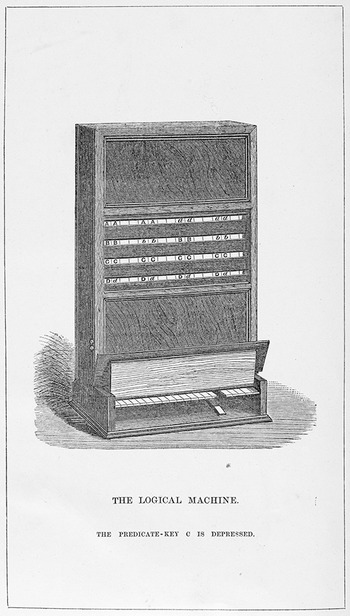
The machine for measuring “your or my quickness” relates to the “machine for measuring the rapidity of thought” that Eliot had seen demonstrated in Schiff’s laboratory, while the “machine for drawing the right conclusion” is not, as many critics have assumed, a satirical absurdity, but rather the “logical piano” created by the political economist and general polymath William Stanley Jevons in 1870 (Figure 14.1).61
“The Logical Machine”

A forerunner of the modern computer, the machine was based on Boolean logical principles, and attracted considerable interest, not least from Lewes, who read the original paper presented to the Royal Society in 1870, and corresponded with Jevons about it.62 Jevons saw himself following through on the work of Charles Babbage, whose designs for an Analytical Engine in particular caught his imagination: “Mind thus seems able to impress some of its highest attributes upon matter, and to create its own rival in the wheels and levers of an insensible machine.”63 Whilst Babbage’s Analytical Engine worked with mathematics, Jevons sought to show that the processes of philosophical deduction could be accomplished by a machine. Like Babbage, who downplayed the significance of his creation, Jevons suggested that his machine was likely to be of little practical use, apart from the teaching of logic. Yet his own language reveals an excitement at a world opened up where the pure logical thinking of machines could help to correct the inaccuracies and faulty judgments holding sway in human interaction. In one of his letters to Lewes, Jevons argues that his machine, with its accumulating knowledge, would “resemble the mind of a pupil who was incapable of forgetting anything delivered to him or of reasoning wrongly from what he knew.”64
By the time Eliot wrote Impressions, the once-revered Jevons had tarnished his reputation for Eliot and Lewes and their circle by publishing a series of vitriolic articles in the Contemporary Review (December 1877–April 1878) outlining the failures of logic in John Stuart Mill’s work, and the dangers represented by the influential “sect” who continued to promulgate his ideas and philosophy.65 Lewes was particularly angered by this betrayal.66 It was as if Jevons had become his own “logical machine,” seeing it as his mission in life to crush those who failed to adhere to the strictest principles of logic, although the vehemence with which he pursued his targets suggests an emotional motivation and a “screaming consciousness” unbounded by the laws of rationality. Eliot’s Theophrastus humorously conjures up a future parliament of machines where the motions might be “infallible in logic,” but class hierarchies and personal motivations still play a role. In this scenario, “a remote descendant of the Voltaic family, might discharge a powerful current (entirely without animosity)” on a more upstart machine “belonging to the ancient edge-tool race which we already at Sheffield see paring thick iron as if it were mellow cheese,”67 Class warfare is played out between different generations of machines. The electrical precision instruments of the laboratory are set against the extraordinary industrial machines Eliot had witnessed on her trip to Sheffield ironworks in 1868 (she described them in letters as “stupendous” and “miraculous,” thoroughly seduced by their power).68 For all the layers of humor and satire in the essay, and Theophrastus’ exaggerated projections, the essay is nonetheless seeking to grapple with the implications of the development of new forms of self-acting, self-recording, and logical machines. The rise of the industrial machines of the North had displaced millions of workers from their employment and their homes; Eliot explores in this essay the potential forms of human–technological displacement to which this new generation of machines might give rise. “What demons so potent as molecular movements,” Theophrastus exclaims, as he outlines the future diminishing energies of the human race (141). As with James Clerk Maxwell and William Thomson’s hypothetical vision of a cricket-playing, sorting demon that might overturn the second law of thermodynamics, and thus the threat of entropy, Eliot is conducting her own playful thought experiment, as to what might occur once “self-repairing and reproducing machines arise.”69
In the initial list of machines that aroused Theophrastus’ anxieties, the final example was that of a microphone so sensitive it could capture the movement of a fly’s foot, and thus “may be expected presently to discriminate the noises of our various follies as they soliloquise or converse in our brains.” Once again Eliot is drawing on very recent science, the unveiling of David Edward Hughes’ discovery of what he termed a microphone, at the Royal Society on May 9, 1878. Such was the power of this instrument, Hughes argued, it could capture sounds “absolutely inaudible to the human ear,” thus “if a fly be confined under a table-glass, we can hear the fly walking with a peculiar tramp of its own.” Once connected to a telephone, the “beating of a pulse, the tick of a watch, the tramp of a fly” could be heard a hundred miles away from the source of the sound.70 The instrument, Hughes observed, could do for sound what the microscope had done for human vision.71 Eliot’s preoccupation with a realm beyond the reach of human senses, the “roar that lies on the other side of silence,” is given technological instantiation in a machine that might indeed hear “the grass grow and the squirrel’s heart beat.”72 In Impressions her concerns focus less on the extension of sympathy than the problems experienced by Latimer in The Lifted Veil, where his “preternatural sense of hearing” exposed him to the puerilities of other minds.73 Theophrastus’ anxieties focus conversely on the potential breaching of the body’s barriers by the new “delicate machines,” so that the workings of the mind are converted into audible sound, exposing the inner self to external scrutiny.
Hughes’ invention of the microphone was only one of the major technological advances in sound at that time. In March 1878, Eliot and Lewes had visited the offices of Bell telephone in London “to have the Telephone explained and demonstrated,” while in January that year, Eliot had closed a letter to Barbara Bodichon with musings on medicine, technology, and the voice.74 She reports that Lewes is buried in physiological periodicals, “and preoccupied with the case of a man who has an artificial larynx with which he talks very well. What do you say to the Phonograph, which can report gentlemen’s bad speeches with all their stammering?”75 The two are complementary versions of the recovery of lost speech, offering technological responses to the “other side of silence.” Edison had made his famous first recording, “Mary had a little lamb” on December 3, 1877, and filed for a patent for the phonograph on December 24, 1877, thus enabling the permanent capture of the voice for the first time. The day prior to Eliot’s letter, Lewes had attended a private demonstration of a patient who had had their larynx removed (due to cancer), and an artificial one inserted, made of vulcanized rubber (with tubes into which reeds could be inserted), enabling perfect, if monotonal speech.76 The Times reported that “The reeds are made of metal, vulcanite, ivory, horn etc, and the patient himself is fond of making reeds which give his voice new and surprising tones.”77 Not only has the patient become a cyborg, he has responded creatively to this new form of human enhancement, creating forms of music with his artificial larynx. As Lewes remarked in a letter to Bodichon, “What will science do next?”78
A preoccupation with sound, voice, and composition runs through “Shadows.” Ada Lovelace, who was the first to understand the true potential of Babbage’s Analytical Engine, suggested (correctly as it turns out) that the machine could be developed to write music. Theophrastus’ sparring partner Trost (or consolation, in German), does not go so far as to suggest the logical machine could write poetry, but he outlines a future where machines would enable humans to set their brains free “for the exquisite enjoyment of dealing with the exact sequences and high speculations supplied and prompted by the delicate machines which yield a response to the fixed stars, and give readings of the spiral vortices fundamentally concerned in the production of epic poems or great judicial harangues” (140).79 Delicate machines like Edison’s tasimeter, which could measure the heat of the sun, could equally be used to unveil the processes of mind that produce great poetry or the rhetorical flourishes of the courtroom. Although comic in depiction, Trost’s enthusiasm has parallels in today’s neuroscience, with the often extravagant claims as to what might be possible in understanding the neural processes of the mind.
Theophrastus responds with his degenerationist vision of the future. Eliot slyly uses here Herbert Spencer’s progressivist language of social improvement and adaptation – “the most persistent groups of movements and the most capable of incorporating new groups in harmonious relation” – to depict a world where the most adapted beings are the machines, who will evolve their own forms of communication or language, “without sensitive impression, without sensitive impulse: there may be, let us say, mute orations, mute rhapsodies, mute discussions, and no consciousness there even to enjoy the silence” (141, 142). Latimer’s desired state of freedom from the impingement of other minds has been achieved, but only with the sacrifice of human consciousness itself. The language returns us to Eliot’s early speculations in “Woman in France,” in which she envisaged further developments of the electric telegraph that, in enhancing the rush to journalism, might “reduce us to a society of mutes, or to a sort of insects, communicating by ingenious antennae of our own invention.”80 Impressions, like this earlier essay, is preoccupied by forms of communication and models of authorship, including the unsavory displays of delusion, rampant egoism, and intellectual vacuity skewered by Theophrastus in his various “characters.”81 Is muteness perhaps a state to be desired?82 At the end of her career, Eliot returns to her earlier preoccupation with the relationship between writing and technology, but this time informed by an engagement over two and a half decades with the “delicate machines” and technologies that sought to render visible and audible a world beyond human senses.
“Shadows of a Coming Race” ends abruptly, with Theophrastus disclaiming ownership of the views he expressed. He was, he suggests, undertaking an exercise in logic: “The supposition is logical…. It is well argued from the premises.” “Whose premises?” Trost angrily retorts (142). There is a subtle dig at Jevons here and the hubris involved in creating a Logical Machine, without reference to the complexities of human language and motivation: The “automaton for finding true premises” will remain a dream of the future.83 Yet the ideas explored in the essay were indeed “flying about in the air” (142) at the time, part of the ferment of excitement created by the new generation of machines, which could track the speed of human thought, or the tramping of a fly, penetrating the “roar that lies on the other side of silence” in ways that mirrored or indeed exceeded the possibilities open to the novelist. With the creation of “self-recording machines,” which, in the words of Marey, did away with “any intermediary between the act and its graphic expression,” the domain of the novelist was being encroached by the machine. Eliot was fascinated by these developments, and the possibilities machines offered of exploring a world beyond the human senses, troubling the boundaries between human, animal, and machine life, and indeed the role of an author in a world where machines could make their own transcriptions of everyday life.84 Impressions was written under difficult circumstances, with Lewes in a state of ill health. He was to die just nine days after the manuscript was delivered. According to Phoebe Marks/Hertha Ayrton, a grief-stricken Eliot spent her mornings doing conic sections, retreating into the consoling space of the silent language of mathematics.

 Open access