Perfectionism has various definitions; however, multidimensional definitions of the construct include key aspects of striving for high personal standards and concern over mistakes (Bieling, Israeli, & Antony, Reference Bieling, Israeli and Antony2004). The two most common measures are the Multidimensional Perfectionism Scales (MPS). The Frost Multidimensional Perfectionism Scale (FMPS; Frost, Marten, Lahart, & Rosenblate, Reference Frost, Marten, Lahart and Rosenblate1990) consists of six subscales: personal standards (PS), concern over mistakes (CM), doubts about actions (DA), parental expectations (PE), parental criticism (PC) and organisation (O). The Hewitt Multidimensional Perfectionism Scale (HMPS; Hewitt & Flett, Reference Hewitt and Flett1991) has subscales of self-oriented perfectionism (SOP): striving for personal standards; socially-prescribed perfectionism (SPP): thinking others hold high standards for the individual; and other-oriented perfectionism (OOP): belief others should be perfect. Factor analyses have found a consistent two-factor structure: positive achievement striving (SOP, PS, O, OOP) and maladaptive evaluative concerns (CM, DA, PC, PE, SPP; e.g., Bieling et al., Reference Bieling, Israeli and Antony2004). There have also been specific measures designed to capture these ‘positive’ and ‘negative’ aspects of perfectionism, including the Positive and Negative Perfectionism Scale (PANPS; Terry-Short, Owens, Slade, & Dewey, Reference Terry-Short, Owens, Slade and Dewey1995). Positive achievement striving has been found to be correlated with positive outcomes in some studies (see Stoeber & Otto, Reference Stoeber and Otto2006, for a review), while maladaptive evaluative concerns represents the negative aspects of perfectionism, which include concern over mistakes and believing others expect one to be perfect, and is related robustly to negative outcomes and psychopathology (see Egan, Wade, & Shafran, Reference Egan and Shafran2011, for a review).
A number of studies have explored the relationship between perfectionism and personality, with most focusing on the Big Five model, representing five dimensions of normal personality: neuroticism, extraversion, openness to experience, agreeableness and conscientiousness (Costa & McCrae, Reference Costa and McCrae1992). There have been some arguments that perfectionism is in itself a personality trait (e.g., Zuroff, Reference Zuroff1994); others have argued that it is a process that consists of cognitive and behavioural elements (see Egan, Wade et al., Reference Egan, Piek, Dyck and Kane2011) and that negative aspects of perfectionism can be reduced through cognitive-behavioural treatment (Shafran, Egan, & Wade, Reference Shafran, Egan and Wade2010; Egan, Wade, Shafran, & Antony, Reference Egan, Wade, Shafran and Antony2014). This argument that perfectionism can be reduced through treatment lends support to the idea that perfectionism is not a personality trait per se.
It has been well established that perfectionism is correlated with neuroticism; for example, socially prescribed perfectionism is positively correlated with neuroticism (Cruce, Pashak, Handal, Munz, & Gfeller, Reference Cruce, Pashak, Handal, Munz and Gfeller2012; Dunkley, Blankstein, & Flett, Reference Dunkley, Blankstein and Flett1997). Furthermore, a number of studies have found that higher perfectionism is related to lower agreeableness (Dunkley et al., Reference Dunkley, Blankstein and Flett1997; Dunkley, Sanislow, Grilo, & McGlashan, Reference Dunkley, Sanislow, Grilo and McGlashan2004; Zuroff, Reference Zuroff1994) with only one study finding no relationship (Stumpf & Parker, Reference Stumpf and Parker2000). Numerous studies have found conscientiousness is positively correlated with perfectionism, including personal standards on the FMPS (Cruce et al., Reference Cruce, Pashak, Handal, Munz and Gfeller2012; Dunkley et al., Reference Dunkley, Blankstein and Flett1997; Dunkley, Blankstein, Zuroff, Lecce, & Hui, Reference Dunkley, Blankstein, Zuroff, Lecce and Hui2006; Stumpf & Parker, Reference Stumpf and Parker2000). Studies utilising the Dysfunctional Attitudes Scale (DAS; Weissman & Beck, Reference Weissman and Beck1978) to measure perfectionism, have found positive correlations between neuroticism and perfectionism and negative correlations between extraversion and perfectionism (Dunkley et al., Reference Dunkley, Blankstein and Flett1997; Dunkley et al., Reference Dunkley, Sanislow, Grilo and McGlashan2004; Zuroff, Reference Zuroff1994).
There is a paucity of literature, however, that has specifically considered positive and negative perfectionism in relation to personality. Stumpf and Parker (Reference Stumpf and Parker2000) argued that negative perfectionism was associated with neuroticism due to the positive correlation they found between neuroticism and CM and DA. They further argued that positive perfectionism was associated with conscientiousness, due to the positive correlation found with PS.
There are several problems, however, with interpreting the results of the relationship between positive and negative perfectionism and personality from the studies reviewed. The studies by Dunkley and colleagues (e.g., Dunkley et al., Reference Dunkley, Blankstein and Flett1997; Dunkley et al., Reference Dunkley, Sanislow, Grilo and McGlashan2004) used the DAS as the measure of perfectionism, and while the DAS is thought to be primarily a measure of negative perfectionism, it is hard to interpret results in terms of negative and positive perfectionism, as the DAS was not designed to measure perfectionism or to distinguish types of perfectionism. While a number of studies have utilised the FMPS and HMPS to investigate personality, these measures are not specifically designed to make a distinction between positive and negative perfectionism, unlike specific measures such as the PANPS (Terry-Short et al., Reference Terry-Short, Owens, Slade and Dewey1995).
It would be useful for research to consider which aspects of personality may be related specifically to positive and negative perfectionism. This is because it may help us to understand the differences between groups where striving for achievement is seen as a more healthy pursuit and positive trait, and those groups where it is associated with negative outcomes such as anxiety and depression. Further understanding these differences may help to inform treatment of perfectionism and prevention approaches aimed at identifying those at risk of negative outcomes due to perfectionism.
The aim of this research was to utilise a specific measure that distinguishes positive and negative perfectionism to examine personality in individuals high or low on positive and negative perfectionism. Athletes have been found to score lower on negative perfectionism than other groups (Terry-Short et al., Reference Terry-Short, Owens, Slade and Dewey1995) and so may be hypothesised to differ from a clinical group on personality traits. Athletes who scored low on negative perfectionism and a group of persons seeking treatment for a psychological disorder who scored high on negative perfectionism were included as comparison groups. We expected a significant negative relationship between negative perfectionism and agreeableness and between negative perfectionism and extraversion in both groups, and a significant positive association between positive perfectionism and these facets in both athlete and clinical samples. As no research has examined differences in personality facets between athletes and a clinical group, between-group differences in personality were exploratory.
Method
Participants
There were 39 participants from two groups: 19 individuals with a diagnosis of an anxiety disorder and/or depression attending an outpatient clinic (85% females) with a mean age of 40.5 years (SD = 6.6), and 20 athletes (60% females) with a mean age of 40.4 years (SD = 14.3). Although there were more males in the athlete group than the clinical group, this difference was not significant, χ2(1) = 2.82, ns. The athletes were recruited from a mail-out to members of the Triathlon Association of Western Australia. The 111 respondents represented a response rate of 24%. After administering the PANPS to all participants, the 20 who obtained the lowest negative perfectionism score were selected for this study.
The clinical participants were recruited from the Psychology Clinic at Curtin University. The inclusion criteria were a DSM-IV (American Psychiatric Association, 1994) diagnosis of an anxiety or depressive disorder, and no suicidal ideation or a psychotic disorder. In most cases (68%), participants had two or more disorders. Common disorders included major depression (58%), obsessive compulsive disorder (42%), generalised anxiety disorder (37%), social phobia (32%), panic disorder with and without agoraphobia (11%), post-traumatic stress disorder (11%) and alcohol abuse (5%). Across the sample, the severity of depression was mild on the Beck Depression Inventory-II (BDI-II; Beck, Steer, & Brown, Reference Beck, Steer and Brown1996), M = 19.5, SD = 13.25.
Measures
The Positive and Negative Perfectionism Scale (PANPS; Terry-Short et al., Reference Terry-Short, Owens, Slade and Dewey1995)
The PANPS is a 40-item self-report scale that was used to measure positive and negative perfectionism. It has good internal consistency in samples of athletes, ranging from .83 to .84 for positive perfectionism and .81 to .88 for negative perfectionism (Haase & Prapavessis, Reference Haase and Prapavessis2004; Haase, Prapavessis, & Owens Reference Haase, Prapavessis and Owens1999, Reference Haase, Prapavessis and Owens2002).
Structured Clinical Interview for DSM-IV Axis I Disorders and Personality Disorders (SCID-I/P, Version 2.0; First, Spitzer, Gibbon, & Williams, Reference First, Spitzer, Gibbon and Williams1996; SCID-II, Version 2.0; First, Spitzer, Gibbon, Williams, & Lorna, Reference First, Spitzer, Gibbon, Williams and Lorna1994)
The SCID I/P was used to determine the axis I DSM-IV (APA, 1994) diagnoses for the clinical participants and the SCID-II was used to determine their Axis II diagnoses. They are widely used as a diagnostic measure and the SCID-I/P has moderate reliability, with a moderate test–retest reliability of .69, and a moderate interrater reliability of .68 (Zanarini et al., Reference Zanarini, Skodol, Bender, Dolan, Sanislow, Schaefer and Gunderson2000).
Beck Depression Inventory — Second Edition (BDI-II; Beck et al., Reference Beck, Steer and Brown1996)
The 21-item BDI-II was used to assess depression in the clinical sample, and was not administered to the athlete sample. It has good internal consistency (alpha = .92) and test–retest reliability (.93; Beck et al.).
The NEO Personality Inventory-Revised (NEO-PI-R; Costa & McCrae, Reference Costa and McCrae1992)
The NEO-PI-R is a 240-item measure of the five-factor model of normal personality consisting of: Neuroticism (N), Extraversion (E), Openness to Experience (O), Agreeableness (A) and Conscientiousness (C) and has excellent reliability and validity (Costa, McCrae, & Dye, Reference Costa, McCrae and Dye1991).
The Brief Symptom Inventory (BSI; Derogatis & Melisaratos, Reference Derogatis and Melisaratos1983)
The BSI is a 53-item brief self-report symptom measure designed for clinical and non-clinical populations. The BSI was included in the study to ensure that the athlete sample was not suffering from significant psychological distress. The BSI has good reliability, with the overall scale having test–retest reliability of 0.90, and acceptable internal consistency (range = 0.71–0.85; Derogatis & Melisaratos, Reference Derogatis and Melisaratos1983).
Procedure
All participants completed an information and consent form and the research was approved by the Curtin University Ethics Committee. The athletes returned completed questionnaires via mail, and the clinical group returned questionnaires at the clinic.
Results
Between Group Comparisons of Positive Perfectionism, Negative Perfectionism, Psychological Distress and Personality
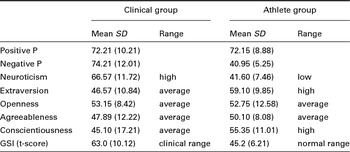
The mean scores on the GSI, perfectionism measure and NEO-PI-R domains for each group are shown in Table 1. Analysis of variance indicated no significant difference in positive perfectionism between the clinical and athlete group, F(1, 37) = .0001, p = .98. However, it can be seen from Table 1 that the clinical group had significantly higher negative perfectionism than athletes with a large effect size, F(1, 37) = 127.74, p = .0001, partial η2 = .77. There was also a significant difference between Global Severity Index (GSI) t-scores, F(1, 37) = 42.11, p = .0001, partial η2 = .53. Table 1 shows the clinical group had a mean GSI score in the clinical range, whereas the athletes were in a normal range. Consequently, it can be concluded that the clinical and athlete group were from different populations, in terms of negative perfectionism and psychological distress.
Mean Scores (SD) and Range on PANPS, GSI and NEO-PI-R Domains

Note: Openness = Openness to Experience.
When comparing the mean scores on each of the NEO domain and facet scores, it can be seen that the clinical group had a higher degree of neuroticism than the athlete group, F(1, 37) = 63.62, p = .0001, partial η2 = .63, and the athlete group had significantly higher scores on extraversion than the clinical group, F(1, 37) = 14.27, p = .001, partial η2 = .27. The only other significant difference was in conscientiousness, where the athlete group had significantly higher conscientiousness than the clinical group, F(1, 37) = 4.95, p = .03, partial η2 = .11. There were no significant group differences on openness to experience, F(1, 37) = .01, p = .90, partial η2 = .0001, and agreeableness, F(1, 37) = .44, p = .50, partial η2 = .01.
The athlete group showed a significantly higher level of achievement striving (M = 56.46, SD = 12.75) than the clinical group (M = 46.94, SD = 13.32), F(1, 37) = 6.13, p = .02, partial η2 = .14. There was also a significant difference between groups found on the facet of competence, where the athletes had higher scores (M = 53.80, SD = 9.75) than the clinical group (M = 44.84, SD = 16.90), F(1, 37) = 4.16, p = .01, partial η2 = .10. There were no significant differences found on the facet of order between athletes (M = 54.20, SD = 13.88) and the clinical group (M = 50.10, SD = 18.39), F(1, 37) = .64, p = .42.
Relationships Between Age, Gender, Personality Domains, and Positive and Negative Perfectionism
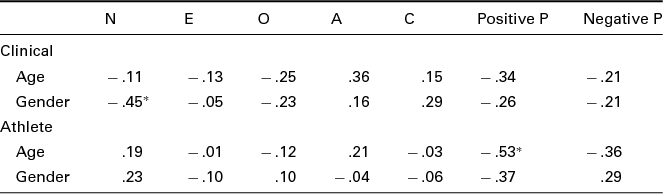
It can be seen in Table 2 that there was a significant correlation between gender and neuroticism in the clinical group, indicating that females in the clinical group had higher neuroticism than males. The only other significant correlation was a negative correlation between age and positive perfectionism in the athlete group. This indicated that younger age was related to higher positive perfectionism.
Correlations Between Age, Gender, Personality Domains, Positive Perfectionism and Negative Perfectionism in the Clinical and Athlete Groups
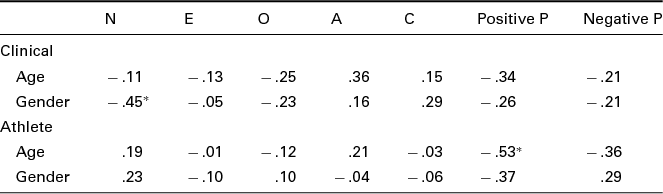
Note: N = Neuroticism; E = Extraversion; O = Openness to Experience; A = Agreeableness; C = Conscientiousness; Positive P = positive perfectionism; Negative P = negative perfectionism.
*p < . 05
Correlations Between Personality, Positive Perfectionism and Negative Perfectionism
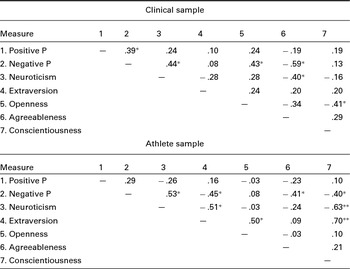
The results of bivariate correlations between the five personality domains, positive perfectionism and negative perfectionism for both groups can be seen in Table 3. For the clinical group, positive perfectionism had no significant relationship with any of the personality domains. In contrast, a significant negative correlation was found between negative perfectionism and agreeableness, indicating that lower agreeableness is related to higher negative perfectionism. There were also significant positive correlations between negative perfectionism and neuroticism and openness to experience.
Correlations Between NEO-PI-R Domains, Positive Perfectionism and Negative Perfectionism in the Clinical and Athlete Groups

Note: *p ≤ .05, **p < .01 (1-tailed).
There were also several significant associations found between the variables in the athlete group, although as with the clinical group, there were no significant associations between positive perfectionism and the five personality domains. For negative perfectionism, there was a significant positive correlation with neuroticism. Furthermore, significant negative correlations were found between negative perfectionism and the domains of extraversion, agreeableness, and conscientiousness.
Discussion
The majority of our predictions regarding relationships between negative perfectionism and personality were supported. As expected, higher negative perfectionism was associated with higher neuroticism and lower agreeableness in both the athlete and clinical groups. Our prediction that negative perfectionism would be negatively correlated with extraversion was supported in the athlete group only. We also found that higher negative perfectionism in the athletes was associated with lower conscientiousness. None of our predictions concerning positive perfectionism and personality were supported. The major finding of this study is that negative perfectionism is associated with distinct personality profiles that appear to differ between clinical versus non-clinical populations. In addition, the results of this study suggest that out of the two subtypes of perfectionism (positive and negative), negative perfectionism may be the more important variable to investigate, given its strong association with different aspects of personality.
This study confirmed the well-established pattern of higher neuroticism and lower extraversion in clinical compared to non-clinical populations (Costa & McCrae, Reference Costa and McCrae1992). Between-group differences are, however, of more interest. Athletes scored significantly higher on conscientiousness than the clinical group, specifically on the facets of achievement-striving, competence and order. These results fit with descriptions of athletes as being high in positive achievement striving (Gould, Dieffenbach, & Moffett, Reference Gould, Dieffenbach and Moffett2002). While we did not find a significant relationship between positive perfectionism and conscientiousness, in contrast to previous studies using PS (Stumpf & Parker, Reference Stumpf and Parker2000) and self-oriented perfectionism (Hill, McIntire, & Bacharach, Reference Hill, McIntire and Bacharach1997), it is likely that the measure of positive perfectionism was insufficient to detect between-group differences. Although the positive perfectionism subscale has been found to have good internal consistency, there are some mixed findings regarding validity (see Egan, Piek, Dyck, & Kane, Reference Egan, Piek, Dyck and Kane2011). Further work comparing the positive perfectionism subscale to measures of achievement-striving would be valuable, as some authors have argued this is the critical aspect that distinguishes negative from positive perfectionism and that the literature should be using the term positive achievement striving rather than positive perfectionism (Frost, Heimberg, Holt, Mattia, & Neubauer, Reference Frost, Heimberg, Holt, Mattia and Neubauer1993).
It was also interesting to note that competence was higher in athletes. This result is not surprising as competence measures feelings of being capable and effective (Costa & McCrae, Reference Costa and McCrae1992) and is related to self-esteem (Costa et al., Reference Costa, McCrae and Dye1991), and the clinical group would be expected to be lower on self-esteem. One explanation of the differences in competence scores is that individuals high in negative perfectionism avoid starting tasks due to thinking they may not be able to achieve their high standard. This fits with Shafran, Cooper, and Fairburn's (Reference Shafran, Cooper and Fairburn2002) explanation of avoidance as a key maintaining factor of clinical perfectionism. This suggests that cognitions regarding competence may be a particularly important aspect to target in treatments for people high in negative perfectionism.
The finding that negative perfectionism was associated with neuroticism in both samples is consistent with extensive evidence linking this personality trait with psychopathology (Costa & McCrae, Reference Costa and McCrae1992). It could be argued that the present findings simply reflect the difference between clinical and non-clinical groups, with clinical groups being high on neuroticism and low on extraversion, rather than reflecting differences in high and low negative perfectionism. However, this argument is unlikely because, although neuroticism was highly correlated with agreeableness, the association between negative perfectionism and agreeableness was stronger in both samples. This suggests that negative perfectionism may account for relationships with other personality factors beyond neuroticism. Future studies could test the unique contribution of negative perfectionism in predicting psychological distress and personality variables such as agreeableness and conscientiousness. Further research could also include only a clinical group and select from within this group individuals who score high and low on negative perfectionism. This would make it easier to determine the nature of relationships between personality and negative perfectionism without the confound of a clinical versus non-clinical group.
The other significant relationship between Big Five personality factors and negative perfectionism in both groups was that higher negative perfectionism was related to lower agreeableness. Individuals who score low on agreeableness are described as egocentric, antagonistic, tough-minded, low in altruism, and competitive rather than cooperative (Costa & McCrae, Reference Costa and McCrae1992). One explanation of the results is that agreeableness may be an indicator of complexity of psychopathology. This is based on research showing significantly lower agreeableness in individuals with a diagnosis of a personality disorder (Saulsman & Page, Reference Saulsman and Page2004; Saulsman, Page, & Egan, Reference Saulsman, Page and Egan2003). Furthermore, recent research has found that low agreeableness is related to perfectionism and relationship distress in couples (Egan, Vinciguerra, & Mazzucchelli, Reference Egan, Vinciguerra and Mazzuchelli2015). One hypothesis to explain our results is that when negative perfectionism is high, individuals are likely to create interpersonal difficulties due to their rigidity about completing tasks perfectly. For example, others may react with frustration to a negative perfectionist being rigid about needing a task to be performed well, which increases interpersonal difficulties. Future research may examine if negative perfectionism is a common factor in personality dysfunction.
There are several limitations of the study. First, it was correlational; therefore, no conclusions can be made regarding the causal nature of relationships between perfectionism and personality. Second, the sample size was small; while it was sufficient to examine between group differences with the statistical methods used, the study was underpowered and significant differences may not have been detected due to this. Finally, while the PANPS has shown good reliability and validity of the negative perfectionism subscale, the current findings add support to the idea that the positive perfectionism subscale may have questionable validity (Egan, Piek et al., Reference Egan, Piek, Dyck and Kane2011). Hence the measure of perfectionism used may not have been ideal in determining the differences in personality between groups that were of interest.
In summary, despite having similar levels of positive perfectionism, athletes had higher conscientiousness, achievement striving, competence and order. Personality differences between groups were best explained by differences in scores on negative as opposed to positive perfectionism. In our clinical sample, negative perfectionism was most strongly associated with low agreeableness while in athletes, negative perfectionism was most strongly related to neuroticism but also associated with extraversion and conscientiousness. Future research should determine if targeting personality factors such as increasing agreeableness or competence in clinical groups with elevated perfectionism may be useful in reducing the negative impact of perfectionism and associated psychopathology.