Introduction
The mammalian ovary is responsible for the generation of oocytes and for the production of steroid hormones required for fertilization and pregnancy (Seneda et al., Reference Seneda, Godmann, Murphy, Kimmins and Bordignon2008). The oocytes are enclosed in the follicles, and the process responsible for their production is folliculogenesis, which consists of the formation from primordial follicles to preovulatory follicles. Primordial follicles are the first follicles to be produced in the ovary and their components, oocyte and granulosa cells, are arrested in a quiescent state until the activation process. Once activated, the primordial follicles start growing and reach the primary, secondary, tertiary and antral stages. It is accepted that the early follicular growth phase is controlled by local activity and by several growth factors, such as the kit ligand (Parrot & Skinner, Reference Parrot and Skinner1999), growth differentiation factor (GDF-9) (Vitt et al., Reference Vitt, McGee, Hayashi and Hsuch2000), basic fibroblast growth factor (bFGF) (Nilsson et al., Reference Nilsson, Parrot and Skinner2001) and leukemia inhibitory factor (LIF) (Nilsson et al., Reference Nilsson, Kezele and Skinner2002); the growth of middle- and late-stage follicles is regulated by gonadotropins secreted by the pituitary (Hasegawa et al., Reference Hasegawa, Kumamoto, Mochida, Komori and Koyama2009). Signalling between the oocyte and granulosa cells has emerged as a key regulator of the primary-to-secondary-to-antral follicle transition, and members of the transforming growth factor-β (TGF-β) family are required for these transitions (Pangas & Matzuk, Reference Pangas and Matzuk2004).
Even though folliculogenesis represents a subject of increasing interest for the researchers, several mechanisms involved in the follicular and oocyte activation and growth process remain unclear. It is admitted that a coordinated programme integrating both genomic and epigenomic elements regulates the complex process of folliculogenesis in the mammalian ovary (Ruiz-Cortés et al., Reference Ruiz-Cortés, Kimmins, Monaco, Burns, Sassone-Corsi and Murphy2005). Recent studies show dynamic changes in chromatin structure and function during oocyte growth are essential to confer growing oocytes with meiotic and developmental competence (De La Fuente, Reference De La Fuente2006), however little information is known about the chromatin status of regulatory sequences in oocytes (Albert & Peters, Reference Albert and Peters2009).
Eukaryotic genetic information is stored within a dynamic polymer called chromatin, comprised of DNA and histone proteins (H1, H2A, H2B, H3 and H4), the fundamental structural unit of chromatin is the nucleosome, which consists of approximately 146 base pairs of DNA wrapped around histones (Trotter and Archer, Reference Trotter and Archer2007). The transcriptional control of gene expression depends crucially on DNA accessibility, which is epigenetically regulated by histone modifications (Narlikar et al., Reference Narlikar, Fan and Kingston2002). Chromatin remodelling is a kind of epigenetic modification capable of regulating transcription by altering nucleosome organization, facilitating or repressing DNA access, and thus determining the activation or repression of transcription. The ATP-dependent chromatin remodelling complex carries out enzymatic activities, changing chromatin structure by altering DNA–histone contacts within a nucleosome in an ATP-dependent manner (Martens & Winston, Reference Martens and Winston2003).
Eukaryotes contain at least four families of chromatin remodellers: SWI/SNF, ISWI, NURD/Mi-2/CHD and INO80, differentiated by the additional presence of unique domains within or adjacent to the ATPase domain (Tang et al., Reference Tang, Nogales and Ciferri2010). The SWI/SNF complex is one of the most studied and is comprised of multiple (7–13) subunits that regulate gene expression by remodelling chromatin directly via promoter sites and regulatory elements (Knott et al., Reference Knott, Palmer and De Matos2006). BRG1 protein (brahma- related gene 1) is an important ATPase subunit of this complex. The exact function of BRG1 is unknown; however, it is known that it binds other proteins such as glucocorticoid (Inayoshi et al., Reference Inayoshi, Kaneoka, Machida, Terajima, Dohda, Miyake and Iijima2005) and estrogen receptors (Ichinose et al., Reference Ichinose, Garnier, Chambon and Losson1997). BRG1 expression in mouse oocytes (Bultman et al., Reference Bultman, Gebuhr, Yee, La Mantia, Nicholson, Gilliam, Randazzo, Metzger, Chambon and Crabtree2000) and embryos (Bultman et al., Reference Bultman, Gebuhr, Pan, Svoboda, Schultz and Magnuson2006) has demonstrated the participation of this protein in folliculogenesis and embryogenesis, although discussion in the literature is scarce. In conditional mutant females, BRG1-depleted oocytes completed meiosis and were fertilized. However, embryos conceived from these eggs exhibited zygotic genome activation defects. Development of these embryos is arrested at the 2- to 4-cell stage and transcriptional activity is reduced for ~30% of genes (Bultman et al., Reference Bultman, Gebuhr, Pan, Svoboda, Schultz and Magnuson2006).
Considering the evidence supporting BRG1 participation in folliculogenesis, as well as the importance of epigenetic modifications in chromatin organization and gene expression, the aim of this study was to research the expression levels of BRG1 at the various follicular development phases.
Materials and methods
Ovaries (n = 10) were collected from prepubertal gilts immediately after evisceration and then rinsed twice in cold phosphate-buffered saline (PBS). Ovarian fragments of 8 × 8 × 8 mm were cut and placed into a 4% paraformaldehyde solution at 4°C for 12 h. Ovarian fragments were then washed three times in PBS at 4°C and transferred to 70% ethanol. Tissues were processed for embedding in paraffin, and sectioned using standard histological protocols. Immunofluorescent staining was performed on 3-μm thick sections.
Immunofluorescence
Tissues were deparaffinized with Citrisolve (Fisher Scientific Canada) and rehydrated through three changes of alcohol. After washing in PBS–Brij 35 0.03% for 10 min, antigen retrieval was performed by incubating the tissue sections in sodium citrate buffer for 5 min in a pressure cooker. Sections were cooled to room temperature followed by washing three times in PBS–Brij. The sections were subsequently blocked for 1 h in PBS–Brij with 10% normal goat serum and 2.5% bovine serum albumin, then incubated with polyclonal rabbit anti-BRG1 (Abcam, ab8895, 1/200) or control rabbit IgG at the same concentration (with rocking), overnight at 4°C. Primary antibodies were detected using Alexa Fluor 594-anti-rabbit (Molecular Probes Inc., 1:1000) secondary antibody. Cells were counterstained with 4′,6-diamidino-2-phenylindole (DAPI). Immunofluorescence signals were evaluated using a Nikon eclipse 80i microscope and recorded by a Retiga 2000R monochromatic digital camera (Qimaging).
Results
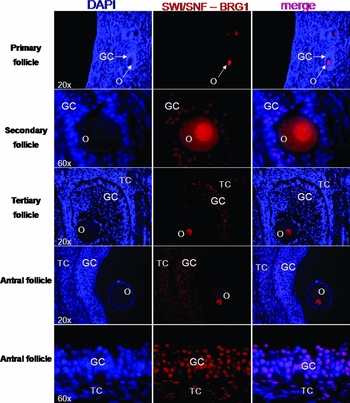
Through immunofluorescence analysis of prepubertal gilts ovaries, the presence of the BRG1 protein was observed, a subunit of the SWI/SNF chromatin remodelling complex, in primary, secondary, tertiary and antral follicles (Fig. 1). Positive fluorescence signal for BRG1 was detected in all analysed samples, thus suggesting an involvement of this protein with follicular development. In primary follicles only oocyte nuclei showed BRG1; however, BRG1 expression was present in the granulosa cells throughout the following developmental steps. In secondary follicles, BRG1 was identified in nuclei and also in the granulosa cells proximal to the oocytes. In this developmental phase, the follicle is a compact structure and there is not much space between follicle and oocyte. The tertiary follicle is characterized by evidence of the first stages of antral cavity formation and complete organization of theca cells, comprised of theca interna and externa. In this stage, the oocyte–granulosa contact begins to decrease because follicular fluid starts to fill in the central space. At this phase, BRG1 expression was observed in the granulosa cells closer to theca cells as well as in the oocyte nuclei. In antral follicles, BRG1 expression was detected in the nuclei of oocytes, as well as in granulosa and theca cells. It is important to note that primordial follicles were not analysed because they did not show expression for BRG1.
Immunofluorescence localization of brahma-related gene 1 (BRG1) protein, a subunit of the SWItch/Sucrose NonFermentable (SWI/SNF) chromatin remodelling complex, in primary, secondary, tertiary and antral ovarian follicles. Positive fluorescence signal (red) for BRG1 was detected in only oocyte nuclei in primary follicle development. In secondary ovarian follicles BRG1 expression was present in nuclei and also in the granulosa cells proximal to the oocytes. In tertiary ovarian follicles positive fluorescence signal for BRG1 was detected in the granulosa cells closer to theca cells as well as in the oocyte nuclei. In antral ovarian follicles BRG1 expression was observed in the nuclei of oocytes, as well as in granulosa and theca cells. 4′,6-Diamidino-2-phenylindole (DAPI) counter staining (blue). O, oocyte; GC, granulosa cells; TC, theca cells.

Discussion
Positive fluorescence signal for BRG1 was detected in all analysed samples, demonstrating the involvement of this SWI/SNF complex subunit in the folliculogenesis process.
Follicular development is a lengthy process, lasting approximately 4 months in pigs, from the initiation of growth of primordial follicles to development of a preovulatory follicle (Morbek et al., Reference Morbeck, Esbenshade, Flowers and Britt1992). During this time, cells of the ovarian follicle undergo extensive proliferation and differentiation (Ruiz-Cortés et al., Reference Ruiz-Cortés, Kimmins, Monaco, Burns, Sassone-Corsi and Murphy2005). The SWI/SNF complex seems to be involved in these two processes; BRM (brama protein), one of the subunits of this complex, is related to cellular differentiation, with increasing levels throughout the course of neural and liver differentiation (Itoh et al., Reference Itoh, Miyake and Lijima2008). BRG1 appears to be more closely linked to cellular proliferation; BRG1 expression is predominantly seen in cell types that constantly undergo proliferation or self-renewal in humans, such as gastrointestinal crypt cells, bladder epithelium and spermatogonia (Reisman et al., Reference Reisman, Sciarrotta, Boudin, Weissman and Funkhouser2005).
For the success of follicular development, primordial follicle activation is necessary. The changes in gene expression during the primordial to primary follicle transition have been considered the most complex event of folliculogenesis, due to intense follicular structure reorganization and the initiation of growth and development (Pan et al., Reference Pan, O'Brien, Wigglesworth, Eppig and Schultz2005). However, changes in chromatin structure during this transition are poorly characterized (Pan et al., Reference Pan, O'Brien, Wigglesworth, Eppig and Schultz2005). In our study, BRG1 expression was detected first in oocyte nuclei of primary follicles. This finding strongly supports participation of BRG1 in folliculogenesis beginning after the activation process.
After activation, the primary follicles begin the growth phase. The mechanisms that regulate this process are not very clear; however, a crucial role has been demonstrated for the oocyte (Eppig, Reference Eppig2001). Early follicular development seems to be dependent on factors secreted by the oocyte itself, such as GDF-9 and BMP-15/GDF-9B (bone morphogenetic protein 15) (Carabatsos et al., Reference Carabatsos, Elvin, Matzuk and Albertini1998; Galloway et al., Reference Galloway, McNatty, Cambridge, Laitinen, Juengel, Jokiranta, McLaren, Luiro, Dodds, Montgomery, Beattie, Davis and Ritvos2000). BRG1 was first seen in the oocyte nuclei of primary follicles, reinforcing the crucial role of oocyte and suggesting a BRG1 participation in this early development. Furthermore BRG1 was seen in the oocytes of all follicles analysed, demonstrating a participation in follicular development through the regulatory activity of the oocyte.
The transition from primary to secondary follicle is characterized by proliferation of granulosa cells and enlargement of oocytes. Some markers that accurately mark secondary follicle formation have been reported, including activin A (Zhao et al., Reference Zhao, Taverne, Van Der Weijden, Bevers and Van Den Hurk2001), EGF (Gutierrez et al., Reference Gutierrez, Ralph, Telfer, Wilmut and Webb2000) and BMP-15 (Juengel et al., Reference Juengel, Hudson, Heath, Smith, Reader, Lawrence, O'Connell, Laitinen, Cranfield, Groome, Ritvos and McNatty2002). At this stage the zona pellucida can be observed, theca cells start organizing themselves and the follicles seem to respond to gonadotrophins (Fair, Reference Fair2003). During the secondary follicular phase, the granulosa cells acquire proliferative capacity. According to our data, in this stage, BRG1 expression was first seen in the granulosa cells, emphasizing a possible role for this protein in regulation of granulosa cells proliferation.
The tertiary follicle is characterized primarily by the beginning of antrum formation. Granulosa layers proliferate and theca cells completely organize themselves in interna and externa theca (Driancourt, Reference Driancourt1991). During this phase, gonadotropin-mediated effects of follicle stimulating hormone (FSH) and luteinizing hormone (LH) can already be detected (van den Hurk et al., Reference Van Den Hurk, Abir, Telfer and Bevers2000). BRG1 expression was strong in the granulosa cells close to theca cells, showing a pattern distinct from that of secondary follicles. Considering the intense communication between granulosa and theca cells in relation to steroidogenesis, we propose a possible role for BRG1 in this process, supported by the previously described interaction between BRG1 and estrogen receptors (Ichinose et al., Reference Ichinose, Garnier, Chambon and Losson1997).
At the antral follicles, the antral cavity increases dramatically and the oocyte remains attached to the granulosa by cumulus cells. It is known that evolution through the successive folliculogenesis stages is dependent on effective communication between oocyte and granulosa cells, as well as between granulosa and theca cells (Knight & Glister, Reference Knight and Glister2003). BRG1 expression was seen in oocytes, granulosa and theca cells. Considering the dynamic modifications of shape and function at this stage of follicular development, the data suggest an effective and wide-reaching participation of BRG1. One possibility is that BRG1 can play distinct roles in different structures: in the oocyte it can act in the regulation of transcription, in the granulosa and theca cells it can influence cellular proliferation, in addition to possible involvement in steroidogenesis. Nevertheless, the area demands further investigation.
Recent studies have shown that some histones, such as histone H3, play an important role in folliculogenesis. Phosphorylation of histone H3 at serine 10 was correlated with transcriptional activity necessary for the process of cellular division (Hans e Dimitrov, Reference Hans and Dimitrov2001). This modification of H3 showed a link with FSH and estradiol action during the preovulatory period, confirming the direct relation of this alteration of chromatin with the regulation of follicular growth (Ruiz-Cortés et al., Reference Ruiz-Cortés, Kimmins, Monaco, Burns, Sassone-Corsi and Murphy2005). In the case of H3, the lysine 4 (K4) has gained the increasing interest of researchers. H3K4 and the regulator enzyme of H3K4 methylation – lysine specific demethylase 1 (LSD1) – seem to play a central role in the command of gene expression of gametes. This situation is true not only in simple organisms, such as Drosophila (Di Stefano et al., Reference Di Stefano, Ji, Monn, Herr and Dyson2007), but also in mammals (Godmann et al., Reference Godmann, Auger, Ferraroni-Aguiar, Di Sauro, Sette, Behr and Kimmins2007). Throughout follicular development, a specific distribution of H3K4 (mono-, di- and tri-methylated forms) has been shown. H3K4 demonstrates a well defined presence in antral follicles, as well as a dramatic and continuous decrease correlated with the proximity of ovulation (Seneda et al., Reference Seneda, Godmann, Murphy, Kimmins and Bordignon2008).
An association of H3K4 with BRG1 was described by Bultman et al. (Reference Bultman, Gebuhr, Yee, La Mantia, Nicholson, Gilliam, Randazzo, Metzger, Chambon and Crabtree2002). During the zygotic genome activation of embryos from BRG1-depleted mouse oocytes, there is decreased dimethyl H3K4 expression. These authors showed a reduction in dimethyl H3K4 levels to ~61% when compared with wild-type embryos. When comparing BRG1 modulation in the different follicular stages of the present study with results for mono-, di-, and tri-methyl H3K4 from Seneda et al. (Reference Seneda, Godmann, Murphy, Kimmins and Bordignon2008), it is possible to establish the characteristic patterns of BRG1 and H3K4 expression in ovarian follicles. The oocytes of primary, secondary and tertiary follicles showed positive signal for H3K4 mono, di and tri-methyl, as well as for BRG1; however, in granulosa cells, only BRG1 was expressed. In antral follicles, all types of H3K4 methylation were identified (Seneda et al., Reference Seneda, Godmann, Murphy, Kimmins and Bordignon2008). In oocytes, granulosa and theca cells, the same situation was observed as was documented in the present study for BRG1. These results clearly support a relationship between the markers. Nevertheless more studies are necessary to confirm a possible correlation for BRG1 and H3K4.
The presence of BRG1 in oocytes from the early stages of follicular growth certifies the active participation of this gene from the beginning of oocyte growth until the embryonic phase. Furthermore, it has also been demonstrated by early embryonic lethality of BRG1 null homozygotes and several phenotypic alterations for heterozygotes (Bultman et al., Reference Bultman, Gebuhr, Yee, La Mantia, Nicholson, Gilliam, Randazzo, Metzger, Chambon and Crabtree2000). Zygotic genome activation was clearly linked to BRG1 through subsequent investigations; BRG1 was considered the first gene required for this activation process (Bultman et al., Reference Bultman, Gebuhr, Pan, Svoboda, Schultz and Magnuson2006). Early embryonic development, before zygotic genome activation, is coordinated by RNAs and proteins that are synthesized and stored by oocytes (Sirard & Coenen, Reference Sirard and Coenen1994). The demonstration in the present work that BRG1 expression is present during the early stages of follicular development suggests the importance of BRG1 in the control of zygotic genome activation from earliest oocyte growth.
The SWI/SNF complex was first identified in yeast and is highly conserved among the eukaryotes (Peterson & Workman, Reference Peterson and Workman2000). This information leads us to hypothesize a basic role for this complex and its subunits in the context of development. More studies are necessary to determine the exact role of BRG1 in folliculogenesis. However, our results suggest that this protein is required in the processes of oocyte and follicular growth, intimately linked to cellular proliferation and differentiation.
Acknowledgements
The authors thank Dr Maren Godmann for all valuable comments and the Brazilian Council for Scientific and Technological Development (CNPq).