Introduction
Differentiation of central lesions is most important for the examination of patients with dizziness or vertigo. Cerebellar stroke is a common cause of a vascular vestibular syndrome, and vertigo and dizziness are the most common manifestations of cerebellar stroke. Acute peripheral vertigo is a clinical disorder caused by acute unilateral damage to the peripheral vestibular structures. It is associated with vestibular neuritis, Ménière's disease, benign paroxysmal vertigo, and sudden deafness accompanied with vertigo. Focal stroke may mimic acute peripheral vertigo when acute vertigo is the only symptom. It is not always easy to differentiate isolated vascular vertigo from acute peripheral vertigo at the bedside.
Nystagmus is one of the most important clues to differentiate central lesions. It is known that direction-changing gaze-evoked nystagmus, upbeat nystagmus, downbeat nystagmus and pure rotatory nystagmus are associated with central lesions. However, these types of nystagmus do not always appear in the acute phase of vertigo with cerebellar stroke.
This study aimed to determine the characteristics of acute phase nystagmus in patients with cerebellar stroke and to identify a useful indicator for differentiating central lesions from peripheral lesions.
Materials and methods
Eleven patients who had clinical symptoms mimicking acute peripheral vertigo with a subsequent diagnosis of cerebellar stroke (10 patients had cerebellar infarction and 1 had cerebellar haemorrhage), over an 8-year period, from January 2003 to January 2011, were studied. Eight patients were men and 3 were women, with ages ranging from 35 to 83 years (mean, 66.6 years).
In the acute setting, all patients underwent a bedside clinical evaluation for the presence of neurological signs and a computed tomography (CT) brain scan in order to rule out central lesions. All patients were referred to our ENT unit as they lacked obvious neurological symptoms (except vertigo).
At the ENT unit, spontaneous nystagmus, gaze nystagmus and positional nystagmus tests were performed at the initial visit. Spontaneous nystagmus and gaze nystagmus were examined with the patient in the upright position, and the positional test was performed with the patient in the supine position.
The eventual diagnosis was vascular lesions in the posterior fossa, as indicated by CT or magnetic resonance imaging (MRI), including diffusion-weighted images. The determination of the site of cerebellar lesions was based on the diagram of Barth et al.Reference Barth, Bogousslavsky and Regli 1 The patients were classified into three groups according to the territories of cerebellar arteries.
Results
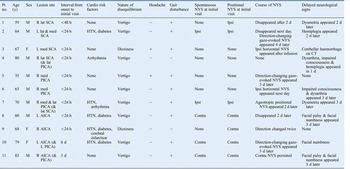
The patients’ clinical features, diagnostic test results and CT findings are summarised in Table I. All patients presented with a sudden onset of disequilibrium.
Patient characteristics

Pt no. = patient number; y = years; cardio = cardiovascular; NYS = nystagmus; M = male; R = right; lat = lateral branch; SCA = superior cerebellar artery; h = hours; − = absent; + = present; ipsi = ipsilesional; d = days; L = left; med = medial branch; HTN = hypertension; F = female; CT = computed tomography; PICA = posterior inferior cerebellar artery; AICA = anterior inferior cerebellar artery; contra = contralesional
After determination of the site of the cerebellar lesions, patients were classified into three groups, according to the territory of cerebellar arteries; namely, superior cerebellar artery, posterior inferior cerebellar artery and anterior inferior cerebellar artery. There were four patients with superior cerebellar artery lesions, three with posterior inferior cerebellar artery lesions and four with anterior inferior cerebellar artery lesions. The lesions were unilateral in all patients. In many patients, more than a single arterial area was involved. In the posterior inferior cerebellar artery patients, the ischaemic lesions were limited to the medial area of the caudal cerebellum. Patients who had ischaemic lesions located in the brainstem in addition to the caudal cerebellum were excluded from this study.
At the initial visit, there were no patients with vertical nystagmus, direction-changing gaze evoked nystagmus or pure rotatory nystagmus. There were four patients with no nystagmus. Horizontal or horizontal-rotatory nystagmus was observed in seven patients. Spontaneous nystagmus was observed in five patients and they also had positional nystagmus. Nystagmus was observed only during the positional test in two patients; spontaneous nystagmus was not observed. Two of the four patients with superior cerebellar artery lesions, one of the three patients with posterior inferior cerebellar artery lesions, and all four of the patients with anterior inferior cerebellar artery lesions had nystagmus at the initial visit. The direction of the nystagmus for patients with superior cerebellar artery or posterior inferior cerebellar artery lesions was to the lesion side, but in four patients with anterior inferior cerebellar artery lesions it was contralateral to the lesion side.
The direction of nystagmus changed with development of the neurological symptoms as the time (days after admission) lapsed (Table I).
There were no neurological symptoms, except for vertigo and hearing loss, in any of the patients at the initial visit. Neurological symptoms besides vertigo and hearing loss appeared after admission (Table I).
Discussion
Nystagmus at initial visit
Superior cerebellar artery
Kase et al. reported that a syndrome of cerebellar infarction in the superior cerebellar artery distribution is suggested by the sudden onset of gait imbalance and ipsilateral limb ataxia, with little or no vertigo, and occasionally associated with upbeat nystagmus.Reference Kase, White, Joslyn, Williams and Mohr 2 The relatively lower frequency of vertigo in the superior cerebellar artery cases has been related to the rich connections of the flocculonodular lobe supplied by the posterior inferior cerebellar artery and anterior inferior cerebellar artery.Reference Kase, Norrving, Levine, Babikian, Chodosh and Wolf 3 Lee and Kim reported that approximately 30 per cent of patients with isolated superior cerebellar artery infarction showed spontaneous nystagmus that mostly beat toward the lesion side, or bidirectional direction-changing gaze-evoked nystagmus in the acute period.Reference Lee and Kim 4 In our series, there were four patients with superior cerebellar artery territory lesions. Two of the four patients had ipsilateral nystagmus at the initial visit, and ipsilateral horizontal nystagmus appeared after admission in another patient. Animal studies have shown that lesions in the fastigial nucleus can cause nystagmus, wherein the slow phase of the nystagmus predominantly occurs in the horizontal plane and beats toward the lesion side.Reference Lee and Kim 4 , Reference Vilis and Hore 5
Posterior inferior cerebellar artery
Amarenco et al. reported that patients with posterior inferior cerebellar artery distribution infarction who exhibit a purely vestibular syndrome are likely to have an isolated cerebellar infarction in the distribution of the medial branch of the posterior inferior cerebellar artery.Reference Amarenco, Roullet, Hommel, Chaine and Marteau 6 The medial branch of the posterior inferior cerebellar artery supplies blood to the inferior vermis (nodulus, uvula, pyramis, tuber and sometimes clivus), and the internal parts of the lobulus semilunaris inferior, lobulus gracilis and tonsils. In posterior inferior cerebellar artery territory cerebellar infarction, the key structure responsible for vertigo is the nodulus. The nodulus is strongly connected to the ipsilateral vestibular nucleus and receives direct projections from the labyrinth.Reference Kim and Lee 7 , Reference Fushiki and Barmack 8
Among our patients, there were three with posterior inferior cerebellar artery lesions, two with lesions of the medial branch of the posterior inferior cerebellar artery and one with lesions of both medial and lateral branches of the posterior inferior cerebellar artery. There was only one patient with nystagmus at the initial visit, and the direction was ipsilateral; in another patient, ipsilateral horizontal nystagmus appeared the next day. In previous studies, the incidence of nystagmus was 39–75 per cent, with a preponderance of patients presenting with horizontal nystagmus toward the lesion side.Reference Kase, White, Joslyn, Williams and Mohr 2 , Reference Lee, Sohn, Cho, Lee, Ahn and Park 9 – Reference Ogawa, Suzuki, Oishi, Kamei, Shigihara and Nomura 11
The mechanism of spontaneous ipsilesional nystagmus may have involved an increased tonic activity of ipsilateral medial and superior vestibular nucleus neurons, caused by damage to the vestibulocerebellum or its outflow tracts to the vestibular nuclei.Reference Kim and Lee 7 The vestibulocerebellum receives a direct projection from the labyrinth and has strong connections with the vestibular nuclei. As the Purkinje fibres from the vestibulocerebellum have an inhibitory effect, usually on ipsilateral vestibular nuclei, damage to this area or its outflow tracts is likely to increase the tonic activity of ipsilateral vestibular nuclei, causing ipsilesional nystagmus.Reference Kim and Lee 7 , Reference Huh and Kim 12
Anterior inferior cerebellar artery
Based on the findings of this study and previous studies, there was a preponderance of patients presenting with contralesional horizontal nystagmus, contrary to nystagmus associated with superior cerebellar artery and posterior inferior cerebellar artery lesions.Reference Lee, Kim, Chung, Yi, Chung and Lee 13 , Reference Lee, Sohn, Jung, Cho, Lim and Yi 14
The internal auditory artery is a branch of the anterior inferior cerebellar artery, and supplies the VIIIth cranial nerve, the cochlea and vestibular labyrinth. Vertigo with anterior inferior cerebellar artery infarction mostly results from ischaemia to both the peripheral and central vestibular structures.Reference Lee, Kim, Chung, Yi, Chung and Lee 13 The mechanism of spontaneous contralesional nystagmus may involve a decreased tonic activity of ipsilateral vestibular nucleus neurons, caused by damage to the labyrinth.
Delayed neurological symptoms
We also considered the delayed appearance of associated neurological abnormalities and changes of nystagmus. There were no neurological symptoms, except for vertigo and hearing loss, in any of our patients at the initial visit. Various delayed neurological symptoms appeared in 9 of 11 patients in this study.
Vertigo and imbalance are the most common symptoms in patients with isolated cerebellar infarctions, and they appear without any other signs of cerebellar dysfunction in approximately 38 per cent of patients.Reference Ye, Kim, Nam, Lee, Nam and Heo 15 , Reference Casani, Dallan, Cerchiai, Lenzi, Cosottini and Sellari-Franceschini 16 Kim and Heo studied 30 stroke patients with vertigo; among these patients, 12 manifested with isolated vertigo at the onset of stroke, and 8 patients developed additional neurological abnormalities from 4 hours to 7 days later.Reference Kim and Heo 10 The authors suggested that the absence of associated neurological abnormalities in patients with vertigo is not sufficient to exclude a diagnosis of vertigo of cerebrovascular origin, especially at the onset of the disease.Reference Kim and Heo 10 In patients with severe vertigo or dizziness, there is a possibility that these symptoms might mask other neurological symptoms and restrict neurological examinations at the initial visit.
-
• In patients with cerebellar lesions, nystagmus indicating central lesions does not always appear in the acute phase of vertigo
-
• There were no neurological symptoms, except for vertigo and hearing loss, in any patients at the initial visit
-
• Horizontal nystagmus was observed in seven patients and there was no nystagmus in four patients at the initial visit
-
• Neurological symptoms (other than vertigo) appeared after admission
-
• It is difficult to differentiate between central lesions and acute peripheral vertigo based on the direction and type of nystagmus
-
• Changes of nystagmus and other neurological findings should be closely followed for differential diagnosis of cerebellar lesions
Other clinical aspects
There may be other clinical points that enable the differentiation of a central lesion from acute peripheral vertigo. In this study, all patients underwent CT at the initial visit. Cerebellar haemorrhage was found in 1 patient and the remaining 10 patients had normal CT findings. Cerebral infarction was detected by MRI. The CT findings tended to be negative regarding initial onset of stroke. Even if the CT findings are normal, cerebral infarction cannot be ruled out. Magnetic resonance imaging should be performed if central lesions are suspected.
In accordance with previous reports, the persistence of acute vertigo with poor or no improvement after 2 to 3 days from the onset represents a very important clinical indicator, and MRI should be performed even in the absence of cerebellar signs.Reference Lee, Sohn, Cho, Lee, Ahn and Park 9 , Reference Casani, Dallan, Cerchiai, Lenzi, Cosottini and Sellari-Franceschini 16
Conclusion
In patients with cerebellar lesions, nystagmus indicating central lesions does not always appear in the acute phase of vertigo, and neurological symptoms other than vertigo tend to appear later. It is difficult to differentiate between central lesions and acute peripheral vertigo on the grounds of the direction and type of nystagmus. It is essential to closely follow the changes of nystagmus and other neurological findings for the differential diagnosis of central lesions.
Acknowledgements
The authors are indebted to the medical editors of the Department of International Medical Communications of Tokyo Medical University for their editorial review of the English manuscript.