Significant outcomes
We compare the data of oxidative metabolism obtained from patients with schizoaffective disorder, bipolar disorder and schizophrenia. We also aimed to investigate whether schizoaffective disorder is similar to schizophrenia and bipolar disorder in terms of oxidative metabolism, or whether it is completely different from them. We found that total oxidant status (TOS) was elevated in patients with schizoaffective disorder compared with those with schizophrenia and bipolar disorder. We suggest that schizoaffective disorder was found to be different from bipolar disorder and schizophrenia in terms of oxidative parameters, indicating that schizoaffective disorder could be a disease different from bipolar disorder and schizophrenia in terms of biochemical parameters.
Limitations
The limitations of our study were small sample size, lack of information about the drug therapies and the clinical symptom severity for each disease group. The failure of serum TOS, total antioxidant status and oxidative stress index may completely reflect those present in the brain tissue.
Introduction
Recently, the number of studies on the similarity and differences of schizoaffective disorder, schizophrenia and bipolar disorder in terms of etiopathogenesis, symptomatology, course and the treatment considerably increased. In this subject, very interesting results were found. The theory called ‘Continuum Model’ claims that these three diseases are the continuation or different ends of each other, and has gained a considerable popularity (Reference Crow1).
Diagnostic systems such as Diagnostic Statistical Manual of Mental disorders Text Revised Version (DSM IV-TR) and International Classification of Diseases-10 (ICD-10), which are currently used, defined these three diseases as different diseases. In reality, the initial presentation of these three diseases occurs with psychotic and affective symptoms. Among these diseases, the definition and the diagnosis of schizoaffective disorder have been excessively discussed. Whereas some theories claimed that there was no such disease and that schizoaffective disorder was an atypical form of schizophrenia that shows affective symptoms, some others suggested that it was an atypical form of bipolar disorder that shows psychotic properties, and another group suggested that it was the comorbid form of schizophrenia and bipolar disorder. However, the discussions on this subject remained (Reference Cheniaux, Landeira-Fernandez and Telles2).
Oxidative and antioxidative processes are a part of the normal metabolism. Oxidative stress, which results from increased oxidants or a weakness of the antioxidant defense, may cause lipid peroxidation, tissue damage, DNA damage and enzyme inactivation. Oxidants react with the proteins related to the cell membrane, prevent the intake of enzymes or neurotransmitters involved in the natural process, and thereby may act as a predisposing factor for the disease (Reference Gergerlioglu, Savas, Bulbul, Selek, Uz and Yumru3). In some psychiatric diseases, total oxidant status (TOS), total antioxidant status (TAS) and oxidative stress index (OSI) were studied. In bipolar disorder, TOS, TAS and OSI were found to be significantly higher compared with the control groups, whereas TAS was found to be inversely correlated with the total number of previously experienced episodes (Reference Yumru, Savas, Kalenderoglu, Bulut, Celik and Erel4). Furthermore, in the study conducted on schizophrenic patients, TAS was found to be lower in schizophrenic patients compared with the healthy controls (Reference Virit, Altindag and Yumru5).
In this study, we aimed to compare oxidative metabolism markers of schizoaffective disorder, bipolar disorder and schizophrenic patients. Furthermore, we also aimed to investigate whether schizoaffective disorder could be differentiated from schizophrenia and bipolar disorder in terms of oxidative metabolism.
Methods
Patients
Thirty patients were included in all schizophrenia, schizoaffective disorder and bipolar disorder patient groups. All the participants were 18 years old or above, who had been admitted to Gaziantep University, School of Medicine, Department of Psychiatry, Psychotic Disorders and Mood Disorders, and were enrolled in the study. The blood samples were taken after 12 h of fasting.
The exclusion criteria included: current or a history of alcohol and substance addiction; severe medical disorder (e.g. Wilson disease); the use of antioxidant agent (e.g. vitamin E, vitamin C); the use of xanthine oxidase inhibitor (e.g. allopurinol, folic acid…, etc.); diabetes mellitus; severe neurological disease (e.g. epilepsy, cerebrovascular stroke, Parkinson's disease…, etc.); mental retardation; the history of head trauma; pregnancy; and severe obesity.
For the participants, the socio-demographic data form was completed. Blood samples were drawn under appropriate conditions. Written informed consent was signed by the participants or their relatives. The study was approved by Gaziantep University, School of Medicine, and the Ethics Board.
Samples
Blood samples were drawn from the antecubital vein. The blood samples obtained were transferred to heparinised tubes, and the serum was separated by centrifuging for 5 m at 3000 rpm in an icy environment to be processed within at most 6 h. The sera that were separated were stored at −80°C to be analysed to measure the TAS and TOS. In the Biochemistry Laboratory of Harran University, School of Medicine, TAS and TOS were measured in the sera using Erel method, and OSI was calculated (Reference Erel6).
Measurement of TOS
The TOS of the plasma was measured using a novel automated colourimetric measurement method for TOS developed by Erel (Reference Erel7). The oxidants present in the sample oxidise ferrous ion-o-dianisidine compound to ferric ion. The glycerol present in the environment accelerates this reaction by approximately threefold. Ferric ions form a coloured compound with xylenol orange in the acidic environment. The intensity of the colour is correlated with the amount of oxidants present in the sample and is measured by spectrophotometry. Its unit is μmol H2O2 Eq/l.
Measurement of TAS
Total antioxidant capacity was measured by using the Erel method.6 This measurement method utilises 2,2′-azinobis-(3-ethylbenzothiazoline-6-sulfonic acid) radical (ABTS radical). ABTS radical loses its blue and green colouring according to the concentration of the antioxidant and its capacity. Absorbance is measured at 660 nm and the discolouration is evaluated. The principle of this measurement method is based on the oxidation of ABTS molecule to ABTS+ molecule in the presence of hydrogen peroxide. The radical, which is dark green in 30 mmol/l acetate buffer with a pH 3.6, becomes lighter with 0.4 mol/l with a pH 5.8. There is an inverse correlation between the discolouration and the amount of antioxidant in each sample. Reaction velocity is calibrated by using the standard method called Trolox. Its unit is Trolox Eq/l (Reference Erel6).
Calculation of OSI
OSI was calculated by dividing the TOS by the TAS (Reference Kosecik, Erel, Sevinc and Selek8).
Apparatus
A Cecil 3000 spectrophotometer with a temperature-controlled cuvette holder (Cecil) and an Aeroset automated analyser (Abbott) were used (Reference Erel9).
Statistical analysis
Statistical analyses required were performed by using ‘SPSS 18.0 for Windows’. p < 0.05 was considered significant. Two valuable variables, such as gender, and the rates were compared using χ 2 test. Assuming that the variables were measured showed a normal distribution, the difference between the groups was evaluated using student t-test. To evaluate the correlation between the variables, Pearson's correlation analysis was used. We used analysis of variance for comparing means of three variables.
Results
TOS was found to be higher in the patients with schizoaffective disorder compared with the patients with schizophrenia and bipolar disorder (p < 0.05). Again, OSI values were found to be higher in patients with schizoaffective disorder compared with patients with schizophrenia and bipolar disorder (p < 0.05). TOS, TAS and OSI were not significantly different between the patients with schizophrenia and the patients with bipolar disorder (p > 0.05). The mean values such as age, age of disease onset and disease duration are shown in Table 1.
Mean values age, age of disease onset and duration of the disease in the patients

SD, standard deviation.
TAS was not significantly different among the patients with schizoaffective disorder, those with schizophrenia and those with bipolar disorder (p > 0.05). Post-hoc analyses were performed accordingly to find the exact difference between groups shown in Table 2.
Mean values for TAS, TOS, OSI and ANOVA in the patients

BD, bipolar disorder; OSI, oxidative stress index; SAD, schizoaffective disorder; SCH, schizophrenia; SD, standard deviation; TAS, total antioxidant status; TOS, total oxidant status.
Nineteen patients (63.3%) with schizoaffective disorder, 12 patients (40%) with schizophrenia and nine patients (30%) with bipolar disorder have previously received electroconvulsive therapy (ECT). The mean number of the hospital stay was 2.90 ± 2.89 in patients with schizoaffective disorder, 2.10 ± 2.39 in patients with schizophrenia and 1.24 ± 1.24 in patients with bipolar disorder. The mean number of manic and depressive episodes were, respectively, 4.27 ± 4.47 and 2.67 ± 2.59 in patients with schizoaffective disorder and 1.9 ± 1.32 and 1.03 ± 1.29 in patients with bipolar disorder.
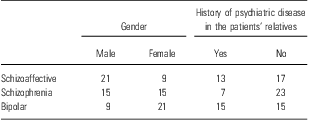
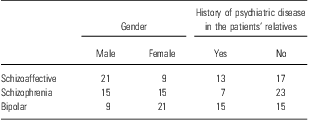
When the patients with schizoaffective disorder, schizophrenia and bipolar disorder were evaluated in their own subgroups, no correlation was observed between TOS, TAS and OSI, and the parameters including marital status, familial history of psychiatric disorder, the history of ECT, number of hospitalisations, educational level and duration of the disease (p > 0.05). Gender distribution of the patients and the history of psychiatric disease in patients’ relatives are shown in Table 3.
Gender distribution of the patients and the history of psychiatric disease in the patients’ relatives
Discussion
To the best of our knowledge, up till now, there has been no study that compared schizoaffective disorder with schizophrenia and bipolar disease in terms of TOS, TAS and OSI. The most important finding of our study was the detection of significantly higher TOS levels in the patients with schizoaffective disorder compared with the patients with schizophrenia and bipolar disorder. In two different studies that were previously conducted, it was observed that the levels of nitric oxide (NO), xanthine oxide and malondialdehyde (MDA) were increased compared with the control group (Reference Derin, Yazici and Erkoc10,Reference Akyol, Herken and Uz11). In other studies conducted on schizophrenic patients, the levels of NO, nitrite, adrenomedullin and MDA were found to be higher compared with the control group (Reference Yanik, Vural and Kocyigit12–Reference Ustundag, Atmaca, Kırtas, Selek, Metin and Tezcan14). In the study conducted in China, plasma levels of NO and lipid peroxide were found to be higher in patients with schizophrenia compared with the controls (Reference Othmen, Mechri and Fendri15).
In studies conducted on patients with bipolar disorder, NO levels were higher than controls in both remission and acute phases (Reference Savas, Gergerlioglu and Armutcu16,Reference Machado-Vieira, Andreazza and Viale17). A study reported that NO was insignificantly higher in the bipolar depressive episode and was markedly decreased with the therapy (Reference Selek, Savas, Gergerlioglu, Bulbul, Uz and Yumru18). In several recent studies, oxidative stress was seen to have higher levels than controls in bipolar disorder (Reference Kuloglu, Ustundag and Atmaca19–Reference Wang, Shao and Sun22). Ozcan et al. showed that pre- and post-treatment MDA levels of bipolar disorder patients were higher compared with controls and pre-treatment NO level was lower than in the control group (Reference Ozcan, Gulec, Ozerol, Polat and Akyol21). In one study, bipolar I, bipolar II and drug-related hypomania groups were compared with the control group, and TOS was significantly higher in three disease groups compared with the control group (Reference Yumru, Savas, Kalenderoglu, Bulut, Celik and Erel4). On the basis of our study data, the finding of TOS was significantly higher in schizoaffective disorder compared with schizophrenia and bipolar disorder. Increased TOS levels observed in schizoaffective disorder may suggest poor clinical course and may be an indicator of poor prognosis.
TAS levels of the groups were not significantly different in this study, whereas Raffa et al. reported that the levels of superoxide dismutase (SOD) and catalase (CAT) activities were lower in patients with schizophrenia when compared with either controls or bipolar patients (Reference Raffa, Barhoumi, Atig, Fendri, Kerkeni and Mechri23). The difference between this study and the one mentioned above may originate from the differences of the study designs. In terms of used biochemical parameters, we used TAS levels, whereas Raffa et al. used CAT and SOD parameters. Another reason of the difference may originate from glutathione levels (total, reduced, oxidized and peroxide). In the study mentioned above, no difference was found between schizophrenic and bipolar patients. Therefore, TAS levels were studied in the present study, instead of SOD, CAT and so on separately.
OSI shows whether the oxidative metabolism is impaired in favour of total oxidants or antioxidants. In our study, OSI levels were higher in schizoaffective disorder compared with schizophrenia and bipolar disorder; these may indicate that oxidative metabolism is impaired in favour of total oxidants in schizoaffective disorder.
This study demonstrates that oxidative stress was higher in patients with schizoaffective disorder compared with patients with schizophrenia and bipolar disorder. Furthermore, it also shows that schizoaffective disorder may be differentiated from schizophrenia and bipolar disorder with its different oxidative metabolism properties.
The limitations of our study were small sample size, lack of information about the drug therapies and the clinical symptom severity for each disease group. The failure of serum TOS, TAS and OSI may completely reflect those present in the brain tissue.
To conclude, the results of the study indicate that schizoaffective disorder may differentiate from both schizophrenia and bipolar patients in terms of oxidative parameter.
Acknowledgements
Thanks for Salih Selek for statistical editing and İhsan Aksoy for language editing.