INTRODUCTION
The Caspian Sea is the largest inland water on the earth (Dumont, Reference Dumont2000). It has a drainage basin covering almost 3.5 million km2 compared with 2.4 million km2 for the Black Sea (Stolberg et al., Reference Stolberg, Borysova, Mitrofanov, Barannik and Eghtesadi2006; Mertens et al., Reference Mertens, Bradley, Takano, Mudie, Marret, Aksu, Hiscott, Verleye, Mousing, Smyrnova, Bagheri, Mansor, Pospelova and Matsuoka2012). The water inputs of this lake contain river discharges, including the Volga (contributing up to 80–85% of the total), Emba, Ural, Terek and Sefidrud rivers (67,000 km2 catchment area and discharge of 4037 million m3; Rodionov, Reference Rodionov1994; Bagheri et al., Reference Bagheri, Mansor, Makaremi, Sabkara, Wan Maznah, Mirzajani, Khodaparast, Negaresatan, Ghandi and Khalilpour2011).
The exchange of species between the Caspian and Black seas has existed since the Pliocene and Quaternary periods. One of the remarkable features of its fauna is the high level of endemism (Dumont, Reference Dumont2000). Numerous groups of the crustaceans (e.g. Mysidacea, Cumacea, Amphipoda and Onychopoda) and molluscs (e.g. Cardiidae and Pyrgulidae) have formed its species groups (Grigorovich et al., Reference Grigorovich, Therriault and MacIsaac2003). At least 159 species have sorts that include obviously isolated habitats in the Caspian Sea (Grigorovich et al., Reference Grigorovich, Therriault and MacIsaac2003). However, the accidental transfer of species by shipping has intensified since the construction of the Volga–Don canal in 1952 (Grigorovich et al., Reference Grigorovich, MacIsaac, Shadrin and Mills2002). Furthermore, the severe environmental destruction which occurred at the beginning of the 1990s (Dumont, Reference Dumont1995; Kideys et al., Reference Kideys, Roohi, Eker-Develi and Beare2008; Bagheri et al., Reference Bagheri, Niermann, Mansor and Yeok2014) and previous introductions of alien species such as Balanus eburneus (1954), Acartia tonsa (1981), Mnemiopsis leidyi (1865) and Hediste diversicolor (1939–1940) would have had an impact on the endemic population (Grigorovich et al., Reference Grigorovich, Therriault and MacIsaac2003).
There are eight mollusc species in the Caspian Sea with Mediterranean origin, of which three are Bivalvia (Kasymov, Reference Kasymov1994). Cirrpedia Balanus improvisus (Darwin, 1854) was also accidentally introduced from the Black Sea in 1954 (Grigorovich et al., Reference Grigorovich, Therriault and MacIsaac2003) and is now extensively distributed in the Caspian Sea.
Balanus improvisus is distributed in mesohaline low intertidal zones to subtidal regions of estuaries worldwide (Newman & Abbott, Reference Newman and Abbott1980; Dineen & Hines, Reference Dineen and Hines1992) and presently found throughout the Caspian Sea, except in areas with fresh water prevailing.
These species attach themselves to all available surfaces, including other aquatic organisms, and with their osmoregulatory characteristics can spend as much as 10 months of the year in fresh water (Newman & Abbott, Reference Newman and Abbott1980). Laboratory studies have indicated the highest larval survival rate (Nasrolahi et al., Reference Nasrolahi, Farahani and Saifabadi2006) and enhanced reproductive success, through year-round breeding and shorter embryonic development time, in Caspian Sea water (Rahmani & Sari, Reference Rahmani and Sari2009).
Riedel et al. (Reference Riedel, Audzijonytė and Mugue2006) reported the infestation of endemic Bivalvia Didacna by invasive Balanus improvisus and the cheilostomate bryozoans Conopeum seurati in the north-western Caspian Sea. Also, Olszewska (Reference Olszewska1999) reported the existence of B. improvisus on C. glaucum. Taxonomic identity of C. glaucum complex has been studied over time. Members of the complex live in isolated communities and there is limited genetic exchange between them (Hummel et al., Reference Hummel, Wolowicz and Bogaards1994). They have a continuous distribution along European shores in the Mediterranean and Black Seas (Nikula & Väinölä, Reference Nikula and Väinölä2003). It is considered a native species in the Caspian Sea because the date of its introduction to the Caspian, Black and Aegean Seas remains controversial (Nikula & Väinölä, Reference Nikula and Väinölä2003).
Populations of Bivalvia and the bulk of benthos biomass have been mainly found in shorelines (<20 m depth) of the Caspian Sea (Mirzajani & Ghaninezhad, Reference Mirzajani and Ghaninezhad2005; Roohi et al., Reference Roohi, Kideys, Sajjadi, Hashemian, Pourgholam, Fazli, Khanari and Eker-Develi2010) and constitute the main diet of the important commercial fish Rutilus frisii kutum (Zarinkamar, Reference Zarinkamar1996; Afraei Bandepei et al., Reference Afraei Bandepei, Mashhor, Abdolmalaki and El-Sayed2009). This fish provides more than 60% of the income of local fishermen (Abdolmaleki & Ghaninezhad, Reference Abdolmaleki and Ghaninezhad2007). Therefore, population variations of kutum will have a major impact on fisheries activities along the coastlines in the Caspian Sea.
There are several studies on the state of Bivalvia and Cirripedia distribution reported by Tadjali-Pour (Reference Tadjali-Pour1977, Reference Tadjalli-Pour1980), Hosseini et al. (Reference Hosseini, Roohi, Ganjian, Roshantabari, Hashemian, Solimanroudi, Nasrollazadeh, Najafpour, Varedi and Vahedi1996), Laloei (Reference Laloei2001) and Mirzajani & Vonk (Reference Mirzajani and Vonk2006) in the southern Caspian Sea. In 2001, a long-term programme was initiated by the Iranian Fisheries Research Organization (IFRO) to investigate the abundance of mesozooplankton species and the impact of alien species (Mnemiopsis leidyi) on endemic fauna in the southern Iranian coast of Guilan and Mazandaran provinces (Bagheri, Reference Bagheri2012). Within the framework of this programme Roohi et al. (Reference Roohi, Yasin, Kideys, Hwai, Khanari and Eker Develi2008), Nasrollahzadeh et al. (Reference Nasrollahzadeh, Din, Foong and Makhlough2008a) and Bagheri et al. (Reference Bagheri, Niermann, Sabkara, Mirzajani and Babaei2012b, Reference Bagheri, Sabkara, Mirzajani, Khodaparast, Foong and Yosefzad2013, Reference Bagheri, Niermann, Mansor and Yeok2014) documented variations of M. leidyi and mesozooplankton species in the southern Caspian Sea from 2001–2010. Roohi et al. (Reference Roohi, Yasin, Kideys, Hwai, Khanari and Eker Develi2008) and Nasrollahzadeh et al. (Reference Nasrollahzadeh, Din, Foong and Makhlough2008a) concluded that the impact of alien species on composition and abundance of plankton community was evident and may remain for years. Bagheri et al. (Reference Bagheri, Mansor, Makaremi, Sabkara, Wan Maznah, Mirzajani, Khodaparast, Negaresatan, Ghandi and Khalilpour2011, Reference Bagheri, Niermann, Sabkara, Mirzajani and Babaei2012b, Reference Bagheri, Sabkara, Mirzajani, Khodaparast, Foong and Yosefzad2013, Reference Bagheri, Niermann, Mansor and Yeok2014) discussed that the main cause of the reduction in endemic species is the Caspian Sea ecosystem destruction, which facilitated the existence of alien species such as Acartia tonsa and M. leidyi. These species in their turn have had their own negative effects on the distribution and abundance of the endemic species.
Recently a huge abundance of Bivalvia was observed at the seashore which was mostly found along with B. improvisus colonies. This strengthens the hypothesis of possible negative effects of exotic species. In this paper, the possible effect of exotic species B. improvisus on the abundance of Bivalvia C. glaucum in the Caspian region was studied.
MATERIALS AND METHODS
Meroplankton (Bivalvia and Cirripedia larvae)
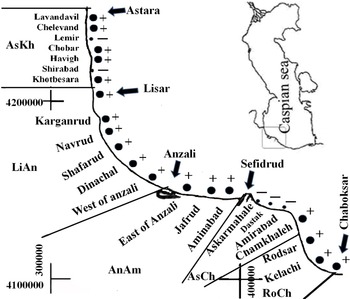
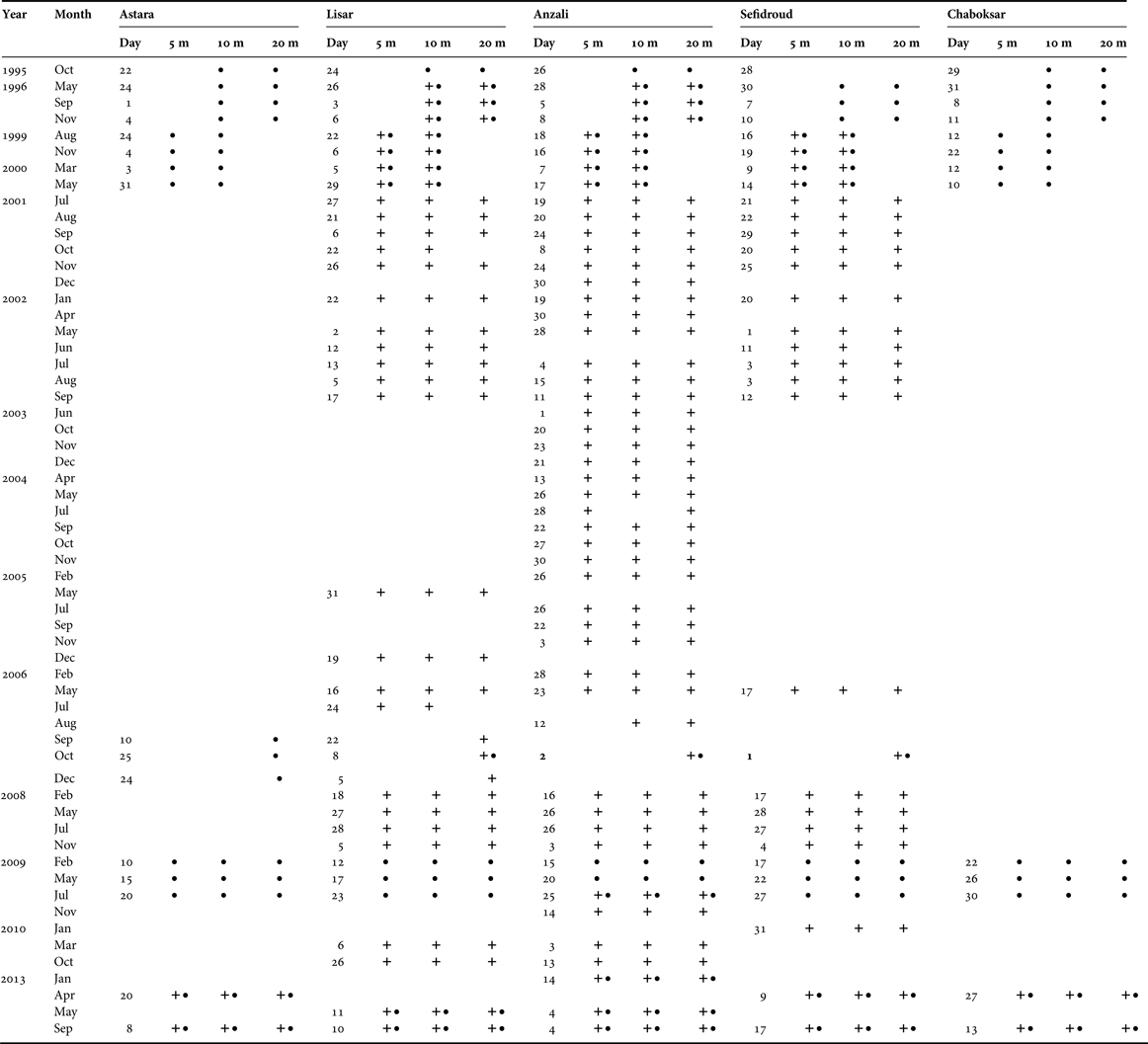
Samplings were performed at 5, 10 and 20 m water depth due to the high abundance of Bivalvia and Cirripedia in the coastal areas with less than 20 m depth (Bagheri et al., Reference Bagheri, Niermann, Sabkara, Mirzajani and Babaei2012b), along five transects: Astara, Lisar, Anzali, Sefidroud and Chaboksar in the south-western Caspian Sea (Figure 1, Table 1).
Sampling regions in the south-western Caspian Sea (−: no alive Bivalvia; +: with alive Bivalvia;  : transect).

Sampling procedures at different regions and depths in the south-western Caspian Sea during 1995–2013 (+ meroplankton, • benthos); adopted from the archives of the Inland Water Aquaculture Research Center (IWARC).

Meroplankton was sampled using a Juday net (opening diameter: 36 cm, mesh size: 100 µm) during April–May and in September 2013 (Table 1). At each station (three different depths) a vertical haul with a Juday net was carried out from bottom to surface using a handle pulley. All samples were preserved in neutral 4% formaldehyde and were taken to the laboratory for analysis. Samples were divided into subsamples using a 1 mL Hensen–Stempel pipette and transferred to a Bogorov chamber for identification of meroplankton. At least 100 individuals were counted per sample and identified to the species level using an inverted microscope (Birshtain et al., Reference Birshtain, Vinogradova, Kondakov, Koon, Astakhova and Romanova1968; Harris et al., Reference Harris, Wiebe, Lenz, Skjoldal and Huntley2000).
Furthermore, the Cirripedia and Bivalvia larvae data were adopted from the archives of the Inland Water Aquaculture Research Center (IWARC); including data of 1996 (12 samples) from Hosseini et al. (Reference Hosseini, Roohi, Ganjian, Roshantabari, Hashemian, Solimanroudi, Nasrollazadeh, Najafpour, Varedi and Vahedi1996); data of 1999–2000 (24 samples) from Laloei (Reference Laloei2001), and data of 2001–2010 (225 samples) from Bagheri et al. (Reference Bagheri, Niermann, Mansor and Yeok2014) (Table 1).
Benthic
Benthic Bivalvia were collected at the same stations and at the same depths as meroplankton. Simultaneously, Bivalvia were sampled using a bottom sampler (Van-Veen grab; opening mouth: 400 cm2; Table 1). The collected samples were washed and sieved (mesh size: 500 µm) by seawater and transferred to the laboratory.
In addition, data of different years were obtained from the archives of the Inland Water Aquaculture Research Center (IWARC) from the following resources to compare Bivalvia abundance data: (a) Hosseini et al. (Reference Hosseini, Roohi, Ganjian, Roshantabari, Hashemian, Solimanroudi, Nasrollazadeh, Najafpour, Varedi and Vahedi1996) for data of 1995–1996 (38 samples); (b) Laloei (Reference Laloei2001) for data of 1999–2000 (40 samples); (c) Khodaparast (Reference Khodaparast2006) for data of 2006 (six samples); and (d) Mirzajani (Reference Mirzajani2010) for data of 2009 (45 samples) (Table 1).
Species composition of the Bivalvia was determined in 23 localities along the 300 km coastline (Figure 1). Live Bivalvia and Cirripedia colonies in their shells were collected by hand along the beach at each locality after a sea-storm when there was a rise in Bivalvia abundance on the coastline, twice: during January–February, and during April–May 2013.
Biometry and statistical analysis
We used a Vernier caliper to measure length, height and inflation of Bivalvia shells (Leal & Matthews, Reference Leal and Matthews2013) (Figure 2). Dimensions of attachment location of Cirripeds on posterior dorsal portion of shells (called settlement surface, SS), which are darker in colour, were measured to estimate Cirripedia biomass.
Cerastoderma glaucum with Balanus improvisus in the south-western Caspian Sea in 2013.

Spatial differences of biomass and length of Bivalvia and Cirripedia were verified by one-way analyses of variance (ANOVA), followed by a Tukey's test. Pearson's rank correlation was used to determine the degree of relationship between Cirripedia biomass and Bivalvia abundance.
RESULTS
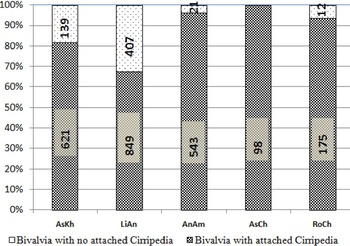
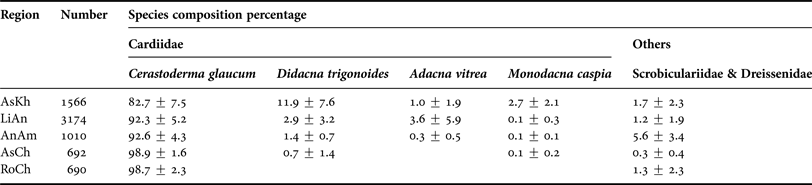
The substrate in the study area is composed of small sand, mud and shell debris offering an appropriate habitat for Cerastoderma glaucum, which can then be a proper surface for the settlement of Balanus improvisus. Cerastoderma glaucum shells constituted 68–100% of Bivalvia shell composition in 23 regions, whereas Didacna trigonoides shells were more abundant in the AsKh region (average 11.9%; Table 2). Adacna vitrea was dominant in the LiAn region particularly in the west of Anzali (Figure 1) with a maximum of 15.3% of bivalve shell composition. No live C. glaucum was observed in the east of Sefidroud (Figure 1; AsCh) region. All C. glaucum (100%) samples collected from the eastern region were attached by B. improvisus (AsCh), while in the western regions this was 68–82% (AsKh and LiAn) (Figure 3).
Percentage of Bivalvia individuals with and without attached Cirripedia in different regions in the south-western Caspian Sea in 2013 (numbers indicate the counted specimens).

The composition of Bivalvia species (number, %) in the south-western Caspian Sea in 2013.

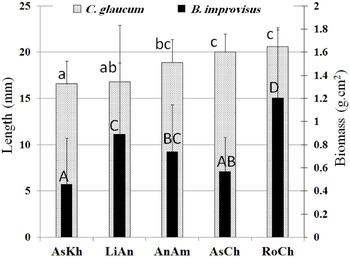
Descriptive statistics on Cirripedia biomass in different regions are depicted in Figure 4. Density in different regions is significantly different (F = 22.6; P < 0.05). Although a peak density was observed in the Anzali region (3.6 g cm−2), the highest average density was observed in RoCh (1.21 g cm−2) compared with AsKh where the lowest average density (0.46 g cm−2) was observed. The statistical test showed there were significant differences between Bivalvia sizes in different regions (F = 16.9; P < 0.05).
Length of Bivalvia and biomass of Cirripedia in the south-western Caspian Sea in 2013 (letters indicate the homogeneous groups).

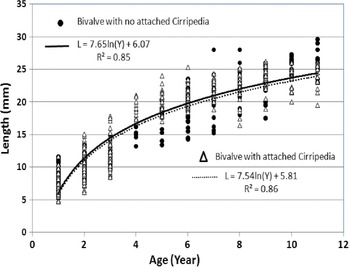
Bivalvia lengths in western regions (AsKh-LiAn) were shorter than those of eastern regions (AsCh-RoCh), belonging to different homogeny groups. In this study we observed a significant positive correlation between Cirripedia biomass and SS (Pearson rank correlation, r = 0.83; P < 0.01) and a significant negative correlation between Cirripedia biomass and Bivalvia abundance (r = −0.71; P < 0.01). Bivalvia samples with no attached Cirripedia showed a higher non-linear growth curve (mean annual growth rate of 1.8 mm year−1) compared with those that were attached to Cirripedia (mean annual growth rate of 1.6 mm year−1) (Figure 5). However, the difference in their growth was not statistically significant (F = 0.06; P > 0.05).
The equations and growth curve of Bivalvia C. glaucum in presence and absence of Cirripedia B. improvisus in the south-western Caspian Sea in 2013.

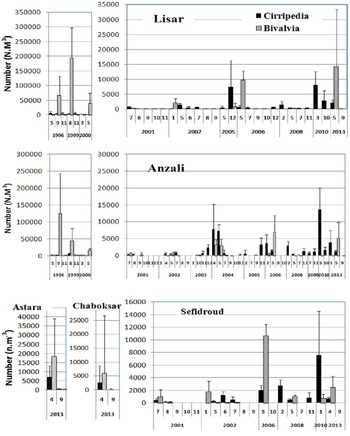
The findings showed that abundance of Bivalvia and Cirripedia larvae declined drastically during 2001–2002 (Figure 6). The abundance of Bivalvia larvae remained very low between 2008 and 2010 (average 157 n m−3 in 2010) as compared with previous years (average: 35,025 n m−3; during 1996–2000). However, a maximum abundance (10,642 n m−3; Figure 6) was observed in May 2006. The Cirripedia larvae showed a gradual increase after 2002 (average 6785 n m−3 in 2010; Figure 6) as compared with 1996–2000 (average 2981 n m−3; Figure 6).
Fluctuation of abundance (n m−3) of Cirripedia and Bivalvia larvae in different regions in the south-western Caspian Sea during 1996–2013.

In 2013, mean abundance of Bivalvia and Cirripedia larvae were 4180 and 1675 n m−3, respectively (Figure 6). The meroplankton abundances were high in Astara and Lisar compared with the Anzali and Sefidroud transects.
A spatial difference of meroplankton abundance was also found in a long time comparison (Figure 6), where Lisar had higher abundances of meroplankton than Anzali. In 2008, Sefidroud transect showed a higher mean abundance of meroplankton than Anzali and Lisar transects.
Neither Bivalvia or Cirripedia larvae showed an overlapping temporal abundance. The Cirripedia larvae showed a high abundance throughout the year with a peak abundance in winter. During 1996–2013, the abundance of Cirripedia larvae varied between 584 and 3255 n m−3 in summer and winter, respectively (Figure 6). The bloom of Bivalvia larvae occurred in April and May during 2004–2013 (average 4704 n m−3), while the highest Bivalvia larvae abundance (average 2135 n m−3; Figure 6) occurred in August and September during 1996–1999.
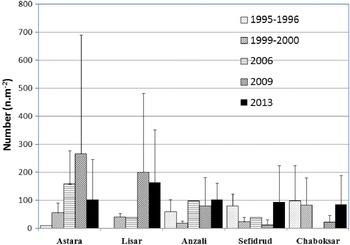
The benthic C. glaucum showed decreased abundance from west to east along the seashore. The highest abundance of C. glaucum was observed in the Astara and Lisar regions, while its lowest abundance was observed in the Sefidroud (AsCh) region (Figures 1 & 7). In 2009, the abundance of C. glaucum for these regions was more than 200 and about 12 n m−2, respectively (Figure 7). In 2013, the highest abundance of C. glaucum (163 n m−2) was observed in the Lisar region, while there was 100 n m−2 in other regions (Figure 7).
Cerastoderma glaucum abundance in different regions in the south-western Caspian Sea during 1995–2013.

DISCUSSION
A drastic decrease in abundance of Bivalvia larvae and a gradual increase in Cirripeda larvae after 2000 (Figure 6) coincided with decrease of diversity and abundance of native zooplankton (Dumont et al., Reference Dumont, Shiganova and Niermann2004; Shiganova et al., Reference Shiganova, Musaeva, Pautova and Bulgakova2005; Roohi et al., Reference Roohi, Yasin, Kideys, Hwai, Khanari and Eker Develi2008, Reference Roohi, Kideys, Sajjadi, Hashemian, Pourgholam, Fazli, Khanari and Eker-Develi2010; Bagheri, Reference Bagheri2012) after the appearance of Mnemiposis leidyi at the end of 1990s (Ivanov et al., Reference Ivanov, Kamakin, Ushivtzev, Shiganova, Zhukova, Aladin, Wilson, Harbison and Dumont2000). The abundance of Bivalvia and Cirripedia larvae declined drastically due to drought years and strong stratification of the Caspian Sea during 2001–2002 (Bagheri et al., Reference Bagheri, Niermann, Sabkara, Mirzajani and Babaei2012b, Reference Bagheri, Niermann, Mansor and Yeok2014). Our findings showed that the abundance of B. improvisus increased after 2002 while abundance of Bivalvia larvae stabilized at about one-tenth of their abundance levels before 2000 (Figure 6). Maximum abundances of Bivalvia larvae have been changed from August–September (1996 and1999) to April–May (2004–2013) (Figure 6). It might be related to changes in weather or habitat conditions.
High larval survival rate (Nasrolahi et al., Reference Nasrolahi, Farahani and Saifabadi2006), reproductive success (Rahmani & Sari, Reference Rahmani and Sari2009) and high biomass of B. improvisus in this study showed its successful adaptation in the Caspian Sea. Malinovskaja et al. (Reference Malinovskaja, Filippov, Osadchikh and Aladin1998) and Kasimov (Reference Kasimov2001) reported higher Cirripedia biomass for south-western areas compared with middle and northern areas in the Caspian Sea. The biomass of B. improvisus in the northern Caspian Sea increased from 1960s to 1980s, while the biomass of Cerastoderma glaucum decreased during the same period (Malinovskaja et al., Reference Malinovskaja, Filippov, Osadchikh and Aladin1998). Perhaps this is due to improved trophic conditions and a drop in water salinity.
Salinity of the Caspian Sea markedly varied from 0.1 PSU in the northern parts up to 11 and 13.5 in the middle and southern parts, respectively (Mamaev et al., Reference Mamaev, Gugele, Strobel, Taylor, Ritter and Jaoshvili2002). The biomass of B. improvisus reported in this study was 8.2 kg m−2, which is higher than those reported by Malinovskaja et al. (Reference Malinovskaja, Filippov, Osadchikh and Aladin1998) for the northern parts (mean 3.5 g m−2) and Kasimov (Reference Kasimov2001) for the middle parts (ranged from 8.1 to 64.0 g m−2 in middle Caspian Sea to 4.7 kg m−2 at off-shore oil installations). Thus it is suggested that as salinity decreases from the southern Caspian Sea toward central and northern areas, the spatial distribution pattern of Cirripedia shows a downward trend from south to north.
Salinity is a main factor in Cirripedia (larvae and adult) distribution with adults occurring at a salinity of 0–13 PSU while the B. improvisus cyprids were most numerous in higher salinities. A salinity decline because of river discharge caused mortality after prolonged exposure (Bousfield, Reference Bousfield1955). Bousfield (Reference Bousfield1955) and Dineen & Hines (Reference Dineen and Hines1992) noted the best salinity range for peak settlement was 10–15 PSU, and according to O'Connor & Richardson (Reference O'Connor and Richardson1994) the settlement of B. improvisus cyprids declined in 30 PSU. The mean salinity in our study area ranged between 11.6 and 12.0 PSU with lower salinities of 5.8 and 8.3 PSU in the Anzali and Sefidroud regions, respectively (Bagheri et al., Reference Bagheri, Niermann, Sabkara, Mirzajani and Babaei2012b). According to Bagheri et al. (Reference Bagheri, Mansor, Turkoglu, Makaremi and Babaei2012a, Reference Bagheri, Niermann, Mansor and Yeok2014), the high volume of freshwater discharge by the Anzali wetland and Sefidroud River were reasons for salinity variations in the south-western Caspian Sea.
Distribution of Bivalvia shell coincides with distribution pattern of these organisms. As Moiseiev & Filatova (Reference Moiseiev and Filatova1985) noted, higher abundances of Cerastoderma was observed in the southern regions of the Caspian Sea compared with northern and middle parts, whereas Adacna sp. and Didacna sp. showed an opposite trend. Slugina (Reference Slugina2006) reported the ranges of salinities for each species while Cerastoderma was found in the highest salinities (11–12 PSU), which nearly resembles our distribution results (Table 2).
Our findings showed that the highest abundance of C. glaucum was observed up to 700 n m−2 (Figure 7; in 2009) in the south-western Caspian Sea (Astara region), comparable to the study of Moiseiev & Filatova (Reference Moiseiev and Filatova1985), who reported a high frequency (about 800 n m−2) in the same area.
High Bivalvia and Cirripedia abundance could be related to rise of salinity, trophic index and nutrient levels in Astara and Lisar regions. According to Kosarev et al. (Reference Kosarev, Yablonskaya and IAblonskia1994) and Nasrollahzadeh et al. (Reference Nasrollahzadeh, Din, Foong and Makhlough2008b) nutrient concentrations, chlorophyll a and trophic index increased during 1946–2005 in the Caspian Sea. Furthermore, Nasrollahzadeh et al. (Reference Nasrollahzadeh, Din, Foong and Makhlough2008a) and Bagheri et al. (Reference Bagheri, Niermann, Mansor and Yeok2014) reported that the nutrient concentrations (DIP & DIN) increased 2–3 times during 2001–2010 as compared with previous years. Spatially, the highest values of chlorophyll a (Kideys et al., Reference Kideys, Roohi, Eker-Develi and Beare2008; Jamalomidi, Reference Jamalomidi2013) and the nutrient levels (Nasrollahzadeh et al., Reference Nasrollahzadeh, Din, Foong and Makhlough2008a, Reference Nasrollahzadeh, Din, Foong and Makhlough2008b) were observed in Anzali and Sefidroud areas. According to Laloei (Reference Laloei2001) and Bagheri et al. (Reference Bagheri, Mansor, Turkoglu, Makaremi and Babaei2012a, Reference Bagheri, Niermann, Sabkara, Mirzajani and Babaeib), the highest concentrations of DIN were observed in the Anzali and Sefidroud regions (average 0.08 and 0.06 mg L−1, respectively). Furthermore the concentrations of DIP were higher in those regions (average 0.04 and 0.03 mg L−1, respectively) than in the Astara, Lisar and Chaboksar regions (reported by Laloei (Reference Laloei2001) and Bagheri et al. (Reference Bagheri, Mansor, Turkoglu, Makaremi and Babaei2012a)). The Anzali and Sefidroud regions are under the influence of their extremely large catchment areas that might be a reason for their high nutrient levels. On the other hand, the runoff pollution from coastal cities such as Astara, Anzali, Rodsar and Chaboksar regions, that discharge their sewage directly into the sea, may be more than other regions. Eutrophication levels will increase in the Caspian region by anthropogenic activities such as fish cage culture which was launched in the Jaf region in 2012, where we observed high abundance of Cirripedia and their full settlement (Figure 3). Based on Malinovskaja et al. (Reference Malinovskaja, Filippov, Osadchikh and Aladin1998) and our findings, full settlement of Cirripedia (Figures 1 & 3 in AnAm-AsCh regions) and absence of C. glaucum in many parts of this region might be related to trophic conditions needed for distribution of both organisms. It might be suggested that the increases in nitrogen and phosphorus concentrations result in the increase and decrease in the biomass of B. improvisus and C. glaucum, respectively.
The findings revealed that there is negative correlation between B. improvisus biomass and C. glaucum abundance. The increase of B. improvisus biomass from western to eastern regions can be related to rising water temperatures as reported by Nasrollahzadeh et al. (Reference Nasrollahzadeh, Din, Foong and Makhlough2008a). Although the negative effects of B. improvisus on C. glaucum such as competition on feeding of suspended organic micro-particles and consuming oxygen were reported by Riedel et al. (Reference Riedel, Audzijonytė and Mugue2006), we could not detect any significant difference in the growth rate of the two species (Figure 5). This might be because Cirripedia settlement and development on Bivalvia occurs in relatively short periods.
Although no data on growth rate and age determination of Cirripedia are available, according to several authors (Bertness et al., Reference Bertness, Gaines, Bermudez and Sanford1991; Sanford & Menge, Reference Sanford and Menge2001; Phillips, Reference Phillips2005), a complex set of oceanographic conditions such as water temperature, high nutrient inputs, abundance of planktonic food and wave-exposure might affect the growth rate of Ciiripedia. Based on our findings, the Cirripedia growth rate ranged between 0.03 and 0.12 mm d−1, which suggest their short-term influence on Bivalvia. The presence of B. improvisus causes C. glaucum to be unstable and unsteady; therefore it is transported to the coastline with wave circulation in stormy situations.
Despite hydro-chemical and pollutant influences, the dominant small size of C. glaucum in the AsKh region is hypothesized to be the result of the high abundance of B. improvisus larvae (Figures 4 & 6). This leads to high Bivalvia transportation to coastline areas without having a chance for further growth. It is predicted that due to high abundance of B. improvisus, Bivalvia size will decrease in other regions too.
In areas not especially invaded by B. improvisus, widespread transportation of live Bivalvia indicated the contribution of other factors strengthened by abundance of Adacna vitrea which constituted 15.3% of Bivalvia individuals to the west of Anzali. The form and length of siphons is largely dependent on clam lifestyle and living depth. Schneider (Reference Schneider1998) used the siphons' position to review the taxonomy of Cardiid. In his cladistic phylogeny tree, three genera of Cerastoderma, Didacna and Hypanis were very close to each other in terms of morphology. Vidal (Reference Vidal2001) has described siphons of C. glaucum to be relatively long with few additional larger tentacles on the outside. No specific data are available on A. vitrea; however, our observations on live specimens showed siphon lengths up to 30 mm compared with 5 mm in C. glaucum.
A longer siphon allows A. vitrea to live a few centimetres below the surface where it is not invaded by B. improvisus but rather by C. glaucum which lives on the sea floor. Foliage and litter (resulting from overgrowth of aquatic plants in wetlands and deforestation in catchment basins) are transported into and settle in the Caspian Sea, and have a strong influence on movements of C. glaucum individuals in stormy situations. We observed that woody particles and other terrestrial plant detritus can expunge small-sized Bivalvia even with low settlement of Cirripedia. Although there is no information on the rate of litter discharge into the Caspian Sea, it seems to be very high.
Olszewska (Reference Olszewska1999) reported the sporadic colonization of C. glaucum by B. improvisus in the southern Baltic. This Bivalvia was known as a very unstable substrate for barnacle. This is because of its spherical shape that can readily roll along the bed by water currents (Olszewska, Reference Olszewska1999). In spite of this morphological characteristic we think that C. glaucum is almost the only target for the settlement of B. improvisus in the southern Caspian Sea; where the bed at 10–20 m depths is composed of small sand and mud.
Although we report possibly negative effects of Cirripedia on Bivalvia survival, Roohi et al. (Reference Roohi, Kideys, Sajjadi, Hashemian, Pourgholam, Fazli, Khanari and Eker-Develi2010) reported a positive influence of the exotic species Mnemiopsis leidyi on Bivalvia abundance after its introduction to the Caspian Sea. The positive influence was observed to be in the form of increased Bivalvia abundance, because of increased food availability due to the decomposition of dead ctenophores. This controversy could be due to differences in sampling sites and statistical analysis. For example, Roohi et al. (Reference Roohi, Kideys, Sajjadi, Hashemian, Pourgholam, Fazli, Khanari and Eker-Develi2010) collected samples from the locations which are not considered as Bivalvia habitats. Furthermore, we used depths shallower than 20 m (as the main distribution areas of Bivalvia) in this study (Hosseini et al., Reference Hosseini, Roohi, Ganjian, Roshantabari, Hashemian, Solimanroudi, Nasrollazadeh, Najafpour, Varedi and Vahedi1996; Mirzajani & Ghaninezhad, Reference Mirzajani and Ghaninezhad2005; Mirzajani & Vonk, Reference Mirzajani and Vonk2006), which is deemed to contribute to data reliability. Further studies on niche overlap and the possible feeding competition between M. leidyi, B. improvisus and C. glaucum, as primary consumers, by new techniques such as isotope measurements are needed.
CONCLUSION
The high volume of live Bivalvia transportation to southern Caspian coastlines, instead of entering into the food chain, is caused by massive settlement of exotic species (B. improvisus) and influences of anthropogenic activities such as erosion and discharge of solid suspended matters by rivers. This movement of molluscs will be intensified in the future due to higher urban nutrient loading, deforestation and many other anthropogenic influences such as cage fish culture, which is under consideration to be carried out in the Caspian Sea. Habitats of the native Caspian species will be restricted by these human activities especially in the coastal areas. Therefore, there is a great need for synecological monitoring of native fauna with special emphasis on evaluation of pollution impacts.
ACKNOWLEDGEMENTS
We wish to thank Jan J. Poorten from the Field Museum of Natural History, Chicago, USA for identification of Cardiidae, as well as M. Sayadrahim and A. Abedini from IWARC for their help in laboratory work. Also we appreciate the kind help of Sam Allen in revising and language editing the manuscript.