Introduction
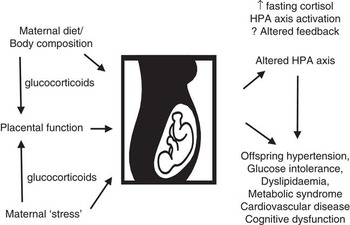
The ‘Developmental Origins of Health and Disease’ (DOHaD) hypothesis proposes that an adverse stimulus or insult during a critical window of development in utero, or during the early postnatal period, ‘programmes’ lifelong changes in tissue structure and function, predisposing the individual to later disease.Reference Barker 1 , Reference Gluckman and Hanson 2 Extensive epidemiological studies and supportive experimental studies have shown an association between an adverse in utero environment, often in association with low birthweight, and later susceptibility to cardiovascular, metabolic and psychiatric disorders in adulthood.Reference Barker 1 , Reference Gluckman and Hanson 2 One of the key mechanisms hypothesized to underlie programming is overexposure of the developing foetus to glucocorticoids.Reference Seckl 3 Glucocorticoids are essential for life, playing a key role in the regulation of growth, metabolism, fluid and electrolyte homoeostasis and the physiological response to stress. Glucocorticoids also have important effects on tissue maturation, as evidenced by the use of antenatal glucocorticoid therapy to mature the foetal lung in women at risk of preterm labour.Reference Roberts and Dalziel 4 In animal models, administration of excess glucocorticoids is associated with a range of adverse effects on offspring health including metabolic, vascular and brain effects, providing good evidence of glucocorticoids as mediators of programming.Reference Seckl 3 The animal models also show that the offspring have programmed changes in hypothalamic–pituitary–adrenal (HPA) axis activity thus indicating that glucocorticoids are also targets of programming. Circulating levels of corticosterone are elevated and there are changes in expression of glucocorticoid receptor (GR) in key metabolic tissues including liver, fat and muscle.Reference Cleasby, Kelly, Walker and Seckl 5 , Reference Nyirenda, Lindsay, Kenyon, Burchell and Seckl 6 Likewise, GR and mineralocorticoid receptor (MR) expression are altered in the brain, particularly in areas of HPA axis central negative feedback.Reference Welberg, Seckl and Holmes 7 This review will focus on the translational studies in humans supporting the role of glucocorticoids as both targets of- and mediators of programming (Fig. 1).
Glucocorticoids as mediators and targets of programming.The maternal glucocorticoid levels may be altered by changes in maternal diet and body composition, maternal stress and anxiety levels and intrinsic activity of the maternal hypothalamic–pituitary–adrenal (HPA) axis. Levels of the placental enzyme 11-β-hydroxysteroid dehydrogenase type 2 protect the developing foetus from exposure to excess glucocorticoids. However, glucocorticoid excess programmes lifelong changes in HPA axis activity, with most evidence suggesting activation of the axis. This is associated with programmed metabolic and cognitive outcomes.

Glucocorticoids as targets of programming
In humans, excess exogenous or endogenous glucocorticoids cause Cushing's syndrome, which, if untreated, is associated with metabolic disturbances including diabetes, hypertension and dyslipidaemia, that is, cardiovascular risk factors comprising the metabolic syndrome. It has therefore been proposed that more subtle variations in glucocorticoid action may be associated with development of the metabolic syndrome. The first study to explore the relationship between fasting cortisol and low birthweight included 370 men born in Hertfordshire, UK, between 1920 and 1930.Reference Phillips, Barker and Fall 8 In this study, high fasting morning plasma cortisol levels were associated with low birthweight.Reference Phillips, Barker and Fall 8 Further studies reported that this association was evident in both men and women, and was seen in adults ranging from 20 to 70 years.Reference Phillips, Walker and Reynolds 9 A subsequent meta-analysis of 11 studies (with data on 2301 subjects) of the relationship between birthweight and cortisol concentrations reported that cortisol concentrations fell on average by 25.3 nmol/l per kg (95% CI, 5.9–44.8) increase in birthweight.Reference van, Finken, le, Dekker and Wit 10 In the Hertfordshire study, a high fasting cortisol was also associated with cardiovascular risk factors including higher glucose, systolic blood pressure and plasma triglycerides.Reference Phillips, Barker and Fall 8 This study provided the first evidence that intrauterine programming of the HPA axis may be a mechanism linking low birthweight with development of the metabolic syndrome in later life.
As plasma cortisol and the prevalence of cardiovascular disease and its risk factors are all higher in people with type 2 diabetes, we hypothesized that, if elevated plasma cortisol does increase cardiovascular risk, this should be apparent in a cohort of individuals with type 2 diabetes. We have investigated this in participants in the Edinburgh Type 2 Diabetes Study (ET2DS). The ET2DS is a population-based prospective study including 1066 men and women aged 60 to 75 years with established type 2 diabetes, living in the Lothian region of central Scotland.Reference Price, Reynolds and Mitchell 11 Participants were recruited during 2006–2007 and underwent detailed cognitive and physical examination, the latter including measures of micro- and macro-vascular disease, glycaemic control, body fat composition and plasma inflammatory markers, cortisol, lipids and liver function tests. A history of cardiovascular disease was carefully ascertained using a combination of self-report of heart attack or angina, or medication for angina or heart attack, evidence of angina/myocardial infarction on the World Health Organization chest pain questionnaire, or electrocardiographic evidence of ischaemia, or prior hospital discharge code for myocardial infarction or angina. The main aim of the study is to explore potentially modifiable risk factors for cognitive decline and cardiovascular risk and 4-year follow-up of participants for cognitive, vascular and liver function has been completed during 2010–2011.Reference Price, Reynolds and Mitchell 11
Morning plasma cortisol levels were measured by radioimmunoassay in samples collected from all participants after an overnight fast. After excluding subjects taking glucocorticoid therapy, elevated plasma cortisol levels were associated with significantly raised fasting glucose and total cholesterol levels.Reference Reynolds, Labad and Strachan 12 This finding was particularly striking as the majority of subjects were treated with cardiovascular risk modifying agents including glucose lowering, lipid lowering and antihypertensive therapies, whereas previous studies linking cortisol to the metabolic syndrome included otherwise healthy individuals.Reference Phillips, Barker and Fall 8 , Reference Phillips, Walker and Reynolds 9 , Reference Ward, Fall and Stein 13 , Reference Watt, Harrap and Foy 14 However, these findings remained significant after adjustment for these therapies and for other potential confounding factors. Thus, there appears consistent evidence that subtle elevations in circulating cortisol levels are associated with increased risk of cardiovascular risk factors (Fig. 1).
Given the association between high cortisol levels and cardiovascular risk factors, is there also a link between circulating plasma cortisol and cardiovascular end-points? To date, the literature in this field has been inconsistent. For example, in a large prospective study a higher morning cortisol:testosterone ratio was associated with ischaemic heart disease in men, although cortisol levels alone were not predictive of future cardiac events.Reference Davey Smith, Ben-Shlomo and Beswick 15 Similarly, there were no significant associations between basal cortisol levels and coronary artery disease demonstrated by angiography.Reference Reynolds, Ilyas and Price 16 However, in another study, cortisol levels in blood obtained on the morning before coronary angiography, which the authors described as taken under conditions of ‘anticipatory stress’, correlated positively with severity of coronary artery disease, independently of other cardiovascular risk factors.Reference Alevizaki, Cimponeriu, Lekakis, Papamichael and Chrousos 17 Timing of sample collection, and conditions under which the samples are collected may be one reason for these different findings. In addition, glucocorticoids have diverse effects within the vessel wall including anti-angiogenic effects,Reference Kakio, Matsumori and Ohashi 18 , Reference Villa, Guzman and Chen 19 which may explain the discrepancy. However, in the ET2DS, elevated fasting morning cortisol levels were associated with prevalent ischaemic heart disease (>800 v. <600 nmol/l, OR 1.58, P = 0.02).Reference Reynolds, Labad and Strachan 12 This association remained significant after adjustment for duration and control of diabetes and other cardiovascular risk factors. Further studies investigating the role of cortisol in the pathogenesis of cardiovascular disease are needed. If proved causal, strategies targeted at lowering cortisol action may be useful to improve the metabolic and cardiovascular phenotype in subjects with type 2 diabetes.
In addition to increasing risk of developing the metabolic syndrome, glucocorticoid excess can cause altered mood and cognitive dysfunction. GRs are highly expressed in the hippocampus in both rodents and humans.Reference McEwen 20 , Reference Seckl, Dickson, Yates and Fink 21 The hippocampus plays a central role in long-term memory and appears particularly vulnerable to the deleterious effects of glucocorticoids.Reference Meaney, O'Donnell and Rowe 22 Human and animal studies have demonstrated that altered hippocampal structure may be associated with a number of consequences for memory and behaviour. In rodents, interventions that maintain low glucocorticoid levels such as adrenalectomy with low-dose glucocorticoid replacement,Reference Landfield, Baskin and Pitler 23 or neonatal handling,Reference Vallee, Maccari and Dellu 24 either prevent or abolish age-related cognitive deficits and hippocampal atrophy.Reference Landfield, Baskin and Pitler 23
In humans, higher plasma cortisol levels at 9 am are associated with worse age-related cognitive function.Reference MacLullich, Deary and Starr 25 The variations in HPA axis function have also been associated with alterations in brain structure including hippocampal atrophy and abnormalities in other areas of the brain involved in cognitive function including the prefrontal cortex and left anterior cingulate cortex.Reference MacLullich, Deary and Starr 25 , Reference Wolf, Convit, de Leon, Caraos and Qadri 26 In ET2DS, there were significant associations of higher cortisol levels with significantly lower general cognitive ability (g) and with poorer performance in two cognitive domains including working memory and processing speed.Reference Reynolds, Strachan and Labad 27 The latter is the first cognitive domain to show a decline with ageing, shows large declines, and is an early predictor of dementia.Reference Finkel, Reynolds, McArdle and Pedersen 28 There were also trends for poorer cognitive function in other domains including mental flexibility, non-verbal memory, immediate and delayed memory and general cognitive ability.Reference Reynolds, Strachan and Labad 27 Regarding mood, subjects treated with glucocorticoids had increased risk of depressive symptomsReference Reynolds, Labad and Sears 29 but surprisingly there were no associations of endogenous cortisol levels with symptoms of depression or anxiety, which is contrast to other published data.Reference Labad, Price and Strachan 30 Reasons for this discrepancy are unknown.
Investigating why cortisol levels are high in those of low birthweight/the metabolic syndrome: dynamic tests of HPA axis function
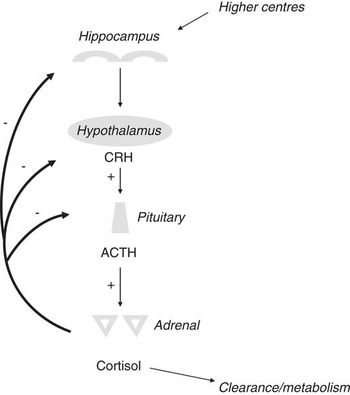
Circulating levels of glucocorticoids are tightly regulated by activity of the HPA axis (Fig. 2). Thus, cortisol exerts negative feedback at the level of the pituitary and hypothalamus to regulate its own secretion. A single fasting measurement of cortisol is an imprecise measurement of HPA axis activity, but it is thought that the combination of fasting and the novel clinic setting in which most of the samples were taken in the studies described above, may act as a form of ‘stress’ test. Interestingly, there is no association of birthweight with cortisol if the measurements are taken in the unstressed state by sampling over 24 h in bloodReference Fall, Dennison and Cooper 31 or saliva.Reference Kajantie, Eriksson and Osmond 32 It has therefore been proposed that low birthweight is associated with enhanced biological responses to stress secondary to central activation of the HPA axis. This is supported by studies in men and women showing increased plasma cortisol responses to synthetic adrenocorticotropic hormone (ACTH)Reference Levitt, Lambert and Woods 33 , Reference Reynolds, Walker and Phillips 34 and increased salivary cortisol responses to stress tests, including the best validated test, the Trier Psychosocial Stress Test.Reference Reynolds, Godfrey, Barker, Osmond and Phillips 35 , Reference Wust, Entringer, Federenko, Schlotz and Hellhammer 36 Alternatively, the association between high fasting cortisol and low birthweight could be explained by impaired central negative feedback sensitivity of the HPA axis. Studies using dexamethasone suppression that tests the GR component of central negative feedback, have suggested there are no differences in central negative feedback sensitivity in association with birthweight.Reference Reynolds, Walker and Phillips 34 However, dexamethasone may not be the best agent to use as this synthetic glucocorticoid does not cross the blood brain barrier well in low doses, and further, may be actively pumped out of the brain by the multi-drug resistant p-glycoprotein.Reference Meijer, de Lange and Breimer 37 Further detailed studies, dissecting different components of central negative feedback including the contribution of both GR and MR, as has been described in obesity,Reference Mattsson, Reynolds, Simonyte, Olsson and Walker 38 are required.
The hypothalamic–pituitary–adrenal axis. Circulating levels of cortisol are released from the adrenal gland under regulation of adrenocorticotrophic hormone (ACTH) released from the pituitary, which is itself regulated by corticotrophin releasing hormone (CRH) from the hypothalamus. Cortisol feedbacks at the level of the pituitary, hypothalamus and hippocampus in a classical negative feedback loop to regulate its own secretion.

Glucocorticoids as mediators of programming
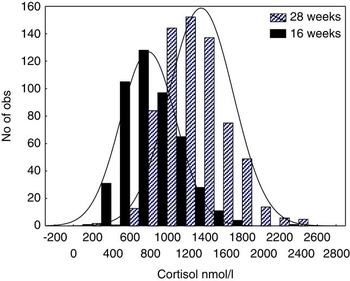
During pregnancy, total cortisol levels rise steadily with values peaking in the third trimester at three times non-pregnant levels.Reference Jung, Ho and Torpy 39 Corticosteroid-binding globulin (CBG) levels rise in parallel with the total cortisol levels under the influence of oestrogen stimulation. There are also progressive rises in 24-h urinary free cortisol and plasma free cortisol, the latter increasing by 1.6-fold by the third trimester, suggesting an upregulation of the maternal HPA axis in addition to the elevated CBG.Reference Jung, Ho and Torpy 39 Despite the increasing circulating levels of cortisol, and large inter-individual variation in circulating levels (Fig. 3), the diurnal pattern of cortisol secretion appears to be maintained.Reference Entringer, Buss and Andersen 40 Physiological responses to stressors during pregnancy, and the cortisol awakening response (a marker of basal HPA activity), are attenuated as pregnancy progresses.Reference Entringer, Buss and Andersen 40 Such variations in ‘intrinsic’ HPA axis activity in addition to variations in the stress responsiveness of the maternal HPA axis are postulated to influence both maternal and foetal physiology. In addition, factors that are recognized to alter circulating glucocorticoid levels in the non-pregnant state including alterations in body composition, maternal diet and maternal ‘stress’ are also likely to be important, and potentially modifiable factors, in pregnancy (Fig. 1).
Changes in circulating morning cortisol levels between the second and third trimester in pregnancy. Figure shows morning cortisol levels measured in 476 women in the early second trimester (solid bars) and 614 women in the early third trimester (hatched bars). Figure demonstrates the overall increase in circulating levels between the second and first trimester (P < 0.05) but also the large inter-individual variation in measurements.

The foetus is protected from high levels of maternal glucocorticoids by the activity of placental 11 β-hydroxysteroid dehydrogenase type 2 (11β-HSD2), which converts active cortisol into inactive cortisone. Deficiencies in this barrier enzyme can lead to overexposure of the developing fetus to glucocorticoids.Reference Seckl 3 Numerous studies in rodents have shown that inhibition of 11β-HSD2 during pregnancy leads to a reduction in birthweight and consequent ‘programmed’ adverse effects for the offspring. Likewise in humans, reductions in placental 11β-HSD2 enzyme activity and rare mutations in the HSD2B2 gene also reduce birthweight (reviewed by SecklReference Seckl 3 ).
Although there is a large amount of evidence from animal models that glucocorticoid excess is a mediator of programming, there are few studies in humans examining the influence of maternal cortisol on birth size. A recent large prospective study of 2810 pregnant women, reported that high maternal cortisol was associated with low birthweight (B = −0.35; P < 0.001) and increased risk of babies being born small for gestational age (OR = 1.00; P = 0.027).Reference Goedhart, Vrijkotte and Roseboom 41 However, this association was only present in participants who provided a blood sample for cortisol measurement before 9 am, suggesting that the timing of the sample is critical. In addition, the findings were statistically insignificant after adjustment for confounders including gestational age at birth, infant gender, ethnicity, maternal age, parity, BMI and smoking. Another small study of 70 pregnant women examined the salivary cortisol awakening response and found that mothers with higher cortisol levels had babies of lower birthweight who were also shorter at birth.Reference Bolten, Wurmser and Buske-Kirschbaum 42 In this study, maternal cortisol levels explained 19.8% of the variance in birthweight and 9% of the variance in body length at birth, even after controlling for gestational age, parity, pre-pregnancy BMI, smoking and infant gender. A further small study included 25 women who collected seven salivary samples per day for measurement of cortisol over a 4-day period. Higher salivary cortisol concentrations at awakening and throughout the day, as well as a flatter cortisol response to awakening, were associated with shorter length of gestation. Women who delivered an infant at 36 weeks of gestation had 13% higher salivary cortisol levels at awakening than women who delivered an infant at 41 weeks of gestation.Reference Entringer, Buss and Andersen 40 Together these studies suggest that high levels of maternal cortisol may be able to overcome the protective 11β-HSD2 barrier and pass across the placenta, slowing foetal growth and/or gestation.
Likewise, although there are many studies in animal models describing the long-term consequences of maternal glucocorticoid excess and offspring cardiometabolic and behavioural outcomes,Reference Seckl 3 the data in humans are scanty. There is supportive evidence of a link between maternal cortisol levels and offspring cortisol levels in very early life. Lower maternal cortisol levels, particularly in the third trimester, in women with post-traumatic stress disorder have been associated with lower cortisol levels in their 1-year-old babies at awakening and bed-time.Reference Yehuda, Engel and Brand 43 Furthermore, increased prenatal cortisol exposure in utero, measured by higher amniotic fluid cortisol levels at 17.2 weeks of gestation, was associated with impaired cognitive development in 125 babies aged 17 months.Reference Bergman, Sarkar and Glover 44 Intriguingly, the 8-year-old children of women who consume large quantities of liquorice, which contains glycyrrhizin, an 11β-HSD inhibitor, have significant decrements in verbal and visuo-spatial abilities and narrative memory, and significant increases in externalizing symptoms, attention, rule breaking and aggression problems with notably a 2.26-fold increase in attention deficit-hyperactivity disorder.Reference Raikkonen, Pesonen and Heinonen 45 As well as potential adverse effects on offspring neurocognitive development, a recent study following up 5-year-old children of 1320 women who had cortisol measurements in pregnancy showed an association of cortisol with offspring adiposity. High maternal cortisol was independently associated with marginally higher fat mass index (FMI) in girls but marginally lower FMI in boys (β 0.09 and β –0.10/100 unit increase in serum cortisol, respectively, P < 0.01).Reference Van Dijk, Van Eijsden and Stronks 46 This finding of an adverse influence in girls, but favourable effect in boys is consistent with other studies showing gender differences in offspring vulnerability.Reference Clifton 47 Further detailed studies of the maternal HPA axis in pregnancy with long-term offspring follow-up for adverse outcomes are needed.
In summary, there is now much evidence from human studies that activation of the HPA axis is associated with increased susceptibility to develop cardiovascular risk factors as well as cognitive decline. There is also substantial evidence from animal studies that glucocorticoid excess is a mediator of programming, and emerging evidence from human studies that the human foetus is also susceptible to excessive glucocorticoids, either through high maternal cortisol levels and/or deficiencies in placental 11β-HSD2. The challenge is still to identify those individuals most at risk. Measurement of cortisol levels in pregnancy may not be practical as ideally plasma samples are needed in the fasting state, or repeated salivary sampling is required. Although birthweight is a crude marker of foetal development, the placenta, is a readily accessible tissue. Increased placental 11β-HSD2 methylation was recently reported to be greatest in infants with lower birthweight and poorer infant quality of movement, a marker of adverse neurobehavioural outcomes.Reference Marsit, Maccani and Padbury 48 Although this finding clearly needs replicating, this observation suggests that it may be possible to use such an approach to identify those who are most susceptible to later life disease.
Acknowledgements
The work for this award was carried out when the author was working in both Southampton at the MRC Unit, and in Edinburgh at the QMRI. The author has been supported by grants from the Wellcome Trust, British Heart Foundation, Sir Jules Thorne Charitable Trust, Medical Research Council, Chief Scientist Office, Scotland and Tommys. She would like to acknowledge her mentors in Southampton (Professors Barker, Phillips and Godfrey) and in Edinburgh (Professors Walker and Seckl) and her colleagues who have assisted with the work at both sites. The author also thanks the men and women who have participated in the studies without whom, none of this work would have been possible.