Introduction
While temperature and moisture content (MC) are the primary factors influencing seed longevity (Ellis and Roberts, Reference Ellis and Roberts1981), the atmosphere surrounding the seeds can also affect storage life. Harrison and McLeish (Reference Harrison and McLeish1954) reported that lettuce (Lactuca sativa L.) seeds sealed in a carbon dioxide atmosphere retained their viability better at room temperature than did similar seeds sealed in air. Lettuce seeds stored at 7% MC [fresh weight (fw) basis] in air, vacuum, carbon dioxide and nitrogen environments showed germination percentages of 1, 91, 93, and 94%, respectively, after 8 years of storage at 10°C (Justice and Bass, Reference Justice and Bass1978). While the presence of O2 can be beneficial to seed longevity at very high seed MC, at which respiration and repair activities can proceed, the presence of O2 is generally detrimental to seed survival at MC typically used in conventional seed storage (Ibrahim and Roberts, Reference Ibrahim and Roberts1983; Ibrahim et al., Reference Ibrahim, Roberts and Murdoch1983). At MC below 10%, lettuce seed longevity approximately doubled in a nitrogen versus an aerobic atmosphere across a range of temperatures (Ibrahim and Roberts, Reference Ibrahim and Roberts1983). On the other hand, Rao and Roberts (Reference Rao and Roberts1990) found relatively little advantage to anaerobic storage of lettuce seeds at 6.1% MC and 50°C. Soybean (Glycine max L.) seeds stored at 25°C and 17 to 20% seed MC under aerobic conditions aged significantly more rapidly than seeds stored anaerobically under the same conditions (Ohlrogge and Kernan, Reference Ohlrogge and Kernan1982). However, O2 had much less effect on longevity when soybean seeds were artificially aged using controlled deterioration (CD) conditions (44°C and 100% RH). Ellis and Hong (Reference Ellis and Hong2007) studied the effect of hermetic or open storage on the sensitivity of timothy (Phleum pratense L.) and sesame (Sesamum indicum L.) seed longevity to MC. They concluded that the deleterious effect of O2 on seed longevity increases as seed MC decreases and confirmed that hermetic packaging is preferable for long-term seed storage.
Hendry (Reference Hendry1993) documented that seeds are subject to O2 injury during storage and hypothesized that O2 plays a central role in seed mortality. Wilson and McDonald (Reference Wilson and McDonald1986) predicted that rates of deterioration would be increased at high O2 levels due to depletion of protective antioxidants. This model may be especially appropriate for oil-storing seeds due to enhancement of lipid peroxidation, which can generate reactive compounds and increase membrane permeability (Bailly, Reference Bailly2004). McDonald (Reference McDonald1999) suggested that eliminating O2 from the seed storage atmosphere might decrease the initiation of free radicals, which should extend seed longevity by reducing lipid peroxidation and generation of additional damaging compounds. In keeping with this, Priestley et al. (Reference Priestley, Werner and Leopold1985) found that ground soybean seeds were more prone to lipid degradation than intact seeds in high O2 atmospheres, and concluded that the intact seeds are protected against atmospheric auto-oxidation due to reduced O2 permeability through the seed coat. However, whether lipid peroxidation is a critical mechanism in seed deterioration is still subject to debate, and different mechanisms may take prominence depending upon the ageing conditions, particularly the seed MC (Lehner et al., Reference Lehner, Mamadou, Poels, Côme, Bailly and Corbineau2008).
Considerable evidence supports the thesis that reactive oxygen species (ROS) play key roles in seed biology and ageing (Bailly, Reference Bailly2004; Bailly et al., Reference Bailly, El-Maarouf-Bouteau and Corbineau2008). Strong negative correlations were found between germination capacity of conventionally aged seeds of beech (Fagus sylvatica L.), soybean and sunflower (Helianthus annuus L.) and content of ROS such as superoxide radicals, hydrogen peroxide and lipid hydroxyperoxides (Kibinza et al., Reference Kibinza, Vinel, Côme, Bailly and Corbineau2006; Pukacka and Ratajczak, Reference Pukacka and Ratajczak2007; Tian et al., Reference Tian, Song and Lei2008). On the other hand, the presence in seed tissues of antioxidants such as tocopherols, ascorbate, glutathione, carotenoids and polyphenols can provide protection against ROS (Sattler et al., Reference Sattler, Gilliland, Magallanes-Lundback, Pollard and DellaPenna2004; Maeda and DellaPenna, Reference Maeda and DellaPenna2007; Pourcel et al., Reference Pourcel, Routaboul, Cheynier, Lepiniec and Debeaujon2007), and a progressive decrease in antioxidant reserves during seed storage parallels the loss of viability (Wilson and McDonald, Reference Wilson and McDonald1986; Galleschi et al., Reference Galleschi, Capocchi, Ghiringhelli and Saviozzi2002; Calucci et al., Reference Calucci, Capocchi, Galleschi, Ghiringhelli, Pinzino, Saviozzi and Zandomeneghi2004). In addition to its role as a phosphorus and mineral cation storage compound, phytic acid has recently been implicated in providing antioxidative protection. Grains of a maize (Zea mays L.) low phytic acid mutant (lpa1-241) showed a lower germination capacity following accelerated ageing and a higher free radical but lower γ-tocopherol content in the embryos relative to the wild type (Doria et al., Reference Doria, Galleschi, Calucci, Pinzino, Pilu, Cassani and Nielsen2009). If ROS and antioxidants are important in advancing or retarding seed ageing, respectively, reduced O2 availability during storage would be expected to extend longevity.
Seed priming (controlled hydration followed by drying) is a technique to improve the germination performance, inducing faster and more uniform germination over broader temperature ranges (Heydecker et al., Reference Heydecker, Higgins and Gulliver1973; Tarquis and Bradford, Reference Tarquis and Bradford1992; McDonald, Reference McDonald, Black and Bewley2000). In lettuce, priming protocols that improved seed germination rates were detrimental to seed longevity under CD conditions, and primed seeds were particularly sensitive to storage at higher MC (Tarquis and Bradford, Reference Tarquis and Bradford1992; Schwember and Bradford, Reference Schwember and Bradford2005; Hill et al., Reference Hill, Cunningham, Bradford and Taylor2007). Short (2 h) hydration/drying treatments prior to storage had little effect on the longevity of lettuce seeds, although humidification or priming after storage could slightly improve viability (Rao et al., Reference Rao, Roberts and Ellis1987). For onion (Allium cepa L.) seeds, priming has been reported to either delay the loss of viability due to ageing (Dearman et al., Reference Dearman, Brocklehurst and Drew1986; Pandey, Reference Pandey1989) or to hasten it relative to non-primed seeds (Drew et al., Reference Drew, Hands and Gray1997). Differences among seed lots in initial quality and specific hydration and drying conditions can influence the effect of priming on longevity (Bruggink et al., Reference Bruggink, Ooms and van der Toorn1999; Powell et al., Reference Powell, Yule, Jing, Groot, Bino and Pritchard2000; Schwember and Bradford, Reference Schwember and Bradford2005). However, little is known about the mechanism by which priming accelerates seed ageing or the effect of O2 on the longevity of primed seeds during storage. It is possible that the priming process makes seed components more susceptible to oxidation or damage due to ROS during subsequent storage, contributing to their more rapid deterioration. If so, then storage of primed seeds under anaerobic conditions might ameliorate the negative effects of priming on seed longevity.
To test this hypothesis, we determined the effects of two ageing conditions in the presence and absence of O2 on control (non-primed) and primed lettuce and onion seeds. We sought to determine whether O2 accelerates the rate of seed deterioration and, if so, whether primed and non-primed seeds respond differently to the presence of O2 during storage under either rapid or slow ageing conditions.
Materials and methods
Seeds and treatments
Lettuce seeds of the cultivar ‘Green Towers’ (lot Q26062) were provided by Harris Moran (Modesto, California, USA). Control seeds and seeds primed using a single protocol (Heydecker et al., Reference Heydecker, Higgins and Gulliver1973; Tarquis and Bradford, Reference Tarquis and Bradford1992) were employed. Seeds (50 g) were osmoprimed in 250 ml of an aerated − 1.25 MPa solution of polyethylene glycol (PEG 8000) for 48 h at 10°C under continuous fluorescent light. Seeds were then rinsed briefly with water and surface water was removed by suction in a Buchner funnel. Subsequently, seeds were rapidly dried for 4 h at 32°C and 25–30% relative humidity (RH) in a ventilated oven, then were transferred to a sealed chamber at room temperature (~25°C) that contained saturated MgCl2 at 33% RH until reaching constant MC at ~6% (fw basis).
Onion (Allium cepa L.) seeds of the cultivar ‘Pandero’ (lot 38 596/10 429) were provided by Nunhems (Haelen, The Netherlands). Seeds were primed commercially by INCOTEC Inc. (Salinas, California, USA) using a proprietary protocol to provide an effective priming treatment.
Controlled deterioration (CD)
Primed and control seeds of both lettuce and onion were placed in separate 12 ml borosilicate vials (Labco Exetainer, High Wycombe, Bucks, UK). These vials were sealed with gas-tight septum caps that allowed gas sampling via a syringe needle at intervals during ageing. Saturated NaCl filled a 0.2-ml polymerase chain reaction (PCR) tube at the bottom of each vial to maintain 75% RH during storage. Vials were flushed with compressed gas containing 21% O2 (air), 2% O2 (O2/N2 mixture), or 0% O2 (N2). After flushing, the levels of O2 were measured in each vial by oxygen chromatography (model S-3A, Applied Electrochemistry Inc., Sunnyvale, California, USA). The seeds were not prehydrated to the higher RH before being placed in the vials to avoid premature ageing before the incubation in the different atmospheres, so water was absorbed by the seeds during the initial stages of the ageing treatments from the saturated salt solution in each vial. The saturated salt solutions also re-established the desired RH within the vials after flushing with the different gases. Subsequently, the vials were transferred to 50°C for different periods depending upon the treatments. At each sampling time, the levels of O2 were quantified again in each vial to confirm that the levels had not changed (data not shown). Finally, standard germination tests were conducted at 20°C in order to assess the percentage of normal seedlings of primed and control seeds of both species. The normal seedling assessments were carried out 5–6 d after planting for lettuce and 10 d after planting for onion, according to the International Seed Testing Association rules (ISTA, 2004). Each germination test was conducted using three replicates of 50 seeds per treatment.
Low RH ageing
The MC of control and primed seeds of lettuce and onion were adjusted by incubation over saturated MgCl2 solution (33% RH) for 4 d at room temperature in a sealed chamber. Subsequently, the seeds were sealed in vials, flushed with one of three different concentrations of O2 (0, 2 and 21%), and the O2 levels were confirmed as described above. The vials were transferred to a controlled-temperature chamber at 37°C and placed inside a RH chamber with saturated MgCl2 solution (33% RH) for different storage periods. In order to maintain constant low O2 levels in the 0 and 2% O2 treatments, the O2 levels of these vials were verified every 3 months and were re-flushed with appropriate gases if needed (data not shown). Other procedures were as described above.
Seed longevity analysis
For the CD and the low RH ageing data, the normal seedling percentages over time were subjected to probit analysis as described by Ellis and Roberts (Reference Ellis and Roberts1981), with the convention that the probit of 50% normal seedlings = 0 (Tarquis and Bradford, Reference Tarquis and Bradford1992). The seed viability equation (Ellis and Roberts, Reference Ellis and Roberts1981) was used to quantify the rate of deterioration as follows:

where v is the probit of percentage normal seedlings after a period p (days) of storage at a given seed moisture content (MC, fw basis) and temperature. K i, the intercept on the probit viability axis prior to storage, is an index of the initial seed quality in probit units. The loss of viability is normally distributed in time (after an initial plateau period of variable length) and can be quantified in terms of σ, the negative inverse of the slope of the probit regression line or the standard deviation of deaths in time (i.e. the time required to lose 1 probit of viability). Differences in ageing rate per se, such as due to differences in MC or temperature, are evident as variation in σ, while differences in the initial seed quality or in the duration of the plateau phase of seed viability are reflected in K i values. This model proposes that as seeds age, the rate of loss of normal seedlings ( − 1/σ) should be constant for a given MC and temperature. For the probit analyses, only data for time points after the initial plateau period when the percentage of normal seedlings was declining were included in the regression analyses (Tarquis and Bradford, Reference Tarquis and Bradford1992). In addition, 100% and 0% of normal seedlings were represented as 99.9 (probit = 3.09) and 0.1% (probit = − 3.09) for the purposes of plotting and fitting the regressions.
Slant board test
Control lettuce seeds stored under low RH conditions at each O2 level were placed on water-saturated blue blotter paper (Anchor Paper Co., St. Paul, Minnesota, USA) on a Plexiglass slant board. The slant board was held at a 10° angle from vertical in a sealed plastic bag at 100% RH and 20°C and exposed to continuous fluorescent light. Five days after planting, the slant board was placed under an inverted flatbed scanner (UMax Data Systems, Inc., Dallas, Texas, USA) and digital images were captured using VistaScan v3.77 software (UMax). Radicle lengths of the seedlings from each O2 ageing treatment were measured using a ruler.
Seed moisture content (MC) determination
Seed moisture contents were measured on control and primed seeds of lettuce and onion at the beginning, during, and at the end of the CD and low RH ageing periods. Three replicates of each treatment were collected at each ageing time, and their MC (fw basis) was determined by oven drying at 130°C for 1.5 h (ISTA, 2004).
Results
Lettuce
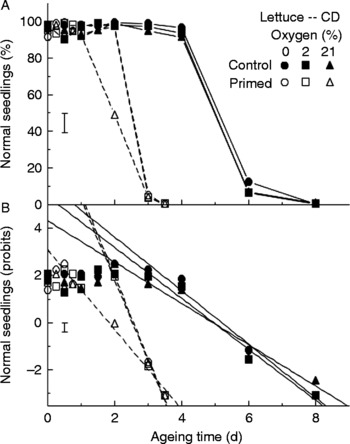
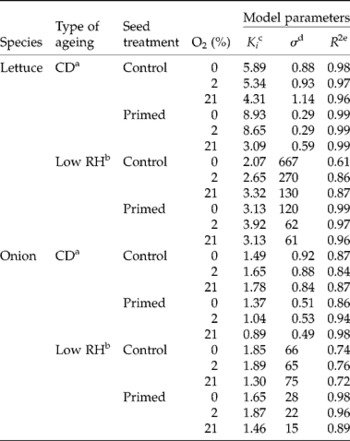
Control lettuce seeds aged in atmospheres containing 0, 2 and 21% O2 did not differ significantly in normal seedling percentages when the seeds were aged under CD conditions (Fig. 1A and B). The seeds aged rapidly under all three O2 conditions, falling from over 90% normal seedlings after 4 d of ageing at 75% RH and 50°C to less than 12% after 6 d of ageing, regardless of the O2 content of the atmosphere in which the seeds were aged. Differences in percentages of normal seedlings were only slightly more evident among the three O2 treatments when the primed lettuce seeds were aged under CD conditions (Fig. 1A and B). Primed seeds aged in the 0 and 2% O2 atmospheres exhibited over 97% normal seedlings after 2 d of ageing, whereas viability was only 49% in the 21% O2 atmosphere. After 3 d of ageing, however, the primed seeds under all three O2 conditions had only ~4% normal seedlings. Priming increased the slopes of the viability loss curves (reduced σ), but except for primed seeds at 21% O2, the differences among O2 atmospheres within either control or primed seeds were small (Fig. 1B; Table 1). Differences in K i between the control and the primed seeds were due to the shorter initial time period before loss of viability began for primed seeds as well as the more rapid rate of viability loss (Fig. 1B; Table 1).
Viability after controlled deterioration of control (closed symbols) and primed (open symbols) lettuce seeds stored at 75% RH and 50°C for up to 8 d. Viability (normal seedlings) is shown on both percentage (A) and probit (B) scales. The vials were flushed with one of three concentrations of O2: 0%, using N2 (circles); 2%, using an O2/N2 gas mixture (squares); or 21%, using ambient air (triangles). Three replications of 50 seeds each per treatment were tested at each time, and the means are presented. Lines in (B) are regressions on data points after the initial lag period before viability begins to fall rapidly. Error bars are not shown for clarity; a pooled error for treatment comparisons is shown in each panel.

Parameters of the probit regressions of lettuce and onion seed viability loss over time under different storage conditions

a CD = 75% RH+50°C.
b Low RH = 33% RH+37°C.
c K i = The intercept on the probit viability axis of the regression line, or an index of the initial seed quality.
d σ = The negative inverse of the slope of the probit regression line, or the days required to lose 1 probit of seed viability.
e R 2 = The coefficient of determination of the probit regression line.
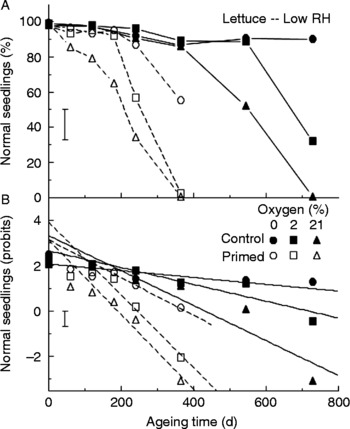
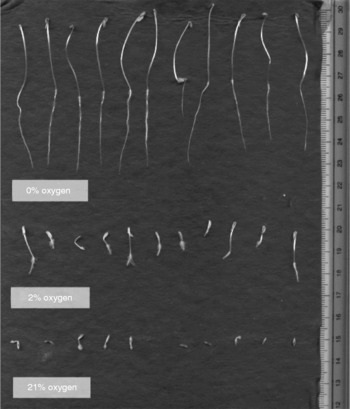
A second ageing condition utilized a lower MC (in 33% RH atmosphere) and a moderately high temperature to accelerate loss of viability (37°C) (Fig. 2). Control lettuce seeds exposed to all three O2 concentrations maintained high percentages of normal seedlings (above 85%) after storage under these conditions for 1 year. Subsequently, the percentage of normal seedlings of control seeds stored in 21% O2 declined to 52% after 1.5 years and to 0% after 2 years (Fig. 2A). In contrast, seeds stored in 2% O2 showed an approximately 6-month delay in the initiation of rapid viability loss, while seeds stored in 0% O2 retained high viability throughout the 2-year storage period (Fig. 2A). These differences in seed quality are evident in a slant board seedling growth test conducted after 2 years of storage. Seeds aged in the 0, 2 and 21% O2 treatments showed average radicle lengths of 5.6, 0.9 and 0.1 cm, respectively (Fig. 3). Similarly, primed lettuce seeds stored in 21% O2 deteriorated most rapidly, followed by seeds in 2% O2, and seeds stored in 0% O2 maintained viability longest (Fig. 2A). For example, the 0, 2 and 21% O2 conditions retained 87, 57 and 34% normal seedlings after 240 days of ageing, respectively. The σ values were smaller (viability loss rates were greater) for the 21 and 2% O2 conditions compared to 0% O2 for both control and primed seeds (Fig. 2B; Table 1). However, insufficient seed samples were available to extend the experiment until viability was completely lost in the primed seeds stored in 0% O2, so this conclusion must be considered to be tentative.
Viability after low RH ageing of control and primed lettuce seeds stored at 33% RH and 37°C for up to 2 years. Viability (normal seedlings) is shown on both percentage (A) and probit (B) scales. Symbols and other conditions are as in Fig. 1.

Slant board seedling growth test of control (non-primed) lettuce seeds stored for 2 years at 33% RH+37°C in atmospheres containing 0, 2 and 21% O2. Germination and seedling growth 5 d after planting are shown.

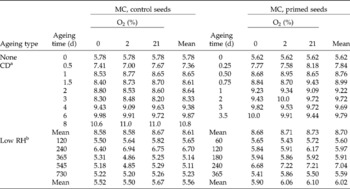
In order to attribute the differences in seed deterioration rates to O2, it is necessary to ensure that seed MC did not vary systematically among the treatments. For example, if seeds exposed to dry nitrogen (0% oxygen) also had lower MC, the interpretation would be confounded. Before ageing, the MC of the control and the primed seeds were similar (5.78 and 5.62%, respectively) (Table 2). During the CD ageing period at 75% RH, the seed MC values increased to 10.8% (control seeds) and 9.79% (primed seeds) as the seeds absorbed moisture during incubation. During the low RH ageing test, the MC of control and primed seeds remained relatively constant around 5.5 to 6%, except for a transient increase in MC apparently occurring after 240 d of storage in both control and primed seeds (Table 2). This transient increase may be due to a systematic error in MC measurement at that sampling time, as the seeds were stored in identical conditions throughout the storage period. However, the MC values were not significantly different among the three O2 treatments (P < 0.25, NS by ANOVA; data not shown), so effects of O2 on seed longevity cannot be attributed to differences in seed MC. Seed MC tended to be slightly higher in primed versus control seeds when stored at the same RH, as has been reported previously for mung bean (Vigna radiata) seeds (Sun et al., Reference Sun, Koh and Ong1997), but differences in MC due to O2 percentages were small (Table 2).
Moisture contents (MC, % fresh weight basis) of control and primed lettuce seeds before and during controlled deterioration (CD) and low RH ageing tests. The seeds were stored in atmospheres containing 0, 2 or 21% O2 over saturated NaCl (75% RH) or MgCl2 (33% RH). MC was calculated based on three replicates for each treatment, and means are shown

a CD = 75% RH+50°C.
b Low RH = 33% RH+37°C.
Onion
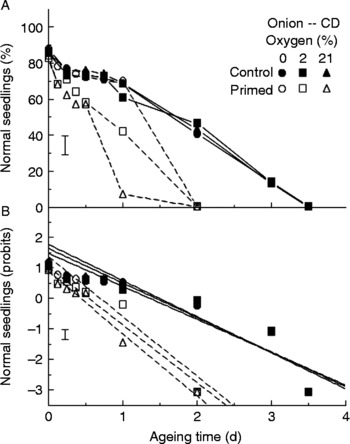
Control and primed onion seeds were also stored under CD conditions in atmospheres containing 0, 2 or 21% O2 (Fig. 4). Unlike lettuce seeds, onion seeds exhibited little or no initial plateau period prior to the initiation of viability loss. The control seeds exhibited indistinguishable patterns of viability loss with respect to the O2 concentration in the storage atmosphere, as all seeds lost viability within 4 d under the CD conditions (Fig. 4A and B; Table 1). However, O2 concentration had a more evident effect on the rates of loss of viability of primed seeds under CD conditions (Fig. 4A). After 1 d of CD, the 0, 2 and 21% O2 ageing treatments exhibited 70, 42 and 7% of normal seedlings, respectively. However, all primed onion seeds had lost viability after 2 d of CD conditions, regardless of the O2 atmosphere during ageing. Priming almost doubled the rate of loss of viability compared to the control seeds, but σ values were similar across O2 concentrations within either control or primed seeds (Fig. 4B; Table 1). Overall, there was a small but positive effect of anaerobic conditions on storage life of primed onion seeds under CD conditions.
Viability after controlled deterioration of control and primed onion seeds stored at 75% RH and 50°C for up to 3.5 d. Viability (normal seedlings) is shown on both percentage (A) and probit (B) scales. Symbols and other conditions are as in Fig. 1.

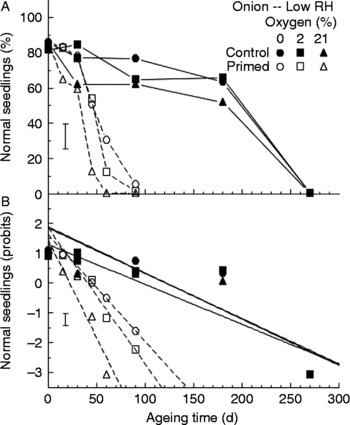
Control onion seeds stored under low RH ageing conditions initially lost ~10 to 20% viability, then maintained relatively constant viability until 6 months (180 d) of storage (Fig. 5A). However, the percentages of normal seedlings dropped sharply after this storage time and no normal seedlings remained after 9 months (270 d) of storage regardless of the O2 atmosphere. Primed onion seeds lost viability much more rapidly than did control seeds, and there was some evidence for an effect of O2 on ageing rates (Fig. 5; Table 1). For example, seeds in the 0 and 2% O2 atmospheres had 50–55% normal seedlings after 45 d at 37°C, whereas in 21% O2 there were only 13% normal seedlings; these differences were reflected in the trend of decreasing σ values as O2 level increased (Table 1).
Viability after low RH ageing of control and primed onion seeds stored at 33% RH and 37°C for up to 9 months. Viability (normal seedlings) is shown on both percentage (A) and probit (B) scales. Symbols and other conditions are as in Fig. 1.

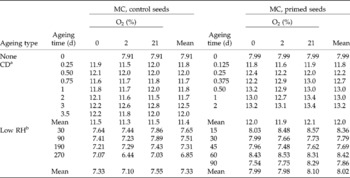
As in the case of lettuce seeds, MC values of control onion seeds were slightly less than those of primed seeds at the same RH, but seed MC for both CD and low RH ageing conditions were independent of the O2 concentration (Table 3; P < 0.32, NS by ANOVA).
Moisture contents (MC, % fresh weight basis) of control and primed onion seeds before and during controlled deterioration (CD) and low RH ageing tests. The seeds were stored in atmospheres containing 0, 2 or 21% O2 over saturated NaCl (75% RH) or MgCl2 (33% RH). MC was calculated based on three replicates for each treatment, and means are shown

a CD = 75% RH+50°C.
b Low RH = 33% RH+37°C.
Discussion
Lettuce seeds have been reported to lose viability in storage in general agreement with the expectations of the seed viability equation (Kraak and Vos, Reference Kraak and Vos1987). For example, Hill et al. (Reference Hill, Cunningham, Bradford and Taylor2007) reported that viability loss rates for control lettuce seeds were similar at 6% MC+48°C and at 9% MC+38°C, as predicted by the seed viability equation. The ageing conditions used here included a common CD condition (75% RH+50°C) and a low RH (33%) and moderately high temperature (37°C) condition. The seed viability equation predicts complete viability loss under these two conditions in 3 or 265 days, respectively (Royal Botanic Gardens, 2008), compared to our results of 6 d and approximately 730 d (Figs 1 and 2). The viability equation as normally applied does not account for an initial period of variable duration during which viability does not decline (Walters et al., Reference Walters, Ballesteros and Vertucci2010), which is often observed with high-quality lettuce seeds (Tarquis and Bradford, Reference Tarquis and Bradford1992; Schwember and Bradford, Reference Schwember and Bradford2005; Hill et al., Reference Hill, Cunningham, Bradford and Taylor2007). Depending upon the source of constants used, the viability equation predicted σ values of ~1 d under CD conditions and 66–114 d under low RH conditions (Royal Botanic Gardens, 2008), similar to our values of 1 and 130 d in 21% O2 (Table 1). Thus, the rates of viability loss for control lettuce seeds observed here were in general agreement with expectations of the seed viability equation, except that the initial lag period before viability loss begins also needs to be taken into account.
Primed lettuce seeds in the current experiments aged approximately twice as fast as control seeds under CD conditions (Fig. 1), which is less than the fivefold difference reported previously under similar conditions (Tarquis and Bradford, Reference Tarquis and Bradford1992; Hill et al., Reference Hill, Cunningham, Bradford and Taylor2007). However, under low RH storage conditions, our results are similar to those of Hill et al. (Reference Hill, Cunningham, Bradford and Taylor2007), with a two- to threefold reduction in longevity compared to non-primed seeds (Fig. 2). Thus, primed lettuce seeds in these experiments did not exhibit greater sensitivity to high MC conditions, as was reported previously (Hill et al., Reference Hill, Cunningham, Bradford and Taylor2007). The relative effect of priming on the loss of lettuce seed viability during storage is apparently dependent on the specific priming and drying treatments utilized, as well as the seed MC during storage (Schwember and Bradford, Reference Schwember and Bradford2005; Hill et al., Reference Hill, Cunningham, Bradford and Taylor2007).
Our results for longevity of control onion seeds were consistent with reported seed viability constants (Ellis et al., Reference Ellis, Hong, Roberts and Tao1990), which predicted 3 d for complete loss of viability under the 75% RH+50°C storage condition and 310 d under the 33% RH+37°C storage condition (Royal Botanic Gardens, 2008), compared to our results of 3.5 d and 270 d, respectively (Figs 4 and 5). Similarly, the σ values predicted 1–2 d or 65–107 d to lose 1 probit of viability under the two conditions, depending upon the source of the constants (Royal Botanic Gardens, 2008), versus our values of < 1 d and 75 d in 21% O2 (Table 1). Reports of the effect of priming on onion seed longevity are inconsistent, with both extended and shortened storage life being observed (Dearman et al., Reference Dearman, Brocklehurst and Drew1986; Pandey, Reference Pandey1989; Drew et al., Reference Drew, Hands and Gray1997). In our experiments, priming reduced the survival period compared to the control seeds under both CD and low RH ageing conditions, but this effect was more pronounced under low RH ageing conditions (Figs 4 and 5). In addition, less vigorous onion seed lots did not respond well to priming treatments in some studies (Caseiro et al., Reference Caseiro, Bennett and Marcos2004), while other studies found the opposite results (Drew et al., Reference Drew, Hands and Gray1997). Priming has been proposed as a method for salvaging onion seed lots with unacceptable percentages of abnormal seedlings (Tajbakhsh et al., Reference Tajbakhsh, Brown, Gracie, Spurr, Donovan and Clark2004). These conflicting results suggest that the priming conditions and the initial quality of the seed lot may influence the success of priming in enhancing onion seed germination and the consequent effects on longevity.
Potential interactions between the effects of seed priming and O2 availability during storage on seed longevity have not, to our knowledge, been reported. There was no significant effect of O2 on the rate of loss of viability of control seeds of lettuce and onion when they were stored under CD conditions (Figs 1 and 4). However, when primed lettuce and onion seeds were stored under CD conditions, the loss of viability was more rapid in the aerobic condition (21% O2) than in the low O2 conditions (0 or 2% O2) (Figs 1 and 4). Although primed seeds lost viability rapidly under CD conditions, there was a consistent trend in both species for longevity to be improved under anaerobic storage.
Both control and primed lettuce seeds stored under low RH ageing conditions lost viability more rapidly in 21% O2 relative to 2% or particularly 0% O2 during 2 years of storage (Figs 2 and 3). Onion seeds, on the other hand, showed less sensitivity to O2 partial pressure during low RH storage, although 21% O2 somewhat accelerated loss of viability in primed seeds (Fig. 5). Thus, our data for control and primed seeds of lettuce and primed seeds of onion (Figs 1, 2, 4 and 5) support the results of previous studies on non-primed seeds of lettuce, soybean, timothy and sesame (Justice and Bass, Reference Justice and Bass1978; Ohlrogge and Kernan, Reference Ohlrogge and Kernan1982; Ibrahim and Roberts, Reference Ibrahim and Roberts1983; Ellis and Hong, Reference Ellis and Hong2007), which showed that seeds aged significantly more rapidly under aerobic conditions than under anaerobic conditions.
It is possible that higher levels of O2 led to lipid peroxidation and/or exhaustion of antioxidants, which resulted in more rapid seed deterioration (McDonald, Reference McDonald1999; Bailly, Reference Bailly2004; Doria et al., Reference Doria, Galleschi, Calucci, Pinzino, Pilu, Cassani and Nielsen2009). Both lettuce and onion seeds have relatively poor shelf life (Walters et al., Reference Walters, Wheeler and Grotenhuis2005), and both have relatively high oil content, with lettuce seeds having twice the oil content (38%) compared to onion seeds (19%) (Royal Botanic Gardens, 2008). While high seed oil content has often been associated with poor longevity in storage, large-scale surveys across species did not support this as a causal relationship (Walters et al., Reference Walters, Wheeler and Grotenhuis2005). In onion seeds, peroxidation of free fatty acids hydrolysed from reserves was calculated to be substantial during ageing, and hydrolytic enzymes such as phospholipase D and lipoxygenase were active when extracted from ageing seeds, while peroxidase, catalase and superoxide dismutase activities declined during ageing (Salama and Pearce, Reference Salama and Pearce1993; Rao et al., Reference Rao, Singh and Rai2006). In sunflower seeds, which have an oil content and seed morphology similar to lettuce, lipid peroxidation was associated with ageing at high MC but not at low MC (Kibinza et al., Reference Kibinza, Vinel, Côme, Bailly and Corbineau2006). Regardless of the mechanism of ageing, the longevity of control and primed lettuce seeds and primed onion seeds can be extended by storage in an anaerobic atmosphere. Oxygen was relatively more deleterious at lower than at higher moisture contents, as has been observed by others (Ibrahim and Roberts, Reference Ibrahim and Roberts1983; Rao and Roberts, Reference Rao and Roberts1990; Ellis and Hong, Reference Ellis and Hong2007). The maximum MC in our studies was less than 15%, the point above which O2 became advantageous for storage of lettuce seeds (Ibrahim and Roberts, Reference Ibrahim and Roberts1983).
It is still unclear whether the molecular mechanisms of seed deterioration are similar across broad ranges of temperature and MC (Walters, Reference Walters1998; Black et al., Reference Black, Bewley and Halmer2006) and how O2 availability may affect these ageing processes. Low RH and CD ageing results were poorly correlated for lettuce seeds of a recombinant inbred line population, and the CD test did not predict the deterioration that occurred under more moderate RH and temperature storage conditions (Schwember and Bradford, Reference Schwember and Bradford2010). This suggests that lettuce seeds age differently depending upon the environmental conditions in which they are stored, and that different ageing mechanisms may occur at different seed MC (Walters, Reference Walters1998; McDonald, Reference McDonald1999). Salama and Pearce (Reference Salama and Pearce1993) reported that phospholipid content declined during onion seed ageing at both 15 and 74% RH (5 and 14% MC, respectively). However, the loss of phospholipids occurred well before the loss of viability in seeds stored at low MC. Further work is required to elucidate the specific role of O2 and how it affects the deterioration of seeds exposed to both types of ageing.
In summary, the longevity of both control and primed lettuce seeds can be extended by storage in anaerobic environments at low MC, while only primed onion seeds benefited from anaerobic storage. However, primed seeds of both species aged more rapidly than control seeds even in anaerobic atmospheres, suggesting that the mechanisms involved in the deterioration of primed seeds are not strictly dependent upon the presence of O2. Distinct mechanisms may be responsible for deterioration of control and primed seeds, or primed seeds may be more susceptible to the same ageing mechanisms. Different mechanisms may also be involved in ageing at different moisture levels, as O2 was more harmful to seeds at lower MC. Alternatively, O2 may be detrimental at all MCs, but ageing proceeds so rapidly at high MC that the additional effect of O2 is not significant. Low MC and low temperature are the major factors that can extend the longevity of both control and primed seeds, with O2 availability being a third, but relatively less important, factor in ageing rates. However, storing high-value primed seeds of some species in anaerobic conditions may be a useful practice for extending their longevity.
Acknowledgements
This work was supported by the Western Regional Seed Physiology Research Group. Charlotte Mesre contributed to developing the anaerobic ageing assay and Anthony Joudi assisted with the germination tests.