Over the past decade we witnessed the emergence and spread of carbapenem-resistant Enterobacteriaceae (CRE), mainly Klebsiella pneumoniae. Reference Bratu, Landman and Haag 1 – Reference Leavitt, Navon-Venezia, Chmelnitsky, Schwaber and Carmeli 7 Identification and isolation of carriers are the main components of an effective infection control strategy in healthcare facilities.Reference Ben-David, Maor and Keller 8 Strict contact isolation precautions, cohorting of CRE carriers, and dedicated personnel are key control measures.Reference Schwaber, Lev and Israeli 9 However, the natural history of CRE carriage after acquisition, the necessary duration of contact isolation of known CRE carriers, and the conditions in which freedom from carriage can be presumed are unknown. Over time, the pool of CRE carriers is getting larger and the amount of resources that these patients require continues to grow. To prevent transmission on the one hand and to optimize the distribution of resources on the other hand, it is important to identify continued carriage with precision.
The aim of this study was to define predictors for recurrent CRE carriage after presumed eradication of CRE, in the attempt to define a better protocol for removing CRE-positive patients from contact isolation.
METHODS
Study Setting, Patient Population, and Definitions
The study was conducted at Rambam Health Care Campus, a 940-bed tertiary care teaching hospital in Haifa, Israel, from January 1, 2008, through August 1, 2014. We designed a case-control study including all CRE carriers in whom CRE carriage was presumably eradicated. Eligible patients were prospectively recorded by the infection control team. The case group consisted of patients with recurrence of CRE carriage and the control group consisted of patients without recurrence. Recurrence of CRE carriage was identified through clinical samples and repeated rectal screening in subsequent admissions to all healthcare facilities in Israel (acute and chronic), through mandatory reporting to the Israeli National Committee of Infection Control. Recurrence could represent failure of eradication (persistence) or re-acquisition. The duration of follow-up was defined as 1 year for all surviving control patients and until recurrence of CRE for case patients. We excluded patients who died in the first 2 days of follow-up. Patients not presenting to healthcare facilities after presumed eradication were included in the control group. We conducted sensitivity analyses including only cases having the same CRE isolate as the initial isolate (presumed persistence) and only controls for whom repeat screening during follow-up was available; and a sensitivity analysis including only K. pneumoniae as the initial and recurrent CRE isolate.
Lacking international or national guidelines, our internal protocol for presuming eradication developed through the study period according to accumulating experience.Reference Zimmerman, Assous, Bdolah-Abram, Lachish, Yinnon and Wiener-Well 10 , Reference Schechner, Kotlovsky and Tarabeia 11 The protocol always mandated 2 negative rectal samples for culture collected on different days after a period of a few months from the last CRE isolation. Culture from the original source of CRE isolation (eg, urine, sputum, wounds) had to be negative if still relevant. As of mid-2009, an additional negative sample for polymerase chain reaction testing of bla KPC was required with a recommendation to wait at least 1 year from the last CRE isolation.
Data Collection
Data were extracted from outpatients’ medical records and from the hospital’s electronic patient file. Baseline variables included demographic characteristics, comorbidities, CRE source and type, functional status, and habitat at time of CRE acquisition. Functional status was classified by the nursing staff prospectively to independent, dependent, or bedridden on admission. Variables collected at the time of presumed eradication and during follow-up included habitat, functional status, hospitalizations, exposure to antibiotics, invasive devices or foreign bodies, and invasive procedures. We recorded the source and type of recurrent CRE for cases.
Statistical Analysis
Univariate analysis of potential risk factors for CRE recurrence was performed using the χ2 or Fisher exact test for categorical variables and the t test (mean [SD]) or Mann-Whitney test (median [interquartile range {IQR}]) for continuous variables. Significant variables (P<.05) associated with CRE recurrence were entered into a logistic regression analysis. We removed clinically and statistically correlated variables. Odds ratios and 95% CIs are reported. Goodness of fit of the models was assessed using the Hosmer-Lemeshow statistic and predictive ability was assessed by receiver operating characteristic curves. We computed the sensitivity and specificity of a predictive score for recurrence, where true-positives were patients with at least 1 of the risk factors and CRE recurrence; true-negatives were those with no risk factor and no recurrence; false-positives were those with at least 1 risk factor and no recurrence; and false-negatives were those with no risk factor and with recurrence.
RESULTS
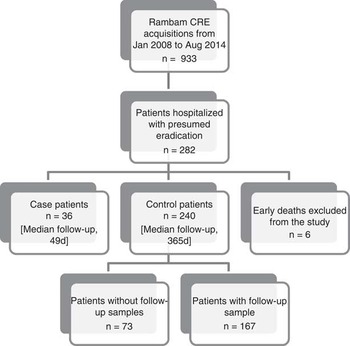
A total of 282 eligible past CRE carriers with presumed eradication were identified (Figure 1). Six patients who died in the first 2 days of follow-up were excluded. Thus, we included 276 past CRE carriers, of whom 36 cases (13%) had recurrent CRE carriage. The screening procedure to declare presumed eradication was performed at a median (IQR) of 11.9 (7.7–19.3) months after the last positive CRE culture. The median (IQR) time to CRE recurrence was 49 (16–130) days. The same CRE recurred in 30 of 36 case patients. Recurrent CRE was isolated in screening samples only in 21 patients (58%); it was isolated in urine in 11 (31%) and in other clinical samples in 4 (11%). The median (IQR) duration of follow-up among controls was 365 (345–365) days. In the year after presumed eradication 64 of the 240 controls died.
Patient flow in case-control study of risk factors for recurrence of carbapenem-resistant Enterobacteriaceae (CRE) carriage.

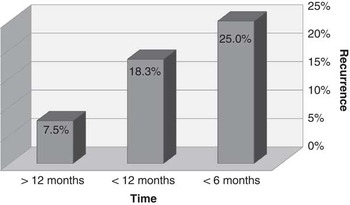
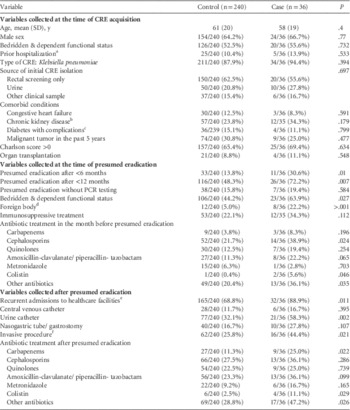
The mean (SD) age of cases and controls was 61 (20) and 58 (19) years, respectively, with two-thirds males in both groups. No significant differences between cases and controls were observed regarding background conditions (Table 1). K. pneumoniae was the most common CRE in both groups. Significant differences between patient groups were observed for several variables collected at the time of presumed eradication (Table 1). Time to presumed eradication was inversely associated with recurrence; the median (IQR) time between last positive CRE isolation and presumed eradication was 9.5 (4.8–12.3) months among case patients versus 12.3 (8.0–19.6) months among controls (P=.005). Recurrence occurred in 11 (25%) of 44 patients for whom presumed eradication was declared less than 6 months after the last positive isolate, 26 (18%) of 142 with a declaration in less than 1 year, and 10 (7.5%) of 134 with a declaration after 1 year (Figure 2). Declaring presumed eradication without polymerase chain reaction testing was not associated with CRE recurrence. Case patients had significantly more foreign bodies at the time of presumed eradication; CRE recurrence was recorded in 8 (40%) of 20 patients with foreign bodies, including artificial joints and other orthopedic devices, pacemakers, prosthetic valves, and ventriculo-peritoneal shunts. Significantly more patients with eventual recurrence were dependent on assistance at the time of presumed eradication. Use of all antibiotics was more common among case patients, except for metronidazole, reaching statistical significance for some of the classes.
Recurrence of carbapenem-resistant Enterobacteriaceae (CRE) carriage (%) as a function of presumed eradication timing (months).

Variables Potentially Associated With Carbapenem-Resistant Enterobacteriaceae (CRE) Recurrence

NOTE. Data are number (percent) unless otherwise indicated. PCR, polymerase chain reaction.
a Discharge from a medical facility, including long-term care facilities, during the 90 days before CRE acquisition.
b Chronic kidney disease was defined as creatinine levels >2 for a lengthy period or as receiving dialysis treatment.
c Complications of diabetes were defined as neuropathy or nephropathy.
d Foreign bodies included artificial joints and other orthopedic devices, pacemakers, prosthetic valves, and ventriculo-peritoneal shunts.
e Includes admissions to acute care hospitals, rehabilitation centers, and long-term care facilities. Each type of healthcare facility alone was not statistically significant.
f Invasive procedure was defined as surgery, endoscopy, or angiography.
During follow-up, recurrent admissions to healthcare facilities were more common in the case group (32/36 [89%] vs 165/240 [69%]; P=.011). Case patients had significantly more frequently a urine catheter or had undergone an invasive procedure in this period. Case patients were more often exposed to antimicrobial treatment, especially to carbapenems (9/36 [25%] vs 27/240 [11%]; P=.022), colistin, and other antimicrobials.
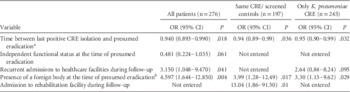
On multivariable analysis, the time between the last positive CRE isolation and presumed eradication, recurrent hospitalization, and the presence of a foreign body at the time of presumed eradication remained significantly associated with CRE recurrence (Table 2). The highest odds ratio was observed for a foreign body. The model fit was adequate (Hosmer-Lemeshow P=.91) and the area under the receiver operating characteristic curve was 0.75 (95% CI, 0.64–0.81). In separate models retaining the significant variables, carbapenem exposure (odds ratio, 1.6 [95% CI, 0.65–3.95]), the presence of a urinary catheter (2.01 [0.91–4.46]), and invasive procedures during follow-up (1.86 [0.86–4.02]) were not significant independent predictors of recurrence.
Multivariable Analysis of Risk Factors for Carbapenem-Resistant Enterobacteriaceae (CRE) Recurrence

NOTE. K. pneumonia, Klebsiella pneumoniae; OR, odds ratio.
a OR per 1-month lag between last positive CRE and the procedure defining presumed eradication.
b Foreign bodies included artificial joints and other orthopedic devices, pacemakers, prosthetic valves, and ventriculo-peritoneal shunts.
On sensitivity analysis including cases with same CRE recurrence (n=30) and only screened controls (n=167), on univariate analysis exposure to specific antibiotic classes, admission to a rehabilitation facility during follow-up, foreign bodies, and the time until presumed eradication were the only significant variables and the last 3 were independently significant (Table 2). Restricting the analysis to K. pneumoniae as the initial and recurrent CRE showed similar results (Table 2).
Because re-admissions are not known at the time of presumed eradication, we computed sensitivity and specificity of a simple 2-variable score for CRE recurrence that can be used to triage patients at the time of eradication evaluation. For patients without a foreign body and at least 1 year after the last positive CRE sample at the time of presumed eradication, the rate of recurrence was 5.6% (7/126), whereas for all others it was 19.3% (29/150). The sensitivity of this score was 80.6% whereas specificity was low at 49.6%.
DISCUSSION
In a cohort of patients with presumed eradication of CRE following repeat negative CRE screens, the rate of CRE recurrence was 13% (36/276). A multivariable analysis demonstrated 3 distinct variables that were significantly associated with CRE recurrence: a shorter time between last positive CRE isolation and presumed eradication, re-admissions to healthcare facilities during follow-up, and the presence of foreign bodies. A 2-point score using variables available at the time of presumed eradication had good sensitivity (80.6%) but poor specificity.
We are not aware of previous studies examining risk factors of CRE recurrence. In a retrospective case-control study, predictors of CRE persistence on subsequent hospitalizations were evaluated.Reference Schechner, Kotlovsky and Tarabeia 11 Sixty-six CRE carriers were included and 23 had persistence. Prior use of antimicrobials (especially fluoroquinolones), subsequent admission to an institution or another hospital, and a time interval less than or equal to 3 months since the first positive CRE test were significantly associated with CRE carriage on the subsequent admission. Another study evaluating the duration of carriage found a mean time to CRE negativity of 387 (95% CI, 312–463) days among 97 CRE carriers, with 39% (12/30) persisters at 1 year.Reference Zimmerman, Assous, Bdolah-Abram, Lachish, Yinnon and Wiener-Well 10 Repeat hospitalizations and clinical cultures as opposed to surveillance CRE cultures were significantly associated with prolonged carriage. The risk factors for CRE recurrence identified in our study were similar to some of these, although the CRE source was not significant, whereas performance of invasive procedures and foreign bodies were.
Many of the variables associated with CRE recurrence in our cohort are biologically plausible. A high percentage of recurrence was documented among patients with recurrent admissions to healthcare facilities. This finding might result from additional CRE acquisitions or intense exposure to antibiotics and indwelling catheters. Exposure to antibiotics at the time of presumed eradication and afterwards was associated with recurrence. The types of antibiotics more likely to induce and maintain CRE colonization are of particular interest to antibiotic stewardship programs in hospitals. According to previous studies, fluoroquinolones were the most prominent culprits, although carbapenems and antipseudomonal penicillins were also pegged as risk factors.Reference Hussein, Sprecher, Mashiach, Oren, Kassis and Finkelstein 5 , Reference Schechner, Kotlovsky and Tarabeia 11 – Reference Falagas, Rafailidis and Kofteridis 13 Our study suggests that exposure to carbapenems, cephalosporins, or colistin might serve as a risk factor for CRE maintenance. Fluoroquinolones did not emerge as significant predictors. Colistin treatment as risk factor seems counterintuitive but probably marks the more highly healthcare-exposed patients.
Our study has several limitations. We could not differentiate between true persistence and re-acquisitions. For epidemiologic purposes, both are important. Whole-gene sequencing is necessary to evaluate whether the repeated cultures are the original strain or a newly acquired strain and were not performed. The follow-up period of the case patients was shorter than that of the control group, which limited their chances of accumulating statistically significant risk factors (eg, hospital admissions, exposure to antibiotics) and 30% of the controls had no follow-up microbiological sample to officially preclude recurrence. We believe that considering these patients as controls is valid because none were hospitalized, thus the risk for recurrence is low and in any case of little epidemiologic consequence. Sensitivity analyses showed similar results when we excluded re-acquisitions and nonscreened controls. The small sample size (36 patients with CRE recurrence) might have prevented identification of other predictors for CRE recurrence. However, this is a common problem in studies dealing with multidrug-resistant microorganisms.Reference Falagas and Kopterides 14 The study represents a selection of patients of a single tertiary care hospital, and the results may not be generalizable to other settings with different occurrence of CRE. Finally, although the factors singled out that are evaluable at the time of assessment for eradication provided a relatively sensitive method for identifying patients who are likely to recur, the model has insufficient specificity. A strength of our study is that data on presumed eradication and CRE recurrence were prospectively collected and a large set of variables was included.
Drawing from our study, some suggestions for assessment of patients for CRE eradication can be derived because we showed a significant rate of CRE recurrence after presumed eradication (13%). A more selective approach for screening is needed. We suggest that the CRE-carrier status be maintained for at least a year following the last known positive CRE sample, especially for patients with foreign bodies. Given the high rate of recurrence, it would be wise to screen upon re-admission all patients following presumed eradication. Further studies should examine whether a period of 1 year or longer is needed prior to screening for CRE eradication and more precisely which antibiotics should be avoided.
ACKNOWLEDGMENTS
This study was performed in partial fulfillment of the MD thesis requirements (Y.B.) of the Bruce Rappaport Faculty of Medicine, Technion–Israel Institute of Technology, Haifa, Israel.
Financial support. None reported.
Potential conflicts of interest. All authors report no conflicts of interest relevant to this article.