

Introduction
Since the Progressives advocated the use of direct democracy to circumvent the power of economic elites (Hill & Klarner, Reference Hill and Klarner2002), activists have employed citizen-initiated legislation to secure voter approval through referenda. But research on the geographical spread of policies adopted through direct democracy is nearly completely absent from the scholarship on policy diffusion. This Research Note employs a case study of state legalization of marijuana for medical purposes to demonstrate the impact of employing the citizen initiative and referendum (hereafter referred to as I&R) on policy adoption. To properly specify a model based on I&R adoptions, we must address two research questions: First, how is policy diffusion using I&R different from ordinary legislative adoptions? Second, how does direct democracy overcome elite opposition to policy adoption?
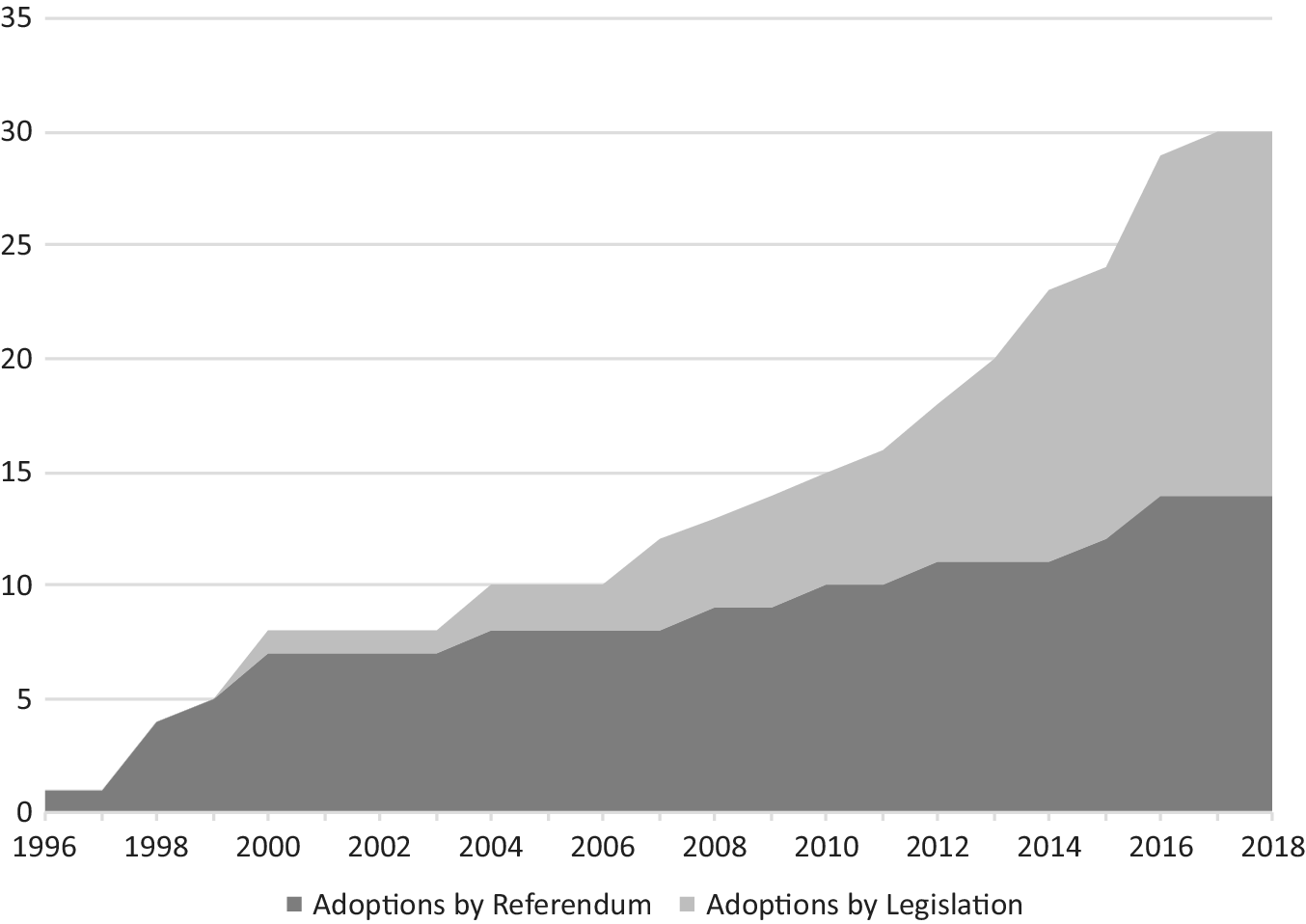
At the start of 2018, 30 states had legalized possession of marijuana for medical purposes, of which 14 did so through citizen-initiated referenda. For many decades, marijuana as “killer weed” was characterized by a long-standing hegemonic consensus about the dangers of illicit drug use, and the policy response was a “war on drugs” that relied on law enforcement, legal deterrence, and criminal sanctions at the federal and state levels (Meier, Reference Meier1994; Timberlake et al., Reference Timberlake, Lock and Rasinski2003). Ferraiolo (Reference Ferraiolo2007) argued that a two-pronged strategy was instrumental to breaking the stranglehold of that coercive marijuana regulatory regime: “Without the twin decisions to abandon representative institutions in favor of direct democracy, and to use the initiative process to tap into public sentiments in favor of patient rights and medical autonomy, the medical marijuana movement would have continued to languish in unsympathetic federal institutions and agencies” (p. 151).
Literature review: Direct democracy and policy diffusion
There is much scholarship on initiatives and referenda, but most studies focus on two broad areas of research. One stream addresses whether direct democracy generates higher voter awareness, competence (Nicholson, Reference Nicholson2003), and turnout for ballot propositions, as well as the vote for candidates being elected on the same ballot (Biggers, Reference Biggers2011; Tolbert et al., Reference Tolbert, Bowen and Donovan2009). The other stream addresses two primary questions (Matsusaka, Reference Matsusaka2018): First, do states with initiatives and referenda have different policy outputs—for example, on taxes and spending—compared with states without direct democracy? A variant of this research asks whether initiatives and referenda are employed to enact anti-minority policies, unlike enactments in states that rely solely on institutions of representative government (Gamble, Reference Gamble1997; Lewis, Reference Lewis2013). Second, do public policies that result from initiatives and referenda correspond more with majority opinion compared with those enacted in states without direct democracy? However, no previous study of plebiscitary democracy has related it directly to the diffusion of policy innovations.
Nor has this research question been considered in the larger body of research on policy diffusion (Graham et al., Reference Graham, Shipan and Volden2012; Karch, Reference Karch2007; Shipan & Volden; Reference Shipan and Volden2012). Overviews of the policy diffusion scholarship rarely, if ever, make any mention of a role for direct democracy (Dolowitz & Marsh, Reference Dolowitz and Marsh1996; Graham et al., Reference Graham, Shipan and Volden2012; Karch, Reference Karch2007). One extensive literature review identified six actors that facilitate policy transfer among governments (Dolowitz & Marsh, Reference Dolowitz and Marsh1996, p. 345): elected officials, political parties, bureaucrats/civil servants, pressure groups, policy entrepreneurs/experts (see also Mintrom, Reference Mintrom1997), and supranational institutions. The primary focus of diffusion research, therefore, has been the institutional policymakers in government. As Pacheco (Reference Pacheco2012) rightly concluded, conventional policy diffusion models “focus largely on the decision making of state officials” (p. 187), not public opinion.
Yet 23 state constitutionsFootnote 1 allow statutes or constitutional amendments to be initiated through voter petitions, and 14 of the 30 states with medical marijuana laws did so through popularly initiated referenda. Apart from the direct use of referenda to bypass the state legislature, moreover, there is evidence of indirect effects: the mere existence of popular initiative in a state may prompt legislators to act in order to preempt the prospect of direct democracy (Arceneaux, Reference Arceneaux2002; Gerber, Reference Gerber1996). This scenario occurred in Ohio. In 2016, Ohio legislators enacted a medicalized marijuana law after a citizen petition was initiated. The drive was organized by Ohioans for Medical Marijuana with backing from the Marijuana Policy Project. Once legislation was signed into law in June 2016 by Republican governor John Kasich, the petition drive was suspended.
In their study of medical marijuana policy diffusion, Hannah and Mallinson (Reference Hannah and Mallinson2018) included “initiative availability” as a dummy variable in their event history analysis to measure “states’ institutional capacity” insofar as “[t]he ability to use the direct initiative should increase the likelihood of a state passing a law” (p. 414). However, presumably the presence of direct democracy would facilitate policy adoption by legislative enactment, because Hannah and Mallinson do not operationalize the direct enactment of medicalized marijuana by citizen I&R. In other words, its positive statistical effect in their model is simply more evidence of an indirect effect of direct democracy on policy adoption by legislative enactment.
As originally formulated (Berry & Berry, Reference Berry and Berry1990, p. 400; see also Berry & Berry, Reference Berry, Berry, Sabatier and Weible2014), their theoretical framework posited the need to include variables that operationalize the “motivations” of political decision-makers to innovate, the “resources” that facilitate policy adoption, and the “obstacles” that sought to block those enactments.
For our purposes, the most important “resource” favoring policy adoption (Berry & Berry Reference Berry and Berry1990, p. 403) would be the positive experiences of other states, which are manifested as the direct effects of horizontal diffusion. As to why states would be influenced by the policy adoptions of other states, there are three prominent explanations in the policy diffusion literature (Karch, Reference Karch2007): emulation, competition, and imitation. Emulation means that policies diffuse because officials view a successful adoption elsewhere and want to copy it. Competition occurs when officials fear that failing to adopt a policy will put their state at a competitive disadvantage with other states. Imitation fuels policy diffusion because officials “believe that they share a policy-relevant characteristic with a jurisdiction that has already enacted it and, therefore, believe that they ought to enact it also” (Karch, Reference Karch2007, p. 59).
Most often, previous adoption by “neighboring” states is included (Mooney, Reference Mooney2001), but limiting the states to only those with a common border would necessitate omitting Alaska and Hawaii from this analysis (see Berry & Berry, Reference Berry and Berry1990). A more relevant consideration is that states with I&R are clustered across the Inter-Mountain and Far West, with none in the South or in the Northeast and Midwest corridors. The use of U.S. Census Bureau regions would include all I&R states in the same geographical area. The regional spread of a larger number of states also raises “the possibility of imitation based on similarities not necessarily found in the most proximate, neighboring states” (Karch, Reference Karch2007, p. 60). Partisan and ideological similarities would be examples (Grossback al., Reference Grossback, Nicholson-Crotty and Peterson2004; Volden, Reference Volden2006), but extending that analogy would suggest that activists in states with direct democracy would be encouraged to imitate policies adopted by activists in other states who employed direct democracy.
A clue to the importance of I&R diffusion through imitation is provided by Figure 1, which shows the cumulative frequency of adoptions of (1) all 30 medical marijuana laws, (2) the 14 medical marijuana laws adopted through referenda, and (3) 16 adoptions that occurred through statutory enactments. Figure 1 does not remotely resemble the conventional S-curve pattern for policy diffusion across states (Berry & Berry, Reference Berry, Berry, Sabatier and Weible2014, p. 315). In fact, the flattest pattern for referendum adoptions of medical marijuana laws is highly suggestive that factors intimately related to direct democracy had unique effects on the overall pattern of policy diffusion. For our purposes, most revealing about Figure 1 is that adoption of medical marijuana through citizen initiatives and referenda began much earlier than statutory adoptions, so we anticipate that previous episodes of adoption by direct democracy should precipitate later adoptions by that method and perhaps have an indirect effect on future statutory adoptions as well. Therefore, Hypothesis 1 posits that medicalized marijuana will be more rapidly diffused when previous states with direct democracy adopted this legislation compared with adoptions by legislation.
Cumulative distribution of adoption of medical marijuana.

Berry and Berry (Reference Berry and Berry1990) also categorized unified party rule as a “resource” that facilitates policy diffusion, whereas divided-party government, they argued, would frustrate adoptions (p. 403). But the use of direct democracy instead of legislative enactment for policy adoptions begs the question of why marijuana activists might bypass the formal institutions of government. What aspect of the political opportunity structure would block legislative enactments? A partisan caveat must be added to Berry and Berry’s (Reference Berry and Berry1990) original formulation because research on other morality policies, notably abortion and gay rights, found that Democrats were more supportive than Republicans (Fleischmann & Moyer, Reference Fleischmann and Moyer2009; Rhodebeck, Reference Rhodebeck2015; Roh & Berry, Reference Roh and Berry2008; Roh & Haider-Markel, Reference Roh and Haider-Markel2003). Partisan bias may be less obvious with drug policy, but Meier (Reference Meier1992) also assumed that Democrats were less punitive than Republicans in their approach to the drug problem, though at that time party proved to have “little impact” on the pattern of marijuana laws (pp. 43, 53). The “war on drugs” was inaugurated by President Richard Nixon and reignited under the Ronald Reagan administration, though Democratic president Bill Clinton also waged a campaign against drugs (Ferraiolo, Reference Ferraiolo2007, pp. 161, 163; McWilliams, Reference McWilliams1991; Sharpe, Reference Sharpe1992). Thus, Hypothesis 2 posits that medicalized marijuana legislation is less likely to be adopted by legislative enactment in states during periods of unified Republican or divided-party rule. However, a corollary, as Hypothesis 2a posits, is that medicalized marijuana legislation is more likely to be adopted through citizen-initiated referenda in states during periods of unified Republican or divided-party rule. Footnote 2
More importantly, an essential variable that is missing from Hannah and Mallison’s (2018) study is that they did not specify how direct democracy would overcome a specific political obstacle to legislative adoption. It was for that reason that an “interaction” term is needed similar to what was employed by Schildkraut (Reference Schildkraut2001) to explain why states with larger populations of foreign born (whose opposition would pose an electoral threat to state legislative enactments) were nonetheless able to enact official English laws through citizen-initiated referenda (p. 448). Similarly, in our analysis, to more precisely specify the political conditions that would prompt the use of direct democracy to adopt medicalized marijuana, we need to include an interaction term between Republican rule or divided government (meaning partial Republican control) and the availability of citizen-initiated referenda.
Because Hypotheses 1 and 2 are the primary drivers of this analysis, six other “control” variables are included, though we do not hypothesize about their probable impact on adoption. Medicalized marijuana adoptions hold the potential for “vertical” diffusion effects given that state laws legalizing marijuana use are constitutionally suspect. Marijuana is classified as a Schedule I drug, like heroin and cocaine, under the Controlled Substances Act (CSA) of 1970, and the U.S. Supreme Court twice upheld federal authority to enforce the CSA in states with conflicting drug laws, in United States v. Oakland Cannabis Buyers’ Cooperative (2001) and Gonzales v. Raich (Reference Raich2005). To resolve this legal thicket, the Barack Obama administration announced in October 2009 that the U.S. government would not prosecute in states with medical marijuana laws (Stout & Moore, Reference Stout and Moore2009), and in August of 2013, it expanded that policy to include individuals who possess small amounts of marijuana for personal use in states which fully legalized marijuana (Dennis, Reference Dennis2013). The Donald Trump administration revoked both those policies in January 2018 (Savage & Healy, Reference Savage and Healy2018), but this decision came after the time frame (1996–2017) of this analysis.
Variables suggested by Berry and Berry (Reference Berry and Berry1990) that indicate “motivation” to adopt legislation would apply to political elites in states where medicalized marijuana was enacted legislatively and may be relevant to referendum states where citizen activists orchestrated petition campaigns. Virtually all the promotional literature by marijuana activists publicized their desire to provide relief for patients suffering from incurable diseases or the side effects from medical treatments (Ferraiolo, Reference Ferraiolo2007); for examples, see the supporting statements that accompanied the medical marijuana referenda held in California, Colorado, Massachusetts, Nevada, and Washington State (Wendell & Tatalovich, Reference Wendell and Tatalovich2020, Table 4F). Among those with afflictions who may benefit from medicalized marijuana, the largest potential constituency would be cancer patients. In 2000, 21 state medicalized marijuana laws specifically included cancer in the listed of approved indications for its therapeutic use (Pacula et al., Reference Pacula, Chriqui, Reichmann and Terry-McElrath2002, pp. 428–430).
An additional motivation would be the desire of public opinion, or constituencies within the polity, to legalize marijuana use. The combined results of three Gallup Polls showed higher support among self-described liberals (Carroll, Reference Carroll2005). Lax and Phillips (Reference Lax and Phillips2012) constructed a public opinion liberalism score to measure state-level attitudes on 39 policies, which confirmed that liberal policies correlated with liberal public opinion. On the specific policy of medicalized marijuana, all 26 states with such legislation had enacted “liberal” laws and every enactment corresponded with majority opinion in those states (Lax & Phillips, Reference Lax and Phillips2012, p. 154). A much earlier study by Meier (Reference Meier1992) similarly determined that liberalism, defined as the 1972 vote percentage for Democratic presidential candidate George McGovern, predicted “those states with lighter penalties for marijuana offenses” (p. 53). In addition to the broad preferences of public opinion, polling (Pew Research Center, Reference Center2015) suggests a relationship between individuals’ age and education and their attitudes toward marijuana.
The last category of variables used by Berry and Berry (Reference Berry and Berry1990) include those factors that act as “obstacles” to policy adoption. One predictable source of opposition would be evangelical Protestants, as there is a substantial body of research on state adoptions of other morality policies such as abortion (Meier & McFarlane, Reference Meier and McFarlane1993), same-sex marriage (Haider-Markel, Reference Haider-Markel2001), prohibition of alcohol (Frendreis & Tatalovich, Reference Frendreis and Tatalovich2010), and lotteries (Mooney, Reference Mooney2001), which include a variable for the presence of evangelical Protestants.
Methods
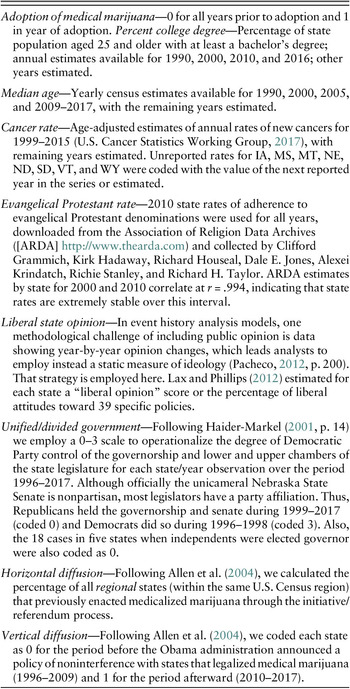
Since its introduction to the policy studies by Berry and Berry (Reference Berry and Berry1990), event history analysis has become the preferred methodology for studying policy diffusion among the 50 states. Briefly, data are a longitudinal record of when a particular event occurred, if it did indeed occur during the period of time being studied. The dependent variable is a dummy variable coded 1 if the event occurs and 0 otherwise. In this analysis, our dependent variable is adoption of medical marijuana laws, coded 1 if the event occurred and 0 if not. Our unit of analysis is individual states. We rely on a discrete time model, dividing our model into units of time or years. The period under observation is 1996–2017. Data are structured so that states are coded 0 in years when there is no adoption and 1 in the year that a medical marijuana provision is adopted. Our model is predicated on the assumption that states will only adopt the provision once. The state is no longer included in the model in years following its adoption.Footnote 3 Once a state adopts a provision, it is dropped from the data in following years. Because of the nature of our dependent variable, we use probit regression. We use robust standard errors clustered on states. There are 843 observations in the model. The operationalization of all of the variables is described in Table 1.
Coding of variables

Results
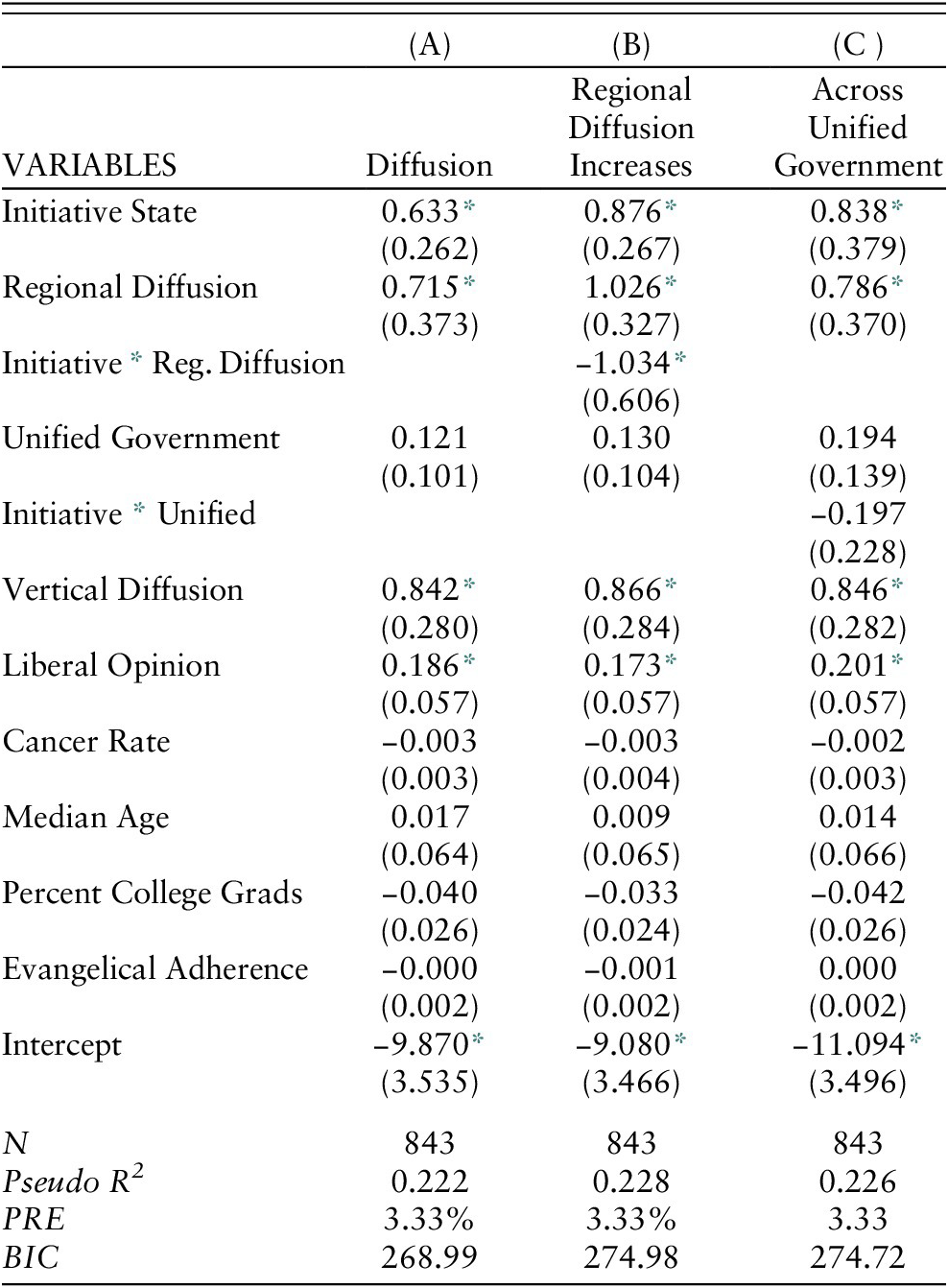
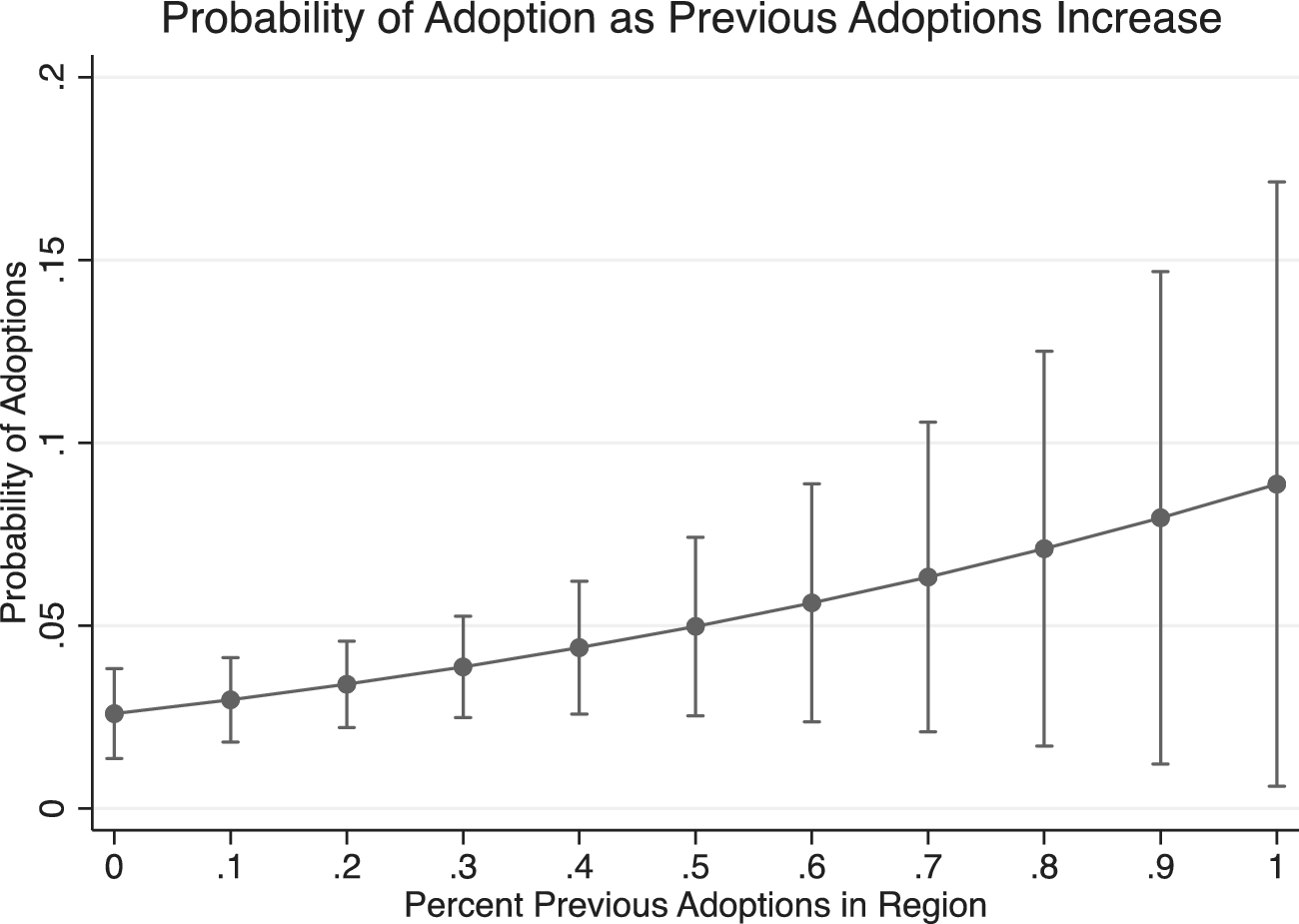
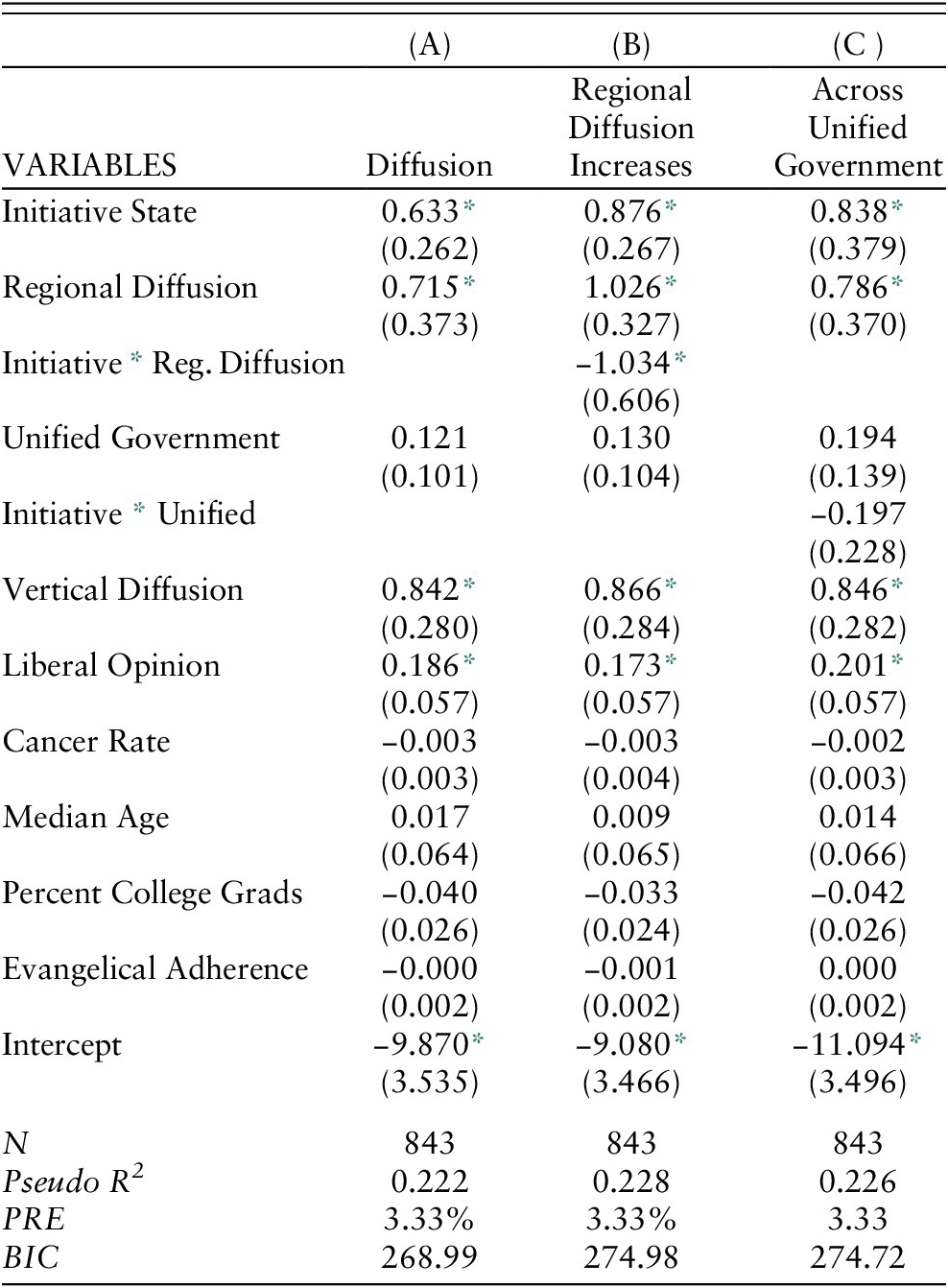
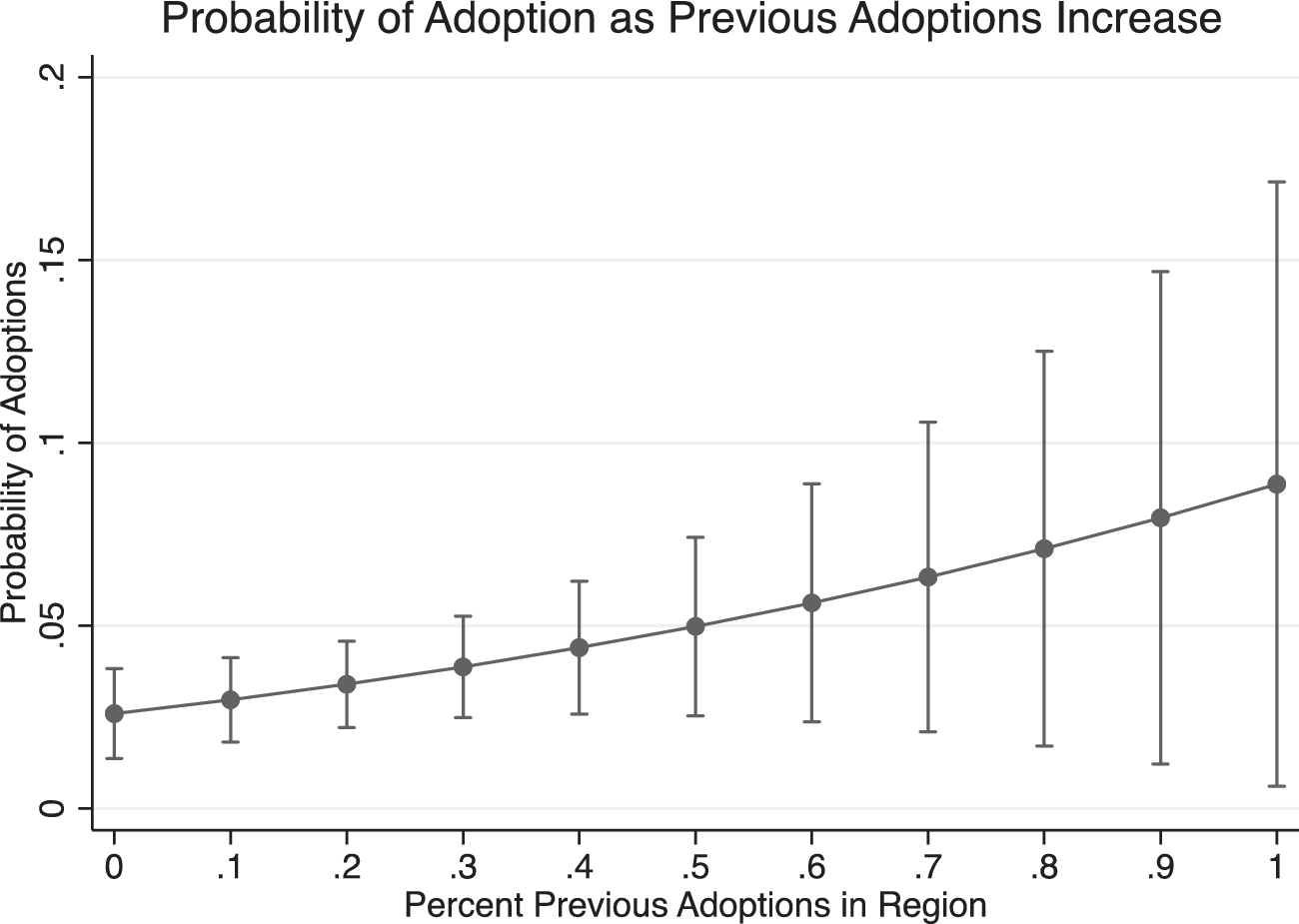
In Table 2, Panel A reports the results of the full model. There is no relationship between the legalization of medical marijuana and cancer rates or the underlying demographics in terms of age, education, and adherence to evangelical Protestantism. As expected, states with more liberal policy opinions are more likely to adopt a medical marijuana law than those that are less liberal. There is also evidence of vertical diffusion as positive signals from the federal government can move this policy forward, although this factor is obviously a double-edged sword. If a sympathetic response by the Obama administration fostered adoption of medical marijuana by states, the more hostile stance by the Trump administration and the Jeff Sessions/William Barr Justice Department may have had the opposite effect. The results also confirm that the probability of a state adopting a medical marijuana law increases as the percentage of other states within its region adopting a similar provision increases. Because coefficients attached to probit analyses have little practical meaning, we estimate predicted probabilities of adoption at various levels of regional diffusion (Figure 2).
Probit estimates of effect of diffusion on policy adoptions
Notes: Robust standard errors in parentheses
p-values based on two-tailed tests
* p<0.05, + p<0.1
Probability of a state adopting medical marijuana as the percentage of adoptions in the region increases. As more states in a region adopt medical marijuana laws, the probability of other states adopting increases. Plots are 95% confidence intervals.
Next we turn to Panel B, which includes the interaction of our measures of initiative state and regional diffusion. In the interaction, a state with I&R at the time of adoption is coded 1 and other states are coded 0. Berry and Berry (Reference Berry and Berry1990) argue that the number of states adopting the lottery is positively related to the number of neighboring states that also have adopted the lottery. Panel A demonstrates a positive relationship between I&R and adoptions, as well as a positive relationship between previous adoptions within a region and the probability that a state will adopt medicalized marijuana.
The interaction term in Panel B allows us to capture the probability of diffusion within a region by whether the state is an I&R state or not. Here we address our primary hypothesis that I&R states will show a different pattern of diffusion than non-I&R states. The coefficient attached to initiative state in Panel B demonstrates that a state with I&R has a higher probability of adopting a medicalized marijuana provision than a non-I&R state, when regional diffusion is set to 0. The regional diffusion variable demonstrates that as more states within a region adopt these provisions, the likelihood that other states within the region will do so increases. The regional diffusion variable is when initiative state is set to 0, or non-initiative state. The interaction term shows that as more states within a region adopt medicalized marijuana laws, the difference in probability between an I&R state and a non-I&R state declines.
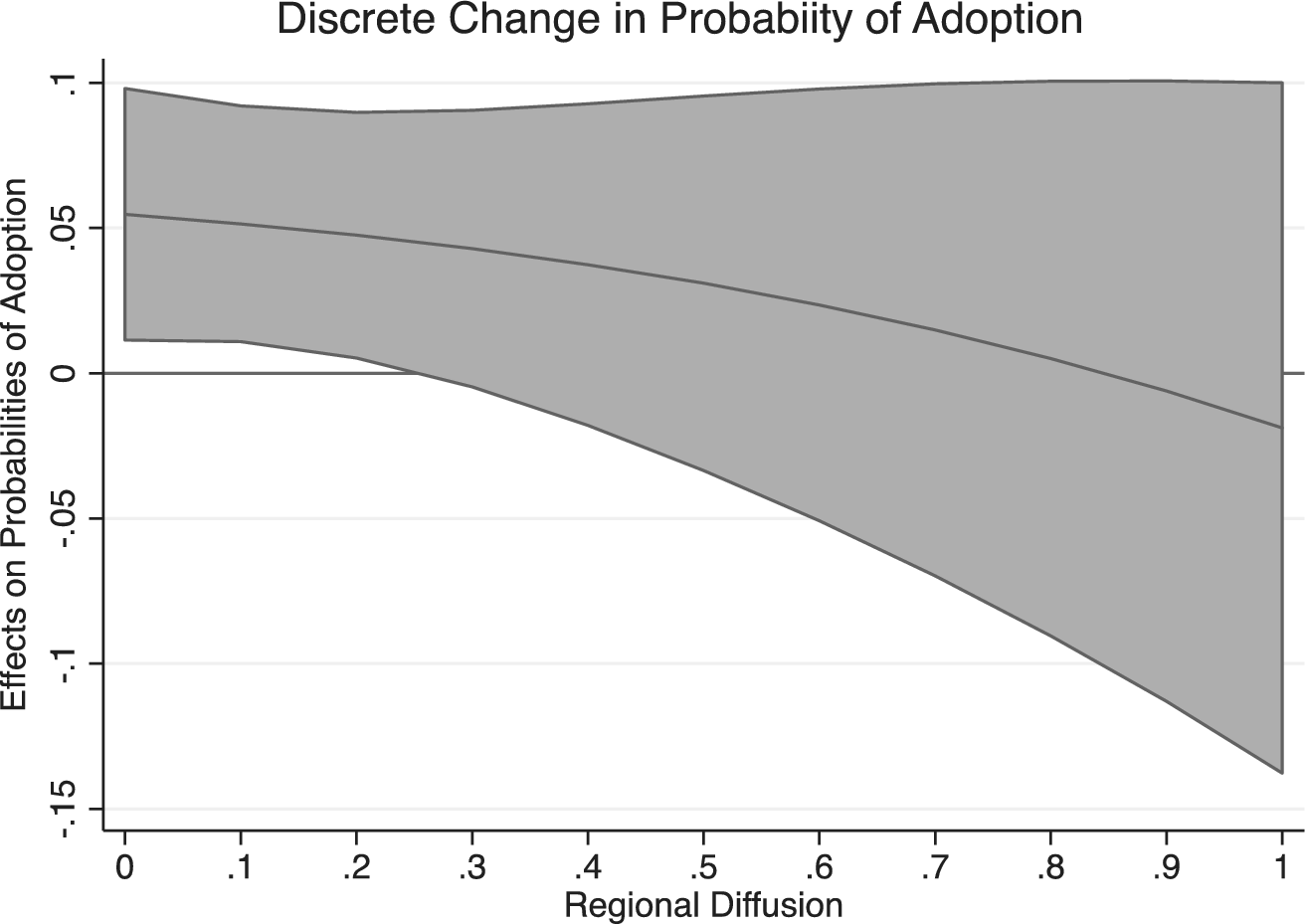
Figure 3 graphically illustrates the discrete change in probability of adoption as diffusion increases. As regional diffusion increases, the discrete change in probability of adoption between a state without I&R and a state with I&R decreases and loses statistical significance. When no other state in the region has adopted a medical marijuana law, the likelihood of an I&R state adopting one is 5.4 percentage points greater than a non-initiative state, and that difference is statistically significant. When 40% of the states have adopted such laws, the difference drops to 4.2 percentage points and is significant at p ˂ .1. When one-half or more of the states in a region have adopted medical marijuana laws, there is no statistically significant difference between the probability of an I&R state and a non-I&R state adopting (Figure 3).
Discrete change in probability of initiative and non-initiative state adopting as diffusion increases. Initiative states are more likely innovate a medical marijuana law that are non-initiative states. As diffusion increases the difference loses statistical significance and non-initiative states are as likely or more likely to adopt than states with initiative. Shaded areas represent 95% confidence intervals.

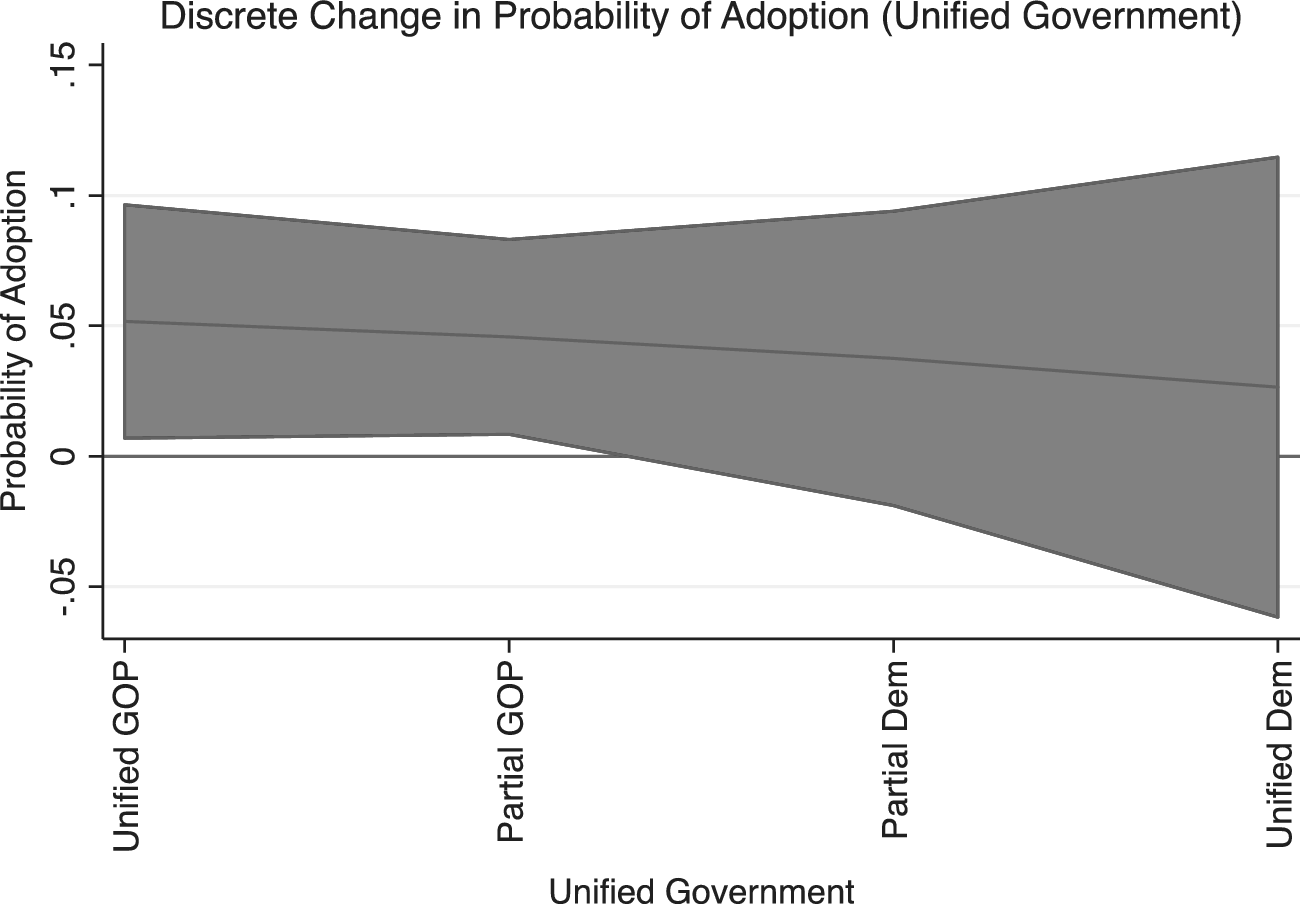
Panel C reports the interaction of initiative state and unified Republican government, which addresses our secondary hypothesis that direct democracy is employed to overcome specific obstacles to the enactment of ordinary legislation. The interaction term captures the effects of unified government in I&R states relative to non-I&R states. Panel C shows that an I&R state is more likely to adopt a medical marijuana provision when unified Republican government is set to its lowest level. The variable for unified Republican government is positive but lacks statistical significance. This simply means that a unified Republican government has no statistically significant effect on the probability of adopting a medical marijuana law in states without an initiative (when initiative state is at its lowest level, 0). The interaction is negative but lacks statistical significance. Because the interaction involves a continuous variable, Figure 4 graphically illustrates the effects of initiative at different levels of unified government.
Discrete probability of adoption as states become less unified Republican. States with I&R are more likely to adopt medicalized marijuana laws than states without I&R when government is unified Republican. As states become less unified Republican or more unified Democrat, the difference between likely of adoption between I&R states and non-I&R states lessens and loses statistical significance. Shaded area represents 95% confidence intervals.

Figure 4 shows that in I&R states, there is little change in the probability of adopting a provision as states become less unified Republican. The probability of an initiative state adopting medical marijuana is roughly 6.2% throughout the range of data. However, for non-initiative states, the probability increases as states become less unified Republican. There is a 5.2% greater likelihood that an initiative state relative to a non-initiative state will adopt a provision under unified Republican government. That drops to a 3.7% difference in a partially unified Democratic state and a 2.6% difference in a fully unified Democratic state. The difference between the likelihood of adoption between a I&R and non-I&R state is no longer statistically significant as states become more Democratic (Figure 4). As was the case with regional diffusion, results indicate that unified government affects the probability of adoption differently in initiative and non-initiative states.
Discussion
In their study of state adoptions of medicalized marijuana Hannah and Mallinson (Reference Hannah and Mallinson2018) argued that direct democracy was “a means for citizens that are dissatisfied with federal policy to circumvent state legislators reticent to defy the federal government” (pp. 409–410). But that perspective is too limiting, because direct democracy can force the adoption of any policies that the political elite oppose for any reason. For obvious reasons, political elites would largely resist passing term-limit legislation, or they might be reluctant to trample on minority rights by banning same-sex marriages, or they might even be willing, in states with weak unionization, to increase the minimum wage. This case study of medicalized marijuana suggests that future research look at other issues of biopolitics that have a strong moral or ethical component, such as cloning, abortion, stem cell research, and genetically modified foods. Because such morality policies engage contested values and not economic interests, they provoke much grassroots conflict that may also implicate the political elites. If legislative stalemate is the result, then citizen activists might turn to direct democracy in order to enact those policies.
Since the very act of circulating voter petitions to initiate referenda involves extensive mobilization effects (Tolbert et al., Reference Tolbert, Bowen and Donovan2009), having ready-made in-state constituencies such as youth or the educated may not be as essential to succeed at the ballot box compared with exerting electoral pressure on state legislators. In our analysis, neither the age nor the education variable exerted any independent effect on the adoption of medicalized marijuana legislation. Available evidence suggests that early mobilization efforts involved homegrown activists in each state and were not orchestrated by any national interest groups. One interest group is the Marijuana Policy Project (MPP) (see https://www.mpp.org), whose website chronicles its achievements from the late 1990s to the present. Although the MPP takes credit for playing “a leading role” in the successful enactments of 12 of the most recent 21 medical marijuana laws, it admits to having no impact on the first eight enactments (of which seven were by referenda). Thereafter, the MPP acknowledged giving substantial funding or logistical support to only the referendum campaigns in Montana in 2004, Michigan in 2008, and Arizona in 2010. (Its chronology therefore confirms that 11 (of 14) referendum campaigns resulted from homegrown activism, for example, Oregonians for Medical Rights, Californians for Compassionate Use, Arkansans for Compassionate Care, People United for Medical Marijuana in Florida in 2016, Alaskans for Medical Rights, Sensible Colorado, Americans for Medical Rights in Washington in 1998 and Nevada in 2000, Footnote 4), North Dakotans for Compassionate Care, and Mainers for Medical Rights. The National Organization for Reform of Marijuana Laws ([NORML] see https://norml.org/) also had established chapters in all but 10 states (including every referendum state except Alaska, North Dakota, and Maine), but public records and news accounts of the referendum campaigns indicate that NORML provided funds or joined the pro-reform coalitions only in Florida, Michigan, and Montana.
But from a broader perspective, state-level ideology matters even if specific demographics do not. That is, the United States is a politically and culturally diverse society, and some states are more politically and culturally liberal than others. On that score, this analysis of medicalized marijuana augments a huge body of research showing a strong linkage between state-level public opinion and public policy (Erikson et al., Reference Erikson, Wright and McIver1993; Lax & Phillips, Reference Lax and Phillips2012), including other morality policies such as abortion (Arceneaux, Reference Arceneaux2002), gay rights (Lax & Phillips, Reference Lax and Phillips2009), and capital punishment (Mooney & Lee, Reference Mooney and Lee2000). Liberal public opinion yields more liberal policies.
It is also very unlikely that “opposition” groups would be able to weaken the resolve of citizen activists who resort to direct democracy in order to overcome institutional and political barriers that block policy reform. However, an organized opposition can be a formidable force in derailing policy reforms in state legislatures. Thus, although we found that evangelical Protestants had no effect on adopting medicalized marijuana legislation, Hannah and Mallison’s (Reference Hannah and Mallinson2018) study did find that evangelical Protestants exerted a negative influence on the legislative adoption of medicalized marijuana (p. 416). Their finding supports previous research showing that a sizeable presence evangelical Protestants in state populations had a negative effect on the adoption of other morality policies (including abortion and same-sex marriage) by political elites.
Finally, presumably statistical indicators of underlying social problems could serve to motivate citizen activists as much as they would influence political elites, but our analysis like the study by Hannah and Mallinson (Reference Hannah and Mallinson2018) showed no statistical effect resulting from state cancer rates (p. 415). On the other hand, our analysis disagrees with Hannah and Mallinson with respect to vertical diffusion effects (p. 416). They found no positive effect from Obama, but our analysis does. In other words, citizen activists were influenced by “positive” signals from the federal government, namely the Obama administration policy that persons in medicalized marijuana states would not be prosecuted for violating federal law. These divergent findings may be a consequence of the slightly longer time frame employed here.
In conclusion, what unique effects on policy diffusion occur when extensive use is made of direct democracy procedures? This analysis points to two factors that have not been included in past research based on the conventional diffusion paradigm. First, if the presence of I&R can facilitate policy diffusion among the states, it stands to reason that previous policy adoptions through the citizen initiative/referendum process should act as precursors to future adoptions, certainly through direct democracy procedures but also as possible “indirect” influences on later enactments by state legislatures. The key to this temporal causal relationship is that policy adoptions by direct democracy must occur before any later adoptions resulted either from direct democracy or legislative enactment. Early I&R adoptions are a signal to activists in other states that obstacles exist in the political opportunity structure that threaten to block enactment by ordinary legislative means.
Second, another important departure from past diffusion studies (Berry & Berry, Reference Berry and Berry1990; Gray, Reference Gray1973; Walker, Reference Walker1969) is that the analysis not target variables that “facilitate” adoption but rather those factors imbedded in the political opportunity structure that block legislative enactment. Including a dummy variable for the availability of the initiative/referendum process is not sufficient, because its presence simply assesses the “indirect” effect of direct democracy on policy adoptions by legislative enactment. Where policies are adopted through direct democracy, the model must include an “interaction” term showing the interplay between direct democracy and the precise variable which blocks the typical method of legislative enactment.
Declaration of conflicting interests
The authors declare no potential conflicts of interest with respect to the research, authorship, and/or publication of this article.
Funding
The authors received no financial support for research, authorship, and/or publication of this article.