INTRODUCTION
As the most pervasive and one of the most powerful institutions in the world today, the media can be described as a key player in propagating gender issues. It is in recognition of this that the media was identified as one of the twelve critical areas of concern at the United Nations’ World Conference on Women, held in Beijing in 1995. Section J of the Beijing Platform for Action notes the failure of the media in most countries to provide a balanced picture of women's diverse lives and contributions to society in our changing world (Beijing Platform for Action 1995). Strategic objective J.2 therefore calls on the media (with a highlight on advertising organizations) to ‘promote a balanced and non-stereotyped portrayal of women in the media’ (Beijing Platform for Action 1995:101). As a response to this call, research into the relationship between gender and the media has intensified on many continents, as scholars address questions of access, participation, production, and representational practices (often focusing on more visual outlets like magazines, newspapers, billboards, and television, rather than on radio).
Although scholarly work on gender and the media abound, such an interrelationship has not been interrogated enough in Africa, as Gadzekpo (Reference Gadzekpo2013) rightly observes. However, such an interrogation is key considering, for instance, the rapid spread of new media and communication technologies in Africa and the fact that these can provide access and new spaces for women to express themselves. This was one of the concerns of the Council for the Development of Social Science Research in Africa (CODESRIA) in its annual gender symposium on ‘Gender and Media in Africa’ held in Cairo in 2011. As a follow up to this, contributions to a special issue (on gender) in the Africa Media Review (Nwosu, Gadzekpo, & Bahi Reference Nwosu, Gadzekpo and Bahi2013) provide some empirical arguments that suggest that there have been some changes in the construction and manifestation of gender in the African media; but contributors also acknowledge that there are still questions on representations of women, among other things.
This article contributes to the ongoing enquiry into how women are represented or portrayed in the media by investigating how the modern Ghanaian (African) woman is represented in radio commercials (an area that has also received little attention from gender and media researchers), and by indicating whether such representations reproduce, reinforce, or challenge traditional feminine practices. In doing this, I take note of the argument that although some studies have shown a decrease in gender stereotypes in recent years, this may be because advertisers have become more gender-conscious, and so they present certain stereotypes in more subtle ways (see Wolin Reference Wolin2003; Patterson, O'Malley, & Story Reference Patterson, O'Malley and Story2009). I therefore pay attention to the language used in order to uncover various nuances of representations of gender, some of which may be subtle.Footnote 1
THE RELEVANCE OF RADIO IN GHANA
In Ghana (as in many African countries), the radio plays a key role in the lives of many people. This is because of its flexibility, low cost, and oral nature, which satisfy the needs of the Ghanaian (African) people quite well. In terms of its flexibility, the radio can be accessed at home, at work, on the farm, and while driving or walking (which are difficult for other forms of media like television or print). It is thus listened to throughout the day, the peak periods being between 6–10 a.m. and 5–7 p.m. With the incessant power cuts in the country, coupled with the fact that not many rural areas in Ghana have access to electricity (to watch TV or read at night, for example), the radio again becomes handy as it can be accessed either on one's phone or through a radio set, using batteries (which is the common practice in places where there is no electricity).
According to the National Communications Authority (2017:4), Ghana has 471 authorised radio stations, with 367 in operation (this suggests that 104 are not operating although they have the license to operate). Since these numerous stations broadcast both in English and the various local languages (unlike the print media which typically uses English), both the literate and the nonliterate and the young and the old can access and benefit from radio programs. Note also that although the literacy rate in Ghana has grown from 53.4% in 2003 (Ghana Statistical Service 2003) to 76.5% in 2015 (Wikipedia, based on UNESCO figuresFootnote 2), the culture of reading is still not popular among Ghanaians. All of these factors make radio the most dominant type of mass media in Ghana (and Africa at large), and its significance can thus not be underestimated. Consequently, the radio can be considered as a good medium for propagating gender issues. For instance, it can reach out to women (and men) from all walks of life, especially the nonliterate and those in rural settings (who are often the most disadvantaged in terms of gender issues). Because of its dominance, advertisers highly patronize this medium, thus making a focus on the representation of women in radio advertising a worthwhile topic of research.
WOMEN AND GENDER RELATIONS IN GHANA
As is typical of patriarchal societies, women in Ghana are generally expected to play supporting roles to men. They are not expected to assert themselves, especially in the presence of their husbandsFootnote 3 (see Diabah & Amfo Reference Diabah and Appiah Amfo2015). Adomako Ampofo, Okyerefo, & Pervarah (Reference Adomako Ampofo, Okyerefo and Pervarah2009), for instance, note that the man is expected to wield ultimate authority over his wife or wives (and children).
Like many cultures, the traditional roles of Ghanaian women mainly involve taking care of domestic tasks, while the men go out and work to fend for the family (Miescher Reference Miescher2005). In the past, where women had to work outside the home, their roles included subsistence farming and petty trading (while still maintaining the house). These roles and expectations were deeply entrenched in traditional family settings, and women (and men) were expected to perform practices and construct identities that conformed to such expectations. Some traditional feminine stereotypes associated with these expectations include motherhood and homemaking competencies like childcare, nurturing, cooking, cleaning, and washing. Women were also seen as less assertive, weak, dependent (lusting after men's money), frivolous, and beauty-conscious.
In recent times, some perceptions of sociocultural norms and expectations about appropriate gender practices have changed. For instance, the social statuses of many Ghanaian women have altered as a result of education, finance, exposure to cosmopolitan lifestyles, and globalization. Anderson, Diabah, & hMensah (Reference Anderson, Diabah; and hMensa2011) for example note how some women have climbed the social ladder and are holding key positions in governance (e.g. Ghana's Chief Justice Sophia Akuffo). While this is generally true across Ghana, Baden, Green, Otoo-Oyortey, & Peasgood (Reference Baden, Green, Otoo-Oyortey and Peasgood1994) note that women in the three northern regions of Ghana have more limited options because of deeply entrenched sociocultural practices like child marriage, widowhood rituals, and polygamy, as well as strong patriarchal family structures and women's lack of influence in decision making.
In her discussion of the role of women in Ghana's economy, Amu (Reference Amu2005:2) indicates that women are no longer confined to the home. Instead, more Ghanaian women are now doing paid jobs outside the home (some of which are stereotypically masculine) and are forced to combine their work at home as homemakers and their jobs outside the home. In other words, women's participation in economic activity (even on a larger scale) does not exclude them from performing ‘their’ traditional domestic roles. Thus, changes to gender practices in contemporary society have not completely eroded perceptions and expectations of what it means to be an ideal Ghanaian woman—a homemaker (including cooking delicious food, general cleaning, providing childcare), as well as fulfilling men's sexual needs; and, of course, going through such a double ‘burden’ is true of other cultures, too.
GENDER STEREOTYPES, THE MEDIA, AND ADVERTISING
Issues of how women have been represented in advertisements have been discussed for almost forty years (mostly from the West), with visual advertisements like magazines, newspapers, billboards, and television commercials dominating this area of research. Discussions have principally centred on the overt use of traditional female stereotypes like mothers, homemakers, sex objects, nurturers, or wives (for some reviews, see Wolin Reference Wolin2003; see also Patterson et al. Reference Patterson, O'Malley and Story2009; Knoll, Eisend, & Steinhagen Reference Knoll, Eisend and Steinhagen2011). For instance, Knoll and colleagues (Reference Knoll, Eisend and Steinhagen2011) conducted research on gender roles in advertising on public and private TV channels in Germany. Their results show that female central characters are often portrayed using domestic products, located in the home setting, or shown as playing dependent roles—findings similar to other studies (e.g. Stern Reference Stern1999).
In another study, Liu, Keeling, & Hogg (Reference Liu, Keeling and Hogg2012) look at cosmetic consumption as a way of (re)defining an individual's sense of self. Their findings suggest that because people use these cosmetics to enhance their physical appearance, consumers of cosmetic products consider their normal physical appearance as lacking some important ‘ingredients’. This is particularly relevant for the current study since one of the frequent feminine stereotypes represents women as attentive to physical appearance. Can women, then, be described as accepting that they are ‘imperfect’ because of their use of body care products? I return to this below, in Women as beauty-conscious: Beauty as (dis)empowering?, where I look at how Ghanaian radio commercials represent women and beauty.
From an African perspective, Sunderland (Reference Sunderland2012) looks at how two adverts on sugar packets in a cafe in Botswana indirectly index gender, which is inflected with both ethnicity and sexuality. She argues that the various lexical and intertextual associations of ‘sugar’ and ‘sweetness’ function to sexualise the women in the adverts in ways which index women's availability within an overall discourse of multiculturalism and social liberalisation. These findings are similar to those which indicate that women are mostly repesented as ‘sex objects’ (Stern Reference Stern1999; Wolin Reference Wolin2003; Kilbourne Reference Kilbourne2005).
In his analysis of gendered narratives and identities of nationhood in documentaries on Zimbabwean television, Muwonwa (Reference Muwonwa2011) notes that Zimbabwean nationhood is represented through masculine identities, and that this follows stereotypical media narratives that focus on men as pillars of strength and as fighters. Documentaries on women, by contrast, showcase them through the feminine stereotypes of ‘motherhood, beauty and by extension weakness and a need for protection by “sons of the soil”’ (Muwonwa Reference Muwonwa2011:463). Such documentaries, he asserts, help to re-inscribe women into the domestic sphere as they focus on women's maternal survival skills.
In Ghana, a small but growing literature on gender and the media concentrates on how women and men are represented, not in terms of stereotypes or challenging the stereotypes, but in terms of their visibility and function (e.g. Yeboah Reference Yeboah2010; Kimani & Yeboah Reference Kimani and Yeboah2011). The results, corroborating findings from other parts of the world (see Wolin Reference Wolin2003 for some reviews), show that women are underrepresented. For instance, findings by Kimani & Yeboah (Reference Kimani and Yeboah2011) indicate 14.6% visibility for women as newsmakers and sources of news, as opposed to 85.4% for men. Their results also show that women were paraphrased slightly more often (i.e. 64% of women who appeared in news stories, as compared to 60% for men), and they were never quoted without an accompanying paraphrase. These findings, as they rightly note, suggest that women are mostly denied the power of their own voice (Kimani & Yeboah Reference Kimani and Yeboah2011). Although the differences in some of these representations are marginal, the findings, nevertheless, are consistent with the stereotypical representation of women as less visible, not only in terms of appearance, prominence, and taking up leading roles, but also in terms of their ability to be authoritative sources of information and experts in language use (see Goodwin Reference Goodwin, McConnell-Ginet, Borker and Furman1980; Maltz & Borker Reference Maltz, Borker and Gumperz1982).
Challenging the stereotypes
Women, of course, are not always represented in stereotypical ways, nor are they always represented as powerless. In recognition of the changing roles and statuses of women, contemporary media is sometimes perceived as representing women as assertive, independent, and in control, while confidently embracing feminine practices (Lazar Reference Lazar2009). Lazar (Reference Lazar2007:156) for instance examines the emergence of what she calls ‘a discourse of popular post-feminism’ in the advertisements of some beauty and body enhancement products from newspapers and women's magazines in Singapore. She notes that although a number of adverts persist in representing women as sex objects, in some cases there is a shift from representing them as passive sex objects towards representing them as sexually autonomous and active. This, she argues, entails a re-signification of the sexual terrain that portrays women's empowerment rather than their exploitation.
In support of this she cites a scenario (from a Unisense Slimming Centre advert) in which a woman is standing on top of a man with a stiletto heel resting on his bare back, with the inscriptions ‘Discover the power of femininity’ and ‘Defy conventions and take the lead’ (Lazar Reference Lazar2007:157). Thus, the stereotypical representation of women as passive sex objects (see Catterall, Maclaran, & Stevens Reference Catterall, Maclaran and Stevens2005) or as powerless is challenged through the way that feminine (hetero)sexuality is represented as women's power in these adverts.
In his study of editorial cartoons from a Kenyan newspaper (Daily Nation), Omanga (Reference Omanga2011) examines how Wanjiku, a female figure used as a metonym for the average Kenyan citizen, was used as a central character to interrogate gender shortly after the postelection violence in Kenya. His study reveals how Wanjiku was represented in ‘an empowered and combative role of motherhood’, something that challenges the ways in which the stereotypical family life of women marginalizes them in politics and media representations (Omanga Reference Omanga2011:412). For example, the mother figure (who is dressed as a peasant) is represented as assertive, a symbol of peace and the voice of the people (i.e. challenging the widely held notion that rural women are voiceless, inarticulate, and trampled upon).
In a cartoon that Omanga interprets as a mother reprimanding her disobedient children—one hand of Wanjiku is on her waist and the other holds a paper on which her demands are written, while Kibaki and Odinga (presidential candidates) stoop slightly towards her with their hands behind them—he rightly argues that motherhood is represented as an empowering role. This empowering role gives Wanjiku the opportunity to address the two most powerful men in Kenya in a rather blunt and direct manner. This can be interpreted as challenging the power relationship that exists between rulers and the ruled and between women and men. Omanga (Reference Omanga2011) concludes that the symbolic Wanjiku should not be seen as a mere creation of the cartoonists but as a sign of the strides Kenyan women have made, especially on the political front.
I find this article useful, not only because it emanates from the same context as mine (Africa), but also because it presents similar findings (see below Empowered through the stereotype). As I show later, while there is still strong evidence for the representation of women in traditionally stereotyped ways, it must also be noted that some of these stereotypes are challenged through the ways contemporary radio adverts portray women—some of which include representing them in ways that both reinforce and challenge gender stereotypes.
FEMINIST POSTSTRUCTURALIST DISCOURSE ANALYSIS
This study uses feminist poststructuralist discourse analysis (FPDA), in which the central concern is to examine how speakers construct (or are represented as constructing) their identities by negotiating, conforming to, challenging, and resisting existing subject positions in competing discourses (Baxter Reference Baxter2003, Reference Baxter, Harrington, Litosseliti, Sauntson and Sunderland2008). In line with the postmodern emphasis on diversity (Cameron Reference Cameron2005), poststructuralism questions the notion of the ‘unified subject’ (see Young Reference Young1981; Collinson Reference Collinson2006). It argues that individuals are not unitary or unified subjects who are uniquely positioned in the same way, but that they may adopt multiple positions or multiple voices depending on the context. Poststructuralism thus creates room for reinterpretation and contestation of meaning and different subject positions in different contexts (Diabah Reference Diabah2011).
Consequently, FPDA rejects a unique and consistent representation of individuals in the same way across discourse contexts. Rather, it sees subject positions as more fragmented, diverse, and context-specific (Baxter Reference Baxter, Harrington, Litosseliti, Sauntson and Sunderland2008). Instead of perceiving women as a unified body who are always positioned as dominated, oppressed, or powerless in discourse, an FPDA approach is interested in analysing the multiple, diverse, and sometimes conflicting subject positions of women in various contexts—including the various nuances of text (either spoken or written). In keeping with the tenets of this approach, it is expected that advertisers will not consistently represent women in traditionally stereotyped ways (for example, as passive sex objects, dominated, dependent, or conforming); instead, they will capture the diverse roles and identities of (modern) women, some of which may be sustaining or reinforcing traditional gender practices while others may challenge these practices.
DATA AND METHODS
The data comes from a number of radio commercials aired between August and December 2013 on two Ghanaian radio stations: Joy FM and Peace FM. Whereas Joy broadcasts primarily in English, Peace broadcasts in Akan (the dominant indigenous language in Ghana, with 47.5% native speakers of the nation's population; see Ghana Statistical Service 2012). These stations were selected for their wider listenershipFootnote 4 (which means a lot of advertisers would like to advertise their products there). The data was collected during the morning show programs—Super Morning Show on Joy FM and Kokrokoo on Peace FM—Monday through Friday between 6 a.m. and 10 a.m. (prime time),. These are current-affairs programs that include the morning's news bulletin, newspaper reviews, interviews, panel discussions, phone-in sessions, and so on. These programs were selected because they cover a wide range of activities with high patronage; as a result, a lot of adverts are aired during that period.
All 112 adverts that were aired during the programs were recorded and transcribed, and those in Akan were translated into English. I then read through the transcripts and listened to the tapes several times for emerging categories. The adverts were sorted into ‘gender-related’ and ‘non-gender-related’. Those that reflect gendered Ghanaian sociocultural norms and expectations (sixty-nine adverts) were categorised as ‘gender-related’ (based on the available literature and my own knowledge as a Ghanaian and a researcher in gender and language issues in Ghana; see above, WOMEN AND GENDER RELATIONS IN GHANA, for a discussion on gendered norms and expectations). Those that do not reflect Ghanaian gendered practices (forty-three adverts) were categorised as ‘non-gender-related’ (for example, an advert in which Lancaster University announces its existence in Ghana and the programmes they offer). Out of the sixty-nine gender-related adverts identified, thirty-seven (which reflect the representation of women) were used for this study.Footnote 5
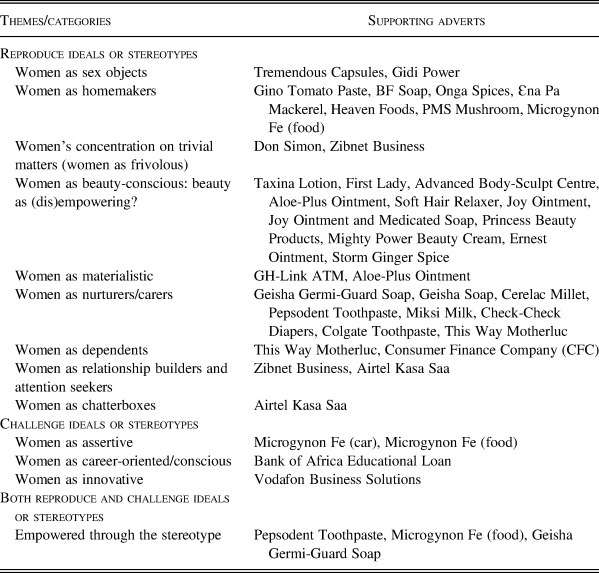
Through an assessessment of the linguistic content, adverts that reflect the sociocultural roles, practices, and expectations of women were categorised as reproducing or reinforcing feminine ideals and stereotypes, whereas those that reflect practices perceived to be socioculturally ‘unacceptable’ were categorized as challenging feminine ideals and stereotypes. I then read through each group of adverts for emerging themes. Thirteen themes or categories were identified, as shown in Table 1: nine reproduce ideals or stereotypes, three challenge them, and the last can be read as both reproducing and challenging ideals and stereotypes (see Appendix A for brief background information on the adverts cited in this study). However, only eight themes are discussed here due to space limitations. They include all three themes that challenge traditional stereotypes and ideals (because these have received little attention from scholars), four that reproduce stereotypes and ideals (chosen based on their rich linguistic information that provide justification for the claims made), and the one theme that both reproduces and challenges stereotypes.
Representations of women.

Note that some adverts appear in more than one theme because of their multiple interpretations, some of which I discuss below.
REPRESENTATIONS OF WOMEN IN COMMERCIALS
This section presents the various ways in which women are represented in the Ghanaian radio commercials. As earlier noted, although thirteen themes were identified, eight are discussed in this section.
Women as sex objects
One major finding from gender (and advertising) research is the representation of women as sex objects (Diabah & Amfo Reference Diabah and Appiah Amfo2015; see Wollin Reference Wolin2003 for some reviews). In some of these studies (e.g. Diabah & Amfo Reference Diabah and Appiah Amfo2015), the female body is objectified in ways that not only serve as a source of pleasure for men, but also as a representation of women's vulnerability and weakness. Some adverts in this study represent women as sex objects, thereby corroborating this previous research. For instance, a critical analysis of the language in Example 1 shows that the woman is represented in ways that suggest that her worth in marriage is only found in providing sexual fulfilment for the man (see Appendix B for transcription conventions).
(1) Tremendous Capsules


In this advert, the woman had earlier asked the man whether he had started taking his Kingdom Ginseng Power medicine since she has seen some improvement in his performance. The man replied in the affirmative and indicated that he takes it to be sexually powerful. As shown in (1) above, the woman also takes Tremendous Capsules to cure her of candidiasis, and this paves the way (i.e. he is no longer driven away, lines 3–4) for the man to exercise his sexual power (men as sex agents). The man's confession that the candidiasis used to drive him away, and the woman's admission that she would have been divorced if not for Tremendous Capsules are both evidence of representing women as sex objects. Saying the man would have divorced her suggests that what the woman is meant for in marriage is just to provide sex.
This point is reinforced through the use of the conditional clause (if…, lines 6–7), which provides the condition for the realization of the proposition expressed in the main clause. That is, if she has candidiasis, and this drives the man away from having sex, Then she is good for nothing and must be divorced. Her stay in the marriage is premised on her cure from candidiasis, which makes her ‘available’ for sex. Note also the link between woman and woman of substance in line 2. This can be interpreted to mean ‘a woman of substance’ is she who has no candidiasis; and by extension, ‘a woman of substance’ is she who is ‘available’ for sex. By saying “sometimes it is not the fault of men” (line 8), the man tacitly admits he would have probably divorced her, and this would be the fault of the candidiasis. The use of “sometimes…” also suggests that although men are often blamed for divorcing their wives, they are blamed unjustly in some cases because the women may not have fulfilled the requirement for marriage—being available for sex.
Women as homemakers
The representation of women as homemakers is one of the traditional stereotypes. For instance, Chytkova & Kjeldgaard (Reference Chytkova and Kjeldgaard2011:209) describe traditional female gender as having ‘its central emphasis on housework as a symbol of being a good woman’. This stereotypically feminine role encompasses taking care of all kinds of domestic work like cleaning, washing, or cooking.
As one of the ideals of femininity within the Ghanaian (African) sociocultural context, a number of adverts represent women as homemakers, mostly involved in cooking (see Table 1). In an Onga Shrimp Powder advert, for example, the tagline reads ‘Onga, Mama's helping hand!’. This reinforces a ‘cooking is for women’ stereotype—because cooking is a woman's job, Onga helps Mama by making her food delicious. In another advert, for Ɛna Pa Mackerel, the name of the mackerel—Ɛna Pa, which translates as ‘good mother’—captures the fact that mothers do the cooking, and this is a good thing to do, hence Ɛna Pa ‘good mother’. Although this is portrayed as a positive characteristic of women, it is patronizing and reinforces the ‘cooking is for women’ stereotype.
In the Gino advert below, by contrast, the stereotype is reproduced more subtly, through what initially seems like a challenge to that same stereotype.
(2) Gino Tomato Paste

This advert appears to challenge the ‘cooking is for women’ stereotype since it is the man who does the cooking (line 1). Making the soup portrays the man as doing what is traditionally feminine. However, and more interestingly, a critical analysis of the sentences below indicates that the advert reproduces or reinforces the stereotype:
• It was the day after our newborn <arrived> (line 2)
• I^ gave him that recipe (lines 2–3)
In the first sentence (focus construction it was…), the fact that the soup was made “the day after our newborn <arrived>” (and not on any other day) is considered relevant to the discourse. It may be argued that because mothers are not considered strong enough to do domestic chores immediately after delivery, it is only appropriate that someone helps out; and perhaps, the only available person at the time was the husband. Accordingly, the man doing the cooking does not take away the fact that cooking is a stereotypically feminine practice. In this case, he did it because the woman's condition would not allow her to carry out her normal duties, hence the highlighting of the fact that it was a day after delivery.
In the second sentence, the stereotype is made even stronger by the stress on the pronoun I. By saying “I^ gave him that recipe”, the woman asserts her stereotypical role as the cook who has knowledge about the recipe for the soup (as well as what Gino does, lines 3–4). In other words, she, and not him, is the authority when it comes to cooking (at least that particular soup). All of these serve to reinforce cooking as a stereotypical feminine practice. It may thus be argued that the stereotype only appears to be challenged because we now live in a society where relatives may not be readily available to help out immediately after a woman delivers, hence, the man steps in. This does not, however, change the fact that cooking is for women.
Women's concentration on trivial matters (women as frivolous)
Another stereotype is the representation of women as frivolous or concentrating on trivial matters, while men do all of the ‘serious businesses’ in life (see Eckert Reference Eckert, Holmes and Meyerhoff2003; Talbot Reference Talbot, Holmes and Meyerhoff2003). Examples (3) and (4) illustrate this further.
(3) Zibnet Business

This advert metaphorically shows the significance of a company's reliability, faithfulness, and loyalty to its customers. As shown above, although the woman claims she expects ‘a lot’ from her man (line 2), one major thing that will probably not go unpunished is for him to forget their anniversary (lines 2–3). Presenting this statement (which begins with the discourse marker at least (line 2), i.e. ‘if nothing else’) after her expectation of faithfulness, loyalty, and reliability connotes the understanding that remembering their anniversary (which many will consider trivial) is more important to her than these major blocks of a good relationship. In other words, she can probably forgive him for being unfaithful, disloyal, or unreliable, but not when he forgets their anniversary. This shifts the focus from important to trivial things, thereby reinforcing the stereotype that women are frivolous, and they talk about trivial matters (see Lakoff Reference Lakoff1973; Eckert Reference Eckert, Holmes and Meyerhoff2003; Talbot Reference Talbot, Holmes and Meyerhoff2003).
In the next example, women are represented as concentrating on trivial matters by contrasting the content of a woman's talk with that of a man. (The man had gone to visit a male doctor, metaphorically represented as Don Simon fruit juice, to thank him for his services of saving lives through the nutrients ‘he’ provides).
(4) Don Simon

As shown above, there is a contrast between the assessment of the juice by the man's father and his mother. Whereas his dad spoke about serious things (sharing his knowledge about the history of the product, lines 1–2), his mum only spoke about fun (‘girls-girls outings’, line 3). Again, this account is a reproduction of the stereotype that whereas women are fun-lovers, concentrating on the not-so-serious stuff, men are information-givers and serious-minded (note also that the juice is represented as a male doctor, who touches and saves the lives of many).
On the other hand, there appears to be a challenge to this stereotype because the man portrays his sister as knowledgeable and an information giver—talking about the nutritional value of the drink (lines 4–5). A critical analysis of the syntactic structure of the statement (i.e. the use of the nonrestrictive relative clause who is a nurse, line 4), however, reveals something rather interesting. He chose to make his sister's occupation relevant to the discussion (note also that being ‘a nurse’, rather than a doctor, is another stereotypical representation of women and their professions). Could he not have omitted it, as in the case of his parents? In answering this question, it must be noted that a nonrestrictive relative clause provides additional information on the antecedent word or phrase. Accordingly, it may be argued that because women are not traditionally considered to use language to communicate information or discuss serious issues (see Maltz & Borker Reference Maltz, Borker and Gumperz1982; Talbot Reference Talbot, Holmes and Meyerhoff2003), the most logical explanation for his sister's depth of knowledge about the nutritional content of the drink is because she is ‘a nurse’. In other words, the ‘significant presence’ of his sister's occupation reinforces the stereotype, though subtly, that women do not use language to give information; when they do, then it must be attributed to something else, in this case, the nature and the expectations of her job.
Women as beauty-conscious: Beauty as empowering?
Another feminine stereotype is the representation of women as beauty-conscious. Women tend to pay attention to their physical appearance because society expects them to be attractive. As one of the ideals of femininity, beauty is represented as ‘empowering’ in some of the adverts. For instance, in a Taxina Lotion advert, the woman notes that ‘part of a person's glory is derived from her skin’, and this is further strengthened by the tagline ‘Taxina Lotion, it gives you skin confidence!’. These examples suggest that skin that is not beautiful causes the individual to lose part of her glory and her confidence.
Similarly, the advertisers of a body lotion in the example below emphasize the points that “you connect when you feel good about yourself” (line 1) and “beauty is confidence” (lines 4–5).
(5) First Lady

Like the advert for Taxina Lotion, this example suggests that beauty has the power to make people confident and feel good about themselves. Having such confidence is what makes one ‘connect’ with others. These beauty products therefore do more than just enhance beauty (lines 2–3); they also empower women. Note also that the name of the lotion ‘First Lady’ (like the wife of a president) reflects a position of power, glamour, and beauty.
Seeing beauty as empowering, and thus something to desire, resonates with Liu and colleagues’ (Reference Liu, Keeling and Hogg2012:19) argument that an imperative aspect of self-completion theory is that ‘when important symbols used to define the self are lacking, individuals will strive to use alternative symbols to reinforce their self-definition’. One of those alternative symbols is using body care products to enhance physical appearance. This suggests that such people consider their normal physical appearance as lacking some important ‘ingredients’. This may lead to a low self-definition, which can be interpreted as disempowering; but using these body care products is a way of boosting one's confidence (as noted in the above examples), hence redefining one's self-identity.
The other adverts on beauty and body care products for women in this study (eleven out of thirthy seven) similarly represent physical beauty as empowering, and as such, it is something to be wished for, pursued, and worked towards by purchasing and consuming the advertised products (see Patterson et al. Reference Patterson, O'Malley and Story2009 for similar claims). This style of advertising reinforces the stereotype that a beautiful physical appearance is ideal for women and thus something to be desired.
Empowered through the stereotype
Although traditional stereotypes and ideals of femininity often portray women in weak, vulnerable, passive, or supporting roles (see Milani & Shaikjee Reference Milani, Shaikjee, Atanga, Ellece, Litosseliti and Sunderland2013; Diabah & Amfo Reference Diabah and Appiah Amfo2015), there are instances in which the stereotypes can also highlight women's ‘power’, especially in the family (see Omanga Reference Omanga2011 for similar findings). As shown in example (6) below, one such stereotype is the representation of women as nurturers or carers (see Table 1).
(6) Geisha Germi-Guard Soap

This advert, first of all, reinforces women's domesticity by reproducing a ‘women as nurturers or carers’ stereotype. One of the marks of a nurturer or carer (and a mother, for that matter) is to care for the daily needs (including hygiene) of her family, especially children. This echoes Nhlekisana's (Reference Nhlekisana, Atanga, Ellece, Litosseliti and Sunderland2013) point—in her analysis of language and gender in popular music in Botswana—that a woman is not expected to forget her traditional family responsibility of taking care of her children and husband. As she rightly notes, this representation prioritises motherhood as part of the ideological structures of patriarchy.
Also of interest in example (6) is the incorporation of the concept of ‘protection’ in the caring roles of mothers or women (line 3). Women's love and concern for their families are shown in their desire to give them products that will protect their skin from germs and all kinds of diseases (lines 3–4), and having a clean and healthy child is a mark of a good mother. By using products that offer protection, women also contribute to the protection of the people they care for. The voiceover from a Pepsodent Toothpaste advert, which also reinforces the ‘women as nurturers or carers’ stereotype, expresses this idea even more strongly through the use of the imperative: ‘keep your family protected and happy’.
However, the concept of protection, especially in the family setting, is traditionally considered to be masculine. It is the duty of the man in the home to offer protection for both his wife and children.Footnote 6 While reinforcing the traditional stereotype of women as nurturers or carers, this advert also challenges the stereotypical representation of men as the protectors of their families.
In another example, a stereotypically feminine task (cooking) is used to challenge another stereotype—that women exhibit cooperative behaviour and play supportive roles to men.
(7) Microgynon Fe

First of all, this birth control pill advert reinforces the stereotype that ‘cooking is for women’ (see above Women as homemakers). By contrast, the woman is represented as assertive in terms of her behaviour, that is, not having children until she and her husband are ready (lines 4–5), and in how she uses language. Unlike the man, who uses linguistic forms that may be described as ‘feminine’—for example, using rising intonation in line 3 (see Eckert Reference Eckert, Holmes and Meyerhoff2003)—the woman is portrayed as being more direct (lines 2, 4–5, 7). She is also represented as the one taking the initiative, by listing some of the things they need to work on before they can have children (lines 4–5). This representation is significant since, worldwide, women's ability to practice birth control is considered important for their independence.
A stereotypically feminine task (cooking) is therefore used to challenge the stereotype that women exhibit cooperative behaviour and play supporting roles to men (see Talbot Reference Talbot, Holmes and Meyerhoff2003)—for example, rather than agreeing with the decisions taken by men, the woman uses the inclusive pronoun we in “we both decide” (line 7). In other words, the ‘power’ the woman has in the kitchen (e.g. to decide whether the food is ready or not, and whether someone can be allowed to taste it or not, lines 1–2) has been transferred into a domain where men have traditionally taken the final decisions (see Adomako Ampofo Reference Adomako Ampofo and Arnfred2004; Adomako Ampofo & Boateng Reference Adomako Ampofo, Boateng and Tamale2011).
Yet, although the woman has the ‘power’ to decide whether to get pregnant or not, this power often operates secretly if the man thinks otherwise. It may well not even be exercised for fear of the man going out to impregnate another woman, which is often seen as a threat to the woman's position in the marriage. This is supported by Adomako Ampofo & Boateng's (Reference Adomako Ampofo, Okyerefo and Pervarah2011) study on the multiple meanings of manhood among boys in Ghana. Their respondents ‘accord[ed] men the final say when it came to having (more) children’ and further rationalised that ‘women who are not willing to “give” men the children they need can be divorced, or the man can take a second wife’ (2011:53; see also Adomako Ampofo Reference Adomako Ampofo and Arnfred2004).
Within the analytical framework of feminist poststructuralist discourse analysis, which assumes that no individual is consistently positioned in the same way across all discourse contexts, the various nuances of these adverts illustrate the diverse identities and roles of women—some conforming to traditional gender stereotypes (women as nurturers or homemakers) and others challenging the stereotypes (women as protectors and as assertive).
Women as assertive
Also challenging the stereotypical representation of women as passive, supportive, and cooperative is another Microgynon Fe advert below in (8).
(8) Microgynon Fe

Like (7), this example challenges the stereotypical representation of women as passive and cooperative; but unlike (7), this example uses a car metaphor (lines 1–4)—which is stereotypically masculine—and applies it to the family setting (line 4). The woman is represented here as assertive and independent-minded as she objects to the suggestion of her partner (line 5). She is part of the decision-making. In fact, she takes a leading role by ‘always putting it on full gear until they decide otherwise’ (line 7). Also, the use of still in her statement “but I still think we are not ready yet” (line 5), suggests that the man has raised the issue of having children before, which she objected to. This portrays her as the one who probably makes the final decision, in contrast with the stereotype that men are the decision-makers. This is a reflection of changing trends in contemporary Ghanaian society—an indication that women are now seen as an essential part of such decisions, including taking leading roles in some cases. This representation resonates with Nhlekisana's (Reference Nhlekisana, Atanga, Ellece, Litosseliti and Sunderland2013) findings that women are constructed in one of the songs she analysed as having agency and as capable of making important decisions about their own lives by challenging or subverting cultural expectations and demands for women to be tolerant and long-suffering in an (abusive) marriage.
Women as career-oriented or conscious
Many studies on gender and advertising have noted how women have been depicted with domestic products and are often portrayed in the home setting (e.g. Stern Reference Stern1999; Chytkova & Kjeldgaard Reference Chytkova and Kjeldgaard2011). However, in the Bank of Africa's educational loan advert below, women are represented as career-oriented,Footnote 7 thereby challenging these traditional depictions of women.
(9) Bank of Africa Educational Loan

In this advert, not only are these women presented as career women, but Woman 2 wants to take her career higher by doing a Masters in Business Administration (line 4). Of relevance also is her reference point—that a new manager, who is male, has finished his chartered accountancy courses and has been given a nice car, so she must also get to that level (lines 5–8). This portrays her not only as career-oriented, but also as competitive and focused—traits that have been considered as masculine in nature (e.g. Maltz & Borker Reference Maltz, Borker and Gumperz1982; Coates Reference Coates and Evetts1994). This representation is a reflection of the changes to gender roles and practices in contemporary Ghanaian society (see Amu Reference Amu2005).
Women as innovative
Women have sometimes been stereotyped as lacking creativity. On language use, for instance, Jespersen's (Reference Jespersen and Cameron1922/1990) seminal paper in which he claims women have no innate ability to be creative language users, is often cited as one of the stereotypes, though his claim has been criticised as lacking scientific basis (see Litosseliti Reference Litosseliti2006). In the Vodafone Business Solutions advert below, however, women are represented as creative or innovative.
(10) Vodafone Business Solutions

This advert (metaphorically) compares innovations or creativity in business (lines 6–8) with creativity in a stereotypically feminine practice—combination in food preparation (e.g. women can put various recipes together to create their own dish). This innovation or creativity is shown when the woman asks for a rather unusual food combination (line 2)—French fries (typically foreign) and okra soup (a typical Ghanaian soup that often goes with Banku, prepared with corn and cassava dough). This presents the woman as creative, as she does what is out of the ordinary—no wonder the waiter appears surprised (line 3) and sees it as funny (line 5). She is also represented as decisive and focused (“I know exactly what I want”, line 2)—unlike the stereotype that women move at the whim of every wind. These traits are considered as stereotypically masculine, and representing the woman as such challenges the stereotype that women are passive, indecisive, and lack innovative ideas.
Comparing this example with (9) above, it can be said that although women are represented as challenging gender stereotypes in both examples, in (9) women are constrained to aim for only what men aim for. The standards are already set by men, and women can only aim to fit into those standards somehow (“me too I go catch there some”, lines 7–8). By contrast, the woman in example (10) is represented as setting the standards—knowing exactly what she wants and going for it (line 2) and having things her own way by creating and designing something out of the ordinary (lines 6–7). Yet although these standards are not defined by men, they are judged by men, as shown in the waiter's laughter (line 5).
SUMMARY AND CONCLUSION
Findings from this study, corroborating those of other studies (e.g. Wolin Reference Wolin2003; Knoll et al. Reference Knoll, Eisend and Steinhagen2011), show that women are often represented in stereotypical ways (nine out of the thirteen themes identified in this study): for example, as sex objects, beauty-conscious, nurturers or carers, and homemakers. There are, however, other representations like being career-conscious, assertive, and innovative, which challenge certain traditional gender stereotypes (three out of the thirteen themes), while another theme (empowered through the stereotype) shows cases of challenging some stereotypes through the reproduction of other stereotypes. Representing women as conforming to certain traditional gender stereotypes, and ideals in some instances, while challenging other stereotypes in other instances reflects the multiple, diverse (and sometimes conflicting) identities and roles of the contemporary (Ghanaian) woman. This is in line with the feminist poststructuralist discourse analytical (FPDA) stance that sees identities as fragmented, diverse, and context-specific, with no one positioning themselves or being positioned by others in the same way across different discourse contexts.
Nonetheless, the fact that there are few adverts representing women in ways that challenge traditional gender stereotypes and ideals (often one advert in each case; see above Women as assertive, Women as career-oriented or conscious, and Women as innovative) is an indication that not much has been done to reflect the changing roles and statuses of women in contemporary Ghanaian society. This could be because advertisers want to highlight these stereotypes and traditional values in order to reinforce a belief that what defines an ideal Ghanaian or African woman are the traditional values, rather than wanting to challenge those values.
My intention in this article is not to devalue traditional gender practices. But adverts that reinforce these practices, making them appear as though there is no alternative, only extend (and sometimes complicate) the roles of the modern woman, since she is expected to play her traditional roles and at the same time take on other nonstereotyped roles (as demanded by the realities of today's world).Footnote 8 This echoes Chytkova & Kjeldgaard's (Reference Chytkova and Kjeldgaard2011:200) argument that ‘while women now have more opportunities to participate in the world of men, at the same time they have to re-negotiate previous ‘fixed’ identities to a much greater extent than men’. For instance, a woman may be expected to go out and work for money (in order to help the man fend for the family) and still be expected to come home and be a great homemaker while the man is left off the hook. Any change of attitude and expectation will mean extensive education about the potentials of women vis-à-vis the delimitations of certain entrenched societal views; and this is where the media (e.g. advertising) can play a critical role. The media's consistent projection of the diverse, complex, and complicating roles of modern women will reinforce the realities on the ground, how we see ourselves, and what we perceive as normal and desirable for women (and men).
APPENDIX A: BRIEF BACKGROUND INFORMATION ABOUT THE PRODUCTS CITED

APPENDIX B: TRANSCRIPTION CONVENTIONS
Adapted from Bucholtz Reference Bucholtz2007
- ,
pause
- .
end of a statement/utterance
- ?
rising intonation/interrogation mark
- !
exclamation
- …
omitted data
- < >
transcriber's comments
- ‘ ’
direct quotes within the adverts
- ^
stress
- bold
my own emphasis to show relevant linguistic forms