Introduction
Tetrahydrobiopterin (BH4) is the cofactor for phenylalanine hydroxylase (EC 1.14.16.1), tyrosine hydroxylase (EC 1.14.16.2), and tryptophan hydroxylase (EC 1.14.16.4). A few genetic defects in the biogenesis of BH4 are known: Segawa disease (MIM 605407), 6-pyruvoyl tetrahydrobiopterin synthase (EC 4.2.3.12) deficiency, sepiapterin reductase (EC 1.1.1.153) deficiency, etc. Deficiencies of BH4 are often associated with neurological symptoms including developmental delay, seizures, and dystonia. Treatment for these conditions is primarily supplementation of L-3,4-dihydroxyphenylalanine (L-DOPA), since supplementation of BH4 has shown limited effects on the neurological symptoms, which are thought to be due to insufficient transport of BH4 into the brain tissues.Reference Niu 1 However, elevation of BH4 levels in the cerebrospinal fluid was shown when a higher dose was given peripherally.Reference Kaufman, Kapatos, McInnes, Schulman and Rizzo 2
Phenylketonuria (PKU; MIM 261600) is an autosomal recessive genetic metabolic disease caused by deficiency of phenylalanine (Phe) hydroxylase (PAH), whose primary role is to hydroxylate Phe by converting it to tyrosine (Tyr). PAH is primarily expressed in the liver, where it utilizes BH4 as its natural cofactor in Phe hydroxylation. If untreated, the outcome results in severe intellectual disability, microcephaly, seizures, and a range of mental disorders including attention deficit disorder, disruptive behavioral disorders, mood disorders, and schizophrenia.Reference Scriver and Kaufman 3 , Reference Pietz, Landwehr, Kutscha, Schmidt, de Sonneville and Trefz 4 Up until the last 10 years, the only available treatment option for individuals with PKU was the highly restrictive low-Phe diet implemented soon after birth, which significantly reduces blood Phe and prevents many of the manifestations of PKU.Reference Bickel, Gerard and Hickmans 5 Recently, sapropterin dihydrochloride (6R-BH4), which is a synthetic form of BH4, has been approved by the Food and Drug Administration under the trade name of Kuvan (BioMarin Pharmaceutical Inc.), and its efficacy has been proven for the treatment of PKU.Reference Levy, Milanowski and Chakrapani 6 It has been demonstrated that 6R-BH4 stimulates PAH in individuals with PKU with residual activity and reduces blood Phe levels.Reference Kure, Hou and Ohura 7 However, since the primary indication for its use is to lower blood Phe, it is typically not used for those who do not respond with at least a 30% drop in blood Phe.Reference Levy, Milanowski and Chakrapani 6 , Reference Burnett 8
The majority of the individuals born before newborn screening are late diagnosed, and many are intellectually disabled. Their symptoms typically include intellectual disability, seizures, and maladaptive behaviors. There are several reports in the literature where the Phe-restricted diet given to previously untreated individuals with PKU resulted in improved behavior and health status.Reference Yannicelli and Ryan 9 – Reference Fitzgerald, Morgan, Keene, Rollinson, Hodgson and Dalrymple-Smith 12 Since the introduction of 6R-BH4 in our clinic, it was not uncommon for patients to report feeling better, more energetic, less moody, and better able to concentrate, with no changes in blood Phe levels, suggesting a possible direct effect on the central nervous system (CNS). In an effort to investigate the effects of 6R-BH4 on behavior, we conducted a study to evaluate behavioral changes after the implementation of 6R-BH4 in 10 adult individuals with PKU.
Methods
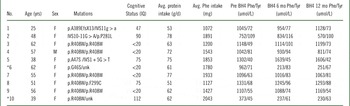
This was a 12-month, open-label, pilot study of 6R-BH4 in adult subjects with PKU who have measurable maladaptive behaviors, with or without intellectual disabilities. Patients were selected from the PKU population currently followed at the LAC+USC Medical Center in Los Angeles. Inclusion criteria included a biochemical confirmation of the diagnosis of PKU, 18 years of age or older, confirmation of the presence of measurable maladaptive behavior at baseline on the Vineland Maladaptive Behavior Index and the PKU Behavior Checklist, and the ability to comply with study procedures. Intelligence quotient (IQ) was not an excluding factor, since the study focused on maladaptive behaviors. Subjects were excluded from the study if pregnant, lactating, or using L-DOPA or methotrexate. See Table 1 for subject profiles. None of the participants had any change in medication or psychiatric treatment during the course of the study. Subject 10 was taken off medication at the beginning of the study and monitored closely by her therapist.
Subject profile

*Responder.
Consent was obtained from each subject or his or her legally authorized representative. The study was approved by the University of Southern California’s Internal Review Board. The trial was also registered at http://www.clinicaltrials.gov.
The study drug given was Kuvan, which was provided in tablets containing 100 mg of 6R-BH4 to be administered orally once daily as the number of tablets equivalent to 20 mg/kg/day with a meal. All study evaluations (at-screening, baseline, 6 months, and end of study) included a medical and nutrition evaluation, which consisted of plasma amino acids, diet history, and a psychological behavior evaluation. Interim tests included monthly blood Phe and Tyr and quarterly plasma amino acids. Monthly blood Phe and Tyr were analyzed using tandem mass spectrometry on filter papers by the California Genetics Disease Branch Laboratory. Patients/care providers were instructed to collect blood samples fasting for at least 4 hours and obtained the same time of day. Plasma amino acids were analyzed at commercial laboratories (Quest Diagnostic Lab and Lab Corp).
Dietary
Subjects were on a modified protein restricted diet and taking a medical food product and/or large neutral amino acid supplements, except subject 10, who was on a regular diet and had never been treated, and subject 5, who took her medical food products only on occasion. All subjects consumed at least 0.7 g/kg protein (including medical food products). No subject consumed low protein food products.
Behavior assessment
Each participant was evaluated in his or her home through an interview with a caregiver or family member, and, for 7 participants who went to a day program or workshop, a person who worked with or knew the participant well. The evaluation instruments used were the Vineland Adaptive Behavior Scales–Second Edition (VABS-II)Reference Sparrow, Ciccetti and Balla 13 and the PKU Behavior Checklist (see Table 2). Throughout the study, the interviews were conducted by a clinical psychologist experienced in administering and scoring the VABS. Caregivers of 2 subjects were given the first VABS interview by a different clinical psychologist, but those results were reviewed with the caregivers by the psychologist who conducted the interviews with all other subjects and all of the follow-up interviews.
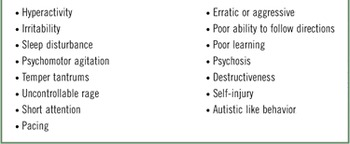
PKU Behavior Checklist

The VABS-II is an individually administered measure of adaptive behavior for ages from shortly after birth through 90 years normed on a national sample of 3,695 individuals equally balanced by sex and representative of the U.S. population in regard to race/ethnicity, community size, geographic region, and socioeconomic status. It is ideally suited for assessing persons with moderate to profound mental retardation. It produces standard scores in 4 broad domains: Communication, Daily Living Skills, Socialization, and Motor Skills. The home interviews used the Parent/Caregiver rating form, while the day programs used the Teacher Rating form, which evaluates the four broad domains, but does not rate maladaptive behaviors. Additionally, the Parent/Caregiver form has a Maladaptive Behavior Index for assessing problem behaviors, grouped as Internalizing, Externalizing, Other, and Critical Items. Internalizing maladaptive behavior includes being overly dependent, avoiding others, having poor eye contact, being overly anxious or nervous, or exhibiting indications of depression such as eating or sleeping difficulties, being sad for no clear reason or lacking energy, or interest in life. Externalizing maladaptive behaviors include impulsivity, temper tantrums, defiance, physical aggression, stubbornness, or sullenness and other items that require being able to talk such as lying, teasing, or saying embarrassing things. The Other scale includes items such as sucks thumb or fingers, wets bed, bites nails, grinds teeth, inattentive, hyperactive, and swears, as well as some other items that participants who live in a controlled environment have no opportunity to do, such as drink alcohol or run away. The Critical Items list includes autistic-like or schizophrenic behaviors, inappropriate sexual behavior, destructive behavior, and inability to work. Behaviors on the VABS-II Maladaptive Behavior Index are scored on a Likert scale with 2 indicating usually performs, 1 sometimes performs, and 0 never performs.
Participants who cannot say more than single words or 2-word phrases received zeros on the Externalizing section items that required communication. The Other measure is a group of behaviors and is not given a numerical score, but is included in the Maladaptive Behavior Index. The Critical Items list is not given a standard score, but is intended to aid in the interpretation, if appropriate, and to identify behaviors that are markedly aberrant.
In addition to the VABS-II, a checklist of 15 behaviors that are typical of late-diagnosed individuals with PKU was constructed (see Table 2). This list was constructed by Kathryn Moseley and Dr. Richard Koch after visiting four state residential developmental centers and interviewing caregivers on common behaviors seen in individuals with untreated PKU. These behaviors have frequently been observed in late-diagnosed PKU patients treated at our center as well. Many of these behaviors are consistent with those reported earlier.Reference Yannicelli and Ryan 9 , Reference Fitzgerald, Morgan, Keene, Rollinson, Hodgson and Dalrymple-Smith 12 , Reference Baumeister and Baumeister 14 This list includes primarily externalizing behaviors that are not included in the VABS-II Teacher Rating form and the Maladaptive Behavior Externalizing section of the Parent/Caregiver form, such as irritability, pacing, psychomotor agitation, and destructiveness. The PKU Behavior Checklist does not include behaviors that require talking; therefore, it is an additional measure that is tailored more to the range of abilities of the participants of the study, and which seeks to present the qualitative aspect of the evaluation in an objective way, giving a more precise picture of externalizing behavior than does the VABS-II for the PKU participants.
The PKU Behavior Checklist was scored in a manner similar to the Maladaptive Behavior Index on the VABS-II, with 0 if the behavior was never observed, 1 if the behavior was observed sometimes, and 2 if the behavior was observed usually. The interviewee gave examples of the behavior, describing the frequency and intensity. Frequency was determined by the number of times the behavior was observed each day, week, or month. Intensity was determined by the description of the behavior. Some caregivers were familiar with this type of reporting since they had done it in the past for reports written by a behaviorist. In addition, the interviewer had observed each participant in the home and at the day program, if there was one, and had observed some of the behaviors, so the descriptions were familiar to the interviewer and made scoring them more accurate. The interviewer took notes during the interview and scored the checklist from the interview notes. A summary score was calculated as the sum of the 15 behavior scores, and each individual behavior was classified as “improved” if its score decreased from the baseline at either the 6th- or 12th-month evaluations. The same clinical psychologist conducted the PKU Behavior Checklist interviews and scored the results for each participant throughout the study.
Statistical analysis
Serial blood levels of Phe and Tyr and the Phe/Tyr ratio were summarized for each individual as the mean over 3 time periods: the 6 months preceding treatment, and the first and second 6-month periods while on Kuvan. Two individuals identified as responders were excluded from analyses intended to evaluate the question of an effect on the CNS independent of lowering blood Phe levels. The change from baseline to 6 and 12 months was evaluated in the 8 nonresponders with repeated measures ANOVA for blood and behavior outcomes, with post hoc comparisons of each on-treatment assessment to baseline when the overall F-test was significant. Since not all participants attended a day care program, home and day care assessments were analyzed separately, with the focus of this report on results from the home assessment. No statistical analyses were performed on the 2 responders, nor were they compared to nonresponders, due to the small sample size, but their results are summarized in the tables and figures. Statistical tests with p<0.05 were considered statistically significant.
Results
Biochemical
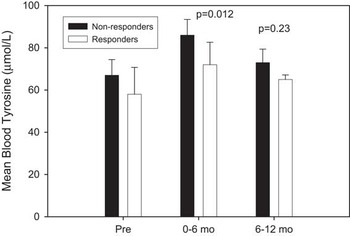
Subjects 6 and 10 responded with the 6R-BH4 and had significant reductions in blood Phe levels of 74% and 39%, respectively. Blood Phe levels showed no change from baseline to 6 and 12 months in the nonresponders (mean±s.d.: 1103±179, 1102±251, 1105±310, respectively; p>0.99). However, there was a significant change over time in blood Tyr levels (mean±s.d.: 67±21, 86±21, 73±18, respectively; p=0.0039), with the increase over baseline significant at 6 months (p=0.012) but not at 12 months (p=0.23, Figure 1). While no statistical tests were performed on the responders, mean Phe for these subjects dropped (mean±s.d.: 667±416, 225±17, 240±14, respectively), and the pattern of change over time in Tyr was comparable to the nonresponders (mean±s.d.: 58±18, 72±15, 65±3, respectively).
Mean tyrosine by time period.

Behavior
Although no significant differences over time were found in the standard scores of the Adaptive Behavior Domains of the VABS-II at either the home or day care settings, the Internalizing score of the Maladaptive Behavior Index (only available for the home setting) changed significantly over time for the 8 nonresponders (p=0.023), with the drop from baseline at 6 months approaching significance (p=0.068) and continued improvement at 12 months (p=0.035; Figure 2). The 2 responders (Subjects 6 and 10) also had lower Internalizing scores at 6 and 12 months, compared to baseline.
Vineland II Internalizing Maladaptive Behavior score prior to Kuvan administration and at 6 and 12 months.

The Externalizing scores were not different from baseline at 12 months, although a transient improvement was observed in the responder group at 6 months.
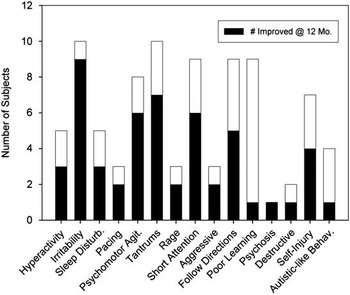
Figure 3 presents the number of individuals among the responders and nonresponders combined who exhibited each of the 15 negative behaviors on the home assessment of the PKU Behavior Checklist at baseline and the number who had improved by the 12-month assessment. The most common behaviors, exhibited by 7 or more subjects, were irritability (n=10), psychomotor agitation (n=8), tantrums (n=10), short attention (n=9), inability to follow directions (n=9), poor learning (n=9), and self-injury (n=7). More than half of those affected at baseline showed some improvement at 12 months in all of these behaviors except for poor learning ability. The more severely delayed participants showed irritability through physical means, such as rocking or hitting self, caregiver, or objects, while the participants with normal to borderline intellectual ability expressed irritation more verbally, such as by scolding their children, saying “shut-up,” or with self-talk such as “sit down and be quiet.” Psychomotor agitation was shown by the inability to sit still, hitting self, hand wringing, or flapping. Tantrums consisted of kicking or hitting, slamming doors, throwing things with verbal participants also yelling and screaming. One severely delayed participant went limp, while another took off her clothes. Those with short attention spans were easily distracted and had trouble focusing. Caregivers reported participants not being able to pay attention long enough to watch a movie or for more than 20 minutes. Directions usually needed to be simple, given one at a time or modeled. Difficulty learning was reflected by the severity of the delay, ranging from having trouble learning parts of the body to having trouble with arithmetic. Self-injury was found in all levels of ability. Some participants hit themselves in different parts of their bodies, sometimes to the point of bruising, and one picked at herself making sores.
Summary of behaviors at home prior to Kuvan administration and at 6 and 12 months.

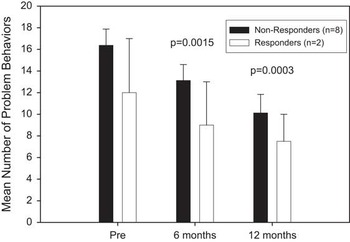
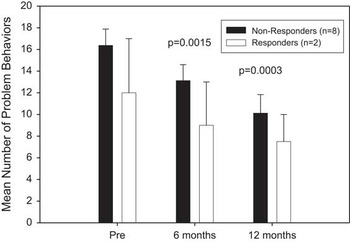
The PKU Behavior Checklist summary score from the home evaluation changed significantly over time for the nonresponders (p<0.0001; Figure 4). At 6 months, the score declined significantly from baseline, and at the end of the 12-month period, a further reduction in negative behaviors was observed (p=0.0015 and p=0.0003, respectively). The responders had lower mean scores initially and followed a similar pattern of change over time. Scores for 7 subjects evaluated at the day care program also declined, but the degree of improvement was smaller (3.7 vs. 6.3 points for the home evaluation) and not statistically significant (results not shown). Two participants did not attend a day program, while one attended infrequently and dropped out of the day program before the study was completed. The person interviewed in the home was more consistent, with 8 participants having the same interviewee throughout the study. Of the 7 participants who attended day programs, only 3 had the same interviewee throughout the study.
Negative behaviors before and after Kuvan administration.

Discussion
The treatment of PKU has been targeted to reduce Phe levels with no significant attention to Tyr levels. In our study, 8 individuals, while taking 6R-BH4, showed no change in blood Phe levels but a significant increase in blood Tyr levels at 6 months. Since the 6R-BH4 is also a co-factor for the Tyr and tryptophan (Trp) hydroxylases,Reference Kappock and Caradonna 15 the behavior improvement may be a result of increased dopamine and serotonin synthesis. It has been shown that homovanillic acid (a dopamine metabolite) and 5-hydroxyindoleactic acid (a serotonin metabolite) were significantly increased in the cerebrospinal fluid in individuals with PKU with supplementation of Tyr and Trp, and showed improved neurological function by assessment of visual reaction time and vigilance.Reference Lykkelund, Nielsen and Lou 16 – Reference Nielsen, Lou and Guttler 18
In our study, it was evident that there were positive changes in behavior at the end of 12 months with no supplementation other than the 6R-BH4. This may be due to the effects of 6R-BH4 on stimulating Try and Trp hydroxylase in the brain via catecholamine synthesis.Reference Fernstrom and Fernstrom 19 In spite of the blood Tyr levels decreasing at the end of 12 months, there was no reversal of the improved behavior.
All subjects, whether a Phe responder or nonresponder, improved in maladaptive behaviors. The two subjects who responded by lowered blood Phe levels (Subjects 6 and 10) had notable improvements in behavior. The 2 subjects with normal IQs (Subjects 2 and 10) showed remarkable improvement in behaviors. Subject 2 had autistic-like characteristics, was impulsive, became frustrated easily, was stubborn, had temper tantrums, and had been physically aggressive. Although many of her autistic-like characteristics remained the same, she was less impulsive and stubborn, more patient, had no temper tantrums, and was not physically aggressive by the end of 12 months. Subject 10 had obsessive compulsive characteristics; became upset over little things, such as her children putting a book in the wrong place on the shelf; had temper tantrums with yelling, screaming, and throwing things; and was physically aggressive toward her husband. Many of these behaviors are the same as those displayed by participants who were more severely impaired, as described in the Results section, but they manifested in more sophisticated ways. Subject 10 had been severely depressed with suicidal thoughts, which she was able to express in words. She was on anti-depressant medication prior to the study. At the end of the study, she no longer needed an anti-depressant medication, was more patient with her children, had fewer temper tantrums, and was not physically aggressive.
Although available standardized instruments were examined, and the best one was chosen for the population included in this study, no instrument was found that covered the range of cognitive abilities, that measured both everyday functioning and maladaptive behaviors, and that could show gains in everyday functioning for the individuals whose intelligence quotients were 20 and below. These measurements did show their maladaptive behavior changes, but not their increase in awareness. This is the reason we chose to develop our own PKU checklist, which included common behaviors that are observed in late-diagnosed and untreated individuals with PKU. The number of behaviors on the PKU Behavior Checklist that improved for each individual ranged from 3 to 10, with most participants improving between 4 and 6 behaviors. No subject exhibited increased negative behaviors. A typical statement from the care providers was that they seemed more aware and alert. On the PKU Behavior Checklist, short attention span, poor ability to follow directions, and poor ability to learn categories reflect the examiner’s observation of impaired awareness and alertness, plus the qualitative comments from the person being interviewed prior to treatment. Six out of 9 improved in short attention at home. At home, 5 improved in poor ability to follow directions and 1 in poor ability to learn. Mood stabilization with less anxiety, sadness, temper tantrums, aggression, and self-injury were important improvements for each participant’s quality of life.
The study was limited by the small sample size and the need to differentiate responders from nonresponders in the statistical analyses. The small number of subjects, coupled with the need to account for possible differences between responders and nonresponders, may have compromised some findings, particularly in the responder group.
Conclusion
This small pilot study suggests that the implementation of 6R-BH4 therapy has an effect on behavior in patients with PKU with or without a response in blood Phe. It has been shown that supplementation with oral BH4 in mice increased Tyr hydroxylase activity, thereby stimulating activity in the dopaminergic neurons, which may have an effect on behavior.Reference Thöny, Calva and Scherer 20 Further studies are needed to investigate the effect of changes in Tyr blood levels due to 6R-BH4 supplementation. A larger study would be needed to evaluate the effects 6R-BH4 on the central nervous system in individuals with PKU and the effects on the conditions associated with decreased dopamine and serotonin levels, including anxiety and depressive disorders.
Disclosures
Shohi Yano has the following disclosures: BioMarin Pharmaceutical, Advisor, Consulting fee; BioMarin Pharmaceutical, Research, Research support.
Kathryn Mosley has the following disclosures: BioMarin Pharmaceutical, Consultant/Advisor, Consulting fee; BioMarin Pharmaceutical, Research, Research support.
Martha Ottina and Colleen Azen have nothing to disclose.