INTRODUCTION
Humans have evolved distinct facial expressions that are reliably associated with specific emotional experiences and convey the experience to others in order to coordinate interactions between individuals as they respond to challenges (e.g., threats, injustice) and opportunities (e.g., formation of bonds, pursuit of resources) in their social environment (Keltner et al., Reference Keltner, Ekman, Gonzaga, Beer, Davidson, Scherer and Goldsmith2003). Affective prosody, the nonlexical component of speech that communicates information about the emotional states of others, also contributes to human social behavior (Edwards et al., 2002).
Neuropsychological processes that are important for emotion perception may be dependent on two neural systems with a reciprocal functional relationship: the ventral and the dorsal system. The ventral system, including the amygdala, insula, ventral striatum, ventral regions of the anterior cingulate gyrus, and orbitofrontal and ventrolateral prefrontal cortex, is important for the identification of the emotional significance of environmental stimuli and the production of affective states. It is additionally important for automatic regulation and mediation of autonomic responses to emotive stimuli and contexts accompanying the production of affective states. The dorsal system, including the hippocampus and dorsal regions of the anterior cingulate gyrus and prefrontal cortex regions, where cognitive processes are integrated with and can be biased by emotional input, is important for the performance of executive functions, including selective attention, planning, and effortful rather than automatic regulation of affective states (Phillips et al., Reference Phillips, Drevets, Rauch and Lane2003a). Consequently, it has been proposed that psychiatric disorders with structural or functional abnormalities in these neural systems might be associated with emotion perception deficits (Phillips et al., Reference Phillips, Drevets, Rauch and Lane2003b).
Data from structural and functional imaging studies on obsessive–compulsive disorder (OCD) have suggested abnormalities in the orbitofrontal cortex, anterior cingulate, caudate, and thalamus, structures interconnected by well-described neuroanatomic circuits (Chamberlain et al., Reference Chamberlain, Blackwell, Fineberg, Robbins and Sahakian2005; Saxena & Rauch, Reference Saxena and Rauch2000). Following reports that patients with Huntington’s disease, a condition characterized by basal ganglia abnormality, showed an inability to perceive facial expressions of disgust, research was extended to patients with OCD (Gray et al., Reference Gray, Young, Barker, Curtis and Gibson1997; Sprengelmeyer et al., Reference Sprengelmeyer, Young, Calder, Karnat, Lange, Hömberg, Perrett and Rowland1996). A study by Sprengelmeyer et al. (Reference Sprengelmeyer, Young, Pundt, Sprengelmeyer, Calder, Berrios, Winkel, Vollmoeller, Kuhn, Sartory and Przuntek1997) showed that all patients with OCD, as well as all patients with Gilles de la Tourette’s syndrome with comorbid obsessive–compulsive symptoms, exhibited impaired recognition of disgust, while patients with other anxiety disorders, patients with Gilles de la Tourette’s syndrome without obsessive–compulsive symptoms, and healthy controls did not present such deficits. More recently, Corcoran et al. (Reference Corcoran, Woody and Tolin2008) partially replicated these findings, as the group of patients with OCD that they examined was significantly less accurate at recognizing facial expressions of disgust as compared to the normal and panic disorder comparison groups. In addition, patients with OCD who showed poor recognition of disgust were more functionally impaired and reported more severe OCD symptoms than those who performed normally on the task. On the other hand, it has been shown that patients with OCD displayed a bias in perceiving facial emotions as sad, especially for female faces (Aigner et al., Reference Aigner, Sachs, Bruckmüller, Winklbaur, Zittel, Kryspin-Exner, Gur and Katschnig2007). Finally, no significant differences in emotion recognition were found between adult patients with OCD and healthy controls in other studies (Korneich et al., Reference Korneich, Blairy, Philippot, Dan, Foisy, Hess, Le Bon, Pelc and Verbanck2001; Montagne et al., Reference Montagne, de Geus, Kessels, Denys, de Haan and Westenberg2008; Parker et al., Reference Parker, McNally, Nakayama and Wilhelm2004), and nor between children with OCD compared to children with other anxiety disorders and nonclinical children (Allen et al., Reference Allen, Abbott and Rapee2006).
So far, no studies have explored the perception of prosodic intonation in patients with OCD. Other patient populations (i.e., patients with schizophrenia or bipolar disorder) who present deficits on facial emotion perception (Bozikas et al., Reference Bozikas, Kosmidis, Anezoulaki, Giannakou, Andreou and Karavatos2006b; Edwards et al., Reference Edwards, Jackson and Pattison2002; Kosmidis et al., Reference Kosmidis, Bozikas, Giannakou, Anezoulaki, Fantie and Karavatos2007; Mandal et al., Reference Mandal, Pandey and Prasad1998) also exhibit impaired affective prosody recognition (Bozikas et al., Reference Bozikas, Kosmidis, Anezoulaki, Giannakou, Andreou and Karavatos2006a, Reference Bozikas, Kosmidis, Tonia, Andreou, Fokas and Karavatos2007; Edwards et al., Reference Edwards, Jackson and Pattison2002). Accordingly, examination of both modalities of emotion-related information reception would provide a more comprehensive evaluation of emotion processing and human social communication in OCD.
Our purpose in undertaking the present study was to investigate the ability to perceive facial and, for the first time, vocal affect in a group of patients with OCD and to explore the specific emotions that might be troublesome for them. Regarding facial affect processing, a task aiming to examine the ability to match appropriate emotions of persons involved in everyday scenarios was also included. This task is presumably more demanding than those simply requiring identification or matching of facial emotional expressions. More specifically, the above task requires participants to process contextual information, to decode everyday scenarios, and finally, to infer the appropriate emotion and select it among several alternatives. We predicted that patients would present difficulties in processing facial, particularly disgust, and vocal affect cues.
METHOD
Participants
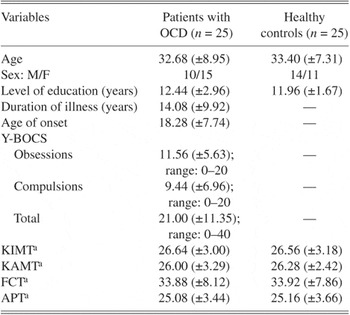
Participants were 25 (10 men) outpatients with a diagnosis of OCD and 25 (14 men) healthy controls. Participants in the two groups gave their informed consent, and experimenters adhered to international ethical standards relating to research participation. The patient group included patients with a diagnosis of OCD who were followed up at a community mental health center, irrespective of demographic and clinical characteristics (e.g., level of psychopathology), while healthy participants were recruited from the community. All patients were diagnosed according to Diagnostic and Statistical Manual, 4th edition, criteria (American Psychiatric Association, 1994); their diagnosis was confirmed with the Greek version (translation and adaptation to the Greek language by S. Beratis) of the Mini International Neuropsychiatric Interview (4.4) (Sheehan et al., Reference Sheehan, Lecrubier, Sheehan, Amorim, Janavs, Weiller, Herguetta, Baker and Dunbar1998). Four patients had a comorbid diagnosis of major depression and two patients a comorbid diagnosis of panic disorder. Severity of OCD symptoms was measured with the Yale–Brown Obsessive Compulsive Scale (Y-BOCS) (Goodman et al., Reference Goodman, Price, Rasmussen, Mazure, Delgado, Heninger and Charney1989a, Reference Goodman, Price, Rasmussen, Mazure, Delgado, Heninger and Charney1989b). Their mean score on the obsession subscale was 11.56 [standard deviation (SD): 5.63, range: 0–20] and on the compulsion subscale was 9.44 (SD: 6.96, range: 0–20), while the mean Y-BOCS total score was 21 (SD: 11.35, range: 0–40). Only one patient was free of obsessions and compulsions, while all other patients presented various levels of psychopathology. At the time of the study, 16 patients were receiving antidepressants (5 of them were also coadministered atypical antipsychotics) and 1 patient was in monotherapy with atypical antipsychotic, while the other eight were free of medication. All patients were also receiving cognitive-behavioral therapy. Demographic characteristics of the two groups, as well as patient clinical data, are presented in Table 1.
Participant demographic characteristics, clinical data, and test scores

Note.
F, female; M, male.
a Test scores for KIMT, KAMT, FCT, and APT represent the number of correct responses.
Exclusion criteria for both groups included neurological and developmental disorders, a history of head injury, alcohol or drug abuse during the 6-month period prior to testing, and any physical illness that may have affected their cognitive performance. Additional criterion for healthy participants was a history of a psychiatric disorder or treatment; all healthy participants were screened during a semistructured interview by the experimenter before entering the study.
Emotion Perception Tests
Kinney’s matching tests
A computerized test assessing identity [Kinney’s Identity Matching Test (KIMT)] and affect [Kinney’s Affect Matching Test (KAMT)] facial processing was administered (Kinney, Reference Kinney1995; Kinney et al., Reference Kinney, Fantie, Pascualvaca, Rodriguez and Mirsky1995). Each condition consisted of 30 stimuli. Every stimulus consisted of a target photograph of a child in the upper part of the computer screen and three other children’s photographs on the lower part of the screen. The black-and-white photographs depicted four girls and three boys, six Caucasian and one African American. The first condition administered was the KIMT, in which participants were asked to match one of the lower photographs to the target photograph based on the person’s identity. In order to obscure the identity to some extent, in some photographs the children’s features were altered with a cap, glasses, etc. In the second subtest, the KAMT, participants were asked to match the photographs based on the children’s emotional expressions. The emotional expressions included happiness, sadness, fear, anger, disgust, and surprise; five items for each emotion (5 faces × 6 emotions).
This test has high internal consistency in the Greek population, and its validity was also established, as the KIMT was able to differentiate healthy adults from patients with right-hemisphere (but not left) stroke, while the KAMT was able to differentiate healthy adults from right- and left-hemisphere stoke (Hiou et al., Reference Hiou, Vagia, Haritidou, Karakostas and Kosmidis2004).
Fantie’s Cartoon Test
Fantie’s (Reference Fantie1989) Affective Cartoon Test is a computerized test that comprises 57 drawings; each one depicts an everyday scenario with one or more people, and in each item, the face of the protagonist is missing. On each item, a series of seven photographs depicting the basic emotional expressions [happiness (9 items), fear (9 items), anger (9 items), disgust (9 items), sadness (11 items), and surprise (10 items)] is presented at the bottom of the computer screen. Participants must decode and interpret the social scenario in order to correctly indicate one of the six emotional expressions that best fit the missing face.
This test has high internal consistency in the Greek population, and its validity has also been established, as the Fantie’s Cartoon Test (FCT) was able to differentiate healthy adults from stroke patients, while patients with right-hemisphere stroke had poorer performance than patients with left-hemisphere stroke (Hiou et al., Reference Hiou, Vagia, Haritidou, Karakostas and Kosmidis2004).
Affective Prosody Test
In this test, 30 audio-recorded sentences of emotionally neutral content (e.g., “Today is Wednesday”) were presented with prosodic intonation by a male actor portraying one of the basic emotions (happiness, sadness, surprise, fear, and anger, as well as neutral intonation), with five items for each emotion (5 stimuli × 6 emotions) (Hiou et al., Reference Hiou, Vagia, Haritidou, Karakostas and Kosmidis2004). The participants had a list of the emotion names in front of them and made their choice after hearing each sentence. A training trial, in which participants heard a sentence with the above six prosodic intonations, preceded the experiment.
This test has high internal consistency in the Greek population, and its validity has also been established, as the Affective Prosody Test (APT) was able to differentiate healthy adults from stroke patients (Hiou et al., Reference Hiou, Vagia, Haritidou, Karakostas and Kosmidis2004).
Statistical Analyses
Group comparisons (patients with OCD and healthy controls) were conducted with two-tailed t tests, for continuous data, and with chi-square tests, for categorical data. Repeated-measures analyses of variance were calculated, with group (patients and controls) as the between-groups factor and the emotion categories from each of the three tests measuring perception of affect (KAMT, FCT, and APT) as the within-subject factor. The presence of any correlations of performance on the KIMT, KAMT, FCT, and APT with age of onset and duration of illness, as well as with the scores on the Y-BOCS (obsessions, compulsions, and total), was investigated using two-way Pearson coefficients. Moreover, the correlations of individual emotion expressions on the KAMT, FCT, and APT with the scores on the Y-BOCS (obsessions, compulsions, and total) were explored. Due to the large number of correlations, we used the Bonferroni correction procedure (dividing the alpha level by the number of bivariate correlations) in order to make the criterion of significance more conservative.
RESULTS
Patients with OCD and healthy individuals did not differ significantly in age [t(48) = 0.31, p = .76], level of education [t(48) = −0.71, p = .48], and male-to-female ratio [χ2(1) = 1.28, p = .26].
Regarding the total scores, patients with OCD and the healthy group did not differ significantly on the KIMT [t(48) = −0.92, p = .93], KAMT [t(48) = 0.34, p = .73], FCT [t(48) = 0.02, p = .98], and APT [t(48) = 0.08, p = .94] (Table 1).
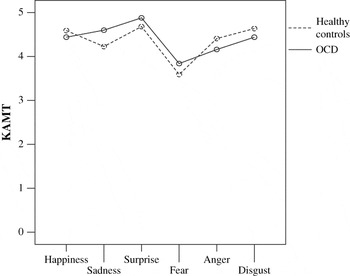
Repeated-measures analyses of variance for the six emotions derived from the KAMT revealed no significant effect for group [F(1,45) = 0.91, p = .76]. There was a significant main effect for emotion categories [F(5,225) = 13.91, p ≤ .001] but no interaction of group × emotion categories [F(5,225) = 1.88, p = 0.1]. The rank orders of the six emotions for both groups are presented in Figure 1. Deviation contrasts were conducted in order to compare the effect of each emotion to the overall experimental effect; surprise [F(1,47)=35.08, p < .001] and fear [F(1,47)=33.28, p < .001] produced higher and lower scores, respectively, in comparison to the mean emotion effect.
Performance on specific emotions on the KAMT of the two groups.

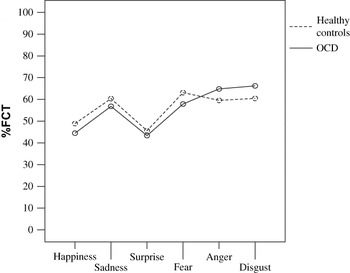
Regarding FCT, no significant effect for group was found [F(1,47) = 0.038, p = .85]. There was a significant main effect for emotion [F(5,235) = 10.28, p ≤ .001] but no interaction of group × emotion [F(5,235) = 0.93, df = 235, p = .45]. The rank orders of the six emotions for both groups are presented in Figure 2. Deviation contrasts showed that happiness [F(1,47) = 20.93, p < .001] and surprise [F(1,47) = 23.37, p < .001] produced lower scores and anger [F(1,47) = 5.28, p = .03] and disgust [F(1,47) = 8.84, p = .005] produced higher scores compared to the mean emotion effect.
Performance on specific emotions on the FCT of the two groups.

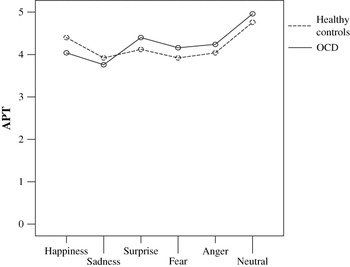
Finally, on the APT, there was no significant effect for group [F(1,48) = 0.17, p = .68]. A significant main effect for emotion categories [F(5,240) = 7.48, p ≤ .001] but no interaction of group × emotion categories [F(5,240) = 1.08, p = .37] was found. The rank orders of the six emotions for both groups are presented in Figure 3. Deviation contrasts showed that only sad [F(1,47) = 9.10, p = .004] and neutral stimuli [F(1,47) = 57.95, p < .001] deviated from the mean, with the former producing lower and the latter higher scores.
Performance on specific emotions on the APT of the two groups.

Only performance on the APT was significantly correlated with the severity of compulsion subscale on the Y-BOCS [r(25) = −.45, p = .023]; after Bonferroni correction, this association was no longer significant (p = .05/20 = .0025). Scores on the compulsion subscale of the Y-BOCS were significantly correlated with recognition of sadness on the APT [r(25) = .42, p = .036] and fear on the KAMT [r(25) = .53, p = .006), while total scores on the Y-BOCS were significantly correlated with fear on the KAMT [r(25) = .41, p = .042]; after Bonferroni correction, these associations were no longer significant (p = .05/18 = 0.0027). No other significant correlations were found between performance on the KIMT, KAMT, FCT, and APT and age of onset, duration of illness, and scores on the obsession subscale, compulsion subscale, and total scores on the Y-BOCS, as well as between recognition of individual emotion expressions and scores on the obsession subscale, compulsion subscale, and total scores of the Y-BOCS.
DISCUSSION
Patients with OCD in the present study were not impaired in the perception of emotion, when given tasks with either facial expressions [still photographs (KAMT) or sketches of everyday scenarios (FCT)] or vocal expressions (APT), as compared with age-, sex-, and education-matched healthy individuals. Moreover, patients with OCD did not differ from healthy individuals in discriminating facial identity (KIMT). With regard to each emotion type separately, patients performed equally well as healthy individuals in all the emotions examined (KAMT: happiness, sadness, fear, anger, disgust, and surprise; FCT: happiness, sadness, surprise, fear, anger, disgust, and neutral expression; APT: happiness, sadness, surprise, fear, anger, and neutral intonation).
Our findings are in accordance with the results of a previous study that found no difference in emotion recognition between patients with OCD and normal controls (Allen et al., Reference Allen, Abbott and Rapee2006; Korneich et al., Reference Korneich, Blairy, Philippot, Dan, Foisy, Hess, Le Bon, Pelc and Verbanck2001; Montagne et al., Reference Montagne, de Geus, Kessels, Denys, de Haan and Westenberg2008; Parker et al., Reference Parker, McNally, Nakayama and Wilhelm2004). Moreover, in a recently published study (Aigner et al., Reference Aigner, Sachs, Bruckmüller, Winklbaur, Zittel, Kryspin-Exner, Gur and Katschnig2006) that used only two emotions, happiness and sadness, patients with OCD were not impaired on sensitivity, nor did they show a deficit in differentiating the intensity of expression within an emotion. However, our results are inconsistent with the findings of the Sprengelmeyer et al. (Reference Sprengelmeyer, Young, Pundt, Sprengelmeyer, Calder, Berrios, Winkel, Vollmoeller, Kuhn, Sartory and Przuntek1997) study, which investigated the recognition of facial expressions. In this study, patients with obsessive–compulsive symptoms (OCD group and Gilles de la Tourette’s syndrome with OCD symptoms group) showed impaired recognition of disgust in comparison with patients with other anxiety disorders, patients with Gilles de la Tourette’s syndrome without OCD symptoms, and healthy controls. The major difference between our investigation and the aforementioned study is the number of patients with OCD who were recruited (25 in our study vs. only 12 in the other study) as well as the cultural homogeneity of the sample (Greek patients vs. a combination of English and German patients). Moreover, our study included a test of affective prosody, on which our patients and healthy control group did not differ. Despite the fact that no significant associations were found between performance on the emotion perception tasks and clinical characteristics (age of onset and duration of illness) or symptom severity of our OCD patients, we cannot exclude the possibility that inconsistencies in the results of our study and the Sprengelmeyer et al. (Reference Sprengelmeyer, Young, Pundt, Sprengelmeyer, Calder, Berrios, Winkel, Vollmoeller, Kuhn, Sartory and Przuntek1997) study might be attributable to differences in the clinical characteristics or symptom severity of the patient samples. In the study by Corcoran et al. (Reference Corcoran, Woody and Tolin2008), the impaired ability to recognize disgust expressions in patients correlated with OCD symptom severity. Based on the means and SDs of OCD symptoms of their patient sample, it is clear that our patients were less symptomatic; this might explain the negative findings of the present study. In any case, no significant correlations were found, in our study, between general performance on the KIMT, FCT, and APT or recognition of individual emotion expressions on one hand and scores on the obsession subscale, compulsion subscale, and total scores of the Y-BOCS on the other hand.
One major concern regarding the lack of significant differences in emotion recognition between patients with OCD (n = 25) and healthy controls (n = 25) could be that the sample size might have limited the potential for detecting such differences between groups. However, power analysis demonstrated that with an overall sample of 50 subjects, a two-group comparison, and six within-subject variables, there was sufficient power (0.8) to detect a small-to-medium effect (0.3) for the between-group comparisons and a small effect (0.15) for the within-subjects interactions. Another possible concern regarding the lack of significant differences between the two groups might be the fact that KIMT is a matching rather than a labeling test and matching emotional expressions is easier than labeling; furthermore, a task including faces depicting varying degrees of disgust might have been more sensitive in revealing significant deficits in patients with OCD. Finally, it would have been of great interest to take into consideration the specific OCD subtype of each participant; unfortunately, qualitative Y-BOCS data were not available for this patient sample.
In summary, emotion processing does not appear to be deficient in patients with OCD. We have expanded previous findings by including not only facial but also vocal emotional stimuli; thus, overall affect processing in OCD appears to be intact. This conclusion is further strengthened by the normal performance of patients with OCD in matching appropriate emotions to everyday scenarios (FCT).
ACKNOWLEDGMENTS
There were no sources of financial support.