INTRODUCTION
This paper aims to consider the transitional period between Roman and early medieval Britain from a zooarchaeological perspective by using the mammal and bird bone assemblages from the baths basilica excavations at Wroxeter (Viroconium Cornoviorum). It will assess the current perspectives that account for this period.
The period between the ending of Roman Britain, in the early fifth century a.d., and the emergence of Anglo-Saxon England, in the sixth and seventh centuries a.d., remains a poorly understood epoch (particularly in the western part of the country). Traditionally this period was characterised as the ‘Dark Ages’; a period of social upheaval, lawlessness, economic and technological collapse. In other words, the demise of Roman Britain culminated in a complete systems breakdown (see below). However, this perspective has been modified to a degree in recent years and more subtle perspectives have emerged.
These perspectives offer quite divergent interpretations and elucidation of this period remains highly contentious. A variety of factors have contributed to this dichotomous situation, including sparse physical evidence (difficult to detect archaeologically), problematic artefact typologies (resulting in incomplete dating frameworks), geographically-biased site prospection (owing to the structure of British archaeology, particularly since the advent of developer-funded research), and dubious documentary evidence (often politically motivated and factually incorrect). Interpretative factors include the extent to which the indigenous population had succumbed to the processes of Romanisation, the exact nature and timing of the Roman administration's abandonment of Britannia, and the precise character and extent of Germanic migration and influence.
It is possible to group different interpretations of this period into five broad categories, although there is some commonality between them: ‘Progressive Devolution’, ‘Discontinuity’, ‘Unsuccessful Acculturation’, ‘The East–West Divide’, and ‘Continental Late Antiquity’. Summaries of the first four perspectives are modified versions of those provided by Dark.Footnote 1
PROGRESSIVE DEVOLUTION
This traditional interpretation argued that Roman Britain wound down as the fifth century a.d. progressed. No Roman political and economic structures and culture existed beyond a.d. 450. Furthermore, Britain appears to have been in gradual decline for the previous century. The only possible exception was Christianity, which persevered. Germanic migration commenced in the very late fourth century in eastern England, whilst a resumption of a way of life more akin to the pre-Roman Iron Age returned across the northern and western margins of Britain. The migrants were initially pagan, whilst the indigenous peoples practised Christianity. During the sixth century the Germanic migrants started to conquer the west and became dominant across most of Britain by the seventh century. This view prospered until the late 1970s. It was fundamentally tied to the ‘continuity debate’. In its widest sense, this debate centred on whether continuous patterns of political, cultural, economic and geographical development can be traced from British prehistory to the present. Within archaeology it focused on whether the histories of specific towns had their origins in the Romano-British period. The possible late fourth to early fifth century overlap between a functioning Roman province and Germanic migration was deemed as likely affirmation. The transition from this perspective to that of ‘Discontinuity’ followed the ‘End of Roman Britain’ conference held at the University of Durham in 1978.Footnote 2
DISCONTINUITY
This perspective argued that a distinct and identifiable discontinuity existed between the demise of Roman Britain and the emergence of Anglo-Saxon England. Roman Britain had prospered until approximately a.d. 400, but then dramatically collapsed around a.d. 430 leaving no obvious traces. Relatively small-scale Germanic migration started to occur in eastern England from the early to mid-fifth century. Therefore, there was no overlap between a functioning Romano-British province and the evolution of an Anglo-Saxon kingdom. Post-Roman indigenous British society was socially, economically and technologically very similar to that of the migrants. The indigenous population were Christian and produced little in the way of identifiable material culture. The migrants gradually absorbed the indigenous people and their institutions, through military action and political alliances, leading to the emergence of Anglo-Saxon England in the seventh century. This view had become the accepted version of events by the early 1990s.Footnote 3
UNSUCCESSFUL ACCULTURATION
The proponents of ‘Unsuccessful Acculturation’ argued that Roman Britain underwent a transition between the third and fourth centuries a.d., rather than in the fifth century. The model of Classical urbanism had floundered by the fourth century and Romano-British towns merely functioned as ‘administrative villages’. This façade did not persevere after the Roman administration's abandonment of Britannia. The concept of Romanitas never took hold and was only ever a passing fad. Conversely, the countryside developed considerably. Villas were the focus and village-like settlements began to form around them from the fourth century a.d. Only small-scale migration occurred and the indigenous population of eastern England adopted Germanic fashions from the Continent. These did not permeate into northern and western Britain until later. This argument was initially put forward in the 1980s and co-existed with the ‘Discontinuity’ perspective.Footnote 4
THE EAST–WEST DIVIDE
This perspective is similar to ‘Unsuccessful Acculturation’ with one exception; the indigenous population maintained certain aspects of the Roman administrative system into the fifth century a.d. Britain was essentially divided into two halves. In the east, society centred on a highly Romanised Christian élite, whilst to the west and north society focused on an unRomanised pagan aristocracy. During the early fifth century, the Romanised Christian élite depended upon Germanic mercenaries, who ‘rebelled’ and quickly became dominant in the east. Across northern and western Britain tribal kingship kept society free from direct Germanic control, although its aristocracy were politically and militarily subordinate to the east by a.d. 500. By the mid-fifth century the whole indigenous population was governed by Christian rulers who deferred to pagan Anglo-Saxon overlords. The latter attempted to retain aspects of the former Roman infrastructure, whilst the indigenous population adopted Germanic fashions.Footnote 5
CONTINENTAL LATE ANTIQUITY
Between the fourth and sixth centuries a.d., Britain underwent the same cultural, political, social and economic transition as Continental Europe. Britain during this period shared the same Romano-Christian identity with the rest of Europe. In some respects, Britain's Roman heritage survived longer than in other North-Western provinces, hence the ability of the establishment to promote Christianity in Ireland.Footnote 6
A ZOOARCHAEOLOGICAL APPROACH
All these perspectives have their limitations, principally because of the datasets they are based upon, as previously outlined. In some respects, faunal remains have certain advantages over structural and artefactual evidence from this period, because they relate directly to the local economy and distribution networks, unlike most other surviving artefact categories that must have constituted luxury items and were generally traded over long distances (such as the various contents of pottery vessels). Therefore, animal bones may be used to assess how local and regional economies functioned and how communities responded to wider events.
PALAEOGASTROMY
If diet and its culinary expressions are to be utilised in relation to ethnicity and acculturation, then it is necessary to go beyond the simplistic reconstruction of production methods that are so common to many zooarchaeological studies — an increasingly frequent criticism.Footnote 7 As stated by Parker-Pearson, ‘… what we might call palaeogastronomy — has yet to make its mark as a recognised aspect of the discipline’.Footnote 8
Attempting to identify ethnic and ideological affiliations from archaeological evidence is an exceptionally fraught process, one that perhaps embodies the fundamental problem central to all archaeological research. Material cultural does not necessarily equate to social groups or identities; changes in material culture do not automatically imply ideological change.Footnote 9 In part, analyses of food residues may elevate the situation because, as Gerritsen stated, ‘… food and eating habits often function as a lens, a means of analysing broader social and cultural patterns and processes’.Footnote 10 Consumption embodies inter-human relationships on many different levels. Hamilakis has summarised the basic premise: ‘First, it is a primarily communicative signifying social act and secondly, it is a means of social self construction.’Footnote 11 This has been clearly demonstrated by anthropological and historical research; to summarise:Footnote 12
food distribution: echoes the politics of allocation and the economics of production and taxation;
food preparation: incorporates gender politics, division of labour, plus cultural and social conceptions of flavour, presentation and dining etiquette;
food consumption: reinforces group identity and competition (whether geographical, social or ethnic), as well as notions of sharing and hospitality, taboos and specific customs.
It has been argued that dietary preferences and culinary practices are more ‘resilient and conservative’ than other cultural behaviours. This makes them ideally suited to analysing evolving cultural identities.Footnote 13 Reputedly ‘socio-cultural’ behavioural patterns alter more slowly than do ‘economic-technical’ developments and, therefore, the ‘foreignness’ of another people may be observed through their culinary preferences.Footnote 14 This assumption is questionable, and is partially contradicted by the assertion that cuisines do not ‘travel’ particularly well because of the availability of ingredients etc., and are consequently subject to all manner of aberrations.Footnote 15 Romano-British mortaria provide an interesting case-in-point, because their adoption, production, longevity and even function(s) differed considerably from the rest of the Empire, which led Cool to suggest that they were not being used simply to prepare Romanised food.Footnote 16
Numerous case-studies have successfully charted how dietary modifications occur within a society when that society has undergone upheaval through external or internal pressures. Ziemann, for instance, demonstrated that there was an initial rush for all things ‘Western’ after the 1989 reunification in East Germany (the former German Democratic Republic) before a desire for ‘traditional’ foodstuffs reasserted itself (out of nostalgia).Footnote 17 Other studies have shown how immigrants initially modify their dietary habits to ‘fit-in’, but once they become established and accepted into their host-nations, their traditional cuisines undergo a renaissance, for example the Greek community in post-Second World War North America.Footnote 18 If caution is applied it may be possible to identify particular dietary preferences and patterns from archaeological animal bone assemblages. Various analyses have successfully achieved this, for instance at the Colonial period sites in North America (often supported by documentary evidence).Footnote 19 Attributing ethnic identity through food remains has often hinged upon the use of taxonomic signatures to denote food avoidances, because almost all societies have some socially-prohibited foods.Footnote 20 Traditional zooarchaeological approaches are also being supplemented by human bone stable isotope analysis, which provides the means for identifying dietary habits between and within different populations. Carbon and nitrogen isotope values obtained from inhumations at the Poundbury Camp cemetery site, Dorchester (Dorset) demonstrated a clear difference between the Iron Age/early Roman and late Roman populations.Footnote 21 The former had a uniform terrestrial based diet, whereas the latter had a more varied terrestrial diet (based on the differing isotope values derived from plant and animal proteins). Late Roman inhumations perceived to represent high-status individuals (those buried in mausolea and lead-lined coffins) also demonstrated a marine dietary component, which was almost entirely absent in the general population. The one post-Roman skeleton analysed produced values consistent with a terrestrial diet with little animal protein in it. Similar work from sites on Orkney demonstrated that marine resources contributed little to the Pictish diet, but made a significant contribution in the Viking Age (initially occurring in men buried with Scandinavian-style grave goods and later in Christian burials of both sexes), which peaked in the medieval period and declined in the late Middle Ages. Ethnic (Scandinavian immigration) and possibly gender differences were thought to have accounted for the Viking Age increase; religious practices (meat avoidance on fast days) for the medieval peak; and environmental change (higher temperatures allowing greater agricultural production) and corresponding loss of markets (trading of dried fish) for the late Middle Ages decline.Footnote 22
PREVIOUS WORK
Most studies have concentrated on eastern and southern England (rather than the western and northern peripheries) and many of these have focused on later Anglo-Saxon sites such as Southampton (Hants.).Footnote 23 Few attempts have been made to compare Romano-British and early medieval animal bones assemblages. A number of factors account for this situation, including the lack of sites with direct continuity between the two periods and the low number of fifth- and early sixth-century a.d. animal bone assemblages, most of which are small, such as Mucking (Essex) and Portchester (Hants.).Footnote 24 One of the few syntheses has been Crabtree's comparison of the assemblages from Icklington (a late Roman villa/‘market centre’) and West Stow (an early Saxon village), situated only 1.5 km apart in west Suffolk.Footnote 25 Cattle dominated the Icklington assemblage, whilst sheep are predominant among the West Stow fauna; the high proportion of cattle was interpreted as provisioning from outside the immediate vicinity because the area is ideal for sheep husbandry. Based on cattle and sheep mortality profiles, it was concluded that Icklington was a consumer site (no neonates and few younger animals) and West Stow was a producer/self-sufficient site (some neonates and a greater proportion of young animals). Systematic butchery (presumably by specialist butchers) was noted at Icklington, but was conducted on a more ad hoc basis at West Stow. Despite these differences, some degree of continuity did seem to exist between the two assemblages; the size and conformation of cattle and sheep between the two sites (and periods) remained fairly consistent, although interestingly the animals were slightly smaller at West Stow. The evidence led Crabtree to conclude that, ‘… what we see … in the fifth century is the collapse of the Roman market system, but not a wholesale system collapse’.Footnote 26
WROXETER
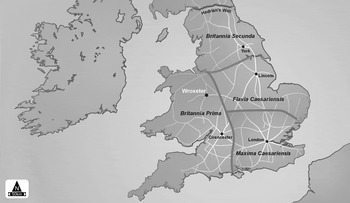
Wroxeter is located in Shropshire (NGR SJ 56 08), part of the northern Welsh Marches region (fig. 1). It is sited on the northernmost crossing-point of the River Severn at the northern terminus of Watling Street. It was the fourth largest Roman city in Britain, in terms of enclosed area within the city walls. Wroxeter was considered to have been a ‘failed’ city because it was assumed to have been sparsely populated.Footnote 27 However, recent geophysical survey has indicated the presence of large numbers of buildings and structures not previously detected.Footnote 28 Wroxeter would have had a profound impact on the surrounding countryside, resulting in agricultural intensification. Traditionally, the indigenous population is thought to have remained socially and materially ‘poor’,Footnote 29 and thus unRomanised. However, it has been postulated, but not substantiated, that the pre-Roman tribal grouping (the Cornovii) may have measured social status through cattle ownership.Footnote 30 If this were the case, then this ‘wealth-on-the-hoof’ attitude may have continued into the Romano-British period.
Location of Wroxeter.

BATHS BASILICA SITE
Large-scale excavations were conducted at the baths basilica between 1966 and 1990, under the direction of Philip Barker.Footnote 31 The excavations revealed one of the few sites in Britain with direct continuity between the late Romano-British and early medieval periods; its post-Roman evidence is rare in Britain. The sequence outlined below follows the excavation report, but it should be noted that this interpretation has been challenged.Footnote 32
The baths basilica continued in use until the early fifth century a.d., when it ceased to operate as a public amenity (Phases T–V and W). For a relatively short period, the baths basilica was turned-over to industrial use (Phase X), after which the roof and upper walls were dismantled before it came back into public use (Phase Y).Footnote 33 During this phase there was little evidence for internal structures within the area of the basilica, with the exception of one stone structure in the southern aisle. However, heavily worn surfaces indicated that this area was in constant use by large numbers of people. The excavators have suggested this phase might represent an open-air market, with a municipal office or tax-collection point.Footnote 34 Taxation in-kind (annona militaris) was practised in the late Roman period and presumably agricultural produce would have formed an important component (see below).
The last phase of activity at the baths basilica consisted of major reorganisation and development of the site (Phase Z). The excavators proposed that the public amenity became a private residence with controlled access. A complex of buildings is thought to have been erected within the shell of the basilica, as a single, planned entity that has become known as the ‘Great Re-building’. Central to this complex was a large structure, reminiscent of a British ‘winged-corridor’Footnote 35 or a Continental ‘tower-façade’ villa.Footnote 36 The architectural style of these buildings — which it has been suggested used Roman units of measurement (pes Monetalis) — might indicate that whoever was in control was deliberately promoting their Romanitas. There are two interpretations of the ‘Great Re-building’: it was either the seat of a sub-Roman ruler (a tyrannus to echo Gildas’ memorable word) who emerged from the tribal élite and/or upper echelons of the Roman administration or it may have been the centre of a Roman bishopric.Footnote 37 The village of Wroxeter had an important early Anglo-Saxon minster church that possibly had links back to a post-Roman British church.Footnote 38 The two scenarios are not necessarily mutually exclusive, but what is evident is that a powerful authority emerged from the disintegrating Roman administration in the early medieval period.
BATHS BASILICA PHASING
Based on stratigraphy, artefact typologies, scientific dating and more subjective criteria, such as the probable life-span of wooden buildings, the following chronology has been suggested for the baths basilica:Footnote 39
Phase T–V (the Baths Basilica): late third–fourth century a.d.
Phase W (the Baths Basilica): late fourth–mid-fifth century a.d.
Phase X (the ‘Building Yard’): late fifth–mid-sixth century a.d.
Phase Y (the ‘Market Place’): early sixth–late sixth century a.d.
Phase Z (the ‘Great Re-building’): early sixth–late seventh century a.d.
BATHS BASILICA ANIMAL BONE ANALYSIS
The baths basilica animal bone assemblage can be used to explore three broad areas — the ‘nature’ of the site, the ‘economic geography’ of the site and its hinterland, and the ‘cultural identity’ of the early medieval population — which in turn can be used to assess the models. It is, however, first necessary to consider the problem of residuality (the incorporation of chronologically earlier material into later deposits). Residuality should not be confused with secondary deposition (the reworking and spatial relocation of material within the same chronological unit/phase), and is perhaps the single most important and potentially limiting factor in the analysis of archaeological artefacts and data. This especially applies to deeply-stratified urban deposits.Footnote 40 The Wroxeter baths basilica site is no exception, particularly because the early medieval ‘building platforms’ included large volumes of residual Roman pottery. It was, therefore, crucial to identify the depositional pathways of the associated animal bones and to ascertain whether they were also residual.
Because it is not practical to scientifically date every animal bone fragment, proxy dating (usually derived from pottery and other artefact categories) has to be applied to zooarchaeological datasets. This in itself is problematic, for different types of archaeological material have very different depositional pathways; animal bones are usually deposited quickly as refuse (unless manufactured into knife-handles, hairpins, etc.), whereas pottery is generally used for longer periods before being discarded as rubbish. Pottery can be curated over several generations, and the ‘use-life’ of Roman pottery at Wroxeter may have been exaggerated owing to a lack of alternative supplies.Footnote 41 For these reasons, it is important to determine independently residuality levels in animal bone assemblages, if possible. One method is to consider the animal bone composition of individual depositional units/contexts. If an animal bone assemblage from a single deposit derives from one activity, such as slaughter waste (evidenced by concentrations of cranial, vertebral and lower limb bones), it is unlikely to be residual. However, the majority of deposit-level assemblages do not provide such categoric proof and are often comprised of reworked material. Consequently researchers have recorded and analysed variables from bone fragments (based on fragmentation, surface preservation and abrasion) in the effort to chart depositional pathways and to gauge residuality, although with limited success.Footnote 42 An attempt to quantify animal bone residuality at Wroxeter in a similar manner also proved largely inconclusive.Footnote 43
The Wroxeter baths basilica site was characterised by large dumps of redeposited material, such as the huge Phase Z rubble platform stretching across the nave, north aisle and north portico for the ‘Great Re-building’ structure. It was concluded that these dumps represented material that had accumulated elsewhere in the city before being brought to the baths basilica (although some primary deposition was also evident, such as articulated bones) and that many of these dumps had their own distinctive compositions.Footnote 44 A ‘functional analysis’ was attempted on two Phase W dump deposits (from the north portico and the nave) by the excavators. It was concluded that they had significantly different compositions and that the nave dump contained more ‘pure’ rubbish, although their exact provenance remained obscure.Footnote 45
A further exercise was also attempted on the animal bones from these two dump deposits by recording the full-suite of zooarchaeological variables pertaining to species, skeletal representation, mortality profiles and butchery evidence, in addition to the taphonomic indicators outlined above. The analysis demonstrated that the dumps had distinct characteristics; the nave deposit included greater proportions of cattle, pig, juvenile individuals, meat-bearing skeletal elements and butchered bones. It also gave the impression of having accumulated, and been sealed, more rapidly because it was better preserved and had suffered less fragmentation, abrasion and scavenger-gnawing.Footnote 46 This would suggest that individual dump deposits were not subject to extensive reworking and did not, therefore, contain large amounts of residual material, but in all likelihood derived from contemporary secondary deposition (thus limiting the scope for spatial analyses). Despite these assurances, any zooarchaeological analysis ultimately has to rely on the opinions of the excavators with regard to levels of reworking and relative and absolute dating frameworks.
THE ‘NATURE’ OF THE SITE
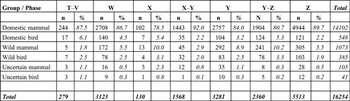
The volume of bone fragments from the early medieval phases suggested a large thriving community on a par with that of the Roman city (Table 1). The increase in the later phases may reflect the change in function from public amenity to private domestic space and the use of dumped material as ‘building platforms’ for new structures.Footnote 47 Since Wroxeter did not have the large rubbish pits present in other cities, such as Silchester,Footnote 48 the excavators suggested that some form of municipal waste collection was in operation, as postulated for Lincoln.Footnote 49 The dump analysis outlined above would suggest that the material derived from discreet contemporary activities elsewhere in the city and could be interpreted as evidence of municipal waste collection.
Wroxeter baths basilica: animal bone frequencies by chronological period, based on number of identified skeletal parts (NISP)

King's work on the relative proportions of cattle, sheep and pig to one another has demonstrated distinct trends across the Roman Empire.Footnote 50 King discovered various trends based on geographical location, social status, type of site and chronological period, for instance high frequencies of pig denoted high status, following the Classical Italian diet.Footnote 51 In North-Western Europe, the ‘Rome’ diet generally had a far less significant impact. It was difficult to export (or emulate) because of the unique socio-economic and geographic conditions in west-central Italy. It would appear that only particularly wealthy and highly Romanised sites could afford the pork-based diet, such as Fréjus-Alguières, Provence, France,Footnote 52 and Fishbourne Palace, West Sussex.Footnote 53
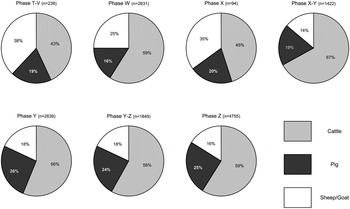
At Wroxeter, pig formed the following proportions of the combined cattle, sheep and pig assemblages, based on Minimum Number of Element (NME) counts (fig. 2): Phase T–V 19%; Phase W 16%; Phase X 20%; Phase X–Y 19%; Phase Y 26%; Phase Y–Z 24%; Phase Z 25%. If one excludes cattle from the calculations, the increase in pig becomes even more apparent: Phase T–V 33%; Phase W 39%; Phase X 37%; Phase X–Y 57%; Phase Y 60%; Phase Y–Z 57%; Phase Z 62%. The increasing frequency of pig (and cattle, plus the corresponding decrease in sheep) appears to support the archaeological interpretation of Phase Y as a market-place, apparently one that was frequented by the upper echelons of society, and Phase Z as a high-status and Romanised residence. A high proportion of pig was also noted from the ‘sub-Roman/Anglian’ levels at York Minster. Interestingly, a divergent explanation was proffered; because of the pig's fecundity and ability to scavenge they are ‘relatively low cost animals’ to keep and could, therefore, reflect a subsistence strategy,Footnote 54 which conversely implies lower-status activity.
Wroxeter baths basilica: pig frequencies relative to cattle and sheep/goat.

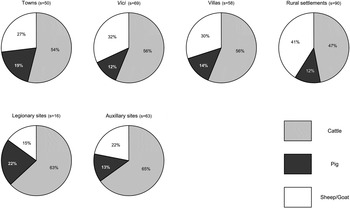
Pig frequencies at Wroxeter, compared with King's settlement type summaries, fall into the upper range or exceed them (fig. 3): towns 19%; vici 12%; villas 14%; rural settlements 12%; legionary sites 22%; auxiliary sites 13%.Footnote 55 It must be noted, however, that the Wroxeter NME counts are not directly comparable with the total fragment counts employed by King; for comparison it was determined that NME counts were more applicable than Number of Identified Skeletal Parts (NISP) counts because diagnostic zones from a limited suite of anatomical elements were used to record the Wroxeter baths basilica assemblage,Footnote 56 which contrasted with the more traditional ‘every identifiable fragment’ methods used to record much of the data utilised by King.
Inter-site pig frequencies relative to cattle and sheep/goat, based on King Reference King, Blagg and King1984, 218–24, table 4; 1999a, 193–5, appendix.

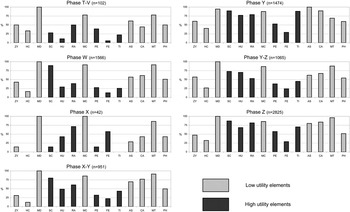
Anatomical distributions can be used to infer animal exploitation, on-site activities and waste disposal practices. The cattle assemblage demonstrated a distinct diachronic trend (fig. 4): the early phases (Phases T–V and W) included mostly ‘low utility’ elements, such as the skull, metapodials and phalanges, and the later phases (Phases Y and Z) included a greater component of ‘high utility’ elements, for example the scapula, humerus and femur. This pattern appears to fit the archaeological interpretation of the different phases. The animal bones from early phases (Phases T–V and W) comprise general refuse, deriving principally from primary butchery and kitchen waste; there is little evidence that dining was occurring directly at the baths basilica itself. During Phase Y carcases may have been butchered at the site and meat sold off-the-bone at the market, hence the deposition of greater proportions of high elements, and during Phase Z carcases may have been butchered at the complex and meat consumed off-the-bone with the residents commanding the choicest cuts. This pattern would appear to be genuine, rather than taphonomic in origin because indicators of bone preservation (such as cortical integrity and levels of abrasion) are constant regardless of phase.
Wroxeter baths basilica: cattle anatomical distributions. (Note: each skeletal element is displayed as a percentage of the most abundant element in each phase; element codes: ZY = zygomaticus, HC = horncore, MD = mandible, SC = scapula, HU = humerus, RA = radius, MC = metacarpal, PE = pelvis, FE = femur, TI = tibia, AS = astragalus, CA = calcaneum, MT = metatarsal, and PH = first phalange.)

THE ‘ECONOMIC GEOGRAPHY’ OF THE SITE AND ITS HINTERLAND
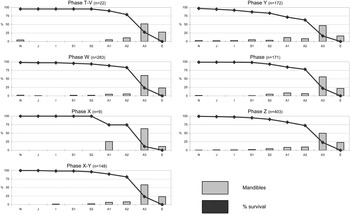
It has been suggested that the early fifth century a.d. saw an economic down-turn (see above).Footnote 57 If this were the case, it should be possible to identify stagnation in the agrarian economy. As outlined previously, the volume of bone indicated that Wroxeter's ability to command resources from its hinterland continued unchanged into the early medieval period (Table 1). Cattle mortality profiles suggest that the proportion of prime beef supplied to Wroxeter increased in the early medieval period — the proportion of immature, juvenile and sub-adult animalsFootnote 58 increased in Phases Y and Z, albeit subtly, while mature beef from animals which had reached the end of their working lives decreased slightly (fig. 5). This might tentatively demonstrate that Wroxeter's ability to control agricultural produce strengthened during the early medieval period. However, other husbandry motivated explanations might account for this observed pattern, such as the early culling of surplus male cattle. Similar patterns have been noted at other late Romano-British cities, for example intramural Colchester (Essex),Footnote 59 Exeter (Devon),Footnote 60 and the General Accident site, York (N Yorks.).Footnote 61 It has been suggested that the supply of younger beef to the urban market may have resulted from a down-turn in arable production, which enabled an intensification of beef production through ‘freed-up’ land and fewer cattle being required as plough oxen.Footnote 62 It is, therefore, clear that further work is required to elucidate whether the presence of younger cattle in urban assemblages was consumer or producer derived.
Wroxeter baths basilica: cattle mortality profiles, following O'Connor 2003, 160 (Note: N = neonate, J = juvenile, S = Sub-adult, A = adult, and E = elderly).

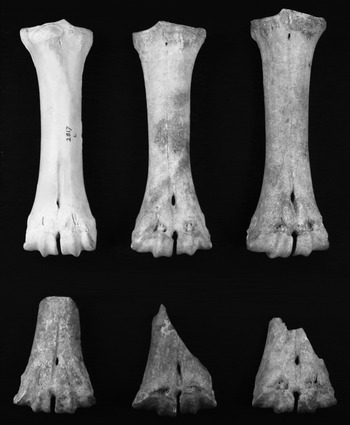
This hypothesis was tested by considering the number of cattle metacarpals with distal condyle ‘splaying’ (fig. 6). Splaying is caused by excessive pressure on joint capsules, resulting in new bone growth around articular surfaces and bone asymmetry. This condition may be caused by the use of cattle for draught purposes, such as ploughing, although other factors might confuse the situation, such as the age and size of the individual.Footnote 63 At Wroxeter, the metacarpal assemblage included a similar proportion of splayed specimens throughout. This might indicate that there was no down-turn in arable cultivation, although it should be noted that animals would presumably still have been used to transport goods, etc.
Wroxeter baths basilica: cattle metacarpal splayed condyles (Note: top left example is a ‘normal’ specimen).

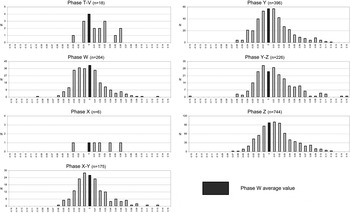
It has been suggested that an economic down-turn would have resulted in animals becoming smaller, through a loss of husbandry techniques (as above). fig. 7 compares cattle biometry from the baths basilica using the log-ratio method. This method calculates the logarithm of the ratio between a measurement and its standard.Footnote 64 In this case, average measurement values from Phase W have been used. Biometrical analysis of the cattle remains demonstrated that the size and shape of animals did not alter between the Romano-British and early medieval periods (fig. 7). This might indicate that there was no loss of husbandry techniques, or stagnation in the pastoral economy. However, it could conceivably take more than a few generations of animals for a loss of husbandry techniques to physically manifest itself as a more diminutive population (although the evidence from West Stow suggests this might not be the case, see above).
Wroxeter baths basilica: cattle biometry.

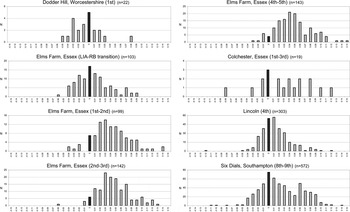
The biometrical analysis also demonstrated that cattle from Wroxeter did not under-go the same breed improvements as those from South-East England. fig. 8 compares measurements from other sites with the Phase W standard. The data from Elms Farm in Essex demonstrated a clear size increase between the Late Iron Age and early Roman periods, which was interpreted as the introduction of animals from Continental Europe to improve local stock.Footnote 65 Similar claims have been made for other sites in Essex: ColchesterFootnote 66 and Great Holts Farm, Boreham.Footnote 67 Therefore, the cattle from Wroxeter may represent unimproved indigenous types and consequently a size decrease resulting from an economic down-turn might not be evident. However, the archaeobotanical evidence from the baths basilica also indicated no obvious down-turn in the arable economy.Footnote 68
Inter-site cattle biometry, based on Davis Reference Davis1988; Dobney et al. Reference Dobney, Jaques and Irving1996, 148–75, appendix 1; Johnstone and Albarella Reference Johnstone and Albarella2002, 173–86, appendix; Luff Reference Luff1993, 183–97, microfiche; University of Southampton 2003.

Long-distance trade appears to have continued at Wroxeter into the early medieval period, as indicated by the recovery of a single first phalange of a Barbary ape (Macaca sylvanus) from a deposit belonging to either Phase Y or Z. It had been recognised as such during the initial analysis and its identification has been confirmed by the Natural History Museum prior to this study.Footnote 69 Few analogous specimens exist: a partial skeleton recovered from a second-century a.d. cesspit in Dunstable (Beds.);Footnote 70 a fragmentary skull of a three- to three-and-a-half-year-old male from Catterick fort (North Yorks.), which is presumed to be of Romano-British date despite being recovered from a modern service trench;Footnote 71 a partial skull and mandible of a five- to seven-year-old male from a second-century b.c. deposit at Navan fort (County Armagh, Northern Ireland).Footnote 72 During the period in question, Barbary apes do not appear to have resided on Gibraltar. The Classical authors do not mention them, despite making numerous references to Barbary apes elsewhere,Footnote 73 while the earliest documentary reference for their presence there dates to the early eighth century a.d. and was made by the Moorish invader, Tarik Ibn Sijad.Footnote 74 Barbary apes are indigenous to North Africa; they are presently confined between Algeria, in the mountainous area between Algiers and Constantine, and Morocco, in the Er-Rif region and High Atlas mountains as far south-west as the Sous river.Footnote 75 Other evidence for continued long-distance trade at Wroxeter in the early medieval period included Palestinian amphorae, dating to the sixth and seventh centuries a.d.Footnote 76
THE ‘CULTURAL IDENTITY’ OF THE EARLY MEDIEVAL POPULATION
In addition to social status, the proportion of different species to one another can be used to infer cultural identity. It has already been demonstrated that the baths basilica included a high-status component in the later phases, owing to the high proportion of pig bones (fig. 2). King also demonstrated that Roman assemblages from North-Western Europe were dominated by cattle.Footnote 77 This occurred through the ‘Germanisation’ or ‘Gallicisation’ of the army, auxiliary units being dominated by soldiers from Lugdunensis, Aquitania, Belgica, Germania Superior, Germania Inferior and Raetia. The indigenous cuisine of these provinces was beef-rich. This contrasted with the pre-Roman British diet, which was dominated by mutton.Footnote 78 A homogeneous beef-based diet became the norm for all urban centres. Although, each site-type retained its own peculiarities, military sites still had the highest proportions of cattle.Footnote 79 At Wroxeter, this continued unchanged into the early medieval period (fig. 2).
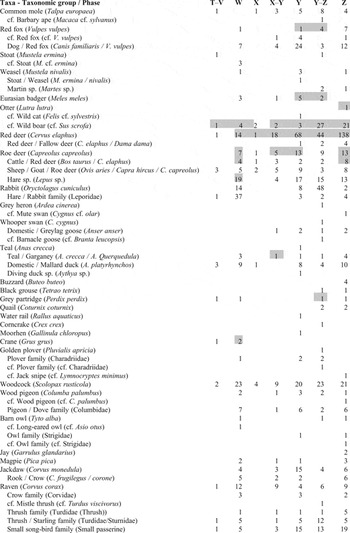
Traditionally, it has been assumed that wild animals were not extensively exploited during the Romano-British period, even on rural sites. Grant suggested this reflected the efficiency and intensity of the Romano-British agricultural system.Footnote 80 However, hunting in most societies incorporates a range of socio-cultural meanings,Footnote 81 although this aspect has yet to be fully explored for the Romano-British period. O'Connor has suggested that the utilisation of wild animal resources in Romano-British and medieval towns does not necessarily reflect differences in availability, but rather the ability to pay for them.Footnote 82 At Wroxeter, the early medieval period saw a slight increase in the exploitation of wild resources, both mammals and birds (Table 2). This appears to have occurred for no utilitarian reason, because wild animals still formed only a small component of the animal economy and it has already been demonstrated that the ability to control agricultural resources was unimpeded (see above). A wide range of wild mammal and bird species were recorded from the baths basilica (Table 3). Some were hunted, or traded, while others may have been food waste of other animals, and it is not always possible to differentiate between them. The physical evidence cannot necessarily be relied upon; for instance butchery should denote an anthropogenic origin, but the level of carcase processing was generally size dependent and may not show in the assemblage (small animals were butchered less, and birds especially may have been cooked whole and then ‘torn apart’ during consumption). Therefore, researchers often have to make assumptions about which species were and were not hunted, and then consumed (the two aspects are not necessarily synonymous). Food preferences and avoidances are obviously socio-culturally determined,Footnote 83 for instance the modern British distaste for horse flesh, so ascribing significance to individual species, and attitudes towards hunting, is fraught with difficulty. This is compounded by the fact that there appears to be a discrepancy between the scarcity of wild species in Romano-British animal bone assemblages and the relatively frequent artistic depictions of wild animals and hunting prevalent in mosaics, etc. This led Cool to conclude that deer and hare, and to a lesser extent wild boar, were primarily hunted by the upper echelons of society and were not routinely consumed, their pursuit perhaps being restricted to special events.Footnote 84 Other explanations, therefore, have to be sought. It may be that hunting had started to become culturally important. There is also the possibility that some late Romano-British villas functioned as ‘hunting lodges’ and this has been inferred at Whitley GrangeFootnote 85 in Wroxeter's hinterland, although the site has not been fully excavated.
Wroxeter baths basilica: domestic: wild taxa ratios by chronological period, based on minimum number of elements (NME)

Wroxeter baths basilica: wild taxa by chronological period, based on minimum number of elements (NME)
(Note: Small rodents and insectivores have been omitted from the table; the shaded cells denote the presence of butchered specimens)

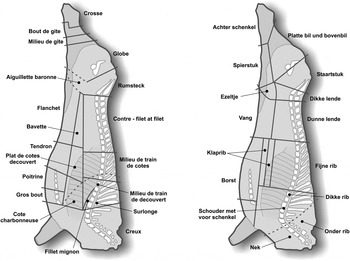
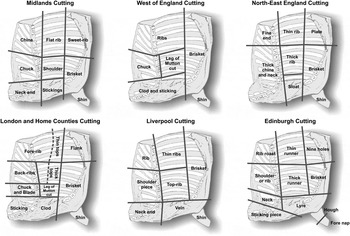
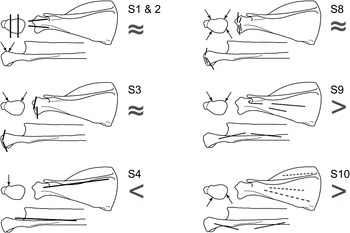
Butchery is another means of inferring cultural differences. Butchery practices and techniques are not solely dictated by anatomical and other functional considerations. Wide national and regional variation can exist, based on cultural and ethnic differences (figs 9–10). Various authors, including Maltby,Footnote 86 have demonstrated that pre-Roman Iron Age butchery involved cutting around joints to dismember carcases, whereas later Roman butchery was characterised by chopping through joints and bone. This shift was partially a response to urbanisation and the development of a specialist butchery trade, which centred on ‘mass production’.Footnote 87 It also incorporated a cultural aspect; during the Romano-British period the unRomanised sites continued to practise knife butchery.Footnote 88
National (French and Dutch) variations in beef cutting, based on Gerrard Reference Gerrard1979, 321–2, figs 56–7.

Regional variations in beef cutting, based on Gerrard Reference Gerrard1979, 313, fig. 50.

Cattle bone from Romano-British Wroxeter displayed heavy chopping, characteristic of a typical urban site. However, butchery techniques started to evolve in the early medieval period. This was characterised by increased cutting to fillet meat from the bone, together with the continuation of typical Romano-British techniques. fig. 11 demonstrates this point with a summary of the baths basilica cattle butchery, using Maltby's classifications.Footnote 89 This occurred along with the greater deposition of high utility elements at the baths basilica (see above) and may denote a change in the way meat was being consumed: meat-off-the-bone as opposed to meat-on-the-bone. It is unlikely to represent a return to indigenous butchery practices, because the Iron Age was completely beyond living memory and the predominance of Romano-British butchery techniques may support the view that Wroxeter's post-Roman inhabitants continued to identify with their ascendant's ‘cultural package’. However, they would have known no other way of life initially, so demonstrating whether or not this was a deliberate act is extremely difficult.
Wroxeter baths basilica: changing butchery techniques, illustrated by cattle scapulae using the butchery categories of Maltby (Reference Maltby1989, 93, table 3). (Note: butchery categories: S1 and 2 = axial/oblique chops through glenoid cavity running in a latero-medial direction; S3 = horizontal superficial chop marks around the glenoid cavity; S4 = axial chop/blade/saw marks on the lateral spine; S8 = horizontal knife cuts around the glenoid cavity; S9 = axial knife cuts on the lateral aspect of blade; and S10 = axial knife cuts on the medial blade.)

ASSESSMENT OF THE PERSPECTIVES
How do these results fit into the perspectives that currently exist for the late Romano-British–early medieval transition? Five models were outlined at the beginning of this article: ‘Progressive Devolution’, ‘Discontinuity’, ‘Unsuccessful Acculturation’, ‘The East–West Divide’ and ‘Continental Late Antiquity’. Overall, the zooarchaeological evidence from Wroxeter has indicated little change between the late Romano-British and early medieval periods. This suggests that for Wroxeter neither the first nor second model is correct, because the agrarian economy apparently continued unimpeded into the sixth and seventh centuries a.d. Cessation of activity at Wroxeter was certainly not ‘… nasty, brutish and short’ to quote Esmonde Cleary.Footnote 90 The likely development of direct taxation in-kind (annona militaris), in response to the start of the disintegration of the moneyed economy and the inability of officials to collect taxation,Footnote 91 would conversely support the view that the Roman administrative system had ceased to exist in its Classical form. Interestingly, it has been argued that the annona system may have acted as a direct stimulus to local production and significantly increased output,Footnote 92 which might partially explain the post-Roman agriculturally-derived activity at Wroxeter. In some respects, the vertebrate remains cannot be used to evaluate the third model, ‘Unsuccessful Acculturation’, because this perspective concentrates on whether urbanism took hold as a concept in Roman Britain and argues that Classical urbanism was a short-lived phenomenon, which was superseded by ‘administrative villages’. However, the archaeological evidence from Wroxeter outwardly supports this proposition, because the baths basilica seems to have constituted some form of ‘central-place’, although the evidence indicates that the transition from Classical city to ‘administrative village’ occurred later than the third-/fourth-century a.d. date suggested by the model. The increased consumption of pork supports the interpretation of the ‘Great Re-building’ as a high-status residence, as possibly does the slight increase in the proportion of younger cattle. Combined with the fact that the distribution network appears to have remained largely intact and that the institutions or persons in residence were able to control the hinterland, it would seem that Wroxeter has some commonality with the fourth and fifth perspectives, ‘The East–West Divide’ and ‘Continental Late Antiquity’. Whether the early medieval settlement at Wroxeter represented a Christian or pagan presence remains to be seen and cannot be explored easily through the vertebrate remains. However, the possible church within the frigidarium may attest the former.Footnote 93 Activity at the baths basilica may even push the fifth-century a.d. date for the continuation of Roman institutions beyond that time. The presence of Barbary ape would indicate that Wroxeter maintained long-distance trade links up to the sixth and seventh centuries a.d. However, fifth- to seventh-century a.d. activity at the baths basilica hardly constitutes the highly developed situation that emerged on the Continent. These disparate perspectives appear to exist because they consider different regions, using different datasets, analysed with different interpretive models regarding levels of acculturation, etc. Perhaps we should accept that no single model is adequate to explain the myriad of responses to the demise of Roman Britain and the eventual emergence of Anglo-Saxon England.
DISCUSSION
Overall, it is possible to relate various constituents of the scenario postulated at early medieval Wroxeter (and its reconstructed animal economy) to all of the perspectives outlined above. Since the evidence remains inconclusive in this respect, it may, therefore, be necessary to develop new models regarding the late Roman–early medieval transition in Britain. Perhaps the degree of fragmentation caused by the social and economic upheavals of the fourth and fifth centuries a.d. caused very different regional responses, which generalised perspectives cannot hope to encompass; the contrasting zooarchaeological evidence from West Stow would seem to support this. Collapse and transition may have occurred side-by-side. The demise of the Soviet bloc provides a modern analogy; Poland and Hungary underwent a gradual transition that pre-dated 1989 and are subsequently prospering 15 years later, whereas Russia and Bulgaria collapsed more suddenly and have not fared so well (as measured, for example, by decreased life expectancy, no real improvement in quality of life, etc.).
People have tended to regard the history of Britannia as a single entity, although it is becoming increasingly obvious that this was not the case. Britain was divided into four provinces in the early fourth century a.d. (Britannia Prima, Britannia Secunda, Maxima Caesariensis, and Flavia Caesariensis), with the addition of Valentia at the end of the century.Footnote 94 These sub-divisions exacerbated the diversity of development. Diocletian's reorganisation happened for a number of reasons: partly military (it would spread forces more widely, though thinly, across the regions, which would in turn prevent revolts), partly economic (more efficient tax-gathering, especially since taxes had possibly been commuted into payment in kind – annona).Footnote 95 Regardless of the precise motivations, it is necessary to realise that the reforms also had unintended consequences. The new provinces each had their own army and governor, both of whom were answerable to higher echelons in London. However, devolved power, combined with the time-lag in communications, meant it was inevitable that these regions developed a certain degree of administrative autonomy which can only have increased with time.
During the fifth century a.d. pressures on the frontiers began to overwhelm the authorities and superstructure; Imperial control was crucially weakened. Consequently, individual provinces began to organise their own affairs. In the east of Britain (Maxima Caesariensis and Valentia), the threat was from Germanic folk movements and in the west (Britannia Prima), it was from the Irish. Thus, when each province (and town) came under pressure, each had to find its own solution. Wroxeter may have employed Irish mercenaries, as evidenced by the early Christian tombstone of Cunorix with its Irish formula.Footnote 96 In some respects, the east–west division within Britain mirrored the empire-wide situation, with the Eastern Roman Empire effectively abandoning the West.
As a consequence, ‘Roman Britain’ virtually collapsed as a single entity because the provinces had to develop their own responses to particular crises. Acting independently of the others, it was only a matter of time before each fell. However, Britannia Prima survived longest; it retained its overall cohesion throughout the fifth century a.d. (as at Wroxeter, for example) and only began to fall apart in the sixth century. The first stage in this process is fragmentation of the province into smaller units, some more Romanised than others. Often these smaller sub-kingdoms were opposed to each other as much as to the Germanic immigrants: the Rowe Ditch (Herefords.) and Wats Dyke (Cheshire) both may have their origins in this era and are, significantly, aligned to prevent traffic coming from the west and not the east.Footnote 97 All the available evidence, including the vertebrate assemblage, would seem to indicate that Wroxeter and its hinterland was one of the more successful (and more Romanised) polities. Ultimately, the survivors of this process gradually coalesced into the Welsh Kingdoms, notably Powys and Gwynedd. A power-struggle ensued between Powys and Gwynedd, the latter of which eventually overcame and absorbed early medieval Wroxeter. Gwynedd survived as an independent kingdom until it was finally conquered by Edward I in 1282.
CONCLUSIONS
The baths basilica faunal assemblage has demonstrated that:
the local pastoral economy and distribution networks were largely unaffected by the demise of the Western Roman Empire;
long-distance trade networks were also maintained, to some degree, during the early medieval period;
the early medieval inhabitants continued to promote their Romanitas through their gastronomic proclivities;
the adoption of new butchery techniques might indicate that their cultural identity was evolving simultaneously;
hunting, possibly as a leisure activity, may have been actively practised in the sub-Roman and even late Roman periods.
Overall the faunal evidence provides some support for the archaeological interpretation proposed by the excavators; the baths basilica developed from public amenity to high-status private residence and indicates direct continuity between the late Roman Britain and early medieval periods in western Britain. Therefore, the faunal evidence from the baths basilica, in conjunction with the overall interpretation and other evidence, lends credence to both ‘The East–West Divide’ and ‘Continental Late Antiquity’ perspectives. The evidence from Wroxeter, however, provides a different picture to that from the Icklington/West Stow analysis (see above) and highlights the need for further synthesis to understand the intricacies involved. It would be very worthwhile to extend this zooarchaeological approach to the rest of post-Roman Britain. A comprehensive study looking at the differences between eastern and southern (Anglo-Saxon) England and western Britain would be particularly illuminating in this respect, although virtually no large animal bone assemblages exist for the latter at present.
ACKNOWLEDGEMENTS
The author would like to thank Roger White for commenting on an earlier version of this paper and the anonymous referees; the responsibility for any remaining mistakes and omissions are the author's alone. This article stems from the author's doctoral research, which would not have been possible without a University of Sheffield scholarship. English Heritage granted access to the material and allowed the author to work on various aspects of this paper, and earlier presentations, while in their employ. John Vallender produced all the images and Eddie Lyons was the photographer for fig. 6. The author would also like to thank the following people, who provided support, suggestions and unpublished data: Umberto Albarella, Polydora Baker, Heather Bird, Gill Campbell, Maureen Carroll, Keith Dobney, Geoff Etheridge, Paul Halstead, Sara Lunt, John Moreland, Terry O'Connor, Krish Seetah, Adam Smith, Sue Stallibrass and Naomi Sykes.