INTRODUCTION
Clinical practice relies on patient-designated and next-of-kin surrogates to make treatment decisions for incapacitated patients. Surrogates are instructed to make decisions based on a patient's advance directive (AD). In the absence of an AD, surrogates are asked to make the treatment decision they think the patient would have made if he or she had the capacity to do so. This approach aims to promote patient autonomy by basing decisions on the patient's own treatment preferences (Buchanan & Brock, Reference Buchanan and Brock1989, Beauchamp & Childress, Reference Beauchamp and Childress2013). Yet many patients do not complete an AD, and those who do frequently just designate a family member to make decisions for them (Connors et al., Reference Connors, Dawson and Desbiens1995; Danis et al., Reference Danis, Mutran and Garrett1996; Teno et al., Reference Teno, Licks and Lynn1997; Fagerlin & Schneider, Reference Fagerlin and Schneider2004; Perkins, Reference Perkins2007). Furthermore, data suggest that many patients want their surrogates to have considerable leeway when making treatment decisions (Sehgal et al., Reference Sehgal, Galbraith and Chesney1992; Kelly et al., Reference Kelly, Rid and Wendler2012; Creswell, Reference Creswell2013).
According to some commentators, these findings suggest that current practice is based on a mistaken understanding of patients' priorities. For example, some regard low completion rates of ADs as a sign that patients do not prioritize “micromanaging” their treatment in the event of incapacity (Hawkins et al., Reference Hawkins, Ditto and Danks2005). Many of these commentators claim that patients are more concerned with who makes decisions for them rather than which treatments they receive (Burt, Reference Burt2005; Hawkins et al., Reference Hawkins, Ditto and Danks2005; Winzelberg et al., Reference Winzelberg, Hanson and Tulsky2005; Perkins, Reference Perkins2007; Berger et al., Reference Berger, DeRenzo and Schwartz2008; Torke et al., Reference Torke, Alexander and Lantos2008; Sudore & Fried, Reference Sudore and Fried2010; Halpern, Reference Halpern2012; McMahan et al., Reference McMahan, Knight and Fried2012; Schenker et al., Reference Schenker, White and Arnold2014). Others hold that patients prioritize minimizing the burden on their loved ones over being treated consistent with their own preferences and values (Perkins, Reference Perkins2007; Berger et al., Reference Berger, DeRenzo and Schwartz2008; Torke et al., Reference Torke, Alexander and Lantos2008; Sudore & Fried, Reference Sudore and Fried2010; White & Arnold, Reference White and Arnold2011; Halpern, Reference Halpern2012; Kelly et al., Reference Kelly, Rid and Wendler2012). These claims imply that clinical practice should be modified to reflect patients' actual priorities (Fagerlin & Schneider, Reference Fagerlin and Schneider2004; Burt, Reference Burt2005; Winzelberg et al., Reference Winzelberg, Hanson and Tulsky2005; Perkins, Reference Perkins2007; Berger et al., Reference Berger, DeRenzo and Schwartz2008; Torke et al., Reference Torke, Alexander and Lantos2008; Sudore & Fried, Reference Sudore and Fried2010; White & Arnold, Reference White and Arnold2011; Halpern et al., Reference Halpern, Loewenstein and Volpp2013; Schenker et al., Reference Schenker, White and Arnold2014). Yet, a literature search found little empirical data regarding which goals patients prioritize in the event of incapacity (see Appendix 1).Footnote 1
Several personal essays and qualitative studies explore the decision-making priorities of individuals, but this information is difficult to generalize (High, Reference High1988; Lynn, Reference Lynn1991; Moore et al., Reference Moore, Sparr and Sherman2003; Eliott & Olver, Reference Eliott and Olver2007). Other studies address related questions, including patients' preferences for specific treatments or treatment outcomes (Garrett et al., Reference Garrett, Harris and Norburn1993; Phillips et al., Reference Phillips, Wenger and Teno1996; Pearlman et al., Reference Pearlman, Cain and Starks2000; Fried et al., Reference Fried, Bradley and Towle2002; Sudore et al., Reference Sudore, Schillinger and Knight2010; Halpern et al., Reference Halpern, Loewenstein and Volpp2013); patients' goals of care (Rosenfeld et al., Reference Rosenfeld, Wenger and Kagawa-Singer2000; Fried & Bradley, Reference Fried and Bradley2003; Kaldjian et al., Reference Kaldjian, Curtis and Shinkunas2008; Fried et al., Reference Fried, Tinetti and Iannone2011; Case et al., Reference Case, Towle and Fried2013); factors patients consider important at the end of life (Mead et al., Reference Mead, O'Keeffe and Jack1995; Singer et al., Reference Singer, Martin and Lavery1998; Reference Singer, Martin and Kelner1999; Steinhauser et al., Reference Steinhauser, Christakis and Clipp2000; Patrick et al., Reference Patrick, Engelberg and Curtis2001; Hawkins et al., Reference Hawkins, Ditto and Danks2005; Heyland et al., Reference Heyland, Dodek and Rocker2006; Kaldjian et al., Reference Kaldjian, Curtis and Shinkunas2008); and how best to identify or document these factors (Doukas & Gorenflo, Reference Doukas and Gorenflo1993; Ditto et al., Reference Ditto, Druley and Moore1996; Emanuel, Reference Emanuel2008; Kirchhoff et al., Reference Kirchhoff, Hammes and Kehl2010; Scheunemann et al., Reference Scheunemann, Arnold and White2012), as well as patients' preferences for how treatment decisions should be made (Kelly et al., Reference Kelly, Rid and Wendler2012; McMahan et al., Reference McMahan, Knight and Fried2013; Daveson et al., Reference Daveson, Bausewein and Murtagh2013). In contrast, we could find no data that explicitly asked patients to indicate, in the event of incapacity, which goal or goals for treatment decision making they prioritize. The present study aims to address this gap in the literature by offering the first quantitative data on patients' priorities for how treatment decisions are made in the event of incapacity. These data provide an opportunity to assess what modifications, if any, are needed to ensure that clinical practice accurately reflects patient priorities.
METHODS
Ethics Statement
The George Washington University and Medical Center Institutional Review Board and the National Institutes of Health (NIH) Office of Human Subjects Protections judged this anonymous survey to be exempt from regulation under the U.S. Code of Federal Regulations (CFR §46.101). With no legal requirement to obtain written informed consent or to obtain ethical approval for modifying the informed consent process, we decided it was ethically appropriate to obtain verbal consent from each individual respondent, considering that the questionnaire was anonymous and posed no more than the minimal risks of boredom or anxiety from answering the questions. Furthermore, even if the study had been covered by the regulations, we would not have been legally required to obtain written informed consent on the grounds that “the research presents no more than minimal risk of harm to subjects and involves no procedures for which written consent is normally required outside of the research context” (CFR §46.117). Each respondent's completed questionnaire served as written documentation of his or her consent to participate in the survey. Potential respondents received an information sheet that informed them of the voluntary nature of their participation, that declining would have no impact on their clinical care, and that they could skip any questions and stop at any time (see Appendix 2). All respondents gave oral informed consent to participate. Consistent with U.S. regulations (CFR §46.101), this consent procedure was not approved by a research ethics committee.
Survey
Based on the widely accepted principles of respect for autonomy and beneficence (Buchanan & Brock, Reference Buchanan and Brock1989; Beauchamp & Childress, Reference Beauchamp and Childress2013; Rid, Reference Rid and Wendler2010), as well as the existing literature (High, Reference High1988; Lynn, Reference Lynn1991; Sehgal et al., Reference Sehgal, Galbraith and Chesney1992; Garrett et al., Reference Garrett, Harris and Norburn1993; Connors et al., Reference Connors, Dawson and Desbiens1995; Mead et al., Reference Mead, O'Keeffe and Jack1995; Danis et al., Reference Danis, Mutran and Garrett1996; Phillips et al., Reference Phillips, Wenger and Teno1996; Teno et al., Reference Teno, Licks and Lynn1997; Singer et al., Reference Singer, Martin and Lavery1998; Reference Singer, Martin and Kelner1999; Pearlman et al., Reference Pearlman, Cain and Starks2000; Steinhauser et al., Reference Steinhauser, Christakis and Clipp2000; Patrick et al., Reference Patrick, Engelberg and Curtis2001; Fried et al., Reference Fried, Bradley and Towle2002; Moore et al., Reference Moore, Sparr and Sherman2003; Fagerlin & Schneider. Reference Fagerlin and Schneider2004; Burt, Reference Burt2005; Hawkins et al., Reference Hawkins, Ditto and Danks2005; Winzelberg et al., Reference Winzelberg, Hanson and Tulsky2005; Heyland et al., Reference Heyland, Dodek and Rocker2006; Eliott & Olver, Reference Eliott and Olver2007; Perkins, Reference Perkins2007; Berger et al., Reference Berger, DeRenzo and Schwartz2008; Kaldjian et al., Reference Kaldjian, Curtis and Shinkunas2008; Torke et al., Reference Torke, Alexander and Lantos2008; Rid & Wendler, Reference Rid and Wendler2010; Sudore & Fried, Reference Sudore and Fried2010; White & Arnold, Reference White and Arnold2011; Halpern, Reference Halpern2012; Kelly et al., Reference Kelly, Rid and Wendler2012; McMahan et al., Reference McMahan, Knight and Fried2012; Halpern et al., Reference Halpern, Loewenstein and Volpp2013; Schenker et al., Reference Schenker, White and Arnold2014; Creswell, Reference Creswell2013), the authors drafted a survey on patients' goals for treatment decision making in the event of incapacity. After numerous rounds of revision, the draft survey was evaluated by four focus groups of 4–10 participants each and revised following each session. The survey then underwent cognitive pretesting with six patients and two academics, using a “think-aloud” approach to ensure that the questions were understood as intended and revised as necessary. Finally, behavioral pretesting with nine patients and two academics was employed to ensure that the survey could be implemented successfully.
The final survey contained 41 questions covering four domains: (1) personal characteristics, (2) personal experience with and planning for decisional incapacity, (3) goals and priorities regarding treatment decision making during periods of incapacity, and (4) views on new approaches. Here we report the results from domains 1–3 (see Appendix 2 for verbatim questions).
To ensure that the questions were relevant to a broad range of patients from different clinics and units, including those with very different health situations, and to avoid the difficulties associated with projecting one's preferences and values into a distant and emotionally uncertain future (Ditto et al., Reference Ditto, Hawkins and Pizarro2005), we asked respondents to indicate their priorities in a scenario involving decisional incapacity following a car accident (“Please consider the following case: You are in a bad car accident. You are unconscious.”). The scenario was described to elicit respondents' preferences for circumstances in which doctors have no clear recommendation to make as to which option would best promote the clinical interests of the patient. This aspect of the scenario was emphasized by a statement that “even your doctors do not know what is best medically.”
Outcomes
We asked respondents to indicate the personal importance of eight possible goals for treatment decision making during periods of incapacity. We also asked respondents which goal they regarded as most important, how confident they were about this judgment, and how they would make tradeoffs between key goals (Table 3). Cognitive pretesting revealed that the distinction between receiving and avoiding specific treatments (e.g., resuscitation) and achieving certain goals of care (e.g., avoiding pain) was not significant for respondents. In addition, many respondents better understood questions that addressed their preferences for specific treatments. Hence, the decision-making goal of being treated consistent with one's preferences and values was phrased in terms of “getting the treatments I want” and “avoiding the treatments I do not want.”
Predictors
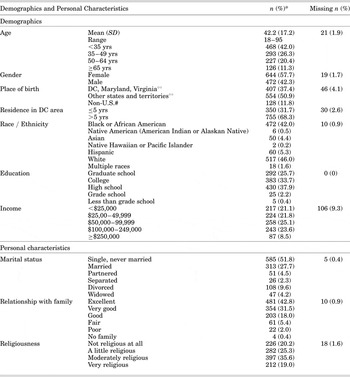
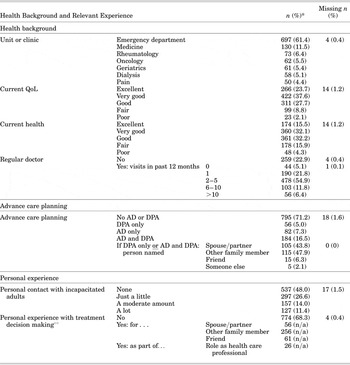
We examined the influence of numerous factors on patients' priorities: sociodemographic and personal characteristics, medical background, previous advance care planning, and personal experience with helping to make treatment decisions for an incapacitated adult (see Tables 1 and 2).
Demographics and personal characteristics of survey respondents (N = 1135 usable respondents; missing n per question in the right column)

* Totals may not sum to 100% due to rounding.
°° Total of 49 states/territories (includes Puerto Rico, Guam, Virgin Islands, Northern Mariana Islands); ≥5 respondents from 29 states.
# A total of 56 countries; ≥5 respondents from 6 countries.
Health background and relevant experience of survey respondents (N = 1135 usable respondents; missing n per question in the right column)

AD = advance directive, DPA = durable power of attorney.
* Totals may not sum to 100% due to rounding.
°° Multiple answers possible.
Study Population and Conduct of Survey
The survey was conducted from September of 2009 to August of 2011 at the George Washington University Hospital, a large tertiary care center in Washington, D.C., and at George Washington University Medical Faculty Associates, a multispecialty physician practice. Patients were recruited from six units or clinics so as to capture the views of as broad a range of patients as possible: general medicine, emergency department (ED), dialysis clinic, pain clinic, geriatrics, and oncology. Trained research assistants approached all patients upon entry, with the exception of patients for whom the responsible clinician regarded a 30-minute survey as overly burdensome. The research assistants explained the survey and were available to answer questions. Inclusion criteria were: (1) inpatient or outpatient, (2) 18 years of age or older, and (3) ability to complete a written survey in English. Nonresponders were asked to provide information on their age, gender, and race/ethnicity. The survey was self-administered and anonymous and took an average of 25 minutes to complete.
Data Analysis
Data were entered by the statistician (RW), two research assistants, and one of the PIs (AR). A random sample of 84 surveys (60 for respondents, 24 for nonrespondents) was recoded for external validation. The error rate of 0.25% was judged to be acceptable.
Data analysis was conducted using Stata software (v. SE12.0). We utilized t tests, standard ANOVA, or their nonparametric alternatives to compare continuous or ordinal outcomes. Paired continuous or ordinal outcomes were compared using either the paired t test or the signed rank test. McNemar's test was employed to compare paired dichotomous outcomes. For contingency tables we employed four different test approaches: (1) Fisher's exact test or χ2 test for two unordered factors; (2) the Kruskal–Wallis nonparametric test for one ordered and one unordered factor (or Wilcoxon rank sum when the unordered factor had two categories); (3) Cuzick's nonparametric extension of the Wilcoxon rank-sum test when both factors were ordered; and (4) Fisher's exact test or multivariate logistic regression to evaluate possible predictors of dichotomous outcomes.
To evaluate patterns of how respondents ranked the eight goals for treatment decision making, we used hierarchical agglomerative clustering with average linkage and a binary similarity coefficient—equaling the proportion of matches for the eight goals between two respondents—with the aim of classifying respondents into two or three groups (Hastie et al. Reference Hastie, Tibshirani and Friedman2009). We dichotomized respondents' rankings of the goals prior to clustering. To assess the continued significance of univariately significant predictors on outcomes with three or more unordered categories, we used multinomial (polytomous) logistic regression to control for other predictors in the model, using the likelihood ratio test (LRT) (Hosmer & Lemeshow, Reference Hosmer and Lemeshow2013).
Given the large sample sizes for most analyses, a p value less than 0.01 (two-tailed, unless noted otherwise) was considered statistically significant. In the following, we report and discuss especially noteworthy findings. The complete analyses—including analyses of the results as a function of age, race, health status, and all other patient characteristics found in Tables 1 and 2—are given in Appendix 3.
RESULTS
Study Population
Of the 1955 patients who were invited, 1169 agreed to participate (overall response rate of 59.8%). In the ED, 723 patients agreed to participate (response rate = 52.3%), while 567 patients agreed to participate in the five other participating units (response rate = 77.8%). Information on the recruitment site was missing for five responders. A total of 34 surveys were excluded due to a lack of substantive answers. The 1135 surveys employed for analysis came from a broad range of respondents, including great diversity in current health, quality of life, and age (Tables 1 and 2). There was no significant difference in gender between respondents and nonrespondents. The response rate was higher among younger patients in the ED (p < 0.001). Furthermore, Asians and whites in the ED, and Hispanics and whites in non-ED units, were more likely to respond (p < 0.001 in each case, comparing combined groups).
Goals for Treatment Decision Making
We asked respondents to consider a scenario in which they were unconscious following a car accident and there were two treatment options. One option was to receive medical treatment with “a low chance of making you better” and “a good chance of making you unable to think clearly and of making you permanently dependent on machines to stay alive.” The other option was that “your doctors can make you comfortable and allow you to die.” We then asked respondents to rate the personal importance of eight goals for treatment decision making in this scenario.
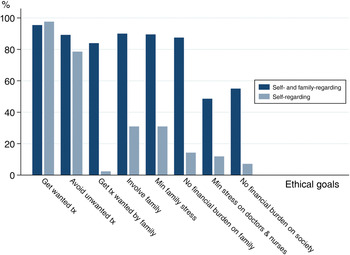
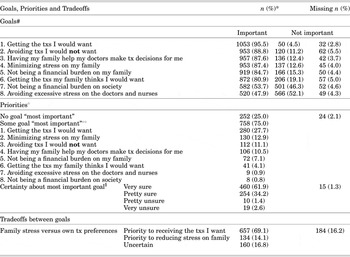
Six of the eight listed goals were ranked as moderately or extremely important by 80% or more of respondents (Table 3). Cluster analysis revealed two groups of respondents (Figure 1). The vast majority of respondents (n = 992) fell into a group that attributed high importance to the goals of getting desired and avoiding unwanted treatments as well as goals relating to their family, thereby essentially reflecting the rankings of the whole sample (“self- and family-regarding” group). A small number of respondents (n = 42) fell into a group that primarily focused on the goals of receiving the treatments they wanted and avoiding the treatments they did not want (“self-regarding” group). Significantly more respondents in the second group had a fair or poor relationship with their family compared to the first group (Wilcoxon rank-sum test, p = 0.005). There were no other significant differences between the two groups.
Cluster analysis of patients' rankings of the ethical goals for treatment decision making. Patient group 1 (n = 992) endorsing “self- and family-regarding” goals. Patient group 2 endorsing “self-regarding” goals (n = 42). Patients' rankings were dichotomized as extremely or moderately important versus less than moderately important. The analysis was confined to the n = 1034 patients who had ranked the importance of all eight goals. tx = treatment; min = minimize.

Goals, priorities, and tradeoffs in treatment decision making (N = 1135 usable respondents unless otherwise noted; missing n per question in the right column)

tx = treatment, txs = treatments.
* Totals may not sum to 100% because of rounding.
# The original questionnaire used a 4-point Likert-type scale: (1) extremely important, (2) moderately important, (3) just a little important, (4) not important at all. Responses are summarized as important (1 + 2) and not important (3 + 4).
° Only includes responses if all eight goals were ranked in the previous question (n=1034). Missing n = 24 for the present question.
°° The following percentages refer to those respondents who ranked all eight goals in the previous questions (n = 1010).
§ Only includes responses if one goal was marked as “most important” in the previous question (n = 758). Missing n = 15 for the present question.
Priorities
When asked which of the eight goals for treatment decision making was most important to them, 27.7% identified getting desired treatments and 11.1% identified avoiding unwanted treatments; 12.9 and 7.1% gave priority respectively to minimizing stress and minimizing financial burden on their family; 10.5% prioritized involving their family in making decisions; 4.1% prioritized being treated consistent with their family's preferences; and 25.0% of respondents stated that no goal was most important to them. The vast majority of respondents (96.1%) who identified one goal as most important to them were “pretty” or “very” sure of this priority.
Older respondents were more likely to prioritize receiving treatment consistent with their preferences and less likely to prioritize minimizing stress on their family (Kruskal–Wallis test, p < 0.001). Respondents with very good or excellent family relationships gave more priority to involving their family in decision making than those who were less close to their families. The latter group cared more about being treated consistent with their own preferences (Kruskal–Wallis test, p = 0.002). Multinomial logistic regression showed that increased age and family relationships were strong predictors of patients' priorities even when controlling for other statistically significant factors (age: p = <0.001; family relationship: p = 0.0021). Respondents' current health and quality of life had no effect on their priorities.
Tradeoffs Between Goals
We asked respondents to consider two options for making treatment decisions in the event of incapacity: “The first way is more likely to give you the treatment you want, but it is very stressful for your family. The second way is less stressful for your family, but it is less likely to give you the treatment you want.” In response, 69.1% preferred the first option, while 14.1% preferred the second option. Among the 122 patients who had previously identified minimizing stress on their family as their primary goal, 42.6% chose option 1 and 27.9% option 2. Respondents who described themselves as strongly religious were more likely to prioritize option 2 (17.3% vs. 10.5% for the less religious group, p = 0.002). No other factors predicted respondents' tradeoffs between these goals.
DISCUSSION
Key Findings
Current clinical practice assumes that, during periods of decisional incapacity, patients prioritize being treated based on their own preferences and values (Buchanan & Brock, Reference Buchanan and Brock1989; Beauchamp & Childress, Reference Beauchamp and Childress2013). Yet many commentators argue that this assumption is mistaken. Some argue that patients care more about involving their family and loved ones in decision making than about being treated consistent with their own preferences and values. Others hold that patients prioritize reducing the burden on their families. These claims suggest that, in order to promote patients' actual priorities, clinical practice may need to be modified in fundamental ways (Fagerlin & Schneider, Reference Fagerlin and Schneider2004; Berger et al., Reference Berger, DeRenzo and Schwartz2008; Torke et al., Reference Torke, Alexander and Lantos2008; Sudore & Fried, Reference Sudore and Fried2010; White & Arnold, Reference White and Arnold2011; Schenker et al., Reference Schenker, White and Arnold2014). However, before making these or other changes to current practice, it is vital to identify patients' actual priorities for treatment decision making.
More than 80% of the patients in our sample indicated that goals related to how they are treated, how decisions are made, and how their treatment or decision making impacts their family are important to them. These data suggest that patients indeed value goals other than which treatments they receive or their treatment outcomes. Yet when asked to identify which goal was most important to them, almost 40% prioritized being treated consistent with their own preferences and values, while 20% prioritized minimizing the burden on their family, and 15% prioritized having their family involved in making decisions.
These findings yield two important insights for current practice and future research. The current emphasis on providing treatment based on the patient's own preferences and values reflects the primary goal of the largest group of patients. However, a significant number of patients would be better served by practices that prioritize reducing the impact on their family or practices that prioritize involving their family in the decision-making process.
Relation to Prior Research
A number of previous studies provide important data on issues that are related to our study, such as patients' goals of care (Rosenfeld et al., Reference Rosenfeld, Wenger and Kagawa-Singer2000; Fried & Bradley, Reference Fried and Bradley2003; Kaldjian et al., Reference Kaldjian, Curtis and Shinkunas2008; Fried et al., Reference Fried, Tinetti and Iannone2011; Case et al., Reference Case, Towle and Fried2013) and factors patients consider important at the end of life (Doukas & Gorenflo, Reference Doukas and Gorenflo1993; Mead et al., Reference Mead, O'Keeffe and Jack1995; Ditto et al., Reference Ditto, Druley and Moore1996; Singer et al., Reference Singer, Martin and Lavery1998; Reference Singer, Martin and Kelner1999; Steinhauser et al., Reference Steinhauser, Christakis and Clipp2000; Patrick et al., Reference Patrick, Engelberg and Curtis2001; Hawkins et al., Reference Hawkins, Ditto and Danks2005; Heyland et al., Reference Heyland, Dodek and Rocker2006; Emanuel, Reference Emanuel2008; Kaldjian et al., Reference Kaldjian, Curtis and Shinkunas2008; Kirchhoff et al., Reference Kirchhoff, Hammes and Kehl2010; Scheunemann et al., Reference Scheunemann, Arnold and White2012). These studies typically address a broad range of considerations. For example, a seminal survey of the U.S. population identified 26 items that patients considered important at the end of life, including items related to symptoms or personal care (e.g., freedom from pain or anxiety, being kept clean), preparing for the end of life (e.g., having financial affairs in order, knowing what to expect about one's death), and achieving a sense of completion about one's life (e.g., saying goodbye to important people, remembering personal accomplishments, resolving unfinished business) (Steinhauser et al., Reference Steinhauser, Christakis and Clipp2000). By contrast, the present study focused on patients' goals for treatment decision making.
Our data confirm results from earlier research, recently summarized in a systematic review of 40 studies, which showed that patients have three primary goals for treatment decision making during periods of incapacity: involving the family, reducing the burden on the family, and receiving treatment consistent with their own preferences and values (Kelly et al., Reference Kelly, Rid and Wendler2012). Accordingly, our data are also consistent with prior findings that many patients want their surrogates to have considerable leeway in interpreting or overriding previously stated wishes (Sehgal et al., Reference Sehgal, Galbraith and Chesney1992; Akabayashi et al., Reference Akabayashi, Slingsby and Kai2003; Hawkins et al., Reference Hawkins, Ditto and Danks2005; Miyata et al., Reference Miyata, Shiraishi and Kai2006; Sulmasy et al., Reference Sulmasy, Hughes and Thompson2007; Kelly et al., Reference Kelly, Rid and Wendler2012). These data equally suggest that receiving or avoiding particular treatments, or achieving certain goals of care, is not the only consideration for patients.
However, the existing literature does not provide explicit data on which goals for treatment decision making patients actually prioritize in the event of incapacity. For example, commentators sometimes conclude from the existing data on surrogate leeway that patients do not prioritize receiving treatment consistent with their own preferences (Berger et al., Reference Berger, DeRenzo and Schwartz2008; Torke et al., Reference Torke, Alexander and Lantos2008; Sudore & Fried, Reference Sudore and Fried2010; Kim, Reference Kim2014). Yet whether the “leeway” data support this conclusion depends on why patients want their surrogates to have leeway when making decisions. Patients might endorse this approach because they prioritize having their loved ones involved in the decision-making process, or because they prioritize reducing the burden on their family. It is also possible that patients grant their surrogates leeway because they prioritize receiving treatment consistent with their own preferences and values, or they prioritize trying to promote their own clinical interests, and they assume that the best way to promote these goals is to allow their loved ones to decide in the given circumstance. These difficulties are reinforced by the fact that most leeway studies ask patients whether they want their surrogate to override their previously stated wishes only in situations where doing so promotes their best clinical interests (Sehgal et al., Reference Sehgal, Galbraith and Chesney1992; Hawkins et al., Reference Hawkins, Ditto and Danks2005; Sulmasy et al., Reference Sulmasy, Hughes and Thompson2007). Therefore, without explicit questions regarding patients' fundamental priorities, it is not possible to infer from these data which goals patients prioritize.
Our findings show—for the first time—that patients' fundamental priorities for treatment decision making in the event of incapacity are manifold and complex. While the largest group of patients in our sample indicated that receiving desired and avoiding unwanted treatments was their primary goal, this group did not constitute a clear majority. Moreover, many patients stated that minimizing the burden on their family or having their family involved in making decisions was most important to them. In addition, a significant number of patients did not have a single primary goal. Thus, while almost all patients endorsed these goals for treatment decision making, no single goal was prioritized by all or by even a clear majority.
Practical Implications
Our findings have important implications for practicing clinicians. The data suggest that current practice—with its emphasis on treating patients consistent with their own preferences and values—promotes the priority of the largest group of patients. Yet, this approach also fails to promote the priorities of many other patients (and the overall majority). Clinicians and policies should therefore not be limited to identifying and documenting patients' treatment preferences. Instead, our data suggest that clinicians should encourage patients to also discuss and document their priorities for how they want decisions to be made for them in the event of incapacity. In particular: do they prioritize receiving specific treatments or achieving particular treatment outcomes, having their family involved in making decisions, or minimizing the burden on their families? This approach goes beyond existing proposals to encourage patients to document their preferred level of surrogate leeway (Sehgal et al., Reference Sehgal, Galbraith and Chesney1992; Berger et al., Reference Berger, DeRenzo and Schwartz2008; Sudore & Fried, Reference Sudore and Fried2010), in that patients would systematically consider and identify their priorities for treatment decision making.
In addition, our findings suggest that framing discussions about advance care planning around patients' fundamental priorities better reflects most patients' concerns. Although advance directives are often regarded as a means for patients to refuse treatment in the event of incapacity, only 11% of patients in our sample indicated that avoiding unwanted treatments was their most important goal. This suggests that clinicians and policies might increase participation in advance care planning by discussing a broader range of goals for treatment decision making. In addition, framing advance care planning around patients' fundamental priorities allows clinicians to discuss how patients might realize these priorities. For instance, independent data suggest that specifying one's treatment preferences often reduces the burdens on surrogate decision makers (Wendler & Rid, Reference Wendler and Rid2011). Thus, for patients who prioritize reducing the stress on their family, clinicians can explain that discussing and documenting their treatment preferences offers an important means to promote this goal.
Questions for Future Research
The present findings that patients prioritize different goals for decision making suggest three important questions for future research. First, is it possible to modify current practice such that it promotes the three goals endorsed by almost all patients? One possibility to evaluate in this regard is whether current practice can be enhanced to treat patients consistent with their own preferences and values, involve their families, and reduce the burden on their families. For example, the Physician Orders for Life-Sustaining Treatment (POLST) program has significantly increased the completion rates for instructional advance directives among seriously ill patients, while also increasing surrogate involvement in advance care planning and treatment decision making (Hammes & Rooney, Reference Hammes and Rooney1998; Detering et al., Reference Detering, Hancock and Reade2010; Bomba et al., Reference Bomba, Kemp and Black2012). Furthermore, evidence suggests that surrogates experience less stress when they know which treatment the patient would prefer (Hammes & Rooney, Reference Hammes and Rooney1998; Detering et al., Reference Detering, Hancock and Reade2010; Wendler & Rid, Reference Wendler and Rid2011). Future research should further evaluate to what extent POLST or similar programs promote the three primary goals of patients for treatment decision making (Hammes & Rooney, Reference Hammes and Rooney1998; Molloy et al., Reference Molloy, Guyatt and Russo2000; Detering et al., Reference Detering, Hancock and Reade2010; Silveira et al., Reference Silveira, Kim and Langa2010; Bomba et al., Reference Bomba, Kemp and Black2012).
Similarly, a recent proposal is to supplement the shared decision-making process between families and clinicians and traditional advance care planning with predictions of which treatment course the patient would want, based on the patient's sociodemographic and other characteristics (Rid & Wendler, Reference Rid and Wendler2014a ). This approach may equally offer a way to involve patients' families, while reducing the burden placed on them. In addition, limited evidence suggests that predictions of a patient's treatment preferences might be more accurate than those of surrogates (Rid & Wendler, Reference Rid and Wendler2014b ), in which case these predictions would also promote the goal of treating patients consistent with their own preferences and values. Future research is needed to evaluate whether the use of such a “patient preference predictor” realizes these goals, and whether its development and implementation are feasible.
In the event that it is not possible to promote all three goals, the second question for future research is to evaluate whether current practice can be modified in ways that allow patients to systematically document their priorities for how treatment decisions are made. This approach would require building on existing scholarship on how to increase participation in advance care planning (Hammes & Rooney, Reference Hammes and Rooney1998; Molloy et al., Reference Molloy, Guyatt and Russo2000; Detering et al., Reference Detering, Hancock and Reade2010; Silveira et al., Reference Silveira, Kim and Langa2010; Bomba et al., Reference Bomba, Kemp and Black2012). In addition, this approach would need to be supplemented with research to identify practices that promote each of patients' three primary goals. For example, for patients who prioritize minimizing the burden on their family, what approach best promotes this goal?
Third, if these avenues for research prove unproductive, it may be necessary to accept that we cannot promote all of patients' priorities, or individualize decision making to promote the highest priority of a specific patient. Instead, it may be necessary to evaluate which of the three goals is most feasible to promote. This approach resonates with arguments that we have to accept the “false promise of advance directives” (Perkins, Reference Perkins2007) and focus on potentially more feasible goals for treatment decision making, such as reducing the burden on patients' families through better communication and support.
LIMITATIONS
The present findings offer the first opportunity to evaluate current clinical practice, as well as proposed modifications, in light of systematic data on patients' priorities regarding treatment decision making during periods of incapacity. Furthermore, the findings are based on a relatively large and diverse sample of patients, representing a broad range of geographical and other backgrounds, ages, and health states.
At the same time, patients were recruited from a single tertiary care center. In addition, while the response rate was high in the participating clinics (77.8%), it was lower in the emergency department (52.3%). Respondents in the emergency department may have been preoccupied with their current health situation, although most respondents there (84.7%) rated their current health as at least “good.” This suggests that we successfully screened for patients who were not in a position to complete a survey.
The survey asked patients to make choices between different goals for treatment decision making that were important to them. While this may have been difficult, patients had the option of not making a choice. Moreover, the vast majority of patients who prioritized one goal were confident in their answer. Next, in some cases, patients' identified goals may have been based on a different goal. For example, a patient may have identified avoiding certain treatments as her primary goal based on the assumption that this approach would be the best way to minimize stress on her family. Finally, the survey employed a quantitative methodology, which has well-known advantages and disadvantages when compared to other methods (Creswell, Reference Creswell2013). Yet given the limitations of existing data on patients' priorities for decision making, and the need for quantitative data to evaluate current practice and proposed changes, the present results address an important gap in the literature.
CONCLUSION
The present survey of a diverse group of 1169 patients suggests that patients prioritize three goals for treatment decision making during periods of incapacity: being treated consistent with their own treatment preferences and values; minimizing the burden on their family; and including their family in the decision-making process. This finding warrants caution regarding any approach to treatment decision making that attempts to promote one goal for all patients. Clinicians and policies should encourage patients to discuss and document their priorities for how they want decisions to be made for them in the event of incapacity. Furthermore, the present results support the need for research into broadening current practice to promote all three goals, or identifying methods that systematically individualize the decision-making process to the priorities of individual patients. If these approaches are unsuccessful, we may be required to focus on determining which of the three goals for treatment decision making is most feasible to promote.
ABBREVIATIONS
- AD
-
= advance directive
- DPA
-
= durable power of attorney
- ED
-
= emergency department
- LRT
-
= likelihood ratio test
- PI
-
= principal investigator
- POLST
-
= Physician Orders for Life-Sustaining Treatment program.
- Txs
-
= treatments
ACKNOWLEDGMENTS
The authors warmly thank all patients who agreed to participate in the survey. Thanks is also due to our clinical collaborators at GW, who generously granted us access to their patients, and to GW, which supported this study as an institution; to our colleagues who gave critical input into the development of the survey; to Virginia Hines, Jonathan Hill, Michol Holloway, Brenna Kelly, and students in the GW “Emergency Medicine Research” class (Fall of 2009) for their outstanding research assistance; and to Karen Smith, NIH Library, for help with the literature search. We are also grateful for helpful comments on earlier versions of the manuscript from Ralf Jox, Institute of Ethics, History and Theory in Medicine, Ludwig Maximilian University of Munich, and Scott Kim, Department of Bioethics, NIH Clinical Center. Only Mr. Hill and Ms. Holloway received financial compensation for their contributions to this article.
COMPETING INTERESTS
The authors state that they have no financial or personal conflicts of interest to declare.
FUNDING
This study was funded by the Department of Bioethics, The Clinical Center, U.S. National Institutes of Health. Annette Rid received funding from the Swiss National Science Foundation (PA00B-117505/1 and PA0033-117502/2).
DISCLAIMER
The opinions expressed herein article are the authors' own. They do not represent any position or policy of the National Institutes of Health, the U.S. Public Health Service, or the U.S. Department of Health and Human Services.
Appendix 1. Literature Search
PubMed Search (English-only).
Search terms: (capacit* or incapacit* or impair*) AND (decision* or choice* or factors or wish* or goal* or values or preference* or priorit* or communicat* or perspective*) AND (terminal care [mh] or terminally ill [mh] or resuscitation [tw] or withholding treatment [mh] or life support care [mh] or end-of-life [tiab]) AND treatment* [tiab].
Appendix 2. Patient Information Sheet and Study Questionnaire
Information about the Research Survey: “Patients' Views on Medical Decision Making”
We invite you to take part in our survey. The survey is paid for by the National Institutes of Health (NIH). Taking part is completely voluntary.
What is the Survey About?
We are interested in your views on how medical decisions should be made for adults who are unable to make their own decisions. For example, adults in car accidents sometimes need treatment when they are unconscious. Some adults with illnesses of the brain need treatment when they cannot talk or understand. Doctors give these patients the treatments they need and the treatments that are best for them.
However, in some cases, it is not clear what is best medically for the patient. For example, sometimes it is not clear whether the benefits of treatment outweigh the burdens. In these cases, the doctors and family members or loved ones must decide how the patient is treated. To help them make the best decisions possible, we are asking patients how they think these decisions should be made.
Are there Any Risks or Benefits to Me from the Survey?
There are no benefits to you. We will not put your name on the survey, so the only risks are the minimal risks of boredom or anxiety while answering the questions. We hope your answers, combined with answers from other patients, will help us improve decision making for patients who are not able to make their own decisions. When we report the results, the people who participated will not be named or identified.
How Long Does the Survey Take?
The survey takes about 20 minutes to complete.
What if I Have Questions?
If you have any questions, please speak with the person who gave you this form. You also can contact the person in charge of the survey, David Wendler, at 301.435.8726 or dwendler@nih.gov. The Office of Human Research of George Washington University, at 202.994.2715, can provide more information about your rights as a research participant.
Do I Have to Do the Survey?
No. Whether you participate is up to you. If you decide not to participate, your medical care will not be affected in any way. If you decide to participate, you may skip any questions that you do not feel comfortable answering.
Please keep a copy of this form in case you want to read it again .

Before You Start
Your views are important to us. Please take as much time as you need and answer as accurately as possible. If you have any questions, please talk to the person who gave you this survey.
To answer a question, mark an X or √ in the box that best matches your view. If a question asks you to write your answer, please try to write clearly.
Please check only one box per question, unless the question asks you to check all the boxes that apply.
Part 1: A Few Questions About You
-
1. Are you male or female?
-
□ Male
-
□ Female
-
-
2. In what year were you born?
19 __ __
-
3. Where were you born? If you were born in the United States, please write the name of the state. If you were born in another country, please write the name of the country.
_________________________________________________
-
4. For how many years have you lived in the Washington DC area? _________
If you do not currently live in the Washington DC area, please write down where you live and for how many years you have lived there.
_________________________________________________
-
5. Do you consider yourself Hispanic or Latino?
-
□ Yes
-
□ No
-
-
6. Do you consider yourself (please check all the boxes that apply)?
-
□ Black or African American
-
□ Native American (American Indian or Alaska Native)
-
□ Asian
-
□ Native Hawaiian or Pacific Islander
-
□ White
-
-
7. Please check the highest level of education that you have completed.
-
□ I completed graduate school
-
□ I completed college
-
□ I completed high school
-
□ I completed grade school
-
□ I did not complete grade school
-
-
8. Last year, what was the total income in your household before taxes?
-
□ Under $25,000
-
□ $25,000–$49,999
-
□ $50,000–$99,999
-
□ $100,000–$249,999
-
□ More than $250,000
-
-
9. Would you say your current overall health is:
-
□ Excellent
-
□ Very good
-
□ Good
-
□ Fair
-
□ Poor
-
-
10. Would you say your current overall quality of life is:
-
□ Excellent
-
□ Very good
-
□ Good
-
□ Fair
-
□ Poor
-
-
11. Do you have a regular doctor?
-
□ Yes
-
□ No
-
-
12. Approximately how many times have you seen your regular doctor in the past 12 months?
-
□ 0 times
-
□ 1 time
-
□ 2-5 times
-
□ 6–10 times
-
□ More than 10 times
-
□ I do not have a regular doctor
-
-
13. What is your current marital status?
-
□ Single, never married
-
□ Married
-
□ Partnered
-
□ Separated
-
□ Divorced
-
□ Widowed
-
-
14. Would you say your overall relationship with your family is:
-
□ Excellent
-
□ Very good
-
□ Good
-
□ Fair
-
□ Poor
-
□ I do not have a family
-
-
15. How religious are you?
-
□ Not religious at all
-
□ A little religious
-
□ Moderately religious
-
□ Very religious
-
Part 2: Your Experience and Planning
-
16. How much personal contact have you had with any adults who were unable to make their own medical decisions?
-
□ No personal contact
-
□ Just a little personal contact
-
□ A moderate amount of personal contact
-
□ A lot of personal contact
-
-
17. Have you ever helped to make medical treatment decisions for another adult who was unable to make his or her own decisions?
----- Please check all the boxes that apply
-
□ No
-
□ Yes. I helped make treatment decisions for my spouse/partner
-
□ Yes. I helped make treatment decisions for a family member other than my spouse/partner
-
□ Yes. I helped make treatment decisions for a friend
-
□ Yes. I helped make treatment decisions for an incapacitated patient in my role as a health care professional
-
-
18. A living will is a form which allows patients to list the treatments they want, and the treatments they do not want, if they ever become unable to make their own decisions. Have you completed a living will for yourself?
-
□ Yes
-
□ No
-
-
19. A DPA (durable power of attorney) is a form which allows patients to name who they want to make medical decisions if they ever become unable to make their own decisions. Have you completed a DPA for yourself?


Part 3: Your Views
When adult patients become unable to make their own medical decisions, doctors give them the treatments they need and the treatments that are best for them. However, sometimes even doctors do not know what treatment is best for patients who are unable to make their own decisions.
[QUESTION 20: RESULTS NOT REPORTED IN THIS PAPER]
For the next question (Question #21), please consider the following case: You are in a bad car accident. You are unconscious. There are only two options for taking care of you.
Option 1: Your doctors can provide you medical treatment. The treatment has a low chance of making you better. Treatment also has a good chance of making you unable to think clearly and making you permanently dependent on machines to stay alive.
Option 2: Your doctors can make you comfortable and allow you to die.
In this case, even your doctors do not know what is best medically. Some people think treatment is worth trying. Other people think it does not make sense to try treatment. Your doctors do not know whether they should give you treatment or not.
-
21. In this case (you are unconscious after a bad car accident and even the doctors do not know what is best for you medically), how important to you are the following things?
-
22. In the previous question (Question #21), is there one thing on the entire list that is most important to you?
-
□ Yes: please write the letter of the one thing on the list that is most important to you:_________
-
□ No, there is not one thing on the list that is most important to me
-
-
23. How sure are you about which thing on the list in Question #21 is most important to you?
-
□ Very unsure
-
□ Pretty unsure
-
□ Pretty sure
-
□ Very sure
-

[QUESTIONS 24-34: RESULTS NOT REPORTED IN THIS PAPER]
-
35. Consider a situation where there are only two ways to make treatment decisions for you. The first way is more likely to give you the treatment you want, but it is very stressful for your family. The second way is less stressful for your family, but it is less likely to give you the treatment you want. Which way would you prefer?
-
□ I prefer the first way that is more likely to get me the treatment I want
-
□ I prefer the second way that is less stressful for my family
-
□ I do not know which of these two ways of making decisions I prefer
-
Part 4: New Approaches to Decision Making
[QUESTIONS 36-41: RESULTS NOT REPORTED IN THIS PAPER]
Thank you for answering our questions. Your answers are very valuable to us as we try to improve medical decision making for patients who are unable to make their own decisions.
If you are feeling anxious or upset, or if you have any questions about this survey, please talk to the person who gave you the survey. You also can talk to the person in charge of the survey, David Wendler, at 301.435.8726 or dwendler@nih.gov.
Thank you very much!
You are done with the survey
Please do not answer Question #42 through Question #63!
These are the same questions we asked you, but we have worded them in a way that works better for people who have completed a Durable Power of Attorney (DPA)
Part 3: Your Views
When adult patients become unable to make their own medical decisions, doctors give them the treatments they need and the treatments that are best for them. However, sometimes even doctors do not know what treatment is best for patients who are unable to make their own decisions.
[QUESTION 42: RESULTS NOT REPORTED IN THIS PAPER]
-
43. For the next question (Question #43), please consider the following case: You are in a bad car accident. You are unconscious. There are only two options for taking care of you.
Option 1: Your doctors can provide you medical treatment. The treatment has a low chance of making you better. Treatment also has a good chance of making you unable to think clearly and making you permanently dependent on machines to stay alive.
Option 2: Your doctors can make you comfortable and allow you to die.
In this case, even your doctors do not know what is best medically. Some people think treatment is worth trying. Other people think it does not make sense to try treatment. Your doctors do not know whether they should give you treatment or not.
-
44. In this case (you are unconscious after a bad car accident and even the doctors do not know what is best for you medically), how important to you are the following things? ----- For these questions, the person you named to make medical decisions for you on your Durable Power of Attorney Form (DPA) is called your DPA.
-
44. In the previous question (Question #43), is there one thing on the entire list that is most important to you?
-
□ Yes: please write the letter of the one thing on the list that is most important to you:_________
-
□ No, there is not one thing on the list that is most important to me
-
-
45. How sure are you about which thing on the list in Question #43 is most important to you?
-
□ Very unsure
-
□ Pretty unsure
-
□ Pretty sure
-
□ Very sure
-

[QUESTIONS 46-56: RESULTS NOT REPORTED IN THIS PAPER]
Consider a situation where there are only two ways to make treatment decisions for you. The first way is more likely to give you the treatment you want, but it is very stressful for your DPA. The second way is less stressful for your DPA, but it is less likely to give you the treatment you want. Which way would you prefer?
-
□ I prefer the first way that is more likely to get me the treatment I want
-
□ I prefer the second way that is less stressful for my DPA
-
□ I do not know which of these ways of making decisions I prefer
Part 4: New Approaches to Decision Making
[QUESTIONS 58-63: RESULTS NOT REPORTED IN THIS PAPER]
Thank you for answering our questions. Your answers are very valuable to us as we try to improve medical decision making for adult patients who have become unable to make their own decisions.
If you are feeling anxious or upset, or if you have any questions about this survey, please talk to the person who gave you the survey. You also can talk to the person in charge of the survey, David Wendler, at 301.435.8726 or dwendler@nih.gov.
Thank you very much!
Appendix 3. Results of Statistical Analysis (NS = not statistically significant at p < 0.01)
-
1. Response rates: (1) patient groupings in the emergency department (ED) vs. (2) patient groupings in non-ED units
-
• Gender: NS
-
• Age: significant difference (in the ED younger patients more likely to respond)
-
• Race: significant difference (in the ED Asians and whites more likely to respond than blacks and Hispanics; in non-ED units Hispanics and whites more likely to respond than blacks and Asians)
-
-
2. Priorities: (1) respondents who prioritize getting the treatments they want/avoiding the treatments they do not want vs. (2) respondents who prioritize having the family help make treatment decisions vs. (3) respondents who prioritize minimizing stress on the family.
-
• Unit: NS
-
• Age: significant difference (older respondents more likely to fall into group 1 and less likely to fall into group 3)
-
• Gender: NS
-
• Race/ethnicity: NS
-
• Education: NS
-
• Income: NS
-
• Relationship status: NS
-
• Marital status: NS
-
• Relationship with family: significant difference (respondents with good/fair/poor family relationships more likely to fall into group 1; respondents with excellent or very good family relationships more likely to fall into groups 2 and 3)
-
• Religiousness: NS
-
• Current quality of life: NS
-
• Current health: NS
-
• Regular doctor: NS
-
• Advance care planning: significant difference (respondents who had engaged in some form of advance care planning more likely to fall into group 1)
-
• Personal experience with incapacitated adults: NS
-
• Personal experience with treatment decision making: NS
-
• Certainty about prioritizing particular goal (Q22): NS
-
• Age and relationship with family remain significant when controlled for other statistically significant factors (polytomous logistic regression)
-
-
3. Clusters: (1) self- and other regarding respondents vs. (2) self-regarding respondents
-
• Units: NS
-
• Age groups: NS
-
• Gender: NS
-
• Race/ethnicity: NS
-
• Education: NS
-
• Income: NS
-
• Marital status: NS
-
• Relationship status: NS
-
• Age-relative relationship status: NS
-
• Relationship with family: significant difference (respondents with fair/poor family relationships more likely to fall into cluster 2)
-
• Religiousness: NS
-
• Current quality of life: NS
-
• Current health: NS
-
• Regular doctor: NS
-
• Advance care planning: NS
-
• Personal experience with incapacitated adults: NS
-
• Personal experience with treatment decision making: NS
-
-
4. Tradeoffs between goals: (1) family stress vs. (2) own treatment preferences vs. (3) no opinion
-
• Unit: NS
-
• Age: NS
-
• Gender: NS
-
• Race/ethnicity: NS
-
• Education: NS
-
• Income: NS
-
• Relationship status: NS
-
• Marital status: NS
-
• Age-relative relationship status: NS
-
• Relationship with family: NS
-
• Religiousness: significant difference (more religious respondents less likely to prioritize 1 and more likely to prioritize 2)
-
• Current quality of life: NS
-
• Current health: NS
-
• Regular doctor: NS
-
• Advance care planning: NS
-
• Personal experience with incapacitated adults: NS
-
• Personal experience with treatment decision making: NS
-