




No CrossRef data available.
Systemic Vulnerability and the Origins of Developmental States: Northeast and Southeast Asia in Comparative Perspective
Published online by Cambridge University Press: 17 May 2005
Abstract
Scholars of development have learned a great deal about what economic institutions do, but much less about the origins of such arrangements. This article introduces and assesses a new political explanation for the origins of “developmental states”—organizational complexes in which expert and coherent bureaucratic agencies collaborate with organized private sectors to spur national economic transformation. Conventional wisdom holds that developmental states in South Korea, Taiwan, and Singapore result from “state autonomy,” especially from popular pressures. We argue that these states' impressive capacities actually emerged from the challenges of delivering side payments to restive popular sectors under conditions of extreme geopolitical insecurity and severe resource constraints. Such an interactive condition of “systemic vulnerability” never confronted ruling elites in Indonesia, Malaysia, the Philippines, or Thailand—allowing them to uphold political coalitions, and hence to retain power, with much less ambitious state-building efforts.Authors listed alphabetically. We are grateful to the following for helpful comments: Cliff Carrubba, Eric Hershberg, Dave Kang, Stephan Haggard, Linda Lim, Greg Noble, Kristen Nordhaug, John Ravenhill, Eric Reinhardt, Dani Reiter, Tom Remington, Michael Ross, Randy Strahan, Judith Tendler, and two anonymous reviewers. Special thanks to David Waldner, whose book inspired this article and who graciously provided important insights.
Information
- Type
- Research Article
- Information
- Copyright
- © 2005 The IO Foundation and Cambridge University Press
Scholars of economic development have become increasingly avid students of economic institutions. Studies abound on the norms, rules, and organizations that regulate and, to varying degrees, coordinate a society's productive activities. Few would now question Rodrik's conclusion that “the quality of institutions is key” for economic growth.1
Rodrik 2003, 10. For general reviews of the vast literature on institutions and growth, see, for example, Aron 2000. On institutions as organizations, see, for example, World Bank 2003; and Hall and Soskice 2001.
Yet our growing understanding of the economic impacts of these institutions has not been matched by our understanding of their political origins.2
In this article, we aim to narrow this gap by providing a political account of the emergence of a particular type of institutional arrangement: “developmental states.” We define developmental states as organizational complexes in which expert and coherent bureaucratic agencies collaborate with organized private sectors to spur national economic transformation. As many scholars have argued, in the small number of countries where they emerged, these institutional features were key to an unparalleled capacity for the promotion of economic development.3Foundational studies include Johnson 1982; Amsden 1989; Wade 1990; and Haggard 1990. Subsequent work includes Noble 1998; Woo-Cumings 1991; Evans 1995; Kuo 1995; and McNamara 1999.
But why do these institutional arrangements emerge? In contrast to scholars who portray developmental states as highly autonomous entities, unconstrained by coalitional demands, we contend that developmental states will only emerge when political leaders confront extraordinarily constrained political environments. Specifically, we argue that political elites will only build such institutional arrangements when simultaneously staring down the barrels of three different guns: (1) the credible threat that any deterioration in the living standards of popular sectors could trigger unmanageable mass unrest; (2) the heightened need for foreign exchange and war matériel induced by national insecurity; and (3) the hard budget constraints imposed by a scarcity of easy revenue sources. We call this interactive condition “systemic vulnerability.”
Developmental states are significant but rare. In the newly industrializing countries (NICs) of South Korea, Taiwan, and Singapore, these institutional apparatuses have enhanced information flows both within and between the public and private sector, giving bureaucrats the wherewithal to help firms compete with global rivals in more challenging economic activities. Just as critically, these institutional arrangements have given bureaucrats the political clout to make credible but conditional commitments and thus to withdraw support from firms that underperform in spite of state assistance. Solving information and commitment problems has helped these states coordinate multiple actors and pursue long-term economic objectives. The result has been an impressive level of “upgrading”: shifts, based on growth in local innovation capacities, from lower-value to higher-value economic activities within global commodity chains. In other words, these countries combined export promotion with industrial deepening. This distinguishes the NICs from the four high-growth members of the Association of Southeast Asian Nations (henceforth ASEAN-4)—Malaysia, Thailand, the Philippines, and Indonesia—where “intermediate” state institutions have been associated with impressive growth and economic diversification, but little upgrading.4
In this article, the causal relationship between developmental states and economic performance is presumed, not proven. For arguments that institutions are key for upgrading, see Evans 1995; Wade 1990; Amsden 2001; and Waldner 1999. On the important distinction between upgrading and diversification (or structural change), see Gereffi forthcoming; Waldner 1999; and Weiss 1998. For empirical studies of economic performance differences between the NICs and the ASEAN-4, see Amsden 2001; Wong and Ng 2001; Booth 1999; and Rasiah 2003.
Analysts differ as to the ultimate benefits of the interventionist policies developmental states have pursued. Yet even economists skeptical as to their benefits agree that, because such policies have been “institutionally demanding,” the particular institutions comprising developmental states were critical to whatever benefits resulted from them. Because developmental failure appears to represent institutional failure, and not just policy failure, our aim in this article is to explain why “these conditions … [of institutional capacity] … rarely obtain.”5
Pack 2000, 64. See also World Bank 1993, 6; and Page 1994.
Any explanation for the scarcity of developmental states must be a political one. Economic institutions ultimately arise from the rough-and-tumble of elite politics, not from choices by private parties to enhance mutual welfare.6
See Bates 1995; and Knight 1992.
Political incentives typically lead neither to shared goals of national economic transformation, nor to the creation of monitoring devices and incentive structures through which political leaders (principals) control the bureaucrats (agents) who implement such goals.8
We thus cannot explain developmental states as a result of either benign motivations or “state autonomy.” Rather, to avoid the “thin politics” that has characterized most work on developmental states, we must specify the constraints that make it difficult for politicians to preserve power through clientelist connections to the private sector alone, as well as the incentives that encourage them to build new institutions for economic transformation.9On “thin politics,” see Wade 1992; Moon and Prasad 1998; and Haggard 2004.
In this article, we argue that the political origins of developmental states can be located in conditions of “systemic vulnerability,” or the simultaneous interplay of three separate constraints: (1) broad coalitional commitments, (2) scarce resource endowments, and (3) severe security threats. Any subset of these constraints might make it somewhat more difficult for rulers to stay in power without improving institutional performance. Even mild constraints might inspire politicians to forego their individual interest in maximizing patronage resources, and press them to convert the bureaucracy into “more of an instrument, less of an arena.”10
Emmerson 1978, 105.
See Evans 1995, 60, for the distinction between “intermediate” and developmental states.

Argument flow
Our argument thus suggests that the interactive condition of systemic vulnerability is both a necessary and sufficient condition for developmental states. We make this structuralist argument in deterministic rather than probabilistic terms not to deny the agency of state leaders, but to facilitate falsification. If future research uncovers instances when leadership failures (or other factors) forestalled the emergence of developmental states, even though all three conditions were in effect, the sufficient argument can be considered falsified. If examples of developmental states can be shown to have emerged in the absence of systemic vulnerability, that is, when one or more of the three conditions were absent, our necessary argument can be considered falsified. Until such evidence is proffered, we treat leadership and agency as epiphenomenal out of our methodological concern for parsimony, rather than any ontological conviction that agency and leadership never matter.
Our causal logic works as follows.12
By “ruling elites,” we refer to the political leaders atop the incumbent regime. By “broad coalitions,” we mean those in which ruling elites provide tangible benefits to popular sectors in exchange for political support or acquiescence. By “severe external threat,” we mean situations in which outsiders credibly threaten not merely to initiate a military dispute or seize valued territory, but to terminate the target state as a sovereign political unit. By “resource constraints,” we refer to a condition in which states enjoy access to neither credible long-term commitments of foreign assistance nor easily exploited commodity resources.
How can politicians build and hold together a broad coalition when revenues are desperately needed for national defense, and when there is precious little revenue to go around? Only by continuously expanding the national pie through sustained growth, yet without pursuing a cheap-labor, “race to the bottom” strategy that could alienate coalition members. We thus anticipate that systemic vulnerability will press elites to abandon low-wage-based export growth for a higher-skill, quality-based export trajectory. Elites must thus design side payments without draining the national treasury or raising exporters' costs. In other words, sustaining broad coalitions over the long run requires the ability to export high value-added goods, namely to upgrade. States exhibiting weak or even “intermediate” institutions lack the capacity to overcome these political-economic challenges.
Our suggestion that developmental states partly reflect elite responses to popular pressures might seem counterintuitive, given both the undeniably authoritarian nature of these regimes when these institutions were built, as well as recent work highlighting the contribution of democratic regimes to the provision of public goods.14
But while popular sectors have been politically subordinated and even brutally repressed in the NICs, they have rarely been economically ignored. The key to the NICs' robust economic institutions lies in how popular sectors have been compensated for their political marginalization.Our interactive concept of systemic vulnerability remedies several weaknesses in existing accounts of developmental states. First, we improve on accounts that treat leaders' preferences as exogenous or fixed. Variation in systemic vulnerability helps explain, for instance, why leaders frequently fail to take advantage of existing institutional endowments. In the Korean case, for example, such variation over time is vital to understanding shifts in ruling elites' commitment to using Japanese colonial legacies of a strong bureaucracy and large business groups.15
See Kohli 1999; and Kang 2002.
We also address gaps in work by scholars whose explicit analysis of elite constraints has inspired our own thinking. We echo Johnson's emphasis on nationalism and Woo-Cumings's analysis of security threats as key to the potency of patriotism in Northeast Asia. But we suggest that the impact of security threats has been critically compounded by resource constraints and coalitional pressures, which channeled nationalist impulses into the building of stronger economic institutions.16
See Woo-Cumings 1998; and Johnson 1982.
See Waldner 1999; and Campos and Root 1996.
We elaborate and assess our argument through a comparative-historical analysis of seven countries in Northeast and Southeast Asia. In the first section below, we specify our dependent variable and establish the empirical puzzle of these two regions' substantial institutional variation. In the second section, we first use the methods of difference and agreement to eliminate several rival hypotheses as necessary explanations. We then demonstrate the potential causal importance of systemic vulnerability: drawing on a broad range of research, we note the shortcomings of arguments that rest on any subset of its component variables, and we suggest that addressing the simultaneous presence of all three conditions requires strong institutions.
We assess our argument in two steps in the first two sections below. In the third section, we demonstrate that the South Korea and Taiwan cases both confirm its plausibility and provide insight as to how systemic vulnerability promotes institutional development. This exercise does not constitute a test of our arguments: South Korea and Taiwan lack variation on our independent and dependent variables; they themselves are the source of prior explanations from which we have developed our approach; and our examination of the two cases generates insights as to how our key causal mechanism, side payments, promoted institutional creation. Specifically, we show that the NICs experienced an incremental process of institutional development. While this process initially involved the construction of institutions capable of providing challenging types of side payments, systemic vulnerability subsequently inspired the elaboration of full-blown developmental state arrangements, designed to facilitate the shift from easy export promotion and first-stage import substitution to the export of higher-value-added products based on domestic inputs.
In the fourth section, we test our hypotheses through cross-national and within-case analyses of all five developing capitalist nations of Southeast Asia: Singapore, Thailand, Malaysia, Indonesia, and the Philippines.18
In extending our sample to countries with a range of institutional capacities beyond the NICs, we avoid selection bias on the dependent variable. This also allows us to capture variation on a range of independent variables. On the importance of variation in both dependent and independent variables, see Gerring 2001, 189.
On using cases to assess the plausibility of an argument and to generate new hypotheses, see McKeown 1999; Acemoglu, Johnson, and Robinson 2003, 107. On nominal versus ordinal variation, see Mahoney 2000.
This article extends the study of developmental state origins beyond the usual focus on the northeast Asian NICs. However, our design does not allow us to vary certain broad regional features, such as Japanese economic dynamism and U.S. security interests. But at this stage of theory development and testing, we believe it preferable to elaborate our hypotheses in some depth, and to limit our assessment of their validity to one world region. Our claims of generalizability outside Northeast and Southeast Asia thus await subsequent testing. The final section reviews our empirical argument and situates it within wider theoretical debates in political science and political economy.
The Institutional Features of Developmental States
What specific features give institutions the capacity to solve the information, commitment, and coordination problems that plague economic development? Accounting for the origins of developmental states requires that we identify such features, independently from the national economic performance with which they are associated. In this section, we identify these features in the NICs (South Korea, Taiwan, and Singapore), and contrast them with those of the “intermediate” states of the ASEAN-4 (Indonesia, Malaysia, the Philippines, and Thailand).
Institutional Features
Developmental states are complexes of particular types of bureaucratic agencies and public-private–sector linkages. The bureaucracies in question are Weberian in nature: recruitment is by competitive exam; promotion is by merit; remuneration is competitive with rates in the private sector; tenure in office is long; sanctions for corruption are clear and effective; and leadership occurs through a “pilot” agency that “stands outside and astride” individual ministries.20
Weiss 1998, 52.
But developmental state bureaucracies go beyond the Weberian ideal by promoting linkages with private actors, particularly business and, ideally, labor as well. These public-private institutions can range from formal “deliberation councils” and joint statutory boards to more ad hoc advisory councils. At least three features distinguish these institutions from the broad spectrum of “clientelist” government-business relations that characterize most political systems, especially (but not exclusively) in the developing world. They operate on functional or industry-wide criteria; their private-sector participants tend to be “encompassing,” often in the form of official, sectoral, or peak associations; and their operations tend to be transparent, at least to government and business, and to proceed according to explicit and consistent rules and norms.22
See Schneider and Maxfield 1997; and Kuo 1995.
Institutional Variation
Drawing on a wide range of scholarship, Table 1 shows that despite some cross-national differences in institutional design (for example, degrees of centralization, roles of large versus small firms), South Korea, Taiwan, and Singapore largely conform to the aforementioned characteristics.23
On inter-NIC differences, see Wong and Ng 2001.
On corruption in Korea and Taiwan, see Kang 2002; and Fields 1997.
Dependent variable

These features contrast with those of the “intermediate” states of Indonesia, Malaysia, the Philippines, and Thailand. Bureaucratic coherence in the ASEAN-4 is uneven at best, and public-private linkages exhibit significant degrees of clientelism and private-sector factionalism.25
Evans 1995, chap. 3.
What accounts for this striking intra-Asian variation in institutional features?
The Argument
Scholars have cited a number of factors as possible explanations for the institutional capacity that drove the NICs' economic success. Emphasizing the importance of “initial conditions,” Kohli has argued that “Japanese colonialism, as brutal as it was,” created new “state structures” and “patterns of state-class relations” that helped postcolonial ruling elites build South Korea's high-growth economy.26
Kohli 1999, 95, 133.
“Logic of Agreement,” however, eliminates the first three variables as potential necessary conditions (see Table 2). Unlike South Korea and Taiwan, Singapore's colonial legacy is British, its reliance on foreign capital has been heavy, and its ethnic structure is heterogeneous. Nor can initial conditions explain why postwar Philippine leaders squandered colonial legacies of a well-educated population and a bureaucracy that exhibited impressive pockets of expertise.29
South Korea sent its bureaucrats to the Philippines for training until the 1960s. See Chang 2002, 224; and Booth 1999.
See, for example, Root 1998, 60–61.
Variables

Three factors identified in the broader state-building literature and explored in the Northeast Asian context prove more useful. But the utility of each of these variables is limited when considered in isolation.
Broad Coalitions
Despite their well-known preference for “minimum winning coalitions,” politicians can be induced to broaden coalitions under specific conditions.31
Riker 1962, 88–89.
See Waldner 1999, 29; Hechter and Brustein 1980; and Crone 1988 for an application to Southeast Asia.
Riker 1962, 105.
Waldner argues that side payments to popular sectors inexorably increase producers' costs and swamp institutions with particularistic demands. Waldner thus concludes that narrow rather than broad coalitions were a necessary condition for the emergence of developmental states in South Korea and Taiwan.34
Yet he does not posit any causal mechanism linking narrow coalitions to developmental states, leaving the reader to wonder why ruling elites facing mild coalitional constraints would seek to strengthen the state rather than simply stealing it. Furthermore, while rightly highlighting the dangers of populist subsidies and unconditional protection, Waldner unnecessarily precludes the possibility that ruling elites might deliver side payments with more salutary effects. There is in fact theoretical and empirical support for the view that the pursuit of selective benefits and rents may result in the “joint production” of both private and public goods. Although such arguments commonly refer to benefits accruing to business, they might also involve broad benefits to popular sectors, such as education and rural infrastructure, that can encourage productivity rather than profligacy.35See Bueno de Mesquita et al. 2003, 22–23; Acemoglu et al. 2003; and Knight 1992.
As we show below, certain types of side payments actually lower factor costs rather than raising them, enhancing rather than undermining a country's export competitiveness. Certain types of side payments also are essentially undeliverable unless state agencies develop enough institutional capacity to distribute them effectively. Indeed, we see side payments as the causal mechanism through which broad coalitions produce stronger institutions. Initial support for this view comes from Campos and Root, who argue that broad rather than narrow coalitions were the basis of institutional development and economic growth in both Northeast and Southeast Asia.36
Yet Campos and Root's blanket endorsement of broad coalitions is as problematic as Waldner's unconditional support for narrow ones. Waldner rightly insists on the potentially deleterious economic and institutional consequences of cross-class side payments. Ruling elites typically do meet broad coalitional pressures with ill-conceived subsidies that breed clientilism. The critical question is: Why do some ruling elites sustain broad coalitions with side payments that break the bank and explode factor costs, while others secure support with side payments that increase cost-competitiveness and “call forth” expanded institutional capacities?
External Threat
We find useful guidance in unraveling this puzzle from the literature on state formation in early modern Europe. This literature broadly agrees that strong states arise in response to security threats, as asserted in Tilly's famous dictum: “War made the state, and the state made war.”37
Tilly 1975, 42.
But research on state formation in the Middle East and Latin America shows that external threats, even in conjunction with mass coalitional pressures, are not always associated with growing institutional capacity.39
On Latin America, see Centeno 1997, 1569. On the Middle East, see Barnett 1992.
Campos and Root 1996, 58–59.
Centeno 1997, 1569.
Resource Constraints
Research suggests that a state's ease of access to revenue influences institutional development. For example, “rentier state” theorists have argued that resource abundance encourages the creation of distributive rather than extractive state institutions, and Ross has proposed that this “resource curse” encourages politicians to dismantle state institutions in order to “seize” rents.42
See Beblawi and Luciani 1987; Ross 2001; and Shafer 1994. On resources and growth, see Auty 1994; and Sachs and Warner 1995.
Rasiah 2003, 66. Similarly, Booth 1999, 311, stresses the negative impacts of “easy to tax” sectors in the ASEAN-4.
But such arguments cannot account for institutional differences between countries with relatively similar resource endowments. Examples include the stark variation in institutional capacity between the Northeast Asian NICs and the resource-poor countries of sub-Saharan Africa, as well as differences between resource-rich countries such as Malaysia and Venezuela, or between Botswana, a country with both diamonds and strong institutions, and its resource-rich but often predatory African neighbors.44
See Rodrik 2003.
Ross 1999, 313.
Systemic Vulnerability
Broad coalitions and external security needs constitute two critical claims on scarce resources that press ruling elites to become revenue maximizers. Under such vulnerable conditions, “easy” development strategies become difficult: shortages of foreign exchange to import inputs for domestic producers means simply subsidizing unprofitable local firms is unsustainable; coalitional obstacles to squeezing wages weaken the long-term feasibility of labor-intensive industrialization; and the lack of foreign exchange makes it difficult to grow simply by buying costly foreign technology. When elites face high levels of systemic vulnerability, they necessarily confront the challenge of simultaneously improving living standards and promoting growth by continuously upgrading local resources.46
This argument holds whether one emphasizes upgrading as simply the result of increased factor inputs or improvements in total factor productivity. On this debate, see, for example, Haggard 2004.
Reconciling these competing political pressures requires strong institutions. Elites confronting systemic vulnerability must go beyond ensuring property rights, establishing macroeconomic stability, and socializing the risks of new investments. They are also pressed to redistribute assets, such as land, identify areas for new investments with real market potential, establish education and training programs that upgrade skills valued by the market, and set up manufacturing and agricultural extension programs that improve the competitiveness of firms.
Implementing policies in these areas poses particular challenges: they require the active “buy-in” of numerous parties. They have important distributional implications, with benefits often taking longer to appear than costs. They require considerable information, often of a specialized nature. They also lack clear “templates.” In these situations, “Policy makers are dealing in much more complex political environments and often walking blind as to what needs to be done to resolve issues of public importance.”47
Grindle 2001, 373. See also Noble 1998; and Waldner 1999.
Policy implementation under these conditions thus requires institutions able to formulate broad developmental objectives; to facilitate information flows within state agencies and between officials and private actors regarding market requirements; to monitor firms' performance; and to be credible in terms of both commitment to economic policies and willingness to exact reciprocity. Such capacities require Weberian bureaucracies led by pilot agencies “embedded” in organized sets of private interests. Even the smartest policies cannot implement themselves.
South Korea and Taiwan
In both South Korea and Taiwan, leaders created institutions to meet the political and economic challenges of systemic vulnerability in three stages. Both began with rural development and import substitution during the early to mid-1950s, shifted to labor-intensive export promotion in the late 1950s and early 1960s, and moved to industrial deepening and upgrading by the early 1970s. Each of these steps involved important elements of institutional growth and adaptation—but it was the third step, when political leaders faced a fateful choice between expanding manufactured exports through cutting wages versus raising productivity, which marked the maturation of developmental state institutions.48
Amsden 1994, 632.
Rural Development, ISI, and Initial State Building
Following World War II, leaders in South Korea and Taiwan had “real fears of attack and instability.”49
Woo-Cumings 1998, 336.
For South Korea, Amsden 1989, 37, speaks of the combined impacts of “violent peasant demands” and “the Soviet example in the North.”
Had revenue sources been abundant in this period, Korean and Taiwanese ruling elites would have been sorely tempted to buy popular quiescence with massive government spending programs. But with no major export commodities on hand, leaders initially relied on uncertain flows of U.S. aid to maintain state viability. Elite concerns that side payments would “break the bank” were thus considerable, especially given the likely effects of any rise in inflation on the militancy of popular sectors. Systemic vulnerability thus provided a necessary political impetus for ruling elites to craft side payments with a broad impact, but a low cost.
Rather than subsidies, side payments took the form of “wealth-sharing mechanisms” in rural development and education. In South Korea, the state “quickly enacted a thorough and extensive land reform…. lest the revolution in the north spill over.”51
Woo-Cumings 1998, 327. See also Wade 1982, 4–5.
See Shiau 1984, 96; and Wade 1990, 241.
Personal communication from Kristen Nordhaug.
Pempel 1999, 170; See also Ashton et al. 1999; and Jeong and Armer 1994, 356.
These side payments were fiscally affordable, yet institutionally challenging. This largely unintended impact of side payments on institutional capacity is illustrated most clearly by rural reform efforts. Because South Korea and Taiwan needed to devote scarce foreign exchange to security needs, land reform had to be complemented by the provision of extension services to ensure that agriculture was not only more egalitarian, but more efficient.56
In South Korea, this involved the creation of a corporatist network of public-private and parastatal organizations that gave subsidized loans to improve farmers' housing, provided technical training, expanded irrigation and access to fertilizer, and disseminated seeds for higher-yield varieties of rice.57 Similar examples of institution-building abound in Taiwan's agricultural sector, where the government developed an “ability to combine development planning and effective local implementation through public and semi-public organizations.”58Nordhaug 1997, 181. In addition to providing key agricultural inputs, government-sponsored organizations–tenancy committees–solved more than 62,000 landlord-tenant disputes between 1952–56. Ibid., 174.
Politically, side payments encouraged a sense of shared growth that reduced uncertainty for risk-averse firms and dampened popular (especially rural) discontent. See Root 1996, 8; and Amsden 2001, 245. In Taiwan, land reform fostered forward linkages and increased agricultural exports; see Wade 1982, 76. Korean rural reforms directed capital away from land speculation, weakened landlords opposing agricultural modernization, and, by cutting rural-urban migration, “buttressed manufacturing wage rates.” See Amsden 1989, 37, 203.
Yet agriculture alone could not bankroll the Taiwanese and Korean war machines, even when supplemented by moderate levels of American aid. These states' simultaneous drives to promote manufactured exports and import substitution of key upstream inputs in the 1950s were explicitly predicated on their shared inability to finance security and import needs through agricultural exports.60
As Woo-Cumings 1998, 331, notes, ISI “came from the need for more state revenues, through tariffs and other duties … in order to support a huge military force.” Unless noted, this account draws on Nordhaug 1997, 200–209.
Ibid., 205.
South Korea also initiated textile exports and import substitution, with similar results: as of the early 1960s, there were still no Korean textile exports, but labor productivity had improved significantly, and the country had achieved “complete import substitution.” As in Taiwan, this effort at import-substitution industrialization (ISI) occurred through an institutional arrangement that, while involving government support for a small oligopoly, nevertheless laid the groundwork for further institutional development as constraints on ruling elites tightened.62
Amsden 1989, 65.
Export-Promotion and Institutional Development
Import substitution became unsustainable in Taiwan by the late 1950s and in South Korea by the early 1960s. Taiwan encountered a severely deteriorating balance of payments due to the combined impact of U.S. aid cuts and rising military expenditures to meet growing tensions in the Taiwan Straits. Unable to finance these payments with agricultural exports or sufficient cuts in imports and government expenditures, the state turned to full-fledged export promotion.63
Nordhaug 1997, 248–65.
Implementing these policy shifts necessitated institutional capacity. In Taiwan, export promotion spurred bureaucratic centralization under technocratic leadership. Equally important was “stronger institutionalization of government-business co-operation” involving an increasingly organized private sector. This was especially marked in light industry such as textiles and electronics, where state agencies encouraged industry rationalization, downstream efficiency, and closer ties between downstream producers and upstream suppliers.64
Ibid., 255, 266; and Kuo 1995.
Fields 1997, 136.
Industrial Deepening, Upgrading, and the Developmental State
In the late 1960s and early 1970s, both countries faced more threatening external conditions: increased North Korean guerrilla infiltration of the South, U.S. preoccupation with Vietnam, reduction of U.S. troop commitments in South Korea, and Taiwan's diplomatic isolation.66
This discussion draws on Woo-Cumings 1998, 332–34; Zhu 2001; and Nordhaug 1998, 144.
Woo-Cumings 1991, chap. 5.
Both countries faced significant challenges in financing this domestic industrialization effort. Labor-intensive manufactured exports were running into competition from cheaper rivals in the region, thus generating fears that continually increasing wages would price these countries' products out of world markets.68
Amsden 1994, 632, and 2001, 244–48.
South Korea and Taiwan therefore had only two realistic alternatives in their efforts to become internationally competitive: either cut real wages or raise the productivity of domestic firms and workers. Although these authoritarian regimes could jail individual political opponents, they feared the potential political backlash that could arise from severely disadvantaging labor as a whole. Squeezing wages would have been political dynamite. Both therefore took the productivity path by raising the domestic value added of increasingly sophisticated exports.
An important source of value added was domestic upstream suppliers. Given hard budget constraints, however, upstream industries would have to pay for themselves. They did so by serving downstream producers who had to be globally competitive.69
Rodrik 1995, 83.
See Chen, Chen, and Chu 2001; Wade 1990, 281; and Cheng 2001, 40–41.
D'Costa 1999, 87.
Implementing such an ambitious linkage strategy required benefits to labor—rising wages and cheap education—that could (1) forestall mass opposition to large-scale business subsidies, and (2) expand human resources necessary for manufacturing efficiency and innovation. Real wages in South Korea and Taiwan grew at annual rates of 7.8 percent and 8.5 percent, respectively, from 1969—90: significantly larger than wage gains in even the top performers in Latin America and Southeast Asia.72
Amsden 2001, 245–46.
Amsden 1989, 195, 200.
Ibid., 201.
Productivity in turn rested on educational expansion and reform. Taiwan initiated an extensive reform of its educational system in 1969, extending primary education and expanding higher education in technical subjects and natural sciences. In South Korea, the government promoted a much closer “coupling of education and economic planning,” expanded secondary enrollments, and directed growth in tertiary enrollments into “engineering, science and technology, which were directly related to the economy's emerging industrial needs.”75
Jeong and Armer 1994. See also Ashton et al. 1999.
Birdsall and Haggard 2002, 60 (emphasis in original).
Successful implementation of universal reforms devoted to improving human capital required the establishment of institutions capable of (1) enhancing consultation with private actors, (2) coordinating diverse interests, (3) monitoring performance of firms and research institutions, and (4) maintaining sufficient autonomy from private interests to impose reciprocity. To these ends, both countries accelerated bureaucratic reform. Centralization took the form of pilot agencies as well as a streamlining of interministerial coordination.77
See Weiss 1998, 53; and Amsden 2001, 278–80.
At the sectoral level, these arrangements ranged from corporatist-type institutions, as in textiles and electronics, to more bilateral linkages, as in autos.79
Research by scholars such as Kuo 1995 and McNamara 1999 demonstrates not only the extent and developmental significance of these arrangements, but also their organizational complexity.
See Weiss 1998, 51–52; and Kim 1997, 48–52.
The experiences of South Korea and Taiwan thus serve to confirm the plausibility of our contention that developmental institutions arose from the challenges of addressing popular pressures through the provision of side payments under hard budget constraints in a highly constrained geopolitical environment. In Southeast Asia, only Singapore has replicated this condition of systemic vulnerability.
Southeast Asia
Singapore
With a coherent and capable bureaucracy that consults extensively with business and labor, Singapore possesses the institutional profile of a developmental state. This profile emerged from ruling elites' efforts to contend with the simultaneous presence of a highly mobilized labor movement, a precarious regional security environment, and a dearth of revenues from commodity exports or external patrons. Singapore's ruling elites have famously confronted these threats with significant political repression.81
For example, Deyo 1989.
Singapore's road to independence (1945–65) was marked by significant social and elite conflict. World War II unleashed mass politics in the form of an armed anti-Japanese resistance that carried over into “a storm of labor unrest and strike action” after the reimposition of British control. Labor militancy peaked in the year from April 1946–March 1947 with “the extraordinary total of 1,173,000 man-days” lost to strikes. Militancy continued well into the 1950s, as evidenced by the 275 strikes, 946,354 man-days lost, and bloody riots of “Black Thursday” in 1955.82
Stenson 1970, 81, 104, 245.
In addition to this fait accompli of mass mobilization, Singaporean elites confronted British demands to introduce electoral democracy as a precondition for independence. With no peasant population to mobilize at the polls, political elites were forced to vie for labor's support. “The new era of mass politics from 1955 necessitated a reorientation of political style and strategy to win the hearts and minds of the largely Chinese-educated, economically discontented, and communist-infiltrated electorate.”83
Lau 2003, 9.
Ibid.
Elite competition for mass support intensified in July 1961, after a PAP candidate lost a critical by-election to labor leader David Marshall. A subsequent split in the party left the PAP with a razor-thin 26–25 majority in parliament, as it confronted a newly formed Socialist Front that applied constant pressure on the PAP to expand and improve public services for popular sectors. The PAP leadership responded by dramatically stepping up its repression of opposition and labor forces, while increasing its delivery of side payments to ease popular opposition to its strong-armed tactics.85
Ibid., 28.
The ruling party's strategy of extending material benefits to labor was politically unavoidable. But it was economically daunting, given Singapore's lack of access to resource revenues and foreign funds. To make matters worse, separation from Malaysia in 1965 threw Singapore into geopolitical limbo, creating a “sense of vulnerability” and shared hardship among the population.86
Schein 1996, 70.
Wong 2001, 507.
Singapore responded by modeling its development strategy after Israel, another resource poor, geopolitically insecure country.88
For example, Schein 1996.
It accomplished this in four ways. First, to help Singaporeans own their homes, the government created the Housing Development Board (HDB) to subsidize land, building prices, and home financing.89
Second, education was prioritized and subsidized, with a special focus on technical training. Third, the PAP restored perks and introduced an aggressive pay scale for the civil service. Finally, the state forced firms to increase their contributions to the Central Provident Fund (CPF); allowed workers to access CPF funds to pay for housing, education, and health needs; and allowed workers to buy discounted shares in government linked corporations (GLCs).These side payments did not impose cost burdens on industrialists. Cheaper housing dissipated upward pressure on wages, improved education meant improved productivity, and high salaries helped the bureaucracy attract many of the city-state's best and brightest. Indeed, these side payments proved critical to Singapore's capacity to earn foreign exchange and generate jobs through export-led growth.
The pursuit of such growth itself—initially through labor-intensive manufacturing, and subsequently through skill-based upgrading—involved the creation of institutions that facilitated ongoing labor and business participation with public officials in policy formulation and implementation. Initial labor-intensive manufacturing required soliciting and coordinating foreign capital through Singapore's “pilot agency,” the Economic Development Board (EDB). The EDB's expertise, coherence, and political backing helped Singapore establish itself in low-cost manufacturing, reaching full employment by the early 1970s.90
But this caused wages to rise more rapidly than labor productivity.91Rodan 1989, 106.
Ibid.
In 1979, under pressure from low-cost competitors, the government launched the “Second Industrial Revolution” to solicit higher value-added, skill-intensive, and capital-intensive investments, while phasing out subsidies for labor-intensive industries.93
This required matching skills with industry demand. To do so, the government created a Skills Development Fund, generating funds to expand training and involving both business and labor in designing, implementing, monitoring, and evaluating training programs.94 The government also encouraged wages to rise to market levels.95Rodan 1989, 142.
However, this again forced wages up faster than productivity, inciting opposition from employers. The PAP rescinded the measure, realizing it could not afford to scare off foreign capital. But neither did it relish the risk of squeezing workers' wages too hard. The solution was to create institutions such as the Productivity and Standards Board and Institutes for Technical Education, through which labor worked with management to improve productivity.
Combined with the foreign direct investment (FDI) boom of the mid-1980s, these measures relieved some of the pressure of reconciling wages with skills and productivity growth. But in the early 1990s, the familiar tension between wages and productivity resurfaced. This time, the state coupled its demands for improved worker productivity with pressure on both local and foreign-owned firms to upgrade. In addition to restructuring its grants to favor firms willing to invest in research and development, the EDB established institutions such as the Local Industry Upgrading Program, through which multinational corporations (MNCs) provided technological mentoring to local companies. The government also created thirteen quasi-public institutes, in collaboration with foreign firms, to encourage research in new markets such as data storage, and engaged labor and business in the formation of development plans based on overlapping clusters of economic activities.
In sum, institutional development in Singapore was driven by the PAP's political need to promote growth in both wages and productivity against a backdrop of resource scarcity and external insecurity. The institutions that arose to meet these challenges have helped Singapore avoid becoming trapped in a low-wage development strategy, and facilitated upgrading by helping firms adapt to the exigencies of rapid economic change.
Thailand
The emergence of a centralized Thai state in the mid- to late-nineteenth century prompted predictions that the country's economy would surpass that of Meiji Japan.96
Feeny 1998, 6.
The modern Thai state was formed in the second half of the nineteenth century in the face of imminent colonial threats. But fortuitous positioning as a buffer between French and British possessions allowed Thai monarchs to preserve national sovereignty through negotiations rather than war. Avoiding annexation required national fiscal autonomy, which came from exponential growth in exports of rice, tin, rubber, and sugar. Finally, early Thai state-builders confronted little elite or social conflict. Modernizing monarchs faced no entrenched landlord class, while a vast land frontier weakened tendencies toward peasant unrest.
Side payments during the 1855–1945 period were minimal, while institutional development was impressive but limited. Borders had to be secured, in part through the construction of railroads; but the necessary steel and technology could be imported with profits from bountiful agricultural exports, which, in turn, required macroeconomic stability, greater revenue collection, and efficient trade administration. All of this was achieved through the creation of a centralized civilian bureaucracy that “ran the provinces, kept the peace, collected the taxes, and educated the children.”97
See Pasuk and Baker 1995, 235; and Brown 1988.
See Christensen 1993; Brown 1988; and Feeny 1982.
Since 1945 Thailand has been intermittently pressed by growing vulnerability to improve institutional capacity, but these promising starts have faltered when constraints loosened. Soon after World War II, a fragmented military elite responded to labor protests over inflation and food shortages by destroying radical labor organizations but legalizing moderate unions and adopting legislation to improve working conditions. But by the mid-1950s, with growing U.S. military support and vibrant rice exports, military rulers outlawed unionism and plowed money into state enterprises. Institutionally, the result was a growth of intra-elite clientelism and a weakening of the state's macro-economic institutions.100
Pasuk and Baker 1995, 124–27.
By the late 1950s, the end of the Korean War commodity boom had cut export revenues, and regional insurgencies were heightening security threats. Higher vulnerability led to impressive capacity in macroeconomic institutions, as well as state support for private-sector arrangements (for example, commercial banks) to promote capital accumulation and agricultural diversification. Yet Thailand also benefited from its land surplus and U.S. military spending that, by the late 1960s, “provided sufficient … foreign exchange … to free Thailand from the reserves constraint that might otherwise have materialized.”101
Muscat 1994, 101–102.
Ibid., 98.
In the early 1970s, social and elite conflict converged to force a broadening of the ruling coalition under civilian rule. As a rural insurgency gathered force, conflict between business and military elites led Bangkok-based business interests to view the countryside as an ally to be co-opted. Now holding executive power, business elites extended benefits to peasants such as price supports and fertilizer subsidies. Labor unrest was mitigated with union recognition, collective wage bargaining, worker benefits, and training.103
But this shift toward distributive goals generated little pressure for productivity or administrative reform. Payments to rural actors were institutionally disjointed. Manufacturing was regulated through ad hoc and complex regulations under a highly fragmented group of state agencies, most of which maintained particularistic links with the private sector.104
See Unger 2003, 9; Muscat 1994, 151, 159; and Siamwalla and MacIntyre 2001.
Jansen 1997, 33.
Rising coalitional pressures did not translate into developmental-state institutions in the 1970s due to the weakness of security and resource constraints. Security threats, temporarily sharpened by the U.S. defeat in Vietnam and Chinese support for Thailand's rural insurgency, abated toward the end of the decade. Revenues from rice and other resources remained high, and Thailand's land frontier was far from exhausted. Moreover, global rises in commodity prices loosened revenue constraints, directly by boosting Thailand's export revenues, and indirectly by permitting Thailand to pursue a strategy of “debt-financed growth.”106
Ibid., chap. 4.
By the early 1980s, however, conditions became less permissive. Severe global recession slowed the flow of foreign exchange to the Thai state. Diminishing agricultural exports meant growth would have to come from manufactured exports, a more institutionally demanding prospect. Throughout the next decade, the Thai state's institutional responses to this challenge were impressive, surpassing previous efforts.107
Muscat 1994, 197.
But these institutions focused almost totally on macroeconomic stabilization. Institutions devoted to upgrading lay dormant, as resource constraints were softened by a flood of foreign investment prompted by Thailand's exchange-rate and labor-cost advantages.108
This FDI inflow helped ignite an export boom in the late 1980s that absorbed low-skilled workers from the inefficient farm sector, alleviated pressure for improved education and training, and reduced the need for improved competitiveness among domestic firms.The “good times” of the late 1980s and early 1990s gave way to the scarcity of the postcrisis period of 1997. This familiar shift from revenue plenty to paucity was accompanied by unprecedented levels of populist pressure. Predictably, this combination of constraints has increased incentives to expand institutional capacity as ruling elites struggle to finance side payments in the context of shrinking revenues and fierce electoral competition. Thailand's initial response to the crisis, under the Democrat Party, had two components. One was to address the country's lack of value added, innovation, and competitiveness through bureaucratic reform and extensive public-private–sector consultation.109
This upgrading initiative was largely overshadowed, however, by neoliberal policies reflecting International Monetary Fund (IMF) views.Responding to widespread dissatisfaction with the effects of IMF orthodoxy, the Thai Rak Thai (TRT) Party won an unprecedented, near-majority victory in the 2000 elections with promises to slow liberalization and increase redistribution. The TRT aimed to prove its populist intentions by quickly introducing a large-scale village fund and a universal health-care scheme.110
Recognizing that financing these side payments over the long term would require improving industrial competitiveness—a task for which Thai institutions were ill-prepared—the TRT passed bureaucratic reforms, created a National Committee on Competitiveness, increased the roles of industry “institutes” for public-private–sector consultation, modified the Board of Investment to emphasize “quality-over-quantity” in FDI promotion, and initiated efforts to reform education and improve vocational training.Such initiatives will likely lose steam, however, if economic recovery provides sufficient funds to meet cross-class commitments. Thailand has officially entered a recovery period, mostly as a result of exchange rate-driven export growth and Keynesian domestic stimulus, not improvements in productivity and innovative capacities. There are already discouraging signs that education and training reform are becoming bogged down in political and redistributive wrangling as the “good times” seemingly return.111
Indonesia, Malaysia, and the Philippines
Like Thailand—but unlike Singapore—Indonesia, Malaysia, and the Philippines have never faced the levels of systemic vulnerability that would have pressed ruling elites to build developmental states. None have faced severe external threat, and resource conditions have generally been permissive. These cases thus provide important corroborative evidence that both the nominal (cross-national) patterns, and the ordinal (within-case) shifts depicted in Singapore and Thailand are not limited to those two examples.
In all three countries, intense social conflict after World War II pressured ruling elites to pay close attention to popular sectors. Elite responses varied, however. In the Philippines, concerns with popular rebellion were addressed primarily through localized electoral mobilization rather than cross-class side payments. Coalitions stayed narrow, as presidential promises to redistribute land and resources remained grossly unfulfilled.112
In sharp contrast, mass mobilization in Indonesia in the decades following World War II was impossible for elites to contain with elections alone. To defeat Dutch attempts at postwar reoccupation (1945–49), Indonesia's leaders defined their “minimum winning coalition” in the broadest possible terms. Elite conflict remained intense throughout the period of parliamentary democracy (1949–57) and “Guided Democracy” (1957–65), and the population remained highly mobilized. Meanwhile, social conflict reached a fevered pitch in the mid-1960s with the meteoric political rise of the Indonesian Communist Party (PKI). The military seized power and forcibly demobilized popular sectors; yet legacies of mass politics pressured President Suharto (1966–98) to complement repression with modest levels of redistribution.
Malaysia's postwar coalition was broadened by highly intense social conflict against the backdrop of a communally divided national elite. Remnants of the anti-Japanese resistance battled British and neocolonial elites, and British plans to eliminate special privileges for the Malay majority led Malay elites to defend their political dominance by incorporating the Malay peasantry into the United Malays National Organization (UMNO) in 1946. Although UMNO initially gained power through a combination of limited electoral mobilization and moderate side payments, ethnic riots in 1969 pressed it to pay increased attention to the economic needs of its Malay base.
These conflicts helped shape side payments, which subsequently shaped state institutions. In the Philippines, low levels of side payments facilitated a virtual absence of elite attention to state-building, especially in the Cold War context of highly reliable American guarantees of military assistance, foreign aid, and preferential market access for Philippine sugar exports. Absent any strong linkage between side payments and their own political survival, elected political elites cultivated regional power bases and largely neglected institutional reforms necessary for growth and structural change, let alone upgrading. The bureaucracy is competent, but hamstrung by clientilist linkages between politicians and businessmen.113
Only in the early 1990s, with the confluence of increasing electoral competitiveness, imminent state bankruptcy, and the closing of U.S. military bases, did the Philippines manage to implement basic first-generation institutional reforms similar to those described in Thailand. The result was temporarily improved growth and FDI-led diversification through price stabilization, not state-building.Unlike their Philippine counterparts, Indonesian and Malaysian ruling elites have been consistently forced to sustain broad coalitions with significant side payments. They have done so in ways that avoided pricing their producers out of key export markets, as Indonesia and Malaysia are notable as two of the world's most impressive cases of export-led growth through low-cost manufacturing. Cost-competitiveness and redistributive generosity were reconciled through side payments such as Malaysia's New Economic Policy (NEP), introduced in 1971, which pressured Chinese and foreign corporations to relinquish 30 percent of their stock to government trusts, ostensibly managed on behalf of ordinary Malays.114
By redistributing wealth through the transfer of corporate assets, Malaysian ruling elites answered broad coalitional pressures while avoiding unaffordable consumer subsidies and unsustainable wage increases.In Indonesia, agricultural price-management by the State Logistics Board (BULOG) stimulated rural production—generating national self-sufficiency in rice by 1985—yet without raising food costs too severely for Indonesia's urban poor. Ruling elites in both Malaysia and Indonesia thus built broad coalitions while keeping factor costs low, helping both countries attract a deluge of foreign investment in export-oriented light manufacturing.
Yet Malaysia's NEP and Indonesia's BULOG also nicely illustrate the deleterious impact of resource abundance on state institutions and subsequent economic performance. Critically, both BULOG and the NEP emerged before Malaysia and Indonesia reaped the massive windfall of the OPEC oil booms, and hence operated under relatively tight budget constraints. But the postboom flushness of state coffers permitted both governments to use resource-generated revenues to bankroll highly inefficient heavy-industry projects managed by favored business cronies—even while the NEP and BULOG continued to secure mass political support in relatively cost-effective ways.115
For example, BULOG continued to be effective in stabilizing rice prices without major distortion even through Indonesia's oil boom. We are grateful to an anonymous reviewer for pointing out this fact.
Broad coalitional pressures in Indonesia and Malaysia have clearly forced ruling elites to worry seriously about promoting growth and structural change to generate foreign exchange and employment for supporters. But as in the Philippines, the absence of external threat and rarity of revenue shortfalls have permitted ruling elites to avoid the hard political work of institution-building in areas beyond property rights and price stabilization. Elite commitment to even such basic “first-generation” institutions has wavered in good times while returning to steadfastness only when times turn bad. Such an institutional profile has permitted more impressive growth and diversification in Indonesia and Malaysia than in the Philippines, but not any significant national upgrading.
Conclusion
As an exercise in empirical analysis, this article has aimed to unravel the political origins of developmental and nondevelopmental states in Northeast and Southeast Asia. We have argued that ruling elites in the NICs constructed coherent bureaucracies and public-private consultative mechanisms in response to a similar set of political-economic constraints: all were pressed to build and maintain broad coalitions and to address security threats without easy access to revenues. In contrast, ruling elites in the ASEAN-4 never confronted such a threatening mix of geopolitical, coalitional, and fiscal constraints. “Intermediate states” thus provided these countries' ruling groups with ample institutional capacity to sustain coalitions and preserve national sovereignty.
Our empirical analysis has also helped us identify a somewhat surprising causal mechanism through which systemic vulnerability actually produces developmental states. Contrary to common views that developmental states were built by utterly unconstrained and ungenerous ruling elites, we have found that the side payments these elites delivered to popular sectors “called forth” impressive new institutional capacities in South Korea, Singapore, and Taiwan. This was an incremental process. Without building new institutions, policies designed to secure mass acquiescence such as land reform, advanced technical training, and subsidized public housing could never have been effectively implemented. Given the fiscal constraints imposed by revenue paucity and daunting defense commitments, ruling elites did not enjoy the luxury of co-opting a restive mass public with more expensive but less institutionally unchallenging types of side payments. Nor was it politically feasible to pursue a low-wage export strategy based on squeezing labor. Over time, then, upholding broad coalitions amid severe fiscal constraints came to require the pursuit of both export promotion and increased domestic inputs, all without sacrificing wage buoyancy. This strategy entailed extensive institutional capacity.
Accounting for these Asian outliers allows us to address broader debates as to the conditions under which political self-interest drives ruling elites to provide growth-promoting public goods and, by implication, to construct better institutions for governance. Implicitly challenging the benefits of “state autonomy,” recent scholarship stresses the contribution of democracy to the provision of public goods, such as education.117
See Lake and Baum 2001; and Baum and Lake 2003.
Nor should we assume that constraints on elite actions are confined to democracies. The primary lesson of state-building in Northeast and Southeast Asia has been that systemic vulnerability, far more than electoral vulnerability, has driven ruling elites to improve institutional performance. At first, this argument might seem crudely functionalist. But it is perfectly consistent with conventional, rationalist premises regarding elite preferences. Developmental states have not arisen from political leaders' selfless love of nation and accompanying recognition that new institutions could help maximize national wealth. Rather, developmental states have arisen from political leaders' recognition that—under conditions of systemic vulnerability—only coherent bureaucracies and broad public-private linkages could produce the resources necessary to sustain coalitions, secure state survival, and thereby maximize their time in office.
We have tested the generalizability of this argument outside Northeast Asia, where our and others' hypotheses regarding the origins of developmental states have been generated. Because Southeast Asia exhibits significant variation on both our key independent variables and on the dependent variable of institutional capacity, it has provided a useful venue for testing our hypotheses. We also believe that our argument is consistent with research outside the Asian theater, such as scholarship on the origins of “nonliberal capitalisms” in the industrialized world and on institutional variation in Africa.118
Our hope is that the hypotheses generated and tested here inspire assessments of our arguments on a broader scale.References
REFERENCES
Acemoglu, Daron,
Simon Johnson, and
James A. Robinson.
2003.
An African Success Story: Botswana. In
In Search of Prosperity: Analytic Narratives on Economic
Growth, edited by
Dani Rodrik,
80–122.
Princeton, N.J.:
Princeton University Press.
Amsden, Alice.
1989.
Asia's Next Giant: South Korea and Late
Industrialization.
New York:
Oxford University Press.
Amsden, Alice.
1994.
Why Isn't the Whole World Experimenting with the East Asian
Model to Develop?
World Development
22 (4):627–33.Google Scholar
Amsden, Alice.
2001.
The Rise of “the Rest”: Challenges to the West from
Late-Industrializing Economies.
New York:
Oxford University Press.
Anek, Laothamatas.
1991.
Business Associations and the New Political Economy of
Thailand.
Boulder, Colo.:
Westview Press.
Aron, Janine.
2000.
Growth and Institutions: A Review of the Evidence.
World Bank Research Observer
15 (1):99–135.Google Scholar
Ashton, David,
Francis Green,
Donna James, and
Johnny Sung.
1999.
Education and Training for Development in East Asia: The Political
Economy of Skill Formation in East Asian Newly Industrialized
Economies.
London:
Routledge.
Auty, Richard M.
1994.
Sustaining Development in Mineral Economies: The Resource Curse
Thesis.
London:
Routledge.
Barnett, Michael N.
1992.
Confronting the Costs of War: Military Power, State, and Society in
Egypt and Israel.
Princeton, N.J.:
Princeton University Press.
Bates, Robert H.
1995.
Social Dilemmas and Rational Individuals: An Assessment of the New
Institutionalism. In
The New Institutional Economics and Third World Development,
edited by
John Harriss,
Janet Hunter, and
Colin Lewis,
27–48.
New York:
Routledge.
Baum, Matthew A., and
David A. Lake.
2003.
The Political Economy of Growth: Democracy and Human Capital.
American Journal of Political Science
47 (2):333–47.Google Scholar
Beblawi, Hazem, and
Giacomo Luciani.
1987.
The Rentier State.
London:
Croom Helm.
Biddle, Jesse, and
Vedat Milor.
1999.
Consultative Mechanisms and Economic Governance in Malaysia.
PSD Occasional Paper 38.
Washington, D.C.:
World Bank Private Sector Development Department.
Birdsall, Nancy, and
Stephen Haggard.
2002.
After the Crisis: The Social Contract and the Middle Class in East
Asia. In
When Markets Fail: Social Policy and Economic Reform, edited
by
Ethan B. Kapstein and
Branko Milosevic,
58–96.
New York:
Russell Sage Foundation.
Booth, Anne.
1999.
Initial Conditions and Miraculous Growth: Why Is South East Asia
Different from Taiwan and South Korea?
World Development
27 (2):301–21.Google Scholar
Brown, Ian.
1988.
The Elite and the Economy in Siam c. 1890–1920.
Singapore:
Oxford University Press.
Bruk, Solomon Il'ich,
V. S. Apenchenko, and
V. G. Telberg.
1964.
Atlas Narodov Mira.
Moscow:
N. N. Miklukho-Maklaya Institute of Ethnography of the Academy of
Sciences, Department of Geodesy and Cartography of the State Geological
Committee of the USSR.
Bueno de Mesquita, Bruce,
Alastair Smith,
Randolph M. Siverson, and
James D. Morrow.
2003.
The Logic of Political Survival.
Cambridge, Mass:
MIT Press.
Campos, José Edgardo, and
Hilton L. Root.
1996.
The Key to the Asian Miracle: Making Shared Growth Credible.
Washington, D.C.:
Brookings Institution.
Centeno, Miguel Angel.
1997.
Blood and Debt: War and Taxation in Nineteenth-Century Latin
America.
American Journal of Sociology
102 (6):1565–605.Google Scholar
Chaipat Sahasakul.
1989.
Lessons from the World Bank's Experience of Structural
Adjustment Loans: A Case Study of Thailand.
Bangkok:
Thailand Development Research Institute.
Chang, Ha-Joon.
2002.
The East Asian Model of Economic Policy. In
Models of Capitalism: Lessons for Latin America, edited by
Evelyne Huber,
197–236.
University Park:
Pennsylvania State University Press.
Chen, Been-Lon,
Tain-Jy Chen, and
Yun-Peng Chu.
2001.
The Role of Textiles and Man-Made Fibre in the Process of
Industrialization: The Case of Taiwan. In
Industrial Policy, Innovation and Economic Growth: The Experience of
Japan and the Asian NIEs, edited by
Poh Kam Wong and
Chee-Yuen Ng,
283–322.
Singapore:
Singapore University Press.
Cheng, Lu-lin.
2001.
Sources of Success in Uncertain Markets: The Taiwanese Footwear
Industry. In
Economic Governance and the Challenge of Flexibility in East
Asia, edited by
Frederic Deyo,
Richard F. Doner, and
Eric Hershberg,
33–52.
Lanham, Md.:
Rowman and Littlefield.
Christensen, Scott R.
1993.
Coalitions and Collective Choice: The Politics of Institutional
Change in Thai Agriculture.
Ph.D. diss.,
University of Wisconsin-Madison.
Crone, Donald K.
1988.
State, Social Elites, and Government Capacity in Southeast
Asia.
World Politics
40 (2):252–68.Google Scholar
D'Costa, Anthony P.
1999.
The Global Restructuring of the Steel Industry: Innovations,
Institutions and Industrial Change.
New York:
Routledge.
Deyo, Frederic.
1989.
Beneath the Miracle: Labor Subordination in the New Asian
Industrialism.
Berkeley:
University of California Press.
Dhanani, Shafiq.
2000.
Indonesia: Strategy for Manufacturing Competitiveness.
Vol. II, Main Report. UNDP/UNIDO
NC/NS/99/004.
Jakarta, Indonesia:
United Nations Industrial Development Organization.
Doner, Richard F., and
Ben Ross Schneider.
2000.
Business Associations and Economic Development: Why Some
Associations Contribute More than Others.
Business and Politics
2 (3):261–88.Google Scholar
Emmerson, Donald K.
1978.
The Bureaucracy in Political Context: Weakness in Strength.
In
Political Power and Communications in Indonesia, edited by
Karl Jackson and
Lucian Pye,
82–136.
Berkeley:
University of California Press.
Emmerson, Donald K.
1983.
Understanding the New Order: Bureaucratic Pluralism in
Indonesia.
Asian Survey
23 (11):1220–41.Google Scholar
Evans, Peter.
1995.
Embedded Autonomy: States and Industrial Transformation.
Princeton, N.J.:
Princeton University Press.
Feeny, David.
1982.
The Political Economy of Productivity: Thai Agricultural Development
1880–1975.
Vancouver, Canada:
University of British Columbia Press.
Feeny, David.
1998.
Thailand vs. Japan: Why Was Japan First? In
The Institutional Foundations of East Asian Economic
Development, edited by
Yujiro Hayami and
Masahiko Aoki,
413–32.
New York:
St. Martin's Press.
Fields, Karl.
1997.
Strong States and Business Organization in Korea and Taiwan.
In
Business and the State in Developing Countries, edited by
Ben Schneider and
Sylvia Maxfield,
122–51.
Ithaca, N.Y.:
Cornell University Press.
Geddes, Barbara.
1994.
Politicians' Dilemma: Building State Capacity in Latin
America.
Berkeley:
University of California Press.
Gereffi, Gary.
Forthcoming.
The Global Economy: Organization, Governance and
Development.
Handbook of Economic Sociology. 2d ed. Edited by
Neil J. Smelser and
Richard Swedberg,
160–82.
Princeton, N.J.:
Princeton University Press.
Gerring, John.
2001
Social Science Methodology: A Critical Framework.
New York:
Cambridge University Press.
Gomez, Edmund Terence, and
Jomo K. S.
1997.
Malaysia's Political Economy: Politics, Patronage, and
Profits.
New York:
Cambridge University Press.
Grindle, Merilee.
2001.
In Quest of the Political: The Political Economy of Development
Policymaking. In
Frontiers of Development Economics, edited by
Gerald Meier and
Joseph Stiglitz,
344–75.
New York:
Oxford University Press.
Haggard, Stephan.
1990.
Pathways from the Periphery: The Politics of Growth in the Newly
Industrializing Countries.
Ithaca, N.Y.:
Cornell University Press.
Haggard, Stephan.
2004.
Institutions and Growth in East Asia.
Studies in Comparative and International Development
38 (4):53–82.Google Scholar
Haggard, Stephan,
David Kang, and
Chung-in Moon.
1997.
Japanese Colonialism and Korean Development: A Critique.
World Development
26 (7):867–81.Google Scholar
Hall, Peter, and
David Soskice.
2001.
Varieties of Capitalism: The Institutional Foundations of
Comparative Advantage.
New York:
Oxford University Press.
Hechter, Michael, and
William Brustein.
1980.
Regional Modes of Production and Patterns of State Formation in
Western Europe.
American Journal of Sociology
85 (5):1061–94.Google Scholar
Hewison, Kevin.
2003.
The Politics of Neo-Liberalism: Class and Capitalism in Contemporary
Thailand.
Working Paper No. 45.
Hong Kong:
Southeast Asian Research Centre, City University of Hong Kong.
Hicken, Allen, and
Bryan K. Ritchie.
2002.
The Origin of Credibility Enhancing Institutions in Southeast
Asia.
Paper delivered at the 98th Annual Meeting of the American
Political Science Association, August, Boston, Mass.
Hutchcroft, Paul D.
1998.
Booty Capitalism: The Politics of Banking in the Philippines.
Ithaca, N.Y.:
Cornell University Press.
Ingram, James C.
1971.
Economic Change in Thailand, 1850–1970.
Stanford, Calif.:
Stanford University Press.
Jansen, Karel.
1997.
External Finance in Thailand's Development: An Interpretation
of Thailand's Growth Boom.
New York:
St. Martin's.
Jeong, Insook, and
J. Michael Armer.
1994.
State, Class, and Expansion of Education in South Korea: A General
Model.
Comparative Education Review
38 (4):531–45.Google Scholar
Jesudason, James V.
1989.
Ethnicity and the Economy: The State, Chinese Business and
Multinationals in Malaysia.
Singapore:
Oxford University Press.
Johnson, Chalmers.
1982.
MITI and the Japanese Miracle: The Growth of Industrial Policy
1925–75.
Stanford, Calif.:
Stanford University Press.
Kang, David C.
2002.
Bad Loans to Good Friends: Money Politics and the Developmental
State in South Korea.
International Organization
56 (1):177–207.Google Scholar
Katzenstein, Peter J.
1985.
Small States in World Markets: Industrial Policy in Europe.
Ithaca, N.Y.:
Cornell University Press.
Keller, William, and
Richard Samuels.
2003.
Crisis and Innovation in Asian Technology.
New York:
Cambridge University Press.
Kerkvliet, Benedict J.
1979.
Land Reform: Emancipation or Counterinsurgency? In
Marcos and Martial Law in the Philippines, edited by
David A. Rosenberg,
113–44.
Ithaca, N.Y.:
Cornell University Press.
Kim, Linsu.
1997.
Imitation to Innovation: The Dynamics of Korea's Technological
Learning.
Boston:
Harvard Business School Press.
Knight, Jack.
1992.
Institutions and Social Conflict.
New York:
Cambridge University Press.
Kohli, Atul.
1999.
Where Do High-Growth Political Economies Come From? The Japanese
Lineage of South Korea's Developmental State. In
The Developmental State, edited by
Meredith Woo-Cumings,
93–136.
Ithaca, N.Y.:
Cornell University Press.
Kuo, Cheng-Tian.
1995.
Global Competitiveness and Industrial Growth in Taiwan and the
Philippines.
Pittsburgh, Penn.:
University of Pittsburgh Press.
Lake, David, and
Matthew Baum.
2001.
The Invisible Hand of Democracy: Political Control and the Provision
of Public Services.
Comparative Political Studies
34 (6):587–621.Google Scholar
Lau, Albert.
2003.
A Moment of Anguish: Singapore in Malaysia and the Politics of
Disengagement.
Singapore:
Eastern Universities Press.
Mahoney, James.
2000.
Strategies of Causal Inference in Small-N Analysis.
Sociological Methods and Research
28 (4):87–424.Google Scholar
Mauro, Paolo.
1995.
Corruption and Growth.
The Quarterly Journal of Economics
110 (3):681–712.Google Scholar
McKeown, Timothy J.
1999.
Case Studies and the Statistical Worldview.
International Organization
53 (1):161–90.Google Scholar
McNamara, Dennis L.
1999.
“From Patron to Partner: Korean State Role in the Textile
Transition.” In
Corporatism and Korean Capitalism, edited by
Dennis McNamara,
95–109.
New York:
Routledge.
Moe, Terry.
1984.
The New Economics of Organization.
American Journal of Political Science
28 (4):739–77.Google Scholar
Moon, Chung-in, and
Rashemi Prasad.
1998.
Networks, Politics and Institutions. In
Beyond the Developmental State: East Asia's Political Economies
Reconsidered, edited by
Steve Chan,
Cal Clark, and
Danny Lam,
9–24.
New York:
St. Martin's Press.
Muller, Siegried H.
1964.
The World's Living Languages: Basic Facts of Their Structure,
Kinship, Location, and Number of Speakers.
New York:
Ungar.
Muscat, Robert J.
1994.
The Fifth Tiger: A Study of Thai Development Policy.
Armonk, N.Y.:
M.E. Sharpe.
Noble, Gregory.
1998.
Collective Action in East Asia: How Ruling Parties Shape Industrial
Policy.
Ithaca, N.Y.:
Cornell University Press.
Nordhaug, Kristen.
1997.
State and U.S. Hegemony in Taiwan's Economic
Transformation.
Ph.D. dissertation,
University of Oslo.
Nordhaug, Kristen.
1998.
Development Through Want of Security: The Case of Taiwan.
Forum for Development Studies
1:129–61.Google Scholar
Pack, Howard.
2000.
Industrial Policy: Growth Elixir or Poison?
The World Bank Research Observer
15 (1):47–67.Google Scholar
Page, John M.
1994.
The East Asian Miracle: An Introduction.
World Development
22 (4):615–25.Google Scholar
Pasuk, Pongphaichit, and
Chris Baker.
1995.
Thailand: Economy and Politics.
Kuala Lumpur:
Oxford University Press.
Pempel, T. J.
1999.
The Developmental Regime in a Changing World Economy. In
The Developmental State, edited by
Meredith Woo-Cumings,
137–81.
Ithaca, N.Y.:
Cornell University Press.
Rasiah, Rajah.
2003.
Manufacturing Export Growth in Indonesia, Malaysia and
Thailand. In
Southeast Asian Paper Tigers? From Miracle to Debacle and
Beyond, edited by
K. S. Jomo,
19–80.
London:
Routledge Curzon.
Rauch, James E., and
Peter Evans.
2000.
Bureaucratic Structure and Bureaucratic Performance in Less
Developed Countries.
Journal of Public Economics
75 (1):49–71.Google Scholar
Riker, William H.
1962.
The Theory of Political Coalitions.
New Haven, Conn.:
Yale University Press.
Ritchie, Bryan K.
2001.
Innovation Systems, Collective Dilemmas, and the Formation of
Technical Intellectual Capital in Malaysia, Singapore, and
Thailand.
International Journal of Business and Society
2 (2):21–48.Google Scholar
Roberts, Janet.
1962.
Sociocultural Change and Communications Problems. In
Study of the Role of Second Languages in Asia, Africa, and Latin
America, edited by
Frank A. Rice.
Washington, D.C.:
Center for Applied Linguistics of the Modern Language Association of
America.
Rodan, Gary.
1989.
The Political Economy of Singapore's Industrialization:
National, State, and International Capital.
New York:
St. Martin's.
Rodrik, Dani.
1995.
Getting Interventions Right: How South Korea and Taiwan Grew
Rich.
Economic Policy
20 (4):53–107.Google Scholar
Rodrik, Dani.
2003.
Introduction. In
In Search of Prosperity: Analytic Narratives on Economic
Growth, edited by
Dani Rodrik,
1–22.
Princeton, N.J.:
Princeton University Press.
Root, Hilton.
1996.
Small Countries, Big Lessons: Governance and the Rise of East
Asia.
New York:
Oxford University Press.
Root, Hilton.
1998.
Distinctive Institutions in the Rise of Industrial Asia. In
Behind East Asian Growth: The Political and Social Foundations of
Prosperity, edited by
Henry Rowen,
60–77.
New York:
Routledge.
Ross, Michael.
1999.
The Political Economy of the Resource Curse.
World Politics
51 (2):297–322.Google Scholar
Ross, Michael.
2001.
Timber Booms and Institutional Breakdown in Southeast Asia.
New York:
Cambridge University Press.
Sachs, Jeffrey D., and
Andrew M. Warner.
1995.
Natural Resource Abundance and Economic Growth.
Development Discussion Paper 517a.
Cambridge, Mass.:
Institute for International Development, Harvard University.
Schein, Edgar.
1996.
Strategic Pragmatism: The Culture of Singapore's Economic
Development Board.
Cambridge, Mass.:
MIT Press.
Schneider, Ben Ross, and
Sylvia Maxfield.
1997.
Business, the State, and Economic Performance in Developing
Countries. In
Business and the State in Developing Countries, edited by
Maxfield and
Schneider,
3–35.
Ithaca, N.Y.:
Cornell University Press.
Shafer, D. Michael.
1994.
Winners and Losers: How Sectors Shape the Developmental Prospects of
States.
Ithaca, N.Y.:
Cornell University Press.
Shiau, Chyuan-Jeng.
1984.
The Political Economy of Rice Policies in Taiwan,
1945–1980.
Ph.D. dissertation,
University of Pennsylvania.
Siamwalla, Ammar, and
Andrew MacIntyre.
2001.
The Political Economy of Foodgrain and Fertilizer
Distribution. In
The Evolving Roles of State, Private, and Local Actors in Rural
Asia, edited by
Amma Siamwalla and
Alex Brillantes,
213–70.
Hong Kong:
Oxford University Press.
Stenson, Michael R.
1970.
Industrial Conflict in Malaya: Prelude to the Communist Revolt of
1948.
New York:
Oxford University Press.
Streeck, Wolfgang.
2001.
Introduction: Explorations into the Origins of Nonliberal
Capitalism in Germany and Japan. In
The Origins of Nonliberal Capitalism: Germany and Japan in
Comparison, edited by
Wolfgang Streeck and
Kozo Yamamura,
1–38.
Ithaca, N.Y.:
Cornell University Press.
Tilly, Charles.
1975.
Reflections on the History of European State-Making. In
The Formation of National States in Western Europe, edited by
Charles Tilly,
3–83.
Princeton, N.J.:
Princeton University Press.
Transparency International.
2002.
Corruption Perception Index.
Berlin,
28 August 2002.
Available at 〈www.transparency.org〉. Accessed 15
December 2004.
Unger, Danny.
2003.
Principals of the Thai State. In
Reinventing Leviathan: The Politics of Administrative Reform in the
Developing World, edited by
Blanca Heredia and
Ben Ross Schneider,
181–210.
Coral Gables, Fla.:
North-South Center Press.
Wade, Robert.
1982.
Irrigation and Agricultural Politics in South Korea.
Boulder, Colo.:
Westview Press.
Wade, Robert.
1990.
Governing the Market: Economic Theory and the Role of Government in
East Asian Industrialization.
Princeton, N.J.:
Princeton University Press.
Wade, Robert.
1992.
East Asia's Economic Success: Conflicting Paradigms, Partial
Insights, Shaky Evidence.
World Politics
44 (2):270–320.Google Scholar
Waldner, David.
1999.
State Building and Late Development.
Ithaca, N.Y.:
Cornell University Press.
Weiss, Linda.
1998.
The Myth of the Powerless State.
Ithaca, N.Y.:
Cornell University Press.
Welsh, Bridget.
2002.
Lessons from Southeast Asia: Growth, Equity and
Vulnerability. In
Models of Capitalism: Lessons for Latin America, edited by
Evelyne Huber,
237–76.
University Park:
Penn State University Press.
Woo-Cumings, Meredith Jung-en.
1991.
Race to the Swift: State and Finance in Korean
Industrialization.
New York:
Columbia University Press.
Woo-Cumings, Meredith Jung-en.
1998.
National Security and the Rise of the Developmental State in South
Korea and Taiwan. In
Behind East Asian Growth, edited by
Henry Rowen,
319–40.
New York:
Routledge.
Wong, Poh-kam.
2001.
The Role of the State in Singapore's Industrial
Development. In
Industrial Policy, Innovation and Economic Growth, edited by
Poh-kam Wong and
Chee-Yuen Ng,
503–69.
Singapore:
Singapore University Press.
Wong, Poh-kam, and
Chee-Yuen Ng.
2001.
Rethinking the Development Paradigm: Lessons from Japan and the
Four Asian NIEs. In
Industrial Policy, Innovation and Economic Growth, edited by
Poh-kam Wong and
Chee-Yuen Ng,
1–55.
Singapore:
Singapore University Press.
World Bank.
1993.
The East Asian Miracle: Economic Growth and Public Policy.
New York:
Oxford University Press.
World Bank.
2003.
Thai Economic Monitor.
June.
Zhu, Tianbiao.
2001.
Threat Perception and Developmental States in Northeast Asia.
Technical Reports Working Paper 2001/3.
Canberra, Australia:
Research School of Pacific and Asian Studies, Australian National
University.
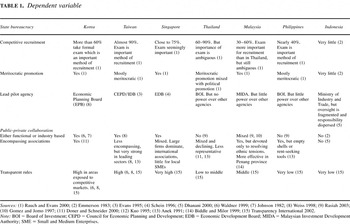
Dependent variable
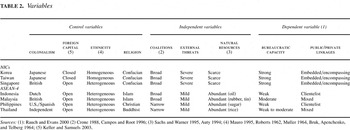
Variables
 You have
Access
- 359
- Cited by