Introduction
Little research has been done on the predictors of the long-term course of post-traumatic stress disorder (PTSD) (reviewed by Steinert et al. Reference Steinert, Hofmann, Leichsenring and Kruse2015). Existing evidence suggests that even though a substantial proportion of cases recover within a few months, at least one-third of cases persist for many years (Kessler et al. Reference Kessler, Sonnega, Bromet, Hughes and Nelson1995; Breslau et al. Reference Breslau, Kessler, Chilcoat, Schultz, Davis and Andreski1998; Pietrzak et al. Reference Pietrzak, Goldstein, Southwick and Grant2011; Chapman et al. Reference Chapman, Mills, Slade, McFarlane, Bryant, Creamer, Silove and Teesson2012), and that chronic PTSD can lead to secondary disorders (Perkonigg et al. Reference Perkonigg, Pfister, Stein, Hofler, Lieb, Maercker and Wittchen2005) and suicidality (Tarrier & Gregg, Reference Tarrier and Gregg2004). The predictors of PTSD recovery considered most often in retrospective research have been trauma type-characteristics, PTSD symptom severity, and history of comorbid mental disorders (Breslau et al. Reference Breslau, Kessler, Chilcoat, Schultz, Davis and Andreski1998; Pietrzak et al. Reference Pietrzak, Goldstein, Southwick and Grant2011; Chapman et al. Reference Chapman, Mills, Slade, McFarlane, Bryant, Creamer, Silove and Teesson2012), although systematic reviews of prospective naturalistic studies suggest that socio-demographic factors and childhood adversities might also be important predictors (Steinert et al. Reference Steinert, Hofmann, Leichsenring and Kruse2015).
Previous studies of PTSD recovery were limited in being based on relatively small samples, making it impossible to investigate fine-grained associations. We address this limitation in the current report by presenting data on patterns and predictors of PTSD recovery in a sample of 1575 respondents with a history of PTSD in the WHO World Mental Health (WMH) surveys, a coordinated series of community epidemiological surveys carried out in countries throughout the world (Kessler & Üstün, Reference Kessler and Üstün2008).
Materials and methods
Samples
Data come from 22 WMH surveys that assessed PTSD due to randomly-selected traumas (defined below). Twelve of these surveys were conducted in countries classified by the World Bank as high-income [Belgium, France, Germany, Israel, Italy, Japan, Netherlands, New Zealand, Northern Ireland, Spain (separate national and regional surveys), the USA], seven in countries classified upper-middle-income (Brazil, Bulgaria, Colombia, Lebanon, Mexico, Romania, South Africa), and three in countries classified low- and lower-middle-income [Peru, Ukraine, Colombia (a national survey administered prior to the previously-mentioned Colombian survey, which was carried out in the Medellin region, when the country income rating was lower)]. Each survey was based on a multi-stage clustered area probability sample of adult household residents. The target population was the entire country in most surveys, all urbanized areas in three (the first Colombian survey in addition to the surveys in Mexico and Peru), and specific metropolitan areas in four (Sao Paulo, Brazil; Medellin, Colombia; Murcia, Spain; six cities in Japan). Response rates ranged from 45.9% (France) to 97.2% (Medellin) and averaged 71.3% across surveys. More details about surveys and sample designs are presented in online Supplementary Table S1.
The interview schedule was developed in English and translated into other languages using a standardized WHO translation, back-translation, and harmonization protocol (Harkness et al. Reference Harkness, Pennell, Villar, Gebler, Aguilar-Gaxiola, Bilgen, Kessler and Üstün2008). Interviews were administered face-to-face in respondent homes after obtaining informed consent using procedures approved by local Institutional Review Boards. Interviews were in two parts. Part I was administered to all respondents and assessed core DSM-IV mental disorders (n = 101 454 respondents across all surveys). Part II assessed additional disorders and correlates. Questions about traumas and PTSD were included in Part II, which was administered to 100% of respondents who met lifetime criteria for any Part I disorder and a probability subsample of other Part I respondents (n = 54 601). Part II respondents were weighted to adjust for differential probabilities of selection into Part II, and deviations between the sample and population demographic-geographic distributions. This weight resulted in prevalence estimates of Part I disorders in the weighted Part II sample being identical to those in the Part I sample. More details about WMH weighting are presented elsewhere (Heeringa et al. Reference Heeringa, Wells, Hubbard, Mneimneh, Chiu, Sampson, Berglund, Kessler and Üstün2008). The analysis sample in the current report was the 1575 respondents who developed DSM-IV PTSD after a randomly-selected trauma (defined below).
Measures
Traumas
As detailed in a prior report in this journal (Benjet et al. Reference Benjet, Bromet, Karam, Kessler, McLaughlin, Ruscio, Shahly, Stein, Petukhova, Hill, Alonso, Atwoli, Bunting, Bruffaerts, Caldas-de-Almeida, de Girolamo, Florescu, Gureje, Huang, Lepine, Kawakami, Kovess-Masfety, Medina-Mora, Navarro-Mateu, Piazza, Posada-Villa, Scott, Shalev, Slade, ten Have, Torres, Viana, Zarkov and Koenen2016), 29 trauma types were assessed. Exploratory factor analysis showed that they can be organized into six broad empirically-related groups (Benjet et al. Reference Benjet, Bromet, Karam, Kessler, McLaughlin, Ruscio, Shahly, Stein, Petukhova, Hill, Alonso, Atwoli, Bunting, Bruffaerts, Caldas-de-Almeida, de Girolamo, Florescu, Gureje, Huang, Lepine, Kawakami, Kovess-Masfety, Medina-Mora, Navarro-Mateu, Piazza, Posada-Villa, Scott, Shalev, Slade, ten Have, Torres, Viana, Zarkov and Koenen2016): five representing exposure to organized violence (e.g., civilian in war zone, civilian in region of terror, relief worker in war zone, refugee), five representing participation in organized violence (e.g., combat experience, witnessed atrocities); three indicators of physical violence victimization (witnessed violence at home as child; beaten by caregiver as child; beaten by someone other than romantic partner); seven representing exposure to sexual violence victimization (e.g., raped, sexually assaulted, beaten by romantic partner); six involving various accidents/injuries (e.g., natural disaster, automobile accident); and three other traumas that did not load on any of the five factors (mugged/threatened with weapon, man-made disaster, unexpected death of loved one).
Positive responses to trauma questions were followed by probes to assess the number of lifetime exposures and age at first exposure to each trauma type. Respondents who reported only one occasion of only one trauma type were assessed for PTSD associated with that occasion. Respondents who reported multiple trauma types and/or occasions were assessed twice: once for the trauma they defined as the worst trauma they ever experienced in terms of persistence-severity of PTSD symptoms and the second time, if different from the worst trauma, for one random occurrence (selected using a random numbers table) of one of the trauma types they ever experienced. We limited the assessment to only one random trauma per respondent because it was a practical impossibility to carry out a separate assessment of PTSD for each of the many lifetime traumas reported by each respondent. As discussed in more detail elsewhere (Kessler, Reference Kessler, Nemeroff and Marmarin press), we used the random trauma approach rather than the more common approach of assessing PTSD only for each respondent's self-reported worst trauma because the latter approach yields biased estimates of conditional PTSD prevalence and course. No respondents had PTSD in response to the randomly-selected trauma of being a relief worker in a war zone. This trauma type was consequently excluded from our analysis.
PTSD
PTSD was assessed with the Composite International Diagnostic Interview (CIDI) (Kessler & Üstün, Reference Kessler and Üstün2004), a fully-structured lay interview that assesses a wide range of common mental disorders. Clinical reappraisal interviews with the Structured Clinical Interview for DSM-IV (SCID) (Haro et al. Reference Haro, Arbabzadeh-Bouchez, Brugha, de Girolamo, Guyer, Jin, Lepine, Mazzi, Reneses, Vilagut, Sampson and Kessler2006) blinded to CIDI diagnoses of PTSD (but instructed to focus on the same trauma occurrence as the one assessed in the CIDI in order to guarantee valid diagnostic comparisons) documented moderate CIDI-SCID concordance (Landis & Koch, Reference Landis and Koch1977) (AUC = 0.69) for PTSD. Sensitivity and specificity were 38.3% and 99.1%, respectively. Although only a minority of clinical cases were detected, likelihood ratio positive [Sensitivity/(1-Specificity)] was 42.0, which is well above the 10.0 typically considered definitive for a positive screen (Gardner & Altman, Reference Gardner and Altman2000), leading to a very high proportion of CIDI cases (86.1%) being confirmed by the SCID. Number of months with PTSD was defined as the minimum of the number of months or years the respondent reported continuing to have re-experiencing (criterion B), avoidance/numbing (criterion C), and hyper-arousal (criterion D) symptoms. If symptoms within all three clusters persisted as of the time of interview, the respondent was classified as not having experienced recovery.
Predictors
We considered three sets of predictors in addition to socio-demographics (sex, age at the time of the random trauma), random trauma type, and age of exposure. The first set included the respondent's prior (to the random trauma) lifetime history of exposure to other traumas. The second set included the respondent's exposure to each of 12 family childhood adversities (CAs). Consistent with prior WMH research on CAs (Kessler et al. Reference Kessler, McLaughlin, Green, Gruber, Sampson, Zaslavsky, Aguilar-Gaxiola, Alhamzawi, Alonso, Angermeyer, Benjet, Bromet, Chatterji, de Girolamo, Demyttenaere, Fayyad, Florescu, Gal, Gureje, Haro, Hu, Karam, Kawakami, Lee, Lepine, Ormel, Posada-Villa, Sagar, Tsang, Üstün, Vassilev, Viana and Williams2010), we distinguished between those in a highly-correlated set of seven previously referred to as ‘maladaptive family functioning’ CAs (parental mental disorder, parental substance abuse, parental criminality, witnessed family violence, physical abuse by a family member, sexual abuse by a family member, neglect) and five ‘other’ CAs (parental divorce, parental death, other parental loss/separation, serious physical illness, family economic adversity). Details on CA measurement are presented elsewhere (Kessler et al. Reference Kessler, McLaughlin, Green, Gruber, Sampson, Zaslavsky, Aguilar-Gaxiola, Alhamzawi, Alonso, Angermeyer, Benjet, Bromet, Chatterji, de Girolamo, Demyttenaere, Fayyad, Florescu, Gal, Gureje, Haro, Hu, Karam, Kawakami, Lee, Lepine, Ormel, Posada-Villa, Sagar, Tsang, Üstün, Vassilev, Viana and Williams2010). The third set included the respondent's history of the 14 DSM-IV mental disorders assessed in the WMH surveys prior to the age of occurrence of the random trauma. These included two mood disorders [major depressive disorder/dysthymic disorder, broadly-defined bipolar disorder (defined elsewhere (Kessler et al. Reference Kessler, Akiskal, Angst, Guyer, Hirschfeld, Merikangas and Stang2006))], six anxiety disorders (panic disorder and/or agoraphobia, specific phobia, social phobia, generalized anxiety disorder, PTSD, and separation anxiety disorder), four disruptive behavior disorders (attention-deficit/hyperactivity disorder, oppositional-defiant disorder, conduct disorder, and intermittent explosive disorder), and two substance use disorders (alcohol abuse with or without dependence; drug abuse with or without dependence). As detailed elsewhere (Haro et al. Reference Haro, Arbabzadeh-Bouchez, Brugha, de Girolamo, Guyer, Jin, Lepine, Mazzi, Reneses, Vilagut, Sampson and Kessler2006), generally good concordance was found between these CIDI diagnoses and blinded clinical diagnoses based on SCID clinical reappraisal interviews.
Analysis method
Reports about random traumas were weighted at the respondent level by the inverse of random trauma probability of selection multiplied by the respondent's Part II survey weight, thereby generating a sample representative of all lifetime traumas, and by extension all episodes of PTSD, experienced by all respondents. PTSD recovery was assessed using a discrete-time survival model framework (Willett & Singer, Reference Willett and Singer1993) with person-month the unit of analysis and a logistic link function in SAS version 9.3 (SAS Institute Inc., 2010). Each month between the onset of PTSD and the reported duration of the PTSD episode (or date of interview if symptoms persisted as of that time) was treated as a separate observational record. The outcome was coded 0 for each person-month until the retrospectively-reported month of recovery. Respondents were censored after the month of recovery. The actuarial method (Halli & Rao, Reference Halli and Rao1992) was used to generate descriptive information about the distribution of speed of recovery.
All models included dummy variables for person-month and survey location so that coefficients for other predictors could be interpreted as pooled within-survey coefficients. This approach implicitly assumed that within-survey slopes were constant across surveys, a decision made because we wanted to focus on central tendencies in the data rather than to analyze between-survey differences in associations that would inevitably be difficult to interpret because of the small number of countries represented in the series.
Model 1 examined associations of recovery with sex, age at trauma exposure, and number of years between age at exposure and age at interview. These variables were also controlled for in all subsequent models. Model 2 then added dummy variables for the random trauma type. Supplementary Model 3 added information about history of prior (to the random trauma) trauma exposure. Supplementary Model 4 added information about history of CAs and Model 5 added information about prior DSM-IV/CIDI mental disorders. Significant predictors were carried forward across models. Logistic regression coefficients and standard errors were exponentiated and are reported as odds-ratios (ORs) with 95% confidence intervals (CIs). In Model 2, the logistic regression coefficients were scaled to have a sum of 0 across the 28 trauma types, resulting in the ORs for these trauma types having a product of 1.0. This means that ORs significantly different from 1.0 can be interpreted as meaning that PTSD due to the associated trauma types have significantly more rapid (ORs >1.0) or slower (ORs <1.0) odds of recovery than the average trauma, noting that the ‘average’ is defined by giving each trauma type equal weight (i.e., ignoring relative prevalence of the different trauma types). Statistical significance was consistently evaluated using 0.05-level two-sided tests. The design-based Taylor series linearization method (Wolter, Reference Wolter1985) implemented in the SAS software system (SAS Institute Inc., 2008) was used to adjust for the weighting and clustering of observations. Design-based Wald χ2 tests were used to evaluate statistical significance of predictor sets.
In order to examine overall final model performance, we generated individual-level predicted probabilities of recovery and examined observed recovery curves separately within the first two quartiles and the latter half of the distribution of predicted probability-of-recovery. The method of replicated 10-fold cross-validation with 20 replicates (i.e., 200 separate estimates of model coefficients) was used to correct for the over-estimation of prediction accuracy when, as in this analysis, model coefficients are both estimated and evaluated in the same sample (Smith et al. Reference Smith, Seaman, Wood, Royston and White2014).
Results
Observed speed-of-recovery distributions by age of onset
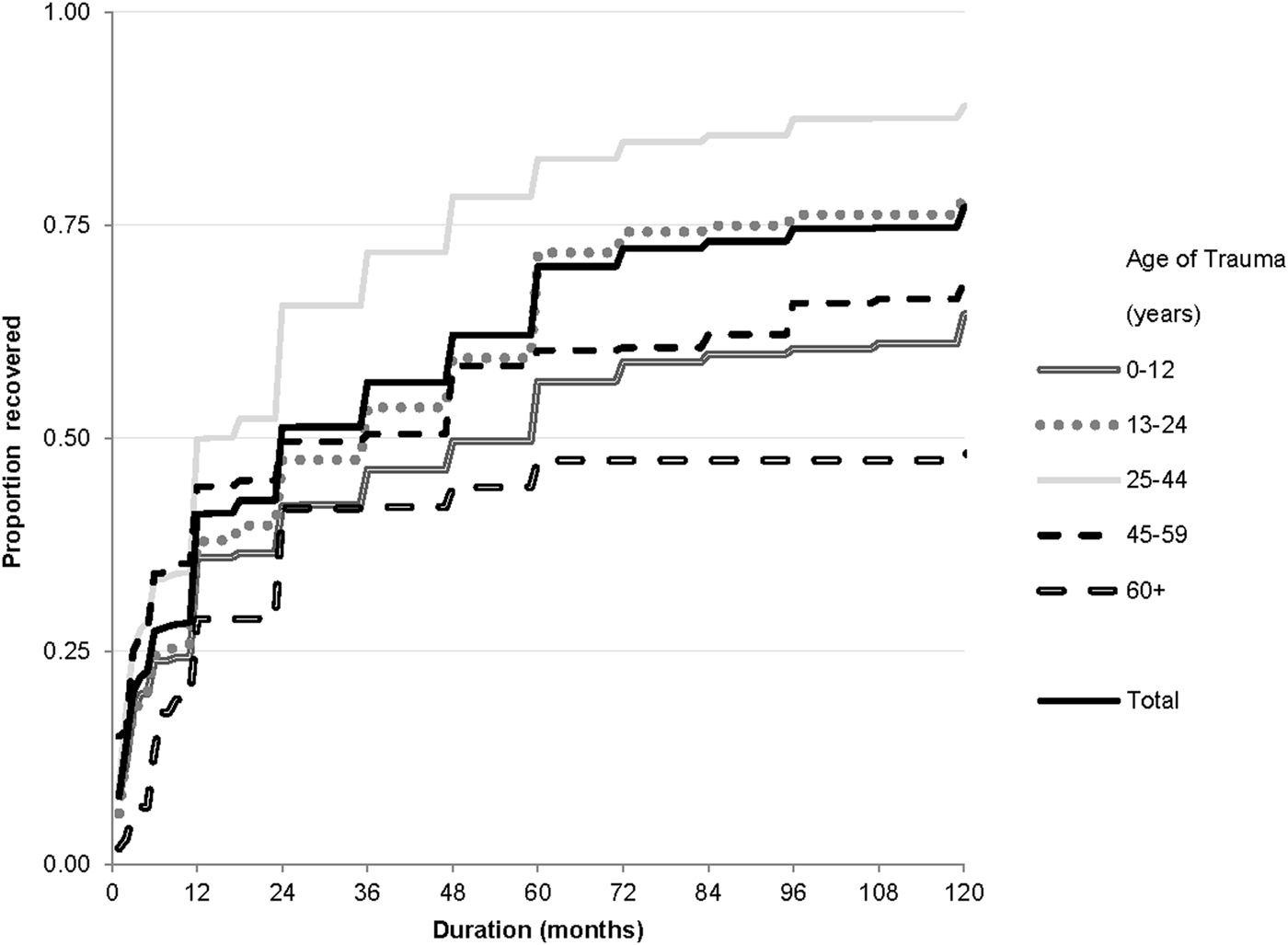
A total of 1404 respondents out of 1575 eventually recovered. The slope of the recovery curve was steepest in the first 6 months (20% recovering within 3 months, 27% within 6 months) (Fig. 1). Fifty percent of cases recovered by 24 months and 77% by 10 years (120 months; the longest follow-up period for which a sufficient number of cases were observed for stable estimation of conditional probability of remission). The lowest projected recovery rate was among cases with onsets at ages 60+ (48%) and the highest among cases with onsets at ages 25–44 (89%).
Speed of recovery from random trauma PTSD, in the total sample and age of trauma exposure subgroups.

Predictors of recovery
Socio-demographics and length-of-recall
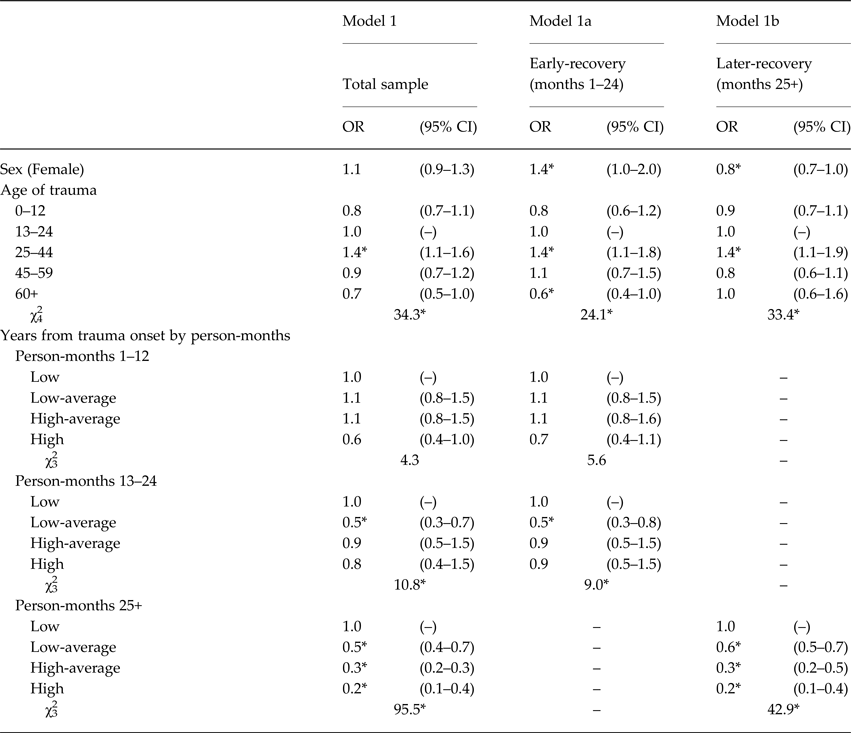
Online Supplementary Table S2 reports distributions of all predictors. Sex was not associated with recovery overall (χ1 2 = 1.0, p = 0.31) and age at trauma exposure was significant along the lines seen in Fig. 1 (χ4 2 = 34.3, p < 0.001) (Table 1, Model 1). Length-of-recall between respondent age at trauma exposure and age at interview was also significant; an association most plausibly interpreted as evidence of time-related recall bias. Length-of-recall was divided into quartiles (low = 0–7, low-average = 8–16, high-average = 17–30, and high = 31+ years) and its association with recovery was found to differ by time-to-recovery, where the latter was collapsed to capture meaningful interactions. Length-of-recall did not predict recovery in the first 12 months after onset (χ3 2 = 4.3, p = 0.23), by which time Fig. 1 shows that roughly one-fourth of cases had recovered. Length-of-recall was significant in months 13–24 (χ3 2 = 10.8, p = 0.013), by which time roughly half of cases had recovered, due to a single significantly reduced OR associated with low-average length of recall (OR 0.5), but odds of recovery were equivalent for cases with both lower and higher length-of-recall. It was only in months 25+ that a consistently strong monotonic inverse association emerged between length-of-recall and odds of recovery (ORs in the range 0.5–0.2 for low-average to high length-of-recall; χ3 2 = 95.5, p < 0.001).
Associations (odds-ratios) of sex, age at trauma exposure, and length of recall with recovery from DSM-IV/CIDI PTSD in the WMH surveys (n = 1575) a

DSM-IV, Diagnostic and Statistical Manual of Mental Disorders, Fourth Edition Revised; CIDI, Composite International Diagnostic Interview; PTSD, post-traumatic stress disorder; WMH, World Mental Health; OR, odds-ratio; 95% CI, 95% confidence interval.
* Significant at the 0.05 level, two-sided test.
a Coefficients in the first pair of columns are based on a multivariate discrete-time person-month survival model controlling for number of follow-up person-months and survey location among the 1575 respondents with PTSD associated with random traumas (a total of n = 111 355 person-months). The coefficients in the next columns are based on separate subgroups in multivariate discrete-time person-month survival models for early-recovery (months 1–24) and later-recovery (months 25–120) among the same 1575 respondents.
Based on these results, all subsequent analyses were carried out separately for months 1–24 and 25+, with a recognition that results in the latter subsample might be biased due to recall error. Women had a significantly elevated odds of early-recovery (OR 1.4) and a significantly decreased odds of later-recovery (OR 0.8) compared with men (Models 1a–1b). Both models found a significantly elevated odds of recovery among respondents whose traumas occurred in middle age (OR 1.4) whereas odds of early-recovery were significantly decreased among respondents whose traumas occurred at ages 60+ (OR 0.6).
Trauma type
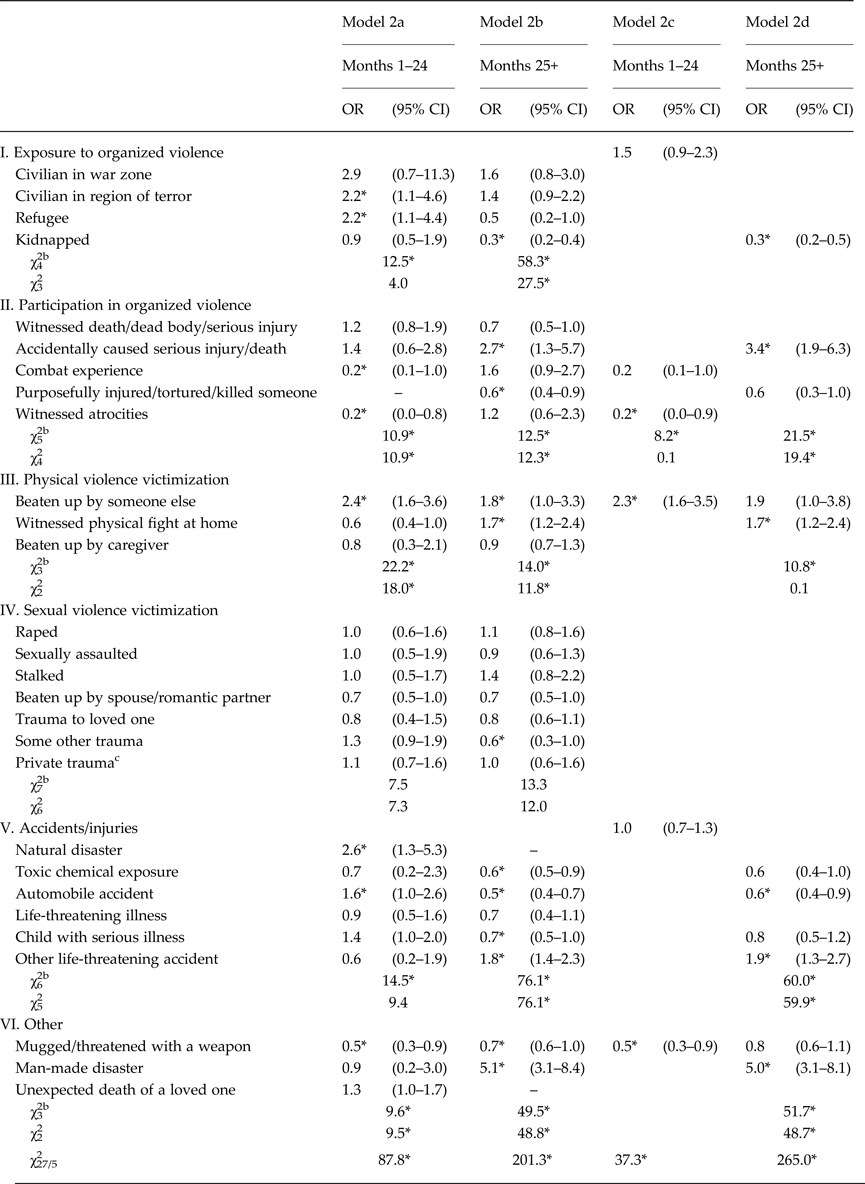
Distribution of random trauma types ranged from a high of 19.8% for unexpected death of a loved one to 0.2% for natural disasters (online Supplementary Table S2). This wide variation was a joint function of differences in population prevalence (Benjet et al. Reference Benjet, Bromet, Karam, Kessler, McLaughlin, Ruscio, Shahly, Stein, Petukhova, Hill, Alonso, Atwoli, Bunting, Bruffaerts, Caldas-de-Almeida, de Girolamo, Florescu, Gureje, Huang, Lepine, Kawakami, Kovess-Masfety, Medina-Mora, Navarro-Mateu, Piazza, Posada-Villa, Scott, Shalev, Slade, ten Have, Torres, Viana, Zarkov and Koenen2016) and PTSD risk (Liu et al. Reference Liu, Petukhova, Sampson, Aguilar-Gaxiola, Alonso, Andrade, Bromet, de Girolamo, Haro, Hinkov, Kawakami, Koenen, Kovess-Masfety, Lee, Medina-Mora, Navarro-Mateu, O'Neill, Piazza, Posada-Villa, Scott, Shahly, Stein, Ten Have, Torres, Gureje, Zaslavsky and Kessler2017). Controlling for the predictors in Models 1a–1b, random trauma type significantly predicted both early- (χ26 2 = 87.8, p < 0.001) and later- (χ26 2 = 201.3, p < 0.001) recovery (Table 2, Models 2a–2b). As none of the respondents whose random trauma was purposefully injuring/torturing/killing someone recovered within 24 months of onset, we removed those respondents from the early-recovery sample. Other traumas in five of the six trauma groups were significant as sets in both the early-recovery and later-recovery models, sexual violence victimization being the exception in both cases. Two of five within-group OR differences were non-significant in the early-recovery model, leading us to collapse traumas in these groups in that model. We retained individually significant traumas otherwise. Neither collapsed group (exposure to organized violence, accidents/injuries) had early-recovery odds significantly different from the omitted category (OR 1.0–1.5). Being beaten up by someone other than a caregiver or romantic partner was the only trauma that had significantly elevated odds of recovery in the early-recovery (OR 2.3) model, and two other traumas had significantly reduced odds (witnessed atrocities, mugged/threatened with a weapon; OR 0.2–0.5). The reduced later-recovery model, in comparison, had four traumas with elevated odds of recovery (accidentally caused serious injury/death, witnessed physical fights at home in childhood, other life-threatening accident, man-made disaster; OR 1.7–5.0) and an additional two traumas with significantly reduced odds (kidnapped, automobile accident; OR 0.3–0.6).
Associations (odds-ratios) between randomly-selected trauma type with recovery from DSM-IV/CIDI PTSD in the WMH surveys (n = 1575) a
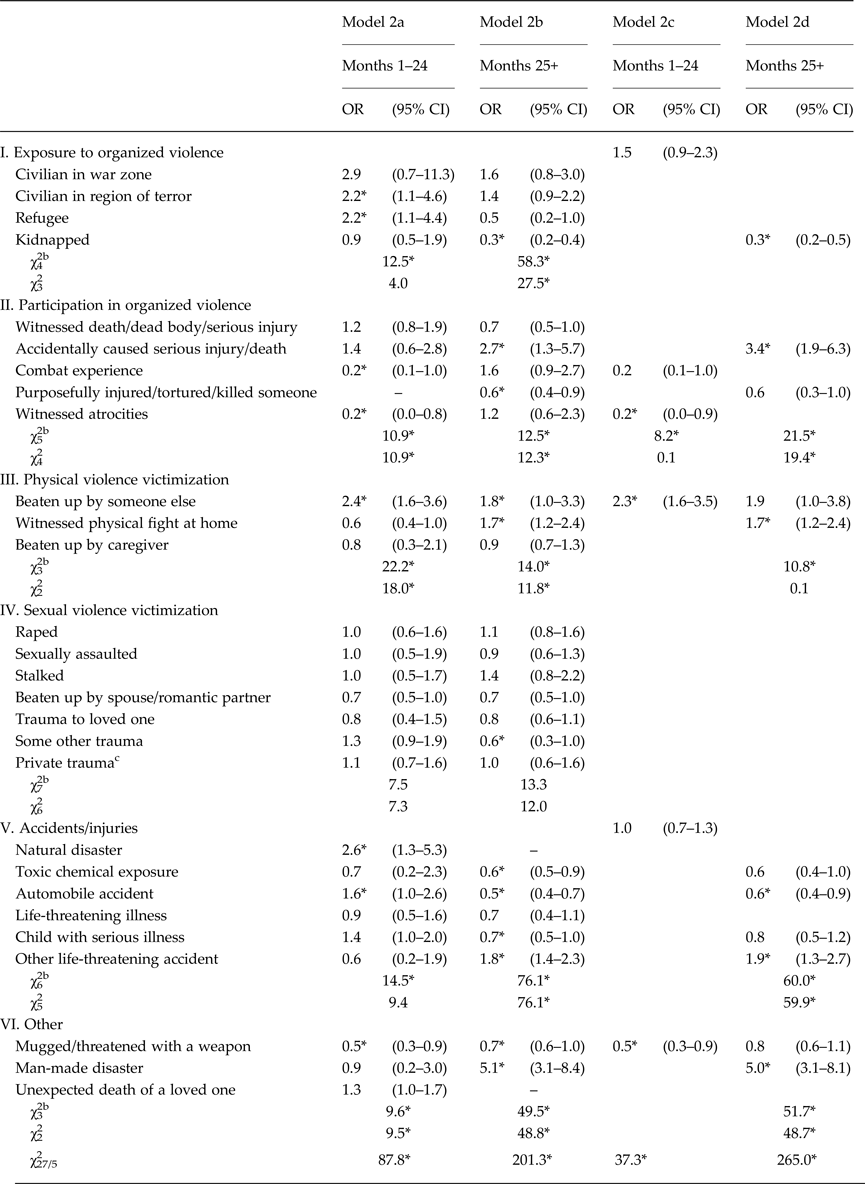
DSM-IV, Diagnostic and Statistical Manual of Mental Disorders, Fourth Edition Revised; CIDI, Composite International Diagnostic Interview; PTSD, post-traumatic stress disorder; WMH, World Mental Health; OR, odds-ratio; 95% CI, 95% confidence interval.
* Significant at the 0.05 level, two-sided test.
a Coefficients are based on multivariate discrete-time person-month survival models for early-recovery (months 1–24) and later-recovery (months 25–120) among the 1575 respondents with PTSD associated with random traumas (a total of n = 111 355 person-months) controlling for number of follow-up person-months, survey location, and all significant variables in Models 1a–1b.
b The first χ2 for each trauma group assesses the significance of the full set of ORs for traumas in the group using all other traumas as the reference. The second χ2 assesses the significance of differences among the ORs within the group.
c A private trauma is a trauma that some individuals reported in response to a question at the very end of the trauma section that asked if they ever had some other very upsetting experience they did not tell us about already because they were too embarrassed or upset to talk about it. Respondents were told, before they answered, that if they reported such a trauma we would not ask them anything about what it was, only about their age when the trauma happened.
Prior traumas
Controlling for the predictors in Models 2c–2d, prior (to age of random trauma exposure) lifetime trauma exposure significantly predicted both early- (χ28 2 = 114.1, p < 0.001) and later- (χ28 2 = 348.2, p < 0.001) recovery (online Supplementary Table S3). Three of the six prior trauma sets were significant in the early-recovery model, in each case with ORs differing significantly within the group, whereas five trauma sets were significant in the later-recovery model (the exception being exposure to organized violence). In one of the latter groups (sexual assault victimization), within-group ORs did not differ significantly from each other and we consequently entered a count variable of all prior lifetime traumas in that group in the reduced model.
In the reduced early-recovery model, three traumas had significantly elevated odds (witnessed death/dead body/serious injury, combat experience, and the residual ‘other’ trauma category; OR 1.4–2.9) and four others had significantly reduced odds (refugee, witnessed atrocities, raped, trauma to loved one; OR 0.3–0.7). In the reduced later-recovery model (Supplementary Model 3d), five traumas had significantly elevated odds (witnessed death/dead body/serious injury, beaten up by someone other than a caregiver or romantic partner, automobile accident, life-threatening illness, unexpected death of loved one; OR 1.4–1.9) and two others significantly reduced odds (accidentally caused serious injury/death, number of sexual violence victimizations; OR 0.3–0.9).
Childhood adversities (CAs)
Controlling for the earlier predictors, CAs significantly predicted both early- (χ12 2 = 44.9, p < 0.001) and later- (χ12 2 = 50.8, p < 0.001) recovery (online Supplementary Table S4). In both cases this was due to maladaptive family functioning (MFF) CAs (χ7 2 = 36.9–39.3, p < 0.001) rather than other CAs (χ5 2 = 5.2–5.6, p = 0.35–0.40). One MFF CA, witnessing family violence, was associated with significantly elevated odds of recovery in both early-recovery and later-recovery models (OR 1.4–1.9) and three others with significantly reduced odds in either the early-recovery (neglect; OR 0.6) or later-recovery (physical and sexual abuse; OR 0.6) models.
Mental disorders
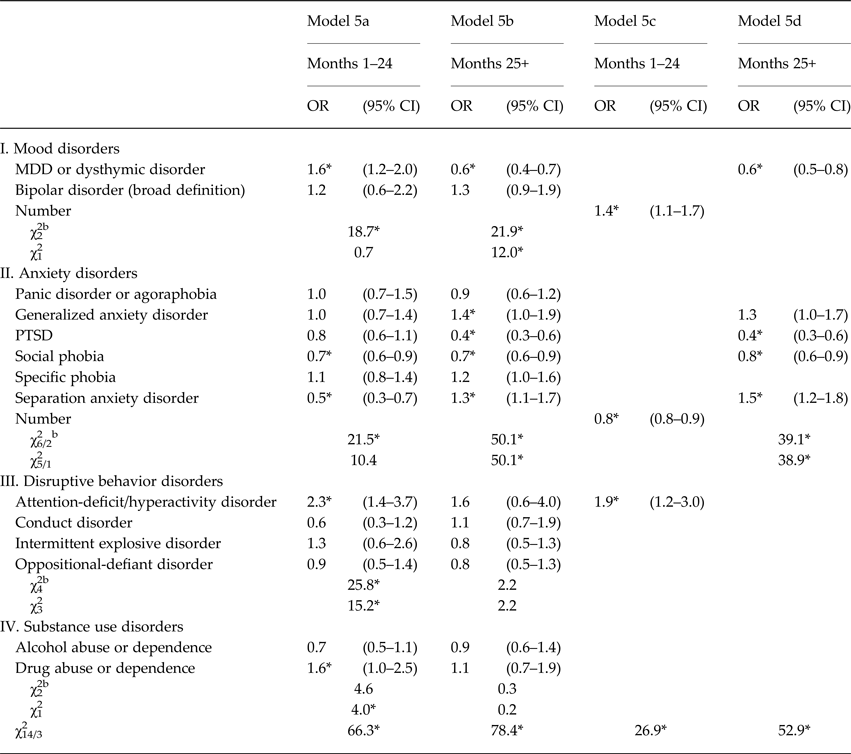
Controlling for earlier predictors, prior (to age of random trauma exposure) lifetime DSM-IV/CIDI disorders significantly predicted both early- (χ14 2 = 66.3, p < 0.001) and later- (χ14 2 = 78.4, p < 0.001) recovery. Mood and anxiety disorders were significant as sets in both models, although ORs did not vary within either group in the early-recovery model but did in the later-recovery model (Table 3, Models 5a–5b). Disruptive behavior disorders were also significant as a set (with significant within-group differences in ORs) in the early-recovery model but not the later-recovery model. Substance use disorders were not significant as a set in either model. In the reduced early-recovery model (Model 5c), number of mood disorders and ADHD were associated with significantly elevated odds of recovery (OR 1.4–1.9) and number of anxiety disorders with significantly reduced odds (OR 0.8). In the reduced later-recovery model (Model 5d), prior separation anxiety disorder was associated with significantly elevated odds of recovery (OR 1.5), whereas major depression-dysthymia, PTSD, and social phobia had significantly reduced odds (OR 0.4–0.8).
Associations (odds-ratios) between mental disorders prior to randomly-selected trauma and recovery from DSM-IV/CIDI PTSD in the WMH surveys (n = 1575) a

DSM-IV, Diagnostic and Statistical Manual of Mental Disorders, Fourth Edition Revised; CIDI, Composite International Diagnostic Interview; PTSD, post-traumatic stress disorder; WMH, World Mental Health; OR, odds-ratio; 95% CI, 95% confidence interval; MDD, major depressive disorder.
* Significant at the 0.05 level, two-sided test.
a Coefficients are based on multivariate discrete-time person-month survival models for early-recovery (months 1–24) and later-recovery (months 25–120) among the 1575 respondents with PTSD associated with random traumas (a total of n = 111 355 person-months) controlling for number of follow-up person-months, survey location, and all significant variables in earlier models.
b The first χ2 for each trauma group assesses the significance of the full set of ORs for traumas in the group using all other traumas as the reference group, while the second χ2 assesses the significance of differences among these traumas within the group.
Overall model performance
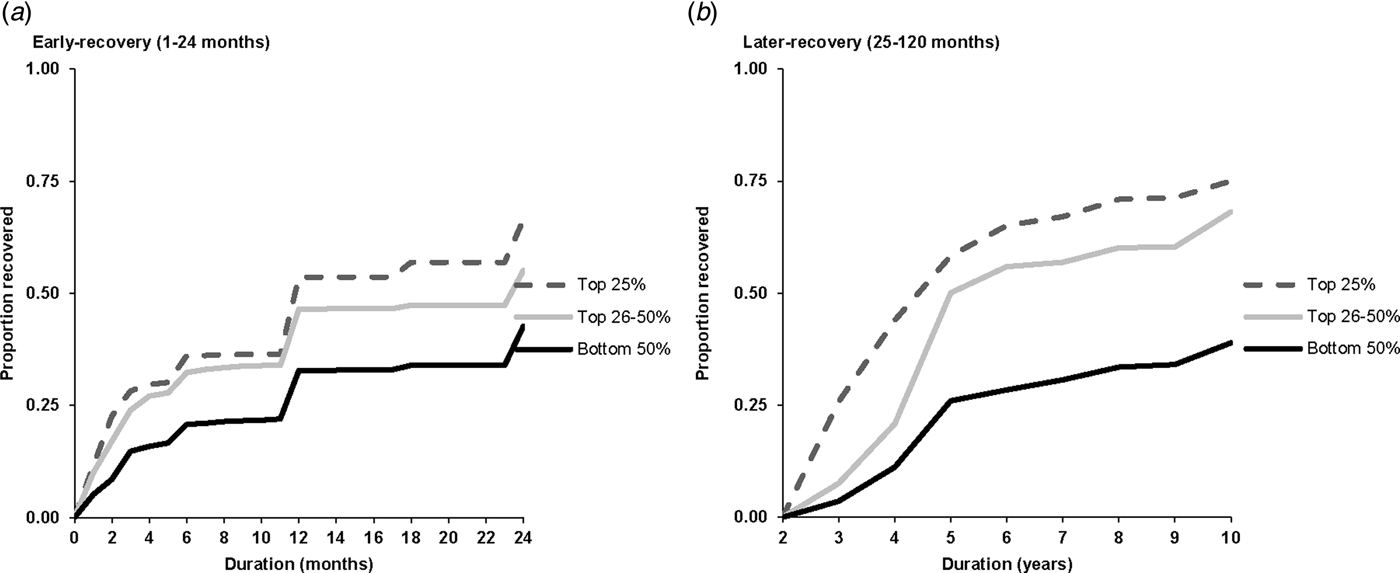
Each respondent was assigned 20 predicted probabilities of recovery in each person-month based on the coefficients in 20 replicates of 10-fold cross-validated versions of models with the predictors in Models 5c and 5d (i.e., the final models) but with coefficients allowed to vary across these replicates. The observations in these two sets of 20 replicates were then divided into three groups consisting of the cases in the top 25%, next 25%, and lowest 50% of predicted probabilities of recovery. Speed-of-recovery curves based on observed time-to-recovery in these subgroups were then generated to simulate the likely performance of the models in an independent dataset (Fig. 2).
Speed of recovery from random trauma PTSD within subgroups defined by cross-validated final model predicted probability of recovery separately for early-recovery (1–24 months; Fig. 1a ) and later-recovery (25–120 months; Fig. 1b ) models. (a) Early-recovery (1–24 months). (b) Later-recovery (25–120 months).

The model distinguished well the two groups predicted to have highest probabilities of recovery (i.e., top 25% and next 25%) from the 50% with lowest predicted probability of recovery and less well between the top two groups. It took 3–4 months for 25% of respondents in the top two groups to recover compared with 12 months in the group predicted to have lowest probability of recovery (Fig. 2a ). It took 12 months for 50% of respondents in the top group to recover, and 66% recovered by 24 months compared with 55% in the middle group and 42% in the group with lowest predicted probability of recovery. Seventy-five percent of respondents with highest predicted probability of later-recovery did, in fact, recover within 10 years of onset (25% within 3 years, 50% within 5 years) compared with 68% of those with intermediate predicted probabilities (25–50% within 5 years) and 39% of those with lowest predicted probabilities (25% within 5 years) (Fig. 2b ).
Discussion
Despite substantial variation in the definitions of PTSD ‘recovery’ in prior studies of PTSD course (Morina et al. Reference Morina, Wicherts, Lobbrecht and Priebe2014; Steinert et al. Reference Steinert, Hofmann, Leichsenring and Kruse2015), our findings that 50% of WMH respondents with PTSD recovered within 2 years and roughly 25% had not recovered within 10 years are broadly consistent with previous epidemiological estimates of PTSD recovery after random traumas (Breslau et al. Reference Breslau, Kessler, Chilcoat, Schultz, Davis and Andreski1998). Somewhat lower and slower rates of recovery have been reported in epidemiological studies of PTSD associated with ‘worst’ traumas (Kessler et al. Reference Kessler, Sonnega, Bromet, Hughes and Nelson1995; Chapman et al. Reference Chapman, Mills, Slade, McFarlane, Bryant, Creamer, Silove and Teesson2012).
Our failure to find a sex difference in overall PTSD recovery is consistent with the results of a meta-analysis of predictors of PTSD recovery carried out by Morina et al. (Reference Morina, Wicherts, Lobbrecht and Priebe2014). Our finding of opposite-sign sex differences in early-recovery (women higher recovery than men) and later-recovery (women lower recovery than men) is not comparable with prior studies as none have examined interactions between predictors and timing of recovery. Nor are we aware of any previous research that speaks to the significant association we found between length-of-recall and retrospective reports about PTSD recovery. As noted above, this association is most plausibly interpreted as due to recall bias related to length of the recall period. Because of this association, which was largely confined to later-recovery, our results regarding the predictors of early-recovery are likely to be less influenced by recall bias than those regarding later-recovery.
Very low relative-odds of early-recovery (OR 0.0–0.3) were found for two trauma types (purposefully injuring/torturing/killing someone and witnessing atrocities) and of later-recovery for another (being kidnapped). Very high odds of early-recovery (OR 3.0+) were found for no trauma types and of later-recovery for two trauma types (accidentally causing serious injury/death, man-made disaster). Other significant between-trauma differences in recovery were few in number and comparatively modest in magnitude. No trauma type was a significant predictor in both early-recovery and later-recovery models. These results are broadly consistent with the Morina et al. (Reference Morina, Wicherts, Lobbrecht and Priebe2014) meta-analysis finding that between-trauma differences in recovery rates are for the most part insignificant, although the one exception to this general pattern in the meta-analysis, a significantly higher recovery rate from natural disasters than other traumas, was not replicated in the WMH data.
We are unaware of previous epidemiological research on the associations of PTSD recovery with prior traumas or childhood adversities even though both have consistently been found to predict increased risk of onset of PTSD (Liu et al. Reference Liu, Petukhova, Sampson, Aguilar-Gaxiola, Alonso, Andrade, Bromet, de Girolamo, Haro, Hinkov, Kawakami, Koenen, Kovess-Masfety, Lee, Medina-Mora, Navarro-Mateu, O'Neill, Piazza, Posada-Villa, Scott, Shahly, Stein, Ten Have, Torres, Gureje, Zaslavsky and Kessler2017; McLaughlin et al. Reference McLaughlin, Koenen, Bromet, Karam, Liu, Petukhova, Ruscio, Sampson, Stein, Aguilar-Gaxiola, Alonso, Borges, Demyttenaere, Dinolova, Ferry, Florescu, de Girolamo, Gureje, Kawakami, Lee, Navarro-Mateu, Piazza, Pennell, Posada-Villa, ten Have, Viana and Kesslerin press). In the WMH data, history of being a refugee and of witnessing atrocities (early-recovery) and accidentally causing serious injury/death (later-recovery) were the only prior traumas associated with very low odds of recovery. No prior trauma type was associated with very high odds of recovery, and no childhood adversities were associated either with very low or with very high odds of recovery. No prior trauma type other than witnessing death/dead body/serious injury and no childhood adversity other than exposure to childhood family violence was a significant predictor in both the early-recovery and later-recovery models. However, the consistently significant ORs for these variables were not large (OR 1.4–1.9).
Our finding that prior history of anxiety disorders (i.e., number of disorders, PTSD, social phobia) was associated with decreased likelihood of PTSD recovery is broadly consistent with the results of both cohort (Pietrzak et al. Reference Pietrzak, Feder, Singh, Schechter, Bromet, Katz, Reissman, Ozbay, Sharma, Crane, Harrison, Herbert, Levin, Luft, Moline, Stellman, Udasin, Landrigan and Southwick2014) and clinical (Zlotnick et al. Reference Zlotnick, Rodriguez, Weisberg, Bruce, Spencer, Culpepper and Keller2004) studies that found comorbid prior anxiety disorders to be associated with a more chronic course of PTSD. It is noteworthy, though, that separation anxiety disorder was associated with decreased likelihood of early PTSD recovery but increased likelihood of later-recovery. Such divergent results may help explain why a summary measure of any pre-trauma anxiety disorder was not significantly associated with PTSD recovery in the one prior general population epidemiological study that examined associations of prior mental disorders with PTSD recovery using retrospective reports (Chapman et al. Reference Chapman, Mills, Slade, McFarlane, Bryant, Creamer, Silove and Teesson2012). We are unaware of prior studies that examined the association of temporally primary ADHD with PTSD recovery.
Our finding that observed recovery curves differed substantially between the subgroups defined as having higher and lower predicted probabilities of recovery raises the possibility that models along the lines presented here could be developed at the time of trauma exposure to classify survivors into those with higher and lower probabilities of recovery. It is unclear how much value this would have, though, for targeting interventions based on the fact that much stronger models exist to predict PTSD onset (Kessler et al. Reference Kessler, Rose, Koenen, Karam, Stang, Stein, Heeringa, Hill, Liberzon, McLaughlin, McLean, Pennell, Petukhova, Rosellini, Ruscio, Shahly, Shalev, Silove, Zaslavsky, Angermeyer, Bromet, de Almeida, de Girolamo, de Jonge, Demyttenaere, Florescu, Gureje, Haro, Hinkov, Kawakami, Kovess-Masfety, Lee, Medina-Mora, Murphy, Navarro-Mateu, Piazza, Posada-Villa, Scott, Torres and Carmen Viana2014) and information about initial treatment response and other post-trauma factors that are not available at the time of trauma exposure have been found to predict recovery (Brackbill et al. Reference Brackbill, Hadler, DiGrande, Ekenga, Farfel, Friedman, Perlman, Stellman, Walker, Wu, Yu and Thorpe2009; North et al. Reference North, Pfefferbaum, Kawasaki, Lee and Spitznagel2011; Pietrzak et al. Reference Pietrzak, Feder, Singh, Schechter, Bromet, Katz, Reissman, Ozbay, Sharma, Crane, Harrison, Herbert, Levin, Luft, Moline, Stellman, Udasin, Landrigan and Southwick2014). Receiving an evidence-based treatment for PTSD, which we did not evaluate here, is also an important determinant of PTSD recovery (Courtois et al. Reference Courtois, Sonis, Brown, Cook, Fairbank, Friedman, Gone, Jones, La Greca, Mellman, Roberts, Schulz, Bufka, Halfond and Kurtzman2016). Nonetheless, it is useful to see based on our simulation results that the joint associations of the pre-trauma predictors considered here in addition to information about random trauma type are associated with striking difference in the shape of speed-of-recovery curves.
A number of limitations of the above analysis are noteworthy. First, the data were based on retrospective reports that are subject to recall bias. Second, PTSD was assessed with a fully-structured diagnostic interview with a low sensitivity rather than with a semi-structured clinical interview, while recovery was defined using a relatively coarse dichotomous measure. Third, the predictors were limited to those available in the survey, which consisted of measures of socio-demographics, childhood adversities, prior (to the index trauma) traumas, and prior psychopathology. Fourth, we did not take treatment or other factors that occurred after the occurrence of the trauma into consideration. Within the context of these limitations, we analyzed a unique cross-national epidemiological sample. We focused on representative PTSD cases associated with randomly-selected traumas. We replicated the findings in previous studies that a substantial minority of PTSD cases recover within a short period of time, that the majority recover within 2 years, and that a substantial minority of cases do not recover even after many years. We found weak evidence for associations of socio-demographics, trauma types, and prior trauma history with recovery. We found that prior anxiety disorders predict recovery, but again with fairly modest magnitudes of association. Although our composite risk model discriminated well between the recovery trajectories within the 50% of patients predicted to have the highest and lowest probabilities of recovery, this recovery model was much weaker than models using the same kinds of pre-trauma variables to predict PTSD onset, highlighting the importance of including information on post-trauma symptoms and experiences to develop powerful models of PTSD recovery.
Supplementary material
The supplementary material for this article can be found at https://doi.org/10.1017/S0033291717001817
Acknowledgements
The World Health Organization World Mental Health (WMH) Survey Initiative is supported by the National Institute of Mental Health (NIMH; R01 MH070884 and R01 MH093612-01), the John D. and Catherine T. MacArthur Foundation, the Pfizer Foundation, the US Public Health Service (R13-MH066849, R01-MH069864, and R01 DA016558), the Fogarty International Center (FIRCA R03-TW006481), the Pan American Health Organization, Eli Lilly and Company, Ortho-McNeil Pharmaceutical, Inc., GlaxoSmithKline, and Bristol-Myers Squibb. We thank the staff of the WMH Data Collection and Data Analysis Coordination Centres for assistance with instrumentation, fieldwork, and consultation on data analysis. A complete list of all within-country and cross-national WMH publications can be found at http://www.hcp.med.harvard.edu/wmh/.
The São Paulo Megacity Mental Health Survey is supported by the State of São Paulo Research Foundation (FAPESP) Thematic Project Grant 03/00204-3. The Bulgarian Epidemiological Study of common mental disorders EPIBUL is supported by the Ministry of Health and the National Center for Public Health Protection. The Colombian National Study of Mental Health (NSMH) is supported by the Ministry of Social Protection. The Mental Health Study Medellín – Colombia was carried out and supported jointly by the Center for Excellence on Research in Mental Health (CES University) and the Secretary of Health of Medellín. The ESEMeD project is funded by the European Commission (Contracts QLG5-1999-01042; SANCO 2004123, and EAHC 20081308), the Piedmont Region (Italy), Fondo de Investigación Sanitaria, Instituto de Salud Carlos III, Spain (FIS 00/0028), Ministerio de Ciencia y Tecnología, Spain (SAF 2000-158-CE), Departament de Salut, Generalitat de Catalunya, Spain, Instituto de Salud Carlos III (CIBER CB06/02/0046, RETICS RD06/0011 REM-TAP), and other local agencies and by an unrestricted educational grant from GlaxoSmithKline. The World Mental Health Japan (WMHJ) Survey is supported by the Grant for Research on Psychiatric and Neurological Diseases and Mental Health (H13-SHOGAI-023, H14-TOKUBETSU-026, H16-KOKORO-013) from the Japan Ministry of Health, Labour and Welfare. The Lebanese Evaluation of the Burden of Ailments and Needs Of the Nation (L.E.B.A.N.O.N.) is supported by the Lebanese Ministry of Public Health, the WHO (Lebanon), National Institute of Health/Fogarty International Center (R03 TW006481-01), anonymous private donations to IDRAAC, Lebanon, and unrestricted grants from Algorithm, AstraZeneca, Benta, Bella Pharma, Eli Lilly, GlaxoSmithKline, Lundbeck, Novartis, OmniPharma, Phenicia, Pfizer, Servier, UPO. The Mexican National Comorbidity Survey (MNCS) is supported by The National Institute of Psychiatry Ramón de la Fuente (INPRFMDIES 4280) and by the National Council on Science and Technology (CONACyT-G30544- H), with supplemental support from the PanAmerican Health Organization (PAHO). Te Rau Hinengaro: The New Zealand Mental Health Survey (NZMHS) is supported by the New Zealand Ministry of Health, Alcohol Advisory Council, and the Health Research Council. The Northern Ireland Study of Mental Health was funded by the Health & Social Care Research & Development Division of the Public Health Agency. The Peruvian World Mental Health Study was funded by the National Institute of Health of the Ministry of Health of Peru. The Romania WMH study projects ‘Policies in Mental Health Area’ and ‘National Study regarding Mental Health and Services Use’ were carried out by the National School of Public Health & Health Services Management (former National Institute for Research & Development in Health), with technical support of Metro Media Transilvania, the National Institute of Statistics-National Centre for Training in Statistics, S.C. Cheyenne Services SRL, Statistics Netherlands and were funded by the Ministry of Public Health (former Ministry of Health) with supplemental support of Eli Lilly Romania SRL. The South Africa Stress and Health Study (SASH) is supported by the US National Institute of Mental Health (R01-MH059575) and National Institute of Drug Abuse with supplemental funding from the South African Department of Health and the University of Michigan. The Psychiatric Enquiry to General Population in Southeast Spain – Murcia (PEGASUS-Murcia) Project has been financed by the Regional Health Authorities of Murcia (Servicio Murciano de Salud and Consejería de Sanidad y Política Social) and Fundación para la Formación e Investigación Sanitarias (FFIS) of Murcia. The Ukraine Comorbid Mental Disorders during Periods of Social Disruption (CMDPSD) study is funded by the US National Institute of Mental Health (RO1-MH61905). The US National Comorbidity Survey Replication (NCS-R) is supported by the National Institute of Mental Health (NIMH; U01-MH60220) with supplemental support from the National Institute of Drug Abuse (NIDA), the Substance Abuse and Mental Health Services Administration (SAMHSA), the Robert Wood Johnson Foundation (RWJF; Grant 044708), and the John W. Alden Trust. Dr. Anthony J. Rosellini is supported by the National Institute of Mental Health (NIMH; K01-MH106710). Howard Liu's work was supported in part by a training grant from the National Institute of Mental Health (T32 MH017119). Dr. Dan J. Stein is supported by the Medical Research Council of South Africa (MRC).
Declaration of Interest
In the past 3 years, Dr Kessler received support for his epidemiological studies from Sanofi Aventis, was a consultant for Johnson & Johnson Wellness and Prevention, Shire and Takeda, and served on an advisory board for the Johnson & Johnson Services Inc. Lake Nona Life Project. Kessler is a co-owner of DataStat, Inc., a market research firm that carries out healthcare research. In the past 3 years, Dr Stein has received research grants and/or consultancy honoraria from AMBRF, Biocodex, Cipla, Lundbeck, National Responsible Gambling Foundation, Novartis, Servier, and Sun. The remaining authors declare no conflicts of interest.
Ethical standards
The authors assert that all procedures contributing to this work comply with the ethical standards of the relevant national and institutional committees on human experimentation and with the Helsinki Declaration of 1975, as revised in 2008.
Group information
The WHO World Mental Health Survey collaborators are Sergio Aguilar-Gaxiola, M.D., Ph.D., Ali Al-Hamzawi, M.D., Mohammed Salih Al-Kaisy, M.D., Jordi Alonso, M.D., Ph.D., Laura Helena Andrade, M.D., Ph.D., Corina Benjet, Ph.D., Guilherme Borges, Sc.D., Evelyn J. Bromet, Ph.D., Ronny Bruffaerts, Ph.D., Brendan Bunting, Ph.D., Jose Miguel Caldas de Almeida, M.D., Ph.D., Graça Cardoso, M.D., Ph.D., Somnath Chatterji, M.D., Alfredo H. Cia, M.D., Louisa Degenhardt, Ph.D., Koen Demyttenaere, M.D., Ph.D., John Fayyad, M.D., Silvia Florescu, M.D., Ph.D., Giovanni de Girolamo, M.D., Oye Gureje, M.D., D.Sc., FRCPsych, Josep Maria Haro, M.D., Ph.D., Yanling He, M.D., Hristo Hinkov, M.D., Ph.D., Chi-yi Hu, M.D., Ph.D., Yueqin Huang, M.D., M.P.H., Ph.D., Peter de Jonge, Ph.D., Aimee Nasser Karam, Ph.D., Elie G. Karam, M.D., Norito Kawakami, M.D., D.M.Sc., Ronald C. Kessler, Ph.D., Andrzej Kiejna, M.D., Ph.D., Viviane Kovess-Masfety, M.D., Ph.D., Sing Lee, M.B., B.S., Jean-Pierre Lepine, M.D., Daphna Levinson, Ph.D., John McGrath, M.D., Ph.D., Maria Elena Medina-Mora, Ph.D., Jacek Moskalewicz, Ph.D., Fernando Navarro-Mateu, M.D., Ph.D., Beth-Ellen Pennell, M.A., Marina Piazza, M.P.H., Sc.D., Jose Posada-Villa, M.D., Kate M. Scott, Ph.D., Tim Slade, Ph.D., Juan Carlos Stagnaro, M.D., Ph.D., Dan J. Stein, FRCPC, Ph.D., Margreet ten Have, Ph.D., Yolanda Torres, M.P.H., Dra.HC, Maria Carmen Viana, M.D., Ph.D., Harvey Whiteford, M.B.B.S., Ph.D., David R. Williams, M.P.H., Ph.D., Bogdan Wojtyniak, Sc.D.
Disclaimer
The views and opinions expressed in this paper are those of the authors and do not necessarily represent the views or policies of the World Health Organization, the National Institutes of Health, other sponsoring organizations, agencies or governments.