INTRODUCTION
Tapping into patient satisfaction is a strategy used by many healthcare programs.Reference Guzman, Sliepcevich, Lacey, Vitello, Matten, Woehlke and Wright1–Reference Schutt, Cruz and Woodford7 Studies have documented the impact of language barrier and cultural barriers on the quality of patient care,Reference Andrulis8–Reference Anderson, Scrimshaw, Fullilove, Fielding and Normand10 especially in oncology.Reference Guzman, Sliepcevich, Lacey, Vitello, Matten, Woehlke and Wright1,Reference Poinsot, Altmeyer, Conroy, Savignoni, Asselain, Léonard, Marx, Cosquer, Sévellec, Gledhill, Rodary, Mercier, Dickès, Fabbro, Antoine, Guerif, Schraub, Dolbeault and Brédart11–Reference Wong, Fielding, Wong and Hedley15 Low levels of satisfactions related to a lack of information provided to patients, about their disease, poor treatment side-effects management, and weak partnerships and decision-making relationships between patient and healthcare providers reducing patient’s engagement in their own treatment, have been found.Reference Wiggers, Donovan, Redman and Sanson-Fisher3,Reference Kleeberg, Feyer, Günther and Behrens16,Reference Ashbury, Findlay, Reynolds and McKerracher17 Other studies also found insufficient information received by patients, lengthy wait times for services, poor communication with healthcare providers, and the complicated physical surrounding of the healthcare facility have been related to lower levels of satisfaction.Reference Groff, Carlson, Tsang and Potter18–Reference Cassileth, Volckmar and Goodman24
Ethnic disparities in patient satisfaction have been examined in the United KingdomReference Campbell, Ramsay and Green25 and the United StatesReference Haviland, Morales, Dial and Pincus26–Reference Wong, Asch, Andersen, Hays and Shapiro31 and have shown that Asians, Africans, and Hispanics have a greater tendency to rate their healthcare experiences being less positive than their White counterparts. Among Asians specifically, lower satisfaction and lack of trust have been consistently foundReference Taira, Safran, Seto, Rogers, Kosinski, Ware, Lieberman and Tarlov29,Reference Murray-García, Selby, Schmittdiel, Grumbach and Quesenberry30,Reference Ngo-Metzger, Legedza and Phillips32 and attributed to linguistic barriers that limit their ability to obtain the type of care they need. However, study findings regarding ethnic satisfaction from other countries cannot be automatically generalised to the Canadian population. The ethnic population in Canada differs greatly from that of the United States and United Kingdom in terms of ethnic makeup making the participants and results incomparable. In the United States, socioeconomic, education level, and insurance status differences contribute immensely as barriers by ethnic minorities to access healthcare services,Reference Hargraves, Cunningham and Hughes33–Reference Shi and Stevens35 which is not the case in Canada. Canada has a universal healthcare system that allows equal access to healthcare services. For these reasons, there is a need for investigation into the healthcare experiences of Canadian ethnic minorities, especially in specialised cancer care services.
Patient satisfaction surveys conducted in English can exclude respondents who are not proficient in the English language. Therefore, little is known from non-English speaking patients making it difficult to assess whether current services are performed at a satisfactory level and whether the services provided are culturally appropriate to this group. Culturally appropriate services have the potential to reduce ethnic disparities. If instigated by the healthcare facility, these initiatives can create and support services that bring greater awareness to the needs and perceptions of non-English patients in an English-proficient setting. Language and culture-specific surveys investigating satisfaction level toward current services received by this particular group is required.
In 2004, the French developed the Radiation Therapy (RT) Patient Satisfaction survey to measure patient satisfaction as a quality improvement initiative for English speaking patients receiving RT at the British Columbia Cancer Agency, Vancouver Centre.Reference French36 Patient satisfaction can be divided into several facets, with five main facets described by WesbrookReference Westbrook37 as and used by the French:Reference French36
• environmental and structural features: quality and appearance of wait areas;
• accessibility and convenience: timing of appointments and wait times;
• hotel services: quality of meals or cleanliness of rooms;
• interpersonal relationships: warmth and friendliness of staffs; and
• clinical competence of healthcare providers: perceived ability of staff and provision of adequate and accurate information
The survey was pre-tested on volunteers and staff members for construct validity before being implemented for use. The survey measures patient satisfaction and appropriateness of service with 13 items, namely:
• Information given about nature and extent of illness;
• Accuracy of information given about nature and extent of illness;
• Information given about RT treatments;
• Accuracy of information given about RT treatments;
• Information given about side effects from RT treatments;
• Accuracy of information given about side effects from RT treatments;
• Help given to manage side effects from treatment;
• Addressing of questions or concerns about RT treatments;
• Information given about support services available at the centre;
• Courtesy and respectfulness of staff at the centre;
• Satisfaction with appointment times;
• Satisfaction with waiting times for
PATIENTS AND METHODS
Setting
The British Columbia Cancer Agency (BCCA), an agency of the Provincial Health Services Authority, is the sole provider of radiation treatments for the residents of British Columbia (BC) and the Yukon. Of the five outpatient clinics that deliver RT, the Vancouver Centre (VC) serves the largest cohort of Chinese speaking patients.
Patient demographics and data collection
The survey developed by the FrenchReference French36 was translated in Chinese and distributed to Chinese speaking patients who completed RT at VC. Completion of the survey is voluntary. Patients had the option of returning the completed survey directly to staff or depositing the survey in a confidential box in the department. All surveys are anonymous and respondents only provide information related to the survey. Patients were excluded if they are unable to understand written Chinese or unable to complete the survey due to illness. Survey results were entered into a Microsoft access database developed specifically for this purpose.
Survey tool
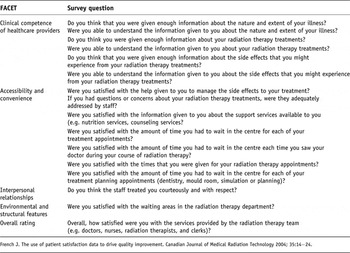
The survey tool included three demographic variables: age, gender, and level of education. At the end, an overall satisfaction which generalised to include services provided by staff and the overall facility was measured using an overall satisfaction question. Table 1 describes the facets and corresponding survey questions.
Facets of satisfaction and related survey items.

French J. The use of patient satisfaction data to drive quality improvement. Canadian Journal of Medical Radiation Technology 2004; 35:14–24.
A six-point Likert scale was used to collect responses, with responses varying depending on the question. The response choices are as follows: 1. I don’t understand this question; 2. Not enough information; 3. Almost enough information; 4. Enough information; 5. A bit too much information; 6. Far too much information – in relation to information received, and 1. I don’t understand this question; 2. Not at all; 3. A little bit; 4. Somewhat; 5. Quite a bit (or mostly); 6. Completely – in relation to other survey questions. Patients were given a section for comments or to expand on any aspect of the survey related to their experience.
Statistical analysis of the available data for the Chinese speaking group was undertaken and compared to the results from the English speaking group analysed in 2009 by the French & McGahan.Reference French and McGahan38 The findings of this survey may contribute to a better understanding of this cohort’s level of satisfaction and appropriateness of services received in an English-proficient environment, issues faced by this particular group, and future planning and development of culturally appropriate services.
Data analysis
For questions related to information received, a response of ‘enough’ was assumed to be completely satisfied; all other responses except ‘do not understand’ assumed patients were not completely satisfied with the information provided. Likewise, for questions related to satisfaction, a response of ‘completely’ were assumed to be completely satisfied and all other responses except ‘do not understand’ assumed patients were not completely satisfied. All 15 measurements of satisfaction (completely satisfied versus not completely satisfied) and the comparison between the Chinese and English Satisfaction Survey results were considered in the analysis. Contingency table analysis using the Pearson chi-square test or Fisher’s exact test was performed at a 5% significance level for all analyses. Logistic regression analysis was conducted to investigate whether complete satisfaction with an aspect of care influenced overall satisfaction with services provided by the RT team. Unknown responses or a response of ‘do not understand’ to a question were excluded from analysis. All statistical analyses were performed using Statistical Analysis System (SAS) Version 9.2 and R version 2.10.1.
RESULTS
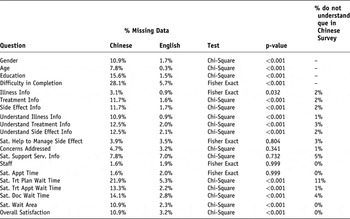
The proportion of patients who were completely satisfied was a primary interest of this study. The total number of surveys distributed to Chinese speaking patients was not noted. Chinese patients can be assigned to any of the nine treatment units available at VC. Since the main priority is to capture satisfaction information from this group, radiation therapists were advised to distribute the survey when the opportunity arises without the additional work of keeping track of the number of surveys given. A total of 128 Chinese surveys were returned from 2004 to 2010. Table 2 provides a summary of missing data from the Chinese survey with respect to each question. In general, a higher percentage of missing data in the non-staff interaction questions for the Chinese Satisfaction Survey, than the English Satisfaction Survey. The three non-staff interacting questions that resulted in the highest percentage of missing data for the Chinese survey were (1) difficulty in completing the survey (28%); (2) level of satisfaction for the amount of time in the centre waiting for the treatment planning appointments (21.9%); and (3) level of education (15.6%).
Percentage of missing data in Chinese and English survey.

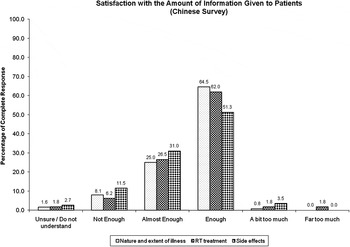
Patient gender, age group and education distributions are shown in Table 3. Four survey items measured satisfaction with the amount of information provided (Figure 1). For these items, 64.5%, 62%, and 51.3% of the respondents stated that they received ‘enough’ information about the nature and extent of their illness, the RT treatment they had, and side effects of the treatment. However, up to 31% of the patients reported receiving ‘almost enough’ and 11.5% of the responding ‘not enough’ information.
Satisfaction with the amount of information given to patients. Abbreviation RT = Radiation Therapy.

Demographic results.
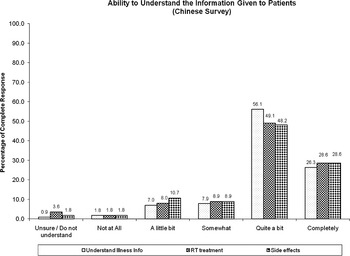
In terms of the ability of the patient to understand the given information related to their illness, treatment, and side effects (Figure 2), 26.3%, 28.6%, and 28.6% of the patients ‘completely’ understood the given information in three areas, respectively. Likewise, 56.1%, 49%, and 48.2% of the patients felt they understood the information ‘quite a bit’ related to their illness, treatment, and side effects.
Patients ability to understand the information given to them. Abbreviation RT = Radiation Therapy.

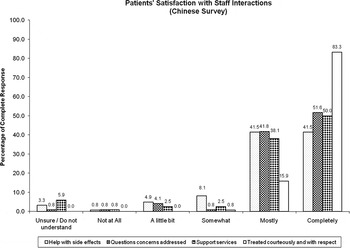
Four survey items measured satisfaction based on interactions with staff with 83% of the respondents indicating that they were treated with respect and courtesy by the staff members and only 50% were completely satisfied with help given about support services, 41.5% with help given to manage side effects, and 51.6% were completely satisfied with the extent to which their questions and concerns were addressed (Figure 3). These findings identify an important aspect for this cohort such that patients feel they experience suboptimal assistance in relation to supportive services offered, with addressing their concerns, and in the managing of their side effects.
Patient satisfaction with interactions with staff.

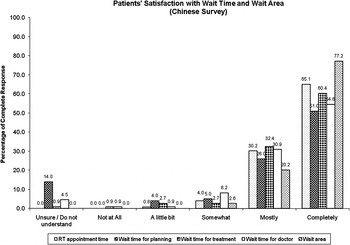
Five survey items were related to wait times with 77% of the patients indicating that they were completely satisfied with the waiting area (Figure 4). The percentage of patients completely satisfied with their treatment planning appointment wait time was the lowest at 51% and waiting for the doctor at 54.6%, while the highest percentage was for treatment appointment time given at 65% and treatment wait time at 60.4%. This suggests that the length of time these patients need to wait during their treatment planning appointment and for the doctor is inversely linked to their level of satisfaction. On the other hand, complete satisfaction is influenced by the appointment times given to the patient, as well as the length of time they need to wait for their daily treatment.
Patient satisfaction with wait times and waiting areas. Abbreviation RT = Radiation Therapy.

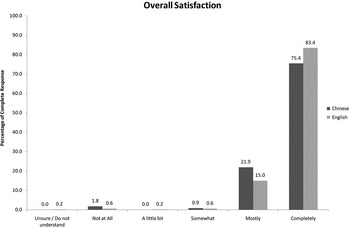
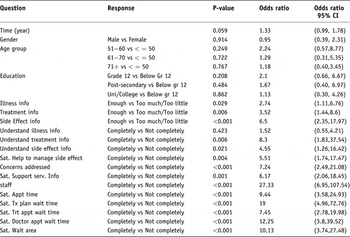
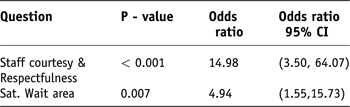
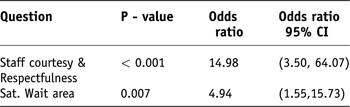
A single survey item measured overall satisfaction in which almost 22% of the respondents were mostly satisfied and 75.4% were completely satisfied with the services provided by the RT team (Figure 5). To further investigate whether there were any specific determinants of satisfaction, survey items were compared to overall satisfaction question (Table 4). As a preliminary analysis, the single logistic regression model was used to assess if any of the survey items influenced the overall satisfaction, and several survey items were found to contribute a significant difference. Since it is possible for different survey items to obscure each other's effects, a multivariate logistic regression model was fitted to explore the association between overall satisfaction and each of the factors that influenced the overall satisfaction after adjusting for each other. The strongest relationship was with patients feeling they were treated with courtesy and respect by staff (odds ratio (OR) of 14.98, p < 0.001) followed by satisfaction with wait area, with an OR of 4.94, p = 0.007. This finding suggests the importance of the relationship and interaction between patient and staff and the availability of a pleasant wait area (Table 5). Demographically speaking, overall satisfaction did not differ amongst the three age groups. Levels of education also did not have an impact on satisfaction level. Satisfaction rating was not influenced by gender.
Overall satisfaction with services provided by RT team. Abbreviation RT = Radiation Therapy.

Odds of a patient being completely satisfied with overall services provided by the RT team, depending on their response to other items & factors that did not influence overall satisfaction.

Multiple logistic regression after forward selection (5% significance level).
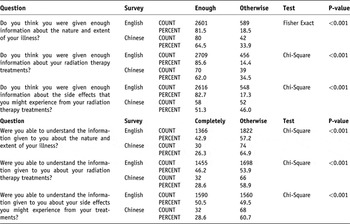
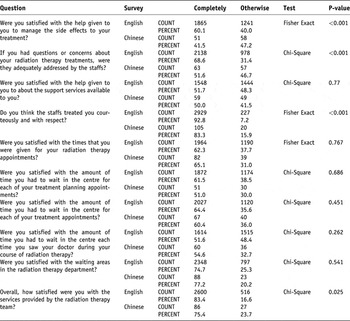
A comparison of results between the English survey and the Chinese survey was made to determine whether there is any difference in the satisfaction between the two cohorts (Table 6 and Table 7). When compared to the English cohort, out of the 15 measurements, Chinese speaking patients were less satisfied or had poorer ratings in 10 of the measured items. Items which measured satisfaction about the amount of information provided related to extent of illness, RT treatments, and side effects were rated lower compared to the English speaking group. The ability to comprehend information had the same result. The Chinese patients were found to be less satisfied with the help given to manage side effects. The rating for whether the patient felt they were treated courteously and respectfully was also lower for the Chinese group. When patients were asked about how satisfied they were regarding whether questions were adequately answered by staff, again, the Chinese speaking cohort was less satisfied. The overall satisfaction was found to be lower in the Chinese speaking group compared to the English group.
Comparison between English and Chinese satisfaction survey results.

Comparison between English and Chinese satisfaction survey results.

DISCUSSION
Despite the small number of surveys completed by the Chinese cohort, there is a statistically significant higher percentage of missing data in the Chinese satisfaction survey compared to previous work in assessing patients who completed the English RT Satisfaction Survey.Reference French and McGahan38 Speculations can be made for the missing data. The Chinese patients have a higher percentage of patients who are aged 70 or above and with an education level that is below Grade 12. Lower education may contribute to Chinese patients having difficulty completing the survey. Language and communication barriers in conjunction with limited ability to read, write, and understand the questions may have triggered Chinese patients to not answer questions, leading to incomplete surveys. Alternatively, incomplete surveys may actually be attributed to cultural differences in their style of answering surveys using Likert scales such that Chinese patients tend to skip items but unrelated to education level.Reference Lee, Jones, Mineyama and Zhang39 This tendency to skip questions ultimately reduced the data that can be used for analysis.
While satisfaction toward the wait time for doctor was lowest in previous work using the English survey, this was not the case with the Chinese. The Chinese survey also reported satisfaction with appointment times given to them for their treatment. Patients meet with their oncologist on a weekly basis and medical interpreters are arranged for patients who require them. Patients do not incur any charge for the use of interpreter as the expense is paid by the department. As a measure to reduce cost, oncologists aim to meet with the patient within the time frame booked to avoid incurring extra charges. Therefore, it may be plausible that patients who completed the Chinese survey did not require waiting a lengthy period of time to see the doctor. Furthermore, Chinese patients tend to arrive for treatment with a family member or friend who is capable of acting as a translator. Since the availability of the family member or friend is limited to a specific time convenient to the family and/or friend, patients often request a specific treatment time. As a result, satisfaction may be a result of staff members accommodating to the time preference, therefore influencing the overall satisfaction toward the RT team.
Medical interpreters are not present daily for patient’s radiation treatment appointments as it would be impractical and costly to do so. This can ultimately affect the scope of the patient’s questions and concerns being addressed when communication between the patient and healthcare provider is limited. Consequently, relaying information about support services available and detailed assistance with management of side effects may have been reduced.
Overall, analyses comparing the Chinese and English satisfaction survey showed the Chinese speaking cohort had less satisfaction in comparison to the English proficient group. There are several plausible explanations for this difference. First, it may be a result of linguistic and cultural barriers that limit the type of care Chinese patients need and desire, but unable to communicate it.Reference Kleeberg, Feyer, Günther and Behrens16,Reference Haviland, Morales, Dial and Pincus26,Reference Haviland, Morales, Reise and Hays27,Reference Saha, Komaromy, Koepsell and Bindman40,Reference Woloshin, Schwartz, Katz and Welch41 However, in 2005, dual language cards with appropriate figures were created by VC to bridge the communication gap between Chinese patients and therapists. The purpose of this tool is not to replace interpreters, but as a tool to overcome resource constraints and to minimise any communication barriers that may hinder patient care.
Second, this group may have higher expectations from health care where they perceive the quality of care to be lower than other groups even when the experience or stimuli is the same. A study conducted by Liu et al suggests perceptions of service are influenced by culture.Reference Liu, Furrer and Sudharshan42 More specifically, different cultures form different perceptions of what quality service is and can result in differences in expectations and different values associated to the same service criteria. In another study, Saha et al found that Chinese patients have a response bias and have different response tendencies when using a rating scale.Reference Saha and Hickam43 Furthermore, Lee et al found the Chinese were more likely to choose the midpoint of a Likert scale, which for our study would be 3 (or ‘almost enough’ or ‘a little bit’), especially on items that involve admitting to positive emotions,Reference Lee, Jones, Mineyama and Zhang39 whereas for our analysis, we choose ‘enough’ or ‘completely’ as our point of assumption for the patient being satisfied. This might explain Chinese patients’ desire to avoid extreme responses and choose the middle response that can point the results toward less satisfaction from the Chinese group. The Chinese group may also perceive their health care as being of the same quality as other groups and they differ simply in their response tendencies, in which case, lower satisfaction scores may simply reflect a different belief system rather than lower levels of satisfaction per se. Culturally, the Chinese may be less inclined to give outstanding ratings. Further investigation in this area is encouraged.
The use of a language and culture-specific questionnaire was helpful in elucidating valuable service performance information and level of satisfaction from Chinese patients, whereas the use of the standard patient satisfaction questionnaire may not have been able to uncover such findings. This study identified several areas where the Chinese-speaking patients were less satisfied. To improve the level of satisfaction of the Chinese-speaking patients, understanding how the facility is and what is causing this group to be less satisfied should be investigated. Other suggestions for improving the satisfaction level of the Chinese cohort include increasing the cultural knowledge and competence of service providers, working with and elucidate opinions from the Chinese-speaking patients to decipher how best to communicate information to enhance comprehension, ascertain what makes this group feel less respectful or treated less courteously, and support healthcare providers and patients by providing bilingual education materials.
Based on the feedback, improvement initiatives will be undertaken at VC to ensure these needs are met and future improvements to include developing culturally specific patient education materials, dual-language cards being more readily available, and disseminating knowledge related to RT in Chinese in the community. Efforts to ensure a culturally appropriate environment and provision of services include recruitment of staff members who reflect the cultural diversity of the community serviced, use of interpreter services or bilingual healthcare providers for clients, use of linguistically appropriately education materials, and maintaining a healthcare setting that is pleasant and respects the cultural diversity of the population serviced.
LIMITATIONS OF THE STUDY
Limitations with regard to comparing these two surveys due to the following reasons:
Timing of data collection was not concurrent with the distribution of English survey
Total number of Chinese surveys distributed was not noted
Higher percentages of missing data in the Chinese Survey, potentially not missing at random.
There were discrepancies in the translation of the questions.
There were discrepancies in the response categories where ‘unsure’ in the English survey is translated into ‘do not understand this question’ in the Chinese survey.
There was an error in the response categories in question 10 of the Chinese survey where the categories were ‘do not understand this question’, ‘completely do not understand’, ‘a little bit’, ‘half’, ‘mostly’ and ‘completely’ in the Chinese survey while it should have been ‘do not understand this question’, ‘not at all’, ‘a little bit’, ‘somewhat’ and ‘mostly’ in the English survey. This will affect the data quality of question 10 (satisfaction with the information regarding management of the side effects.)
Due to discrepancies between the surveys, the data with responses of ‘I do not understand this question’ in the Chinese survey was removed from the analyses when comparing the dichotomous response distribution between the two surveys. Due to the relatively high percentage of missing data compared to the English survey as well as discrepancies in the translation of the survey, these findings highlight the difficulty in translating an instrument into other languages. Even though this survey was reviewed by 3 individuals, with one being a medical interpreter, it still highlights the difficulty in ensuring the meaning and context in the English survey is not lost in translation for the Chinese survey.
The use of a Likert scale survey for ethnic populations have also been suggested as challenging for some cultures.Reference Flaskerud44 Previous works have well-documented the tendency of the Chinese being more likely to choose the midpoint of a Likert scale item, especially if it involves expression of positive feelings, and being likely to skip questionsReference Lee, Jones, Mineyama and Zhang39 which affected the data available for analysis. It may be plausible that the concept of measuring on a continuum is foreign and incoherent to this group , and therefore using a Likert scale to study perceptions of care for the Chinese may not truly capture the satisfaction level and at best a speculation affecting data reliability.
Translating instruments in other languages is challenging, especially related to colloquial phrases, jargon, idiomatic expressions, and word means.Reference Hilton and Skrutkowski45Assumptions cannot be made about a particular concept having the same relevance across different cultures. Simply translating an English version word for word is not adequate to account for linguistic and cultural differences. A phrase that may be an adequate translation may provide a different meaning for another. Furthermore, level of education will play a role in facilitating how much is understood by the reader. As a result, the choice in phrasing must be at a level that is commonly understood and the choice of wordings must not compromise the contextual meaning. There needs to be a stringent development and testing process in place to ensure the meaning and the context behind a translated survey is not compromised. Consequently, a revised Chinese RT survey will be created to address these discrepancies.
CONCLUSION
The Vancouver Centre provides a culturally appropriate environment including services that respect the culture diversity of the population. This study has shown that patient satisfaction can still be obtained from Chinese speaking patients who do not read or write English and these patients can still participate in quality improvement initiatives. Identified by the results include satisfaction was mainly driven by the waiting area and staffs treating them with courtesy and respect. Satisfaction level differed between the English- and Chinese-speaking groups, with the latter rating their satisfaction lower. Suggestions that may improve the Chinese-speaking cohorts include increasing cultural competence of healthcare providers and understanding of the underlying causes that can lead to lower satisfaction.